Our Lady of Kibeho: The Complete Guide to Africa's Only Approved Marian Apparition
Roman Catholic • Approved Apparition • November 28, 1981 • Kibeho, Rwanda • First Approved Apparition in Africa
Our Lady of Kibeho: The Complete Guide to Africa’s Only Approved Marian Apparition — The Prophecy, the Visionaries, the Messages, and the Genocide That Proved Her True
She appeared to three young women in Rwanda as a beautiful young Black African woman. She gave the world urgent warnings of repentance. She requested a forgotten rosary. She showed her visionaries visions of rivers of blood and fields of corpses — visions that a decade later became the Rwandan genocide. The Church confirmed it all. This is everything about the most prophetically verified Marian apparition in modern history.
Our Lady of Kibeho — At a Glance
- Event Name
- Apparitions of Our Lady of Kibeho (also: Notre-Dame de Kibeho)
- Location
- Kibeho College & Town, Nyamasheke District, Southern Province, Rwanda
- First Apparition
- November 28, 1981 (to Alphonsine Mumureke)
- Apparition Period
- 1981–1989 (major approved period: 1981–1983)
- Approved Visionaries
- 3: Alphonsine Mumureke • Nathalie Mukamazimpaka • Marie-Claire Mukangango
- How She Appeared
- Beautiful young Black African woman • White seamless garment • Radiant light
- Self-Identification
- “Umubyeyi w’Imana” (Mother of God) • “Nyina wa Jambo” (Mother of the Word)
- Core Messages
- Repentance • Prayer • Penance • Love • Seven Sorrows Rosary
- Devotion Requested
- Chaplet of the Seven Sorrows of Mary
- Major Prophetic Visions
- Rivers of blood • Decapitated bodies • Mass death • Fulfilled 1994
- Official Church Approval
- June 29, 2001 • Bishop Augustin Misago • Diocese of Gikongoro
- Significance
- First and only officially approved Marian apparition in Africa
- Vatican Recognition
- Pope John Paul II personally interested • Vatican confirmed 2001 declaration
- Genocide Connection
- Visions prophesied 1994 genocide • ~800,000 killed • Marie-Claire martyred
- The Shrine Today
- Sanctuary of Our Lady of Kibeho • Major African pilgrimage destination
- Annual Feast
- Week of November 28 & August 15–19 commemoration
What Is Our Lady of Kibeho? The Apparition That Prophesied a Genocide
On the evening of November 28, 1981, in a small Catholic boarding school in the hills of southwestern Rwanda, a seventeen-year-old girl named Alphonsine Mumureke was serving tables in the school dining hall when a voice called her name. She walked toward the corridor to see who was there, and she encountered a woman of extraordinary beauty — a young, luminous Black African woman surrounded by radiant white light, who spoke to her with a gentleness that Alphonsine would spend the rest of her life trying to describe.
That encounter was the beginning of one of the most remarkable and theologically urgent events in the history of modern Christianity. Over the following years, two more of Alphonsine's schoolmates — Nathalie Mukamazimpaka and Marie-Claire Mukangango — would receive their own apparitions. Thousands of witnesses would attend the public ecstasies and emerge shaken. The visionaries would describe visions so terrible that observers who heard their accounts wept and prayed aloud. And ten years after the visions ended, approximately 800,000 people would be slaughtered in Rwanda in one hundred days — a genocide so precise in its horror that those who remembered the Kibeho visions recognized in it exactly what the Mother of God had shown her visionaries and begged them to help her prevent.
Our Lady of Kibeho is unique in the history of approved Marian apparitions in several ways. She is the first and only officially approved apparition in Africa — confirmed by Bishop Augustin Misago in 2001 and recognized by the Vatican. She appeared not as a European woman but as a young Black African woman, in the face and features of the people she came to. She did not give a message of gentle consolation; she gave a message of urgent, prophetic warning that the world — and Rwanda in particular — faced catastrophic consequences if it did not repent. And she gave a specific devotional request that had fallen into neglect: the Chaplet of the Seven Sorrows of Mary, a profound prayer meditating on the suffering of the Mother of God that she said was urgently needed for a world in spiritual peril.
This article is the most comprehensive account of Our Lady of Kibeho available anywhere: every visionary, every message, every miracle, the full timeline, the complete theological analysis, the genocide prophecy in detail, the Church investigation, and the devotional tradition that has developed since the apparitions. Read it, pray with it, and carry the prayer card of Our Lady of Kibeho as a connection to the Mother of God who came to Africa and told the truth about what was coming.
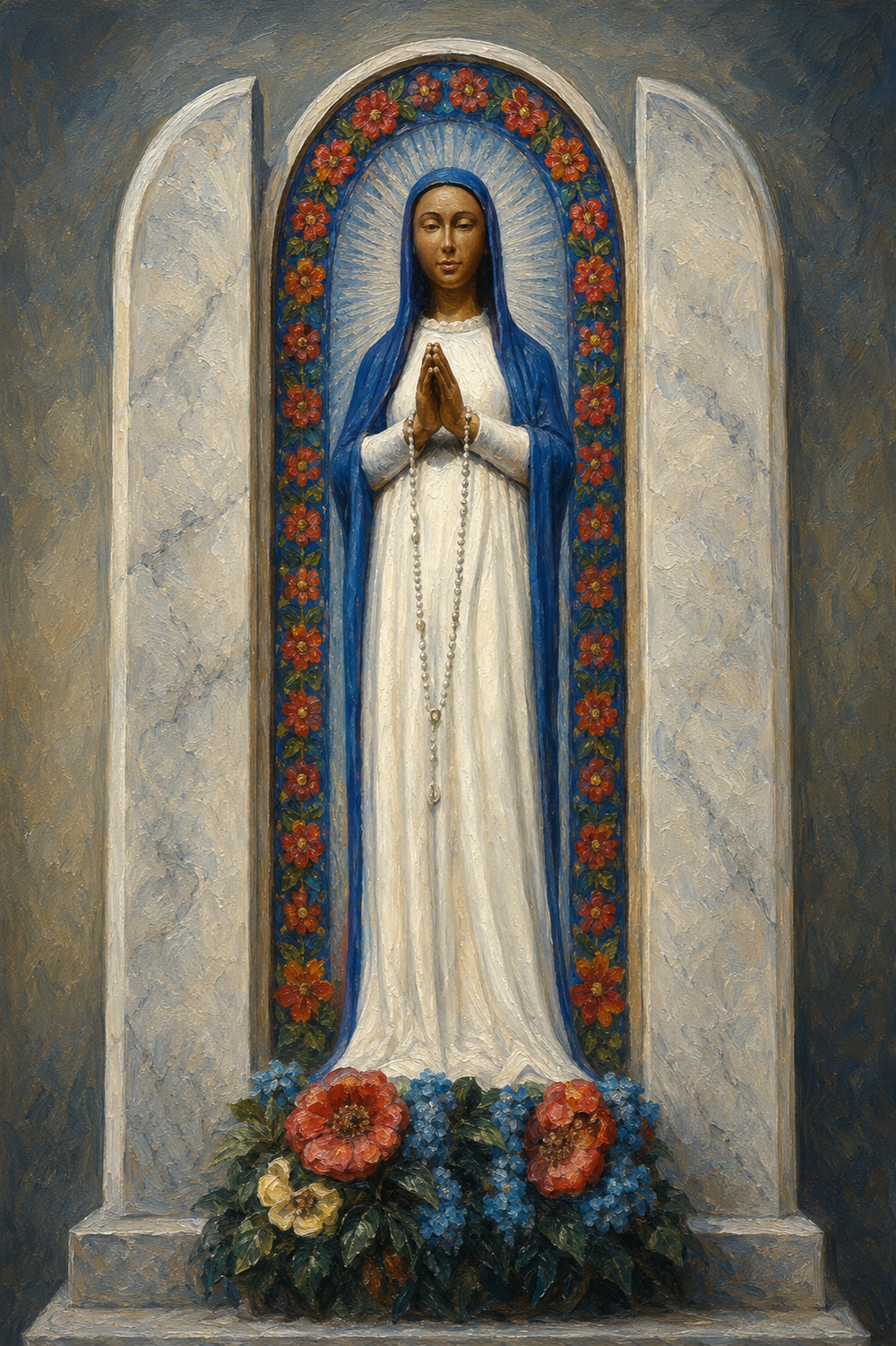
The Our Lady of Kibeho prayer card carries the image of the only officially approved Marian apparition on the African continent — a Mother who came to Rwanda as a Black woman, who warned of unspeakable suffering, whose prophecies came true in blood, and who asks today for repentance, the Seven Sorrows, and love. To carry this card is to carry the intercession of the Mother of God for a world she has not stopped warning, and not stopped loving.
Part II
Rwanda in 1981: The World She Came Into
To understand why Our Lady of Kibeho appeared where she did and why her message had the character it did, you need to understand Rwanda in 1981. Rwanda was a small, densely populated, and predominantly Catholic nation in Central Africa. Catholicism had taken deep root during the Belgian colonial period of the early twentieth century — Rwanda was among the most Christianized nations in Africa, with the Catholic Church operating schools, hospitals, and parishes throughout the country. By 1981, the majority of Rwandans identified as Catholic.
But beneath the surface of this Christian nation, something was deeply, dangerously wrong. The ethnic divisions between the Hutu majority and the Tutsi minority — divisions that had been sharpened and institutionalized by Belgian colonial policies, including the infamous identity card system that classified every Rwandan by ethnicity — had already produced episodes of mass violence. In 1959–1962, during and after independence, anti-Tutsi pogroms killed tens of thousands and drove hundreds of thousands into exile. In the years following independence, periodic violence against Tutsis continued. By 1981, Rwanda was governed by President Juvénal Habyarimana, a Hutu nationalist whose regime maintained the ethnic categorization system and practiced systematic discrimination against Tutsis.
The Catholic Church in Rwanda was deeply intertwined with this history — both as an institution that had sometimes facilitated and sometimes failed to prevent ethnic violence, and as the source of genuine Christian witness for millions of Rwandans who prayed, celebrated sacraments, and tried to live their faith in a context of structural injustice. The Church was not a monolith: it contained priests and bishops who were complicit in ethnic politics, and it contained saints. The Catholic schools, including Kibeho College, were educating Rwanda's young people in this complex environment.
Kibeho: A Village in the Hills
Kibeho was, in 1981, a small rural town in the Butare prefecture of southern Rwanda (today the Nyamasheke District of the Southern Province). It sat in the green hills that characterize Rwanda's landscape — the country called the “Land of a Thousand Hills” — at an elevation that kept it cool and sometimes cloudy. There was a Catholic parish, a modest Church infrastructure, and a secondary school: Kibeho College, a boarding school primarily for girls, operated by the Congregation of the Benebikira Sisters (the Daughters of the Virgin Mary), a Rwandan religious community.
Kibeho College was not a wealthy or prestigious institution. It served young women from rural Rwandan families who sought secondary education in a Catholic environment. The students were daughters of farmers, local officials, and working families — the ordinary population of rural Rwanda. The school had a chapel, dormitories, classrooms, and a dining hall. It was in this ordinary, specific place — not a great cathedral, not a famous pilgrimage site, not a place of theological distinction — that the Mother of God chose to appear in November 1981.
Why Rwanda? Why Then?
The theological answer, which the Kibeho messages themselves partly provide, is that the Mother of God came to Rwanda precisely because of what was coming. She came not to a nation living in peace and prosperity who needed to be reminded to be grateful. She came to a nation whose ethnic fault lines were deepening invisibly beneath a Christian surface — a nation where neighbors were already learning to think of neighbors as enemies, where hatred was being organized and prepared at levels most ordinary Rwandans could not see. She came early enough, if her message had been received, to prevent the catastrophe. She came to the most vulnerable — young girls in a rural school, not bishops or politicians — because the ones who most needed to hear the message were not the powerful but the people. She asked for what only people, not institutions, can give: repentance, prayer, and love.
Part III
Alphonsine Mumureke: The First Visionary
Alphonsine Mumureke was approximately seventeen years old and a student at Kibeho College when the apparitions began. By all accounts of those who knew her, she was a devout but ordinary young woman — earnest in her faith, friendly with her classmates, not known for mystical tendencies or unusual spiritual gifts. She was not a student who claimed special religious experiences or sought spiritual distinction. She served tables in the dining hall. She attended Mass. She was, in the most important sense, unremarkable — which is to say she was exactly the kind of person the Mother of God has historically chosen.
The first apparition came on November 28, 1981, during the lunch service. Alphonsine heard a voice calling her name. She walked toward the corridor and encountered a woman of breathtaking beauty — young, luminous, and unmistakably African. The woman spoke to her with gentleness and love, asking who she was and whether she was willing to receive a message. Alphonsine, frightened and overwhelmed, said she was. The woman identified herself as the Mother of God.
When Alphonsine returned to the dining hall visibly shaken and described what had happened, her reception was not warm. Her classmates mocked her. Her teachers were suspicious. The school environment in which she tried to explain that the Virgin Mary had just appeared to her was one of skepticism and social pressure. But the apparitions continued. And it was in this context of being dismissed and ridiculed that Alphonsine persisted — not with evangelical certainty or self-promotional zeal, but with the quiet, suffering insistence of someone who knew what she had seen and could not unsee it.
Over the following months and years, Alphonsine's apparitions continued regularly. She entered deep ecstatic states during which she was examined by doctors, religious superiors, and investigators, all of whom noted the extraordinary character of the phenomena: total insensibility to pain, unresponsiveness to external stimuli, and yet complete coherence of speech and reported experience within the vision state. She described conversations with Our Lady about repentance, prayer, the state of the world, and the dangers coming to Rwanda. She was given messages of profound depth about the nature of love, suffering, and the mercy of God.
Alphonsine eventually entered religious life and became a Consolata missionary sister. She has spoken about her experiences internationally and has been received in Rome. She lives today as a testimony to the truth of what she received in that corridor in Kibeho in 1981.
Part IV
Nathalie Mukamazimpaka: The Second Visionary
Nathalie Mukamazimpaka received her first apparition on January 12, 1982, less than seven weeks after Alphonsine's initial vision. The context was again the school environment, and again the immediate reception from the community around her was mixed at best. But Nathalie's case added a new dimension to the Kibeho phenomenon: where Alphonsine had described messages of love and urgent appeals for prayer, Nathalie's visions moved into territory that was more explicitly theological and more explicitly disturbing.
Nathalie is described by those who knew her during the apparition period as a young woman of unusual intellectual and spiritual seriousness. Her conversations with Our Lady, as she reported them, included profound theological exchanges about the nature of God's love, the reality of hell, the meaning of human suffering, and the urgency of conversion. She reported being shown visions of souls in states of great distress — souls who had refused God's love and found themselves in the isolation that the Christian tradition calls damnation. These visions, which she described with great reluctance and emotional pain, were consistent with what other approved visionaries at other sites had described when shown the consequences of unrepentance.
The particular emphasis that came through Nathalie's visions was the seriousness of the spiritual state of the contemporary world — not the confident self-assurance of a world that had outgrown the need for God, but the reality of what that self-assurance costs. Our Lady spoke to Nathalie about a world that had stopped praying, that had substituted convenience for love, that had organized its common life in ways that made genuine encounter with God increasingly difficult. And she spoke about what could be done: not through political power or social programs, but through prayer, penance, and the willingness to love genuinely and at cost.
Nathalie survived the genocide and has continued to live a life of consecrated prayer. She speaks rarely in public, consistent with the interiority that characterized her during the apparition period, but when she does speak, her witness carries the unmistakable quality of someone who encountered something true and has organized her entire life around that encounter.
Part V
Marie-Claire Mukangango: The Skeptic, the Visionary, and the Martyr
Of all the figures in the Kibeho story, none carries a greater theological weight than Marie-Claire Mukangango. She is the skeptic who became the believer. She is the visionary who was entrusted with the most specific and actionable message of the apparitions. And she is the woman who died in the very violence she was shown in her visions — murdered in the Rwandan genocide of 1994, along with her husband, in an event that the Mother of God had specifically warned about more than a decade before it happened.
When Alphonsine's apparitions began in November 1981, Marie-Claire was among the most vocal skeptics in the school community. She was older than Alphonsine, intellectually sharp, and deeply unimpressed by what she regarded as Alphonsine's attention-seeking fantasy. She reportedly confronted Alphonsine directly and challenged the authenticity of the visions with the energy of someone who was certain she was right. She did not believe, and she said so.
Then, in early March 1982, the apparitions came to Marie-Claire herself.
The conversion of the skeptic is one of the most theologically eloquent aspects of the Kibeho story. Marie-Claire had done everything in her power to discredit what Alphonsine reported — and then she was chosen to receive it herself. Our Lady did not reward the believer with a second confirmation; she came to the doubter and made her the bearer of the most specific and important message of the entire Kibeho period. Marie-Claire was entrusted with the Seven Sorrows Rosary.
During her apparition period, which ran from March 1982 through September 1982, Our Lady appeared to Marie-Claire specifically to transmit the Chaplet of the Seven Sorrows — a traditional Catholic devotion meditating on the seven great sufferings of the Virgin Mary that had fallen into near-total neglect. Mary told Marie-Claire that this chaplet was of urgent importance, that its revival was needed for Rwanda and for the world, and that those who prayed it with sincerity and love would find in it a powerful means of conversion and consolation in suffering. She asked Marie-Claire to share this devotion and to teach it to others.
Marie-Claire married a man named Etienne Kamagaju and they had children together. She spoke about the apparitions publicly, shared the Seven Sorrows devotion, and lived as an ordinary Rwandan Catholic woman in the years between the apparitions and the genocide. In April 1994, she and her husband Etienne were killed by Interahamwe militia. The woman who had been shown visions of rivers of blood and had been given a rosary of sorrow as a preparation died in the blood she had been shown. She was in her early thirties. The Church has taken note of the circumstances of her death, and her cause for beatification has been discussed, though no formal process has been opened.
Part VI
The Other Visionaries: Vestine Salima, Emmanuel Segatashya, and More
The three approved visionaries — Alphonsine, Nathalie, and Marie-Claire — are those whose apparitions the Church has formally confirmed as supernatural in character and worthy of belief. But they were not the only people who claimed apparitions during the Kibeho period. A number of others came forward, and their cases are part of the full picture of what happened at Kibeho in the 1980s, even as the Church's official discernment reached different conclusions about them.
Vestine Salima
Vestine Salima, a student at Kibeho, reported receiving apparitions that began in 1982. Her visions, like those of the three approved visionaries, included warnings of approaching catastrophe for Rwanda. Vestine's case was examined by the Church's investigation commission, which ultimately classified her apparitions as “non constat de supernaturalitate” — meaning that the supernatural character of the apparitions could not be established. This is not the same as saying they were false; it means the evidence was insufficient for a positive determination. Vestine died young, before the genocide, and her case has remained in the category of the uncertain. What she reported was consistent with the broader Kibeho message, but the Church was appropriately rigorous in applying its standards of discernment.
Emmanuel Segatashya: The Boy Who Saw Jesus
Emmanuel Segatashya is one of the most remarkable figures associated with the Kibeho apparitions. A teenage boy from a non-Christian family, Emmanuel reported that he began receiving apparitions not of the Virgin Mary but of Jesus Christ himself — a young man of extraordinary beauty who spoke to him about love, suffering, and the need for the world to return to God. Emmanuel had no Christian formation when the apparitions began; he did not know how to pray, had not been baptized, and had no theological vocabulary for what he was experiencing. The Jesus who appeared to him reportedly taught him Christian prayer, the Our Father, and the fundamentals of faith. Emmanuel subsequently asked for and received baptism, taking the name Emmanuel from the Hebrew title of the Messiah: “God with us.”
The content of Emmanuel's visions was consistent with and complementary to those of the three main Kibeho visionaries: urgency about the spiritual state of humanity, the need for repentance and love, and warnings about approaching suffering. His case was examined by the Church commission, which classified it similarly to Vestine's: not formally approved but also not condemned. Emmanuel died in the Rwandan genocide in 1994 — like Marie-Claire, a victim of the catastrophe that the Kibeho visionaries had been shown.
The Importance of the Church’s Discernment
The fact that the Church did not approve all of the Kibeho visionaries is itself evidence of the integrity of the investigation. A credulous or politically motivated process would have validated everyone. The Church's careful distinction between the three approved visionaries and the others whose cases could not be positively confirmed demonstrates the rigor with which Bishop Misago's commission approached its task. The approved apparitions are approved because the evidence for them crossed the Church's threshold of certainty. The others remain in the larger cloud of Kibeho's influence without specific ecclesiastical endorsement.
Part VII
How She Appeared: A Beautiful Young Black African Woman
The single most distinctive visual fact about Our Lady of Kibeho — and one of the most theologically significant features of the apparition for the whole of Christianity — is the manner in which she appeared: as a beautiful young Black African woman. The visionaries were consistent and unambiguous in this description across their independent accounts. This was not a white European Madonna who happened to appear in Africa. This was a woman who looked Rwandan. Who looked like the people she came to.
The Visionaries’ Descriptions
Alphonsine described the woman who appeared to her as young, with a face of extraordinary beauty, and with the features of an African woman. She described her skin as Black, her face as framed by dark hair, and her entire bearing as that of a young Rwandan woman of uncommon grace and serenity. She wore a seamless white dress without decoration, and she was surrounded by a light that the visionaries variously described as brighter than sunlight but not painful to look at, and as somehow carrying within it a quality of warmth and presence that was distinct from any physical light they had previously experienced. Nathalie and Marie-Claire independently described what Alphonsine described: a young Black woman of surpassing beauty, clothed in white, radiant with light, and bearing an expression of love that the visionaries found it impossible to fully articulate.
She did not carry a rosary in her hands as she does in many Western artistic representations. She did not appear crowned in the style of European Marian imagery. She appeared as a young African woman — unadorned, beautiful, luminous, and present.
The Theology of Her Appearance
It is a well-attested pattern in the history of Marian apparitions that Our Lady appears in a form adapted to the cultural and racial context of the people she visits. At Guadalupe in 1531, she appeared to Juan Diego as a young woman with indigenous Mexican features — her skin the warm brown of the native peoples of central Mexico, her clothing and iconography bearing elements of Aztec cosmological symbolism that communicated her message within the existing cultural framework. At Lourdes and Fatima, she appeared as a young European woman consistent with the French and Portuguese people she visited. At Zeitoun, she appeared as a luminous figure above an Egyptian church to a city of Muslims and Christians. At Kibeho, she appeared as a young Black Rwandan woman.
The theological content of this pattern is profound and consistent. The Mother of God does not come as a foreigner from one culture descending upon another with the implicit message that the other culture's forms are inadequate or inferior. She comes as one of the people. She comes in their face. This is the Incarnation repeated in the logic of apparition: just as the Son of God became fully human in a particular historical, cultural, and racial body, the Mother of God presents herself in particular, local, incarnate forms to the people she loves. To the Africans of Rwanda, she came as an African. To see Our Lady of Kibeho is to see the Mother of God as she chose to be seen by Rwandan eyes — as one of their own.
This is also why the Our Lady of Kibeho prayer card carries enormous theological weight for Black Catholics, for African Christians, for all who have felt that Marian devotion carried implicitly Western or European cultural freight. At Kibeho, the Mother of God explicitly, definitively, and beautifully rejected that framing. She is Black. She is African. She is the mother of the Rwandan people as surely as she is the mother of any people on earth.
Her Name in Kinyarwanda
The names by which Our Lady identified herself to the Kibeho visionaries are theologically rich and culturally specific. She called herself Umubyeyi w'Imana in Kinyarwanda — the Mother of God. She also called herself Nyina wa Jambo — the Mother of the Word. This second title, “Mother of the Word,” resonates with the Johannine theology of the Incarnation: “In the beginning was the Word, and the Word was with God, and the Word was God” (John 1:1). The Word who became flesh was born of this woman. She is the Mother of the Word made flesh. To use this specific title in the context of Rwanda is to place the Kibeho apparitions squarely within the ancient Christological tradition of the universal Church, expressed in the particular language and cultural voice of a Rwandan people.
Part VIII
The Messages: Everything Our Lady Said at Kibeho
The messages of Our Lady of Kibeho are different in character from those of virtually every other major approved Marian apparition. They are not, primarily, messages of consolation. They are not primarily messages of doctrinal information. They are urgent, prophetic, and at times terrifying appeals from a mother who sees what is coming and desperately wants her children to change course before they experience it. Understanding the messages requires understanding this urgency — these were not pleasant spiritual encouragements but warnings delivered with the passion of a mother whose children are walking toward a cliff.
What follows is a comprehensive account of every major theme and specific content of the Kibeho messages, drawn from the documented accounts of all three visionaries and confirmed by the Church’s investigation.
Part IX
The Seven Sorrows Rosary: The Devotion Our Lady Specifically Requested
One of the most actionable and specific fruits of the Kibeho apparitions is the revival of the Chaplet of the Seven Sorrows of Mary. This is not a generic request to pray more; it is a specific devotional form that Our Lady asked Marie-Claire to receive, practice, and share. Understanding what it is, where it came from, and why it was requested is essential to understanding the full meaning of Kibeho.
The Origin of the Seven Sorrows
The devotion to the Seven Sorrows of Mary has roots in the medieval Church. It was particularly associated with the Servite Order (the Order of the Servants of Mary), founded in Florence in 1233, whose entire charism was oriented toward meditating on the sufferings of the Virgin Mary. The Seven Sorrows Chaplet as a formal prayer structure developed over the following centuries, reaching its current form by roughly the fifteenth century. It meditates on seven pivotal moments in the life of Mary in which she experienced profound suffering — not suffering for its own sake, but the suffering that is inseparable from genuine love, from participating in the salvific mission of her Son, from being the Mother of the One who came to bear the world's sin.
By the twentieth century, the devotion had largely fallen from regular practice in most of the Catholic world. It was known, but not commonly prayed. The prayer cards, if they existed at all in most parishes, gathered dust. It was this neglect that Our Lady specifically addressed at Kibeho.
The Seven Sorrows: A Complete Description
- The Prophecy of Simeon (Luke 2:25–35) When Mary and Joseph presented the infant Jesus in the Temple, the holy elder Simeon took the child in his arms and spoke a blessing — and then turned to Mary and said: “And a sword will pierce through your own soul also, that thoughts from many hearts may be revealed.” This is the first sorrow: the moment when the Mother of the Living God learned from a holy man that her motherhood would include specific, foreknown suffering. She accepted it. She did not run. This sorrow meditates on the willing acceptance of a suffering that has not yet arrived but has been announced.
- The Flight into Egypt (Matthew 2:13–14) An angel appeared to Joseph in a dream and warned him that Herod sought to kill the child. Mary took her infant Son in the middle of the night and fled — a refugee, stateless, fleeing state violence with a newborn in arms. She slept in the road, in strangers' houses, in whatever shelter was available. The second sorrow meditates on the suffering of displacement, of being a refugee, of protecting the most precious thing in your life against the violence of political power.
- The Loss of Jesus in the Temple (Luke 2:41–52) When Jesus was twelve years old, the Holy Family traveled to Jerusalem for Passover. On the return journey, Mary and Joseph discovered that Jesus was not with their group. They searched for him for three anguished days before finding him in the Temple, discussing the Law with the teachers. The third sorrow meditates on the anguish of a mother who cannot find her child — not the passive anxiety of a temporary separation but the active, grinding terror of three days of not knowing.
- Mary Meets Jesus on the Road to Calvary (Luke 23:26–27) As Jesus carried his cross through the streets of Jerusalem toward Golgotha, Mary was in that crowd. She saw him. He saw her. What passed between them in that moment — her eyes, his eyes, the cross on his broken back, the soldiers, the crowd, the knowledge of what was about to happen — constitutes the fourth sorrow. To meditate on it is to stand with a mother watching her child die publicly, in agony, under the power of the state.
- The Crucifixion and Death of Jesus (John 19:25–30) At the foot of the Cross, Mary stood with the Beloved Disciple and several other women. She did not run. She did not avert her eyes. She stood at the foot of the instrument of her Son's death and she watched him die. Every minute of it. The fifth sorrow is the most ancient and most complete of all human suffering: a mother who cannot stop her child's death, who can only be present to it with love. It is the sorrow from which all other sorrows derive their deepest resonance.
- The Taking Down of Jesus from the Cross (Matthew 27:57–59) When Jesus died, his body was taken down from the Cross and placed in Mary's arms. This is the Pietà, the image that Michelangelo carved in marble and that every mother who has ever lost a child has recognized as her own experience. The sixth sorrow is the sorrow of holding what you love after it has died — the sorrow of a love that continues past the death of the beloved, that has no object now but the body, and that cannot let go.
- The Burial of Jesus (John 19:38–42) The body of Jesus was wrapped in burial cloths and placed in the tomb. The stone was rolled across the entrance. Mary walked away from the tomb as a mother who had just buried her son. The seventh sorrow is the sorrow of aftermath — the silence, the walk home, the empty house, the beginning of grief's long residence. It is the sorrow that does not yet know about the Resurrection, that sits with loss and does not yet know it will be transformed.
Why Our Lady Asked for This Devotion at Kibeho
The connection between the Seven Sorrows and the message of Kibeho is not arbitrary. Our Lady was asking Rwanda — and through Rwanda, the world — to meditate on suffering. Not to escape it, not to be protected from it, but to enter it with her, to understand it through her, to find in the suffering of the Mother of God a model for enduring the suffering that comes to human beings who live in a world broken by sin. She was asking Rwandans to pray the Seven Sorrows precisely because terrible sorrow was coming, and the only way to survive it with one's soul intact was to have learned to hold it with the love that she had modeled at the foot of the Cross.
She also said explicitly, through Marie-Claire, that the Seven Sorrows Rosary was a powerful means of conversion — that those who prayed it with sincere hearts would find themselves moved to repentance and love in ways that other forms of prayer did not always produce. Meditating on the suffering of the Mother of God opens the heart. It breaks the hardness that ethnic hatred and political ideology require. It is hard to hold the image of Mary holding her dead Son and maintain in your heart the conviction that your neighbor deserves to die.
If you do not already pray the Seven Sorrows, Our Lady of Kibeho is asking you to begin. The prayer card of Our Lady of Kibeho on this page carries her image and is a starting point. The chaplet itself can be prayed with seven groups of seven Hail Marys, each group preceded by an Our Father and meditation on one of the seven sorrows.
Part X
The August 1982 Apparitions: The Great Public Warning
The week of August 15–19, 1982 represents the most publicly dramatic, most extensively witnessed, and most prophetically significant episode of the entire Kibeho apparition period. August 15 is the Feast of the Assumption of the Virgin Mary in the Catholic calendar — the highest Marian feast of the liturgical year — and it was on this feast and the days surrounding it in 1982 that Our Lady delivered, through her three visionaries, the most terrifying warnings she gave at Kibeho.
By August 1982, word of the Kibeho apparitions had spread across Rwanda. Thousands of people — from the surrounding villages, from Butare, from Kigali, from across the country — made their way to Kibeho College to be present for the August apparitions. Church authorities were present. Medical personnel were on hand. The international press had begun to take notice. And on the grounds of this small secondary school in the Rwandan hills, in front of enormous crowds, three young women simultaneously entered the most devastating ecstatic visions of the entire apparition period.
The Simultaneous Ecstasies
What happened during the August 1982 apparitions was witnessed by thousands. All three approved visionaries entered deep ecstatic states simultaneously. Medical personnel who examined them during these states documented the characteristic features that the Church's investigation would later assess: complete insensibility to pain, inability to be roused by normal stimuli, eyes fixed on a point invisible to observers, and yet internally coherent and responsive states of experience that the visionaries could subsequently describe in detail.
What the witnesses in the crowd saw was this: three young women who, a moment before, had been standing in prayer — falling into trances. Then: terror. The faces of the visionaries transformed from peace to abject horror. They began to scream. They wept with a desperation that witnesses described as unlike any ordinary human grief — not the weeping of personal loss but the weeping of someone watching a catastrophe unfold before their eyes that they cannot stop. They cried out. They covered their faces. They fell to their knees. Some fell prostrate. For hours, in front of thousands of witnesses, the three visionaries experienced visions they could not bear.
What They Saw
When the ecstasies ended and the visionaries were able to describe what they had experienced, the accounts were consistent across all three. They had been shown Rwanda. They had been shown the future. What they saw included:
- Rivers of Blood The visionaries described seeing rivers of literal blood flowing through the Rwandan countryside — not metaphorical blood or symbolic violence, but actual streams of human blood moving through fields and valleys. The scale of what they described implied mass death of a kind Rwanda had never experienced.
- Decapitated Bodies and Skulls They saw fields strewn with headless human bodies and human skulls. In the Rwandan genocide that occurred in 1994, decapitation was a common method of killing. The visionaries described exactly the kind of mass death scene that witnesses to the genocide would later describe.
- A Tree on Fire A great tree, burning. The tree is a symbol used in Rwandan culture, and a burning tree carries within it images of the destruction of roots, of family, of the structures that hold a people together. The interpretation of this image became clear only after the genocide, when Rwanda's entire social fabric had been destroyed.
- People Killing Each Other The visionaries described seeing Rwandans killing Rwandans — neighbors killing neighbors, not soldiers killing enemies but ordinary people turning on ordinary people. This is exactly what the 1994 genocide was: not a battle between armies but a mass mobilization of civilians to kill civilians.
- A Deep Pit They described seeing a deep pit, dark and terrible, from which there seemed to be no escape — bodies falling into it, people being pushed into it, a sense of irreversible descent. Some interpreters have understood this as a vision of both physical death and spiritual loss — the double catastrophe of lives lost and souls that had not been prepared.
Our Lady’s Words During the Visions
Throughout these visions, according to the visionaries' accounts, Our Lady was weeping. She was not showing them these things with detachment or as a demonstration of prophetic power. She was weeping as she showed them, with the grief of a mother who sees what is coming and has exhausted every other means of warning. She said: “This is what will happen if people do not repent and return to God. Pray. Pray. Pray.” She specifically invoked Rwanda: “There are so many sins committed in Rwanda. If Rwandans do not repent, great catastrophes will come.”
The crowds watching the visionaries could not see the visions themselves, but they could see the faces of the women experiencing them. They could hear the screaming and the weeping. They could see the prostration. Many of the thousands present wept themselves — from the contagion of what they were witnessing, from something they felt in the air, or from the same instinct that makes every human being afraid when they encounter genuine fear in someone else. Those who were present in August 1982 at Kibeho College have never forgotten what they saw.
Part XI
The Prophecy of Blood: The 1994 Rwandan Genocide and the Kibeho Visionaries
On April 6, 1994, a plane carrying Rwandan President Juvénal Habyarimana was shot down over Kigali airport. Within hours, the Interahamwe — Hutu extremist militia — had set up roadblocks across the city. Soldiers and police joined the killing. Over the radio network RTLM, announcers broadcast incitement to murder, referring to Tutsis as inyenzi (cockroaches) and giving out names and addresses of targets. In the following one hundred days, between 500,000 and 800,000 people — primarily Tutsi but also Hutu moderates — were slaughtered by their neighbors, their colleagues, and in some cases their family members. It was the most efficient act of mass murder since the Holocaust: more people killed per day than in any genocide of the twentieth century.
Those who had heard the Kibeho visionaries describe their 1982 visions recognized what they were seeing.
The Fulfillment of the Visions: Detail by Detail
The parallels between what the Kibeho visionaries described in their ecstatic visions of 1982 and what happened in Rwanda in 1994 are detailed, specific, and disturbing in their precision:
- The Rivers of Blood During the genocide, rivers in Rwanda literally ran red with the blood of the murdered. Bodies were dumped in the Nyabarongo River and other waterways in such numbers that the water was visibly contaminated. The United Nations and international journalists documented this. The rivers of blood the visionaries described in 1982 were not metaphor; they became literal.
- The Decapitated Bodies Decapitation with machetes was one of the most common methods of killing during the genocide. Mass graves found after the genocide contained large numbers of headless bodies. The skulls separated from bodies that the visionaries described in their 1982 visions matched precisely the physical evidence of the genocide.
- Neighbors Killing Neighbors The visionaries described not an external invasion but an internal catastrophe — people within the same community killing each other. The genocide was precisely this: Hutu neighbors killing Tutsi neighbors, in many cases people they had known for their entire lives, people from the same villages, the same churches, the same schools.
- The Scale of Death The scale of the visions — a scale of death that overwhelmed the visionaries' capacity to describe it — matched the scale of the genocide. Rwanda in 1994 lost approximately ten percent of its total population in one hundred days.
- Kibeho Village in the Genocide In April 1994, approximately 50,000 to 80,000 Tutsi refugees had gathered at the Kibeho refugee camp — established near the same site where the apparitions occurred — believing they would be safe in the proximity of the Marian sanctuary. On April 22, 1994, Rwandan government soldiers and militia attacked the camp over several days. Thousands were killed. The United Nations soldiers present were unable to stop it. The site of the Marian apparitions became the site of one of the worst individual atrocities of the genocide.
Marie-Claire: The Visionary Who Died in Her Own Prophecy
The most theologically piercing fact of the entire Kibeho story is this: Marie-Claire Mukangango — the woman who had been specifically chosen to receive the Seven Sorrows, the woman who had been given visions of rivers of blood and had reported them in tears before thousands of witnesses — was killed in those rivers of blood. She and her husband Etienne were murdered by militia in April 1994. She had been shown the future. She had been given the instrument of spiritual protection — the Seven Sorrows Rosary — to share with others. And she died in the catastrophe she had been shown.
There is no theological resolution for this that removes its anguish. The Mother of God showed her visionary what was coming and gave her a devotion to help prevent it. The devotion was not sufficiently received. The catastrophe happened. And the visionary herself became a victim of the very violence she had described twelve years earlier on the grounds of Kibeho College. Marie-Claire is by any definition a martyr: she died in a mass killing that specifically targeted the community of faith to which she belonged, and she died having spent years of her life trying to communicate a warning that went unheeded.
The Question the Genocide Raises About Kibeho
The genocide raises a theological question that must be addressed honestly: if Our Lady of Kibeho prophesied the genocide and asked for repentance to prevent it, and the genocide happened anyway, what does that mean? Was the apparition a failure? Was the prophetic warning useless?
The answer requires distinguishing between two things: the purpose of prophecy and the freedom of the people to whom it is given. The Kibeho prophecy was not a predetermination. It was a warning: if Rwanda does not repent, this is what is coming. This is the prophetic logic of the Hebrew Bible — the logic of Jonah, of Isaiah, of Jeremiah, of every prophet who came to a nation in crisis and said: turn, or this is what awaits. The genocide was not fated; it was chosen — by those who organized it, by those who carried out the killings, by those who remained silent while it was happening. Our Lady did not cause the genocide. She tried to prevent it. The choice was made by human beings who had the freedom to choose otherwise.
But the fulfilled prophecy also does something irreversible for the theological status of the Kibeho apparitions. It transforms them from claims to be evaluated into historical facts to be reckoned with. What the visionaries described in 1982, in terms specific enough that witnesses recognized the genocide when it came, is not explainable by fraud, coincidence, or self-fulfilling prophecy. The Kibeho visionaries were not in a position to engineer a genocide, nor to predict the specific forms it would take on the basis of political analysis. What they described, they were shown. And what they were shown happened.
Part XII
Complete Chronological Timeline: 1981–2001
- November 28, 1981 — The First Apparition (Alphonsine)Alphonsine Mumureke, 17, a student serving at lunch in the dining hall of Kibeho College, hears a voice calling her name. She walks to the corridor and encounters a beautiful young Black African woman surrounded by radiant white light who identifies herself as the Mother of God. The apparition lasts approximately fifteen minutes. Alphonsine returns visibly shaken and attempts to describe what she has experienced to her fellow students, who react with mockery and skepticism.
- November 28, 1981 – Early 1982 — Initial Apparitions and SkepticismAlphonsine's apparitions continue, occurring at irregular intervals. The school community is divided: some students and teachers are sympathetic, others actively hostile. Alphonsine is subjected to various tests, including deliberate attempts by students and teachers to provoke or frighten her during ecstatic states, all of which prove ineffective. Church authorities in the Diocese of Butare are informed and begin informal monitoring of the situation.
- January 12, 1982 — Nathalie’s First ApparitionNathalie Mukamazimpaka, a student at Kibeho College, receives her first apparition. The arrival of a second visionary at the same school, shortly after the first, significantly changes the character of the phenomenon. Two independent young women, neither of whom had prior claim to mystical experience, are now reporting the same apparition from the same location. The reports are consistent. Church officials intensify their attention.
- March 2, 1982 — Marie-Claire’s First ApparitionMarie-Claire Mukangango, who had been among the most vocal critics of Alphonsine's visions, receives her own apparitions. Her conversion from skeptic to visionary is immediate and dramatic. She undergoes several apparitions in quick succession, during which Our Lady gives her the specific commission to receive and share the Chaplet of the Seven Sorrows of Mary. Marie-Claire’s case immediately draws particular attention from investigators: the very person who had publicly rejected the apparitions is now experiencing them.
- Spring–Summer 1982 — Growing Crowds and Church AttentionNews of the three visionaries spreads through Rwanda with increasing speed. The Diocese of Butare establishes a formal team to observe the apparitions. Thousands of Rwandans begin traveling to Kibeho College to be present during the expected apparitions. Medical personnel are brought in to examine the visionaries during their ecstatic states. Their findings are consistent across multiple examinations: total insensibility to pain (needles inserted without reaction), unresponsiveness to external stimuli including bright lights directly in front of open eyes, elevated heart rates consistent with intense emotional states, and full coherent experience within the vision state that the visionaries can subsequently describe in detail.
- August 15–19, 1982 — The Great Public ApparitionsThe most dramatic and prophetically significant episode of the entire Kibeho period occurs during the feast of the Assumption. Tens of thousands of witnesses gather at Kibeho. The three visionaries simultaneously enter ecstatic states and experience visions of extreme violence and mass death. They scream and weep for hours in front of the assembled crowd. Their accounts afterward describe rivers of blood, decapitated bodies, people killing each other, a tree on fire. Our Lady is described as weeping and urging repentance urgently. The scene — publicly witnessed, observed by medical and Church personnel, documented by journalists — represents the most dramatic public prophetic warning in modern Marian apparition history.
- September 1982 — Marie-Claire’s Apparitions EndThe apparitions to Marie-Claire conclude in September 1982, approximately six months after they began. The principal mission given to her — the transmission of the Seven Sorrows Rosary — has been communicated. She continues to live, speak about her experiences, and share the devotion, but the direct visions cease.
- 1982–1986 — Continuing Apparitions to Alphonsine and NathalieThe apparitions to Alphonsine and Nathalie continue beyond 1982, though with changing frequency. Other young people at Kibeho and in the surrounding area also claim apparitions, and the Church investigates each case individually. The site at Kibeho College becomes an increasingly significant pilgrimage destination. The Diocese of Butare continues to observe, document, and maintain pastoral oversight of the phenomena.
- 1983 — Formal Episcopal Commission EstablishedBishop Jean-Baptiste Gahamanyi of Butare diocese establishes a formal episcopal commission to investigate the Kibeho apparitions. The commission includes theologians, medical doctors, psychologists, and clergy. Their mandate is to evaluate the apparitions by the standard criteria applied by the Church to claimed supernatural events: internal consistency, theological orthodoxy, fruits in the lives of the visionaries and the communities around them, and the evidence of medical examination. The commission operates continuously through 1988.
- 1985 — Alphonsine’s Major Vision of Heaven, Purgatory, and HellAlphonsine reports being taken in vision to three states of the afterlife: a place of great joy and light (which she understood as heaven), a place of darkness and suffering where souls were being purified (purgatory), and a place of absolute desolation and terror from which there was no return (hell). Her descriptions are detailed and theologically consistent with Catholic teaching without being merely derivative of it — she was not a theology student and the specificity of her descriptions went beyond what could be generated by prior religious instruction. This vision and her report of it became one of the major pieces of evidence in the Church’s positive assessment of the supernatural character of her apparitions.
- November 28, 1989 — Alphonsine’s Final ApparitionOn the eighth anniversary of her first apparition, Alphonsine receives what would prove to be her last apparition from Our Lady of Kibeho. The apparition is described as a farewell of great beauty and peace. Our Lady leaves her with a message of trust and perseverance. The formal apparition period at Kibeho effectively ends, though the site continues as a pilgrimage destination and the investigation continues.
- 1988–1993 — Bishop Misago and the Continued InvestigationFollowing the transfer of diocesan responsibility, Bishop Augustin Misago of the Diocese of Gikongoro (which had jurisdiction over the Kibeho area following a diocesan restructuring) takes responsibility for the ongoing investigation. Misago is known as a careful, methodical bishop who brings both theological rigor and pastoral sensitivity to the investigation. His work over the following years involves reviewing all documentation, interviewing visionaries and witnesses, examining the medical evidence, and submitting the full case to evaluation by Vatican theological authorities.
- April 1994 — The Rwandan GenocideThe Rwandan genocide begins on April 6, 1994, and continues for approximately one hundred days. Approximately 500,000 to 800,000 Rwandans are killed, primarily Tutsis but also Hutu moderates. The Kibeho area is among the most affected regions. Approximately 50,000–80,000 Tutsi refugees at the Kibeho refugee camp near the Marian sanctuary are attacked on April 22 by government soldiers and militia in one of the worst single atrocities of the genocide. Marie-Claire Mukangango and her husband Etienne Kamagaju are killed during the genocide. Emmanuel Segatashya, the non-approved visionary who had claimed to see Jesus, is also killed. The genocide fulfills, with terrifying precision, the visions the visionaries had described in their 1982 ecstasies.
- Post-1994 — Rwanda’s Recovery and Kibeho’s New SignificanceFollowing the end of the genocide and the establishment of a new Rwandan government, the Kibeho sanctuary begins a new chapter. The fulfilled prophecy gives the apparitions a new and painful urgency. Survivors of the genocide, many of whom had heard the Kibeho warnings before 1994, return to the site. International attention to the apparitions intensifies. The case for formal Church approval is resubmitted.
- June 29, 2001 — Official Church ApprovalBishop Augustin Misago issues a formal declaration on the Feast of Saints Peter and Paul: the apparitions of Alphonsine Mumureke, Nathalie Mukamazimpaka, and Marie-Claire Mukangango are declared constat de supernaturalitate — confirmed supernatural in character and worthy of belief by the faithful. Kibeho becomes the first officially approved Marian apparition site in Africa. The Vatican subsequently recognizes the declaration. Pope John Paul II, who had been following the Kibeho case with personal interest throughout his pontificate, publicly endorses devotion to Our Lady of Kibeho.
- 2001–Present — The Sanctuary and Global DevotionThe Sanctuary of Our Lady of Kibeho is developed as a major pilgrimage site. Annual pilgrimages, particularly around the feast of Our Lady of Kibeho (third Sunday of November) and the August 15–19 commemoration, draw hundreds of thousands. Alphonsine Mumureke continues to speak internationally about her experiences and has been received by Pope Francis at the Vatican. Devotion to Our Lady of Kibeho has spread among African Catholics worldwide, among Black Catholics in the diaspora, and among Marian devotees across all traditions who have encountered the Kibeho story and the fulfilled prophecy.
Part XIII
The Public Ecstasies: What Thousands Witnessed
One of the distinctive and most-examined features of the Kibeho apparitions is the public character of the visionaries' ecstasies. Unlike many claimed private mystical experiences that occur in solitude and must be evaluated entirely on the basis of the mystic's own account, the Kibeho ecstasies happened repeatedly, in front of large crowds, in the presence of medical personnel, Church investigators, and journalists. This public character is one of the strongest elements in the evidentiary case for the supernatural character of the apparitions.
Medical Examination During Ecstasy
Medical doctors who were present during the ecstasies conducted formal examinations of the visionaries while they were in ecstatic states. Their findings, documented and submitted to the Church investigation, are among the most compelling pieces of evidence in the Kibeho case. The documented phenomena included:
- Complete Insensibility to Pain Needles were inserted into the skin of the visionaries during ecstasy without any reaction — no flinching, no change in expression, no physiological indicators of pain response. In normal waking consciousness, needle insertion produces an immediate and largely involuntary pain response; the absence of this response during the examinations was documented by multiple physicians on multiple occasions.
- Non-responsiveness to Stimuli Strong lights were directed into the open eyes of the visionaries without producing pupillary constriction or blinking. The eyes were open and fixed but not responding to external light in the normal physiological manner. Loud noises produced no startle response. Physical contact did not break the ecstatic state.
- Impossible Postures Sustained Without Fatigue During some ecstasies, the visionaries maintained physically demanding postures — kneeling upright without support, arms extended — for periods far longer than is physiologically possible for someone in a normal state of conscious effort. No signs of muscular fatigue were observed.
- Normal Vital Signs Despite Extreme Emotional State While the emotional content of the ecstasies (particularly the vision-ecstasies of August 1982) was obviously intense — weeping, trembling, expressions of extreme distress — the vital signs of the visionaries remained within normal ranges for the circumstances. This is the opposite of the physiological pattern of a panic attack or a dissociative episode, both of which are associated with characteristic vital sign changes.
- Immediate Return to Normal Consciousness At the end of ecstatic states, the visionaries returned immediately and completely to normal consciousness — no grogginess, no confusion, no transitional disorientation of the kind associated with epileptic episodes, hypnotic states, or dissociative disorders. They could immediately and coherently describe what they had experienced.
Simultaneous Ecstasies
Among the most significant features of the Kibeho ecstasies was their simultaneous character. On multiple occasions, Alphonsine, Nathalie, and Marie-Claire entered ecstatic states at exactly the same moment and subsequently described the same visions independently. They were not in communication during the ecstasy — they were physically separated and their eyes were fixed on the same point in space, beyond the visible. Their subsequent accounts, given independently of each other, described the same scenes, the same gestures of Our Lady, the same content of conversation. The probability of three independent people simultaneously producing matching accounts of elaborate visionary experiences without a common external cause is, by any statistical analysis, negligible.
The Reaction of Witnesses
The witnesses to the Kibeho ecstasies consistently describe them as unlike anything they had encountered before. Ordinary crowd phenomena — mass hysteria, religious excitement, contagious emotion — were present in the crowd around the visionaries, but observers noted the fundamental difference between the crowd's reaction and the visionaries' experience: the crowd was responding to something, the visionaries were encountering something. Those who came as skeptics and remained as witnesses report not being converted to faith in the apparitions necessarily, but being unable to provide any explanation that satisfied them intellectually for what they had observed.
Part XIV
Miracles, Healings, and Signs at Kibeho
The Kibeho apparitions were accompanied by a significant record of reported miracles and healings, both during the apparition period itself and continuing to the present day at the sanctuary. The Church's investigation reviewed this record as part of its assessment, and the ongoing miracles associated with the sanctuary are an important dimension of the devotion that has developed since the 2001 approval.
- Physical Healings During the Apparition Period Multiple reports of physical healings were recorded during the 1981–1989 apparition period. People who came to Kibeho with chronic illnesses, physical disabilities, and serious medical conditions reported improvements or recoveries that their physicians were unable to explain. The healings were not formally documented by a medical bureau in the manner of Lourdes, but they were reported by named individuals, attested by witnesses, and collected in the records of the diocese.
- Healings at the Sanctuary Post-Approval Since the 2001 official approval and the establishment of the sanctuary as a major pilgrimage site, a continuing record of reported healings has accumulated. The sanctuary maintains files of testimonies from pilgrims who report miraculous recoveries following prayer at the site. These include cases of cancer remissions, restoration of function after paralysis, and healings of chronic conditions. The Diocese of Gikongoro has begun a more formal process of documenting and investigating these reports in the manner of the Lourdes Medical Bureau model.
- Conversions: The Most Numerous Miracle By far the most numerically significant category of miracle associated with Kibeho is conversion — radical changes of life, return to faith after abandonment, reconciliation of enemies, transformation of character. These conversions began during the apparition period itself and have continued since. Pilgrims who come to Kibeho in the spirit of the apparition's message — who come for repentance and prayer — frequently report profound interior changes that reorganize their lives. The fruit of conversion is, in the Church's theology of miracles, the most reliable indicator of a genuine divine action, because it is the fruit that cannot be explained by any natural process and that is consistent with the stated purpose of the entire Kibeho apparition.
- Reconciliation Between Former Enemies In the specific context of post-genocide Rwanda, the miracle of reconciliation has taken on a dimension of extraordinary spiritual significance. Survivors of the genocide who come to the Kibeho sanctuary in the spirit of the apparition's message of love — including, in documented cases, people who come alongside the families of those who killed their loved ones — have reported experiences of forgiveness that they describe as impossible by their own will but that happened at Kibeho in the presence of the Mother of God. Rwanda's ongoing process of national reconciliation has been significantly influenced by the Kibeho message, and the sanctuary has been a site of some of the most remarkable acts of Christian forgiveness in post-genocide Rwandan history.
- The Sign of the Sun On multiple occasions during the apparition period, witnesses reported seeing the sun spin, pulse, or appear to change color and move — phenomena similar to those reported at Fatima in 1917 and at other major Marian apparition sites. These solar phenomena were witnessed by crowds of thousands at Kibeho on several dates in 1982 and 1983. No natural explanation was found for them by investigators. They are documented in the Church investigation records as evidence considered in the positive assessment of the supernatural character of the apparitions.
- The Fragrance Witnesses at Kibeho repeatedly reported inexplicable fragrances during and after the apparitions — the smell of flowers or incense in circumstances where no natural source was present. This phenomenon, common in the accounts of verified Marian apparitions, was reported by enough independent witnesses at Kibeho that the Church investigation noted it as among the supporting signs of the supernatural character of the events.
Part XV
The Church Investigation: Twenty Years of Careful Discernment
The Catholic Church's investigation of the Kibeho apparitions was one of the most thorough, prolonged, and rigorous investigations of any claimed apparition in the modern era. It lasted approximately twenty years — from the establishment of the first formal oversight in 1982 to the final declaration in 2001 — and it involved medical professionals, theologians, psychologists, and Church officials at multiple levels of the hierarchy, up to and including Vatican consultation.
The Three-Phase Investigation
The investigation can be understood as unfolding in three broad phases. The first phase (1982–1988) involved the establishment of formal observation under Bishop Gahamanyi of Butare, the accumulation of medical evidence during the ecstatic states, the collection of testimony from visionaries and witnesses, and the monitoring of the fruits of the apparitions in the communities affected. The second phase (1988–1994) involved the transfer of jurisdiction to Bishop Misago and the continuation and deepening of the investigation, including the submission of materials to Vatican consultors. The third phase (1994–2001) was fundamentally altered by the genocide: the fulfillment of the 1982 prophecies created a new evidentiary context that required theological assessment, and the post-genocide investigation necessarily engaged with the question of what the prophetic character of the visions implied about their origin.
The Church’s Criteria for Evaluation
The Catholic Church applies a specific set of criteria in evaluating claimed apparitions, based on the 1978 Vatican norms and their subsequent development. The criteria assess: (1) whether the messages are theologically orthodox and free of doctrinal error; (2) whether the fruits of the apparitions in the visionaries' lives are consistent with genuine sanctity; (3) whether the fruits in the surrounding community are spiritually healthy (conversions, deepening of prayer life, reconciliation) rather than harmful (spiritual pride, fanaticism, division); (4) whether the visionaries are psychologically stable and free from pathological tendencies; (5) whether the physical phenomena (if any) have been subjected to medical examination and found inexplicable by natural means. The Kibeho investigation assessed all of these criteria across twenty years of evidence and found each of them satisfied.
The Role of the Genocide in the Investigation
The fulfillment of the Kibeho prophecy in the 1994 genocide created an unprecedented situation for the Church's investigation. No previous Marian apparition had produced a prophecy of such specific and verifiable content that was subsequently fulfilled with such precision in a documented historical event. The investigation had to engage with the question of what the prophetic accuracy of the 1982 visions implied for the origin of the apparitions themselves. The conclusion was that prophetic accuracy of this character — specific, detailed, beyond the capacity of the visionaries to generate from political analysis or prior knowledge — constituted significant additional evidence for the supernatural character of the apparitions. The fulfilled prophecy did not replace the other criteria; it was evaluated alongside them as an additional dimension of the evidence.
Bishop Misago’s Final Assessment
Bishop Augustin Misago is described by those who know him as a bishop of exceptional intellectual and spiritual rigor — someone who was not inclined toward hasty credulity and who brought genuine theological acuity to the investigation. His 2001 declaration represented the conclusion of his own extended engagement with all the evidence, consultation with Vatican theological authorities, and the full weight of the twenty-year investigation. The declaration that the apparitions were constat de supernaturalitate — confirmed supernatural — was the most positive determination the Church can make about claimed apparitions. It means that the Church's investigation found positive evidence for the supernatural origin of the apparitions, not merely the absence of contrary evidence.
Part XVI
June 29, 2001: The Official Approval — First Marian Apparition Approved in Africa
On June 29, 2001 — the Feast of Saints Peter and Paul, the most significant feast of the papacy and of the universal Church's apostolic foundation — Bishop Augustin Misago of the Diocese of Gikongoro, Rwanda, issued his formal declaration on the Kibeho apparitions. The date was not accidental: by issuing the declaration on the feast of Peter and Paul, Bishop Misago situated it explicitly in the apostolic tradition of the Church and invoked the authority of the two founding apostles as the backdrop for his conclusion.
The declaration stated that the Church had found positive evidence that the apparitions of Alphonsine Mumureke, Nathalie Mukamazimpaka, and Marie-Claire Mukangango were supernatural in character and worthy of belief by the faithful. In canonical terms, the declaration was constat de supernaturalitate — it is established that the supernatural is present — which is the highest positive category available in Church evaluation of apparitions. This does not mean that every detail reported by the visionaries is declared infallibly true, or that any specific private revelation at Kibeho is binding on the faith. It means that the Church has determined, after thorough investigation, that the apparitions are genuinely from God and that Catholics may embrace devotion to Our Lady of Kibeho with full confidence in its spiritual legitimacy.
What Was and Was Not Approved
The declaration approved the apparitions of the three main visionaries: Alphonsine, Nathalie, and Marie-Claire. It did not extend approval to the other claimed visionaries at Kibeho, whose cases received the classification of non constat de supernaturalitate (the supernatural character cannot be established). The declaration specifically approved devotion to Our Lady of Kibeho under her title as “Mother of the Word” and endorsed the revival of the Chaplet of the Seven Sorrows as a fruit of the approved apparitions.
Pope John Paul II and Kibeho
Pope John Paul II was personally engaged with the Kibeho apparitions throughout his pontificate. He had been pope since 1978 and was therefore already in office when the first apparitions began in 1981. He received reports from the Rwanda investigation regularly and was known to pray for Rwanda and to follow the Kibeho case with personal interest. In 1990, he visited Rwanda during his African tour and spoke about the importance of prayer, repentance, and love in a way that those familiar with the Kibeho messages heard as a resonance with what the Mother of God had been asking. Following the 2001 approval, he publicly encouraged devotion to Our Lady of Kibeho, and the Kibeho prayer card and imagery were brought to Rome for his blessing.
Pope John Paul II died in April 2005. He was himself canonized in 2014 — Saint John Paul II — and the saint who canonized him, Pope Benedict XVI, had also been deeply aware of Kibeho through his years as the head of the Congregation for the Doctrine of the Faith. The current Holy Father, Pope Francis, received Alphonsine Mumureke in private audience in a sign of his personal regard for the Kibeho apparitions and their message.
The Historical Significance
The 2001 approval of Kibeho as the first officially approved Marian apparition in Africa is a landmark in the history of African Christianity. Africa is now the continent with the fastest-growing Catholic population in the world. The Kibeho approval represents the Church's recognition that the Mother of God has appeared not only in Europe and the Americas but on African soil, in African features, to African people, in the African language of Kinyarwanda. It is an ecclesial statement about the universality of Marian devotion and about the equal dignity of African Christianity within the universal Church. It is also a statement of theological seriousness: the evidence for Kibeho was evaluated by the same rigorous standards applied to Lourdes, to Fatima, to any other approved apparition, and it passed.
Part XVII
What Happened to the Three Visionaries: Their Lives After the Apparitions
Alphonsine Mumureke survived the genocide — a survival she has attributed to God's providence and to the protection of the Mother of God whose apparitions she received. After years of living as a laywoman who spoke publicly about her experiences, Alphonsine eventually discerned a call to religious life and entered the Consolata Missionary Sisters. She was received in audience by Pope Francis at the Vatican, an encounter that she has described as one of the most moving experiences of her adult life. She continues to speak internationally about Our Lady of Kibeho, the Seven Sorrows, and the urgent message of repentance and love that she received as a seventeen-year-old girl in a corridor of Kibeho College in 1981.
Alphonsine's life is itself a kind of testimony. She did not become famous; she became holy. She did not leverage her extraordinary experiences for celebrity or wealth; she continued on the path of prayer and service that the Mother of God pointed her toward in 1981. The forty-plus years since her first vision have been years of sustained faithfulness to the message she received, and the woman who emerges from accounts of those who know her is recognizably the same young woman whom the Mother of God called by name in a dining hall corridor in Rwanda: earnest, joyful, serious, and full of love.
Nathalie Mukamazimpaka, the second of the three approved visionaries, has maintained a much lower public profile than Alphonsine. She survived the genocide and has continued to live in Rwanda, dedicated to a life of prayer and witness. She speaks rarely and carefully, consistent with the depth and interiority that characterized her during the apparition period. Those who have encountered her in recent years describe a woman of remarkable peace — a peace that seems not merely temperamental but the fruit of decades of sustained interior life with the God she encountered in her visions.
Nathalie's visions were particularly rich in theological content — the conversations about the afterlife, the descriptions of spiritual danger, the urgency of the call to repentance. That she has spent her subsequent decades in quiet prayer, away from the public eye, is consistent with the character of the visionary who received the most theologically weighty content of the Kibeho messages. Some things are too large for a public stage. Some forms of witness are lived in silence.
Marie-Claire Mukangango's story is the most theologically arresting of all the Kibeho visionaries. She was the one who mocked Alphonsine. She was the one chosen to receive the Seven Sorrows. She was the one given the most specific and actionable message of the entire apparition period. She married, had children, and continued to share the Seven Sorrows Rosary with anyone who would receive it. And she was killed in April 1994, in the genocide she had described in tears twelve years earlier on the school grounds where Our Lady had appeared.
There is a pattern in the history of Marian apparitions in which the visionary participates, in their own life, in the mystery they were shown. Jacinta Marto of Fatima, shown visions of suffering and told that she would die young, died at nine years old of influenza in 1920. Marie-Claire was shown rivers of blood in Rwanda and died in those rivers of blood. The parallelism is not coincidental. It is the logic of the mystical life: you do not merely receive a vision; you are conformed to it. You are asked to bear, in your own body and life, the truth of what you were shown. Marie-Claire bore it completely.
Her cause for beatification has been informally discussed within the Church in Rwanda and among those who follow the Kibeho story. She has not been formally proposed for beatification, but the circumstances of her death — killed in a mass persecution of her community, having spent her adult life sharing a Marian devotion at the request of the Mother of God — are those of a martyr in both the technical canonical sense and the deepest theological sense of the word.
Part XVIII
The Sanctuary of Our Lady of Kibeho Today
The Sanctuary of Our Lady of Kibeho is today the most significant Marian pilgrimage site in Africa and one of the most spiritually significant pilgrimage destinations in the world. Built on and around the site where the original apparitions occurred at Kibeho College in the early 1980s, the sanctuary has developed since the 2001 approval into a major Church institution receiving hundreds of thousands of pilgrims annually.
The Physical Site
The original Kibeho College still exists and is still an operating school. The chapel on the school grounds where the earliest apparitions occurred has been preserved and is itself a pilgrimage destination. Adjacent to the school, the Diocese of Gikongoro has developed a larger sanctuary complex that includes an open-air shrine area capable of accommodating hundreds of thousands of pilgrims for major feast day celebrations, a permanent chapel dedicated to Our Lady of Kibeho, facilities for pilgrims (accommodation, a medical facility, confessionals), and a museum documenting the apparitions and their historical context.
Kibeho is situated approximately 140 kilometers from Kigali on roads that have been improved since the 1990s. The town is accessible by road, and the Diocese maintains liaison with the major transportation and hospitality infrastructure of Rwanda to support the pilgrimage flow. The sanctuary employs full-time staff and is administered by the Diocese with significant involvement from the Benebikira Sisters (the Rwandan religious congregation that originally operated the school where the apparitions began).
The Annual Pilgrimages
The sanctuary hosts two major annual pilgrimage events. The first is in the week of August 15–19, commemorating the feast of the Assumption and the great public apparitions of 1982 when the three visionaries simultaneously experienced and described the prophetic visions of violence. This pilgrimage draws pilgrims from across Rwanda and from neighboring countries, typically in the hundreds of thousands over the week. The second is in late November, around November 28, commemorating the anniversary of the first apparition on that date in 1981. A feast in honor of Our Lady of Kibeho under her title of Our Lady of the Poor (Notre-Dame des Pauvres) is also observed on the third Sunday of November.
Kibeho in Post-Genocide Rwanda
The role of the Kibeho sanctuary in post-genocide Rwanda cannot be overstated. It has been a site of healing, of reconciliation, and of the kind of mourning that survives its object and becomes prayer. Survivors of the genocide come to Kibeho to pray for those they lost, including in some cases people killed at or near the sanctuary site during the 1994 Kibeho camp massacre. They come in the knowledge that the Mother of God warned of what was coming and that she wept when she warned them — that she was not indifferent to the suffering, that God was not indifferent, that the genocide was not the last word on Rwanda or on the people who died in it.
Some of the most remarkable acts of Christian reconciliation in post-genocide Rwanda — survivors forgiving perpetrators, families of the killed embracing the families of the killers — have occurred at or been inspired by the Kibeho sanctuary. Our Lady's central message of love one another has found its most costly and most beautiful expression in a Rwanda that is trying to rebuild its common life on the foundation that the Mother of God offered in 1981 before anyone understood how urgently it would be needed.
Visiting Kibeho
- Location: Kibeho Town, Nyamasheke District, Southern Province, Rwanda
- Distance from Kigali: Approximately 140 km; 3–4 hours by road
- Major Feasts: August 15–19 (Assumption Week) • Third Sunday of November • November 28 anniversary
- Administration: Diocese of Gikongoro, in collaboration with the Benebikira Sisters
- Accommodation: The sanctuary has limited on-site accommodation; additional accommodation is available in the surrounding area. Major pilgrimage periods require advance planning.
- For Those Who Cannot Travel: The Our Lady of Kibeho prayer card is a devotional connection to the sanctuary and its message for those who are not able to make the physical pilgrimage.
Part XIX
Theological Significance: Why She Came to Africa, What It Means for the Church
The theological significance of Our Lady of Kibeho extends far beyond Rwanda and far beyond the specific historical context of the genocide and its aftermath. The Kibeho apparitions make a series of theological statements that have implications for the whole Church.
The Inculturation of the Blessed Mother
The fact that Our Lady of Kibeho appeared as a Black African woman is not a peripheral feature of the apparition; it is one of its most important theological contents. It declares, definitively and by her own choice, that the Mother of God is not a Western or European figure who belongs to one cultural tradition. She is the mother of all people. She appears in the face and features of the people she comes to. This has always been the logic of the Incarnation — God became a specific human being in a specific time and place, not a universal abstraction — and it is the logic of the apparitions as well.
For the African Church — the fastest-growing Catholic community in the world, the community that will in the coming decades form the numerical majority of global Catholicism — the Kibeho apparition carries a particular significance. The Mother of God has come to Africa. She came in African features. She spoke in Kinyarwanda. She came to rural schoolgirls, not to university professors or political leaders. She came to the ordinary people of the African Church, and she came as one of them. This is not merely a feel-good observation about diversity; it is a theological statement about the universality of Marian intercession and the preferential character of God's attention to the poor, the young, and the voiceless.
Kibeho and the Prophetic Marian Tradition
The Kibeho apparitions stand in a specific tradition of prophetic Marian apparitions that includes Fatima (1917) and La Salette (1846) — sites where Our Lady gave urgent warnings of suffering to come if humanity did not repent. The La Salette apparition warned of famine and disaster for France if it did not observe the Sabbath and stop blaspheming; aspects of the warning were fulfilled in the upheavals of 19th-century France. Fatima warned of a second, worse war if Russia did not be converted; the Second World War followed. At Kibeho, the prophetic character of the apparitions was fulfilled with greater precision and greater documented specificity than at any previous approved apparition site. This places Kibeho at the apex of the prophetic Marian tradition — not because prophecy is the primary purpose of Marian apparitions, but because the fulfilled prophecy is the clearest evidentiary indicator of divine origin.
The Seven Sorrows and Suffering Christianity
The specific devotion Our Lady requested at Kibeho — the Chaplet of the Seven Sorrows — is a devotion oriented entirely toward suffering. It asks its practitioner to sit with the sorrows of the Mother of God, to enter into them, to meditate on them, and to find in them not escape from suffering but a way of bearing suffering with love and without despair. This is a specific theological gift to a Rwanda that would need to bear enormous suffering in 1994 and afterward — and to a world that needs, in every age, a way of bearing the suffering that comes to human beings who love truly in a world broken by sin.
The Seven Sorrows is not a prayer for the removal of suffering. It is a prayer for the transformation of suffering. It asks the practitioner to stand with Mary at the foot of the Cross, where the worst thing in the world is happening and where love does not abandon its post. That is what Rwanda needed in 1994 — people who could stand at the foot of their particular cross and not run. And it is what every person in every situation of suffering needs: not the promise that it won't hurt, but the company of a mother who has been through the worst and who is still standing.
The Relevance of Kibeho’s Message Today
Our Lady's message at Kibeho — repentance, prayer, penance, love, and the urgent need for conversion before catastrophe — is not dated by time or place. Every element of it speaks with equal force to the contemporary world. The warning about a world moving away from God, about the organization of common life in ways that exclude love and dehumanize neighbor, about the consequences of ethnic hatred and the failure of reconciliation — these are not messages for 1981 Rwanda alone. They are messages for every society, in every era, that has organized itself along the lines of fear and hatred rather than love. The mother who came to Rwanda in 1981 with tears on her face is still weeping. She is still asking for the same thing she asked for then. She is still available to those who ask her for help.
Part XX
Devotion to Our Lady of Kibeho: Who Prays to Her and How
Devotion to Our Lady of Kibeho has grown significantly since the 2001 official approval and has spread well beyond Rwanda and the African continent. It is now practiced by Catholics and Christians worldwide, with particular depth and particular meaning in specific communities.
The Kibeho Devotion for African Catholics Worldwide
For African Catholics — whether in Rwanda itself, in the broader African continent, or in the African diaspora in Europe, North America, Australia, and elsewhere — Our Lady of Kibeho carries a specific and personal significance. She appeared to their people. She appeared in their face. She spoke in a language that belongs to their cultural heritage. The Kibeho prayer card, when held by an African Catholic, is a Marian image that does not require the psychological adjustment that a white European Madonna can sometimes demand — an image of the Mother of God who looks like a person who looks like them. This is not a small thing. It is a significant grace.
The Kibeho Devotion for Black Catholics
More broadly, Our Lady of Kibeho has become an important devotional figure for Black Catholics in the United States and elsewhere who have sometimes felt that mainstream Catholic imagery reflected cultural assumptions that were not always welcoming. Our Lady of Kibeho is the Mother of God who chose to appear as a Black woman. She is fully approved by the Church. Her apparitions are confirmed as supernatural. She is the Theotokos, the Mother of God, the same Mary who appeared at Lourdes and Fatima and Guadalupe — and she appeared Black. For Black Catholics who carry this devotion, the Kibeho prayer card is not an ethnic curiosity; it is a statement about who the Mother of God is and who she comes for.
Those Who Suffer and Seek Meaning in Suffering
Our Lady of Kibeho is particularly prayed to by those who are enduring suffering that seems without meaning or consolation — people who are experiencing the kind of grief that the Seven Sorrows were designed to address. She is prayed to by those who have lost family members to violence or to sudden death, by those who are experiencing persecution, by those who are living through the aftermath of catastrophe — natural disaster, war, genocide, or the personal disasters of illness, loss, and abandonment. She came to Rwanda in the shadow of a catastrophe not yet arrived and offered not explanation but presence. That same presence is available to those who pray to her now.
Those Who Pray for the World
Our Lady of Kibeho is prayed to by those who carry a prophetic awareness of the world's condition and who pray urgently for conversion, for the prevention of catastrophe, for the healing of ethnic and racial hatred, for the return of nations and individuals to God. Her message was addressed to Rwanda, but it was also addressed to the world. Those who hear the Kibeho message and feel in it a word for their own time and context — for the hatred in their own country's political life, for the dehumanization of the neighbor that they see in their own cultural environment — find in Our Lady of Kibeho a specific intercessor for exactly the kind of conversion she was asking for in 1981.
The Prayer Card as Devotional Anchor
Like the Our Lady of Zeitoun prayer card, which carries the actual photograph of the most witnessed Marian apparition in history, the Our Lady of Kibeho prayer card carries the image of Africa’s only officially approved Marian apparition — the image of the young Black woman who came to Rwanda with warnings and tears and a rosary of sorrow and the intercession of the Mother of God. To hold it is to hold a connection to an event that the Church has confirmed as genuinely from heaven. To pray before it is to pray before the image of the Mother of God in her African face, in her Rwandan presence, in her urgent maternal love for a world she has not given up on.
Part XXI
Prayers to Our Lady of Kibeho
Our Lady of Kibeho, Mother of the Word, help us to believe in God and to love Him with all our hearts. Help us to love one another as He has loved us. Be our mediator with your Son Jesus, who alone has the power to transform our hardened hearts into hearts of flesh.
Mother of Sorrows, teach us to understand the value of suffering united to the Cross of Christ. Obtain for us the grace of converting ourselves now rather than waiting until tomorrow. Help us to pray always and to fulfill the will of God in all things.
Our Lady of Kibeho, bring all humanity to your Son Jesus Christ, the only Savior of the world. Renew in us the desire to pray the Seven Sorrows so that our hearts may be broken open with your love and filled with repentance. Amen.
Most Holy Mother of Kibeho, you who wept for the sins of the world and for the suffering that those sins would cause — I come to you with the sins of my own heart that I have not yet fully surrendered to God.
You told the visionaries that the world was in great spiritual danger and that the only remedy was repentance and prayer. You showed them the consequences of hatred and asked for love. I am part of the world you warned. I carry within me some of the very things you came to Rwanda to address: the preference for comfort over love, the hardness of heart toward those who are different from me, the willingness to live as though God does not exist and my neighbor does not matter.
Stand before your Son with me. Ask Him to do in my heart what I cannot do on my own: to break the hardness, to dissolve the fear, to replace the self-sufficiency with dependence on His grace. You who were given the Seven Sorrows to share with the world — let me begin to pray them with you. Let the sorrow that you bore in love become in me a sorrow for my own sins and a tenderness for the suffering of my neighbor.
Mother of the Word, intercede for me. Amen.
Mother of Kibeho, you who came to Rwanda before the darkness fell and wept for what was coming — come to Rwanda now with the light you carried then. Come to the survivors who still carry their grief and their terror. Come to those who did terrible things and have not found their way to repentance. Come to the families of the martyred, who must live in the same villages as the families of those who killed them.
You asked for love. You asked for the end of hatred. Help Rwanda to find, in the only place where such things are possible — at the foot of the Cross, in the Seven Sorrows you gave your visionary — the love that can outlast murder. Help Africa, your Africa, to rise into the fullness of what your Son died to make possible: a humanity reconciled to God and to itself.
And for all who carry, wherever they are in the world, the wounds of communal violence, ethnic hatred, and the memory of atrocities — be present with them as you were present with Alphonsine and Nathalie and Marie-Claire. Bring your tears. Bring your light. Bring the intercession of the Mother of God to those who have seen rivers of blood and must now find a way to live. Amen.
Most Holy Mother, you came to Kibeho to give us this prayer. You gave it to Marie-Claire — the one who did not believe — so that even the hardest hearts might know they are not excluded from your love. I take up this chaplet in obedience to your request and in trust that you know what my heart needs that I do not know myself.
As I meditate on your Seven Sorrows, open me to the truth that suffering united to love is not wasted and not meaningless. Let me stand with you at each station of your grief. And at the end of this prayer, let me be a little more like you: willing to remain at the foot of whatever cross God places before me, in love rather than in flight. Amen.
Our Lady of Kibeho, Mother of the Word, you who came to Africa as a Black woman and wept for what was coming — stand beside me today. Help me to repent of what I have not yet given to God. Help me to love the one in front of me with the love you asked for in Rwanda. Pray the Seven Sorrows with me and for me. And remind me, whatever this day holds, that you have not abandoned the world. Amen.
Frequently Asked Questions
Our Lady of Kibeho — Questions & Answers
She Told the Truth. She Wept. She Is Still Asking.
Our Lady of Kibeho came to a small school in the hills of Rwanda in 1981, appeared as a young Black African woman surrounded by radiant light, gave three young women messages that would reshape their lives and ultimately cost one of them her life, and told a nation the truth about what was coming. The truth she told was devastating. The catastrophe she warned against happened. The visionary she chose to receive the Seven Sorrows died in the violence she had been shown.
The Church has confirmed it. The evidence stands. The prophecy was fulfilled. And the Mother of God who came to Rwanda is still available to be asked — for conversion, for healing, for the love that can outlast genocide, for the courage to stand at the foot of the cross when the cross is what is being asked. She is the Mother of the Word. She carries all sorrow. She is still weeping for the world she loves.
Get the Our Lady of Kibeho Prayer Card →