Our Lady of Lourdes: All 18 Apparitions, Miraculous Spring, 70 Miracles & Complete Guide
Roman Catholic • Approved Apparition • February 11 – July 16, 1858 • Lourdes, France • Feast: February 11
Our Lady of Lourdes: The Complete Guide — All 18 Apparitions, the Miraculous Spring, “I Am the Immaculate Conception,” 70 Recognized Miracles, Saint Bernadette’s Incorrupt Body, and the World’s Most Visited Marian Shrine
She appeared eighteen times in a cold grotto beside a river in the Pyrenean foothills to the most unlikely person imaginable: a sickly, illiterate, fourteen-year-old girl from the poorest family in town. She asked for penance and the Rosary. She produced a miraculous spring. She confirmed a doctrine four years after the Pope defined it. She has been healing people ever since. This is everything about Our Lady of Lourdes — the most documented, most scientifically investigated, and most thoroughly confirmed Marian apparition in the history of Christianity.
Our Lady of Lourdes — At a Glance
- Location
- Grotto of Massabielle, Lourdes, Hautes-Pyrénées, France
- Apparition Period
- February 11 – July 16, 1858 • 18 total apparitions
- Visionary
- Bernadette Soubirous • Age 14 • Born January 7, 1844
- Lady’s Description
- Young woman • White dress • Blue sash • White veil • Yellow roses at feet • White Rosary with gold chain
- Self-Identification
- “Que soy era Immaculada Concepciou” — I am the Immaculate Conception (March 25, 1858)
- Core Requests
- Penance • Prayer for sinners • Rosary • Build a chapel • Processions
- The Miraculous Spring
- Discovered February 25, 1858 • Flows to this day • ~35,000–45,000 litres/day
- Official Church Approval
- January 18, 1862 • Bishop Bertrand-Sévère Laurence of Tarbes
- Miracles Recognized
- ~70 officially declared • Investigated by the Lourdes Medical Bureau • Founded 1883
- Bernadette’s Death
- April 16, 1879 • Age 35 • Nevers, France • Sisters of Notre Dame
- Canonization
- December 8, 1933 • Pope Pius XI • Feast of the Immaculate Conception
- Incorrupt Body
- Chapel of Saint Gildard, Nevers, France • Found incorrupt 1909, 1919, 1925
- Papal Visits
- John Paul II (1983, 1992) • Benedict XVI (2008) • Francis (spiritual solidarity)
- Annual Pilgrims
- ~6 million per year • World’s most visited Marian shrine
- Feast Day
- February 11 • World Day of the Sick (since 1992)
What Is Our Lady of Lourdes? The Apparition That Changed the World
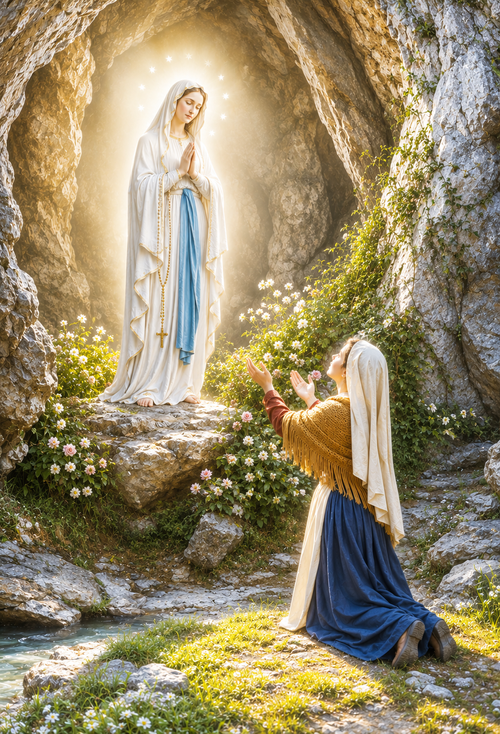
On the morning of February 11, 1858, a fourteen-year-old girl named Bernadette Soubirous went with her sister and a friend to gather firewood along the banks of the Gave de Pau river near the small town of Lourdes in the French Pyrenees. Near a rocky outcrop called Massabielle — a name meaning roughly “old rock” — beside a shallow cave used as a pig shelter, she heard a sound like wind in the trees, though the trees were still. She looked toward the grotto and saw a light. And in the light, standing in the niche of the rock, was a young woman of breathtaking beauty: white dress, blue sash, white veil, yellow roses at her feet, and in her hands a white Rosary with a golden chain that she ran through her fingers without speaking.
This happened seventeen more times. Over the following months, the Lady gave Bernadette messages of extraordinary theological precision, produced a miraculous spring that has been flowing uninterruptedly for over 165 years, and revealed her identity with six words in the local Gascon dialect that theologians are still unpacking: Que soy era Immaculada Concepciou. I am the Immaculate Conception. Four years after Pope Pius IX had defined the Immaculate Conception as a dogma of the Catholic Church, the Mother of God came to a pigsty in the French Pyrenees and confirmed it through the testimony of a child who could not possibly have known the phrase.
Lourdes is the most scientifically investigated Marian apparition in history. The Lourdes Medical Bureau, founded in 1883, has examined thousands of claimed miraculous healings using the methods of contemporary medicine, and approximately seventy cases have completed the full process of Church recognition as genuine miracles — with several hundred more classified as medically unexplained. Six million pilgrims come to Lourdes every year. The site generates more hotel accommodation than any city in France except Paris. The spring Bernadette found still flows at the rate of tens of thousands of liters per day.
This article is the most comprehensive account of Our Lady of Lourdes available: all eighteen apparitions in chronological detail, every message and its theological significance, the miraculous spring and the water, Bernadette’s extraordinary life and incorrupt body, the full investigation and official approval, the Medical Bureau and its documented miracles, the shrine as it exists today, the prayers, and the devotional tradition that Our Lady of Lourdes put in motion on a cold February morning in 1858 when she appeared to the most unprepossessing person she could have chosen and changed everything.
The Our Lady of Lourdes prayer card carries the image of the woman who appeared in the grotto, who produced the miraculous spring, who said “I am the Immaculate Conception,” and who has been healing the sick for over 165 years. She asked for penance and the Rosary. Carrying her card is the simplest act of faithfulness to a request she has been making since 1858.
Part II
France in 1858: The World She Came Into
France in 1858 was Napoleon III’s Second Empire — a country in the throes of rapid industrialisation, caught between the revolutionary secularism of 1789 and the traditional Catholicism of its rural population, governed by a regime that was simultaneously suspicious of the Church’s political power and dependent on its moral authority. The intellectual climate of mid-nineteenth century France was shaped by the triumph of scientific rationalism: Darwin’s On the Origin of Species would be published the following year; the positivist philosophy of Auguste Comte had declared that the age of religion was passing; and educated France was increasingly confident that the supernatural was a category belonging to the Middle Ages, not to the modern world.
The Catholic Church in France had been in a complex position since the Revolution. Physically present in every village through its parish churches and schools, institutionally powerful in education and social welfare, and yet operating under the constant pressure of an anti-clerical intellectual culture that regarded religious belief as superstition and religious institutions as obstacles to progress. The Church had also just completed one of its most theologically significant acts of the modern era: on December 8, 1854, Pope Pius IX had defined the Immaculate Conception of the Virgin Mary as a dogma of the Catholic faith — a definition that the secular world regarded with a mixture of indifference and contempt, and that the Catholic world received with jubilation.
Lourdes in 1858
Lourdes itself was a small market town of approximately four thousand people at the foot of the Pyrenees, twelve kilometres from the Spanish border. It had a modest castle, a parish church, a local market, and the kind of community life that characterized provincial France in the mid-nineteenth century: close, Catholic, poor, and largely untouched by the intellectual currents of Paris. The town was divided along the usual French provincial lines between the comfortable bourgeoisie, the working poor, and the truly destitute — and the Soubirous family, when Bernadette received her first apparition in February 1858, belonged emphatically to the last category.
The choice of Lourdes — a small town in the remotest part of France, near the Spanish border, at the foot of mountains whose winter cold would have kept away all but the locally desperate — is consistent with the entire logic of Marian apparitions. She does not come to the centres of power. She does not come to the cities where the intellectuals live. She comes to the margins: to the poor, the young, the sick, the voiceless. And in coming to them, she addresses the centres of power with a message whose authority derives precisely from its source in the powerless.
Part III
Saint Bernadette Soubirous: Who She Was Before the Apparitions
Bernadette Soubirous was born on January 7, 1844, the eldest child of François Soubirous and Louise Casterot. Her father had been a miller — a trade that once provided a modest living — but by a series of misfortunes and the economic pressures of mid-century France, he had lost his mill, his livelihood, and eventually his family’s housing. By 1858, when Bernadette was fourteen, the family was living in the cachot — a former town prison — which a charitable relative allowed them to occupy because they could afford nothing else. There were six of them in the small dark room.
Bernadette herself was small for her age, chronically ill with severe asthma that had begun in infancy, and by fourteen still unable to read or write with any competence. Her illness had prevented her from attending school with any regularity. She spoke Gascon at home — the dialect of the Pyrenean southwest — and had only a rudimentary command of French. Those who knew her described her as quiet, gentle, direct, and honest, but not particularly remarkable. She was preparing for her First Communion — late, because of her irregular schooling — at the time of the first apparition.
She was not a candidate for mystical experience by any worldly criterion. She was poor, sick, uneducated, and completely without the religious formation that might have primed her imagination for visions. She had no known prior interest in Marian apparitions or in mystical religion. She was a child in a dark room in a poor town who went out to gather firewood one morning and encountered something that neither she nor the world was prepared for.
Part IV
The Cachot: Living in the Prison of Poverty
To understand Bernadette, you must spend a moment in the cachot. The word means “dungeon” or “prison cell” in French, and the building the Soubirous family occupied had been exactly that: a small stone room in the former town prison that had been decommissioned because it was considered too unhealthy for prisoners. The room was approximately four metres by four metres — roughly thirteen feet square. It had one small window that admitted almost no light. The walls were damp and the floor earthen. In this room in the winter of 1857–1858, François and Louise Soubirous and their four children lived, ate, and slept.
François Soubirous had been reduced, by this point, to working as a day labourer whenever he could find work — which was not always. He had been arrested on suspicion of theft, falsely, and the accusation had destroyed whatever remained of his social standing. The family ate irregularly and poorly. Bernadette’s asthma was chronic and debilitating; the cold damp of the cachot was the worst possible environment for her. She was, in the census of 1858, the most invisible kind of person France produced: a sick girl from a destitute family living in a former jail.
Why God Chose This Family
The pattern of Marian apparitions consistently favours the invisible. At Fátima, it was three shepherd children. At Kibeho, it was rural schoolgirls in one of Africa’s poorest countries. At Knock, it was the ordinary poor of County Mayo. At Lourdes, it was the daughter of a family so destitute they lived where prisoners had been kept because it was too unhealthy even for prisoners. This is the logic of the Beatitudes: Blessed are the poor in spirit, for theirs is the kingdom of heaven. Blessed are the meek, for they shall inherit the earth. Our Lady does not appear to emperors or theologians. She appears to the ones the world has already decided do not matter — and then she makes them matter for centuries.

Part V
All 18 Apparitions: A Complete Account of Every Visit
The eighteen apparitions at Lourdes constitute one of the most carefully documented series of Marian apparitions in the history of the Church. What follows is the complete account of each apparition: who was present, what was seen, what was said, and what occurred. This is the first time most readers will encounter the full sequence in a single accessible form.
Bernadette, her sister Marie-Toinette (Toinette), and a friend, Jeanne Abadie, go to gather firewood along the Gave. Approaching the Massabielle grotto, Bernadette hears a sound like wind. She looks at the grotto and sees a golden cloud and then a young woman in the niche of the rock — white dress, blue sash, white veil, yellow roses on her feet, white Rosary with a gold chain. Frightened, Bernadette pulls out her own Rosary to pray; her hand shakes. The Lady smiles and gestures for her to come forward. Bernadette prays a full Rosary; the Lady fingers her beads but does not join in the prayer. As the vision ends, the Lady withdraws into the niche. Toinette and Jeanne, who were across the millrace, see nothing but notice Bernadette’s ecstatic state. Bernadette says only that she saw “something white.” Toinette tells their mother, who forbids Bernadette from returning.
Bernadette returns, disobeying her mother, with a group of girls and a bottle of holy water. She throws holy water toward the figure as a test of whether it is good or evil; the Lady only smiles and bows her head. Bernadette enters a prolonged ecstasy. The girls around her become frightened; a large stone is rolled near Bernadette and she does not react. A miller observing from across the stream sees the ecstasy end and Bernadette’s face return to normal. When he carries her home, he notes she seems abnormally light — “as light as a feather.”
Two respectable women from Lourdes accompany Bernadette, bringing paper and pen at the suggestion of the local notary. The Lady speaks for the first time. Bernadette offers her the writing materials and asks the Lady to write her name. The Lady smiles and says in Gascon: “Ce qui doit venir ne sera pas nécessaire de le mettre par écrit” — What has to come need not be put in writing. The Lady then asks Bernadette: “Will you do me the favour of coming here for fifteen days?” Bernadette agrees. The Lady adds: “I do not promise to make you happy in this world, but in the next.” This honest disclaimer — given at the very first verbal exchange — is one of the most striking features of the Lourdes account: the Lady makes no promises of earthly comfort.
Bernadette returns, accompanied by approximately twenty people. The Lady appears. Bernadette prays the Rosary. No specific message is recorded. The crowds begin to grow; word is spreading through Lourdes and the surrounding villages.
The Lady confides to Bernadette a secret — something for Bernadette alone, which she never revealed to anyone throughout her life. Bernadette is visibly moved and her expression shows sadness during the apparition. Those present describe her face as reflecting a deep interior experience. She does not explain what she was told.
The crowds now number in the hundreds. The local police commissioner, Dominique Jacomet, summons Bernadette and interrogates her sharply, trying to break her story or catch inconsistencies. Bernadette holds her ground calmly and without embellishment. Jacomet’s notes of the interview show his frustration at her composure. He forbids her to return to the grotto. Bernadette’s father tells her she must obey the authorities. But the Lady has asked her to come for fifteen days, and she continues to go.
This apparition delivers one of the two core verbal messages of the entire Lourdes series. The Lady says: “Pénitence! Pénitence! Pénitence! Priez Dieu pour les pécheurs” — Penance! Penance! Penance! Pray to God for sinners. She also asks Bernadette to kiss the ground as an act of penance for sinners. Bernadette does so. This message — its triple insistence, its orientation toward sinners rather than toward the devout — is the heart of the Lourdes message: urgent, outward-facing, motivated by love for those furthest from God. It anticipates by decades the Fátima message’s nearly identical urgency about sinners.
The most dramatic and physically consequential single apparition. The Lady tells Bernadette: “Go drink at the spring and wash yourself there, and eat the grass that is there.” Bernadette goes toward the Gave river, assuming that is the spring meant. The Lady calls her back and points to a spot on the muddy ground in the grotto. Bernadette digs with her hands; the first water is muddy. She drinks it, then washes her face — to the mystification and, initially, the ridicule of those watching. She also eats a few blades of grass growing near the spot, an act of public humility that horrifies onlookers. By that afternoon, the muddy hollow had become a clear flowing spring. It has been flowing ever since. The gestures of drinking, washing, and eating grass were understood by those who later reflected on them as acts of penitential humility — Bernadette performing publicly, and at the Lady’s direction, acts that made her look foolish in order to demonstrate that the penance being asked was real, not symbolic.
The apparitions continue. Crowds at the grotto now number in the thousands — people coming from throughout the Hautes-Pyrénées. The spring continues to flow and people begin to use the water. Reports of unusual experiences — feelings of peace, healings — begin to be attached to the water. Bernadette continues to hold her Rosary and enter ecstatic states in which she is completely unresponsive to external stimuli. Civil authorities are increasingly agitated.
Catherine Latapie, a woman from the village of Loubajac whose right arm had been paralysed after an accident two years earlier, comes to the spring in the early morning before the apparition begins. She plunges her arm and hand into the spring water. Immediately, sensation and movement return. She rides home on her horse and is observed throughout the day to have full use of the arm she could not move that morning. This is the first recorded miraculous healing at Lourdes. Catherine’s account was documented and later examined as part of the canonical investigation.
The Lady delivers her structural request, which Bernadette is asked to transmit to the priests: “Go and tell the priests that people are to come here in procession and to build a chapel here.” This is the most specific and institutionally consequential request of the entire series. Bernadette goes to Abbé Dominique Peyramale, the parish priest of Lourdes, and delivers the message. He is sceptical and asks for a sign: he wants the Lady to make the wild rosebush that grows at the grotto bloom in February, in the middle of winter. He sends Bernadette away. She returns to the grotto and reports the priest’s request; the Lady smiles but says nothing.
March 4 is the fifteenth and final day of the promised fortnight. An enormous crowd estimated at approximately 20,000 people gathers at the grotto — an astonishing number for a rural French village in 1858. Many have come expecting a spectacular public miracle. Bernadette arrives, enters ecstasy, and the apparition occurs. No public miracle takes place. The crowd is disappointed. Some are angry. Bernadette is simply peaceful. The Lady has not promised a miracle on that day; she has promised to come for fifteen days, and she has kept that promise. The absence of a dramatic public sign on the day the crowd expects one is itself a lesson: the signs of Lourdes are not produced to order for sceptics, but given freely by God when and as God chooses.
After a gap of three weeks following the end of the fortnight, the Lady appears again on the Feast of the Annunciation — the feast celebrating the moment when the Angel Gabriel announced to Mary that she would conceive the Son of God. Bernadette has been pressing the Lady across several apparitions to give her name; Abbé Peyramale has told her to ask again and again until she receives an answer. On this morning, the Lady finally responds. She raises her eyes to heaven, joins her hands on her breast, and says in the Gascon dialect: “Que soy era Immaculada Concepciou” — I am the Immaculate Conception. Bernadette runs to Abbé Peyramale, repeating the phrase to herself the entire way so as not to forget it. She does not know what the words mean; she asks the priest what an “Immaculate Conception” is. The priest — who has been resistant to the apparitions — is shaken. He cannot immediately respond. He later says: “A girl would not know how to invent those words.”
Bernadette holds a lit candle in her clasped hands during the ecstasy. The candle flame burns between her fingers for a prolonged period — estimated by observers at approximately fifteen minutes. The medical doctor Joseph-Alexandre Dozous, present with a sceptical scientific intention, observes the flame making contact with Bernadette’s hands repeatedly without producing any burn, reddening, or reaction. He times the duration. He examines her hands immediately after the ecstasy ends and finds no marks, burns, or irritation. He subsequently becomes one of the most important scientific supporters of the apparitions, writing a detailed account of what he witnessed. His testimony is part of the canonical investigation record.
The civil authorities have barricaded the grotto and forbidden access. Bernadette can no longer approach the niche. She goes to a spot on the other bank of the Gave river, directly across from the barricaded grotto, and kneels there. The Lady appears — more beautiful, Bernadette says, than ever before. The two are separated by the river. The barricade could keep Bernadette from the grotto; it could not keep the Lady from Bernadette. The apparition is brief and wordless. When it ends, Bernadette says later: “She was more beautiful than ever.” It is the Feast of Our Lady of Mount Carmel — a Marian feast associated with the Carmelite tradition’s emphasis on prayer and contemplation. This is the last time the Lady appears to Bernadette. The eighteen apparitions are complete.
Part VI
How She Appeared: A Complete Description of the Lady
Bernadette’s descriptions of the Lady at Lourdes are remarkably consistent across all her accounts given over the years following the apparitions — accounts given to church investigators, to the canonical commission, to individual interlocutors, and in her own written records. The consistency and specificity of her descriptions across years of questioning, under pressure and examination, is one of the features of the Lourdes record that investigators found most compelling.
Her Clothing and Appearance
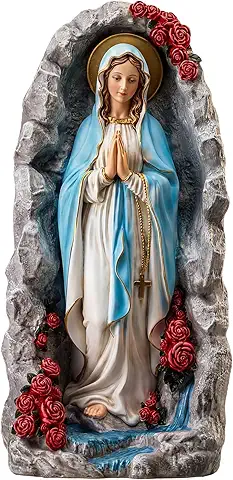
The Lady was young — Bernadette consistently described her as appearing no older than approximately sixteen to eighteen years, though with a quality of bearing that did not match the impression of ordinary youth. She wore a white dress of extreme whiteness and simplicity, with no decoration. Over the dress she wore a white veil that covered her hair and fell below her shoulders. Around her waist was a blue sash, the only colour in her clothing. At her feet — slightly elevated above the ground, as if standing on nothing visible — were two yellow roses, one on each foot. Her skin was luminous; she appeared to emit her own light. Her face was of extraordinary beauty — Bernadette said she had never seen anyone so beautiful — but a beauty that was not threatening or overwhelming, that invited rather than overawed.
The Rosary
In her hands the Lady held a Rosary — white beads with a golden chain and a golden cross. Bernadette always noted with precision that the Lady moved the beads through her fingers during the Rosary prayer but did not herself join in the spoken Hail Marys. She joined only in the Glory Be at the end of each decade. This detail — the Mother of God moving the Rosary beads but not saying the prayer to herself — was interpreted by theologians as significant: the Hail Mary is addressed to Mary, and she cannot pray to herself. But she joins in the Gloria, the Trinitarian doxology, which is addressed to the Father, Son, and Holy Spirit.
The Gascon Dialect
The Lady spoke to Bernadette in Gascon, the local dialect of the Pyrenean southwest, not in French. This choice is theologically and pastorally significant: she spoke the language of the poorest, the language of the countryside, the language of a people who might have felt that God’s formal communications came in the learned languages of the educated. She spoke what Bernadette could understand. The phrase Que soy era Immaculada Concepciou is Gascon, not standard French. The choice of language, as with the choice of Bernadette herself, says something about who the Mother of God considers worth addressing in her own idiom.

Part VII
The Miraculous Spring: February 25, 1858
Of all the physical phenomena associated with the Lourdes apparitions, none has been more consequential for more people than the miraculous spring. A spring of water that did not exist on the morning of February 25, 1858 began flowing that afternoon from a spot where a fourteen-year-old girl was directed to dig by an apparition, and it has been flowing continuously for over 165 years. Everything that happens at Lourdes — the healings, the baths, the water taken home by millions of pilgrims worldwide — flows from this spring.
What Happened on February 25
The ninth apparition began in the morning with the Lady’s instruction: “Go drink at the spring and wash yourself there, and eat the grass that is there.” Bernadette initially went toward the Gave de Pau river, understanding that to be the spring. The Lady stopped her and pointed to a spot on the ground within the grotto itself. Bernadette knelt and began to dig in the earth with her hands. The ground was hard and muddy. The first water that appeared was muddy and foul-smelling; Bernadette scooped it up and tried to drink it, could not, tried again, and on the third attempt managed to drink some. She washed her face with the mud.
Observers watching from a few metres away were mortified. They could see a girl digging in mud and drinking dirty water and rubbing mud on her face, apparently at the direction of an invisible being. The crowd that had come expecting a miracle or a consolation found instead a spectacle of public humiliation. Many left disgusted. Those who stayed saw Bernadette eat a few blades of grass from the area, as she had also been told to do. And then the apparition ended and Bernadette went home.
That evening, the hollow Bernadette had dug was a clear flowing spring.
The Spring That Never Stops
The spring has never stopped. It currently produces approximately 35,000 to 45,000 litres of water per day — which the shrine channels into the baths, into drinking taps, and into the bottles and containers that pilgrims fill and carry home. The geological survey of the area has found no natural aquifer or underground water source that would explain a spring of this volume and constancy at this location. Before February 25, 1858, there was no spring at Massabielle. Bernadette found it by digging in the dirt at an apparition’s direction, and it has been flowing every day since.
The Water’s Healing Power
The Lourdes spring water has been scientifically analysed many times and found to be ordinary water — clean, cold (approximately eleven degrees Celsius year-round), and containing no special minerals or chemicals that would explain its association with healings. This is theologically important. The healings at Lourdes are not a consequence of the water’s chemistry. They are a consequence of supernatural intervention by God, at the intercession of Our Lady of Lourdes, in the context of prayer, faith, and the use of the water as a sacramental focus for petition. The water is not a medicine. It is a contact point for a divine action that depends entirely on the free gift of God and not on any property of the water itself. This is consistent with the Church’s understanding of sacramentals: physical objects and actions that, when used with faith and prayer, become occasions for God’s grace.

Part VIII
“I Am the Immaculate Conception”: The Defining Words of March 25, 1858
Of all the words spoken at Lourdes across the eighteen apparitions, none carries greater theological weight than the six Gascon words the Lady spoke on March 25, 1858: Que soy era Immaculada Concepciou. These words are the pivot on which the entire Lourdes event turns. They explain why the Church was ultimately convinced of the apparitions’ authenticity. They explain why the shrine grew as fast as it did. They explain why Lourdes occupies the position it does in the history of Catholic theology. And they explain something important about the character of the Mother of God’s self-presentation to the world.
What Bernadette Did with the Words
When the Lady spoke these words, Bernadette did not understand them. She was fourteen, largely uneducated, and had never encountered the phrase “Immaculate Conception” in any form. What she understood from the sound was not a concept but a sequence of syllables that she did not want to lose. She ran from the grotto to the presbytery of Abbé Peyramale, repeating the phrase to herself the entire way — “Que soy era Immaculada Concepciou, que soy era Immaculada Concepciou” — like a child who has been told a word she doesn’t know and wants to remember long enough to ask an adult what it means.
When she reached Abbé Peyramale and delivered the phrase, his first reaction was stunned silence. He asked her to repeat it. She did. He later said: “She could not have invented those words.” As a theologian, he understood immediately what the words meant — and he understood immediately that they were theologically precise, specifically referring to the dogma defined four years earlier, and utterly beyond the theological vocabulary available to the girl standing in front of him.
The Precision of the Language
The phrase is not “I was immaculately conceived” — which would be a description of a historical fact about Mary’s conception. The phrase is “I am the Immaculate Conception” — which is an identity claim. Mary does not say she possesses the grace of the Immaculate Conception, as one might say a holy person possesses grace. She says she is the Immaculate Conception — that this theological reality is not something she has but something she is, that her identity and her freedom from original sin are inseparable at the deepest level of her being.
This distinction — between having a quality and being it — is theologically sophisticated in a way that an uneducated child cannot be expected to have invented. Theologians would later compare it to the difference between “I am holy” and “I am Holiness itself.” The Lady at Lourdes identified herself not as one who participates in a grace but as the living incarnation of a grace — Mary, whose entire existence was ordered from the moment of her conception to the reception and bearing of the Word of God.
Part IX
The 1854 Dogma and Why Bernadette’s Words Proved It
On December 8, 1854, Pope Pius IX issued the apostolic constitution Ineffabilis Deus, formally defining as a dogma of the Catholic faith: “the doctrine which holds that the most Blessed Virgin Mary, in the first instance of her conception, by a singular grace and privilege granted by Almighty God, in view of the merits of Jesus Christ, the Saviour of the human race, was preserved free from all stain of original sin.” This is the Immaculate Conception: not the virginal conception of Jesus (a common confusion), but the conception of Mary herself, free from the stain of original sin that all other human beings receive at the moment of their conception.
The definition was controversial. Many theologians and educated Catholics had debated the doctrine for centuries. The formal definition ended the debate at the level of doctrine — Catholics were now required to hold it as a matter of faith — but the theological controversy did not simply disappear. There were those who accepted the definition obediently but felt its historical and scriptural basis was thin. The definition had been a matter of devotion and speculation for centuries; it had now become a dogma, but without a confirmatory supernatural sign.
The Supernatural Confirmation: Four Years Later
The Lourdes apparitions began four years after the 1854 definition. When the Lady revealed her identity on March 25, 1858, as “the Immaculate Conception,” through a girl who could not have known the theological phrase, the effect on the Catholic world was electric. It was understood immediately as a divine confirmation of the 1854 dogma: the same Mary whose freedom from original sin had just been defined as a matter of faith had appeared in France and identified herself using the technical theological title of that doctrine. The Church had defined a dogma; the person the dogma was about came four years later and confirmed it.
This confirmation gave the Lourdes apparitions an immediate and profound theological significance that went beyond the locality of a French grotto. They were not merely a healing site or a place of pilgrimage; they were a supernatural event that bore directly on one of the most significant doctrinal developments of the nineteenth-century Church. The bishop who conducted the investigation and ultimately approved the apparitions was aware of this dimension. It contributed significantly to the speed and decisiveness of the Church’s positive response.
The Feast Connection
The Lady revealed her name on March 25, 1858 — the Feast of the Annunciation, the feast celebrating the moment when Mary said yes to the angel and conceived the Son of God. The choice of this feast for the self-identification is another layer of elegant theological precision: the feast celebrates the moment that defines Mary’s identity in salvation history, and on that feast she reveals the identity that made that moment possible. She is the Immaculate Conception — the woman prepared from her own conception to be the worthy vessel of the incarnation of God — and she reveals this on the day that celebrates the Incarnation she made possible. The theology of the Annunciation and the theology of the Immaculate Conception are woven together in the date itself.

Part X
Every Message and Request of Our Lady at Lourdes
The messages of Our Lady of Lourdes are fewer and simpler than those of Fátima or Kibeho, but they are no less urgent and no less demanding. What follows is the complete list of everything the Lady communicated at Lourdes, drawn from the full record of all eighteen apparitions.
- Penance! Penance! Penance! The most insistent verbal message of the Lourdes series, delivered on February 24, 1858. Three times, with the emphasis of repetition. The word covers a broad range of voluntary acts of suffering, deprivation, and discipline offered in reparation for sin. It is not primarily about ecclesiastical forms of penance (confession, penances assigned by a confessor) but about the personal, interior willingness to accept and offer suffering as an act of love for sinners. Bernadette herself embodied this in her subsequent life at Nevers to a degree that those who knew her found extraordinary.
- Pray to God for Sinners The orientation of the Lourdes prayer request is not primarily for oneself or one’s own needs but for sinners — those who are furthest from God, those most in danger of eternal loss. This is the same orientation as the Fátima prayer added to the Rosary decades later: lead all souls to heaven, especially those in most need of thy mercy. The Mother of God at Lourdes is asking her children to expand their prayer beyond their own circle to include those they might never know.
- Pray the Rosary The Lady modelled Rosary prayer at every single apparition by running the beads of her own Rosary through her fingers. She did not always articulate this as a verbal request; she demonstrated it by her presence and her action. The Rosary is the devotion she endorsed both at Lourdes and at Fátima and at virtually every major Marian apparition in the modern era. It is the prayer she carries. It is the prayer she asks for.
- Go Drink at the Spring and Wash There On February 25, the Lady directed Bernadette to a specific physical location and specific physical actions: drink from the spring, wash in it, eat the grass growing there. These actions were penitential acts of humility performed publicly. They also produced the miraculous spring. The combination — penance and miracle — in a single instruction is characteristic of the Lourdes message: spiritual action and physical sign are not separated but interwoven.
- Build a Chapel Here On March 2, the Lady asked Bernadette to tell the priests to build a chapel at the grotto. This institutional request — for a permanent structure of worship at the apparition site — is consistent with the Lourdes message’s emphasis on the long term rather than the immediate: she is not merely appearing to comfort a few local people but establishing a permanent place of encounter between God and the sick, the penitent, and the searching.
- Come in Procession Along with the chapel request, the Lady asked for processions — the communal, public, embodied act of walking in prayer toward a holy place. Procession is one of the most ancient forms of Christian liturgical expression: the community moves together, physically, in prayerful formation. The evening Rosary procession at Lourdes, with its thousands of candles, has become one of the most powerful communal prayer experiences in world Catholicism.
- “I Do Not Promise to Make You Happy in This World, but in the Next” This single sentence, spoken to Bernadette personally at the third apparition, is one of the most honest and least comforting things a divine messenger has ever said to a visionary. It is a clarification of the terms: following the Mother of God is not a guarantee of earthly comfort, ease, or success. It is a guarantee of the next world. For Bernadette, this honesty proved prophetic: her life after the apparitions was one of sustained suffering, illness, misunderstanding, and the peculiar isolation of someone who has been a vessel for something too large to live alongside ordinarily. She was not made happy in this world. She was made a saint.
Part XI
The Growing Crowds and Civil Opposition
The crowds at the Lourdes grotto grew with a speed that alarmed the civil authorities and overwhelmed the capacity of the small town to manage. On February 11, there were three people at the grotto. By the end of the fortnight in early March, there were an estimated twenty thousand. This pace of growth in a pre-mass-communication era — word of mouth, written letters, and the local press — speaks to the power of what people were experiencing at Massabielle and the speed with which genuine encounters with the supernatural generate their own momentum.
The Civil Response: Commissioner Jacomet
The local police commissioner, Dominique Jacomet, was the first official to take Bernadette seriously as a threat to public order. He interviewed her on February 21, after the sixth apparition had drawn a crowd of hundreds. His interview strategy was the classic one: catch her in contradictions, imply that she was lying, and frighten her into recanting. It failed completely. Bernadette answered every question calmly and without embellishment, gave consistent answers, and showed no sign of being intimidated. Jacomet’s notes of the interview survive and are remarkable for the evidence they provide of his frustration: he could not break the account of a fourteen-year-old girl from the poorest family in town. He forbade her to return to the grotto.
Prefect Massy: The Attempt at Institutionalisation
Baron Anselme-Anastase Massy, the imperial prefect of the Hautes-Pyrénées and the highest civil authority in the region, took a more aggressive approach. He attempted to have Bernadette committed to a psychiatric institution, sought the opinion of medical doctors about her mental state (the doctors refused to certify her as insane), and ultimately ordered the grotto barricaded and access prohibited. It was this barricade that forced the final apparition of July 16 to occur from across the river.
Massy also pressured Abbé Peyramale to discourage the apparitions, attempted to prevent the spring water from being distributed, and sought to contain the growing pilgrimage before it became a major public phenomenon. All of these efforts failed. The pilgrimage continued to grow. The spring continued to produce healings. And eventually, the matter reached Paris.
The Empress Eugénie and Napoleon III
The intervention that ultimately removed the barricade from the Lourdes grotto came from the highest level of French political authority. Empress Eugénie de Montijo, wife of Napoleon III, heard about the Lourdes events and became personally interested. She made inquiries. The case of a young girl from an impoverished family being harassed by the civil authorities for reporting a religious experience had, by 1858, generated enough national press coverage to embarrass the imperial government. Napoleon III himself ordered the barricade removed and the grotto reopened. Whatever the Emperor’s personal religious beliefs, the political calculation was clear: the state had no legitimate interest in preventing people from praying at a grotto, and the attempt to do so was generating more attention to the apparitions than leaving them alone would have done.
Part XII
The Miracle of the Candle: April 7, 1858
The seventeenth apparition on April 7, 1858 produced what is probably the most carefully documented physical sign of the entire Lourdes series. During the ecstasy, Bernadette’s clasped hands, in which she held a lit devotional candle, were exposed to the candle’s flame for a sustained period estimated at approximately fifteen minutes by Dr. Joseph-Alexandre Dozous, the medical doctor who was present and who timed the phenomenon specifically.
Dozous was a trained physician who had come to the grotto with scientific scepticism. He had been examining Bernadette’s physiological state during her ecstasies over several apparitions and was in the process of compiling a medical assessment. On April 7 he observed the flame of the candle touching the flesh of Bernadette’s fingers repeatedly over the fifteen-minute period. He did not intervene, though he was close enough to do so, because he wanted to observe the phenomenon completely. When the ecstasy ended, he immediately examined Bernadette’s hands. He found no burn marks, no reddening, no blistering, no indication that the skin had been exposed to a flame at all.
Dozous subsequently became one of the most important scientific advocates for the authenticity of the Lourdes phenomena. His written account of the candle miracle — authored as a physician, in the language of medical observation — was submitted as part of the canonical investigation and was one of the pieces of physical evidence the commission found most difficult to explain by natural means. He also documented multiple cases of apparent miraculous healings with the same medical precision, creating a record that later formed part of the foundation for the Lourdes Medical Bureau established in 1883.
Part XIII
The Church Investigation: 1858–1862
The Catholic Church’s investigation of the Lourdes apparitions is one of the most thorough ecclesiastical investigations of any claimed supernatural event in modern history. It lasted four years, involved the systematic collection of medical and testimonial evidence, subjected Bernadette to repeated interviews under conditions designed to reveal inconsistency or fabrication, and applied the Church’s standard criteria for evaluating supernatural claims with methodical rigour.
The Commission Established
Bishop Bertrand-Sévère Laurence of Tarbes established the canonical commission of inquiry in 1858, shortly after the apparitions had occurred. The commission was composed of theologians, canon lawyers, medical doctors, and other experts whose combined expertise could address the full range of questions the apparitions raised: theological orthodoxy, psychological stability of the visionary, physical phenomena, and the healings associated with the spring. The commission collected testimonies from Bernadette, from witnesses, from doctors who had examined claimed healings, and from the civil officials who had interrogated Bernadette.
What the Commission Examined
The investigation assessed every major criterion by which the Church evaluates supernatural claims. The theological content of the messages was examined: were they orthodox? Did they contradict Catholic teaching? The answer was clearly no — the messages of penance, prayer, the Rosary, building a chapel, and praying for sinners were entirely consistent with and supportive of Catholic faith and practice. The phrase “I am the Immaculate Conception” was assessed as a theologically precise statement that an uneducated girl could not have invented. The physical phenomena — the candle miracle, the ecstatic states, the dry spring that began to flow — were examined and found inexplicable by natural means. The healings were investigated medically with the available tools of 1858–1862, and several were judged to be miraculous.
Bernadette Under Examination
Bernadette herself was subjected to repeated examinations. She was interviewed by the diocesan commission, by individual clergy, by physicians, by the civil authorities, and by curious visitors of every social rank. The consistency of her account across hundreds of such encounters, over four years, under conditions that ranged from supportive to hostile, is one of the most striking features of the Lourdes record. She never embellished. She never changed her story on the essential details. She said exactly what she had experienced and no more, and she refused to add interpretations or theological commentary. When asked what the Lady looked like, she described what she saw. When asked what the Lady meant by this or that message, she said she didn’t know. This consistency and modesty — unusual in someone who would benefit from claiming more — was one of the features the commission found most compelling.

Part XIV
Official Approval: January 18, 1862
On January 18, 1862 — the Feast of the Chair of Saint Peter, the feast celebrating the apostolic authority of the See of Rome — Bishop Bertrand-Sévère Laurence of Tarbes issued his formal pastoral letter on the Lourdes apparitions. The date was deliberate: by choosing the Feast of the Chair of Saint Peter, the bishop was situating his declaration within the apostolic tradition of the Church and implicitly acknowledging the extraordinary nature of what he was declaring.
The declaration stated: “We judge that the Immaculate Mary, Mother of God, really appeared to Bernadette Soubirous on February 11, 1858, and on subsequent days, to the number of eighteen times, in the Grotto of Massabielle, near the town of Lourdes; that this apparition bears all the marks of truth and that the faithful are justified in believing in it as certain. We humbly submit our judgment to the supreme authority of the Sovereign Pontiff who rules the universal Church.”
The phrase “really appeared” is decisive. The bishop did not say the apparitions were probably genuine, or that they could not be ruled out, or that the faithful might believe in them if they chose. He said the Immaculate Mary really appeared — that the canonical investigation had concluded not merely that the witnesses were sincere but that the events were real. This is constat de supernaturalitate: confirmed supernatural. It is the highest positive finding available in Church investigations of claimed apparitions, applied to Lourdes four years after the last apparition and after the most thorough investigation the Church had mounted to that date.
What Approval Means and Does Not Mean
Church approval of a Marian apparition means that Catholics may believe in it and find spiritual benefit from devotion to it; it does not mean that Catholics are required to believe in it as a matter of faith. The apparitions at Lourdes, Fátima, Kibeho, and Knock are in the category of “private revelation” in the technical theological sense — supernatural communications to specific individuals or groups that the Church has judged authentic, but that do not constitute part of the deposit of faith (Sacred Scripture and Sacred Tradition) that all Catholics must believe. A Catholic who for whatever reason is not personally drawn to Lourdes devotion is not thereby in any deficiency of faith. But a Catholic who has encountered the evidence for Lourdes and found it persuasive is fully supported by the Church in embracing it with complete confidence.
Part XV
Complete Chronological Timeline: 1858 to Today
- January 7, 1844 — Bernadette Is BornBernadette Soubirous is born in Lourdes to François Soubirous and Louise Casterot. The family is comfortably situated at this point; her father is a working miller. The decline into desperate poverty will come over the following decade.
- February 11, 1858 — First ApparitionBernadette, age 14, sees the luminous Lady in the niche of the Massabielle grotto while gathering firewood with her sister and a friend. The first of eighteen apparitions. No words are spoken. She prays a Rosary.
- February 14 — Second ApparitionBernadette returns with holy water, which she throws at the figure. The Lady only smiles. Bernadette enters a deep ecstasy.
- February 18 — Third ApparitionThe Lady speaks for the first time. She asks Bernadette to come for fifteen days and says: “I do not promise to make you happy in this world, but in the next.”
- February 19–21 — Apparitions 4–6Crowds grow from dozens to hundreds. Commissioner Jacomet interrogates Bernadette and fails to break her account. Her father forbids her to return, then relents.
- February 23 — Seventh ApparitionThe Lady gives Bernadette a personal secret, not to be shared. Bernadette is visibly moved.
- February 24 — Eighth Apparition“Penance! Penance! Penance! Pray to God for sinners.” The core verbal message of the entire series.
- February 25, 1858 — Ninth Apparition • The Miraculous SpringThe Lady directs Bernadette to drink at the spring and wash there. Bernadette digs in the grotto floor; by evening, a clear spring is flowing. It flows to this day.
- February 27 – March 1 — Apparitions 10–12Crowds reach thousands. On March 1, Catherine Latapie’s paralysed arm is restored after she plunges it in the spring — the first recorded miraculous healing at Lourdes.
- March 2, 1858 — Thirteenth ApparitionThe Lady asks Bernadette to tell the priests to build a chapel at the grotto and to come in procession. Abbé Peyramale is sceptical but moved.
- March 4, 1858 — Fifteenth Apparition (End of Fortnight)Approximately 20,000 people gather. No public miracle. The crowd is disappointed. Bernadette is peaceful. The Lady has kept her promise to come for fifteen days.
- March 25, 1858 — Sixteenth ApparitionFeast of the Annunciation. The Lady reveals her identity: “Que soy era Immaculada Concepciou” — I am the Immaculate Conception. Bernadette runs to Abbé Peyramale with the phrase she doesn’t understand. The priest is shaken.
- April 7, 1858 — Seventeenth ApparitionThe miracle of the candle: the flame rests on Bernadette’s hand for approximately fifteen minutes without burning her. Dr. Dozous times and documents the phenomenon and immediately examines her hands.
- July 16, 1858 — Eighteenth & Final ApparitionFeast of Our Lady of Mount Carmel. The grotto is barricaded. Bernadette kneels across the river and sees the Lady for the last time, more beautiful than ever. The apparition period ends.
- 1858–1862 — The Church InvestigationBishop Laurence of Tarbes establishes a canonical commission. Four years of investigation: medical testimony, witness accounts, theological assessment. Bernadette is interviewed repeatedly and her account never wavers.
- January 18, 1862 — Official ApprovalBishop Laurence declares: “The Immaculate Mary, Mother of God, really appeared to Bernadette Soubirous… and the faithful are justified in believing in it as certain.”
- 1866 — Bernadette Enters Religious LifeBernadette Soubirous enters the Sisters of Notre Dame de Nevers at Nevers, France. She will remain there for the rest of her life, largely hidden from the public. She takes the religious name Sister Marie-Bernard.
- 1871 — Upper Basilica ConsecratedThe Basilica of Our Lady of the Immaculate Conception (Upper Basilica) is consecrated, built on the rocky outcrop above the Massabielle grotto in fulfilment of Our Lady’s request for a chapel.
- April 16, 1879 — Bernadette Dies at NeversSister Bernadette Soubirous dies of tuberculosis of the bone at the age of 35. Her reported last words: “Holy Mary, Mother of God, pray for me, a poor sinner, a poor sinner.”
- 1883 — The Lourdes Medical Bureau FoundedDr. G.B. de Saint-Maclou establishes a permanent medical bureau at Lourdes to examine claimed miraculous healings using the methods of contemporary medicine. This becomes the most rigorous scientific investigation process ever applied to claimed miraculous events.
- 1889 — Lower Basilica ConsecratedThe Basilica of Our Lady of the Rosary (Lower Basilica) is consecrated beneath the Upper Basilica, completing the double-basilica structure above the grotto.
- 1909 — First Exhumation of BernadetteAs part of the beatification process, Bernadette’s body is exhumed for the first time. It is found to be essentially intact despite thirty years in the ground without embalming. Medical examiners certify the unusual state of preservation.
- 1919 — Second ExhumationA second exhumation finds the body again essentially intact, though moisture has caused some deterioration to the face and hands. Medical examiners prepare a report. The body is re-encased.
- June 14, 1925 — Bernadette Beatified • Third ExhumationPope Pius XI beatifies Bernadette Soubirous. The third and final exhumation takes place; the body is found still intact. A light wax coating is applied to the face and hands to restore their appearance for public display. The body is placed in a glass reliquary at the Chapel of Saint Gildard in Nevers, where it is publicly displayed for the first time.
- December 8, 1933 — Bernadette CanonizedPope Pius XI canonizes Saint Bernadette Soubirous on the Feast of the Immaculate Conception. The feast day is chosen deliberately: the saint who received the identity revelation of the Immaculate Conception is raised to the altars on the feast celebrating that very doctrine.
- 1947 — International Medical Committee of Lourdes EstablishedThe International Medical Committee of Lourdes (CMIL) is established as a more formal international body to review healing cases that pass the initial Medical Bureau examination. Its members are doctors from multiple countries and multiple faiths.
- 1958 — Centenary • Underground BasilicaThe centenary of the apparitions is marked by the consecration of the Basilica of Saint Pius X, a massive underground church capable of holding 25,000 people, making Lourdes one of the largest pilgrimage complexes in the world.
- August 14–15, 1983 — Pope John Paul II’s First VisitPope John Paul II visits Lourdes for the first time. He prays at the grotto, bathes in the spring, leads the torch procession, and celebrates Mass for hundreds of thousands of pilgrims. His visit is the most significant papal endorsement of Lourdes in the twentieth century.
- August 14–15, 1992 — Pope John Paul II’s Second VisitJohn Paul II visits Lourdes a second time, this time in an explicitly pilgrim capacity — as a sick man seeking the intercession of Our Lady. He has been suffering the effects of the 1981 assassination attempt and of advancing Parkinson’s disease. The image of the Pope as one of the sick pilgrims coming to Our Lady of Lourdes is one of the most theologically eloquent images of his pontificate.
- 1992 — World Day of the Sick EstablishedPope John Paul II establishes the World Day of the Sick on February 11 — the feast of Our Lady of Lourdes — to draw the Church’s attention annually to the sick, the suffering, and those who care for them. Lourdes becomes the spiritual centre of the Catholic Church’s engagement with illness and healing.
- September 13–15, 2008 — Pope Benedict XVI VisitsPope Benedict XVI visits Lourdes for the 150th anniversary of the apparitions. He prays at the grotto, speaks extensively about the theological significance of the Lourdes message, and leads major ceremonies at the shrine. His visit emphasises the Eucharistic dimension of Lourdes.
- 2018 — 70th Recognized Miracle DeclaredThe Diocese of Beauvais declares the healing of Sister Bernadette Moriau, a French Dominican nun cured of a severe neurological disorder, as the 70th officially recognized miraculous healing associated with the Lourdes apparitions. The declaration comes after years of rigorous medical investigation by the Medical Bureau and the CMIL.
Part XVI
Bernadette After the Apparitions: “Put Away Like a Broom”
After the final apparition on July 16, 1858, Bernadette Soubirous’s life became, in certain respects, more difficult rather than less. She was the central figure in the most significant religious event in France in decades. Every visitor to Lourdes wanted to see her. Clergy, curiosity-seekers, journalists, the devout, the sceptical, and the devotional all sought access to the girl who had seen the Lady. She was examined, questioned, and prodded by an endless succession of investigators. She bore this with remarkable equanimity and without complaint, but it was exhausting and, as she later said, spiritually dangerous: the temptation to vanity, to the enjoyment of the attention, to the elaboration of the story for the benefit of an audience — all of these she identified and resisted.
She continued to live in poverty. The family’s circumstances did not improve dramatically in the immediate aftermath of the apparitions. Bernadette received no income from the growing pilgrimage industry that her experiences had generated. She stayed in Lourdes for several more years, attending school and continuing the catechetical instruction she had not been able to complete before the apparitions. She received First Communion on June 3, 1858 — barely three months after the last of the public apparitions — and described it as the happiest moment of her life.
The Decision to Leave Lourdes
In 1866, Bernadette made the decision that would define the rest of her life: she entered the Sisters of Notre Dame de Nevers, a religious congregation whose motherhouse was in Nevers, in Burgundy — approximately 770 kilometres from Lourdes. The distance was not accidental. One of the things that drew Bernadette to Nevers was precisely that it was far from Lourdes: far from the grotto, far from the pilgrimage, far from the endless procession of people who wanted to see and question and analyse the visionary of the Immaculate Conception. She wanted to be a nun, not a relic.
When she arrived at the Nevers motherhouse, the superior of the community received her with a phrase that Bernadette herself later quoted without bitterness as perfectly describing her position: “She has come. She is good for nothing. She will be put away like a broom.” It was, Bernadette accepted, accurate. The apparitions were over; her supernatural utility was complete; what remained was to be a nun among nuns, doing the small work of religious life with the same fidelity and without the extraordinary circumstances that had briefly made her the most famous girl in France.
Part XVII
Bernadette at Nevers: Suffering, Holiness, and the Hidden Life
The seventeen years Bernadette spent at the Nevers motherhouse (1866–1879) were years of sustained physical suffering and quiet, hidden sanctity. She suffered from asthma that she had carried since childhood, but her principal illness at Nevers was tuberculosis of the bone — a disease that causes the bone tissue to deteriorate, producing intense and chronic pain, immobility, and ultimately the failure of the affected structures. At various points she was confined to bed for months, unable to walk, and in persistent pain.
The treatment she received within the religious community was not always kind by modern standards. Some of her superiors were aware that the temptation to spiritual pride was a genuine danger for a young woman who had been the subject of the most famous religious event in France and who was sought after by the devout as though she were already a saint. The antidote some of them applied was deliberate humbling: correction in front of the community, being given the most menial tasks, being criticised for small faults. Bernadette accepted this treatment as appropriate penance and did not resent those who administered it. She later said that the humiliations she received at Nevers were among the most spiritually formative experiences of her life — more formative, she implied, than the apparitions themselves, because the apparitions had happened to her from outside while the Nevers suffering required her active cooperation.
Her Interior Life
What those who knew Bernadette at Nevers most consistently observed was a quality of deep interior peace that did not depend on external circumstances. She was in pain, chronically. She was sometimes treated harshly. She was cut off from the grotto and the spring that had defined the formative experience of her life. She was separated from her family. And she was consistently, recognizably at peace. Those who worked alongside her and who examined her later for the beatification process described a woman whose union with God had gone deep enough that it sustained her in conditions that would have broken others. She was, as her superior had predicted, a broom — a useful implement for God’s purposes, which in her case proved to be the purpose of demonstrating to the twentieth century what sustained suffering borne with love actually looks like.
Part XVIII
Bernadette’s Death and Incorrupt Body
Bernadette Soubirous died on April 16, 1879, at the age of thirty-five, in the infirmary of the Sisters of Notre Dame de Nevers. She died of tuberculosis of the bone that had progressed through her body over years of illness. She died in pain, in the arms of her religious community, reciting the Hail Mary. Her reported last words were: Holy Mary, Mother of God, pray for me, a poor sinner, a poor sinner. The woman who had seen the Immaculate Conception eighteen times died calling herself a poor sinner, asking the same Mother of God who had appeared to her to pray for her. It is the most theologically perfect exit possible.
The Three Exhumations
Bernadette’s body was exhumed three times as part of the process of beatification and canonization. Each exhumation produced the same finding: her body was essentially intact. The first exhumation was in 1909, thirty years after her death. Bernadette had been buried in the convent garden, in an ordinary coffin, without embalming. When the coffin was opened, her body was found to be essentially preserved — flexible, with the flesh largely intact, and the habit she had been buried in undamaged. The doctors who examined the body submitted a report certifying that the state of preservation was beyond what natural decomposition in those conditions would produce.
The second exhumation in 1919 found some deterioration — moisture had darkened and slightly shrunk the face and hands — but the body was still essentially intact after forty years without embalming. The medical examiners again submitted reports. The third exhumation in 1925, in preparation for her beatification, also found the body intact. At this point the decision was made to prepare the body for permanent public display: a light wax coating was applied to the face and hands, whose surface had been affected by the repeated examinations and atmospheric exposure, while the body beneath remained genuine. The body was placed in a glass reliquary crafted in Paris and installed at the Chapel of Saint Gildard at Nevers.
Visiting Bernadette’s Body
The body of Saint Bernadette has been continuously displayed at the Chapel of Saint Gildard in Nevers, France, since 1925. The chapel is part of the motherhouse of the Sisters of Notre Dame and is accessible to visitors. Bernadette’s expression is serene; she appears to be sleeping. Her hands are folded in prayer. She is dressed in the habit of the Sisters of Notre Dame de Nevers. Hundreds of thousands of visitors come annually to see and pray before the body of the woman who saw the Immaculate Conception and whose body has been kept incorrupt for over 145 years as a sign that what she claimed was true.
Part XIX
The Canonization of Saint Bernadette: December 8, 1933
Pope Pius XI canonized Bernadette Soubirous on December 8, 1933 — the Feast of the Immaculate Conception. The choice of this feast day was not merely symbolic convenience; it was a theological statement. The woman who had been told by the Lady that she was “the Immaculate Conception” was raised to the altars of the Church on the feast celebrating the very doctrine the Lady had confirmed. The saint and the dogma she witnessed are thus permanently joined in the Church’s liturgical calendar.
The canonical process for Bernadette’s beatification and canonization was thorough and methodical. It examined the heroic virtue of her life at Nevers, the miracles attributed to her intercession, the three exhumations and the state of her body, and the testimony of those who had known her. The finding was unambiguous: Bernadette Soubirous had lived a life of heroic virtue, had suffered with heroic patience, and had demonstrated through her death and the state of her body the marks that the Catholic tradition associates with genuine holiness.
Her feast day in the universal calendar is April 16, the anniversary of her death. The Feast of Our Lady of Lourdes is February 11, the anniversary of the first apparition. John Paul II established February 11 additionally as the World Day of the Sick. So the full Catholic observance of the Lourdes event spreads across two feasts: the feast of the apparition (February 11) and the feast of the visionary (April 16) — a liturgical acknowledgment that Lourdes is both the place where Mary appeared and the place where a saint was formed.
Part XX
The Lourdes Medical Bureau: The Most Rigorous Scientific Investigation of Miracles in History
No claimed miraculous healing site in the history of Christianity has subjected its claimed miracles to the level of scientific and medical scrutiny that Lourdes has undergone since 1883. The Lourdes Medical Bureau is a standing institution staffed by physicians and operating according to protocols that are more demanding than those of many clinical research institutions. Understanding how it works is essential to understanding what the seventy recognized Lourdes miracles actually represent.
What the Medical Bureau Is
The Bureau des Constatations Médicales de Lourdes (Bureau of Medical Findings at Lourdes) was established in 1883 by Dr. G.B. de Saint-Maclou at the suggestion of Bishop Langénieux of Tarbes. It is a permanent institution located at the shrine, open every day during the pilgrimage season, staffed by volunteer physicians who donate their time and expertise. Its fundamental principle is that any medical professional — of any faith or no faith, of any nationality — may participate in the examination of claimed miraculous healings. A sceptical atheist doctor has the same right to examine a healing claim as a devout Catholic physician. The Bureau actively solicits the participation of non-believers in its examinations, specifically to prevent the accusation that it operates as a self-confirming religious institution.
The Five-Stage Process
A claimed miraculous healing at Lourdes must pass through five distinct stages before it can be officially declared miraculous by the Church. The rigour of this process is precisely why, in over 140 years of operation, only seventy cases have completed it.
- Stage 1: Initial Medical Bureau Examination A pilgrim who believes they have been healed at Lourdes presents their case to the Medical Bureau. The Bureau examines the available medical documentation — diagnoses, test results, physician’s records before and after the claimed healing — and the person themselves. The Bureau must determine that the healing is real: that there was a genuine medical condition before the Lourdes visit and that it is genuinely absent or resolved after. If the Medical Bureau concludes that the healing is real, the case advances.
- Stage 2: Documentation and Follow-Up The healing must be stable over time. The Bureau follows up with the person and their physicians over a period of years to ensure the healing is lasting, not temporary. Early remissions and spontaneous improvements — which occur in some diseases — are distinguished from permanent healings. The Bureau waits for the evidence to be complete before proceeding.
- Stage 3: International Medical Committee (CMIL) Review Cases that pass the Medical Bureau’s initial examination are submitted to the International Medical Committee of Lourdes, an international body of specialists whose membership includes physicians from multiple countries and multiple faith traditions. The CMIL examines the full medical record of the case and renders a finding on whether the healing is “medically inexplicable.” The Committee is looking specifically for cases that are incompatible with the known natural history of the disease.
- Stage 4: Diocesan Canonical Commission Cases declared medically inexplicable by the CMIL are submitted to the bishop of the diocese of the healed person. The bishop convenes a canonical commission to examine the case from a theological perspective: was the person praying for healing in a spirit of faith? Is there evidence of a genuine encounter with the sacred at Lourdes? Is the person living a life consistent with the grace claimed? The canonical commission submits its findings to the bishop.
- Stage 5: Bishop’s Declaration The bishop, on the basis of the medical and canonical findings, may declare the healing miraculous. The declaration is a bishop’s act, not a Vatican act: it is a diocesan finding, not an infallible pronouncement. It carries the weight of careful episcopal discernment based on the full evidentiary record. The bishop has no obligation to declare a healing miraculous even if the CMIL found it medically inexplicable; the miraculous character requires a positive supernatural dimension, not merely the negative finding of medical inexplicability.
The Numbers: What They Mean
The statistics are striking. Since 1858, the Lourdes Medical Bureau has examined thousands of cases. Several thousand have been examined carefully. Approximately 2,500 are in the Bureau’s files. Several hundred have been classified at various stages as “remarkable” or “medically unexplained.” Sixty-nine cases have been submitted to the CMIL and found to be medically inexplicable. Seventy cases have ultimately been declared miraculous by bishops. These numbers represent not the total of miraculous healings at Lourdes — which no human institution could enumerate — but the total of healings that have passed through the most demanding scientific and ecclesiastical verification process ever applied to claimed supernatural events. The relative scarcity of official declarations reflects the rigour of the process, not the rarity of the healings.
Part XXI
The 70 Recognized Miracles: Who They Are and What Happened
The seventy officially recognized miraculous healings at Lourdes are some of the most carefully documented cases of claimed supernatural healing in the history of medicine. What follows is an account of the most significant cases and the patterns they establish.
- Catherine Latapie (1858) — The First Healing Catherine Latapie, from Loubajac near Lourdes, had suffered a paralysed arm following an accident two years before the apparitions. On March 1, 1858, during the apparitions (before the grotto had any official recognition), she plunged her paralysed arm into the spring at the Massabielle grotto and immediately recovered full use of it. She gave testimony to this recovery to the canonical commission, and it became the first healing to be formally examined in the Lourdes investigation. Her recovery was complete, instantaneous, and permanent. She lived for many decades after the healing and continued to attest to it throughout her life.
- Louis Bouriette (1858) — Restoration of Sight Louis Bouriette, a quarryman from Lourdes, had lost most of the sight in his right eye in a blasting accident fourteen years before the apparitions. He used water from the Massabielle spring and recovered full sight in the damaged eye. His cure was examined by his doctor, Abbé Dozous (who had observed the candle miracle), and by the canonical commission. It became one of the most cited early Lourdes healings.
- The Cases of Tuberculosis Several of the early recognized miracles involve tuberculosis in various forms — pulmonary, spinal (Pott’s disease), and peritoneal. These cases were particularly significant because tuberculosis was well understood medically even in the nineteenth century, its progression was well documented, and spontaneous complete recovery from advanced tuberculosis was sufficiently rare to be considered medically extraordinary. Several cases of spinal tuberculosis with paralysis, declared incurable by the treating physicians, recovered completely at Lourdes in ways that the Medical Bureau found impossible to explain by any natural mechanism.
- Vittorio Micheli (1963) — Bone Regeneration One of the most physically dramatic and most thoroughly documented Lourdes miracles is the case of Vittorio Micheli, an Italian soldier who was diagnosed in 1962 with a sarcoma of the pelvis so severe that it had destroyed a large portion of the bone. He was discharged from the army as terminally ill and brought to Lourdes on a stretcher in May 1963. He bathed in the spring. When he returned home and was examined by his doctors, the tumour had disappeared and the bone was regenerating — the pelvic structure was rebuilding itself in a sequence that his doctors described as physiologically impossible; bones do not spontaneously regenerate lost tissue. The regeneration was complete over the following months. The case was examined over many years and found to be medically inexplicable. It was declared miraculous by Bishop Raimondo Lugari of Trent in 1976.
- Delizia Cirolli (1976) — Terminal Cancer in a Child Twelve-year-old Delizia Cirolli of Sicily was diagnosed with Ewing’s sarcoma of the right knee — a cancer with a very poor prognosis even with treatment. When surgical amputation of the leg was recommended and the family refused, the child was brought to Lourdes. Her condition resolved completely over the weeks following her Lourdes pilgrimage. Her case was examined extensively by the Medical Bureau and CMIL and found to be inexplicable. The declaration of miraculous healing was issued in 1989 by the Bishop of Catania.
- Sister Bernadette Moriau (2008) — The 70th Miracle The most recently declared Lourdes miracle is the healing of Sister Bernadette Moriau, a French Dominican nun who had suffered for nearly twenty years from a severe cauda equina syndrome — a neurological disorder affecting the nerves at the base of the spine, causing chronic pain, incontinence, and partial paralysis of the lower limbs. In August 2008 she participated in the national pilgrimage to Lourdes for the 150th anniversary of the apparitions. Returning to her convent, she removed the medical braces she wore on her feet and discovered that her condition had resolved. Medical examination confirmed that the neurological damage associated with her syndrome had disappeared. The case was examined by the Medical Bureau and CMIL and found medically inexplicable. Bishop Jean-Claude Boulanger of Bayeux declared the healing miraculous on February 11, 2018.
Part XXII
The Healing Baths: The Piscines of Lourdes
The piscines — the bathing pools fed by the miraculous spring at Lourdes — are the most physically immediate encounter with the Lourdes grace available to pilgrims. The water from the spring is channelled into a series of stone baths, separate for men and women, where pilgrims are immersed in the cold spring water (approximately eleven degrees Celsius year-round) in an act of prayer and petition. There is no charge for the baths. There is usually a long queue.
What Actually Happens in the Baths
Pilgrims enter a small stone room where volunteer helpers (brancardiers for men, hospitalières for women) assist them in undressing and preparing for the bath. The pilgrim is wrapped in a wet cloth and lowered into the cold water, or in some cases simply stood in the water and immersed. A brief prayer is offered. The immersion lasts only a few seconds. The pilgrim is then lifted out, dried, and dressed. Many pilgrims report that the water, despite being unheated at eleven degrees in any season, does not feel as cold as it objectively is — that there is a quality of the experience that is difficult to describe as purely physical. Others report nothing extraordinary. Others weep. Others emerge healed. The baths are not a vending machine for miracles; they are a sacramental act of prayer, and their effectiveness is entirely dependent on the free gift of God and not on any property of the water or the act.
The Volunteers: A Theology of Service
The volunteers who staff the Lourdes pilgrimage — the brancardiers who carry the sick in wheelchairs and stretchers, the hospitalières who assist in the baths and at the grotto — represent one of the most remarkable ongoing expressions of Catholic service in the world. Approximately 60,000 volunteers serve at Lourdes annually. They come from across France, from across Europe, and from the global Catholic world. Many are doctors, nurses, and other healthcare professionals who volunteer their skills specifically in the context of Marian devotion. The tradition of lay service at Lourdes, continuous since the first decades of the pilgrimage, is itself a fruit of the apparitions: Our Lady asked for penance and prayer; the volunteers of Lourdes have made their service an act of both.
Part XXIII
The Lourdes Shrine Today: The World’s Most Visited Marian Pilgrimage
The Sanctuary of Our Lady of Lourdes is today one of the largest and most elaborate pilgrimage complexes in the world, receiving approximately six million visitors annually — more than any destination in France except Paris. It has grown from a natural cave used as a pig shelter in 1858 to a major sacred complex encompassing three large churches, the preserved original grotto, the miraculous spring, the baths, extensive pilgrimage facilities, and a tradition of organized pilgrimage that serves the sick, the poor, and the searching from every country on earth.
The Three Basilicas
The Upper Basilica (Basilica of Our Lady of the Immaculate Conception) — The first church built in fulfilment of Our Lady’s request, consecrated in 1871, sits high on the rock above the grotto. It is Neo-Gothic in style, decorated with ex-votos — marble tablets left by those who attribute miraculous healings to Our Lady of Lourdes — which cover the walls of the crypt below. Its spire dominates the Lourdes skyline and was the architectural statement that the Church had accepted and responded to the request made by the Lady in 1858.
The Lower Basilica (Basilica of Our Lady of the Rosary) — Built beneath and in front of the Upper Basilica, consecrated in 1889. Romanesque in style, with a large open esplanade in front of it that serves as the gathering space for outdoor Masses and the evening Rosary procession. Its dedication to the Rosary honours the central Lourdes devotional request. The large mosaic decorations within depict the mysteries of the Rosary.
The Underground Basilica of Saint Pius X — Consecrated in 1958 for the centenary of the apparitions, this massive underground church is one of the largest in the world, capable of holding 25,000 people. Its design is deliberately simple and functional: it was built not for architectural beauty but for pastoral capacity, to accommodate the enormous crowds of the sick and their helpers who attend the major Lourdes pilgrimages.
The Grotto of Massabielle
The original grotto where the apparitions occurred is preserved essentially as it was in 1858. The niche in the rock where the Lady appeared still exists; a white marble statue of Our Lady of Lourdes (placed there in 1864, with Bernadette’s observation that it was beautiful but not like the Lady she had seen) stands in the niche. The spring flows through a pipe below the grotto floor. Pilgrims queue to enter the grotto, touch the rock wall, drink from the spring taps, and pass beneath the niche. Candles are lit continuously. The grotto is open twenty-four hours a day during the pilgrimage season and is the most frequented single spot in the entire sanctuary complex.
The Evening Rosary Procession
Every evening of the pilgrimage season, after nightfall, a candlelight procession of thousands winds its way through the sanctuary complex. Pilgrims carry lit candles and pray the Rosary aloud in dozens of languages simultaneously. The sight and sound of thousands of candles moving through the darkness, accompanied by the Rosary in every tongue, is one of the most powerful communal prayer experiences in Catholicism. It directly enacts Our Lady’s request at Lourdes: come in procession, pray the Rosary. The procession has been conducted every evening since the establishment of the shrine; it was not interrupted during either World War.
Visiting Lourdes
- Address: Sanctuaires Notre-Dame de Lourdes, 65100 Lourdes, Hautes-Pyrénées, France
- By Air: Tarbes–Lourdes–Pyrénées Airport (LDE), 10 km from the shrine; Pau Pyrénées Airport (PUF), 40 km. Direct flights from major European cities.
- By Rail: Direct trains from Paris (5.5 hours), Toulouse, and Bordeaux to Lourdes station, a short walk from the sanctuary.
- Principal Pilgrimage Season: April–October. The Feast of Our Lady of Lourdes (February 11) draws pilgrims year-round but major organised pilgrimages are concentrated in the summer months.
- Visiting Bernadette’s Birthplace: The Moulin Boly (her family’s mill birthplace) and the cachot (the former prison) are both preserved as devotional sites in Lourdes and are open to visitors.
- Visiting Bernadette’s Body: Chapel of Saint Gildard, rue St. Gildard, 58000 Nevers, France. Open daily. The incorrupt body is visible in the glass reliquary. Train from Paris takes approximately 2 hours.
Part XXIV
Papal Visits to Lourdes
Three popes have visited Lourdes in person, and their visits together constitute a sustained record of papal engagement with the Lourdes message that spans four decades of the late twentieth and early twenty-first centuries.
Pope John Paul II: August 14–15, 1983
Pope John Paul II’s first visit to Lourdes was in August 1983, two years after the May 13, 1981 assassination attempt that nearly killed him. He came as a man who attributed his survival to Our Lady of Fátima, who understood the Marian apparition tradition with deep personal faith, and who was himself beginning the physical suffering that would characterise the last two decades of his life. He prayed at the grotto, bathed in the spring waters, led the torch procession, and celebrated Mass. His homily connected the Lourdes message of penance and healing to the broader call of the Gospel to care for the sick and the suffering.
Pope John Paul II: August 14–15, 1992
John Paul II’s second visit to Lourdes in 1992 was in a different register. He came this time not primarily as the head of the Church conducting a papal visit to a major shrine but as a sick man. He had been diagnosed with Parkinson’s disease; the effects of the assassination attempt on his body were compounding the neurological deterioration. He came to Lourdes as one of the sick who come to ask Our Lady’s intercession. The image of the Vicar of Christ as a Lourdes patient — bathing in the spring, queuing with the pilgrims, presenting himself to the Mother of God as one who needed healing — was one of the most theologically powerful images of his long pontificate. It enacted in the person of the Pope the entire Lourdes message: everyone is sick, everyone needs the Mother of God, no office or dignity exempts anyone from the human need for divine grace.
Pope Benedict XVI: September 13–15, 2008
Pope Benedict XVI visited Lourdes for the 150th anniversary of the apparitions in September 2008. His visit was characterised by a deeply theological emphasis: he spoke extensively about the significance of the Immaculate Conception for the Lourdes message, about the Eucharistic dimension of Marian devotion, and about the relationship between suffering, faith, and healing. Benedict XVI’s homilies at Lourdes remain among the most theologically rich pontifical addresses ever delivered at a Marian shrine. His visit confirmed Lourdes as a living theological centre as well as a healing pilgrimage.
Part XXV
Lourdes and the World Day of the Sick: February 11
In 1992, Pope John Paul II established February 11 — the Feast of Our Lady of Lourdes — as the World Day of the Sick. The annual observance is an invitation to the whole Church to focus its attention on those who are sick and those who care for them, to pray specifically for healing, and to recommit to the pastoral care of the ill that has been part of the Church’s mission since Jesus himself healed the sick as a sign of the Kingdom of God.
The choice of the Lourdes feast for this observance is theologically precise. Lourdes is not merely a healing pilgrimage in the sense of a place where people go hoping to be cured. It is a theological statement about the relationship between illness, faith, and the love of God. The sick who come to Lourdes do not all receive physical healing — the vast majority do not, in the sense of a complete cure of their condition. But the Lourdes tradition consistently reports that pilgrims leave transformed regardless: that the encounter with Our Lady, with the spring, with the community of the sick and the volunteers who serve them, produces a healing at a level deeper than the physical — the healing of the spirit, the acceptance of suffering, the discovery that God is present in the illness and not absent from it.
This is the deepest theological fruit of Lourdes for the sick: not the hope that God will take the illness away (though he sometimes does, and the Medical Bureau has documented seventy cases), but the discovery that God accompanies the sick through the illness in the person of his Mother, who stood at the foot of the Cross and did not leave, who comes to the piscines and the grotto and the candlelight processions and does not leave. See our guides to saints for healing and cancer, Saint Raphael the Archangel, and Saint Luke the Surgeon for the Church’s broader tradition of healing intercession.
Part XXVI
Theological Significance: Why Lourdes Matters for the Whole Church
Lourdes’ theological significance is the deepest and most multifaceted of any Marian apparition in the modern era. Each major element of the apparition series opens onto a dimension of Catholic theology that rewards extensive reflection.
The Confirmation of the Immaculate Conception
The phrase “I am the Immaculate Conception” did more for popular reception of the 1854 dogma than any theological treatise could have done. The dogma, which had been controversial in some quarters and received in others with indifference, was suddenly confirmed by the Mother of God herself, speaking to a child who could not have known the term, in a way that made the theological claim immediate, personal, and incontrovertible to the millions of Catholics who followed the Lourdes story. The Immaculate Conception — that Mary was created without original sin in preparation for her role as the vessel of the Incarnation — was no longer merely a doctrinal formula. It was something the Lady herself had declared as her identity.
Lourdes and the Theology of the Body in Illness
The healing tradition of Lourdes has generated a theology of the sick body that is one of the most important pastoral contributions of the Marian apparition tradition. The sick come to Lourdes not to escape their bodies but to bring their bodies into the most sacred space available to them: the place where the Mother of God appeared, where a miraculous spring flows, where the community of faith gathers specifically in solidarity with the ill. The Lourdes pilgrimage enacts in physical, bodily terms what the Christian tradition says about illness: that the sick body is not an abandoned or punished body, but a body sharing in the Passion of Christ, held within the Church’s prayer, and under the maternal care of the Mother of God. See our guide to Orthodox saints for healing for the broader tradition of healing intercession.
Penance and the Conversion of Sinners
The core verbal message of Lourdes — “Penance! Penance! Penance! Pray to God for sinners” — places the apparition squarely in the tradition of prophetic Marian appearance: a Mother who sees her children in danger, who sees the consequences of sin in individual lives and collective human history, and who asks those who hear her to offer their own voluntary suffering as a form of intercession for those who are furthest from God. This is the same message as Fátima, as Kibeho, as every major Marian apparition of the modern era: the world is in spiritual danger, the only response is conversion and prayer, and the Mother of God is asking her children to take this seriously.
Lourdes and Eastern Christianity
The Lourdes apparition resonates deeply with the Eastern Christian tradition in ways that are not always articulated in Western commentary. The Theotokos as the pre-eminent intercessor for the sick is a constant of Eastern devotion: every Paraklesis (the Eastern supplicatory canon to the Theotokos) asks the Mother of God to intercede for the healing of the sick and the consolation of the suffering. The theology of the Theotokos as the one “from whom the Sun of Righteousness dawned” — as the vessel of the Incarnation, preserved pure for this purpose — maps directly onto the Immaculate Conception that Lourdes confirmed. Eastern and Western Christianity approach the person of Mary from different theological angles and with different doctrinal frameworks, but they agree on her intercessory power and on her particular association with healing. See our articles on Saint Nektarios of Aegina and Saint Charbel of Lebanon for Eastern Christian healing saints whose traditions parallel the Lourdes healing tradition.
Part XXVII
Devotion to Our Lady of Lourdes: Who Prays to Her and How
Devotion to Our Lady of Lourdes is the most widely practised form of specifically apparition-based Marian devotion in the Catholic world. Her image — the white dress, the blue sash, the folded hands, the roses at her feet — is one of the most universally recognized religious images in the world. Her specific intercessory charism is for the sick, but her message of penance and prayer for sinners makes her the intercessor for every human condition.
Our Lady of Lourdes and the Sick
She is the patron saint of the sick. Since 1858, the tradition of bringing the ill to Lourdes — physically, when possible; spiritually, through prayer and the use of Lourdes water, when physical pilgrimage is not possible — has made her the Marian figure most closely associated with the human experience of illness in all its forms. She is prayed to especially for: physical healing from serious illness, cancer, chronic conditions, neurological disorders, blindness, paralysis, and conditions that medicine has declared incurable or untreatable; for the grace of a peaceful and holy death when healing does not come; for the spiritual dimension of illness — the acceptance of suffering, the discovery of meaning in pain, the avoidance of bitterness and despair; and for the families and caregivers of the sick, who bear their own specific suffering in the experience of watching someone they love suffer. See our guides to saints for depression and despair, and Catholic saints for chronic illness.
The Prayer Card and Devotional Objects
The most immediate way to begin a devotion to Our Lady of Lourdes is to place her image in your prayer space. The Our Lady of Lourdes prayer card from our store carries her image in the characteristic Lourdes posture: hands joined, white dress, blue sash, standing in the grotto. Paired with a Lourdes Rosary and a statue for your home altar, these devotional objects create a physical space of regular Marian prayer in the Lourdes tradition. Set up a home prayer corner with her image, a candle, and a copy of the Lourdes prayer, and pray the Rosary before it daily in the spirit of what she asked.
Lourdes Water in the Home
Lourdes water — the water from the miraculous spring — is freely available at the shrine and is also distributed through Catholic pilgrimage organisations worldwide. Having a bottle of Lourdes water in the home is a traditional act of Marian devotion that connects the home to the spring Bernadette found in 1858. It is used to bless the sick, to bless the home, and as a sacramental focus for prayer. The water has no natural healing properties; its efficacy is entirely dependent on the faith and prayer with which it is used.
Part XXVIII
Prayers to Our Lady of Lourdes
O ever Immaculate Virgin, Mother of Mercy, Health of the Sick, Refuge of Sinners, Comforter of the Afflicted, you know my wants, my troubles, my sufferings; deign to cast upon me a look of mercy. In appearing in the Grotto of Lourdes, you were pleased to make it a privileged sanctuary, whence you dispense your favours; and already many sufferers have obtained the cure of their infirmities, both spiritual and corporal.
I come, therefore, with the most unbounded confidence to implore your maternal intercession. Obtain, O loving Mother, the grant of my requests. Through gratitude for favours, I will endeavour to imitate your virtues, that I may one day share your glory. Amen.
Our Lady of Lourdes, Immaculate Conception, Health of the Sick — I bring you this illness, this diagnosis, this fear, this body that is not well. You have been healing the sick for 165 years. Seventy times the Church has formally confirmed your miraculous intervention. And thousands of times more, in the files of the Medical Bureau and in the memories of pilgrims, the sick have been healed without any certificate that science could issue.
I am not asking for a certificate. I am asking for the same thing that every pilgrim who ever queued for the baths was asking: that you bring my petition before your Son, who healed the sick during his earthly ministry and who has never stopped having that power. Ask Him. With the confidence of a Mother before her Son. And whatever He decides, give me the grace to bear it as Bernadette bore everything — in peace, in trust, and in love. Amen.
Most Holy Mother of Lourdes, you cried out three times for penance and asked a fourteen-year-old girl to pray to God for sinners. I receive that message now, as if it were spoken to me in 1858. I am one of those sinners. And I know others — people I love, people I have lost, people I am afraid are far from God — for whom I want to offer this prayer.
Accept my small acts of penance today: the discomfort I do not complain about, the convenience I voluntarily give up, the moment of self-denial I offer explicitly for those who do not pray for themselves. Unite these offerings to the sufferings of your Son. And pray with me — in the orans posture, eyes to heaven, as you prayed before the altar at Knock — for the conversion of sinners, especially those most in need of your Son’s mercy. Amen.
Immaculate Conception, you who are not merely conceived immaculately but who are the Immaculate Conception itself — the perfect and complete fulfilment of what God intends when He creates a human being in perfect freedom for Himself — intercede for me, who am so far from that perfection.
You were preserved from the first moment of your existence for the reception of the Word. I was given the same invitation at baptism and have honoured it imperfectly. Pray that I may grow into the grace that was given me, as you grew into the grace that was yours. Pray that I may say yes to God as you said yes to the angel — without reservation, without conditions, without knowing exactly what it would cost. Amen.
Our Lady of Lourdes, Immaculate Conception, Health of the Sick, refuge of sinners — I bring you today’s small penances for those who cannot pray. I bring you those I love who are sick. I bring you the Rosary I am about to pray, or that I am asking you to pray for me. And I ask you to stand before your Son with whatever I am carrying today and say what only a Mother can say: they have no wine. Amen.
Frequently Asked Questions
Our Lady of Lourdes — Questions & Answers
She Said: I Am the Immaculate Conception. The Spring Has Been Flowing Ever Since.
In 1858, a sick girl from the poorest family in a poor French town saw a Lady in a grotto. The Lady asked for penance and the Rosary and prayer for sinners. She produced a spring that hasn’t stopped in 165 years. She said six words in a Pyrenean dialect that a fourteen-year-old illiterate girl could not have invented, and those six words confirmed a Church dogma that had been defined four years before. The Church investigated for four years and said: she really appeared. Seventy miraculous healings have been medically confirmed. Six million people come every year. Three popes have knelt at the grotto.
She is still asking for what she asked for in 1858: penance, the Rosary, and prayer for sinners. She is still receiving the sick and their petitions. She is still answering. Carry her prayer card. Pray her Rosary. Bring the sick to her intercession. She came to the least important person in the least important town in France to say the most important thing she could say — and she is saying it still.
Get the Our Lady of Lourdes Prayer Card →