Our Lady of Knock: The Complete Guide to Ireland's Silent Apparition
Roman Catholic • Approved Apparition • August 21, 1879 • Knock, County Mayo, Ireland • Ireland’s National Marian Shrine
Our Lady of Knock: The Complete Guide to Ireland’s Silent Apparition — The 15 Witnesses, the Lamb of God, the Eucharistic Vision, and the Shrine that a Pope Came to Honor
On a wet August evening in 1879, fifteen people in a village in County Mayo saw the Virgin Mary, Saint Joseph, Saint John the Evangelist, and the Lamb of God on an altar standing against the church gable in a blaze of white light. She said nothing. She gave no messages. She did not need to. What she showed them was the Mass itself, made visible in the rain of the Irish west. This is everything about the most theologically rich and least understood approved Marian apparition in the world.
Our Lady of Knock — At a Glance
- Event Name
- Apparition of Our Lady of Knock (also: Cnoc Mhuire — Marian Hill)
- Location
- South gable, Parish Church of Saint John the Baptist, Knock, County Mayo, Ireland
- Date
- Evening of Thursday, August 21, 1879
- Duration
- Approximately 2 hours • Heavy rain throughout • Wall and ground beneath figures stayed dry
- Number of Witnesses
- 15 identified witnesses • Ages 5 to 75
- Who Appeared
- The Virgin Mary • Saint Joseph • Saint John the Evangelist • The Lamb of God on an altar
- Accompanied By
- Angels hovering around the Lamb • A large cross behind the altar • Brilliant white light
- Words Spoken
- None — entirely silent apparition • No messages • No requests • Only presence
- Our Lady’s Posture
- White robes • White crown • Eyes raised to heaven • Hands raised in orans prayer
- Church Investigation
- First commission: October 1879 • Testimony “trustworthy and satisfactory” • Second commission: 1936
- Official Status
- Ireland’s National Marian Shrine • Recognized as worthy of belief
- Papal Visit
- Pope John Paul II • September 30, 1979 • Golden Rose presented
- Also Visited By
- Saint Teresa of Calcutta (Mother Teresa) • 1993
- Annual Pilgrims
- ~1.5 million per year • One of the world’s major pilgrimage destinations
- The Shrine Today
- Apparition Chapel • Basilica of Our Lady Queen of Ireland • Museum • Knock Airport
- Feast Day
- August 21
What Is Our Lady of Knock? The Apparition That Said Everything by Saying Nothing
On the evening of Thursday, August 21, 1879, the rain was coming in hard off the Atlantic across the boglands of County Mayo in the west of Ireland, as it always does in late summer, and the village of Knock was quiet and wet and cold. The parish church of Saint John the Baptist stood at the edge of the village, as it had for years, its stone walls darkened by the rain, its south gable facing a field. Nobody had any reason to expect that evening to be different from any other wet August evening in one of the poorest, most remote, most thoroughly beaten-down counties in Ireland.
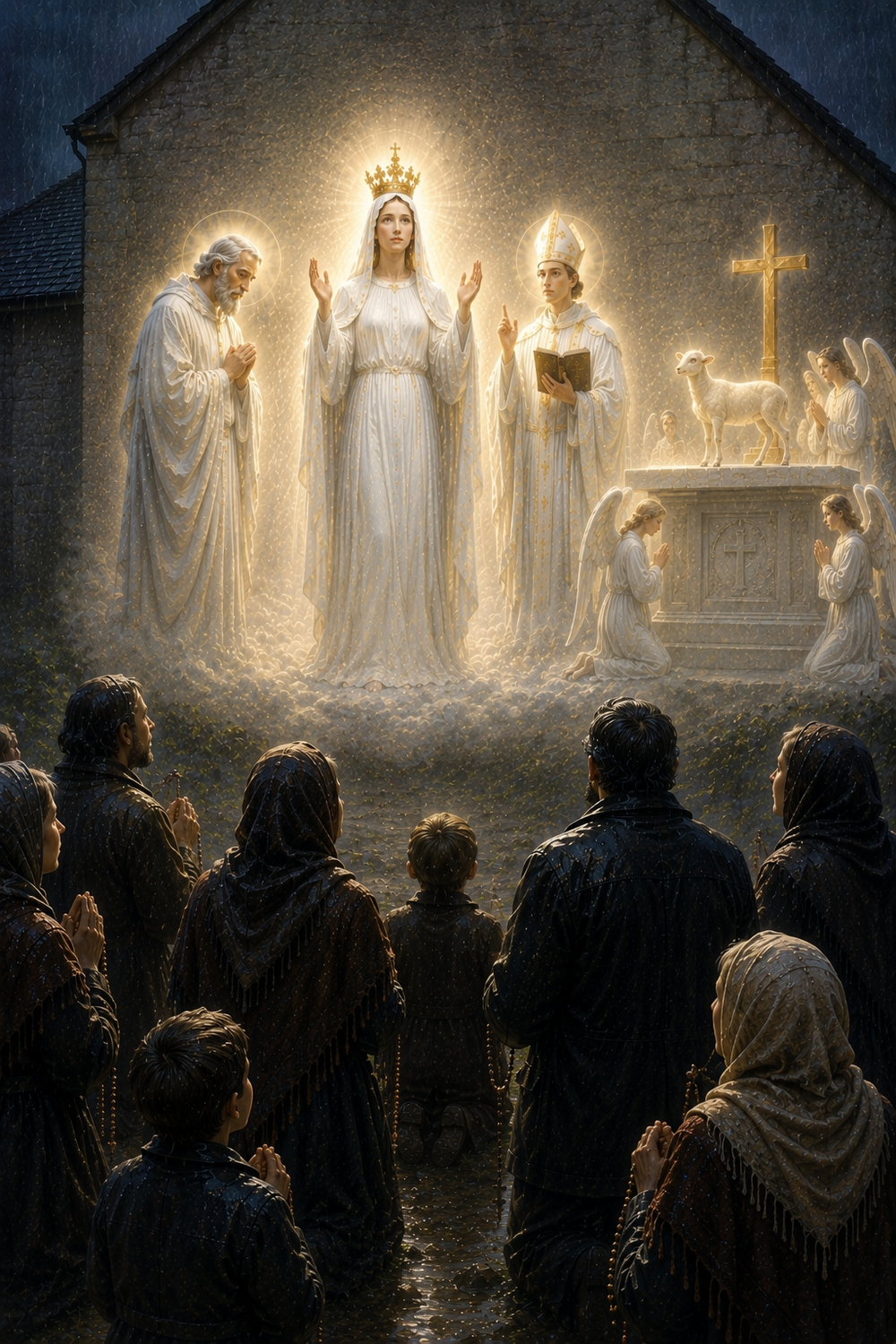
Then Mary McLoughlin, the housekeeper of the local priest, walked past the church and saw, standing against the south gable in a blazing white light that made the whole wall luminous, three figures surrounded by angels and before an altar on which stood a Lamb. And she called others. And they came. And they saw what she saw. And for approximately two hours, fifteen people of all ages stood in the rain and watched the Virgin Mary, Saint Joseph, and Saint John the Evangelist standing in light against the wall of their church, while the Lamb of God stood on an altar before a cross and angels hovered in adoration.
Not one of the figures spoke a word. Our Lady did not deliver a message. She did not warn of war or request devotions or entrust the witnesses with secrets. She simply appeared, with Saint Joseph and the beloved disciple, before the Lamb of God on an altar, and she prayed. And the rain fell around the figures and the ground beneath them stayed dry, and the light blazed, and after two hours it was over.
Our Lady of Knock is the most theologically dense and most intellectually understated Marian apparition in the history of Christianity. Every other major approved apparition speaks — Fátima delivers warnings and secrets, Lourdes produces self-identification, Kibeho gives urgent messages of repentance, Zeitoun appears in a blaze of public light to a million witnesses. Knock says nothing. And in saying nothing, it communicates the single most important theological reality of Catholic Christianity: the Mass. The Lamb of God. The Eucharist. The altar. The cloud of witnesses in adoration. What Our Lady showed the fifteen people of Knock on the evening of August 21, 1879 was not a private vision or a prophetic warning. It was the eternal liturgy, rendered visible on the gable wall of an Irish country church.
This article is the most complete account of Our Lady of Knock available: every witness, every testimony, the full theological significance of every element of the apparition, the investigation and its findings, the miracles and healings, the history of the shrine, and the devotional tradition that has made Knock Ireland’s National Marian Shrine and one of the most visited pilgrimage destinations in the world.
The Our Lady of Knock prayer card carries the image of the Queen of Ireland — the Mother of God who came in silence to a wounded country and showed them the Lamb of God on an altar. She asked for nothing because she gave everything. Carry her image and let her silent presence be its own intercession.
Part II
Ireland in 1879: A Nation Broken by Famine, Eviction, and the Land War
To understand Our Lady of Knock, you must understand Ireland in 1879 — and to understand Ireland in 1879, you must understand the Great Famine of 1845 to 1852, which was still, thirty years later, the defining wound in the national memory and the daily reality of millions of people who were living in its shadow.
The Great Famine killed approximately one million Irish people from starvation and disease and drove another million or more to emigrate in the famine years alone. In County Mayo — in the west of Ireland, where the soil was poorest and the dependence on the potato most total — the devastation was among the worst in the country. Whole townlands emptied. Families were buried in mass graves. Children starved in ditches while bailiffs evicted their parents from stone cottages at the instruction of absentee landlords. The physical landscape of County Mayo in the 1870s still bore the marks of the famine in its abandoned houses, its overgrown potato ridges, its graveyards that had been filled faster than they could accommodate the dead.
The Land War: 1879 and the Year of the Apparition
1879 was not simply a decade after the famine; it was itself a year of acute crisis. The agricultural harvests of 1877, 1878, and 1879 had failed in succession, plunging Ireland’s western counties — already deeply impoverished — into renewed danger of famine. The Land War, which would formally begin in the autumn of 1879, was the organised mass resistance of Irish tenant farmers against the system of rack-renting and eviction that had characterized the relationship between the mostly Irish Catholic tenantry and the mostly English Protestant landowning class throughout the nineteenth century. The Irish National Land League, founded in October 1879 by Michael Davitt and Charles Stewart Parnell — just weeks after the Knock apparition — was the political expression of a people who had been broken by eviction and starvation and were refusing to be broken any further.
County Mayo was at the epicentre of all of this. The village of Knock itself was poor, remote, and agricultural. The family of Archdeacon Bartholomew Cavanagh — the parish priest at whose church the apparition occurred — knew intimately the condition of his parishioners. The people who stood in the rain outside his church on the evening of August 21, 1879 and saw what they saw were not comfortable middle-class believers whose faith was an occasional luxury. They were people who had lived through famine, who had watched neighbors and relatives starve, who had been threatened with eviction, who prayed the Rosary and attended Mass because the Church was the one institutional structure that had remained with them through everything.
Why Knock? Why County Mayo?
The question of why the Mother of God appeared in Knock rather than in Dublin or Cork or London carries a clear answer in the Marian tradition: she comes to the poor. She came to Lourdes in the person of a girl from a family so poor they lived in a former prison. She came to Fátima in the persons of three illiterate shepherd children who tended sheep in a rocky Portuguese hillside. She came to Kibeho in the persons of schoolgirls in the hills of one of Africa’s poorest countries. At Knock she came to County Mayo — one of the most impoverished, most traumatized, most repeatedly abandoned counties in the Western world of 1879 — and she brought with her not a message of warning or a set of instructions or a prophetic revelation. She brought the Mass. She brought the Lamb of God. She brought the eternal reality that the suffering of Mayo, like all human suffering, was not outside the cross but within it.
Part III
The Evening of August 21, 1879: How It Began
The sequence of events on the evening of August 21, 1879 is well documented through the subsequent testimony of the witnesses. It is worth narrating in detail because the manner in which the apparition came to light — through the accidental observation of a woman walking past a church in the rain — is itself part of the Knock story’s character.
Mary McLoughlin, the housekeeper of Archdeacon Cavanagh, was walking from the priest’s house to visit a friend, Mary Byrne, whose family home was near the church. She passed the south gable of the church and noticed a bright light on the gable wall, together with what she perceived as figures. She assumed, initially, that the Archdeacon had installed some new statues or religious images on the outside of the church — perhaps gifts that had arrived that day. She did not stop to examine what she saw. She continued to the Byrne house.
Later that evening, returning from the Byrne house, Mary McLoughlin was accompanied by Mary Byrne. This time, they both stopped. What Mary McLoughlin had assumed were statues were clearly not statues: the figures were standing in light, they were life-sized or larger, and they were radiant with a quality that no painted image or carved figure produces. Mary Byrne immediately called her family. Word spread rapidly through the small village. Within a short time, fifteen people of varying ages had gathered at the south gable of the church and were standing in the rain watching what was before them.
The Rain That Did Not Fall on the Apparition
The weather on the evening of August 21, 1879 was consistently described by all witnesses as rainy — heavy Atlantic rain coming from the south or southwest, the kind of persistent wet that characterizes the west of Ireland in late summer. The witnesses stood in this rain and observed that the rain fell everywhere around the apparition — on themselves, on the church walls to the side, on the field — but did not fall on the gable wall where the figures stood, nor on the ground in front of them. The wall remained dry. The figures themselves were untouched by the weather. This physical phenomenon — the dry wall in the middle of rain — was observed and attested by all the witnesses and was one of the details that the church commission found most striking in its investigation. It is a detail that admits no natural explanation and that was immediately understood by the witnesses themselves as a sign.
The Archdeacon Was Not Present
One of the most often-noted facts about the Knock apparition is that Archdeacon Bartholomew Cavanagh — the parish priest at whose church the apparition occurred — was not among the witnesses. He was at home, reportedly unwell that evening. This absence is theologically notable: the apparition was not granted as a private experience to the most holy or the most learned member of the community, but to the ordinary people of the parish going about their ordinary evening. The housekeeper, the neighbours’ children, a schoolboy, an elderly woman, a farm worker — these are the people to whom the vision was given. As with all the great Marian apparitions, the Mother of God chose the unimportant as her witnesses.
Part IV
What the Witnesses Saw: A Complete Description of the Apparition
The fifteen witnesses at Knock observed the same tableau, and their descriptions — collected independently by the Church commission — are consistent with each other in all essential details. What follows is the complete composite picture drawn from their testimony.
- The Brilliant White Light The entire south gable of the church was illuminated by a light that witnesses described as brilliant, white, and different in quality from any natural light source. It did not flicker like fire, was not harsh like electrical light, and was not the diffuse glow of lanterns. It was a steady, intense, all-encompassing white radiance that made the gable luminous and cast light onto the surrounding area. The light was visible from a distance before the individual figures within it could be distinguished. Several witnesses described the experience of approaching the gable and gradually making out the details of the figures within the light.
- The Virgin Mary — Centre of the Tableau The central and largest figure was a woman identified by all witnesses as the Blessed Virgin Mary. She stood slightly elevated above the ground, as if floating or standing on something not visible to the observers. She was dressed in white robes of brilliant whiteness and wore a large crown of gold or golden light. Her hands were raised in the traditional orans position — the ancient prayer posture of early Christianity, arms raised and spread, palms outward — with her eyes lifted toward heaven. Her expression was described as one of deep, absorbed prayer. She was not looking at the witnesses. She was not acknowledging their presence. She was in prayer.
- Saint Joseph — To Mary’s Right To the right of the Virgin (from the witnesses’ perspective, on the Virgin’s right) stood a male figure identified as Saint Joseph. He was older in appearance than the central female figure, with white or grey hair. His head was slightly bowed, in an attitude of veneration or reverence. His hands were clasped or folded. He was not speaking and was not looking at the witnesses; he was oriented toward the Virgin and toward the altar, in the posture of one who is attending to something holy.
- Saint John the Evangelist — To Mary’s Left To the left of the Virgin stood a male figure who was identified by the witnesses as Saint John the Evangelist (the beloved disciple, author of the fourth Gospel and of the Book of Revelation). He was dressed in bishop’s vestments — a mitre and liturgical garments — and held an open book in his left hand. His right hand was raised with the index finger pointing upward or slightly outward, in the gesture of one preaching or proclaiming. He was oriented slightly toward the witnesses, as if preaching to them, though he too did not speak. The book he held was identified as the Book of Revelation (the Apocalypse) or the Gospel of John. This identification of Saint John as a bishop is consistent with Eastern and early Western iconographic tradition, which depicts John in episcopal vestments as the Bishop of Ephesus.
- The Altar with the Lamb of God In front of the three figures, slightly to the left (toward Saint John), stood an altar. On the altar stood a Lamb — small, white, clearly a young lamb — standing upright, facing the witnesses. This is the Agnus Dei: the Lamb of God, the image from the Book of Revelation in which John of Patmos sees the Lamb standing on the heavenly mount as the centre of the divine liturgy. Behind the Lamb stood a large cross of plain wood. Around the Lamb, hovering in the air, were small angelic figures in attitudes of adoration.
- The Angels Multiple witnesses described small winged figures — angels — hovering in the air around the Lamb and altar. They were in postures of worship. They moved their wings. They did not interact with the observers. They were attendants to the Lamb on the altar, just as the Book of Revelation describes myriads of angels surrounding the Lamb in the heavenly liturgy.
- The Duration and the Weather The apparition lasted approximately two hours — from roughly eight-thirty in the evening until around half past ten. Throughout this period, the heavy rain continued. The witnesses stood in the rain and watched. The gable wall and the ground immediately beneath the figures remained dry. When the apparition ended, there was no gradual fading: the light simply ceased and the figures were gone. The wall was dark. The rain continued.
Part V
The Virgin Mary at Knock: Her Appearance, Her Posture, Her Crown
The description of the Virgin Mary at Knock is consistent across all fifteen witnesses in its essential features, and every element of her appearance carries theological meaning that rewards careful attention.
The White Robes
Every witness described Our Lady at Knock as clothed entirely in white — white robes that were brilliant, luminous, and of a whiteness that seemed to produce its own light rather than merely reflect the white light of the apparition. White in Christian symbolism is the color of baptismal purity, of resurrection, of divine holiness. The Book of Revelation describes the saints clothed in white robes (Revelation 7:9) as those who have been washed in the blood of the Lamb. Our Lady’s white robes at Knock place her visually within the same liturgical scene as the Lamb and the altar: she is the first of the saints who have been redeemed, standing in glory before the Lamb of God.
The Golden Crown
Witnesses described a large, beautiful crown of gold or golden light on Our Lady’s head. The crown is the sign of queenship — she is the Queen of Heaven, the Regina Coeli, the title that the Church has given to Mary as the culmination of her role in salvation history. At Knock, she appeared as Queen not in the setting of a royal court but in the setting of the heavenly liturgy — a queen who stands in adoration before the altar of the Lamb. Her queenship at Knock is not authority over the earthly order but the queenship of one who has been most perfectly conformed to the King whose kingdom is not of this world. She is queen because she is the most perfect worshipper of the Lamb.
This queenship is why Our Lady of Knock has been given the specific title Queen of Ireland — the recognition that the nation of Ireland, historically the most Marian country in the Christian West, has been placed under the protection of the Queen of Heaven who appeared on Irish soil in 1879.
The Orans Posture and Eyes Raised to Heaven
Perhaps the most distinctive and most theologically significant feature of Our Lady’s appearance at Knock is her posture: hands raised in the orans prayer position, eyes fixed on heaven, entirely absorbed in worship. She was not looking at the witnesses. She was not addressing the witnesses. She was praying.
The orans posture — arms raised and spread, palms outward, face lifted toward heaven — is one of the oldest prayer postures in Christian history. It is visible in the earliest Christian art of the Roman catacombs, where painted figures in this posture represent souls in prayer or in the bliss of the divine presence. In the Eastern Christian tradition, the orans posture is the characteristic stance of the Theotokos in iconography — the Virgin of the Sign, the Blachernitissa, the Oranta — where Mary stands with arms raised as the perfect intercessor, the one whose prayer is most perfectly aligned with the will of God because it is most perfectly ordered toward God alone.
At Knock, Our Lady appears in this ancient intercessory posture in the context of the Eucharistic liturgy. She is doing what she is always doing: interceding. Her presence at the altar of the Lamb is the presence of the Church’s greatest intercessor, joining her prayer to the perfect sacrifice of her Son.
Part VI
Saint Joseph at Knock: The Silent Foster-Father in Adoration
The presence of Saint Joseph at Knock is unique in the history of major Marian apparitions. Joseph does not appear at Lourdes, at Fátima, at Kibeho, or at Zeitoun. He appears at Knock, and his presence is theologically significant.
Saint Joseph is the Guardian of the Holy Family, the Foster-Father of the incarnate God, the spouse of the Virgin Mary, the man to whose care the divine plan entrusted the physical protection of the Messiah during his vulnerable infancy and childhood. His place in the theology of the Incarnation is one of silent, faithful, obedient service: he does not speak a recorded word in the entire New Testament, yet he obeys every divine instruction, protects every divine charge, and provides every earthly necessity for the childhood of the Son of God.
At Knock, he appears as he lived: silent, reverent, slightly bowed, attending to the holy. He is not the subject of the apparition but its attendant. His presence says: the one who guarded the Word made flesh in his infancy now stands at the altar of the Lamb in eternal adoration. The same providential care that brought the Holy Family safely out of Herod’s reach and through the years of the hidden life at Nazareth is now consummated at the altar of the sacrifice that those years were ordered toward.
Saint Joseph’s appearance at Knock also connects the apparition to the Holy Family as a unit: at Knock, the earthly family of the Son of God is present together in the heavenly liturgy. Mary and Joseph, who raised the Lamb of God as a child, now stand before the Lamb in the fullness of his divine identity. The domesticity of Nazareth and the glory of the heavenly altar are revealed as one continuous act of love and obedience.
For the Irish people of 1879, who were losing their families to emigration, whose family structures had been shattered by famine and eviction, the presence of the Holy Family at Knock was also a pastoral consolation: the family that had been most threatened, most hunted, most displaced by human power had not been destroyed. It was present in glory, together, before God.
Part VII
Saint John the Evangelist at Knock: The Bishop-Apostle and the Open Book
The most theologically layered figure in the Knock apparition is Saint John the Evangelist, and his identification and his posture repay the most careful attention.
Why a Bishop’s Vestments?
Saint John is depicted at Knock in bishop’s vestments — a mitre and liturgical robes. This may seem surprising to those who think of John primarily as one of the twelve apostles and a fisherman from Galilee. The tradition of depicting John in episcopal vestments is ancient and has a firm historical foundation: John did serve as the Bishop of Ephesus in Asia Minor in his old age, shepherding one of the earliest and most significant Christian communities, and the early Church venerated him as both Apostle and Bishop. The council of bishops that shaped early Christian theology operated within a living memory of John’s episcopal ministry. To see him at Knock in bishop’s vestments is to see him in his full ecclesial identity: not merely a witness to the earthly life of Jesus, but a father and teacher of the Church.
The Open Book
The book that John holds open in the Knock apparition has been identified by most commentators as the Book of Revelation (the Apocalypse) — the final book of the Christian canon, attributed to John of Patmos, which contains the great vision of the heavenly liturgy centred on the Lamb. This identification is theologically perfect: the entire Knock apparition is a visual citation of the Book of Revelation. The Lamb on the altar, the angels in adoration, the saints standing before the Lamb in white robes, the heavenly liturgy — all of these are images drawn directly from the Apocalypse. John holds the book of his own vision, and the scene unfolding around him is that vision made visible.
Some witnesses described the book as white with gold lettering or as exceptionally beautiful in its appearance. The content was not visible to the witnesses, but the gesture of holding the book open — presenting it to those before him — is the gesture of proclamation. John at Knock is not merely witnessing the heavenly liturgy; he is presenting its scriptural basis to those who observe it.
The Preaching Gesture
John’s right hand is raised with the index finger pointing upward or outward in the classic gesture of proclamation. He is oriented slightly toward the witnesses, as if addressing them, though he does not speak. The gesture without words is itself the message: look. Look at what I have been showing you since the beginning. Look at the Lamb. This is what the whole Gospel has been pointing toward. This is what I tried to say in the Apocalypse and what has never been fully received. Here is the Lamb of God who takes away the sins of the world, standing on the altar before you, in the village church of a poor county in Ireland, because God will not stop saying this until it has been fully heard.
The Parish Church Was Dedicated to Saint John the Baptist
A detail of elegant theological symmetry: the church on whose gable the apparition appeared was the Parish Church of Saint John the Baptist. The John the Baptist connection adds another dimension to the presence of John the Evangelist: the church is dedicated to the one who said Behold the Lamb of God who takes away the sin of the world (John 1:29) — the first human proclamation of Christ’s Eucharistic identity — and on its gable appears John the Evangelist, who in his Apocalypse provided the fullest scriptural account of the heavenly Lamb. Both Johns, in their different witnesses to the Lamb, converge in the Knock apparition.

Part VIII
The Lamb of God: The Most Important Detail at Knock
If you want to understand Our Lady of Knock, you must understand the Lamb. Everything else in the apparition — the figures of Mary and Joseph and John, the light, the crown, the vestments — is the context for the Lamb. The Lamb is the point. The Lamb on the altar, before a cross, surrounded by adoring angels, is the theological heart of the entire apparition. It is what everything else is pointing to.
The Lamb of God in Scripture
The title “Lamb of God” is one of the most ancient and most dense Christological titles in the New Testament. John the Baptist uses it at the Jordan: Behold the Lamb of God, who takes away the sin of the world (John 1:29). The identification connects Jesus to the Passover lamb of Exodus, whose blood on the doorposts of the Israelite houses protected them from the destroying angel — a lamb that died so that others might live, a sacrifice whose blood was the means of salvation. It also connects to the suffering Servant of Isaiah 53: like a lamb that is led to the slaughter, and like a sheep that before its shearers is silent, so he opened not his mouth. The Lamb is Christ in his salvific death: the one who gives his life as a ransom for many.
In the Book of Revelation, the Lamb becomes the central figure of the entire heavenly liturgy. John of Patmos sees the Lamb standing on Mount Zion, bearing the marks of having been slain, yet alive and glorious (Revelation 5:6). The entire heavenly court — the four living creatures, the twenty-four elders, the myriads of angels, the saints — falls in worship before the Lamb. The great liturgical acclamation rings out: Worthy is the Lamb who was slain, to receive power and wealth and wisdom and might and honor and glory and blessing (Revelation 5:12). The Lamb is worshipped because the Lamb died. The Lamb is glorified because the Lamb gave everything. And the Lamb is alive, standing on the altar, because death could not hold him.
The Lamb on the Altar: The Eucharist Made Visible
The Lamb standing on the altar at Knock is the Eucharist. This is the direct, simple, and profound theological reading that the Church has consistently applied to the Knock apparition. In the Mass, the sacrifice of Christ is made present — not repeated but made present, once-for-all brought into the present moment of every celebration of the Eucharist. The priest does not sacrifice Christ again; he makes the one sacrifice of Calvary truly and really present at the altar. And in the Mass, the assembly prays: Lamb of God, you take away the sins of the world: have mercy on us. Lamb of God, you take away the sins of the world: grant us peace. These words are addressed to the same Lamb who stands on the altar at Knock.
At Knock, the heavenly liturgy described in Revelation is rendered visible against the gable of a country church. The scene the witnesses saw was the scene that is made present at every Mass, usually invisible, usually available only to the eyes of faith: the Lamb on the altar, the saints and angels in adoration, the sacrifice of Calvary present to the community of God’s people. Our Lady appeared at Knock not to deliver a message about the Mass but to show the Mass. To make visible, for two hours in the rain of County Mayo, the reality that is present at every altar in every Catholic church at every moment of every day.
The Cross Behind the Lamb
The cross that stands behind the Lamb on the altar at Knock is the connection between the present sacrifice and the historical event of Calvary that it makes present. The Lamb stands on the altar because the Lamb was crucified on Calvary. The glory of the Lamb in Revelation is inseparable from the wounds he still bears: he is a Lamb standing, as though it had been slain (Revelation 5:6). At Knock, the cross behind the Lamb is the sign of how the Lamb came to stand on the altar: through death, through the Cross, through the giving of everything. The cross at Knock is not a symbol of defeat; it is the means by which the Lamb is on the altar at all.
Part IX
The Great Silence: Why Our Lady of Knock Spoke No Words
The silence of the Knock apparition is not an absence. It is a statement. And it is, in some respects, the boldest theological statement of any approved Marian apparition in the history of the Church.
At Lourdes, Our Lady identifies herself: I am the Immaculate Conception. At Fátima, she delivers warnings, prophecies, secrets, and specific devotional requests. At La Salette, she weeps and speaks at length about the sins of her people. At Kibeho, she delivers urgent messages, shows horrifying visions, and asks for the Seven Sorrows. At Guadalupe, she speaks to Juan Diego and provides a miraculous image. At Zeitoun, she appears in silence too — but a silence that is the maternal presence of a mother whose children are grieving after a war, offering comfort through being there. At Knock, the silence is different in character: it is the silence of the liturgy itself.
The Liturgy Does Not Explain Itself
When you attend Mass, the priest does not stop the Eucharistic Prayer to explain what is happening. He does not pause at the words of consecration and say: “What I am about to do is make present the sacrifice of Calvary, and what you are about to see is the Lamb of God, and what I am about to offer you is the body and blood of the incarnate God.” He simply does it. The liturgy presents itself. It does not explain. The people who have eyes to see, see. The people who have ears to hear, hear. The words of the rite say what needs to be said, and those words are enough.
At Knock, the apparition is the liturgy. The Lamb is on the altar. The saints and angels are in adoration. The great High Priest has offered the perfect sacrifice. There is nothing to add. Any words Our Lady might have spoken would have been commentary on a reality that is already complete, already sufficient, already the fullest possible communication. She did not speak because the scene before the witnesses already said everything. She held the orans posture of intercession and she let the Lamb on the altar say what the Lamb always says: this is my Body, given for you. This is my Blood, shed for you.
The Silence as Invitation
The silence of Knock is also an invitation. Every other major apparition, in delivering messages and secrets and requests, gives the recipient something to do: pray the Rosary, build a chapel, make reparation, wear a scapular, consecrate Russia. These are good and important things. But Knock says: come and adore. There is nothing to do here except what you are already called to do every time you attend Mass. Come to the altar. Behold the Lamb. Be present to the reality that your faith says is present at every Eucharist. The message of Knock is not a message at all; it is an invitation to do what every baptized Catholic is already invited to do at every Mass, and to do it with the attention and wonder that the fifteen witnesses experienced on the evening of August 21, 1879.
The Gift of Presence Without Demand
In this way, Our Lady of Knock speaks to something very specific in the experience of suffering people: the mother who comes and sits and does not demand anything. The fifteen people of Knock had been through thirty years of famine and eviction and grief. Many of them had lost family members. Many of them lived with the daily insecurity of a tenant who could be removed from their home at any time. What they needed was not more instructions or more requirements. They needed to know that God was there. They needed to see the altar. They needed the eternal liturgy made visible in their village, on their church, in their rain. Our Lady gave them that. She showed them the Mass. She showed them the Lamb. She showed them that the suffering of County Mayo was not outside the cross but within it — and then she was gone, and they were left with the rain and the wet clothes and the permanently altered knowledge of what that gable wall had held for two hours on an August evening.
Part X
The Fifteen Witnesses: Who They Were
The fifteen witnesses to the Knock apparition are among the most carefully examined witnesses to any supernatural event in the modern history of the Church. Their testimonies, collected by the episcopal commission in October 1879, are the primary evidentiary basis for the Church’s assessment of the apparition. Understanding who these people were — their ages, their relationships to each other, their backgrounds — is essential to understanding the quality of the evidence.
- Mary McLoughlin Housekeeper of Archdeacon Cavanagh, the parish priest. The first person to observe the apparition, walking past the church on her way to visit the Byrne family. An adult woman of mature years, employed in a position of trust by the parish priest. Her initial assumption that the figures were new statues — and her subsequent realization that they were not — is one of the most compelling details of the Knock narrative: a sensible adult woman initially sought a rational explanation.
- Mary Byrne (later Mary O’Connell) The daughter of the Byrne family, a young adult woman who was with Mary McLoughlin when the crowd gathered. She became one of the most important ongoing witnesses, later giving testimony to both the 1879 and the 1936 commissions, and her long life made her testimony available to investigators for decades after the event. Her account is the most detailed of all the witness testimonies.
- Margaret Byrne Sister of Mary Byrne.
- Patrick Byrne Brother of Mary Byrne.
- Dominick Byrne Sr. Father of Mary, Margaret, and Patrick Byrne. An adult man of considerable local standing.
- Dominick Byrne Jr. Son of Dominick Byrne Sr.
- John Curry The youngest witness, approximately five years old at the time of the apparition. The testimony of a five-year-old child independently corroborating the accounts of adults was noted by the commission as significant: young children are not capable of constructing or maintaining elaborate deceptions, and John Curry’s basic account — describing the figures and the light — matched those of the adult witnesses in essential details.
- Judith Campbell An adult woman of the parish.
- Mrs. Hugh Trench (née Campbell) An adult woman of the parish.
- Patrick Hill A thirteen-year-old boy who gave one of the most vivid and detailed testimonies of all the witnesses. His account described approaching the gable, going close enough to the figures to examine details, and observing the Lamb and the angels with particular attention. His age — old enough to give a coherent and detailed account, young enough to be credible as a witness without agenda — made his testimony particularly valuable to the commission.
- John Durkan An adult man of the parish.
- Catherine Murray An adult woman of the parish.
- Bridget Trench The oldest witness, approximately seventy-five years old. She prostrated herself before the apparition and, in one of the most moving details of the whole Knock account, tried to embrace the feet of the Virgin — and found that her hands passed through the figure as if through mist, even as the figure appeared fully solid and three-dimensional to the eye. This detail — a figure that looked solid but could not be physically grasped — is one of the most distinctive features of the Knock witness testimony and is consistent with the character of apparitions as described in the broader tradition.
- Thomas Byrne A man of the parish, separate from the Byrne family of Dominick Byrne Sr.
- Margaret Beirne (also Berney) A young girl of approximately eight or nine years of age, who like John Curry provided independent child testimony corroborating the adult accounts.
The Significance of the Witness Range
The fifteen witnesses range in age from five to approximately seventy-five, include both men and women, come from multiple families, and include both adults in positions of social responsibility and young children whose testimony could not be motivated by the social or religious interests that might (in principle) have motivated adults. The range makes coordinated fabrication extraordinarily implausible: a conspiracy to fabricate a religious vision would need to recruit a five-year-old and a seventy-five-year-old, multiple family units, and individuals with no close social relationship to each other, all of whom would need to agree on the same detailed account and maintain it consistently over decades. The commission found no evidence of collusion, no inconsistency between the accounts on essential details, and no motive for deception.
Part XI
Key Witness Testimonies: In Their Own Words
Mary Byrne gave the most extensive testimony of any of the witnesses and was interviewed on multiple occasions over the following decades. Her account described the apparition in careful detail: “I saw three figures — the Blessed Virgin, Saint Joseph and Saint John. I gave the name Saint John from the description I had heard of him, as a young man with an open book. I said it was he; I then left the scene and returned with others. I saw all of this with perfect distinctness. The Blessed Virgin was life-size, the others were not so tall or large. She was clad in white, and had on a large cloak. I remarked a most beautiful crown on her head. She had her eyes towards heaven and her hands raised on a level with her shoulders, and turned towards her palms outwards in the position of one at prayer.”
Asked about the altar: “The Lamb was standing, the head was turned in our direction. The figures were full and round, as if they had a body and a life; they said nothing; but as I looked at them, I felt great happiness.”
Patrick Hill’s testimony is notable for its detail and for his active, curious engagement with the apparition. He described approaching the gable closely and examining the figures: “I ran to the gable and, being a young boy, I was anxious to see all I could see. I looked at it with great attention. I saw distinct moving of the wings of the angels who were around the Lamb, and I noticed it particularly. I went, then, nearer to the altar, and I perceived the Lamb distinctly — a beautiful, white Lamb, having its head turned towards the people. Behind the Lamb was a large cross. Around the Lamb I saw angels, though I could not count them. I looked at them and moved about to see if they were real.”
On the figures of Mary, Joseph, and John: “I never saw anything more beautiful. The Virgin, the tallest and most beautiful of the three, had her hands upwards at the level of her shoulders. Her face was lit and beautiful to see. Saint Joseph stood behind her on the right. The third figure appeared to be preaching, as I saw him move his hand.”
Bridget Trench’s testimony contains one of the most striking physical details in the entire Knock account. She prostrated herself before the apparition and tried to embrace the feet of the Virgin: “I went there immediately on hearing what others said they saw. I beheld the Blessed Virgin Mary, and I went nearer to her and I knelt down. I then drew near to the figure and tried to embrace the feet of the Blessed Virgin, but I felt nothing in my hands — it was like the air. I said: ‘Oh, Virgin Mother of God, who gave birth to Jesus, have mercy on us.’ I looked at her, and I saw her standing there with beautiful white robes and a crown. The Lamb was on the altar, white and beautiful.”
Part XII
The Dry Wall: The Physical Sign at Knock
Among all the features of the Knock apparition, the dry wall is the one most easily verifiable in principle and most resistant to natural explanation. Every witness attested that throughout the approximately two-hour apparition, in continuous heavy rain, the south gable wall of the church and the ground directly beneath the figures remained dry. The rain fell everywhere else — on the witnesses, on the surrounding land, on the rest of the church — but not on the area of the apparition.
This physical detail was investigated by the 1879 commission, which found the testimony entirely consistent and credible. Witnesses were asked specifically about the weather and the condition of the wall and gave matching accounts. The dry wall is not susceptible to any natural meteorological explanation: it is not a rain shadow effect (the gable was not shielded from any direction in which the rain was falling), not a trick of the architectural structure, and not an error of observation by rain-soaked witnesses who might have misjudged the dryness of the area.
The Wall as a Relic
In the years following the apparition, the plaster from the gable wall of the church became an object of intense devotion. Pilgrims arrived at Knock and scraped pieces of the plaster from the wall to keep as relics. This practice was so extensive that by the early 1880s the gable had been significantly damaged, and Church authorities had to intervene to protect the remaining structure. The pieces of plaster were carried throughout Ireland and to the Irish diaspora in Britain, America, and Australia, and numerous healings were reported in connection with them. The original gable was eventually encased in the Apparition Chapel built in 1976, which was constructed around and over the original wall to protect it while keeping it accessible to pilgrims.
Part XIII
The Church Investigations: 1879 and 1936
The Church’s response to the Knock apparition was notably prompt. Within weeks of the events of August 21, 1879, Archbishop John MacHale of Tuam — the Archbishop with jurisdictional oversight of Knock parish — had established a commission of inquiry to collect and evaluate the testimony of the witnesses.
The 1879 Commission
The commission was led by Canon Ultan Bourke and investigated the apparition in October 1879, less than two months after the event. The commissioners conducted individual interviews with the witnesses, collecting their accounts separately so that inconsistencies would be apparent. They examined the witnesses on the details of what they had seen, the conditions under which they had seen it, the duration of the apparition, and the physical circumstances including the weather and the state of the wall.
The commission’s conclusion was expressed in careful ecclesiastical language: the testimony of the witnesses was found to be “trustworthy and satisfactory.” This language, while more restrained than a formal declaration of supernatural character, represented a significant positive assessment. The commission did not find evidence of fraud, collusion, mass hysteria, or any natural explanation for the consistent accounts of fifteen witnesses. The Church at Tuam was sufficiently satisfied with the investigation to allow the emerging pilgrimage to Knock to continue and grow without official opposition.
The 1936 Commission
A second commission of inquiry was established in 1936, when public interest in Knock was growing and the question of a more formal ecclesiastical recognition was being considered. This commission interviewed surviving witnesses — most significantly Mary Byrne (O’Connell), who was by then an elderly woman but gave testimony consistent in all essential details with her 1879 account. The commission also received testimony from fourteen additional witnesses who had not been formally interviewed in 1879. The 1936 commission reaffirmed the findings of the 1879 investigation and provided additional grounds for the Church’s confidence in the authenticity of the Knock events.
Formal Recognition and the 1979 Papal Visit
The formal ecclesiastical recognition of Knock as a national Marian shrine built gradually across the twentieth century. In 1939, Knock was officially designated a national place of pilgrimage by the Irish bishops. In 1954, the Marian Year, the shrine was elevated in significance by papal recognition. The critical moment of formal public papal endorsement came in 1979, when Pope John Paul II’s visit — described in detail in Part XVIII — placed the full weight of the papacy behind Knock’s status as an approved Marian site.
Part XIV
Miracles and Healings at Knock
Healings associated with the Knock apparition began within days of the event itself and have continued for over 140 years. The Knock shrine maintains an archive of healing testimonies and has maintained a formal process for receiving and documenting accounts of miraculous cures since the early twentieth century.
- The First Healing: Weeks After the Apparition The first documented healing associated with the Knock apparition occurred within weeks of August 21, 1879. A woman named Delia Gordon from Knock had been deaf for approximately fifteen years. She visited the gable wall, applied some of the cement from the wall to her ears, and reported the restoration of her hearing. This healing was reported to the 1879 commission and became the first of the Knock healing tradition.
- The Healing of a Limerick Woman Among the earliest and most widely reported Knock healings was the cure of a woman from Limerick, Mrs. Curry, who had been bedridden with a serious illness for years. She was brought to Knock by her family, prayed at the gable wall with a piece of plaster from the wall applied to her body, and recovered. Her recovery was reported and investigated, and became one of the most celebrated of the early Knock miracles.
- Healings Associated with the Gable Plaster The most numerous category of early Knock healings were those associated with pieces of plaster from the apparition gable. Pieces of the plaster were distributed widely throughout Ireland and among the Irish diaspora, and a significant number of individuals reported miraculous recoveries in connection with their use. The pieces became so sought after that the gable was seriously damaged by the demand, leading to Church intervention to protect the structure.
- Twentieth-Century Documented Healings The Knock shrine has maintained records of reported healings throughout the twentieth and twenty-first centuries. The healings cover a wide range of conditions: blindness, paralysis, cancer remissions, hearing loss, and serious chronic illnesses. Some of these cases have been investigated and documented by the Knock Medical Bureau, which was established to evaluate healing claims in a manner modelled on the Lourdes process. While the Knock Medical Bureau process is less internationally known than its Lourdes equivalent, it has produced documented cases of unexplained recoveries that have been submitted to Church review.
- Healings Reported by the Irish Diaspora Given the scale of Irish emigration in the nineteenth and twentieth centuries, devotion to Our Lady of Knock spread wherever the Irish went — to Britain, the United States, Canada, Australia, and beyond. The healing tradition associated with Knock pilgrimage and with images and medals of Our Lady of Knock has been reported by Irish communities worldwide, making the Knock healing record one of the geographically broadest of any Marian apparition tradition.
Part XV
Complete Chronological Timeline: 1879 to Today
- August 21, 1879 — The ApparitionThe evening apparition occurs at the south gable of the Parish Church of Saint John the Baptist in Knock, County Mayo. Fifteen witnesses observe the Virgin Mary, Saint Joseph, Saint John the Evangelist, and the Lamb of God on an altar. The apparition lasts approximately two hours. The gable and ground beneath the figures remain dry throughout in heavy rain.
- Late August – September 1879 — Word SpreadsNews of the apparition spreads rapidly through County Mayo and beyond. The first pilgrims begin arriving at the gable wall. The first reported healing — Delia Gordon’s restoration of hearing — occurs within weeks of the apparition.
- October 1879 — First Commission of InquiryArchbishop John MacHale of Tuam establishes an episcopal commission of inquiry led by Canon Ultan Bourke. The commission interviews the witnesses individually and concludes that their testimony is “trustworthy and satisfactory.” The commission’s findings are submitted to the Archbishop.
- 1880–1890 — The Pilgrimage Grows and the Gable Is DamagedPilgrims arrive at Knock in increasing numbers throughout the 1880s. The practice of scraping plaster from the gable wall becomes so widespread that the wall is seriously damaged. Church authorities install protective measures. Numerous healing testimonies are collected from across Ireland and from Irish diaspora communities. Archdeacon Cavanagh oversees the growing pilgrimage with pastoral care until his death in 1897.
- 1897 — Death of Archdeacon CavanaghArchdeacon Bartholomew Cavanagh, the parish priest who was absent during the apparition but became its faithful steward for the following eighteen years, dies. He is buried at the Knock shrine.
- 1929 — 50th AnniversaryThe golden jubilee of the apparition is marked by a major pilgrimage gathering at Knock. The shrine receives increased national attention and the pilgrimage infrastructure is developed.
- 1936 — Second Commission of InquiryA second episcopal commission is established and interviews surviving witnesses, most significantly Mary Byrne O’Connell, whose 1936 account is entirely consistent with her 1879 testimony. The commission reaffirms the positive assessment of the 1879 investigation and submits its findings to Church authorities.
- 1939 — National Pilgrimage DesignationThe Irish Catholic bishops formally designate Knock as a national place of pilgrimage. The shrine gains official national status within the Irish Church.
- 1954 — Marian Year RecognitionDuring the Marian Year proclaimed by Pope Pius XII, the Knock shrine receives additional ecclesiastical recognition. The shrine is visited by thousands of pilgrims from across Ireland and internationally.
- 1960s–1970s — Development of the Shrine ComplexSignificant development of the Knock shrine complex occurs in the 1960s and 1970s in preparation for the centenary. Plans for a large basilica are approved and construction begins.
- 1976 — Apparition Chapel and Basilica ConsecratedThe Apparition Chapel, built around and enclosing the original south gable wall to protect it while keeping it accessible to pilgrims, is completed. The Basilica of Our Lady, Queen of Ireland — capable of holding 20,000 people — is consecrated on July 18, 1976.
- September 30, 1979 — Pope John Paul II Visits KnockOn the centenary of the apparition, Pope John Paul II visits the Knock Shrine on September 30, 1979, during his pastoral visit to Ireland. He presents the shrine with a Golden Rose — a significant papal gesture reserved for major Marian sites of particular importance. He leads a prayer service at the Apparition Chapel and addresses the large crowd gathered at the basilica. His visit is the most significant moment in the shrine’s post-apparition history and constitutes de facto papal endorsement of Knock as a major approved Marian site.
- 1986 — Knock Airport OpensHoran International Airport (now Ireland West Airport Knock) opens, the result of the vision and determination of Monsignor James Horan, the parish priest of Knock whose tireless campaigning secured government support for the project. The airport was built specifically to serve the international pilgrimage traffic to Knock and to bring economic development to the region.
- 1993 — Mother Teresa Visits KnockMother Teresa of Calcutta (now Saint Teresa of Calcutta) visits the Knock Shrine. Her visit adds to the long list of significant figures who have made pilgrimage to the Mayo shrine.
- 1979–Present — Ongoing PilgrimageThe Knock Shrine continues to receive approximately 1.5 million pilgrims annually. Major pilgrimage events occur on August 21 (the feast of Our Lady of Knock), on the last Sunday in August (the National Pilgrimage), and on various other dates throughout the year. The shrine maintains healing testimony archives, retreat facilities, a museum, and a hospice.
Part XVI
Theological Significance: The Mass Made Visible
The theological significance of Our Lady of Knock is, in the judgment of the theologians and bishops who have engaged most seriously with it, richer and more profound than that of any other approved Marian apparition. This may seem a surprising claim for an apparition that involved no messages, no secrets, no prophecies, and no specific devotional requests. But it is precisely the absence of all these things that makes Knock theologically distinctive: stripped of everything except the essentials, what remains is the Mass itself.
The Knock Apparition as Heavenly Liturgy
The scene at Knock — the altar, the Lamb, the cross, the adoring angels, the saints in worship — is the heavenly liturgy described in the Book of Revelation, chapters 4 through 8. John of Patmos is brought through a door into heaven (Revelation 4:1) and sees a throne, a sea of glass, four living creatures, twenty-four elders in white robes with golden crowns, and then (Revelation 5:6) the Lamb standing on the throne as if slain. The entire heavenly assembly falls in worship before the Lamb. The incense of the prayers of the saints rises before the altar. This vision — the vision of the eternal liturgy — is what was rendered visible on the gable wall of the Knock church.
The theological claim of this identification is enormous. Every Mass is a participation in this eternal liturgy. When a Catholic priest celebrates the Eucharist, the veil between the earthly liturgy and the heavenly liturgy becomes thin: the same Lamb who stands in the heavenly vision is present on the altar. The words of the Mass — Holy, holy, holy, Lord God of power and might. Heaven and earth are full of your glory — are the words of the four living creatures in Revelation 4:8, brought into the earthly celebration to acknowledge the intersection of heaven and earth at the altar. Knock makes this intersection visible. It shows, against an Irish church gable, what the Mass says is true but what faith usually apprehends in darkness.
Knock and the Real Presence
The specific Eucharistic emphasis of the Knock apparition — the Lamb on the altar — speaks directly to the doctrine of the Real Presence: the teaching that in the Eucharist, the body, blood, soul, and divinity of Jesus Christ are truly, really, and substantially present under the appearances of bread and wine. This is not a symbolic presence or a memorial presence but a real one. The Lamb that stands on the altar at Knock is the same Lamb who is present on every Catholic altar at every moment of the Mass. Our Lady of Knock showed the reality of what every Catholic professes when they receive Communion. The Lamb is real. The altar holds the actual sacrifice of the actual Son of God. The angels who adore are not figures of speech.
In the decades following the Second Vatican Council, when questions about the Real Presence became more acute in Catholic theological discussion and when some of the reverence associated with Eucharistic devotion had diminished in practice if not in doctrine, Knock’s message — always silent, always the same — has carried a renewed urgency: the Lamb is on the altar. Adore.
Knock, John’s Gospel, and the Apocalypse
The presence of Saint John the Evangelist at Knock creates a specific scriptural axis running through the whole apparition. John’s Gospel begins: In the beginning was the Word, and the Word was with God, and the Word was God (John 1:1). The Word became flesh (1:14) and was manifested in the world. John the Baptist, seeing Jesus, proclaimed: Behold the Lamb of God (1:29). John’s Gospel ends with the Resurrection and the invitation to the beloved disciple to remain until the Lord comes (21:22). And John’s Apocalypse provides the full eschatological vision of the Lamb in glory. At Knock, all of this is present simultaneously: the Lamb of the Gospel, the Lamb of the Apocalypse, the Evangelist who proclaimed and described both, standing together at the altar in the presence of the Mother of the Word made flesh. It is the entire Johannine theology of the Incarnation in one visual image.
What Knock Says to Eastern Christianity
The Knock apparition resonates deeply with the Eastern Christian tradition in ways that Western commentary sometimes misses. The theology of the Divine Liturgy in the Eastern Church has always emphasized the intersection of the earthly and heavenly liturgies: the Divine Liturgy is not merely an act of the local community but a participation in the eternal liturgy of heaven, a thinning of the veil. The iconostasis of Eastern churches, covered with images of saints and angels, represents the heavenly cloud of witnesses who join the earthly congregation in worship. The icons of the Theotokos in the orans position — which decorate Eastern churches from Hagia Sophia to the most rural Orthodox chapel — show exactly what the witnesses at Knock described: the Mother of God with arms raised in prayer, interceding for the people before the presence of her Son.
Our Lady of Knock, in her silence and in her posture, is the living embodiment of Eastern Marian theology: the Theotokos as the great intercessor, present at the altar of the Lamb, praying for the people of God, her arms raised to heaven as they have been raised since the ancient Church first depicted them in the catacombs of Rome.
Part XVII
Knock and Irish History: A Wounded Nation Visited by Its Queen
The Knock apparition cannot be fully understood without the Irish Catholic experience that it addressed, and the Irish Catholic experience of 1879 cannot be fully understood without the Great Famine. The Famine killed and displaced roughly a quarter of Ireland’s population in seven years. It was an event of catastrophic scale and of theological as well as human significance: it raised, for millions of deeply devout Catholics, the question of where God was when Ireland was starving.
The answer the faith gave — the only answer the faith could give — was the Cross. God was where God always is when his people suffer: at the Cross, in the cross, not absent from it but present within it, not causing the suffering but redeeming it. This was not always a fully consoling answer. But it was the answer the Irish Catholic tradition offered, and it was the answer encoded in the Knock apparition: the Lamb on the altar, slain and yet standing, the sacrifice of Calvary present in the village church of one of Ireland’s most devastated counties.
The Irish Catholic Identity and the Church
By 1879, the Catholic Church had become, for the Irish people, more than a religious institution. It was the continuity of Irish identity through centuries of colonial suppression. The Penal Laws of the seventeenth and eighteenth centuries had forbidden Catholics to own land, attend school, hold public office, or practice their faith publicly — and the Church had survived underground, celebrated in Mass rocks on hillsides and in thatched houses, maintained by a people for whom faith was inseparable from survival. The priest was not merely a religious figure but a community leader, an educator, a preserver of culture. The church building was not merely a place of worship but a statement that Ireland still existed as a people.
When Our Lady appeared on the gable of the Knock church in 1879, she appeared on the wall of a building that represented all of this. She appeared in the county that had suffered most and retained its faith most stubbornly. She appeared not as a foreigner but as the Queen of Ireland — Muire na nGael, Mary of the Irish — who had been venerated as the special patroness of Ireland since the earliest days of Irish Christianity. She came to the place she had always been honored, and she showed her people the altar of her Son.
Knock and the Irish Diaspora
The millions of Irish who emigrated from Ireland in the decades before and after the famine carried their Marian devotion with them. The devotion to Our Lady of Knock became, in the Irish diaspora communities of Britain, America, Australia, and beyond, a specific form of Irish Catholic identity — a connection to the homeland mediated through the Mother of God who had appeared on Irish soil. The building of Knock Airport in 1986 was partly the work of this diaspora: Monsignor Horan’s campaign for the airport drew on the support of Irish communities around the world who wanted Knock accessible by international air travel.
Part XVIII
Pope John Paul II at Knock: September 30, 1979
When Pope John Paul II visited Ireland in September 1979, the centenary of the Knock apparition, the question of whether he would include Knock in his itinerary was itself a matter of enormous importance to Irish Catholics. He did. On September 30, 1979, he came to County Mayo.
The images of that day — the Polish pope kneeling at the Apparition Chapel, surrounded by hundreds of thousands of Irish pilgrims who had come to Mayo from every county in Ireland and from the Irish communities of Britain and America — are among the most powerful in the modern history of Irish Catholicism. John Paul II brought with him a Golden Rose, the most significant papal gift that can be presented to a Marian shrine — a gesture reserved for sites of particular and officially recognized importance. He placed the Golden Rose at the shrine as a formal act of papal veneration.
In his address at Knock, John Paul II spoke about the significance of the apparition in the context of Irish history: “I have come to Knock as a pilgrim, a pilgrim of devotion to the Mother of God. In the life of the people of God, the pilgrimages occupy a high place. From very early times, Christians used to go in pilgrimage to places associated with Our Lord and with His Mother.” He connected the Knock apparition to the universal Church and to the specific mission of Ireland as an evangelizing nation. He acknowledged the suffering of Ireland’s history and the persistence of faith through that suffering. And he knelt in silence at the gable where fifteen people had stood in the rain a hundred years before.
The pastoral significance of the papal visit for Ireland in 1979 cannot be overstated. Ireland was in the midst of significant social and political tensions, the Troubles in Northern Ireland were at their height, and the Church was navigating the complex aftermath of the Second Vatican Council. A pope who came to Knock, who knelt at the Apparition Chapel, who gave the Golden Rose — this was an act of solidarity with the Irish Catholic tradition and a statement that what had happened at Knock a hundred years before had the full weight of the Church’s regard.

Part XIX
Mother Teresa and Other Notable Pilgrims
The Knock Shrine has attracted some of the most significant figures of twentieth and twenty-first century Catholic life. Beyond Pope John Paul II, the most notable visitor was Mother Teresa of Calcutta — now Saint Teresa of Calcutta — who came to Knock in 1993. Her visit connected two of the most significant Catholic spiritual movements of the era: her own Missionaries of Charity and the Marian pilgrimage tradition of the west of Ireland.
Mother Teresa’s visit to Knock was characteristic of the woman: quiet, prayerful, and unannounced in any promotional sense. She came to pray. She knelt at the Apparition Chapel. She spoke to those present about the silence of Knock as an invitation to contemplative prayer. Her words about Knock — preserved in the accounts of those who heard her — reflected her own spirituality of silent presence before God: she understood the Knock apparition, with its wordless tableau of the Lamb on the altar, as a call to the same silent adoration that defined her own prayer life before the Blessed Sacrament.
Every president of Ireland since the foundation of the state has been associated with pilgrimage to Knock, and the shrine has received visits from Catholic leaders from every continent. The annual National Pilgrimage, held on the last Sunday in August, draws delegations from Irish Catholic communities worldwide and has been attended over the decades by leading figures of Irish political, cultural, and religious life. Knock has also received visits from leaders of other Christian denominations seeking to understand what the Catholic Church in Ireland considers sacred ground.
Part XX
The Knock Shrine Today: Ireland’s National Marian Shrine
The Knock Shrine today is one of the largest and most visited Marian pilgrimage sites in the world. It has grown from a damp gable wall in a County Mayo village to a major shrine complex receiving approximately 1.5 million pilgrims annually from every continent.
The Apparition Chapel
The heart of the shrine is the Apparition Chapel, completed in 1976, which was built around and enclosing the original south gable of the Parish Church of Saint John the Baptist — the wall where the fifteen witnesses saw the apparition in 1879. The original gable is preserved within the chapel, now behind a protective glass panel that allows pilgrims to see and venerate the actual stone while protecting it from further damage. The area directly before the gable — where the witnesses stood in the rain watching for two hours — is a covered but open-air space used for prayer and the celebration of Mass. Pilgrims approach this area in a spirit of reverence and many approach it on their knees.
The Basilica of Our Lady, Queen of Ireland
The Basilica of Our Lady, Queen of Ireland, consecrated on July 18, 1976, is one of the largest churches in Ireland, capable of accommodating approximately 20,000 people. It is used for the major pilgrimage Masses and ceremonies throughout the year. The basilica’s architecture reflects the landscape of the west of Ireland: low, horizontal lines, stone and glass, letting in the often-dramatic Mayo light. It is dedicated under the specific title that the Knock tradition has given to the Mother of God: Queen of Ireland.
The Original Parish Church
The original Parish Church of Saint John the Baptist — the church on whose gable the apparition occurred — still stands at the centre of the shrine complex. It continues to function as an active parish church. Masses are celebrated there regularly, and pilgrims attend them as part of the pilgrimage experience. To attend Mass in the church whose gable held the vision of the Lamb on the altar is to participate, in an especially immediate way, in the theology the apparition proclaimed.
Annual Pilgrimages and Feast Days
- August 21: Feast of Our Lady of Knock • Anniversary of the apparition • Major pilgrimage day
- Last Sunday of August: National Pilgrimage • Attended by pilgrims from across Ireland and internationally
- Every Sunday: Outdoor Masses and Rosary processions are regular features of the shrine’s year-round pilgrimage calendar
- May – October: Principal pilgrimage season • Various diocesan and national pilgrimages throughout the summer
Getting to Knock
- Address: Knock Shrine, Knock, Co. Mayo, F12 N505, Ireland
- By Air: Ireland West Airport Knock (NOC), approximately 15 km from the shrine, with direct flights from major UK and European cities
- By Road: Approximately 3 hours from Dublin • 1.5 hours from Galway • The shrine is well signposted throughout the west of Ireland
- For Those Who Cannot Travel: The Our Lady of Knock prayer card, medal, and statue from this page are a connection to the shrine and its message for those who cannot make the physical pilgrimage
Part XXI
Knock Airport: The Airport Built for Pilgrims
One of the most remarkable facts about Our Lady of Knock’s shrine is that it has its own international airport. Ireland West Airport Knock — originally named Horan International Airport — opened in 1986 and exists specifically because of the pilgrimage to the Knock Shrine.
The driving force behind the airport was Monsignor James Horan, the parish priest of Knock from 1967 until his death in 1986. Monsignor Horan was a man of extraordinary pastoral and practical vision: he oversaw the construction of the Basilica of Our Lady, Queen of Ireland (consecrated 1976) and the Apparition Chapel (also 1976), transforming the physical infrastructure of the shrine into something capable of accommodating the millions of pilgrims who came. And he conceived the idea of an international airport for County Mayo that would allow pilgrims from the Irish diaspora worldwide to fly directly to Knock without changing planes in Dublin.
The project was widely mocked. The site was a bogland on a windswept Mayo hillside. Government support was obtained only after a prolonged campaign. The Irish media treated the project with considerable scepticism, and Monsignor Horan was nicknamed “Monsignor the Airport” by some commentators. He died in August 1986, months after the airport opened, having seen his vision become reality. He is buried at Knock. The airport he built now connects the west of Ireland to the international Irish diaspora and to pilgrims from across Europe, carrying approximately 700,000 passengers annually and serving as the economic anchor of one of Ireland’s most historically disadvantaged regions.
The airport is the tangible expression of what Our Lady of Knock has meant for County Mayo: a presence that attracts the world to a place that the world had otherwise ignored, and in attracting the world, transforms the earthly conditions of the people who live there.
Part XXII
Devotion to Our Lady of Knock: Who Prays to Her and How
Devotion to Our Lady of Knock is practised worldwide, but with particular depth in the communities most connected to the apparition and its history.
The Irish Diaspora
For the estimated 80 million people of Irish descent around the world, Our Lady of Knock carries a specific weight of national and familial identity. She is not merely a Marian apparition; she is the apparition of the Irish Church, the Queen of Ireland who appeared on Irish soil in the worst century of Irish history and showed her people that God had not forgotten them. Devotion to Our Lady of Knock is carried in families across generations of emigrants who never saw County Mayo but who kept the image of the Knock apparition in their homes and taught their children to pray the Knock novena. The prayer card of Our Lady of Knock is a connection to this tradition available to anyone of Irish heritage anywhere in the world.
Those Who Are Called to Silence
Our Lady of Knock speaks particularly to those whose spiritual life is characterized by silence: those in contemplative religious life, those suffering illnesses that reduce them to quiet dependence, those in grief that has no words, those whose prayer has become a simple being-present before God without the ability to formulate petitions. Knock’s wordless apparition is an invitation to this kind of prayer. The Mother of God praying in the orans posture, eyes to heaven, before the Lamb, saying nothing — this is the model of contemplative prayer in its simplest and most powerful form. Those who have entered spiritual dryness or who find themselves unable to pray with words find in Knock a precedent: she prayed without words too, and her prayer was efficacious.
Those Who Pray Before the Blessed Sacrament
Given Knock’s specifically Eucharistic theology — the Lamb on the altar, the scene of the heavenly Mass made visible — Our Lady of Knock has a special affinity with those who practise Eucharistic adoration. She appeared before the altar of the Lamb in the posture of adoration. To sit before the Blessed Sacrament in adoration is to do exactly what the Knock apparition depicted. Setting up a home prayer corner with an image of Our Lady of Knock and a candle is a simple way to create a daily space of the kind of silent, adoring presence she modelled.
Who Prays to Our Lady of Knock for Specific Intentions
Our Lady of Knock is prayed to especially for: healing — both the long pilgrimage tradition of physical healings at Knock and the spiritual healing that comes from silent encounter with the Lamb; peace in family life and in national life; the grace of a holy death — the tradition associates Our Lady of Knock with the final passage because the scene she showed witnesses is the eternal liturgy into which the dead enter; comfort for those who are alone or suffering in silence; and the renewal of Eucharistic faith for those who have lost or are losing a sense of the Real Presence. See also our guides to saints for healing and saints for depression and despair.
Part XXIII
Prayers to Our Lady of Knock
Our Lady of Knock, Queen of Ireland, you gave hope to our people in a time of distress, and comforted them in sorrow. You have continued to give hope to countless pilgrims who have come to your shrine, not seeking temporal gain, but expressing sorrows, begging pardon, and seeking your powerful intercession. We come to renew our faith and hope in your Son, Jesus Christ, who is the same yesterday, today, and forever.
We thank God for the graces bestowed on our people through your intercession. We are filled with confidence in your intercession and with gratitude for the life and example of those who came to you in faith, love, and hope.
Intercede for us with your Son. May He, who is the Lamb of God, who takes away the sins of the world, grant us, through your powerful intercession, what we ask of Him, if it be His holy will. Amen.
Our Lady of Knock, you who appeared before the Lamb of God who takes away the sins of the world — take away this illness, this pain, this suffering that I bring before you now. You showed us the altar where the eternal sacrifice is present. You showed us the Lamb who died so that we might live. Ask Him who healed the sick and raised the dead — who is the same yesterday, today, and forever — to reach into this body and into this life with the same creative power that made us.
I do not know whether your Son’s will for me is healing now or in the life to come. But you stood before the Lamb in the orans posture of intercession, and I ask you to stand there now with my petition in your upraised hands. Your Son does not refuse you. Place this before Him. Amen.
Most Holy Mother, you who stood before the Lamb in silence and adored — I come to join my silence to yours. I have no words today. I have no formed petition. I have only this: I am here, before the Lamb you showed us, in the same posture of open hands and upraised eyes that you showed us on the gable wall in the rain.
Be my prayer when I cannot pray. Be my words when I have none. Stand before the altar of your Son with me, and let your intercession be sufficient for what I cannot name. Amen.
Our Lady of Knock, Queen of Ireland, you came to Mayo in 1879 when this country was carrying wounds that had not yet healed and burdens that had not yet been lifted. You came without words because the wounds were too large for words. You showed us the Lamb. You showed us that the suffering of this island was not outside the cross but within it.
Come to Ireland again. Come to the Ireland that is losing the faith you came to strengthen. Come to the Ireland that is searching for identity beyond the one you stood at the center of for a thousand years. Come to the Ireland of the diaspora who carry the image of your Knock apparition in the homes of a hundred countries and pray to you in the languages of the nations that received them. Pray for us. Pray for reconciliation between North and South, between faith and culture, between what Ireland was and what it must become. You are our Queen. We are your people. Amen.
Our Lady of Knock, Queen of Ireland, you who came in silence and showed us the Lamb — be with me in my silence today. Intercede for me before the altar of your Son. And in whatever cross this day brings, help me to stand with you before the Lamb, hands raised, eyes to heaven, trusting that His sacrifice is sufficient. Amen.
Frequently Asked Questions
Our Lady of Knock — Questions & Answers

She Came in Silence. She Showed the Lamb. She Is Still There.
On August 21, 1879, in the rain of County Mayo, fifteen people stood before a church gable in Ireland and saw the Virgin Mary, Saint Joseph, Saint John the Evangelist, and the Lamb of God on an altar, surrounded by angels and a cross, in a blaze of white light, for two hours, while the wall beneath them stayed dry. She said nothing. She did not need to say anything. The Lamb on the altar said it. The altar said it. The cross said it. The angels in adoration said it.
A hundred and forty years later, the Lamb is still on the altar. In every Mass celebrated at every Catholic church in the world, what the Knock apparition made visible for two hours is invisibly present. Our Lady came to Knock to remind a suffering people of that presence — and through them, to remind us. Come to the altar. Behold the Lamb. Stand with her, hands raised, eyes to heaven, in the silence that is fullness, in the adoration that is prayer.
Get the Our Lady of Knock Prayer Card →