The Armenian Christian Tradition Explained: History, Saints, and Its Place in the Catholic and Orthodox World
A Nation Born Into Faith
There is a saying among Armenians — "To be Armenian is to be Christian." This is not merely a cultural sentiment or a casual conflation of ethnicity and religion. It is the distilled memory of seventeen centuries of an identity so thoroughly woven from theological conviction, martyrdom, literary achievement, and ecclesiastical independence that to separate the Armenian people from their Christianity would be, in a very real sense, to unmake them entirely. Armenia was not simply a nation that adopted Christianity. Armenia was, according to the historical record as best it can be reconstructed, the first nation on earth to adopt Christianity as its official state religion — and it did so in the year 301 AD, more than a decade before the Roman Emperor Constantine would even issue the Edict of Milan extending tolerance to Christians throughout his empire.
To understand the Armenian Christian tradition is to undertake a journey through one of the most remarkable chapters in the history of world religion. It is a story of apostolic origins claimed from the very circle of Christ's disciples, of a people who built monasteries into the sides of volcanic mountains, who invented an alphabet specifically to preserve their sacred scriptures, who produced theologians of breathtaking sophistication, who suffered genocides and dispersions without surrendering their faith, and who occupy a unique and genuinely complex position in the great architecture of Christian division — standing neither fully within the Eastern Orthodox world nor within the Roman Catholic world, yet touching both in intimate and theologically fascinating ways.
This article attempts to do justice to the full scope of that tradition — its origins, its theology, its saints, its art and architecture, its liturgical life, its relationship with Rome and Constantinople, and its survival into the modern world.


The Apostolic Origins — Real History and Sacred Memory
The Mission of Thaddaeus and Bartholomew
The Armenian Apostolic Church — the mother church of all Armenian Christianity — takes its name with absolute seriousness from the word apostolic, tracing its founding not to a later missionary enterprise or imperial mandate but to the direct ministry of two of Christ's original twelve apostles: Thaddaeus (also known in some traditions as Jude, or Addai) and Bartholomew (Nathanael in the Gospel of John).
According to Armenian ecclesiastical tradition, the Apostle Thaddaeus traveled to the region of Greater Armenia sometime between 35 and 43 AD, preaching the Gospel in the kingdom of Artaxias (Artashes). He is said to have brought with him a relic of extraordinary importance — a fragment of the True Cross — and to have made converts among members of the Armenian royal house, including the princess Sandukht, who is venerated as the first Armenian Christian martyr. Thaddaeus was eventually arrested and executed by King Sanatrouk, who according to tradition was his own nephew. The site of his martyrdom and burial is venerated at the monastery of Qara Kelisa in what is now northwestern Iran, also known as the Church of Saint Thaddaeus or the Black Church, one of the oldest Christian structures in the world.
The Apostle Bartholomew followed, preaching in the regions of Aghbania (Caucasian Albania) and Greater Armenia, making converts and establishing communities before he too suffered martyrdom — traditionally understood to have been flayed alive and beheaded by the pagan King Astyages in the region of Albanopolis. His relics are claimed by multiple locations, including the island of Lipari in Sicily and the Cathedral of Saint Bartholomew in Rome, though his apostolic connection to Armenia remains central to Armenian self-understanding.
How much of this is verifiable historical fact, and how much is pious elaboration, is a question that honest scholarship must acknowledge. There is no contemporary Roman or Jewish documentation of apostolic missions to Armenia in the first century. However, the general framework is not implausible. Armenia in the first century was neither remote nor isolated. The kingdom of Osroene, which adjoined Armenia's southwestern territories, had a well-documented early Christian community, and the city of Edessa (modern Urfa in southeastern Turkey) was one of the earliest centers of Christianity outside Judea. Trade routes connected Armenia to Syria, Mesopotamia, and the Hellenistic world, and the possibility of early Christian missionaries traversing these routes is entirely plausible from a historical standpoint, even if the specific narratives about Thaddaeus and Bartholomew are shaped by later theological and ecclesiastical purposes.
What matters enormously, however, is the function that these apostolic claims serve within Armenian Christianity. By anchoring its origins in the direct apostolic succession of Christ's own disciples, the Armenian church establishes its independence from any other church's authority. It does not require Rome's approval, Constantinople's sanction, or Antioch's blessing. Its legitimacy flows directly, it claims, from the same source as all other apostolic churches. This is not a trivial matter of historical pride. It is a foundational theological and ecclesiological claim that has shaped every subsequent relationship the Armenian church has had with other Christian bodies.
The Interlude Before Constantine: Christianity Under Persecution
Between the apostolic missions of the first century and the official Christianization of Armenia in 301 AD, there were roughly two and a half centuries during which Christianity existed in Armenia as a minority, persecuted, and sometimes underground phenomenon. The Armenian kings of the Arsacid dynasty (a branch of the great Parthian royal house) maintained a Zoroastrian religious orientation, and the Zoroastrian priesthood — the magi — held considerable power at the Armenian court. Christian communities survived in this environment, but they did so at risk.
The persecution under the Armenian king Tiridates III (also spelled Trdat or Khosrov) is particularly important. Tiridates, who had been raised partly in Rome and had absorbed Roman religious sensibilities including a degree of sympathy for traditional Roman paganism, actively persecuted Christians in his kingdom. It was in this context that the figure of Gregory the Illuminator enters the story in a way that transforms everything.


Gregory the Illuminator and the Christianization of Armenia
The Man Who Changed a Nation
Grigor Lusavorich —Saint Gregory the Illuminator — is the central figure of Armenian Christianity in a way that few individuals are central to any religious tradition. He is simultaneously historical person, theological patriarch, national symbol, and living presence in the Armenian spiritual imagination. His story, as recorded in the Agathangelos (a fifth-century source whose historicity is complex but whose theological importance is immense), is one of suffering, imprisonment, miraculous healing, and national conversion of the most dramatic kind.
Gregory was born around 257 AD, the son of a Parthian nobleman named Anak who assassinated the Armenian king Khosrov I on behalf of the Sassanid Persian king. After this assassination, Gregory's father was himself killed, and the infant Gregory was taken to Caesarea in Cappadocia (in modern Turkey), where he was raised as a Christian, educated in the Christian faith, and eventually ordained. He returned to Armenia and entered the service of the young Armenian prince Tiridates, concealing his Christian faith, until his identity as the son of the man who had murdered Tiridates's father was revealed. Tiridates, consumed by rage and the added grievance of Gregory's Christian identity, ordered Gregory thrown into the deep prison pit of Khor Virap (meaning "deep dungeon" in Armenian), a terrifying subterranean confinement near the base of Mount Ararat. Gregory survived in this pit for thirteen years — sustained, according to tradition, by the ministrations of a pious Christian widow who secretly lowered bread to him.
Meanwhile, Tiridates executed a group of Christian virgins who had fled Roman persecution and arrived in Armenia seeking refuge. These women — thirty-seven in number according to tradition — are venerated as the Holy Hripsimian Virgins, named after their leader Hripsime (also spelled Rhipsime). Tiridates, attempting to take Hripsime as a concubine, was refused and had the women tortured and executed. According to the Agathangelos, divine punishment followed swiftly: Tiridates was struck mad, losing his human form and taking on the form of a wild boar, wandering the countryside in torment. His sister Khosrovidukht received a divine vision commanding that Gregory be released from Khor Virap, that he alone could heal the king.
Gregory was brought out of the pit — his survival after thirteen years being itself regarded as miraculous — and he proceeded to pray over Tiridates and preach to him. Tiridates was healed and, in his gratitude and conviction, converted to Christianity. His conversion was not merely personal. As king, his conversion became the conversion of Armenia as a nation. In 301 AD — the traditional date, though some scholars argue for a date closer to 314 AD — Armenia officially became a Christian kingdom, the first in the world.
Gregory's Theology and Legacy
Gregory was subsequently sent to Caesarea in Cappadocia, where he was consecrated as the first Catholicos — the supreme head — of the Armenian Church by the Archbishop Leontius of Caesarea. This consecration is enormously important: it established a formal hierarchical link between the early Armenian church and the Greek-speaking church of Cappadocia, and it also established the precedent that the head of the Armenian church would carry the title Catholicos (from the Greek katholikos, meaning "universal"), a title that emphasizes the universality and self-sufficiency of the Armenian ecclesiastical jurisdiction.
Gregory went on to conduct a massive program of evangelization throughout Armenia, baptizing vast numbers, destroying pagan temples, and building churches on their sites — a common pattern of early Christian conversion throughout the Mediterranean and Near Eastern world. He appointed his own son Aristakes as his successor, establishing what would become a hereditary pattern in the earliest period of the Armenian catholicate. He died around 331 AD and was immediately venerated as a saint. His feast day in the Armenian church is celebrated on multiple occasions throughout the liturgical year, and he is given the supreme honorific title Lusavorich — the Illuminator — because he is understood to have brought the light of the Gospel to the Armenian people.
The site of Khor Virap, where Gregory was imprisoned, became one of the most sacred pilgrimage destinations in Armenia. The monastery that was eventually built above the pit still stands today, dramatically situated with Mount Ararat — now in Turkish territory — looming in the background. It remains one of the most photographed and most spiritually charged locations in the entire Armenian world.
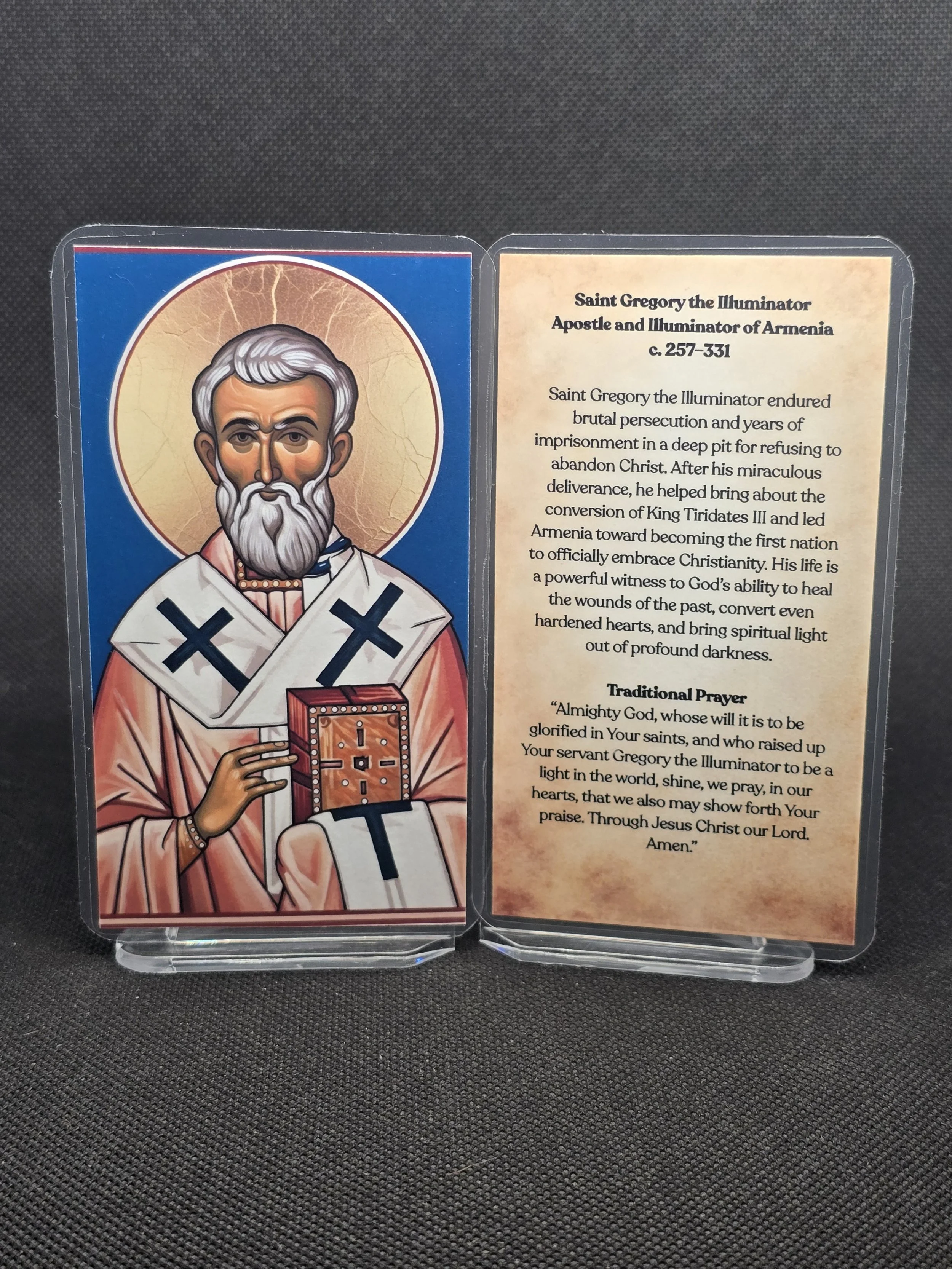
Saint Gregory the Illuminator is the father of Armenian Christianity and one of the most powerful conversion saints in all of Church history. He is venerated in the Armenian Apostolic Church, honored by Eastern Catholics, and revered throughout the Orthodox world as the apostle who brought an entire nation to Christ.
His principal feast is celebrated on September 30 in the Armenian tradition, with additional commemorations tied to his imprisonment and miracles.
Saint Gregory did not grow up in holiness.
He grew up in exile.
His father assassinated the Armenian king. Gregory was taken away as a child, raised far from his homeland, and formed in Christian faith while carrying a legacy of violence he did not choose. When he returned to Armenia as an adult, he entered royal service under the very king whose father his own father had murdered.
That king would later torture him.
Gregory was imprisoned in a deep underground pit for thirteen years.
No sunlight.
No comfort.
No certainty of survival.
People pray to Saint Gregory the Illuminator today for generational healing, impossible conversions, and deliverance from spiritual darkness. He understands what it means to carry family trauma. He understands what it feels like to suffer unjustly. He understands how hopeless situations can suddenly become holy turning points.
He also understands resurrection.
This prayer card is for those praying over hardened hearts, broken family lines, and situations that feel spiritually sealed shut. Saint Gregory does not specialize in small victories. He specializes in transformations that seem humanly impossible.
Each card is handmade in Austin and created to order. We do not keep stock, because every prayer card is treated as a unique devotional offering. They are printed on museum-quality photo paper, not cardstock, and each one is made during prayer. The saints are venerated throughout the entire process, and prayers are intentionally offered for the person who will receive the card. These are not mass-produced items. They are created slowly, reverently, and with spiritual intention, because every soul and every prayer matters.
The Alphabet of God — Mesrop Mashtots and the Armenian Language
The Creation of the Armenian Script
No account of the Armenian Christian tradition can be considered complete, let alone comprehensive, without dwelling at length on what may be the most consequential cultural act in Armenian history: the invention of the Armenian alphabet by the monk and theologian Mesrop Mashtots in approximately 405 AD.
To understand why this matters so profoundly, one must understand the linguistic situation of Armenia at the turn of the fifth century. Armenian is an Indo-European language of great antiquity, related distantly to Greek and Latin but belonging to its own independent branch of the language family. However, at the time of Armenia's Christianization and for the first century of its Christian life, Armenian had no written form of its own. The liturgy was conducted in Greek or Syriac — the two dominant languages of the early Christian Near East — and whatever sacred texts existed in Armenian circulated orally. This was not merely a practical inconvenience. It was a deep theological and political vulnerability: a church that cannot read and transmit its scriptures in its own language is dependent on those who possess the languages in which the scriptures exist, and is therefore subject to their authority, their translations, and their interpretations.
Mesrop Mashtots understood this with extraordinary clarity. Born around 362 AD in the village of Hatsekats in the province of Taron, he had been educated in Greek and Persian, had served at the Armenian royal court, and had eventually become a monk and missionary preacher. His work in evangelizing the more rural and linguistically diverse regions of Armenia brought him face to face with the problem: how do you preach and teach in a language that has no written form? How do you ensure that the scriptures, the liturgy, and the theological tradition are transmitted accurately and accessibly to a people who cannot read them in their own tongue?
Working with the Catholicos Sahak the Great (also known as Isaac the Great) and with the support of the Armenian king Vramshapuh, Mesrop undertook the creation of an alphabet. He is said to have spent years researching existing alphabets, corresponding with scholars in Edessa and Alexandria, and ultimately receiving divine inspiration that guided him to the final form of the letters. The Armenian alphabet he devised consists of thirty-six letters (later expanded to thirty-eight), arranged in a specific order, capable of representing every sound in the Armenian language with extraordinary precision. It is, by any measure, a masterwork of linguistic engineering — phonologically sophisticated, visually distinctive, and so well-suited to the Armenian language that it has undergone remarkably little modification in the sixteen centuries since its creation.
The Golden Age of Armenian Literature
The immediate consequence of the alphabet's creation was an explosion of literary and theological activity that Armenians call the Oskedar — the Golden Age. The first text written in the new alphabet was, appropriately, a verse from the Book of Proverbs: "To know wisdom and instruction, to perceive the words of understanding." (Proverbs 1:2). The symbolism was perfectly intentional.
A team of scholars, known as the Targmanichner (the Translators), was assembled and sent to various centers of Christian learning — Edessa, Constantinople, Alexandria, and beyond — to gather manuscripts and translate them into Armenian. The translation of the Bible into Armenian, completed around 434 AD, is considered a monument of both theological fidelity and literary elegance. The Armenian Bible is sometimes called Թագուհի թարգմանությանց — the "Queen of Translations" — a phrase that reflects the extraordinary care, scholarship, and linguistic artistry that went into its production. It drew on Greek (Septuagint) sources, Syriac Peshitta sources, and in the case of the New Testament, closely followed the Greek text while achieving a natural and beautiful Armenian idiom.
Beyond the Bible, the translators produced Armenian versions of the works of the great Greek theologians: Basil of Caesarea, Gregory of Nyssa, Gregory the Theologian (Nazianzus), John Chrysostom, Cyril of Alexandria, and many others. Philosophical works by Plato and Aristotle were also translated — indeed, some works of Hellenistic philosophy survive today only in their Armenian translations, their Greek originals having been lost, making the Armenian tradition an irreplaceable repository of ancient thought.
The first original work written in the Armenian alphabet — the first work of Armenian original literature, as opposed to translation — was Mesrop Mashtots's own biography of Gregory the Illuminator, and after him came a succession of writers who established Armenian as a language of theological and historical substance. Among the most important was Movses Khorenatsi (Moses of Khorene), whose History of Armenia (written sometime in the fifth century, though some scholars argue for a later date) is the foundational work of Armenian historical consciousness — sweeping in scope, richly detailed, deeply patriotic, and theologically saturated. Agathangelos wrote the account of Gregory the Illuminator and the conversion of Armenia. Yeghishe wrote a magnificent account of the Battle of Avarayr (451 AD), one of the most sacred events in Armenian history, of which more below. Lazarus of Pharpi continued the historical narrative. Eznik of Kolb wrote a remarkable theological treatise against Zoroastrianism, paganism, and Greek philosophy called Refutation of the Sects. These writers created a literary tradition that was simultaneously national and theological, in which the identity of the Armenian people and the identity of the Armenian church were woven together into a single narrative.
Mesrop Mashtots also created the Georgian and Caucasian Albanian alphabets, extending his linguistic mission to neighboring peoples. He died in 440 AD and was immediately venerated as a saint. Together with Sahak the Great, he is commemorated in the Armenian church calendar as one of its greatest holy fathers, and the feast of the Holy Translators — Surb Targmanchats — is one of the most important feasts in the Armenian ecclesiastical year, celebrating not just Mesrop and Sahak but all the scholars who contributed to the Golden Age of translation.
Avarayr and the Theology of Martyrdom
The Battle of Avarayr (451 AD)
In the same year — 451 AD — that the Council of Chalcedon was convening in the Byzantine Empire to resolve pressing questions about the nature of Christ, the Armenians were fighting a war that would become as theologically significant for them as that council was for the rest of Christendom. These two events, occurring simultaneously, would shape Armenian Christian identity for the next sixteen centuries, and their relationship is deeply ironic and deeply instructive.
The Sassanid Persian king Yazdegerd II, having consolidated his rule over the Armenian territories that fell within the Persian sphere of influence, issued a decree in 449 AD demanding that the Armenians apostasize from Christianity and adopt Zoroastrianism as their religion. This was not an unprecedented demand in the context of Persian religious politics — Zoroastrianism was the state religion of the Sassanid empire, and the Persians periodically attempted to impose religious conformity on their subject peoples. But for the Armenians, who had by 451 AD been Christian for a century and a half, who had built their identity around their faith, and who had a rich tradition of theological and literary life rooted in Christianity, this demand was absolutely unacceptable.
The Armenian nakharars (nobles) and the church, united in a way that was extraordinary given the usual tensions between secular and ecclesiastical power, organized resistance. The leader of the Armenian forces was Vardan Mamikonian, a member of one of the great Armenian noble houses and a figure of towering courage and theological clarity. Vardan did not resist simply as a political matter of Armenian sovereignty, though that was certainly part of it. He resisted as a matter of explicit religious confession — he could not, and would not, deny Christ.
The battle took place on May 26, 451 AD, on the plain of Avarayr in the region of Vaspurakan, along the banks of the Tghmut River. The Armenian forces were vastly outnumbered by the Persian army, which included war elephants. The battle itself was, by conventional military standards, a Persian tactical victory: Vardan Mamikonian and thirty-six of his commanders fell in the fighting. The Armenians suffered significant losses and did not drive the Persians from their territory that day.
But it was not a Persian victory in any meaningful sense. The Armenians had demonstrated a willingness to die for their faith that was so total and so costly that the Persians were ultimately unable to impose Zoroastrianism upon them. After decades of further resistance — guerrilla warfare, diplomatic pressure, the continuation of the Armenian church's defiant existence — the Persians ultimately issued the Nvarsak Treaty in 484 AD, granting Armenians the freedom to practice Christianity. The battle of Avarayr, which began as a military defeat, became through this longer arc of history a spiritual and political victory of the first order.
Vardan Mamikonian and the Theology of Holy War
Vardan Mamikonian was canonized as a saint by the Armenian Church, along with his thirty-six fallen commanders, as the Holy Vardanantz Martyrs. Their feast — Vartanantz — is observed on the Thursday five weeks before Easter and is one of the most beloved commemorations in the Armenian liturgical calendar, celebrated not only in Armenia but throughout the Armenian diaspora worldwide.
The theology of Avarayr is worth examining with some care because it reveals something essential about how the Armenian church understands the relationship between faith, nation, and martyrdom. In the tradition of Yeghishe's account of the battle, and in the subsequent liturgical commemoration, Avarayr is understood not as a military campaign but as a confession of faith — a liturgical act, in a sense, in which the sacrifice of the warriors' lives is understood as analogous to the sacrifice of the Christian martyr. Vardan and his companions are not soldiers who happened to be Christian; they are Christians whose soldiering was itself a form of theology, a bodily declaration that there is no compromise possible between the living God and the demands of a pagan empire.
This theology of redemptive resistance — of the willingness to suffer and die rather than deny one's faith and one's identity — became absolutely central to Armenian Christian self-understanding and would be called upon again and again through the centuries: under the Byzantine emperors who attempted to impose Chalcedonian theology, under the Arab caliphates, under the Seljuk and Mongol invasions, under the Safavid Persians, and ultimately under the Ottoman persecution that culminated in the Genocide of 1915.


The Council of Chalcedon and the Miaphysite Theology
The Great Divide: What Happened at Chalcedon
The Council of Chalcedon in 451 AD — the same year as Avarayr — defined for the majority of the Christian world the doctrine of Christ's two natures: that Jesus Christ is fully divine and fully human, existing in two natures, without confusion, change, division, or separation, in one person and one hypostasis. This definition, the Chalcedonian Definition, became the standard of orthodoxy for what would become both the Roman Catholic Church and the Eastern Orthodox churches.
But several ancient Christian communities rejected the Council of Chalcedon, and among the most important of these was the Armenian Church. To understand why requires understanding both the theological substance of the debate and the political circumstances surrounding it.
The theological tradition that Armenian Christianity had inherited was primarily that of Cyril of Alexandria, whose formula for expressing the union of divinity and humanity in Christ was mia physis tou theou logou sesarkomene — "one nature of the Word of God incarnate." This formula, called miaphysitism, affirms the complete union of divinity and humanity in Christ while insisting that after the Incarnation, Christ's divine and human realities are not to be spoken of as two separate natures but as one united nature, fully divine and fully human in that single unified reality.
Chalcedon's language of "two natures" sounded to miaphysites like Nestorianism — the position condemned at the Council of Ephesus in 431 AD, which was understood to divide Christ into two separate persons or subjects, one divine and one human. For the Armenians and other non-Chalcedonian churches (the Coptic Church of Egypt, the Ethiopian Church, the Syriac Orthodox Church, and the Malankara Church of India), Chalcedon seemed to walk back the theological victory of Ephesus and reintroduce a division in Christ that was theologically unacceptable and pastorally dangerous.
The Armenian Rejection of Chalcedon
The Armenian church's formal rejection of Chalcedon was not immediate but developed over a period of decades and was confirmed at a series of Armenian church councils. The Council of Dvin in 506 AD is typically regarded as the definitive moment when the Armenian church aligned itself formally with the non-Chalcedonian position, anathematizing the Council of Chalcedon and the Tome of Leo (the letter of Pope Leo I that had provided the theological framework for the Chalcedonian Definition).
A second Council of Dvin in 554 AD reaffirmed this rejection with even greater force, and the Armenian church's non-Chalcedonian identity became firmly established as a matter of ecclesiastical policy and theological conviction.
It is crucial to note — and the Armenian church itself is emphatic on this point — that miaphysitism is not the same as monophysitism. Monophysitism, in its technical theological sense, was a position associated with Eutyches, who denied the genuine humanity of Christ and held that Christ's human nature was absorbed into or overwhelmed by his divine nature like a drop of wine in an ocean of water. The Armenian church, along with the other non-Chalcedonian churches, explicitly rejects Eutychianism and Monophysitism. Miaphysitism affirms that Christ's humanity is real, complete, and undiminished — it is united with his divinity without confusion or mixture, but it is genuinely present. The Armenian church was therefore deeply offended by the label "Monophysite" historically applied to it by Chalcedonian churches, and the twentieth and twenty-first centuries have seen formal dialogues between the Armenian church and both the Eastern Orthodox churches and the Roman Catholic Church that have acknowledged that the term was a mischaracterization and that the underlying theological disagreement may be less profound than centuries of mutual condemnation suggested.
Consequences of Non-Chalcedonianism
The practical consequence of the Armenian church's non-Chalcedonian position was its separation from the mainstream of Byzantine Christianity, and eventually from the churches of both Rome and Constantinople. This separation was not merely theological; it was political, social, and cultural. It contributed to the development of the Armenian church as a genuinely self-sufficient ecclesiastical entity, developing its own liturgical tradition, its own theological literature, its own canon law, and its own institutional structures largely independent of external influence.
The separation also had profound consequences for the way Byzantine emperors and later crusader states related to the Armenians — sometimes with hostility and attempted coercion, sometimes with grudging accommodation, and occasionally with remarkable alliance and cooperation, as in the Crusading period when Armenian kingdoms in Cilicia (southern Turkey) maintained complex and significant relationships with the Latin church.
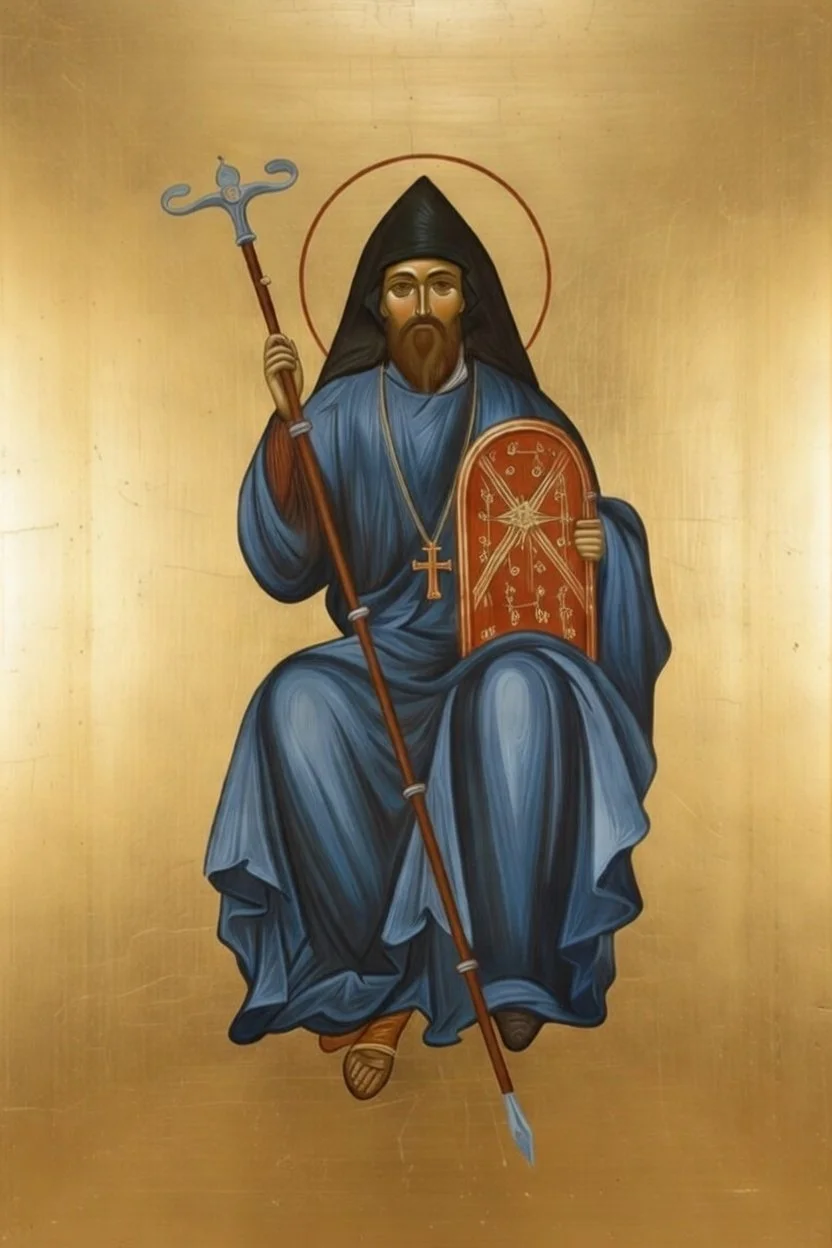
Saint Mesrop Mashtots was an Armenian monk, missionary, and sacred teacher whose life changed an entire civilization. He is venerated in the Armenian Apostolic Church and honored by Armenian Catholics and Eastern Christians worldwide as the holy architect of the Armenian alphabet and the spiritual guardian of Armenian literacy.
His principal feast is celebrated on February 19 in the Armenian tradition.
Saint Mesrop did not conquer lands.
He opened minds.
He did not build armies.
He built language.
At a time when Armenian Christians could not read Scripture in their own tongue and children were growing up disconnected from both faith and identity, Mesrop saw something devastating: a people slowly losing their spiritual inheritance simply because they lacked words.
People pray to Saint Mesrop Mashtots today for learning difficulties, for restoring cultural and spiritual identity, and for wisdom in teaching children the faith. He understands what it feels like to watch young minds struggle. He understands how education shapes souls. He understands how fragile belief becomes when it cannot be spoken or understood.
He also understands how knowledge becomes prayer.
This prayer card is for parents guiding children through school struggles, for teachers forming hearts as well as minds, and for anyone longing to reconnect with faith through learning. Saint Mesrop does not separate education from holiness. He unites them.
Each card is handmade in Austin and created to order. We do not keep stock, because every prayer card is treated as a unique devotional offering. They are printed on museum-quality photo paper, not cardstock, and each one is made during prayer. The saints are venerated throughout the entire process, and prayers are intentionally offered for the person who will receive the card. These are not mass-produced items. They are created slowly, reverently, and with spiritual intention, because every soul and every prayer matters.
The Armenian Church — Structure, Leadership, and the Catholicate
The Catholicosate of All Armenians: Etchmiadzin
The supreme ecclesiastical institution of the Armenian Apostolic Church is the Catholicosate of All Armenians, headquartered at Holy Etchmiadzin in the Ararat plain of Armenia, near the modern city of Vagharshapat. Etchmiadzin — the name means "the Descent of the Only-Begotten" — is the oldest cathedral in the world still in active use, traditionally founded in 303 AD by Gregory the Illuminator on the site where, according to tradition, Christ himself descended in a vision and struck the earth with a golden hammer, indicating where the cathedral should be built. The vision, as recorded in the Agathangelos, involved Gregory seeing the heavens open, a column of light, and the Son of God descending, surrounded by an angelic host, to strike the ground where the pagan temple of Anahit had stood. This foundation narrative gives the cathedral its name and its extraordinary sacred status.
The current cathedral structure at Etchmiadzin dates from 483 AD in its foundational form, though it has been rebuilt, expanded, and embellished many times, with major renovations in the seventh century, the seventeenth century, and various subsequent periods. It houses some of the most sacred relics in Armenian Christianity, including the Holy Lance (the spear that pierced Christ's side at the Crucifixion, which according to tradition was brought to Armenia by the Apostle Thaddaeus), fragments of Noah's Ark (the Armenians have an ancient tradition associating Mount Ararat with the Ark's resting place), and the right hand of Gregory the Illuminator. These relics are used in liturgical ceremonies, and the Holy Lance in particular is carried in procession during the feast of the Discovery of the Holy Cross.
The Catholicos of All Armenians bears the title Vehapar — Supreme Patriarch — and exercises spiritual authority over the majority of the Armenian Apostolic Church worldwide. Since 1995 the Catholicos of All Armenians has been Karekin II (Nerses Bedros XIX Tarmouni by birth), who leads the church from Etchmiadzin and is involved in ecumenical dialogues with numerous other Christian bodies.
The Catholicosate of Cilicia
History has given Armenian Christianity not one but two catholicate centers, a situation that reflects the turbulent territorial displacements of the Armenian people over the centuries. The Catholicosate of Cilicia — the second great seat of Armenian ecclesiastical authority — has its origins in the Armenian kingdom of Cilicia, which flourished in the region of modern southern Turkey and northern Syria from approximately 1080 to 1375 AD. When the political and demographic center of Armenian life shifted westward during the invasions of the Seljuk Turks (and later the Mongols), significant portions of the Armenian church migrated with them, and a separate catholicate developed in Cilicia.
Today the Catholicosate of Cilicia is headquartered in Antelias, Lebanon, having been forced to relocate following the Armenian Genocide of 1915 and the subsequent forced population movements. The Catholicos of Cilicia currently exercises spiritual authority over Armenian Apostolic communities in Lebanon, Syria, Cyprus, Greece, Iran, and parts of the diaspora in North and South America and Europe. Relations between Etchmiadzin and the Catholicosate of Cilicia have at times been strained — particularly during the Soviet period, when the Etchmiadzin catholicate was operating under the constraints of Soviet state supervision, causing some diaspora communities to align more closely with Cilicia as a symbol of free Armenian ecclesiastical life. Since Armenian independence in 1991, the relationship has improved significantly, though the two catholicates maintain distinct institutional identities.
The Patriarchates of Constantinople and Jerusalem
In addition to the two catholicates, the Armenian church maintains two ancient patriarchates that carry great historical and symbolic weight.
The Armenian Patriarchate of Constantinople was established in 1461 by the Ottoman Sultan Mehmed II following the conquest of Constantinople, who recognized the Armenian Patriarch as the civil as well as ecclesiastical head of the Armenian community within the Ottoman Empire — a role within the millet system of Ottoman administration of non-Muslim religious communities. This gave the Constantinople Patriarchate enormous practical importance for centuries, as it was the interface between the Armenian community and the Ottoman state. Today the Patriarchate of Constantinople continues its work in Istanbul, though the Armenian community in Turkey has been reduced from its pre-Genocide size of over two million to approximately sixty to seventy thousand.
The Armenian Patriarchate of Jerusalem is one of the oldest and most historically significant institutions in the Holy City. The Armenian presence in Jerusalem dates to at least the fourth century, and the Armenian Quarter of the Old City of Jerusalem — one of the four historic quarters of the walled city — is a remarkable enclave of Armenian culture and religious life, including the Cathedral of Saint James (built on the traditional site of the martyrdom and burial of the Apostle James the Less), the extensive monastic complex of the St. James Monastery, a seminary, a library with irreplaceable manuscript collections, a printing press, and residential quarters. The Armenian Patriarchate of Jerusalem also holds significant custody rights at key sites in the Church of the Holy Sepulchre, including the Chapel of the Division of the Raiment and parts of the Edicule, and maintains rights at the Church of the Nativity in Bethlehem. These rights — established and contested over centuries — are an important dimension of the complex arrangement of "Status Quo" that governs access to and custody of the Holy Sites in Jerusalem and Bethlehem among the various Christian communities.


The Great Saints of the Armenian Church
The Sanctoral Calendar as Theology
The Armenian church's calendar of saints is a theological document as much as a liturgical one. The saints commemorated — who they are, how they died, what they wrote and taught, what they are believed to intercede for — reflect the deepest convictions of Armenian Christianity about what matters, what endures, and who God honors. A survey of the major Armenian saints is therefore essential to understanding the tradition.
Grigor Lusavorich — Gregory the Illuminator (c. 257–331 AD)
Already discussed at length, Gregory the Illuminator is the supreme saint of the Armenian church — its founding father, its apostolic patron, its model of suffering and faithfulness. He is given the extraordinary title Equal-to-the-Apostles in Armenian veneration, which places him in the highest tier of sanctity. His life encompasses the entire narrative of Armenian Christianity: persecution, imprisonment, miraculous survival, healing, conversion, evangelization, and church-building. His feast days are among the most important in the Armenian liturgical year, and virtually every major Armenian church worldwide is dedicated to him. The Holy Muron — the sacred chrism used in the sacrament of confirmation and in other liturgical rites — is traditionally prepared at Etchmiadzin every seven years and is understood to descend in an unbroken line from the chrism prepared by Gregory himself. The ceremony of preparing the Muron is one of the most solemn in the entire Armenian liturgical tradition.
Saint Gregory the Illuminator is the father of Armenian Christianity and one of the most powerful conversion saints in all of Church history. He is venerated in the Armenian Apostolic Church, honored by Eastern Catholics, and revered throughout the Orthodox world as the apostle who brought an entire nation to Christ.
His principal feast is celebrated on September 30 in the Armenian tradition, with additional commemorations tied to his imprisonment and miracles.
Saint Gregory did not grow up in holiness.
He grew up in exile.
His father assassinated the Armenian king. Gregory was taken away as a child, raised far from his homeland, and formed in Christian faith while carrying a legacy of violence he did not choose. When he returned to Armenia as an adult, he entered royal service under the very king whose father his own father had murdered.
That king would later torture him.
Gregory was imprisoned in a deep underground pit for thirteen years.
No sunlight.
No comfort.
No certainty of survival.
People pray to Saint Gregory the Illuminator today for generational healing, impossible conversions, and deliverance from spiritual darkness. He understands what it means to carry family trauma. He understands what it feels like to suffer unjustly. He understands how hopeless situations can suddenly become holy turning points.
He also understands resurrection.
This prayer card is for those praying over hardened hearts, broken family lines, and situations that feel spiritually sealed shut. Saint Gregory does not specialize in small victories. He specializes in transformations that seem humanly impossible.
Each card is handmade in Austin and created to order. We do not keep stock, because every prayer card is treated as a unique devotional offering. They are printed on museum-quality photo paper, not cardstock, and each one is made during prayer. The saints are venerated throughout the entire process, and prayers are intentionally offered for the person who will receive the card. These are not mass-produced items. They are created slowly, reverently, and with spiritual intention, because every soul and every prayer matters.
Sahak Partev — Isaac the Great (c. 350–439 AD)
Sahak Partev — Isaac the Great or Isaac I of Armenia — was the son of Nerses the Great and the great-great-grandson of Gregory the Illuminator, one of the hereditary line of Catholicoi who occupied the throne of the Armenian church in its earliest period. He is venerated as one of the greatest Catholicoi in Armenian history for his role in the creation of the Armenian alphabet in partnership with Mesrop Mashtots, and for his leadership of the extraordinary Golden Age of Armenian literature and theology. It was Isaac who organized and dispatched the team of scholars known as the Targmanichner to gather and translate Greek and Syriac texts, and it was under his tenure that the Armenian Bible was completed.
Isaac's importance to Armenian Christianity can hardly be overstated. He understood that the survival of the Armenian Christian identity depended on the creation of an indigenous literary tradition — that a church which worships and thinks only in borrowed languages is ultimately a dependent church, vulnerable to the priorities and distortions of whoever controls those languages. His partnership with Mesrop was one of the great collaborative achievements of early Christianity, and the feast of the Holy Translators that commemorates their work is celebrated with enormous enthusiasm throughout the Armenian world.
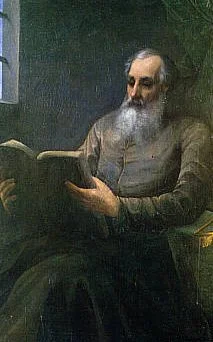
Saint Sahak Partiev, also known as Isaac the Great, was Catholicos of Armenia, spiritual father of a nation, and one of the quiet architects who ensured Christianity survived when political powers tried to erase it. He is venerated in the Armenian Apostolic Church and honored by Eastern Catholics and Orthodox Christians as a shepherd who carried Armenia through cultural collapse and spiritual siege.
His principal feast is celebrated on September 9 in the Armenian tradition.
Saint Sahak did not inherit an easy Church. He inherited a wounded one.
Armenia stood between empires. Persian authorities sought to dismantle Christian identity. Clergy were pressured. Scripture was inaccessible to ordinary people. Children were growing up without spiritual language. Faith itself was becoming fragile.
People pray to Saint Sahak Partiev today for strength in spiritual leadership, for help preserving faith during cultural upheaval, and for wisdom when teaching children in uncertain times. He understands what it feels like to lead while everything is shaking. He understands the exhaustion of carrying responsibility for souls. He understands how devastating it feels to watch a generation drifting away from God.
He also understands how quiet perseverance reshapes history.
This prayer card is for parents guiding children through spiritual confusion, for leaders bearing invisible burdens, and for believers trying to protect faith inside unstable systems. Saint Sahak does not offer dramatic rescue. He offers steady shepherding.
Each card is handmade in Austin and created to order. We do not keep stock, because every prayer card is treated as a unique devotional offering. They are printed on museum-quality photo paper, not cardstock, and each one is made during prayer. The saints are venerated throughout the entire process, and prayers are intentionally offered for the person who will receive the card. These are not mass-produced items. They are created slowly, reverently, and with spiritual intention, because every soul and every prayer matters.
Mesrop Mashtots (c. 362–440 AD)
Commemorated together with Sahak the Great and honoured separately on the Feast of the Holy Translators, Mesrop Mashtots occupies a unique position in Armenian Christian consciousness as the man who gave the Armenian people their alphabet — and therefore, in a profound sense, their full capacity for Christian self-expression. The alphabet he created is sometimes called by Armenians Mesropian script, and its thirty-eight letters are taught to Armenian children worldwide as a matter of cultural as well as educational importance. The first letter of the Armenian alphabet — Ayb (Ա) — is considered particularly sacred, representing both the beginning of Armenian literacy and, symbolically, the Alpha and Omega of Christ.
Mesrop's missionary work also extended his significance beyond the purely literary. He traveled throughout Armenia and neighboring regions preaching, teaching, and establishing schools where the new alphabet could be taught. He understood literacy not as a luxury or an intellectual achievement but as a pastoral necessity — a tool of evangelization and of spiritual formation. His canonization places him in the company not merely of scholars but of genuine apostles of the faith.
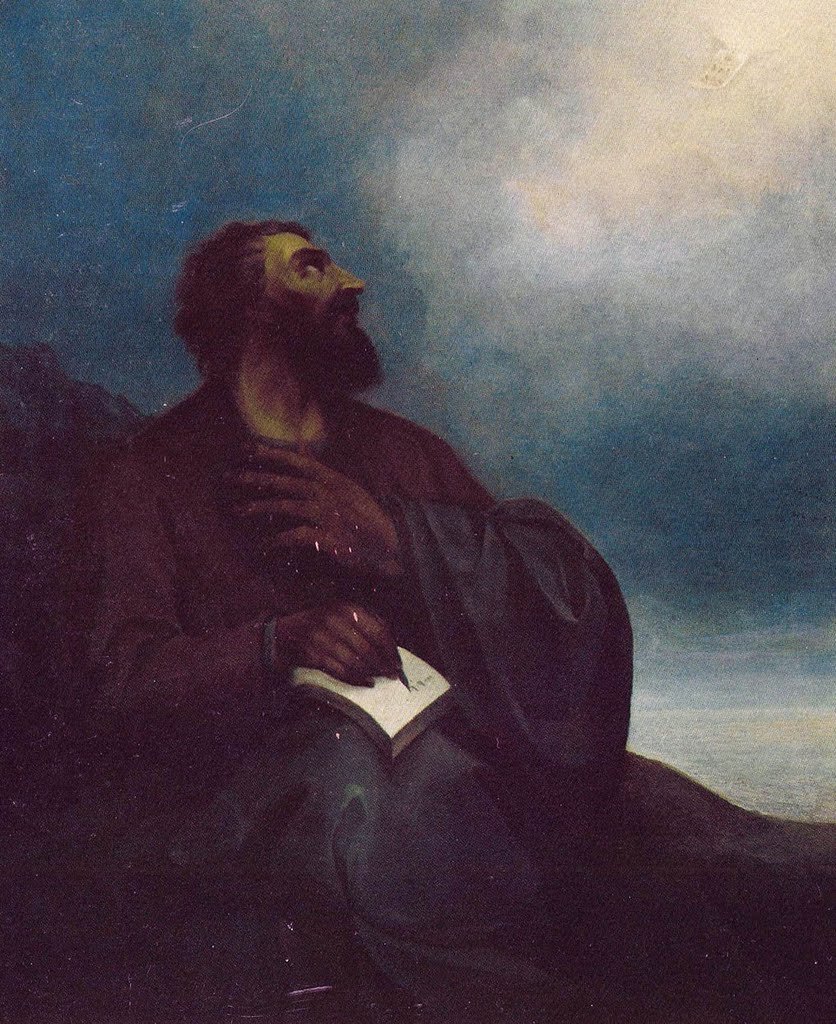
Saint Mesrob Mashtots stands at the crossroads of faith, language, and cultural survival. He lived in the late fourth and early fifth centuries, during a fragile moment in Armenian Christian history, when foreign empires pressed inward and spiritual identity risked being diluted or erased.
He is venerated primarily within the Armenian Apostolic Church (Oriental Orthodox), with historical reverence also preserved among Armenian Catholics.
His principal feast day is celebrated on February 17 in the Armenian calendar.
Mesrob was not born a monk.
He began his life as a royal secretary and scholar, fluent in Greek, Syriac, and Persian. He knew the machinery of empire. He understood politics, education, and power. But his heart was drawn elsewhere.
He left court life to become a monk and missionary, traveling through Armenia and neighboring regions preaching Christ. What he encountered broke him open.
People could not understand Scripture in their own tongue.
Prayers were recited in borrowed languages. The Gospel sounded foreign in Armenian ears. Faith existed, but intimacy with God was being filtered through translations that did not belong to the people.
Mesrob saw something devastating and sacred at once.
Without language, souls drift.
Without Scripture in the heart-language, faith weakens.
People pray to Saint Mesrob today for mental clarity when learning feels overwhelming, for perseverance when spiritual burnout sets in, and for strength when they feel intellectually or emotionally exhausted. He understands the fatigue that comes from carrying responsibility for others, the strain of building something that does not yet exist, and the quiet loneliness of visionaries who labor in obscurity.
If you are struggling to focus, feeling spiritually drained, or carrying the weight of teaching, parenting, leadership, or creative work, Saint Mesrob knows that terrain. His life reminds us that God meets us not only in silence, but in letters, in study, in perseverance, and in the slow labor of love.
This prayer card is created as a spiritual heirloom. It is meant to accompany desks, prayer corners, classrooms, and tired hearts, reminding you that God sanctifies learning, language, and effort offered with humility.
Each card is handmade in Austin, TX and created to order. We do not keep stock, because every prayer card is treated as a unique devotional offering. They are printed on museum-quality photo paper, not cardstock. Every card is made slowly, during prayer, with intentional reverence for the saint or holy image and for the person who will receive it. Names are lifted before Christ. Intentions are held carefully. Each piece is handled multiple times in prayerful silence, asking God for mercy and asking the saint or Theotokos to intercede for the soul it is being made for. This is not production work. It is devotional craftsmanship shaped with patience, care, and spiritual responsibility, because every soul and every prayer matters.
Vardan Mamikonian and the Holy Vardanantz (d. 451 AD)
The thirty-seven warriors who died with Vardan Mamikonian at the Battle of Avarayr are venerated as martyrs — specifically as Kedronagir martyrs, martyrs for the faith — in the Armenian church. This canonization of soldiers as saints is not an entirely unique phenomenon in Christian history (one thinks of the Roman soldier-martyrs Maurice and his companions, or the Georgian military saint George), but the Vardanantz are unique in the scale and clarity of their theological meaning for the Armenian tradition.
The feast of Vartanantz has taken on something of the character of a national-religious holy day, celebrated with great solemnity in Armenia itself and throughout the diaspora. Liturgically, the day combines the Office of the Dead with hymns of triumphant commemoration, holding simultaneously the grief of loss and the joy of faithful witness. The prayer associated with Vardan Mamikonian, attributed to him in tradition, captures the spirit of the entire enterprise: "For the faith we are ready to be despoiled of all that is good in this life; and it is not one death that we shall die, but as many times as you smite us, so many deaths shall be our gain."
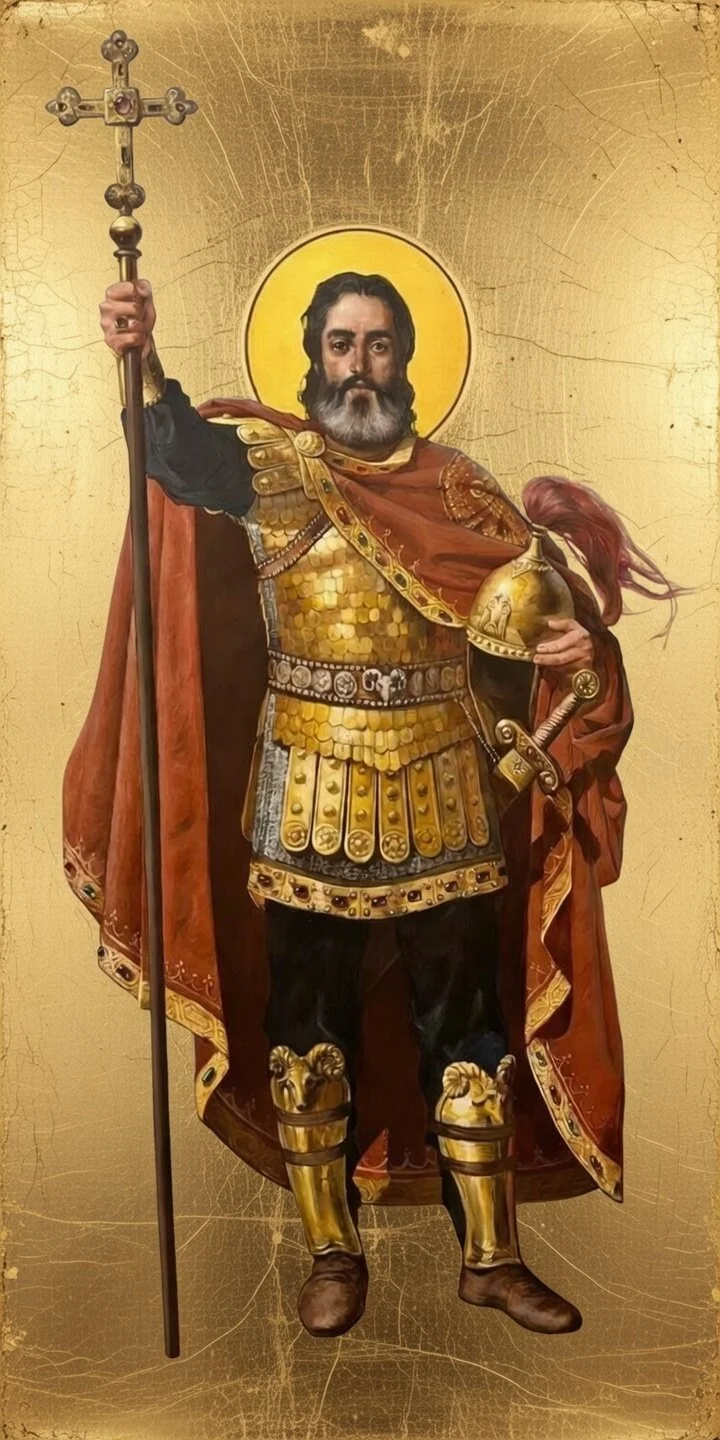
Saint Vartan Mamikonian was an Armenian military commander, nobleman, and martyr whose sword was guided by conscience and whose final battle was fought not for territory, but for the soul of a nation. He is venerated in the Armenian Apostolic Church and honored by Eastern Catholics and Orthodox Christians as the defender of Christian Armenia against forced religious conversion.
His principal feast is celebrated on the Thursday before Great Lent in the Armenian tradition, known as Vartanants, with related commemorations throughout Armenian Christian communities worldwide.
Saint Vartan did not seek war.
He was forced into it.
When the Persian Empire demanded that Armenia abandon Christianity and return to Zoroastrian worship, Vartan was faced with an impossible choice: submit politically and betray Christ, or resist militarily and risk annihilation.
He chose Christ.
People pray to Saint Vartan Mamikonian today for courage under political pressure, for strength to defend faith when authority demands compromise, and for perseverance in battles that feel unwinnable. He understands what it means to stand between empire and conscience. He understands the fear that rises when livelihoods, families, and futures are threatened. He understands how lonely leadership becomes when obedience to God isolates you.
He also understands holy resistance.
This prayer card is for believers navigating hostile workplaces, governments, or institutions, for fathers and leaders carrying heavy responsibility, and for anyone called to stand firm when surrender would be easier. Saint Vartan does not promise victory without sacrifice. He promises faithfulness that outlives defeat.
Each card is handmade in Austin and created to order. We do not keep stock, because every prayer card is treated as a unique devotional offering. They are printed on museum-quality photo paper, not cardstock, and each one is made during prayer. The saints are venerated throughout the entire process, and prayers are intentionally offered for the person who will receive the card. These are not mass-produced items. They are created slowly, reverently, and with spiritual intention, because every soul and every prayer matters.
Nerses Shnorhali — Nerses the Gracious (1102–1173 AD)
If Gregory the Illuminator is the founding saint of the Armenian church, Nerses Shnorhali — Nerses IV, Catholicos of All Armenians from 1166 to 1173 AD — is perhaps its greatest poet-theologian, a figure of such luminous holiness and intellectual brilliance that even his adversaries in theological controversy admired him. The title Shnorhali means "the Gracious" or "the Eloquent," a reference both to the charm and elegance of his personality and to the extraordinary quality of his literary and musical output.
Nerses was born in 1102 into the Pahlavid family, a branch of the nobility that had produced earlier Catholicoi, and was educated at the great monastery of Dzoravarank. He was ordained at a young age and quickly distinguished himself as a poet, musician, theologian, and ecclesiastical diplomat. His poetry in Armenian is regarded as among the finest in the language — lyrical, theologically dense, emotionally rich, and possessed of a musical quality that made many of his works suitable for liturgical use. His most famous poetic work, Jesus, Son Only Begotten, is a long theological meditation on the persons and attributes of the Trinity and on salvation through Christ, and it is still recited in Armenian churches today.
As Catholicos, Nerses entered into an ecumenical correspondence with the Byzantine Emperor Manuel I Komnenos that is one of the most remarkable instances of early ecumenical dialogue in Christian history. The theological letters exchanged between Nerses and Manuel — and between the Armenian church and the Byzantine church more broadly — represent a serious attempt to find theological common ground between the Chalcedonian and non-Chalcedonian traditions, and Nerses's contributions to this dialogue were of extraordinary sophistication and irenic spirit. He died before a formal reunion could be achieved (which ultimately never came about), but his engagement with the dialogue established a model of serious ecumenical theology that the Armenian church would return to in subsequent centuries and especially in the twentieth century's remarkable dialogues with both Rome and the Eastern Orthodox churches.
Nerses's liturgical compositions — hymns (sharakan), prayers, and theological poems — are still used in the Armenian Divine Liturgy, giving his voice a presence in the worship of every Armenian church in the world. He is venerated as a saint and Doctor of the Church, and his feast is celebrated in the Armenian calendar with the kind of reverence reserved for the very greatest figures of the tradition.
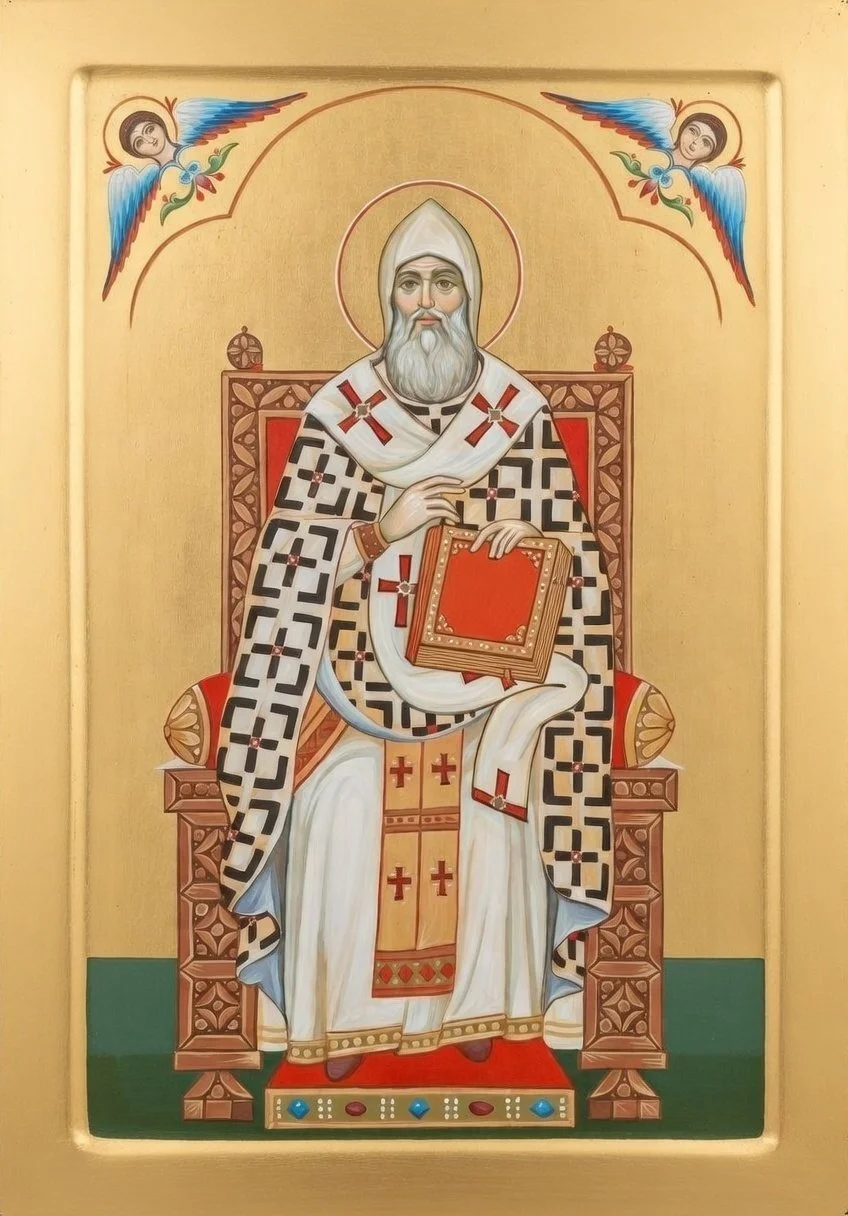
Saint Nerses the Gracious, known in Armenian as Nerses Shnorhali, was Catholicos of the Armenian Church in the twelfth century and one of the most luminous spiritual voices of medieval Christianity. Born in 1102 into a noble and ecclesiastical family, he was raised within a world marked by political upheaval, theological division, and the fragility of Christian communities under pressure.
He is venerated in the Armenian Apostolic Church within the Oriental Orthodox tradition and honored among Armenian Catholics as a holy hierarch and theologian.
His principal feast is kept in the Armenian calendar on August 13.
Nerses lived during a time when the Armenian Church stood between powerful empires and strained relations with both Byzantine and Latin Christians. The wounds of division were real. Suspicion was strong. Unity felt distant.
Yet Nerses did not answer conflict with harshness.
He answered it with prayer.
He wrote hymns that softened hardened hearts. He composed theological works that sought clarity without aggression. He corresponded with leaders in Constantinople and Rome, not as a politician, but as a pastor longing for reconciliation rooted in truth.
People pray to Saint Nerses the Gracious today for inner peace when spiritual fatigue sets in, for wisdom when navigating Church tensions, and for strength when unity feels impossible. He understands what it means to carry responsibility for a wounded people. He understands how discouragement can creep into leadership and prayer alike.
If you are weary from division, burdened by church conflicts, or spiritually exhausted from carrying others, Saint Nerses knows that interior terrain. His voice still whispers through centuries of Armenian prayer, inviting the soul back into humility, patience, and trust in Christ.
This prayer card is created as a spiritual heirloom. It is meant to rest in places of study, prayer, and reconciliation, reminding the heart that gentleness is strength and that holiness can be firm without being harsh.
Each card is handmade in Austin, TX and created to order. We do not keep stock, because every prayer card is treated as a unique devotional offering. They are printed on museum-quality photo paper, not cardstock. Every card is made slowly, during prayer, with intentional reverence for the saint or holy image and for the person who will receive it. Names are lifted before Christ. Intentions are held carefully. Each piece is handled multiple times in prayerful silence, asking God for mercy and asking the saint to intercede for the soul it is being made for. This is not production work. It is devotional craftsmanship shaped with patience, care, and spiritual responsibility, because every soul and every prayer matters.
Gregory of Narek — Grigor Narekatsi (951–1003 AD)
If Nerses Shnorhali is the greatest poet-theologian of the Armenian church, Gregory of Narek (Grigor Narekatsi) is its deepest mystic and its most universally beloved spiritual writer — and one of the most extraordinary Christian writers of any tradition in the medieval period. Born in 951 AD on the shores of Lake Van in the region of Vaspurakan (eastern Turkey), Gregory entered the famous Monastery of Narekavank (Narek) as a child and spent virtually his entire life there as a monk, scholar, and contemplative. He died in 1003 AD, having produced a body of work that is simply staggering in its theological depth, literary beauty, and psychological insight.
His masterpiece — the work that has made him famous across centuries and cultures — is the Matean Voghbergutyan, known in English as the Book of Lamentations or the Narek. This is a collection of ninety-five prayer-poems (ban, or "speeches"), each addressed directly to God, each a profound meditation on sin, repentance, longing, divine love, and the mystery of the human soul before its Creator. What makes the Narek extraordinary is not merely its literary quality, though that is remarkable — it is the fearless psychological honesty with which Gregory plumbs the depths of the human condition. He does not soften or aestheticize the reality of sin and suffering; he faces it with unflinching courage, and then turns that same unflinching gaze toward the infinite mercy of God. The prayers are simultaneously confessions, theological meditations, poems of devastating beauty, and acts of pure contemplative surrender.
The Narek occupies a position in Armenian culture roughly analogous to what the Psalter occupies in Hebrew culture — it is the primary text of personal and communal prayer, the book that Armenian Christians reach for in times of illness, grief, confusion, or spiritual crisis. For centuries it was kept under the pillows of the sick, believed to have healing power. It is given as a gift at weddings and baptisms. It is cited in times of national catastrophe. It has been translated into many languages. And on February 23, 2015, Pope Francis declared Gregory of Narek a Doctor of the Universal Church — the thirty-sixth such Doctor in Catholic history and the first from the Oriental traditions — a declaration of extraordinary significance for relations between the Armenian church and Rome, and a recognition that Gregory's theological and spiritual depth transcends the boundaries of ecclesiastical communion.
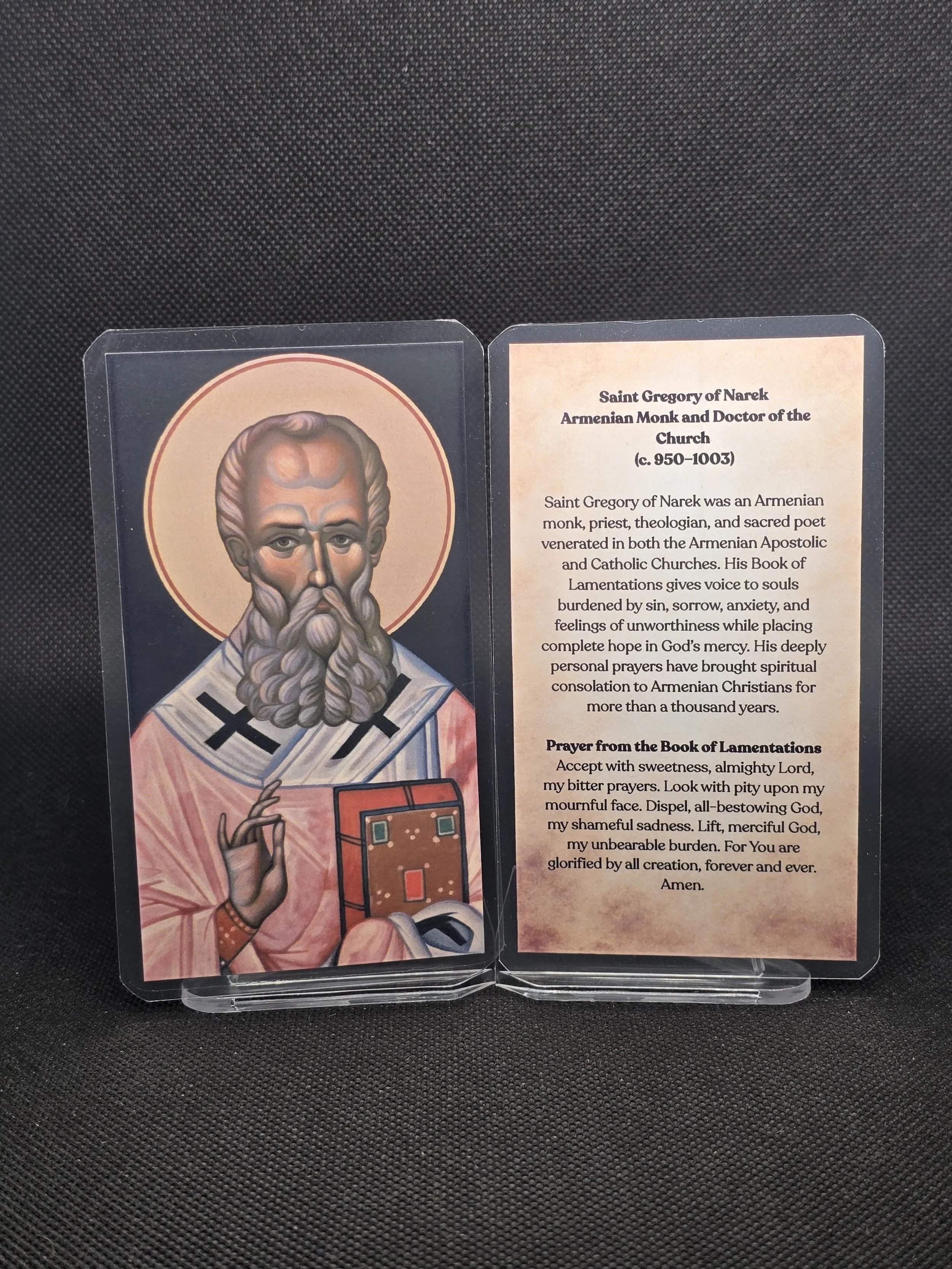
Saint Gregory of Narek was an Armenian monk, mystic, poet, and Doctor of the Church whose tears became theology and whose prayers have comforted broken souls for over a thousand years. He is venerated in the Armenian Apostolic Church and honored by Armenian Catholics and the wider Catholic Church, which proclaimed him a Doctor of the Church in 2015. His principal feast is celebrated on February 27 in the Armenian tradition, with commemorations also observed in the Catholic calendar.
Saint Gregory did not live a dramatic public life.
He lived interiorly.
He was born around 950 near Lake Van and entered monastic life at the monastery of Narek, where he spent his years in study, repentance, and relentless prayer. His most famous work, the Book of Lamentations, is not a treatise. It is a cry. It is the voice of a soul wrestling with anxiety, guilt, fear of judgment, and longing for mercy.
People pray to Saint Gregory of Narek today for depression healing, scrupulosity, and freedom from crushing spiritual despair. He understands what it means to feel unworthy. He understands the ache of overexamining every fault. He understands how heavy the human heart can feel when burdened by shame and intrusive thoughts.
He also understands mercy.
This prayer card is for those battling interior darkness, for believers tormented by spiritual anxiety, and for anyone longing to learn how to pray from the depths rather than from performance. Saint Gregory does not dismiss suffering of the mind. He walks into it and prays from within it.
Each card is handmade in Austin and created to order. We do not keep stock, because every prayer card is treated as a unique devotional offering. They are printed on museum-quality photo paper, not cardstock, and each one is made during prayer. The saints are venerated throughout the entire process, and prayers are intentionally offered for the person who will receive the card. These are not mass-produced items. They are created slowly, reverently, and with spiritual intention, because every soul and every prayer matters.
Catholicos Komitas (c. 580–628 AD)
Komitas Aghtseetsi — Catholicos Komitas I of Armenia — was one of the most important figures in the development of Armenian liturgical music, a tradition that is one of the most distinctive and beautiful aspects of Armenian Christian worship. He composed sharakan (hymns), organized the liturgical calendar, and is credited with significant contributions to the development of the Armenian Jashots (divine offices). He is venerated as a saint and is revered particularly by musicians and liturgical scholars. Interestingly, the twentieth-century Armenian composer and ethnomusicologist Soghomon Soghomonian took the religious name Komitas in honor of this saint — and Komitas the composer is himself one of the most significant figures in Armenian cultural and spiritual history, having preserved thousands of Armenian folk and sacred songs before his own tragedy in 1915.

Sahak Partev, Mesrop Mashtots, and the Feast of the Holy Translators
As noted above, the feast of Surb Targmanchats — the Holy Translators — commemorates not only Sahak and Mesrop but the entire group of scholars who participated in the translation work of the Golden Age. This feast, celebrated on the Saturday nearest to October 11, is one of the most distinctively Armenian of all liturgical commemorations — there is nothing quite like it in the calendar of any other Christian church. It celebrates intellectual and literary work as a form of sanctity, translation as a form of apostleship, and scholarship as a form of service to God and to the people. In a tradition that has always understood the alphabet and the Book as sacred gifts, the sanctification of the translators who made those gifts fully available to the Armenian people is entirely consistent.
Saint Sahak Partiev, also known as Isaac the Great, was Catholicos of Armenia, spiritual father of a nation, and one of the quiet architects who ensured Christianity survived when political powers tried to erase it. He is venerated in the Armenian Apostolic Church and honored by Eastern Catholics and Orthodox Christians as a shepherd who carried Armenia through cultural collapse and spiritual siege.
His principal feast is celebrated on September 9 in the Armenian tradition.
Saint Sahak did not inherit an easy Church. He inherited a wounded one.
Armenia stood between empires. Persian authorities sought to dismantle Christian identity. Clergy were pressured. Scripture was inaccessible to ordinary people. Children were growing up without spiritual language. Faith itself was becoming fragile.
People pray to Saint Sahak Partiev today for strength in spiritual leadership, for help preserving faith during cultural upheaval, and for wisdom when teaching children in uncertain times. He understands what it feels like to lead while everything is shaking. He understands the exhaustion of carrying responsibility for souls. He understands how devastating it feels to watch a generation drifting away from God.
He also understands how quiet perseverance reshapes history.
This prayer card is for parents guiding children through spiritual confusion, for leaders bearing invisible burdens, and for believers trying to protect faith inside unstable systems. Saint Sahak does not offer dramatic rescue. He offers steady shepherding.
Each card is handmade in Austin and created to order. We do not keep stock, because every prayer card is treated as a unique devotional offering. They are printed on museum-quality photo paper, not cardstock, and each one is made during prayer. The saints are venerated throughout the entire process, and prayers are intentionally offered for the person who will receive the card. These are not mass-produced items. They are created slowly, reverently, and with spiritual intention, because every soul and every prayer matters.
The Armenian Divine Liturgy
The Badarak — The Sacrifice
The central act of Armenian Christian worship is the Badarak — the Divine Liturgy, sometimes rendered as "the Sacrifice" in English translation. The Badarak is one of the oldest surviving Christian liturgical rites, and its roots reach back to the earliest period of Armenian Christianity, drawing on both Syriac and Greek liturgical traditions that were subsequently Armenianized, expanded, and refined over many centuries.
The Armenian Badarak is distinguished by several characteristics that set it apart from both the Byzantine liturgies of the Orthodox East and the Roman liturgies of the Catholic West, while bearing family resemblances to both.
The language of the Badarak is Classical Armenian — Grabar, the ancient literary form of the language, which is to modern Armenian something like Latin is to modern Romance languages: a sacred, venerable, and somewhat archaic tongue that carries enormous liturgical and theological weight but is not the vernacular of everyday life. Many Armenian churches read the Gospel and other portions of the service in modern Armenian as well, and in diaspora communities in various countries, elements of English, French, or other languages have been introduced. But the liturgical language of the Badarak at its most formal is Grabar, and for many Armenians, the sound of Grabar is itself a sacred experience, connecting them acoustically and emotionally to the entire span of Armenian Christian history.
The music of the Badarak is one of its most immediately striking characteristics. Armenian liturgical music is based on a system of eight modal scales (jins) called the Oktaechos (borrowed from Byzantine practice but developed in distinctly Armenian ways), and the melodies are ancient, modal, and deeply moving. The tradition includes both unison congregational chanting and, in many churches, polyphonic settings that draw on the rich tradition of Armenian liturgical composition from Komitas Catholicos through the medieval period and into the modern era. The composer Komitas (Soghomonian) made a particular contribution in the late nineteenth and early twentieth century by transcribing and harmonizing ancient liturgical chants that had previously existed only in oral tradition, giving them a fixed musical form that could be taught, printed, and performed consistently.
The structure of the Badarak follows a general shape similar to other ancient Christian liturgies: preparation rites, the Liturgy of the Word (readings from Scripture, sermon), the Liturgy of the Faithful (the Eucharistic prayer, consecration, and communion), and dismissal. But the specific texts, prayers, and ceremonial actions are distinctly Armenian. The priest's vestments (shurhajib, varkas, shapat, and others) are distinctive in form and color. The liturgical vessels — chalice, paten, and the distinctive Armenian star-shaped astgh or liturgical curtain screen — are characteristic of the Armenian rite. The use of a curtain (veil) at key moments of the liturgy, drawing a screen between the altar and the congregation during the most sacred moments of the Eucharistic prayer, is a distinctive feature of the Armenian rite with parallels in some other Eastern liturgical traditions.
Unleavened Bread and Unmixed Wine
Two practices of the Armenian Badarak that have been points of theological discussion in ecumenical conversations are worth noting here. The Armenian church uses unleavened bread (like the Latin Catholic church) rather than the leavened bread used in Byzantine Orthodox practice — a difference that carries theological symbolism in each tradition's interpretation. And the Armenian church uniquely among all Christian traditions does not mix water with the wine in the chalice. All other ancient liturgical traditions — Latin, Byzantine, Syriac, Coptic — mix a small amount of water with the wine as a liturgical practice rooted in the Gospel accounts of the Last Supper and the Blood and Water that flowed from Christ's side at the Crucifixion. The Armenian practice of unmixed wine has been noted and discussed by theologians of other traditions since the medieval period, and the Armenian church's own explanation has varied over time, but it remains a distinctive marker of the Armenian liturgical identity.


Armenian Monasticism and Sacred Architecture
The Monastery Tradition
Armenian Christianity produced one of the richest monastic traditions in the entire Christian world, and the monasteries of Armenia — scattered across the mountains, valleys, gorges, and plains of the ancient Armenian homeland in modern Armenia, eastern Turkey, Iran, and elsewhere — are among the most spectacular and spiritually charged architectural achievements in human history.
The earliest Armenian monasteries were founded in the fourth and fifth centuries in the immediate wake of Armenia's Christianization, and the monastic tradition grew rapidly in the following centuries, encouraged by the church's theological life, the scholarly needs of the Golden Age of translation, and the political and military turbulence that made monasteries — often built in remote and defensible locations — both refuges from the world and centers of cultural preservation.
Khor Virap
Already discussed as the site of Gregory the Illuminator's imprisonment, Khor Virap became a monastic complex built above and around the ancient prison pit. The monastery as it stands today dates primarily from the seventeenth century, though earlier structures occupied the site. Its location — at the foot of the great sweep of the Ararat plain, with Mount Ararat (Masis) rising dramatically behind it — makes it not only one of the most important pilgrimage sites in Armenia but one of the most visually stunning religious locations in the world. The symbolism of the site is multilayered: the place of suffering that became the cradle of Armenian Christianity, set against the backdrop of the mountain that Armenian tradition associates with Noah's Ark and with the very origins of post-diluvian human civilization.
Geghard — The Monastery of the Spear
The Monastery of Geghard (Geghardavank) — a UNESCO World Heritage Site — is built dramatically into a gorge carved by the Azat River in the province of Kotayk, where parts of the complex are literally carved into the living rock of the cliff face. The monastery's name means "monastery of the lance" and refers to the Holy Lance — the spear of the Roman soldier Longinus that pierced Christ's side — which was kept here for many centuries before being transferred to Etchmiadzin. Founded in the fourth century according to tradition (though the existing structures date primarily from the twelfth and thirteenth centuries), Geghard is a masterwork of Armenian medieval architecture, combining free-standing churches with rock-cut chapels, gavits (narthexes), and monastic cells, all decorated with intricate khachkars (cross-stones) and sculptural reliefs.
The experience of entering Geghard's rock-cut churches is one of the most powerful in Armenian Christianity — the transition from the bright exterior light to the dark, enclosed, cave-like interior, lit by candles and permeated by the smell of incense and the sound of chanting, creates an experience of entering another world entirely, one in which the boundary between the material and the spiritual feels remarkably thin.
Haghpat and Sanahin
The monasteries of Haghpat and Sanahin, both in the Lori province of northern Armenia and both UNESCO World Heritage Sites, are remarkable complexes dating primarily from the tenth through thirteenth centuries. Built during a period of relative peace and cultural flourishing under the Bagratid Armenian kings, they represent the high point of Armenian medieval architectural achievement.
Haghpat — founded in the 970s under the Bagratid queen Khosrovanuysh — contains the Church of the Holy Cross, a gavit (narthex) of extraordinary spatial sophistication, a library, a belfry, and numerous khachkars and funerary monuments. Its architecture shows the integration of Armenian structural principles with decorative programs of great elaborateness, including intricately carved decorative bands, animal reliefs, and inscriptions. The church interiors retain traces of frescoes and continue to function as active places of worship.
Sanahin, just a short distance from Haghpat, was founded approximately simultaneously and shows a similar integration of ecclesiastical and monastic functions. Its Academy building is one of the earliest purpose-built educational institutions in Armenia, testifying to the Armenian church's consistent investment in scholarship and intellectual formation.
Tatev
The Monastery of Tatev, perched dramatically on a basalt promontory above the gorge of the Vorotan River in the Syunik province of southern Armenia, is both one of the most visually spectacular and one of the most historically important monastic complexes in the Armenian world. Founded in the ninth century, it became in the medieval period one of the most important centers of Armenian theological and philosophical education, housing a university that at its height in the fourteenth and early fifteenth centuries attracted students from across the Armenian world and produced some of the most significant intellectual figures of medieval Armenian Christianity, including the great theologian and encyclopedist Hovhannes Vorotnetsi and his student Grigor Tatevatsi.
Grigor Tatevatsi (1346–1409) — Gregory of Tatev — is one of the great intellectual giants of the Armenian tradition, a systematic theologian of formidable erudition who produced comprehensive commentaries on scripture and theology, delivered and preserved a massive collection of sermons, and is venerated as a saint and Doctor of the Church. His Book of Questions is a systematic theological encyclopedia that covers cosmology, anthropology, soteriology, and eschatology with a comprehensiveness that reflects the influence of both the Armenian theological tradition and the Aristotelian philosophical inheritance transmitted through translation.
Khachkars — The Cross-Stones
No discussion of Armenian sacred art can omit the khachkar — the Armenian cross-stone, one of the most distinctive and beautiful artistic creations of any Christian tradition in the world. A khachkar is a carved stone stele, typically standing upright, dominated by an intricately carved cross in high relief, surrounded by elaborate interlaced decorative patterns of vegetal and geometric forms. Khachkars have been produced in Armenia since the ninth century, and they are found throughout the Armenian world — in churches and monasteries, in cemeteries, along roadsides, on mountain passes, embedded in walls, and free-standing in fields. They serve as commemorative markers, dedications, memorials, boundary markers, and objects of veneration, and the tradition of their creation has continued without interruption into the present day.
The artistry of the khachkar reaches its highest expression in the thirteenth and fourteenth centuries, when carvers in centers like Haghpat, Noravank, and Goshavank produced works of such intricate delicacy that the stone appears almost to have been woven rather than carved. The lacy, interlaced patterns that fill every surface around the central cross show the influence of Armenian textile traditions, manuscript illumination, and architectural ornamentation, all brought together in a single monumental form. Each khachkar is unique — no two are identical — and the artistic tradition passed from master to apprentice through the centuries carries an implicit theology of creation as participation in divine creativity.
The most celebrated single khachkar in existence is probably the Amenaprkich (All-Savior) khachkar at Haghpat Monastery, carved in 1273 by the master Poghos. But equally famous, in a different way, are the approximately five hundred khachkars that were systematically destroyed by Azerbaijani authorities at the medieval cemetery of Julfa (Djulfa) in Nakhchivan between 1998 and 2005 — a destruction documented by satellite imagery, eyewitness accounts, and international observers, and widely condemned as a form of cultural genocide. The fate of the Julfa khachkars is one of the most painful chapters in the ongoing story of the destruction of Armenian cultural heritage in territories from which Armenians have been displaced.


The Armenian Church in Medieval History
The Kingdom of Cilicia and the Crusades
Between approximately 1080 and 1375 AD, there existed in the region of Cilicia (modern southern Turkey and adjacent areas) an Armenian political entity that went through various stages from principality to kingdom — the Armenian Kingdom of Cilicia, sometimes called Little Armenia or Armenian Cilicia to distinguish it from the historical Armenian homeland to the east. This kingdom was established by Armenian nobles who had fled westward following the Seljuk conquest of Greater Armenia, and it developed a rich culture that blended Armenian traditions with Byzantine influences and, significantly, with the Latin Christian traditions brought by the Crusaders.
The relationship between the Armenian Kingdom of Cilicia and the Crusader states was one of the most significant encounters between Oriental and Latin Christianity in the medieval period. Armenians and Crusaders were natural allies in the face of common Muslim adversaries, and the alliance produced significant cultural and ecclesiastical exchange. Armenian kings sought and at times received crowns from both Byzantine emperors and the Holy Roman Emperor, and some Armenian rulers married into Latin noble families and adopted elements of Western feudal and ecclesiastical practice.
This interaction with Latin Christianity had important consequences for the Armenian church. Some Armenians in Cilicia adopted elements of Latin liturgical practice, moved toward acceptance of Roman primacy, and in some cases entered into formal communion with Rome — a process that contributed eventually to the development of the Armenian Catholic Church. But the majority of the Armenian church maintained its non-Chalcedonian identity and resisted Latin pressures toward conformity. The tension between pro-Latin and anti-Latin factions within the Armenian church of Cilicia was a source of significant internal conflict, and when the Kingdom of Cilicia fell to the Mamluk Sultanate in 1375, the political context that had sustained the pro-Latin party largely disappeared.
The Mongol Invasions and Their Aftermath
The Mongol invasions of the thirteenth century were catastrophic for Armenia, as they were for much of the Near East. The armies of Genghis Khan and his successors swept through the Armenian highlands, destroying cities, monasteries, and the institutional infrastructure of Armenian cultural and religious life. Yet the aftermath of the Mongol conquests also offered a strange opportunity: the Mongol Ilkhanate that came to rule over Persia and much of the Near East was initially relatively tolerant of Christians, and some Mongol rulers actively favored Christian advisors and ambassadors. This created a brief period during which Armenian Christians, along with Nestorian Christians, experienced a degree of favor and even influence within the Mongol administration.
The conversion of the Mongols to Islam in the fourteenth century closed this window of opportunity and inaugurated a new period of pressure and persecution for Armenian Christians throughout the region. The subsequent rise of Tamerlane (Timur) at the end of the fourteenth century brought a new wave of devastation, and by the fifteenth century the Armenian highlands had been so thoroughly depopulated by successive invasions that the demographic and institutional foundations of Armenian cultural life were drastically weakened.
The Armenian Church Under Ottoman and Persian Rule
Five Centuries of Ottoman Rule
The Ottoman conquest of the Armenian highlands in the early sixteenth century brought the majority of the Armenian population under Ottoman rule, where they would remain for the next four centuries. The Ottoman millet system — by which non-Muslim communities were organized as autonomous religious communities under the leadership of their patriarchs, who were responsible to the Ottoman government for the community's taxes, legal affairs, and general conduct — gave the Armenian church an important institutional role as the political as well as ecclesiastical representative of the Armenian people.
The Armenian Patriarchate of Constantinople, as noted above, was established by Mehmed II in 1461 and served as the primary interface between the Armenian community and the Ottoman state. This gave the Patriarch of Constantinople enormous power within the Armenian community, and also made him the target of Ottoman pressure when state interests and Armenian interests conflicted. The patriarchs navigated this complex situation with varying degrees of skill and integrity, and the history of the Constantinople Patriarchate during the Ottoman centuries is a remarkable story of institutional survival under sustained pressure.
The Armenian community under the Ottomans was primarily concentrated in the eastern provinces of the empire — the vilayets of Van, Bitlis, Erzurum, Diyarbakir, Mamüret-ül-Aziz (Harput), and Sivas — as well as in Constantinople itself, in Cilicia, and in the interior cities of Anatolia. Armenian communities were also significant in the major commercial centers of the empire, and Armenians played important roles in trade, craftsmanship, and finance, as well as in the professions and in the imperial bureaucracy.
Armenian Christians under the Ottomans were subject to the general conditions of dhimmi (non-Muslim protected subjects) status: they paid special taxes, faced certain legal disabilities, and were subject to various forms of social discrimination. But for long periods the communities were able to maintain their churches, schools, charitable institutions, and cultural life with a degree of autonomy that, if far from full equality, was sufficient for the continuation and in some periods the flourishing of Armenian cultural and religious life.
The Armenian Catholics Under Persian Rule
A significant portion of the Armenian population — those living in the eastern Armenian territories under Safavid Persian rule — had a somewhat different experience, shaped by the Safavid state's Shi'a Muslim identity and its complex relationship with Christian minority communities. The forced mass deportation of Armenians by Shah Abbas I in 1604–1605, which brought tens of thousands of Armenians to New Julfa (Isfahan) in Persia, paradoxically created one of the most prosperous and culturally active Armenian communities of the early modern period. The Armenians of New Julfa became important intermediaries in the silk trade and in Persian diplomatic relations with European powers, and they built a remarkable complex of churches — including the Cathedral of the Vank (All Savior's Cathedral) — that contains some of the most extraordinary examples of Armenian art anywhere in the world, combining Armenian architectural traditions with Persian and European Baroque influences in a unique synthesis.
The Armenian Catholic Church
Origins and Development
The Armenian Catholic Church — one of the Eastern Catholic Churches in full communion with Rome — has its origins in the centuries of contact between Armenian Christianity and Latin Christianity during and after the Crusading period. As noted above, some Armenians in Cilicia had moved toward acceptance of Roman primacy during the Kingdom of Cilicia, and a continuous thread of pro-union sentiment existed within the Armenian church from the thirteenth century onward. Various attempts at formal union — most notably in the context of the Council of Florence in 1439, which produced a brief paper union between Rome and the Armenian church — ultimately failed to take root.
The Armenian Catholic Church as a distinct institution with its own hierarchy dates from the eighteenth century. Pope Benedict XIV in 1742 established a separate Armenian Catholic Patriarch, Abraham Ardzivian (who took the name Abraham Pierre I), following a period of internal conflict within the Armenian church in Aleppo and Lebanon over the question of union with Rome. The creation of a separate Catholic hierarchy meant that Armenians who chose full communion with Rome now had their own ecclesiastical institution distinct from the Armenian Apostolic Church, rather than operating as a potentially destabilizing minority within it.
Theology and Liturgical Practice
The Armenian Catholic Church maintains the traditional Armenian liturgical rite — the Armenian version of the Badarak — with only modest adaptations required by full communion with Rome. The language of the liturgy remains Classical Armenian (Grabar), the vestments and ceremonies are essentially those of the Armenian Apostolic tradition, and the liturgical calendar follows the Armenian ecclesiastical year. The theological content of the liturgy has been very slightly adjusted in a few places to reflect Catholic doctrine, but the overall liturgical experience of an Armenian Catholic Badarak is very similar to that of an Armenian Apostolic Badarak.
Theologically, the Armenian Catholic Church accepts the full teaching of the Roman Catholic Church, including papal primacy and infallibility, the filioque (the Western addition to the Nicene Creed affirming that the Holy Spirit proceeds from the Father and the Son), the Immaculate Conception, and other distinctively Catholic doctrines. This represents, in the case of Chalcedon, an acceptance of the Chalcedonian Christology that the Armenian Apostolic Church has historically rejected — though in practice, as the twentieth-century ecumenical dialogues have shown, the difference between miaphysite and Chalcedonian Christology may be more a matter of terminological emphasis than of genuine doctrinal disagreement.
The Armenian Catholic Church today has approximately 600,000 to 750,000 members worldwide, concentrated primarily in Lebanon, Syria, Turkey, Iraq, Iran, Egypt, and in diaspora communities in Western Europe, the Americas, and Australia. Its Patriarch — who bears the title Patriarch of Cilicia of the Armenians — resides in Beirut, Lebanon. The church maintains a number of monasteries, schools, and cultural institutions, and plays an important role in the preservation of Armenian cultural heritage in communities throughout the diaspora.
The Relationship Between Armenian Catholics and Armenian Apostolics
The relationship between the Armenian Catholic Church and the Armenian Apostolic Church has historically been complicated by the pain of division and the political circumstances of communities living under the same Ottoman or Persian administration. At times the relationship was actively hostile, with each side viewing the other with a suspicion that went beyond purely theological disagreement. But in the modern period, and especially in the aftermath of the Armenian Genocide — which devastated both communities without distinction — the relationship has generally been one of respectful coexistence and increasing practical cooperation, especially in diaspora communities where the preservation of Armenian identity itself requires unity across confessional lines.
The Armenian Church and the Eastern Orthodox World
A Relationship of Proximity and Distance
The Armenian Apostolic Church's relationship with the Eastern Orthodox churches is one of the most theologically interesting and historically complex in the entire landscape of Christian ecumenism. The two traditions share enormous amounts: both are ancient, both are liturgical, both have a profound theology of theosis (deification) as the goal of the Christian life, both maintain a rich tradition of iconography and sacred art, both have a deep theology of martyrdom and sanctity, and both understand themselves as churches of apostolic origin rooted in the great tradition of the undivided church. Yet they are not in full communion, separated primarily by the unresolved question of Chalcedon.
The Eastern Orthodox churches — the Greek Orthodox, Russian Orthodox, Serbian Orthodox, Romanian Orthodox, Bulgarian Orthodox, and all the other churches of the Byzantine tradition — are Chalcedonian: they accept the Council of Chalcedon as an Ecumenical Council and the Chalcedonian Definition as normative Christology. They commemorate the Council of Chalcedon in their liturgical calendars and anathematize the opponents of Chalcedon, at least in formal historical terms.
Ecumenical Dialogues in the Twentieth Century
The most important development in the relationship between the Armenian church and the Eastern Orthodox churches in the modern period has been the series of theological dialogues between the Oriental Orthodox churches (including the Armenian, Coptic, Ethiopian, Syriac Orthodox, and Malankara churches) and the Eastern Orthodox churches that began in the late twentieth century. These dialogues — conducted formally through the World Council of Churches and bilaterally between specific churches — produced a series of agreed statements of remarkable theological significance.
The most important of these, the Agreed Statement on Christology produced by the Joint Commission of the Theological Dialogue between the Orthodox Church and the Oriental Orthodox Churches in 1989 and 1990, essentially acknowledged that the Chalcedonian and non-Chalcedonian traditions share the same fundamental Christological faith — that the division is primarily one of terminology and philosophical vocabulary rather than of substantive doctrinal content. The statement declared: "We have inherited from our fathers in Christ the one apostolic faith and tradition, though we have sometimes used Christological terms in different ways."
This is an extraordinary statement, given that the separation of the non-Chalcedonian churches from the Chalcedonian churches was the defining schism of the fifth century and has lasted for fifteen hundred years. Its implications — including the theoretical possibility of eventual restoration of full communion — have not yet been fully worked out in practice, and the path to full union remains long and complex. But the theological groundwork laid by these dialogues represents one of the most hopeful developments in modern ecumenism.
The Genocide of 1915 and Its Theological Dimension
The Catastrophe
No account of Armenian Christianity can avoid, or should attempt to avoid, the Armenian Genocide of 1915–1923, in which between 600,000 and 1.5 million Armenians — estimates vary widely — were killed, and the remaining Armenian population of Anatolia was forcibly expelled, destroying a community that had lived in those lands for three thousand years and a Christian presence that dated to the first century AD.
The genocide was carried out by the Ottoman government under the Committee of Union and Progress (the Young Turks) and by its successor, the government of Mustafa Kemal Atatürk, and involved mass killings, death marches through the Syrian desert, organized rape and enslavement, forced conversion, confiscation of property, and the systematic destruction of Armenian cultural and religious monuments. Churches were burned or converted to mosques or stables. Monasteries were looted and destroyed. Priests, bishops, and intellectuals were among the first to be arrested and killed — a deliberate strategy of decapitating the community's leadership. The ancient Armenian communities of Van, Diyarbakir, Erzurum, Harput, Bitlis, Maraş, Adana, and hundreds of other cities and towns were wiped out.
The theological dimensions of the Genocide are complex and have been extensively reflected upon within Armenian Christianity. The Genocide is sometimes understood in the context of the Armenian theology of martyrdom rooted in Avarayr — as a new Avarayr, a collective martyrdom of a nation for its identity and its faith, though the scale was incomparably greater and the suffering incomparably more prolonged. The Armenian church has canonized the victims of the Genocide as martyrs — specifically, the decree of the Catholicos of All Armenians in 2015, on the hundredth anniversary of the Genocide, proclaimed the canonization of all the Genocide martyrs, adding them collectively to the Armenian martyrology.
Pope Francis, in 2015, celebrated a commemorative Divine Liturgy at St. Peter's Basilica in Rome for the centennial of the Genocide, in which he referred to it as "the first genocide of the twentieth century" — a formulation that provoked strong diplomatic protests from Turkey but was consistent with the historical judgment of the overwhelming majority of genocide scholars worldwide. His canonization of Gregory of Narek in the same year was, among other things, a gesture of profound solidarity with the Armenian people and their church.
The Trauma of Displacement and the Diaspora Church
The demographic consequence of the Genocide was the destruction of the majority of Armenians living in their historic homeland and the creation of a massive diaspora community scattered across the Middle East, Europe, the Americas, and elsewhere. The diaspora church — Armenian Apostolic, Armenian Catholic, and Armenian Protestant communities established in countries from Lebanon and Syria to France, the United States, Argentina, and Australia — became the primary institutional carrier of Armenian identity for the survivors and their descendants.
The diaspora church has faced distinctive challenges: maintaining linguistic and liturgical continuity in communities where the vernacular language is English, French, Arabic, or Spanish rather than Armenian; preserving a distinctive confessional identity in culturally plural societies where assimilation pressure is strong; and sustaining the memory of the Genocide and the connection to the homeland across generations of diaspora life. These challenges have produced, in some cases, remarkable creativity — new forms of Armenian Christian education, cultural programming, and community organization — and in other cases painful losses of membership, especially among younger generations.
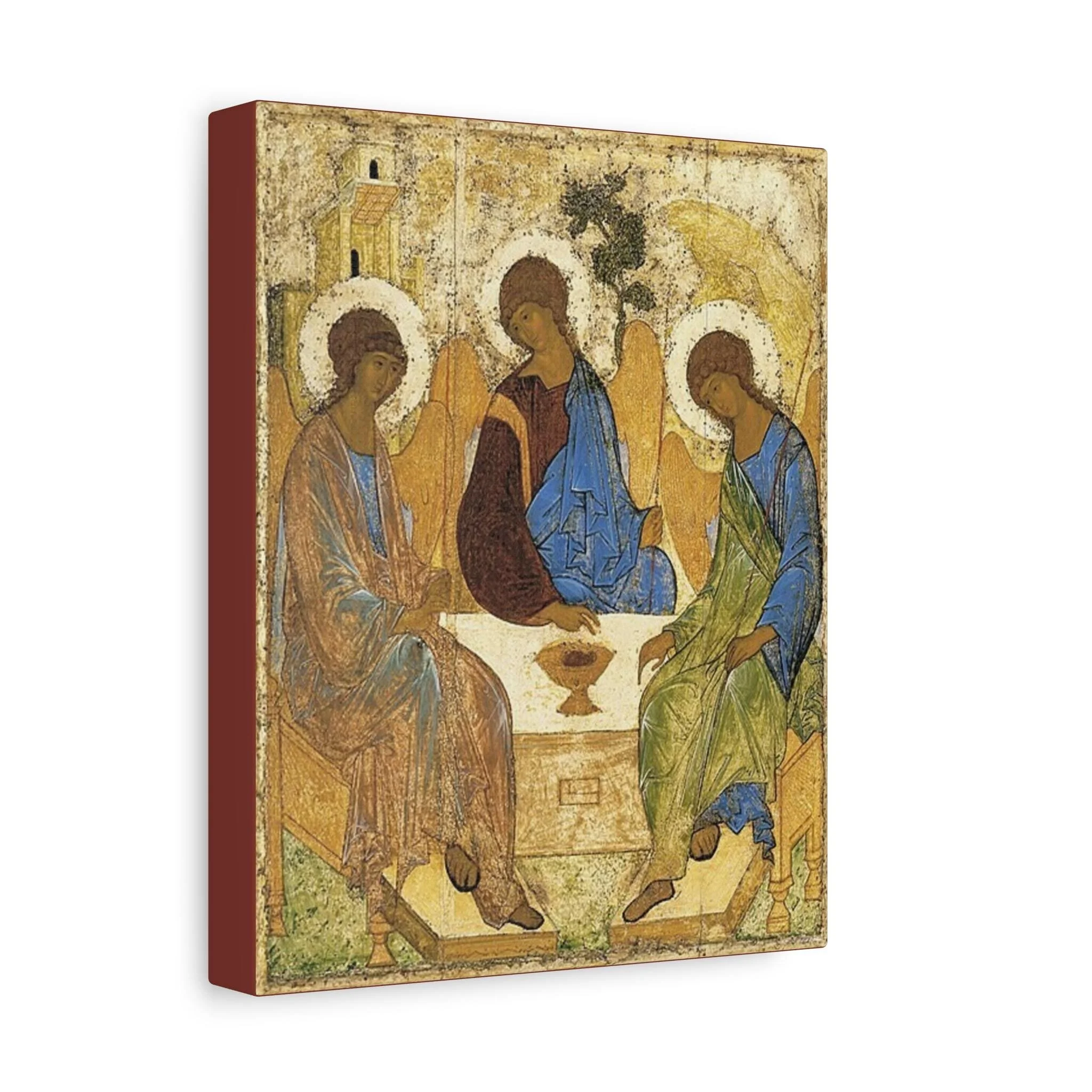
Rendered in warm gold tones with the delicate texture of traditional iconography, this canvas invites prayer, contemplation, and stillness. Every gesture and color carries meaning, making it a profound focal point for home chapels, prayer corners, churches, or contemplative spaces.
Printed on a durable matte canvas, the artwork preserves the reverence and depth of the original icon while offering exceptional clarity and long-lasting color. This piece is suited for gifting, devotional use, or as a striking sacred centerpiece in any Christian home.
Product features
- Matte cotton-poly canvas with unique high-quality coating for crisp image detail
- Stretched on 1.25" radiata pine frame from FSC-certified renewable forests
- Printed with non-toxic, UL-certified Greenguard Gold latex inks
- Soft rubber dots on back corners plus included hanging hardware for secure, level display
- Available in horizontal, vertical, and square formats across 60 sizes (±1/8" tolerance)
Care instructions
- If the canvas does gather any dust, you may wipe it off gently with a clean, damp cloth.
EU representative: HONSON VENTURES LIMITED, gpsr@honsonventures.com, 3, Gnaftis House flat 102, Limassol, Mesa Geitonia, 4003, CY
Product information: Generic brand, 2 year warranty in EU and Northern Ireland as per Directive 1999/44/EC
Care instructions: If the canvas does gather any dust, you may wipe it off gently with a clean, damp cloth.
The Armenian Church in the Modern World
Armenia After Soviet Rule
The Republic of Armenia, independent since the dissolution of the Soviet Union in 1991, is a predominantly Armenian Apostolic Christian country, with the Armenian church playing a significant role in the country's cultural and national identity. The Soviet period (1920–1991) was a deeply difficult one for the church: the Bolsheviks closed monasteries, confiscated church property, suppressed religious education, and executed or imprisoned clergy. The Catholicate at Etchmiadzin survived under Soviet rule, but under significant constraints and with varying degrees of accommodation to Soviet requirements. Since 1991, the church has undergone a significant revival: churches have been restored, religious education has been reestablished, and the church plays an active and sometimes powerful role in Armenian public and political life.
The relationship between the Armenian Apostolic Church and the state in independent Armenia raises complex questions about the proper role of a national church in a pluralistic society, questions that the Armenian church and Armenian civil society are still working through. The church's position as the institutional embodiment of national identity gives it an influence that sometimes strains the boundaries of appropriate ecclesiastical engagement with secular politics, while its deep roots in the community give it a pastoral presence and a moral authority that secular institutions lack.
The Ecumenical Position of the Armenian Church
Today, the Armenian Apostolic Church is a member of the World Council of Churches and participates actively in multilateral ecumenical conversations. Its most significant ongoing dialogues are with the Roman Catholic Church and with the Eastern Orthodox churches, as described above. The Armenian Catholic Church, meanwhile, participates in the life of the Roman Catholic Church while maintaining its distinctive Eastern tradition.
The Armenian church has been particularly active in the dialogue with Rome. Pope John Paul II visited Armenia in 2001 and signed a joint declaration with Catholicos Karekin II acknowledging the deep spiritual unity between their churches and expressing hope for eventual full communion. Pope Francis's 2016 visit to Armenia was similarly marked by declarations of solidarity and deep mutual respect. A joint declaration signed by the two leaders at Etchmiadzin expressed shared confession of Christ and shared commitment to Christian unity.
These dialogues have not yet produced full communion — the theological, canonical, and practical questions involved are enormously complex — but the trajectory is one of deepening mutual recognition and shared testimony. The recognition of Gregory of Narek as a Doctor of the Universal Church is perhaps the most concrete and significant gesture in this direction, acknowledging that a non-Chalcedonian Armenian monk and mystic who lived in the eleventh century has something essential to teach the entire Catholic Church.
The Living Tradition
To be Armenian and Christian in the twenty-first century is to inhabit a tradition of extraordinary depth, a tradition formed in the crucible of suffering and the grace of beauty, carrying in its liturgical life the sounds and words of fifteen centuries, carrying in its art the carved prayers of medieval stone-cutters, carrying in its calendar the memories of martyrs and saints who died for the faith that the congregation recites each Sunday.
The Armenian Christian tradition is neither simply "Oriental Orthodox" (though it is that), nor simply "Catholic" (though a significant portion of its members are Catholic), nor simply "Eastern" (though it is deeply Eastern in its theological and liturgical instincts). It is uniquely itself — formed by the specific geography of the Armenian highland, by the specific history of the Armenian people, by the specific genius of the Armenian language and alphabet, and by the specific weight of a martyrdom that encompasses both the ancient warriors of Avarayr and the modern victims of 1915.
What persists across the centuries, through every disaster and every displacement, is the Badarak — the Sacrifice — the community gathered around the altar, the priest in his ancient vestments, the Grabar prayers ascending in their ancient melodies, the bread and wine becoming what the tradition has always claimed they become. This is the center of Armenian Christianity, and it has never been extinguished.
The Narek of Gregory of Narek — that terrifying, beautiful, inexhaustible book of prayer — contains a passage that serves as an appropriate final word for any account of this tradition: "In the name of the Father, Son, and Holy Spirit, I, Gregory, the servant of God, sinner among sinners, having gathered together with labor and toil, having learned from books and from experience, and having reflected in my heart, I have written these prayers..." He wrote them into the darkness, toward the light, in the language that Mesrop Mashtots had given to a people so that they might always have words — Armenian words, their own words — in which to speak to God.
That conversation, begun seventeen centuries ago at the foot of Mount Ararat, has never ceased.
This article has drawn on primary Armenian ecclesiastical sources, the works of major scholars of Armenian Christianity including Robert Thomson, Nina Garsoïan, Vrej Nersessian, Abraham Terian, Aram Topchyan, and Krikor Maksoudian, as well as the theological documents produced by the Armenian Apostolic Church, the Armenian Catholic Church, the Holy See, and the Joint Theological Commissions of the Oriental Orthodox and Eastern Orthodox churches.