Reading List • Church Fathers • Modern Elders • Available on Amazon
Books by Orthodox Saints: Every Saint's Book Worth Reading, Ranked by Influence
54 books by 34 saints and saint groups, from the Church Fathers to the elders of our own time. Each entry tells you who the saint was, what the book covers, and why it matters.
As an Amazon Associate we earn from qualifying purchases. The links below are affiliate links, and they cost you nothing extra.
The saints of the Orthodox Church did not only live holy lives. Many of them wrote, and their books have been copied, translated and read for centuries. This guide gathers the ones you can find on Amazon today, ordered by how widely they have shaped Orthodox life, beginning with the books that nearly every Orthodox Christian knows and ending with the quieter voices of the last century.
The list covers both ancient Fathers such as Athanasius, Basil and Chrysostom, and canonized saints of modern times such as Paisios, Porphyrios and Sophrony. Where a book is a collection of a saint's teachings gathered by disciples, rather than something he wrote himself, we say so plainly. We chose the best available English edition of each title, preferring the translations that Orthodox monasteries and publishers recommend.
John spent most of his life as a monk at the foot of Mount Sinai, first as a disciple of an elder and later as a hermit in a cell some distance from the monastery. In his old age the monks of Sinai chose him as abbot. A fellow abbot asked him to write down the wisdom of his years, and the result became the most widely read book of monastic life in the Christian East.
Book 1 of 54
The Ladder of Divine Ascent
Thirty chapters, one for each year of the hidden life of Christ, describe the steps from renunciation of the world to love. He names the passions, the virtues that heal them, and the traps that await the proud. It is read aloud in Orthodox monasteries every Great Lent, and it is the book most often recommended to a serious beginner who wants to understand repentance, humility and prayer.
Athanasius attended the Council of Nicaea as a young deacon and spent the rest of his life defending its teaching that the Son is fully God. He was exiled five times by emperors who favored the Arians, and he is called the Father of Orthodoxy for refusing to give way. He also wrote the life of his friend Saint Antony and helped spread monasticism across the world.
Book 2 of 54
On the Incarnation
Written when he was still young, this short treatise asks why God became man and answers it with clarity that has not been surpassed. It explains the Cross, the Resurrection and the idea that God became man so that man might become god by grace. Many readers say it is the best single book to begin reading the Fathers.
The first great Christian biography tells the story of Saint Antony of Egypt, the father of monks, and his struggle against the demons in the desert. It shaped nearly every later saint's life and is the source of the monastic movement in the West as well as the East. The volume also includes Athanasius on how to pray the Psalms.
Saints Nikodemos the Hagiorite and Makarios of Corinth
Nikodemos 1749 to 1809, Makarios 1731 to 1805 • Compilers of the Philokalia
Saint Makarios, Metropolitan of Corinth, gathered the great ascetic texts of the Fathers from manuscripts on Mount Athos and asked the monk Nikodemos to edit them. Nikodemos, a tireless scholar who lived on the Holy Mountain, shaped the collection and published it in Venice in 1782. It spread through Greece and Russia and sparked a renewal of the Jesus Prayer.
Book 4 of 54
The Philokalia, Volume 1
This is the first volume of the English translation of a collection that runs from the fourth to the fifteenth century. It includes Saint Antony, Evagrius, Cassian and Saint Mark the Ascetic, all on stillness, watchfulness and the inner life. It is not an easy read, but it is the foundation of Orthodox spirituality as it has been lived on Athos and in the Russian forests.
Isaac was briefly made bishop of Nineveh in the Persian lands, and after only a few months he left the office for the desert and lived as a hermit in the mountains of Khuzistan. He wrote in Syriac. His homilies were translated into Greek and then into Slavonic and Arabic and became treasured by monks across the whole Christian world.
Book 5 of 54
The Ascetical Homilies of Saint Isaac the Syrian
Eighty-six homilies on repentance, silence, tears and the mercy of God. His famous description of a merciful heart, one that burns for all creation including the demons, has comforted countless readers. This hardcover edition from Holy Transfiguration Monastery is the standard English translation of the Greek text.
John was born in Antioch and trained as a rhetorician before living as a monk. He became so famous for preaching that he was given the name Chrysostom, which means golden mouth. As archbishop of Constantinople he challenged the luxury of the court and was exiled twice. He died on a forced march to the edge of the empire. The Divine Liturgy used in most Orthodox churches bears his name.
Book 6 of 54
Six Books on the Priesthood
A dialogue written early in his life about the greatness and the terrible weight of pastoral ministry. It remains a classic for clergy and for any lay reader who wants to understand what a priest is and why the Church takes the office so seriously.
A collection of his sermons on money, wealth and the poor. Chrysostom is blunt about greed and generous in describing how almsgiving heals the soul. It is among the most practical of the Fathers for modern life.
Written in exile, this book comforts those who suffer by explaining that God is not absent in hard times. It is a good companion for anyone going through loss, injustice or grief.
Born Arsenios Eznepidis in Cappadocia, he grew up in Greece and served as a radio operator in the army before becoming a monk on Mount Athos. He lived as a hermit and received thousands of visitors who came for counsel, healing and a word of encouragement. He was glorified by the Ecumenical Patriarchate in 2015 and is among the most loved saints of the modern Church.
Book 9 of 54
Spiritual Counsels I: With Pain and Love for Contemporary Man
His own words, gathered from talks and conversations, on faith, the modern world and how Christians should respond to its troubles. Short, warm and often funny, it is a very accessible entry to his thought.
His teaching on how to pray, on the Jesus Prayer, and on the sort of prayer that comes from a humble heart. A good book to read next to the Philokalia.
A Serbian monk and later archimandrite, Thaddeus suffered under the Communist regime and spent his last decades at the monastery of Vitovnica, where he counseled pilgrims with great humility. His sayings, which stress love, forgiveness and guarding the thoughts, are among the most quoted of modern Orthodox elders. He was glorified by the Serbian Orthodox Church.
Book 14 of 54
Our Thoughts Determine Our Lives: The Life and Teachings of Elder Thaddeus of Vitovnica
This is a life and teachings book, with his sayings gathered and arranged by a disciple rather than written by him in a treatise. It has become a bestseller in Orthodox circles because it is warm, simple and deeply practical. The central idea, that what we think shapes who we are, is explained with stories from his life.
A monk of Mount Athos who later became archbishop of Thessalonica, Gregory defended the hesychast monks against critics who said that no one could truly know God. He taught the distinction between God's essence, which no one can approach, and His energies, in which we truly share. His teaching was confirmed by councils in Constantinople and has shaped Orthodox theology ever since.
Book 15 of 54
The Triads
His main defense of the hesychasts, in Classics of Western Spirituality. It is demanding reading, but it sets out in his own words the Orthodox teaching on the vision of divine light and on how the human body, as well as the soul, takes part in prayer.
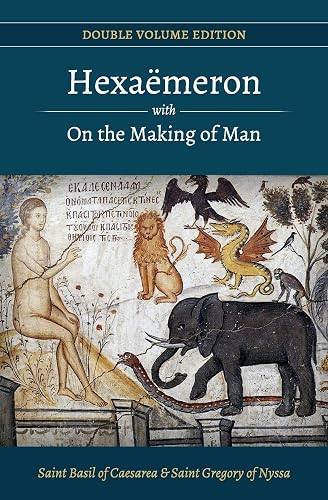
Basil came from a family of saints, studied in Athens beside Saint Gregory the Theologian, and founded monastic communities in Cappadocia. As archbishop of Caesarea he built a great charitable complex for the poor and the sick and defended the Nicene faith. His monastic rules still govern much of Orthodox monastic life.
Book 16 of 54
Hexaemeron, with On the Making of Man
His nine homilies on the six days of creation, paired with the treatise on the making of man traditionally attributed to his brother Gregory of Nyssa. They show how the Fathers read Genesis, with wonder at nature and a clear sense that creation points to its Maker.
The younger brother of Saint Basil, Gregory was one of the most original thinkers of the early Church. He was bishop of Nyssa, was exiled by Arian emperors, and helped complete the Creed at the Council of Constantinople. His writings combine philosophy with mystical depth.
Book 17 of 54
The Life of Moses
A spiritual reading of the story of Moses as the soul's journey toward God. Gregory teaches that the perfection of the Christian life is never reaching an end but always going further. It is one of the most influential works of mystical theology in Christian history.
A monk and former imperial secretary, Maximus defended the teaching that Christ has both a divine and a human will. For this he was put on trial, had his tongue cut out and his right hand cut off, and died in exile. He is called the Confessor because he held the faith under torture, and his works shaped later Byzantine theology.
Book 18 of 54
Two Hundred Chapters on Theology
Short, dense chapters on God, creation, the Incarnation and the human person. They reward slow reading and repeated returns.
A short and much-loved work on love as the center of the spiritual life, in the form of brief sayings meant to be read slowly and prayed over. A good place to begin with Maximus.
Born in Kursk, Seraphim entered the monastery of Sarov, lived for years as a hermit in the forest, and spent a thousand days and nights in prayer on a rock. After years of silence he received visitors with a joyful greeting, Christ is risen, my joy. He taught that the aim of the Christian life is the acquisition of the Holy Spirit.
Book 20 of 54
Little Russian Philokalia: Saint Seraphim of Sarov
A short collection of his spiritual instructions, translated by the Saint Herman Brotherhood, with his conversation with Motovilov about the Holy Spirit and other teachings. It is a brief and inspiring way into Russian spirituality.
John served in the court of the Muslim caliph in Damascus before becoming a monk at Mar Saba near Jerusalem. He wrote the first summary of Orthodox doctrine, composed hymns still sung at Pascha, and defended the veneration of holy images when the emperor attacked them.
Book 21 of 54
Three Treatises on the Divine Images
His three defenses of icons. He argues that since God became visible in Christ, it is right to depict Him. This is the root of the Orthodox understanding of icons.
A Byzantine monk and abbot who taught that every Christian can and should experience the Holy Spirit in a conscious way. His sermons caused controversy, he was exiled for a time, and he remains one of the most intense voices in Orthodox tradition. He is one of only three saints called Theologian.
Book 22 of 54
The Discourses
Sermons given to his monks on repentance, the sacraments and the vision of divine light. Classics of Western Spirituality.
A deacon in Nisibis and then in Edessa, Ephrem wrote hymns, commentaries and homilies in Syriac. He is called the Harp of the Holy Spirit and is honored by many Christian traditions. The Lenten prayer of Saint Ephrem is prayed in Orthodox churches throughout the fast.
Book 24 of 54
Hymns on Paradise
Fifteen hymns on the garden of Eden and the paradise to come. Ephrem uses symbol and image to describe a world where heaven and earth are united. A beautiful place to meet the Syriac tradition.
A young army officer who became a monk, Ignatius later served as bishop in the Caucasus and Black Sea region before retiring to a monastery to write. He was a careful reader of the Fathers who warned against false spiritual excitement and gave sound guidance for Christians in the modern world.
Book 25 of 54
On the Prayer of Jesus
A guide to the Jesus Prayer, based on the Fathers and on his own experience. It is one of the clearest short books for those who want to begin.
Saint Nikodemos the Hagiorite and Saint Theophan the Recluse
Nikodemos 1749 to 1809, Theophan 1815 to 1894 • Editor and Spiritual Writer
Saint Nikodemos adapted an Italian Catholic book and turned it into a classic of Orthodox spiritual struggle, and Saint Theophan the Recluse later revised it for Russian readers. Theophan was a bishop who withdrew to a cell for his last decades and taught countless people through letters.
Book 28 of 54
Unseen Warfare
A manual of the inner struggle, with practical help for resisting temptation, trusting God rather than ourselves, and keeping peace of heart. Favored by many Orthodox spiritual fathers.
A Greek monk and priest who had little formal schooling, Porphyrios served as chaplain at a hospital in Athens and was known for his gift of insight and for his joyful love of Christ and of nature. He taught that we should love God and not simply fear Him. He was glorified in 2013.
Book 30 of 54
Wounded by Love: The Life and Wisdom of Elder Porphyrios
This is a compilation of his life and teachings gathered by disciples, not a book that he wrote himself. It is popular because of his simplicity, his tenderness and his teaching that we grow by loving Christ rather than by fighting ourselves.
Saint Sophrony of Essex and Saint Silouan the Athonite
Silouan 1866 to 1938, Sophrony 1896 to 1993 • Athonite Elder and His Disciple
Silouan was a Russian peasant who became a monk on Mount Athos and heard the words, Keep thy mind in hell, and despair not. His simple, humble teaching on loving even our enemies has touched many. His disciple Sophrony, a former painter, preserved his writings and founded a monastery in Essex, England.
Book 31 of 54
Saint Silouan the Athonite
The life and teaching of Silouan written by his disciple Sophrony, including his own writings. One of the most important Orthodox books of the twentieth century.
A married parish priest in the port city of Kronstadt, John served the poor and the sick, celebrated the liturgy almost every day and was believed to heal by prayer. Millions saw him in his lifetime, and his diary is a rare book in which a parish priest opens his inner life.
Book 35 of 54
My Life in Christ
His spiritual journal, made up of his daily thoughts on prayer, the Eucharist, and love for neighbor. A classic of Russian piety that shows how a married parish priest can reach the heights of holiness.
A disciple of Saints Barsanuphius and John, Dorotheos founded his own monastery near Gaza. His instructions are warm, practical and well suited to people who must live with others.
Book 36 of 54
Discourses and Sayings
Short talks for his monks on humility, conscience, judging others and how to live in community. Many readers find him the most approachable of the desert writers.
Cassian lived among the monks of Egypt and brought their teaching to the West, founding monasteries in southern Gaul. Saint Benedict recommended his writings to his monks, and they shaped Western monasticism.
Book 37 of 54
The Conferences
Twenty-four conversations with the desert fathers on prayer, discernment, chastity and the goal of the monastic life. Many of the great sayings of the desert come from this book.
Cyril was bishop of Jerusalem during years of dispute and was exiled more than once. His lectures to new converts are the earliest detailed account of how baptism, chrismation and the Eucharist were celebrated in Jerusalem.
Book 38 of 54
Lectures on the Christian Sacraments
Cyril's talks to the newly baptized. They explain the rites of Holy Week and the sacraments and show how the early Church understood them.
A disciple of Saint Polycarp, who knew the apostle John, Irenaeus became bishop of Lyons in Gaul. He defended the apostolic faith against Gnostic teachers and is among the earliest voices to treat the whole Scripture as one story of salvation.
Book 39 of 54
Against Heresies
His major work, which sets out the teaching of the apostles against the Gnostics. It is a foundational book on tradition, the Incarnation and the unity of the Church.
Saint Gregory the Theologian (Gregory of Nazianzus)
c. 329 to 390 • Archbishop of Constantinople
A friend of Saint Basil and a gifted poet and orator, Gregory served briefly as archbishop of Constantinople and presided over part of the Council of 381. He is one of only three saints called Theologian.
Book 40 of 54
Five Theological Orations
The sermons that earned him the title Theologian. They defend the divinity of the Son and the Holy Spirit and are among the clearest statements of the Trinity.
Macarius was a disciple of Saint Antony and a priest in the Egyptian desert of Scetis. The homilies that bear his name come from a Syrian monastic setting, and scholars now often call the author Pseudo-Macarius, but the Orthodox Church has long read them under his name.
Book 41 of 54
Fifty Spiritual Homilies
Homilies on the heart as the place where the Spirit works, on prayer, and on the power of grace. They have been read in the Orthodox Church for more than a thousand years.
Theodore reformed the monastery of Stoudios in Constantinople and made it the model for later monastic life. He suffered beatings and exile for defending icons.
Book 43 of 54
On the Holy Icons
Three defenses of the veneration of holy images, written during the second period of iconoclasm.
A Greek bishop who was slandered and dismissed from his see, Nektarios lived in poverty, taught in a seminary, and founded a convent on the island of Aegina. He is greatly loved for his humility and his many miracles. He was glorified in 1961.
Book 44 of 54
Know Thyself
His short book about self-knowledge, humility and the beginning of the spiritual life.
A Serbian monk and professor, Justin spent most of his life under Communism, forbidden to teach. His books tie the faith of the Fathers to the questions of modern man. He was canonized in 2010.
Book 47 of 54
Man and the God-Man
A collection of essays arguing that the Incarnation is the center of all human existence.
A Greek monk and elder on Mount Athos, Joseph practiced the Jesus Prayer in great silence with a small group of disciples. Many leading monks of today trace their lineage to him.
Book 49 of 54
Monastic Wisdom: The Letters of Elder Joseph the Hesychast
Letters to his disciples about prayer, obedience and watchfulness. It is one of the best looks inside the life of a modern hesychast.
A bishop in Voronezh who left his see for health and lived in a monastery at Zadonsk, where he ministered to the poor. His writings influenced many Russian writers.
Book 50 of 54
Journey to Heaven
Counsels on the Christian life, drawn from his sermons and letters.
Bishop of Ohrid and Zica, Nikolai was imprisoned at Dachau during World War II and later lived in exile in the United States, where he died. He is loved for his sermons and poems. He was canonized in 2003.
Book 51 of 54
The Prologue of Ohrid
A day-by-day book of saints' lives, hymns, reflections and homilies for the whole year. This is the Kindle edition.
A surgeon who wrote an important textbook on surgery, Luke became a priest and then a bishop. He spent years in Soviet prisons and exile, yet continued to treat patients and to preach. He was glorified in 2000.
Book 53 of 54
Spirit, Soul, Body
His reflections on how the human person is made of spirit, soul and body, written by a doctor and bishop.
What are the best books by Orthodox saints for beginners?
Start with On the Incarnation by Saint Athanasius, The Ladder of Divine Ascent by Saint John Climacus, and Our Thoughts Determine Our Lives, which gathers the teaching of Saint Thaddeus of Vitovnica. For prayer, add The Arena or On the Prayer of Jesus by Saint Ignatius Brianchaninov.
What is the most famous book written by an Orthodox saint?
The Ladder of Divine Ascent by Saint John Climacus is usually named as the most read, since it is read aloud in Orthodox monasteries every Great Lent and has been copied and translated for more than thirteen centuries.
Are all of these books written by the saints themselves?
Most are. A few are collections of their teachings gathered by disciples, such as the books on Elder Paisios, Saint Porphyrios and Saint Thaddeus. The Philokalia is a collection of texts by many Fathers that Saints Nikodemos and Makarios compiled. We note this in each entry.
Which book by an Orthodox saint is best for prayer?
The Philokalia, On the Prayer of Jesus by Saint Ignatius Brianchaninov, Spiritual Counsels VI: On Prayer by Saint Paisios, and On Prayer by Saint Sophrony are the usual recommendations.
Which books are best for Great Lent?
The Ladder of Divine Ascent is traditional Lenten reading. Saint Isaac the Syrian's Ascetical Homilies, Saint Nektarios on Repentance and Confession, and Saint Nektarios on the Holy Cross also suit the fast.
Are there modern Orthodox saints with books in English?
Yes. Saint Paisios, Saint Porphyrios, Saint Sophrony, Saint Justin Popovich, Saint Nikolai Velimirovic, Saint Luke of Crimea, Saint Nektarios and Saint Joseph the Hesychast all have English books on Amazon.
Do you earn money if I buy through these links?
Yes. As an Amazon Associate we earn from qualifying purchases at no extra cost to you. That income helps support the work of this site.
These books have fed generations of Christians. Choose one, read a few pages each day, and let the saint teach you. Every link above goes to Amazon, and each purchase helps support this ministry.
As an Amazon Associate we earn from qualifying purchases.
The work here is about bringing little-known saints to light, so their holiness can stand as an example for the whole world. If you'd like to support this mission, please consider purchasing a prayer card. This site was never just about the cards themselves — they're the way I help fund the research and documentation of saints both known and forgotten.
If buying a card to support the work isn't possible for you right now, could I ask you for something else instead? A prayer. I love our Heavenly Father, and I would only ask that you pray I might love Him more.
Lord Jesus Christ, Son of God, please have mercy on me, a horrible sinner.