Eastern Catholic News • Ukraine • Ecumenism • November 17, 2026
Khust Ecumenical Conference: Why Does God Permit Suffering, and What Do Christians Owe Victims of War?
Clergy and laypeople of several Christian churches gathered in Khust, in Transcarpathia, to ask three questions: Where is God? Where is the human being? What is the Church called to do? Here is what the Ukrainian Greek Catholic Church reported, and the Christian tradition behind each question.
The Khust Conference at a Glance
- Title
- “Questions War Asks: On Faith, Evil, Justice and Hope” (our translation of the Ukrainian title)
- Where
- Khust, Zakarpattia (Transcarpathia), Ukraine
- When
- November 17, 2026 (UGCC report published the same day)
- Blessing
- Bishop Theodor Matsapula, Eparch of Mukachevo
- Organizers
- UGCC Commission for Interconfessional and Interreligious Relations; Ecumenical Commission of the Mukachevo Eparchy; Institute of Ecumenical Studies of the Ukrainian Catholic University
- Main speakers
- Fr. Ihor Shaban and Fr. Roman Fihas
- Round table opened by
- Protopresbyter Volodymyr Babych, coordinator of the Ecumenical Council of Churches of the Khust community
- Ended with
- A joint prayer for Ukraine, the army and a just peace
What Was Reported
On November 17, 2026, clergy of several Christian churches, laypeople, representatives of local government, lecturers and public figures met in Khust, in Ukraine's Transcarpathian region, for an ecumenical conference on the challenges of war for Christians. The Ukrainian Greek Catholic Church reported on it the same day. The title, in our translation, is “Questions War Asks: On Faith, Evil, Justice and Hope.”
It was held with the blessing of Bishop Theodor Matsapula, Eparch of Mukachevo, and organized by the UGCC Commission for Interconfessional and Interreligious Relations, the Ecumenical Commission of the Mukachevo Eparchy and the Institute of Ecumenical Studies of the Ukrainian Catholic University. Its purpose, per the report, was to reflect theologically on the challenges of war and to find ways for the churches to cooperate.
The format was two main reports, a round table on the pastoral experience and social effects of the war, and an open discussion. Fr. Ihor Shaban, head of the UGCC Commission, and Fr. Roman Fihas, director of the Institute of Ecumenical Studies at the Ukrainian Catholic University, gave the main reports. Mitrophoric Protopresbyter Volodymyr Babych, coordinator of the Ecumenical Council of Churches of the Khust community, opened the round table, and six short presentations followed. The report does not name those speakers.
The UGCC report is in Ukrainian and does not quote speakers directly. This article summarizes it in English and does not put words in anyone's mouth. Where we add background from Christian tradition, we say so.
Part II
Three Questions
The central open discussion was organized around three questions, the report says: “Where is God?” “Where is the human being?” and “What is the Church called to do?”
Where is God? The report says participants discussed the problem of evil and the “silence of God” in the face of suffering, and whether people can keep their faith and keep praying after loss. This is the oldest question in the Psalms. The Christian answer, in both East and West, has never been an argument that makes suffering reasonable. It is that God in Christ entered suffering, and that the cross is where God is found. The report says participants held that both theological reflection on suffering and direct presence with those who suffer are needed.
Where is the human being? The question turns toward the person: the victim, the soldier, the displaced, and also the one who does violence. The report does not detail the answers given to this question.
What is the Church called to do? The report's answer, in the final theme, is practical: support those who are hurting, and cooperate across the churches in service.
Part III
Defense, Violence and the Neighbor
The report says the conference discussed Christian attitudes toward violence, self-defense and the just war concept, and where the line lies between nonviolence and passivity when faced with aggression. It says participants considered a Christian's responsibility to protect a neighbor.
For readers new to the subject: the Catholic tradition has long taught that legitimate defense is permitted, and that the use of force is subject to strict conditions, including just cause, proportionality and protection of the innocent. The Catechism of the Catholic Church addresses this in its teaching on legitimate defense. The Orthodox Church has historically honored soldiers who died defending their people while holding that war is always a tragedy. We summarize that tradition as background. The report does not say that the conference adopted a position, and we do not claim it did.
What the report does say is a precise point: participants insisted that Christian calls to love and forgiveness must not be used to excuse aggression or to pressure victims to give up their right to defend themselves.
Part IV
Forgiveness, Truth and Justice
The report says participants discussed forgiveness, repentance and reconciliation, and stressed that true reconciliation cannot be separated from truth, acknowledgment of responsibility and justice.
That is a recognizable Christian position. Forgiveness in the Gospel is a gift from the one wronged and does not wipe out the truth of what was done. Reconciliation requires the wrongdoer to name the wrong. Neither forgiveness nor reconciliation is a command to the victim to be silent, and neither is a license to the aggressor.
Part V
The Church and the Victims of War
The report lists those the Church is called to support: soldiers, the families of the fallen and wounded, internally displaced persons and people in spiritual crisis. Participants called for combining spiritual support with concrete aid and for deeper cooperation among Christian communities in social service, defending human dignity and overcoming social divisions.
The conference ended, the report says, with a joint prayer for Ukraine, the Ukrainian army and a just peace. Organizers described the event as a chance for different Christian traditions to discuss the hard questions of war openly and to look for shared directions for service to Ukrainian society. No formal resolutions are reported.

Part VI
Mukachevo and Blessed Theodore Romzha
Khust is in the Mukachevo Eparchy, the Greek Catholic eparchy of Transcarpathia. Its best-known martyr is Blessed Theodore Romzha, the young bishop of Mukachevo, who was attacked in an apparent staged accident by Soviet authorities in October 1947 and died on November 1, 1947. He was beatified in 2001. For Greek Catholics in Transcarpathia, a conference about faith and violence held in that land is not an abstract exercise: the Church there knows what persecution costs.
For the larger story of how the Soviet state tried to destroy the Ukrainian Greek Catholic Church in 1946, see our articles on Cardinal Josyf Slipyj and on the history of the UGCC.
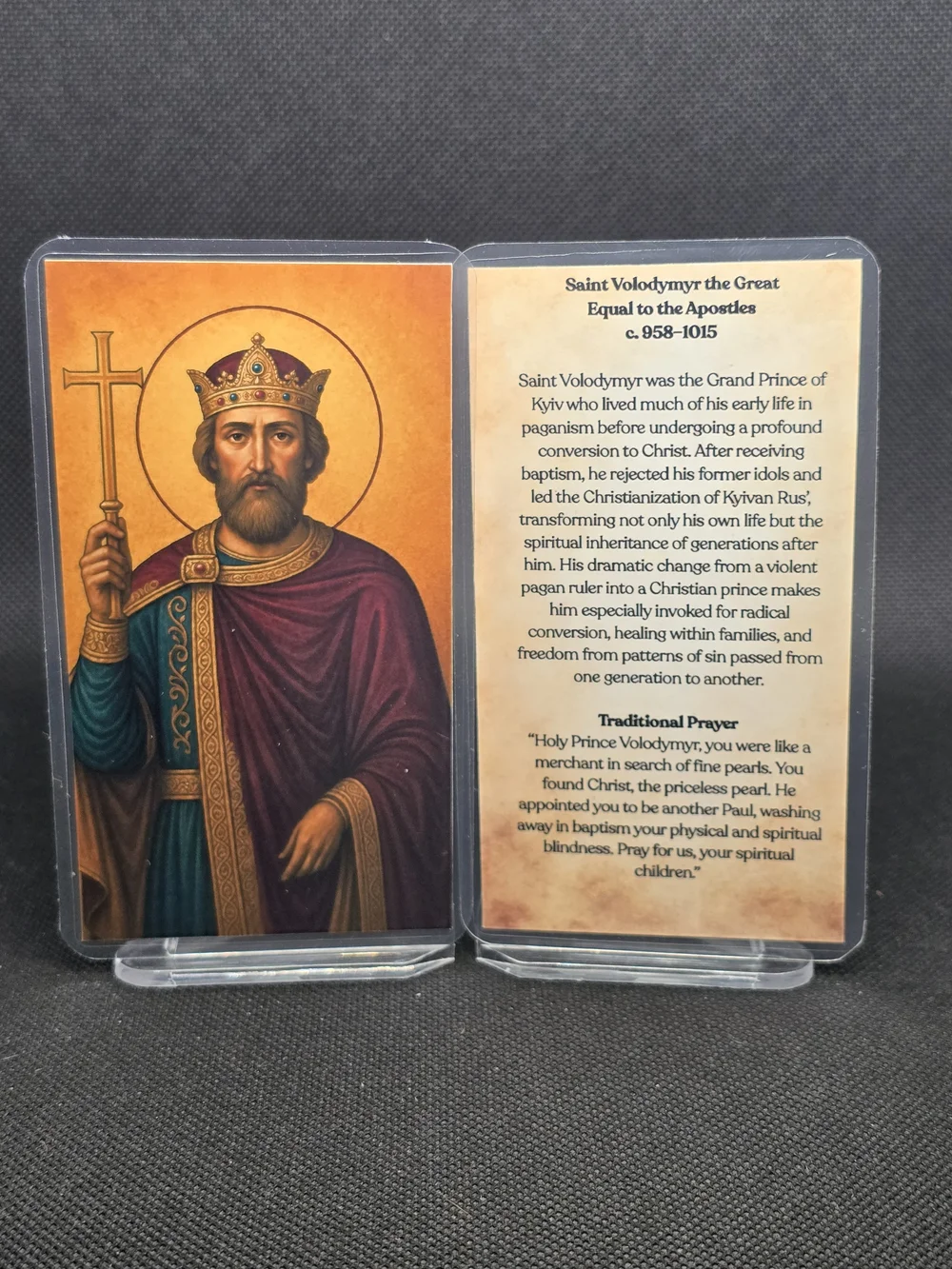
Handmade prayer cards for UGCC saints and a Saint Michael mug and shirt. Prayer cards are handmade; mugs and shirts are print on demand.
Part VII
What the Report Does Not Say
Direct quotes. The report does not quote speakers, so we do not.
The six round-table speakers. They are not named.
The date and place details beyond Khust. The report gives the city but not the venue.
Any resolution. None is reported; it ended in prayer.
The English title. It is our own translation of the Ukrainian.
Lord Jesus Christ, You wept at the tomb of Your friend and You are close to the brokenhearted. Look upon Ukraine. Console the families of the fallen, heal the wounded in body and soul, shelter the displaced, and give strength to those who defend their neighbors. Teach us to forgive without forgetting the truth, and to seek a just peace. Through the prayers of Your Most Pure Mother and of all the saints of the Ukrainian land, have mercy on us and save us. Amen.
Questions That War Asks
In Khust, Christians of several churches sat down to ask where God is, where the human being is, and what the Church is called to do. They ended in prayer. The report claims no final answers, and that is probably honest.
Get the Blessed Theodore Romzha Prayer Card →Sources
- UGCC Department for Information (in Ukrainian): In Khust, an ecumenical conference on the challenges of war for Christians took place (November 17, 2026), the primary source for this article.
- Ukrainian Greek Catholic Church official news site (English) for the Church's English-language coverage.
