Eastern Catholic News • Ukrainian Greek Catholic Church • Technology and the Church • November 2026
Ukrainian Greek Catholic Monastic Communities Begin Practical Training in Artificial Intelligence
Monks and nuns are learning to use AI tools for reports, project coordination and searching internal documents, with firm limits: no confidential data, and spiritual guidance stays with people. Here is what the Church reported, and what it did not.
UGCC Monastics and AI at a Glance
- Reported by
- UGCC Department for Information, November 13, 2026
- Organizer
- The Platform for Social Change, founded by Fr. Mykhailo Melnyk of the Kyiv Archeparchy
- Participants
- Eight teams from UGCC and Roman Catholic monastic and religious communities
- Training began
- November 10, 2026; six practical sessions, independent work and individual consultations
- Earlier webinars
- Sept 24, Oct 8 and Oct 22, free and online
- Limits stated
- No personal, pastoral, medical or other confidential data in AI tools; people keep spiritual guidance, crisis response and management decisions
- Where
- The article does not say
- Status
- A real, reported program; early stage, results not yet published
What the UGCC Reported
On November 13, 2026, the Ukrainian Greek Catholic Church reported that monastic communities had begun practical training in artificial intelligence. The report says the training began on November 10. It is a program of six practical sessions, independent work and individual consultations, built for teams from monastic and religious communities. The report does not say where the sessions take place or whether they are held online or in person.
The program is run by the Platform for Social Change as an AI Accelerator. Before it began, the Platform held three free online webinars for monastic communities. On September 24 the topic was digital communication, including announcements, answering questions and handling feedback. On October 8 it was building an AI assistant from a community's internal materials. On October 22 it was working with donor information, reporting and communicating results.
This is a real, reported training program with a named organizer, named instructors and published limits. It is also small: eight teams. The summary we received called it a developing story rather than a confirmed trend, and that is a fair reading. We report what the UGCC itself published and nothing beyond it.
Part II
Who Is Taking Part
Eight teams are taking part. They represent monastic and religious communities of the Ukrainian Greek Catholic Church and the Roman Catholic Church, per the UGCC report, so the headline claim that this is about UGCC monks and nuns alone is slightly too narrow.
Three people are named. Oleksiy Minakov is the lecturer who teaches the tools and helps teams build first working versions of their solutions. Vladyslav Prysyazhnyuk is the mentor who guides teams as they test and refine them. Fr. Mykhailo Melnyk, a priest of the Kyiv Archeparchy and the founder of the Platform for Social Change, led the ethics component of the earlier webinars.
What the teams build is practical: tools for coordinating projects, preparing reports, searching internal documents, and organizing educational and charitable activities. At the end, teams will present their tools and results, including whether the tools saved time and improved the quality of their work, and the communities will decide how to use and develop them further.
Part III
The Limits Set by the Organizers
The most important sentences in the report are the limits. The organizers say the program stresses responsible use of AI in line with the Church's social teaching. They state, in the report's words:
Human oversight is emphasized throughout. That is the part that answers the obvious worry. The tools are for administration, such as drafting a report or finding a document, and the pastoral and spiritual work stays with people.
Part IV
What the Church Teaches About AI
The Vatican's Antiqua et nova, issued on January 28, 2025 by the Dicastery for the Doctrine of the Faith and the Dicastery for Culture and Education, is the Catholic Church's fullest recent statement on the subject. It argues that AI imitates outputs of human thought by finding statistical patterns, while human intelligence is wider, involving the body, relationships, moral judgment, creativity and openness to truth and goodness. It says humans keep moral responsibility for what AI is used to do, and that final decisions affecting people should not be handed to machines.
It sees real benefits and warns of real harms: deepfakes and misinformation, invasive surveillance, economic concentration, replacing human relationships, and treating AI as a substitute for God. The UGCC program's limits are consistent with that: the tools help with paperwork, and the people keep the pastoral and moral decisions.
The note applies to the whole Catholic Church, Eastern and Latin. The UGCC is an Eastern Catholic church in full communion with Rome, and our article on its history from Brest to today explains the relationship.
Part V
A Parallel Course in Rome
A similar effort was reported from Rome a few weeks earlier. Vatican News reported on October 28, 2026 on a formation course titled “Women's Monasteries in the Age of Artificial Intelligence,” held on October 27 and 28 at the Istituto Maria Santissima Bambina in Rome. It was the first event of the Ad Bonum Facere ETS Foundation, founded in 2025 by monasteries and federations of cloistered nuns.
The speaker, Fr. Philip Larrey, a philosophy professor at Boston College, told Vatican News that AI has little place in the direct relationship with God at the heart of contemplative life, but can help communities with practical tasks such as dealing with real estate agents and lawyers or buying provisions. He warned of “hallucinations,” confident answers with no basis, and urged users to check outputs and verify cited references. According to Vatican News, the course connects to Pope Leo XIV's encyclical Magnifica humanitas.
The two programs are separate, with different organizers, but they show the same pattern: religious communities asking how to use the tools for administration while keeping the interior life human.
Part VI
Why Monastic Communities Might Want This
Monastic communities are often small, with many obligations: accounts, donors, schools, charitable projects, guest houses. In wartime Ukraine, the UGCC's religious communities also carry humanitarian work. The report's own aim, to streamline internal processes so that communities have more time for service, is the reasoning of a community that is stretched.
The Church's older monastic tradition has always wrestled with how much of the world's tools to take in. The early monks wrote with pens, and later monks printed books. The Eastern Christian question has long been the same: does the tool serve prayer, or does it crowd it out? The report answers in its limits. We take it at its word and note that the real test is in the results the teams will present.
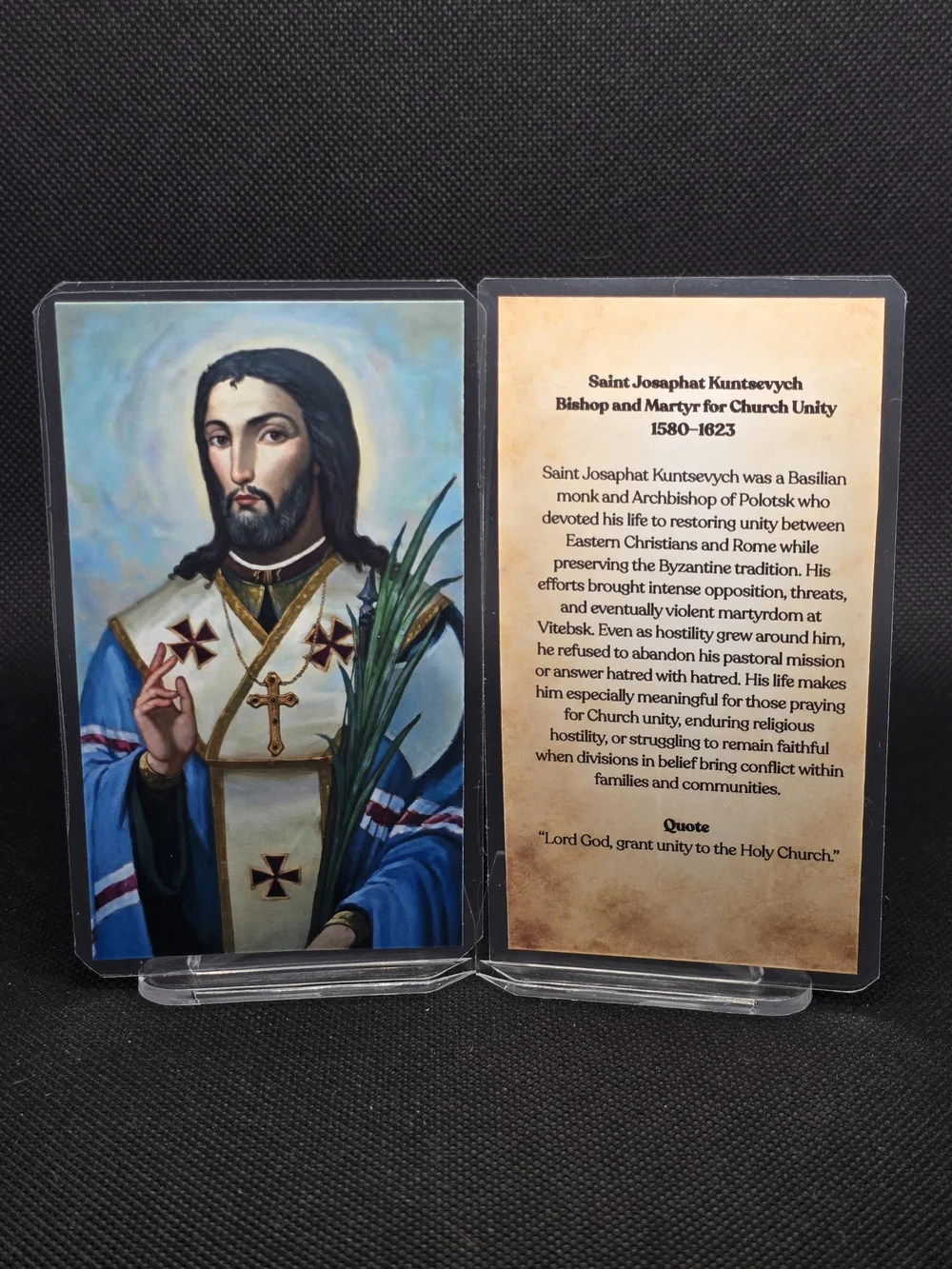
Handmade prayer cards for UGCC saints and blesseds, plus a Jesus Prayer mug and shirt. Prayer cards are handmade; mugs and shirts are print on demand.




Part VII
What Is Not Yet Known
Where and how. The report does not say where the sessions are held or whether they are online.
How many communities. It says eight teams. It does not say how many communities that is in total.
Which tools. The report names no specific products.
The results. Teams will present tools and results at the end. No date or outcome is published yet. We will revisit this article if the UGCC publishes them.
Monks, Nuns and New Tools
Eight teams from two Catholic churches are learning to use AI for the paperwork of religious life, with a clear line drawn around confidential data and spiritual guidance. It is a modest program with clear limits. How it works out is still to be reported.
Get the Blessed Josaphata Prayer Card →Sources
- UGCC Department for Information: Monastic Communities of the Ukrainian Greek Catholic Church Begin Practical Training in the Use of Artificial Intelligence (November 13, 2026), the primary source.
- Dicastery for the Doctrine of the Faith and Dicastery for Culture and Education: Antiqua et nova, Note on the Relationship Between Artificial Intelligence and Human Intelligence (January 28, 2025).
- Vatican News: Dr. Philip Larrey on monastic life and the proper use of AI (October 28, 2026), on a course for women's monasteries in Rome.
- Ukrainian Greek Catholic Church official news site for the Church's own reporting.
