What Does the Orthodox Church Believe About UFOs?
Orthodox Theology • Spiritual Warfare • Patristic Discernment • Fr. Seraphim Rose • Fr. Spyridon Bailey
What Does the Orthodox Church Believe About UFOs?
The Orthodox Church is the only institution in the modern world with seventeen centuries of documented, categorized experience with exactly what UFO researchers are describing. This is not a new phenomenon. The Church Fathers named it, analyzed it, and left detailed instructions for how to survive it.
“The UFO phenomenon is a sign to Orthodox Christians to walk all the more cautiously and soberly on the path to salvation, knowing that we can be tempted and seduced not merely by false religions, but even by seemingly physical objects which catch the eye.”— Fr. Seraphim Rose • Orthodoxy and the Religion of the Future • 1975
Jump to a Section
The Question No One in the Modern World Can Answer — Except the Orthodox Church
Every few years, the question forces its way back into public consciousness. Senate hearings. Military pilots on the record. Declassified footage. Government officials using the word "non-human." The world's most sophisticated instruments tracking objects that defy the known laws of physics. And always, underneath the data and the press conferences and the theories, the same question that none of the scientists and none of the governments have ever been able to answer: what are these things, and what do they want?
The Orthodox Church has an answer. It is not a new answer — it was developed in detail by Fr. Seraphim Rose in 1975, in a book called Orthodoxy and the Religion of the Future, and it draws on a tradition of spiritual discernment that goes back to the desert fathers of 4th-century Egypt. The answer is not popular in secular circles, and it is not designed to be. It is designed to be true. And the more the secular world documents the UFO phenomenon in clinical detail, the more precisely its findings match what the Church Fathers described seventeen centuries ago when they wrote about the beings they called the aerial spirits, the demons of the air, the princes and powers of the atmosphere.
This article explains the Orthodox theological position on UFOs — what it is, where it comes from, who developed it, and why it explains what no purely materialist framework ever has. It also introduces the two books that any Orthodox Christian or serious inquirer should read on this subject: Fr. Seraphim Rose's foundational analysis, and Fr. Spyridon Bailey's comprehensive modern expansion of it.
One note before we begin. The Orthodox Church does not dismiss the reality of the UFO phenomenon. Fr. Seraphim Rose, Fr. Spyridon Bailey, and the patristic tradition they draw on all affirm that these encounters are real, that the beings involved have genuine power, and that treating them as mere psychological projections or weather balloons is as naive as treating demonic possession as a psychiatric disorder. The question is not whether these things are real. The question is what kind of real they are.
Orthodoxy and the Religion of the Future — Fr. Seraphim Rose

Written in 1975 by Hieromonk Seraphim Rose of Platina, California, Orthodoxy and the Religion of the Future is one of the most prophetic Orthodox books of the 20th century — and its chapter on UFOs, titled "Signs from Heaven: An Orthodox Christian Understanding of Unidentified Flying Objects," remains the clearest and most patristically grounded treatment of the subject ever written.
Fr. Seraphim Rose did not set out to write a book about UFOs. He set out to document what he saw as the emergence of a new global religion — a post-Christian spirituality assembling itself from yoga, Transcendental Meditation, New Age channeling, the charismatic movement, and the growing conviction among millions of people that contact with extraterrestrial intelligence represented humanity's next spiritual evolution. What he recognized, drawing on his exhaustive study of the Church Fathers, was that the entire phenomenon — including and especially the UFO encounters — fit perfectly into the patristic taxonomy of demonic activity. The beings were real. The experiences were real. The source was exactly what the Fathers had described.
His conclusion was not a metaphor. He identified UFOs specifically as what the Church Fathers called the aerial spirits — the fallen angels who, according to Orthodox cosmology, inhabit the atmosphere and whose primary activity is the deception of human souls. In a culture that had abandoned belief in demons, these beings had adopted a new form. They appeared not as angels or spirits but as technologically advanced beings from other planets, communicating a message perfectly calibrated to the spiritual hunger and the materialist assumptions of the modern world. The form had changed. The message and the mission had not.
Fr. Seraphim Rose was born Eugene Rose in 1934 in San Diego, a child of no religious background who became one of the most serious scholars of Eastern Orthodox theology in American history. He was tonsured as a monk in 1968, ordained to the priesthood in 1977, and died in 1982 at the age of 48. He is currently in the process of being formally glorified as a saint by the Russian Orthodox Church Outside of Russia — the Council of Bishops blessed the process of preparing his ecclesiastical glorification in May 2026, and many Orthodox Christians across multiple jurisdictions already venerate him as St. Seraphim of Platina. The book that identified UFOs as demonic deception in 1975 was written by a man whom the Church is in the process of formally recognizing as holy.
The permanent #1 position in Comparative Religion on Amazon — with 988 reviews at 4.8 stars — reflects the fact that Orthodoxy and the Religion of the Future has not dated in fifty years. Its analysis has grown more accurate with every passing decade, not less.
Part II
Aerial Spirits: What the Church Fathers Already Knew
The modern world discovered the UFO phenomenon after World War II, when military pilots began reporting objects that outperformed any known aircraft, disappeared and reappeared at will, and seemed to respond to human observation in ways no physical object should. The Orthodox Church did not discover this phenomenon in the 1940s. It has been documenting it for seventeen hundred years under a different name.
The Apostle Paul, writing to the Ephesians, described the enemy of the human soul as "the prince of the power of the air" — the archon of the aerial realm, the being who rules the atmosphere between earth and heaven. The early Church Fathers built on this language with extraordinary specificity. St. John Chrysostom, St. Basil the Great, Evagrius Ponticus, and the authors of the Philokalia all wrote in detail about the beings they called the aerial spirits — fallen angels who inhabit the atmosphere, who have real but limited physical power, who can produce apparitions and illusions and pseudo-miraculous phenomena, and whose primary activity in human life is deception.
The Fathers were not speaking metaphorically. They were reporting what they had encountered and observed in the course of their spiritual warfare, documented with the precision of men who had spent decades learning to distinguish genuine divine action from its demonic counterfeit. What they described — beings that can alter their apparent form, appear and disappear, produce physical effects in the material world, communicate false spiritual teachings, and leave their recipients in a state of psychological and spiritual disturbance — is a description that fits the most troubling category of modern UFO encounter with remarkable exactness.
The key patristic insight is that the form these beings take is not fixed. They are shape-shifters — in the language of Orthodox theology, they take on whatever appearance is most likely to deceive the person they are approaching. To a 4th-century Egyptian monk, the demon appeared as a beautiful angel or a terrifying monster. To a medieval European, it appeared as a fairy or an incubus. To a 21st-century human being raised on science fiction and the assumption that extraterrestrial intelligence represents humanity's next great encounter — it appears as a grey alien aboard a spacecraft, communicating messages about humanity's spiritual evolution and the need to abandon the old religious traditions.
The form changes because the culture changes. The mission never does. The Orthodox Fathers identified that mission with precision: to separate the human soul from God, to induce spiritual pride and confusion, to substitute a false encounter with the divine for a real one, and to leave the person who has experienced it convinced they have received special knowledge that elevates them above ordinary believers and ordinary religious traditions.
Mutability: UFO phenomena change shape, size, and behavior constantly — exactly as the Church Fathers described the aerial spirits, who have no fixed form of their own.
Psychological manipulation: UFO encounters consistently leave recipients feeling chosen, elevated, given a special mission — the patristic definition of prelest, or spiritual delusion.
Spiritual message: Communication from "aliens" almost universally undermines Christianity, promotes a new universal spirituality, and claims that the old religions are incomplete. The Church Fathers documented this same message from demonic sources across fifteen centuries.
Physical disturbance: The "medical examinations" and abduction experiences described by UFO contactees match the patristic descriptions of demonic assault with disturbing precision.
Mimicry of the divine: The light, the sense of unconditional love, the communication of cosmic purpose — these precisely mimic the characteristics of genuine mystical experience as described by the saints, but without the fruit of repentance, humility, and deepening prayer that genuine divine encounter always produces.
The Modern Orthodox Analysis — The Most Comprehensive Treatment Available
The UFO Deception — Fr. Spyridon Bailey
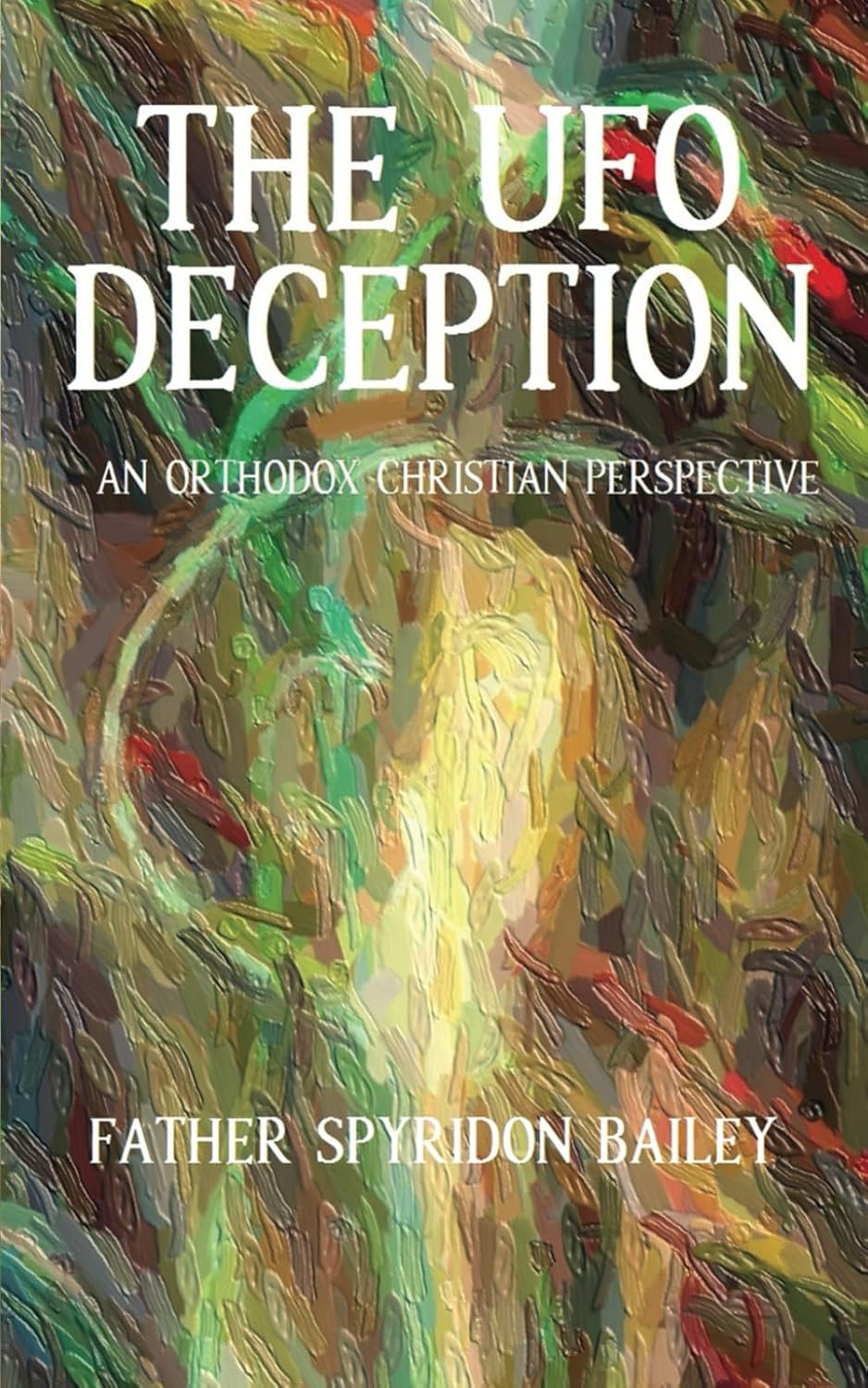
When World War II pilots began reporting small luminous globes flying alongside their bombers — objects the Air Force called "foo fighters" — military authorities began what would become the longest and most systematic cover-up in modern government history. Fr. Spyridon Bailey, a priest of the Russian Orthodox Church serving in England, begins The UFO Deception there — with the historical and documentary record — and traces the UFO phenomenon through eight decades of military research, congressional hearings, government misinformation, and civilian investigation, arriving finally at the Orthodox theological conclusion that makes sense of all of it.
Fr. Spyridon's central thesis is direct: UFOs are not extraterrestrial spacecraft. They are demons. Shape-shifting beings of the aerial realm, as described by St. Paul and the Church Fathers, have taken on new forms appropriate to the 21st century. And many of the world's governments, he argues, are aware of this — which adds to the deception rather than resolving it, since governments are no better equipped than secular researchers to identify demonic activity for what it is or to protect the people who encounter it.
The book builds Fr. Seraphim Rose's foundational analysis with thirty additional years of documentation. Fr. Spyridon draws extensively on the most credentialed secular UFO researchers — Jacques Vallee, John Keel, and others — who independently arrived at conclusions strikingly similar to the patristic position: that the phenomenon cannot be adequately explained as nuts-and-bolts spacecraft from other planets; that its behavior is "more akin to magic than to physics"; that the beings involved display a consistent pattern of deception, mockery, and psychological manipulation; and that their apparent purpose is the manipulation of human belief systems rather than the exploration of the physical universe.
Importantly, Fr. Spyridon's own family has had a direct UFO encounter — his wife witnessed one — which gives the book a personal dimension that distinguishes it from purely academic analysis. He is not dismissing the phenomenon. He is not treating it as delusional. He is taking it with full seriousness and subjecting it to the one analytical framework that has the depth and the historical precedent to explain it.
The book has accumulated 466 reviews at 4.6 stars on Amazon, making it among the most widely read Orthodox books on spiritual warfare currently in print. It functions as both a thorough introduction to the UFO phenomenon for readers who are new to the subject and as a definitive Orthodox theological analysis for those who already know the history and are looking for the framework that makes it coherent.
Part III
Prelest: The Orthodox Theological Key to the UFO Phenomenon
No Orthodox theological concept is more important for understanding the UFO phenomenon than prelest. The word comes from the Church Slavonic for "deception" or "enticement," and refers to a specific spiritual condition described throughout the patristic literature: the state of a person who has accepted a demonic experience as divine, who believes they have received special spiritual illumination when in fact they have been deceived, and who is now cut off from genuine spiritual correction because they are certain they already possess the truth.
The Church Fathers wrote about prelest with urgency because they saw it destroy souls who were otherwise sincere in their seeking. The experience of prelest is not unpleasant — that is precisely what makes it dangerous. The person in prelest typically feels chosen, illuminated, in possession of knowledge unavailable to ordinary believers, and exempt from the normal requirements of humility, repentance, and submission to the Church's authority. The demonic encounter that produces this state is designed to feel more real, more loving, and more spiritually significant than anything the person has encountered in ordinary religious life.
Now compare this to the reported experience of UFO contactees — the people who have had the most prolonged and direct encounters with these phenomena. A large proportion of them report feeling chosen for a special mission. They receive communications presenting a new spiritual teaching — typically one that presents conventional Christianity as incomplete, outdated, or deliberately concealing the truth. They feel elevated by the experience, in possession of knowledge unavailable to ordinary people. Many become evangelical about their new understanding, convinced they must communicate it to others. And many of them, as Fr. Seraphim Rose noted, end in psychological devastation — depression, family destruction, obsession, and in some cases what clinical psychiatry would call psychotic breaks.
This is not the fruit of divine encounter. It is the fruit of prelest. The Orthodox tradition knew this because the saints had documented the same trajectory in the lives of monks who had accepted demonic visions as genuine divine illumination — the initial experience of elevation and special knowledge, followed by spiritual arrogance, then instability, then collapse. The progression is identical. The form of the encounter has changed — from luminous apparitions in a desert cell to aerial craft over a suburban field — but the spiritual mechanism, the damage it produces, and the warning signs are the same ones the Fathers described sixteen centuries ago.
Part IV
The Pattern That Repeats Across Every Century
One of the most striking aspects of Fr. Spyridon Bailey's analysis is his documentation of the way the UFO phenomenon has adapted its form to the cultural moment while maintaining an absolutely consistent underlying structure. The beings change their appearance. The mission never does.
In the ancient world, they appeared as gods and demanded worship. In the medieval period, they appeared as faeries, incubi, and aerial spirits, creating abduction narratives and returning their victims confused, altered, and spiritually damaged. In the early modern period they appeared as witches' familiars, as spirits summoned in occult practice, as the beings contacted by the founders of most of the new religious movements of the 18th and 19th centuries. In the 20th century, in a culture saturated with science fiction and the assumption that advanced technology is the highest form of intelligence, they appeared as extraterrestrial visitors bearing a message of cosmic significance.
Jacques Vallee — the French astrophysicist whose research into UFOs became the most credentialed secular analysis ever conducted — eventually concluded that the phenomenon was not extraterrestrial but ultraterrestrial: beings of non-human intelligence that had always been present, that had always interacted with human civilization, and that consistently adapted their form to whatever framework would make them most plausible to the humans of a given era. He did not use Orthodox theological language. But his conclusion was functionally identical to what St. John Chrysostom wrote about the aerial spirits in the 4th century.
John Keel, whose book UFOs: Operation Trojan Horse became one of the most important works in secular UFO research, wrote that the UFO phenomenon was "more akin to magic than to physics" and that the beings involved were dedicated to psychological manipulation of human belief. He warned specifically that "dabbling with UFOs can be as dangerous as dabbling with black magic" — a warning Fr. Seraphim Rose quoted directly, noting that a secular researcher had independently arrived at the patristic conclusion without the framework to fully understand what he was describing.
For a detailed examination of what specific Orthodox saints and elders have said about the aerial spirits, paranormal phenomena, and the dangers of occult contact, see our full article: What the Saints Said About Aliens and UFOs. The patristic record is more extensive than most Orthodox Christians realize — and the consistency of what the saints describe across fifteen centuries is one of the most compelling arguments for the Orthodox position on the modern UFO phenomenon.
Part V
What the Best Secular Researchers Eventually Concluded
It is worth dwelling on the secular researchers who arrived independently at conclusions that parallel the Orthodox position — not because their authority matters more than the Church Fathers', but because their conclusions, reached through the methods of empirical investigation rather than theological tradition, serve as an unexpected confirmation of what the patristic tradition had already established.
Jacques Vallee, with a doctorate in computer science from Northwestern University and long-term association with the French Centre National de la Recherche Scientifique, became one of the most respected figures in UFO research precisely because he was willing to follow the evidence wherever it led, even when it contradicted the extraterrestrial hypothesis he had originally investigated. His conclusion: "I do not believe anymore that UFOs are simply the spacecraft of some race of extraterrestrial visitors. This notion is too simplistic to explain their appearance, the frequency of their manifestations through recorded history, and the structure of the information exchanged with them during contact." He noted that "the modern UFOnauts and the demons of past days are probably identical" — not as a theological statement but as an empirical one, based on the consistency of the behavioral profile across centuries.
Dr. Pierre Guerin, associated with the French National Council for Scientific Research, stated that UFO "behavior is more akin to magic than to physics as we know it." John Keel documented that "a large part of the available UFO literature is closely linked with mysticism and the metaphysical" and that UFO incidents "are strikingly similar to demonic possession and psychic phenomena." These are not fringe voices. These are among the most serious secular researchers in the history of the field — and they arrived at the demonological conclusion not from a theological starting point but from the data.
What none of them could offer, because none of them had access to the patristic tradition, was the other half of the answer: what to do about it. They could identify the phenomenon correctly. They could not offer protection from it. The Orthodox Church can do both — because the tradition that correctly identified these beings is the same tradition that spent seventeen centuries developing the spiritual practices that protect against their activity.
Part VI
The Only Real Protection — What the Orthodox Tradition Teaches
The Orthodox response to the UFO phenomenon is not, as some assume, simply to dismiss it or to refuse to think about it. Fr. Seraphim Rose was clear that the phenomenon was real, spiritually serious, and worthy of sober attention. What he warned against was naive curiosity — the approach of treating these encounters as interesting experiences to be explored rather than as dangerous spiritual encounters to be approached with the full armor of Christian practice.
The protection the Orthodox tradition prescribes against demonic deception of all kinds — including the kind that presents itself as extraterrestrial contact — is the same protection the Fathers have always prescribed. It is not esoteric. It is not complicated. It is the ordinary life of the Church: regular reception of the sacraments, a consistent daily prayer rule, fasting in accordance with the Church's calendar, obedience to a confessor, humility, and above all the practice of the Jesus Prayer. The person who maintains these disciplines is not immune to demonic encounter — the saints themselves were subjected to demonic attacks of extreme intensity — but they possess the discernment to recognize deception for what it is, the spiritual resources to resist it, and the protection of God's grace, which the demons cannot overcome.
The person who has no prayer life, no confessor, no sacramental grounding, and no patristic framework for understanding spiritual experience has none of these resources. They encounter something of enormous apparent spiritual significance — lights, presences, communications, a sense of cosmic mission — and they have nothing with which to evaluate it except their own feelings and the alien contact literature they have been reading. The result is exactly what Fr. Seraphim Rose documented in 1975 and what Fr. Spyridon Bailey has documented again in 2021: spiritual confusion, obsession, psychological damage, and in the worst cases, full possession.
The answer to the question of UFOs is also, in the Orthodox tradition, an argument for the Church itself. The only institution that correctly identified these phenomena seventeen centuries ago is the same institution that has the spiritual technology to navigate them. That is not a coincidence. It is the reason the Church exists.
What the Orthodox Saints Said About These Phenomena
Fr. Seraphim Rose and Fr. Spyridon Bailey did not develop their conclusions in isolation. Behind them stands an extensive patristic record of saints and elders who encountered aerial spirits directly and left detailed accounts of what those encounters looked like — accounts that read, in many cases, as precise descriptions of modern UFO contact experiences.
The Desert Fathers of Egypt documented encounters with luminous beings that appeared in the night sky and in the cell, communicated spiritual teachings, and demanded veneration — beings that vanished when the monk made the sign of the Cross or invoked the name of Jesus. The ladder icon found in most Orthodox churches depicts monks being pulled from a golden ladder by beings of the aerial realm, in a visual vocabulary the Church developed in the 7th century to describe exactly what Fr. Spyridon Bailey is analyzing in the 21st.
Elder Paisios of Mount Athos, one of the greatest saints of the 20th century, spoke directly about demonic deception in the modern world and the danger of spiritual phenomena encountered without the protection of the Church and a confessor. St. John Maximovitch, one of the most powerful wonder-workers of the 20th century, also addressed the reality of the demonic activity in the atmosphere with the same directness the desert fathers brought to it fifteen centuries earlier.
The tradition is not silent on these matters. It is one of the most extensively documented bodies of spiritual knowledge in human history. The two books reviewed here are the most accessible entry points into that tradition as it applies to the specific modern phenomenon of UFOs.
Read our complete article on what specific Orthodox saints and elders have said about the aerial spirits, UFOs, and encounters with non-human intelligences across the history of the Church: What the Saints Said About Aliens and UFOs →
Frequently Asked Questions
Orthodox Christianity & UFOs — Questions Answered
The Church Has Always Known What These Things Are
The world has been trying to answer the UFO question with radar and congressional hearings and astrophysics. The Orthodox Church answered it in the 4th century with the writings of the desert fathers, and Fr. Seraphim Rose answered it again in 1975 with a precision that has grown more rather than less accurate in the fifty years since. The two books reviewed here are where that answer lives.
Read them together. They are not frightening books — they are clarifying ones. The person who has read them knows what these things are, knows what protection exists against them, and understands why the Church, the sacraments, and the prayer life the Orthodox tradition prescribes are not optional features of Christian life but its essential armor.
Orthodoxy & Religion of the Future → The UFO Deception →