What the Saints Said About Aliens and UFOs: Orthodox Christian Warnings
Orthodox Saints • Prophecy • Spiritual Warfare • Demonic Deception • Last Days
What the Saints Said About Aliens and UFOs
Four Orthodox Christian saints — a Georgian fool-for-Christ, a Greek elder of Mount Athos, a mystic of Kavsokalyvia, and an American hieromonk — all said the same thing about the UFO phenomenon decades before the world’s governments started taking it seriously. They were not guessing.
“In the years of the Antichrist, people will expect salvation from space. This will be the devil’s greatest trick! Humanity will seek help from the aliens, not knowing that they are actually demons.”
“You should know that these are all demonic things, which take various forms. There is no life on another planet!”
“All these, you know, are imaginary, demonic things. There is no life on another planet!”
“The UFO phenomenon is a sign to Orthodox Christians to walk all the more cautiously and soberly on the path to salvation, knowing that we can be tempted and seduced not merely by false religions, but even by seemingly physical objects which catch the eye.”
In This Article
Why These Four Warnings Are Not Coincidental
Between 1975 and 1995, four Orthodox Christian holy men — living in four different countries, speaking four different languages, operating in separate spiritual traditions that rarely communicated with one another — all said the same thing about UFOs and alien contact. They did not coordinate their statements. They had no shared research agenda. They were not following congressional hearings or reading the UFO literature. They were speaking from a common source: seventeen centuries of Orthodox patristic tradition on the discernment of spirits, and their own direct experience of spiritual warfare.
The world is only now beginning to take seriously what these men described. Senate testimony from credentialed military officials. Declassified footage showing objects with flight characteristics that violate known physics. Government acknowledgment of “non-human intelligence.” The vocabulary of secular institutional authority is, haltingly, groping toward a conclusion that four Orthodox saints stated plainly decades ago.
None of the four was speaking metaphorically. None of them said UFOs were weather phenomena, misidentified aircraft, or psychological projections. They affirmed the reality of the encounters. What they disputed — with the authority of men who had spent their lives learning to distinguish divine action from its demonic counterfeit — was the interpretation. The beings are real. They are not from planets. They are the aerial spirits that the Church Fathers have been documenting since the 4th century: fallen angels who take whatever form will most effectively deceive the person they are approaching.
This article presents each of the four saints in detail — their lives, their spiritual authority, and the context of their warnings — and recommends the Orthodox books that develop these warnings into the fullest theological analysis available, including a newly published work that traces the entire pattern from Genesis to the modern disclosure movement.

Everything this article surveys — the Watchers of Genesis, the aerial spirits of the Church Fathers, and the warnings of Gabriel, Paisios, Porphyrios, and Seraphim Rose — is traced in full in this new book. It maps the entire biblical and patristic tradition of deceiving spirits onto the modern UAP disclosure movement, chapter by chapter, and shows exactly where the alien narrative fits within two thousand years of documented spiritual deception.
Where the article above summarizes the four saints, the book builds the complete case: Genesis 6 and the Nephilim, the patristic doctrine of the Powers of the Air, the Desert Fathers’ documented demonic encounters, and a full theological framework for discerning the phenomenon now surfacing in Senate hearings. If this question has your attention, this is where you go next.
Part I — The Georgian Prophet
St. Gabriel Urgebadze: The Devil’s Greatest Trick
Vasiko Urgebadze was born in Tbilisi in 1929, raised without religious instruction in a Soviet state that had spent decades attempting to exterminate Christianity from Georgian soil. He encountered the faith almost by accident as a child — a neighbor’s icon caught his attention, he began to pray, and the encounter was sufficient. By the time he was ordained as a hieromonk and given the name Gabriel, he had already distinguished himself as a man of absolute fearlessness before Soviet power and absolute tenderness before everyone else.
The moment that made him famous — and that sent him to a psychiatric prison — came on May 1, 1965, when he climbed to a rooftop in Tbilisi and burned a twelve-meter portrait of Lenin during the official Soviet May Day parade. He was arrested immediately, declared insane, and confined to a psychiatric institution — the standard Soviet disposal mechanism for Christians who refused to conceal their faith. The doctors examined him repeatedly and could find nothing clinically wrong with him. He was released.
He spent the rest of his life in the monastery of Samtavro in Mtskheta, living in a small cell in the garden, rarely sleeping, fasting to extremes that alarmed those around him, receiving a constant stream of visitors who came seeking spiritual counsel. He was known for prophecy, healing prayer, and an ability to see things at a distance and know the interior states of people he had never met. He died in 1995 and was canonized by the Georgian Orthodox Church in 2012.
His warning about the aliens requires reading in its full eschatological context. Gabriel spoke consistently about the last days — about the specific deceptions that would be deployed against humanity in that period. His statement is not a casual opinion about space exploration. It is a prophetic identification of a demonic strategy for the end times:
“In the years of the Antichrist, people will expect salvation from space. This will be the devil’s greatest trick! Humanity will seek help from the aliens, not knowing that they are actually demons.”— St. Gabriel Urgebadze, Fool for Christ, Georgian Orthodox Church, Canonized 2012
The precision of this warning is remarkable. Gabriel does not say people will be deceived by UFOs. He says they will expect salvation from them — a word that carries its full theological weight. Salvation is what Christianity offers. Gabriel is identifying a satanic parody of the Christian Gospel: beings appearing from beyond the sky, offering humanity rescue from its problems, presenting themselves as the answer to the deepest spiritual hunger of the human heart. The deception works precisely because the impulse driving it — the longing for divine intervention, for rescue from above — is itself genuine and good. The devil does not invent new desires. He redirects existing ones.
The phrase “the devil’s greatest trick” also deserves attention. Gabriel, who had spent decades in direct confrontation with Soviet atheism and who knew exactly what the powers of darkness were capable of, identified this as the supreme deception — greater than all the others. He was not making a footnote. He was issuing the warning he most wanted people to hear.
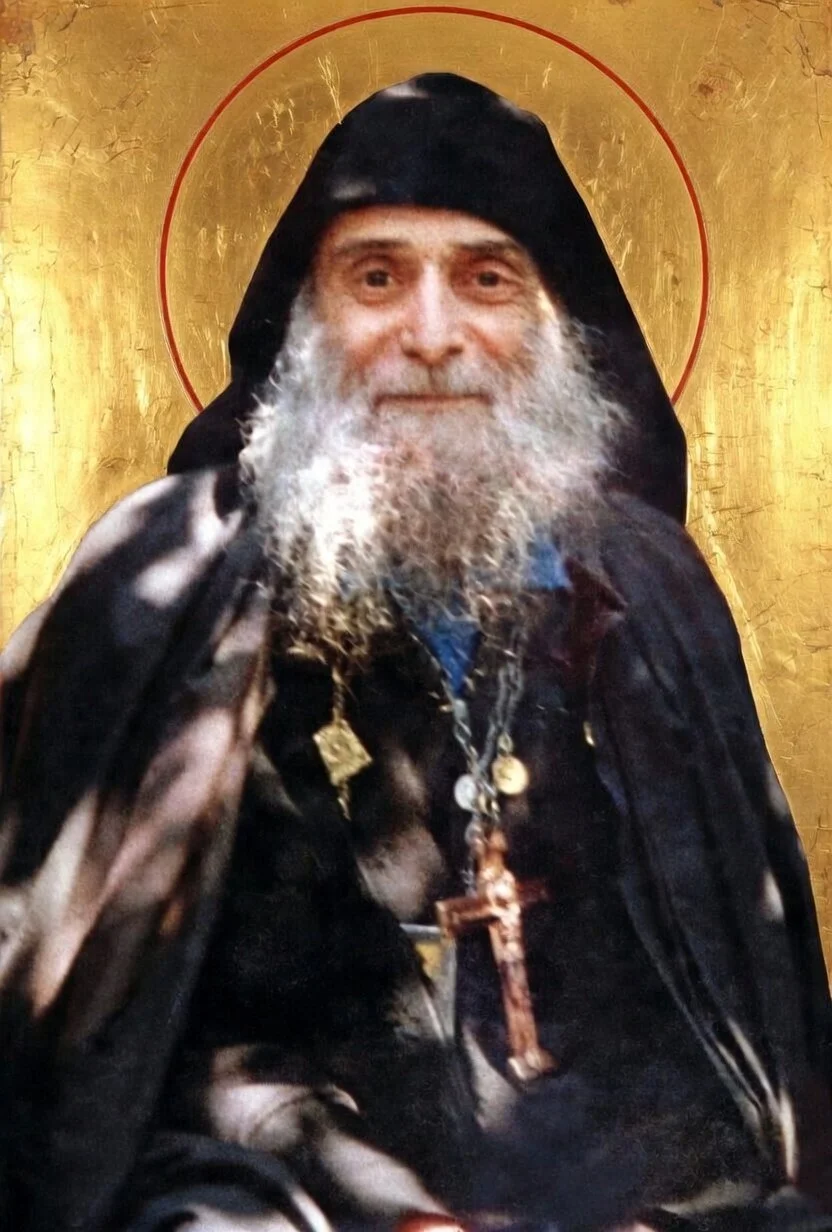
Handmade Orthodox prayer card featuring the icon of St. Gabriel the Fool for Christ of Georgia — the prophet who identified the alien deception as the devil’s greatest trick for the last days. An ideal companion for those seeking the intercession of this bold Georgian confessor.
St. Gabriel spent his life confronting the deceptions of his own era — Soviet atheism, the suppression of the Church, the lies of a state that declared faith to be madness. His intercession is specifically invoked for those navigating spiritual confusion and deception of all kinds, and for those under pressure to abandon or compromise their faith.
Part II — The Elder of Mount Athos
St. Paisios of Mount Athos: There Is No Life on Another Planet
Arsenios Eznepidis was born in 1924 in Farasa, Cappadocia — the ancient heartland of Orthodox monasticism, the land of Basil the Great and Gregory the Theologian — on the same day his village priest, St. Arsenios of Cappadocia, baptized him and gave him his own name as a blessing for the child’s future. His family fled to mainland Greece as part of the 1923–24 population exchange. He served in the Greek Army during the civil war and in 1954 entered the monastic life that would define the remaining forty years of his existence.
He settled eventually on Mount Athos in a small cell called the Panagouda — “the little Panagia” — and lived there until poor health forced him to spend his final years near Thessaloniki. He died in 1994 and was formally glorified as a saint by the Ecumenical Patriarchate in 2015, in what was by any measure one of the most straightforward canonizations in modern Orthodox history: by the time of his death, he was already venerated by hundreds of thousands of Orthodox Christians across the Greek-speaking world and far beyond.
Paisios was not an academic theologian. He was, in the fullest sense of the Orthodox tradition, a man of prayer — someone whose ceaseless practice of the Jesus Prayer had opened him, according to the consistent testimony of everyone who encountered him, to a level of spiritual perception well beyond ordinary human capacity. He saw the interior states of visitors before they spoke. He prayed for specific individuals at distances of hundreds of miles and they recovered. He warned about events that had not yet happened. When he was asked about UFOs and alien contact — a subject generating significant anxiety among Greek Orthodox Christians by the 1980s — his response was immediate and direct:
“You should know that these are all demonic things, which take various forms. There is no life on another planet!”— St. Paisios of Mount Athos, Canonized by the Ecumenical Patriarchate, 2015
The phrase “take various forms” is the theological heart of his statement. Paisios is drawing on the patristic tradition’s understanding of demonic mutability — the teaching, developed in detail by the Desert Fathers and systematized throughout the Philokalia, that fallen angels have no fixed form of their own and appear in whatever shape will most effectively accomplish their purpose. In an earlier century those shapes were luminous figures, terrifying monsters, beautiful women, angel-like beings of overwhelming radiance. In the late 20th century they appear as grey beings aboard disc-shaped craft, communicating messages about humanity’s cosmic destiny.
That Paisios said this with the authority he had — the authority of a man who had spent decades in direct, unshielded contact with both divine and demonic spiritual reality — is significant. He was not dismissing the phenomenon as fictional. He was classifying it. He had encountered the full spectrum of spiritual experience, genuine and counterfeit, and he was identifying these encounters as belonging to the counterfeit category: real in their effects, demonic in their source.
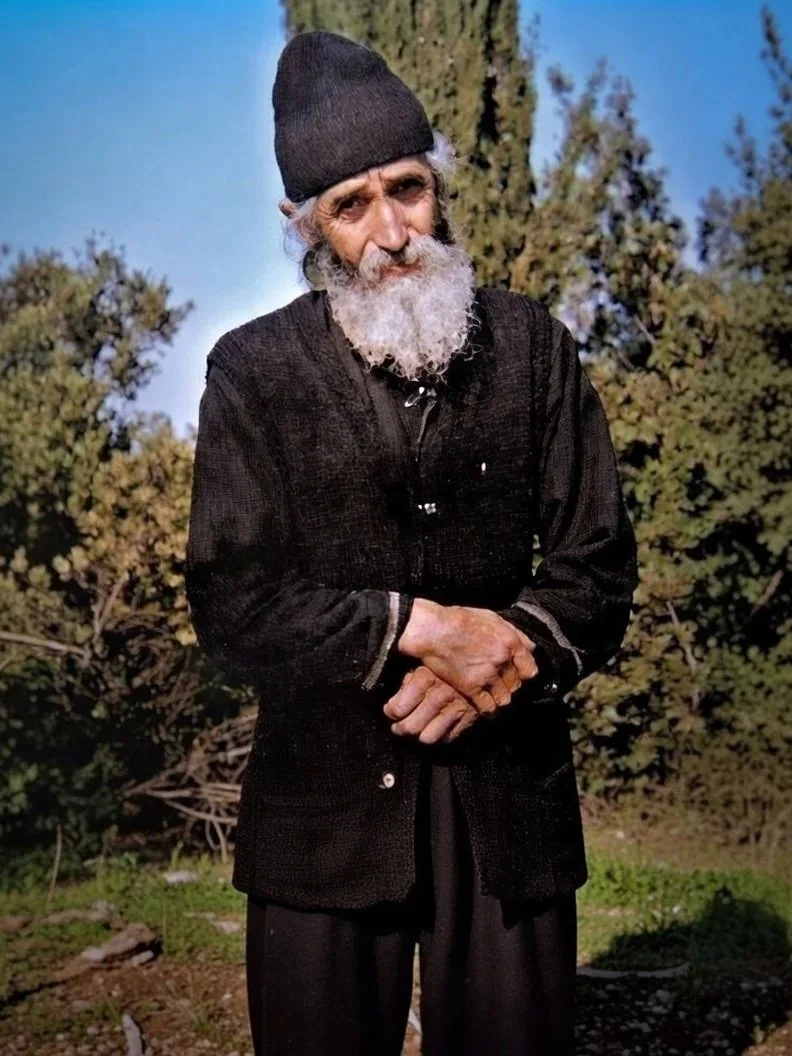
Handmade prayer card featuring the icon of St. Paisios the Athonite — one of the greatest spiritual elders of the 20th century, canonized by the Ecumenical Patriarchate in 2015, and one of the most trusted Orthodox voices on the discernment of spirits in the modern world.
St. Paisios is particularly invoked for anxiety, spiritual confusion, and situations requiring discernment — making him an ideal intercessor for those navigating the unsettled spiritual atmosphere of the present era. His clear, authoritative teaching on demonic deception makes his icon a fitting presence on any Orthodox home altar.
Part III — The Mystic of Kavsokalyvia
St. Porphyrios of Kavsokalyvia: Imaginary, Demonic Things
Evangelos Bairaktaris was born in 1906 in the village of Agios Ioannis in Evia, Greece, the third of six children in a peasant family. He left home at fourteen to become a novice on Mount Athos, where he encountered two elders at the hermitage of Kavsokalyvia whose tradition of unceasing prayer and radical interior stillness — the hesychast tradition of Athos — formed the spiritual framework of his entire life. At Kavsokalyvia he received what the tradition calls the charismata of the Holy Spirit — gifts of healing, clairvoyance, and spiritual vision — in a way that remained consistent and verifiable throughout the six decades that followed.
He lived for many years in Athens, serving as a confessor to a hospital chapel and receiving a constant stream of spiritual children who came from every corner of Greece seeking his counsel. His clairvoyance manifested primarily as an intimacy — a knowledge of each visitor’s interior life, history, and specific spiritual condition that went far beyond what any ordinary counselor could possess. He died in 1991 and was glorified by the Ecumenical Patriarchate in 2013.
The word he used when speaking about UFOs — “imaginary” — requires the same careful reading we gave to Paisios’s phrase “take various forms.” In ordinary usage, “imaginary” means unreal, fictional. But Porphyrios was himself a man whose spiritual vision extended far beyond ordinary human perception. He was not saying these encounters don’t happen or that the people who experience them are deluded. The Greek tradition uses “imaginary” in the patristic sense — a fantasma, a phantasm, an image projected by a being to conceal its true nature. The encounter is real. The form is a fabrication. The source is demonic.
“All these, you know, are imaginary, demonic things. There is no life on another planet!”— St. Porphyrios of Kavsokalyvia, Canonized by the Ecumenical Patriarchate, 2013
What is striking about both Paisios and Porphyrios is that they use virtually identical language and arrive at virtually identical conclusions, independently, without apparent coordination. “All demonic things, which take various forms. There is no life on another planet.” “All these, imaginary, demonic things. There is no life on another planet.” The convergence is not coincidental. They are drawing from the same source: a patristic tradition that developed its taxonomy of aerial spirits in meticulous detail over fifteen hundred years, and their own direct spiritual experience navigating that taxonomy in the practice of prayer.
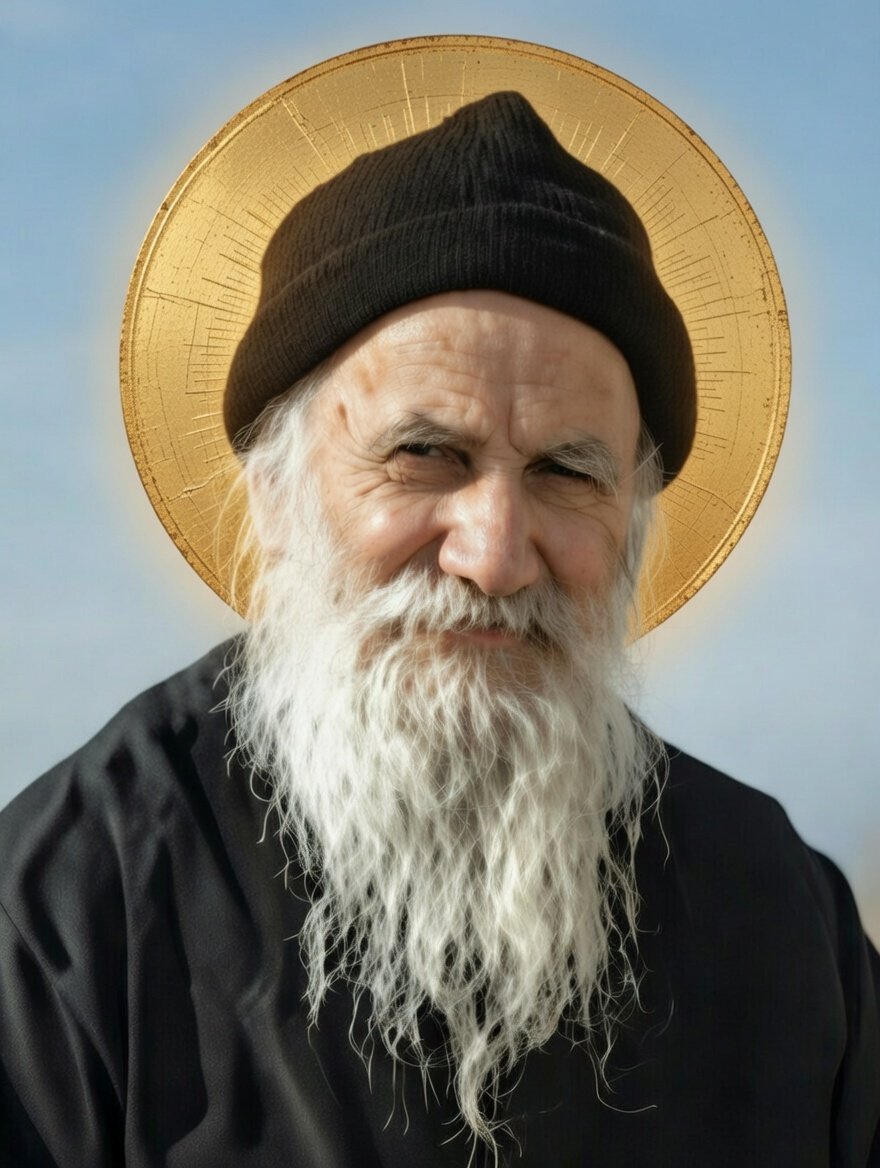
Handmade prayer card featuring the icon of St. Porphyrios of Kavsokalyvia — the Greek elder and mystic whose spiritual vision encompassed both the heights of divine grace and the depths of demonic deception, and who spoke with the same authority on both.
St. Porphyrios is one of the most beloved Orthodox intercessors for those struggling with anxiety, depression, and spiritual dryness — and one of the most authoritative voices in the modern tradition on the nature of demonic encounter. His icon belongs on every Orthodox home altar for those seeking clarity in a spiritually confusing world.
Part IV — The American Hieromonk
Fr. Seraphim Rose of Platina: Walk More Cautiously and Soberly
Eugene Dennis Rose was born in 1934 in San Diego, California, the child of a secular middle-class family with no religious convictions. He was, by all accounts, among the most intellectually gifted students of his generation at Pomona College and later at the American Academy of Asian Studies in San Francisco — a young man who had read everything, believed nothing, and was searching for a framework that could bear the full weight of human experience without collapsing. He found it in Orthodox Christianity, specifically in the reading of the early Fathers, and the conversion that followed was absolute. Nothing about Eugene Rose ever appeared to be halfway done.
He was tonsured a monk in 1968, ordained to the priesthood in 1977, and died at the age of 48 in 1982, before most of the works he had planned were completed. What he left behind — particularly Orthodoxy and the Religion of the Future, published in 1975 — proved sufficient. The book’s chapter on UFOs, titled “Signs from Heaven: An Orthodox Christian Understanding of Unidentified Flying Objects,” was the first sustained patristic analysis of the UFO phenomenon ever written in English. His argument — that UFOs are demonic manifestations of the fallen angels the Church Fathers called the aerial spirits — was the systematic application of seventeen centuries of Orthodox patristic teaching to a contemporary phenomenon, conducted with the scholarly rigor of a man who had read the Fathers in their original languages.
“The UFO phenomenon is a sign to Orthodox Christians to walk all the more cautiously and soberly on the path to salvation, knowing that we can be tempted and seduced not merely by false religions, but even by seemingly physical objects which catch the eye.”— Fr. Seraphim Rose, Orthodoxy and the Religion of the Future, 1975
The phrase “seemingly physical objects which catch the eye” is the theological key to his warning. For centuries, the Church’s argument against spiritual deception was essentially: do not trust religious experiences that conflict with scripture and tradition. This worked when the deceptions presented themselves as spiritual. It fails — or at least fails to immediately apply — when the deception presents itself as a physical object: a craft with mass and velocity, tracked on radar, filmed by multiple witnesses. Fr. Seraphim Rose’s point is that Orthodox sobriety must extend even here, to objects that are “seemingly physical” — and that the spiritual danger is real even when the experience appears entirely material.
Fr. Seraphim Rose is currently in the process of being formally glorified as a saint by ROCOR. The Council of Bishops, meeting in Munich in May 2026, blessed the process of preparing his ecclesiastical glorification. He was previously locally canonized by the Diocese of Akhalkalaki of the Georgian Orthodox Church in 2023, and Metropolitan Neophytos of Morphou of the Church of Cyprus declared him a saint in 2022. Millions of Orthodox Christians across multiple jurisdictions already venerate him as St. Seraphim of Platina. The book that identified UFOs as demonic deception in 1975 was written by a man the Church is preparing to formally recognize as holy.

The book behind the warning quoted throughout this article. Fr. Seraphim Rose’s chapter “Signs from Heaven” remains the most patristically grounded treatment of the UFO phenomenon ever written in English, identifying UFOs as what the Church Fathers called the aerial spirits — fallen angels who have taken on the form most plausible to a post-Christian, science-saturated culture.
Beyond the UFO chapter, the book analyzes yoga, Eastern meditation, the charismatic movement, and the emergence of New Age spirituality — all through the same rigorous patristic lens. Written by a man the Church is preparing to canonize, permanently #1 in Comparative Religion on Amazon with 988 reviews at 4.8 stars. Read this before any other Orthodox book on the subject.
Part V
What These Four Warnings Have in Common
Gabriel, Paisios, Porphyrios, and Seraphim Rose had virtually nothing in common by the ordinary measures of human life. Different countries, different languages, different ecclesiastical jurisdictions, different biographical trajectories. What they shared was the patristic tradition and a life of prayer sufficiently deep to make that tradition experientially real rather than academically theoretical.
All four, from that shared depth, arrived at the same identification of the same phenomenon. This is not coincidence. It is what the Orthodox tradition would call the consensus patrum — the agreement of the Fathers — applied to a modern question. When the saints agree, it is because they are drawing from the same source. The tradition is not silent on UFOs. It simply uses older and more precise language to describe them.
The phenomenon is real. None of the four dismissed UFO encounters as hallucinations or weather balloons. All affirmed that these are genuine encounters with real beings possessing real power.
The beings are demonic. All four identified the source as the fallen angels the Church Fathers called the aerial spirits — demons who inhabit the atmosphere and whose primary activity is the deception of human souls.
The form is a fabrication. The spacecraft, the grey aliens, the cosmic messaging — these are the contemporary form of a shape-shifting deception that has presented itself differently in every era while pursuing the same goal: to separate human souls from God through a false encounter with the divine.
The danger is spiritual, not physical. The real damage is to the soul: spiritual pride, confusion, obsession, the replacement of genuine faith with a demonic parody. The protection is not scientific literacy. It is the life of the Church — prayer, fasting, sacraments, and a confessor.
For the full patristic framework behind what these saints said — including the Church Fathers’ taxonomy of aerial spirits, the concept of prelest, what secular researchers independently concluded, and a complete analysis of both Orthodox books — see: What Does the Orthodox Church Believe About UFOs? The Patristic Answer →
The Books — The Complete Orthodox Analysis
The UFO Deception — Fr. Spyridon Bailey
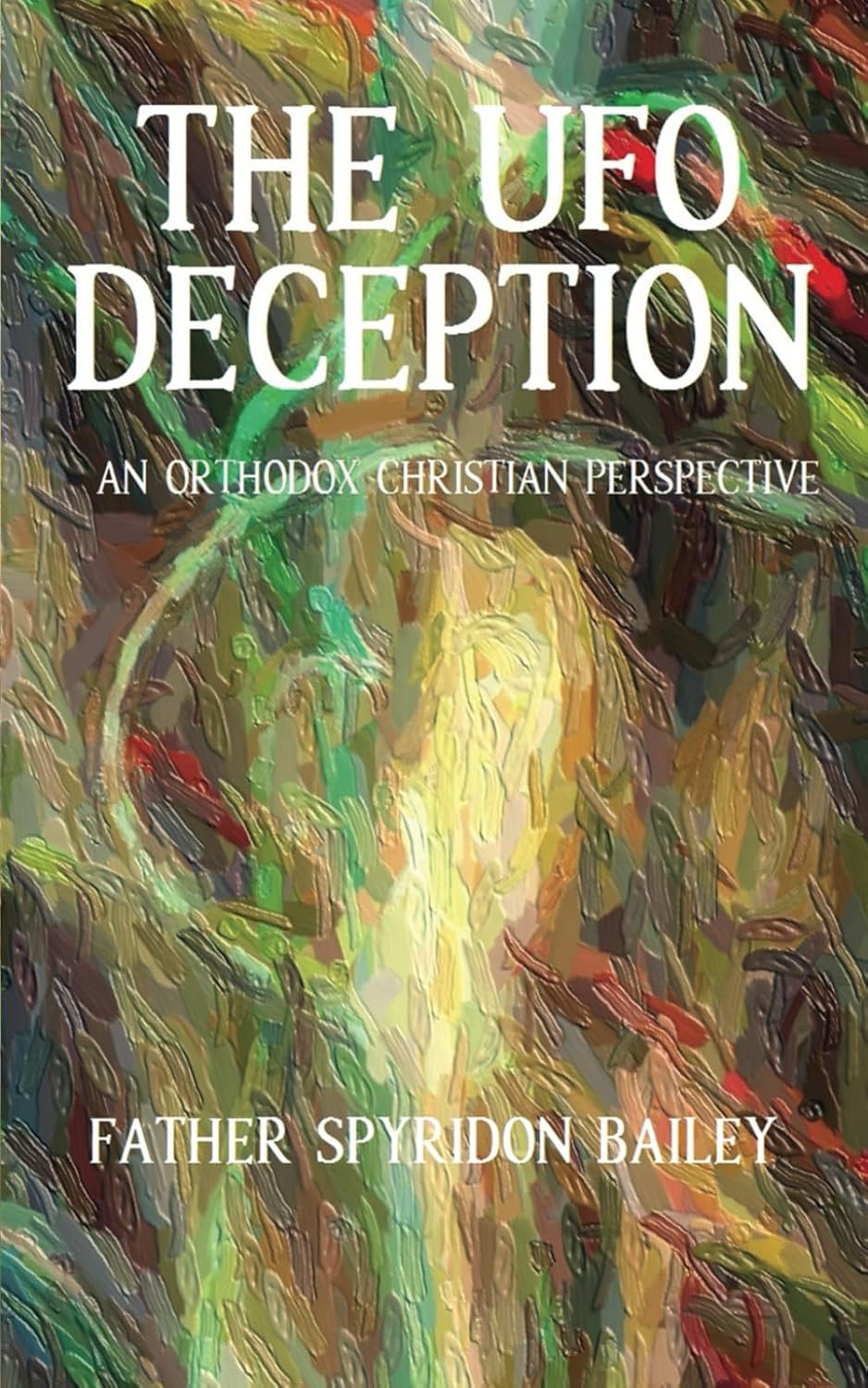
Fr. Spyridon Bailey — an Orthodox priest of ROCOR serving in England, whose wife personally witnessed a UFO encounter — published The UFO Deception in 2021 as the most comprehensive Orthodox treatment of the subject ever written. Where Orthodoxy and the Religion of the Future established the patristic framework in 1975, Fr. Bailey’s book fills in four more decades of evidence.
He traces the phenomenon from the “foo fighters” of World War II through eight decades of congressional hearings and government cover-ups, arriving at the Orthodox theological conclusion: UFOs are demons, the aerial spirits of the Church Fathers, and many of the world’s governments are aware of this — which deepens the deception rather than resolving it. He draws extensively on Jacques Vallee and John Keel, whose independent secular conclusions parallel the patristic position with remarkable precision.
Aliens and Demons: Discerning the Great Deception
Where Seraphim Rose established the patristic framework in 1975 and Fr. Bailey filled in four more decades of evidence in 2021, this newest addition to the Orthodox reading list starts a step earlier — at Genesis 6 and the Watchers — and carries the argument forward into the present disclosure movement in a single continuous line, rather than as a chapter within a broader work.
It puts the biblical text, the patristic doctrine of the Powers of the Air, and the modern warnings of Paisios, Porphyrios, Gabriel, and Seraphim Rose side by side, building the complete case for why the alien narrative fits the oldest pattern of spiritual deception in the Christian tradition. Read alongside the two books above, it is the most complete Orthodox and biblical treatment of this subject currently available.
Part VI
The Only Protection the Orthodox Tradition Offers
The four saints quoted in this article did not leave their warnings as isolated observations. They embedded them in a larger pastoral context: the practice of the spiritual life that protects against deception of all kinds. Gabriel counseled fearlessness rooted in explicit faith in Christ. Paisios directed those troubled by spiritual confusion back to prayer, the sacraments, and a confessor. Porphyrios, whose entire ministry was the pastoral guidance of people struggling to live the interior life faithfully, was equally consistent: the answer to spiritual danger is not more information about the danger but deeper rootedness in the life of the Church. Fr. Seraphim Rose concluded Orthodoxy and the Religion of the Future with the same pastoral emphasis: the person who lives the ordinary Orthodox life faithfully — prayer, fasting, the sacraments, obedience to the Church — has, in that ordinariness, the only real protection that exists.
The Jesus Prayer — “Lord Jesus Christ, Son of God, have mercy on me, a sinner” — practiced with regularity and attention, is the primary weapon the hesychast tradition prescribes against demonic encounter of every kind. The sign of the Cross, consistently made over oneself and one’s household. Regular confession and communion. Fasting according to the Church’s calendar. None of this is exotic. All of it is the ordinary life of a serious Orthodox Christian. And all of it, the saints affirm, is sufficient protection against the deception that is now on the Senate floor and in the New York Times.
Understanding the shape of the deception is part of that protection. Knowing what the Fathers documented, what the saints warned, and how the pattern repeats across centuries is what makes discernment possible in the moment it is needed.
The protection the saints describe — prayer, fasting, the sacraments, humility — is the practice. Knowing exactly what you are protecting yourself against, and why the Church has always understood it this way, is the other half. This book supplies that half: the full biblical and patristic case, worked through chapter by chapter, so the discernment these saints call for has something solid underneath it.
Frequently Asked Questions
Orthodox Saints & UFOs — Questions Answered
The Saints Were Watching the Same Thing You Are
Four Orthodox saints, in four different countries, with no coordination between them, all said the same thing about the phenomenon that is now on the Senate floor, in the New York Times, and in the briefings of military pilots. They had seen it before. The Church Fathers saw it in the 4th century. The tradition named it, categorized it, and left detailed instructions for how to survive it. The three books below are where those instructions live.
Aliens and Demons → Orthodoxy & Religion of the Future → The UFO Deception →