Popular Orthodox Saints and Their Inspiring Stories
A Living Communion of Faith, Courage, and Prayer
In Eastern Christianity, saints are not remembered primarily as historical figures or moral examples. They are encountered as living members of the Church. Their stories are not preserved to inspire admiration from a distance, but to invite imitation, intercession, and communion. This understanding shapes how Orthodox and Eastern Christians speak about the saints, pray with them, and integrate their presence into daily life.
Interest in Orthodox saints continues to grow, especially among those exploring Eastern Christianity for the first time. Some are drawn by the depth of devotion, others by the antiquity of the tradition, and many by a sense that the saints of the East lived the Christian faith with an intensity that feels rare today. Feast days, liturgical seasons, and family traditions often bring renewed attention to these holy men and women, making their lives an evergreen source of spiritual reflection.
This article explores several of the most beloved Orthodox saints, not as a catalogue, but as a theological and devotional journey. Each saint is presented within the spiritual logic of Eastern Christianity, showing not only who they were, but why they continue to matter. Their stories are not relics of the past. They are ongoing invitations to faithfulness.
Saints in the Orthodox Christian Understanding
Before looking at individual saints, it is important to understand how sainthood itself is understood in Orthodox and Eastern Christian theology. A saint is not someone who achieved moral perfection through effort alone. A saint is someone who allowed their life to be fully transfigured by grace.
Orthodox hagiography does not hide weakness, struggle, or failure. It emphasizes repentance, perseverance, and union with God. Saints are not admired because they were exceptional by worldly standards, but because they became transparent to divine life. Their lives testify that holiness is possible in every age, culture, and circumstance.
The veneration of saints is inseparable from prayer. Icons, feast days, hymns, and personal devotions all express the belief that the saints are alive in Christ and active in the life of the Church. To know their stories is not merely to know history. It is to recognize companions in faith.
Saint Andrew the First-Called
Faith That Responds Immediately
Saint Andrew holds a unique place in Orthodox Christianity as the first apostle called by Christ. His title, the First-Called, is not simply honorary. It reflects the Orthodox emphasis on responsiveness to divine invitation.
Andrew’s story is marked by immediacy. When he encounters Christ, he does not delay. He follows. He brings others to Christ quietly, without seeking prominence. His missionary journeys, according to tradition, carried him deep into the Greek world and beyond, planting seeds of faith that would bear fruit centuries later.
In Orthodox spirituality, Andrew represents obedience without spectacle. His faith is steady, not dramatic. He reminds the faithful that holiness often begins with simple attentiveness and willingness to move when God calls.
Many Eastern Christians turn to Saint Andrew in prayer when discerning vocation, change, or obedience in uncertain circumstances. His life teaches that fidelity does not require clarity, only trust.
Prayer cards honoring Saint Andrew can be used as part of a daily prayer routine, especially during times of discernment or transition.
https://www.theeasternchurch.com/eastern-catholic-eastern-orthodox-prayer-cards
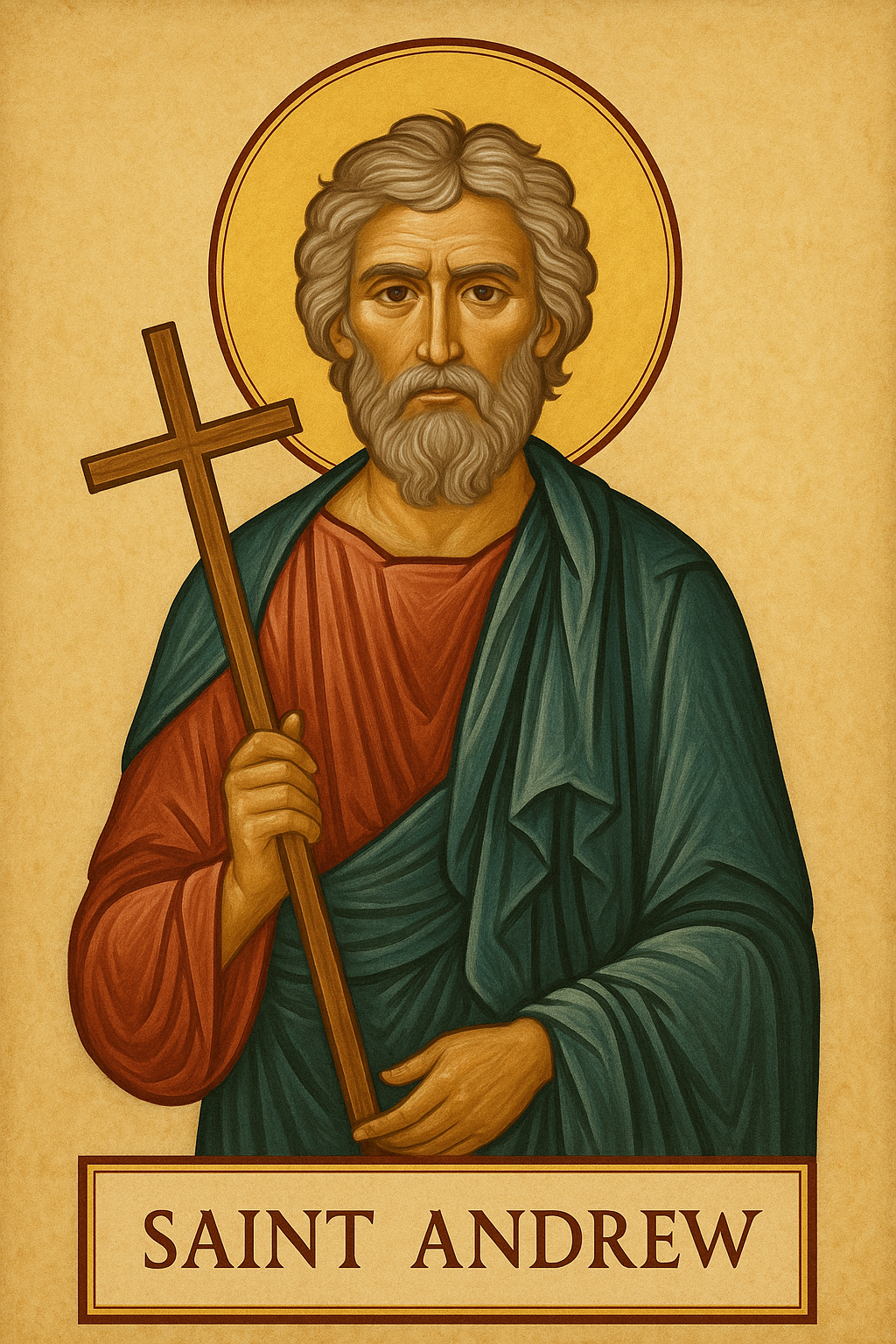
This handmade prayer card honors Saint Andrew the Apostle, the first-called disciple of Christ and the beloved brother of Saint Peter. Renowned for his humility, missionary zeal, and deep love for the Gospel, Saint Andrew carried the message of Christ throughout the Greek world. His witness, teachings, and martyrdom continue to inspire Christians across the world.
Each card is individually made by hand, printed on heavy museum-quality photo paper that preserves the richness, clarity, and color depth of the icon. It is then double-laminated to ensure the card will last a lifetime—durable enough to carry daily, keep in a prayer book, display on a home altar, or pass down through generations.
During the entire creation process—printing, cutting, sealing, and laminating—every card is intentionally prayed over, asking God to bless the person who will receive it and to allow Saint Andrew’s intercession to strengthen their faith and draw them closer to Christ. These cards are not mass-produced; each one is a small act of devotion, crafted with reverence and purpose.
Perfect for Catholics, Orthodox Christians, converts, catechumens, sponsors, and anyone who feels drawn to the apostolic witness of Saint Andrew.
Saint Basil the Great
Theologian of Charity and Order
Saint Basil the Great stands as one of the most influential figures in Orthodox Christianity. He was a theologian, bishop, monastic founder, and advocate for the poor. Yet his legacy is not defined by intellectual achievement alone. It is defined by integration.
Basil lived in a time of doctrinal confusion and social inequality. His response was not withdrawal, but disciplined engagement. He articulated Trinitarian theology with clarity while simultaneously organizing care for the poor, the sick, and the abandoned. His understanding of theology was inseparable from action.
In Orthodox tradition, Basil represents the harmony of prayer, doctrine, and service. His liturgy, still celebrated today, reflects a deep sense of awe before God and responsibility toward humanity. He teaches that true theology always bears fruit in love.
Saint Basil is often invoked in prayer by those seeking balance between contemplation and responsibility, faith and action. His life offers a corrective to both spiritual isolation and shallow activism.
Prayer cards dedicated to Saint Basil the Great are commonly used in study, workspaces, and prayer corners.
https://www.theeasternchurch.com/eastern-catholic-eastern-orthodox-prayer-cards
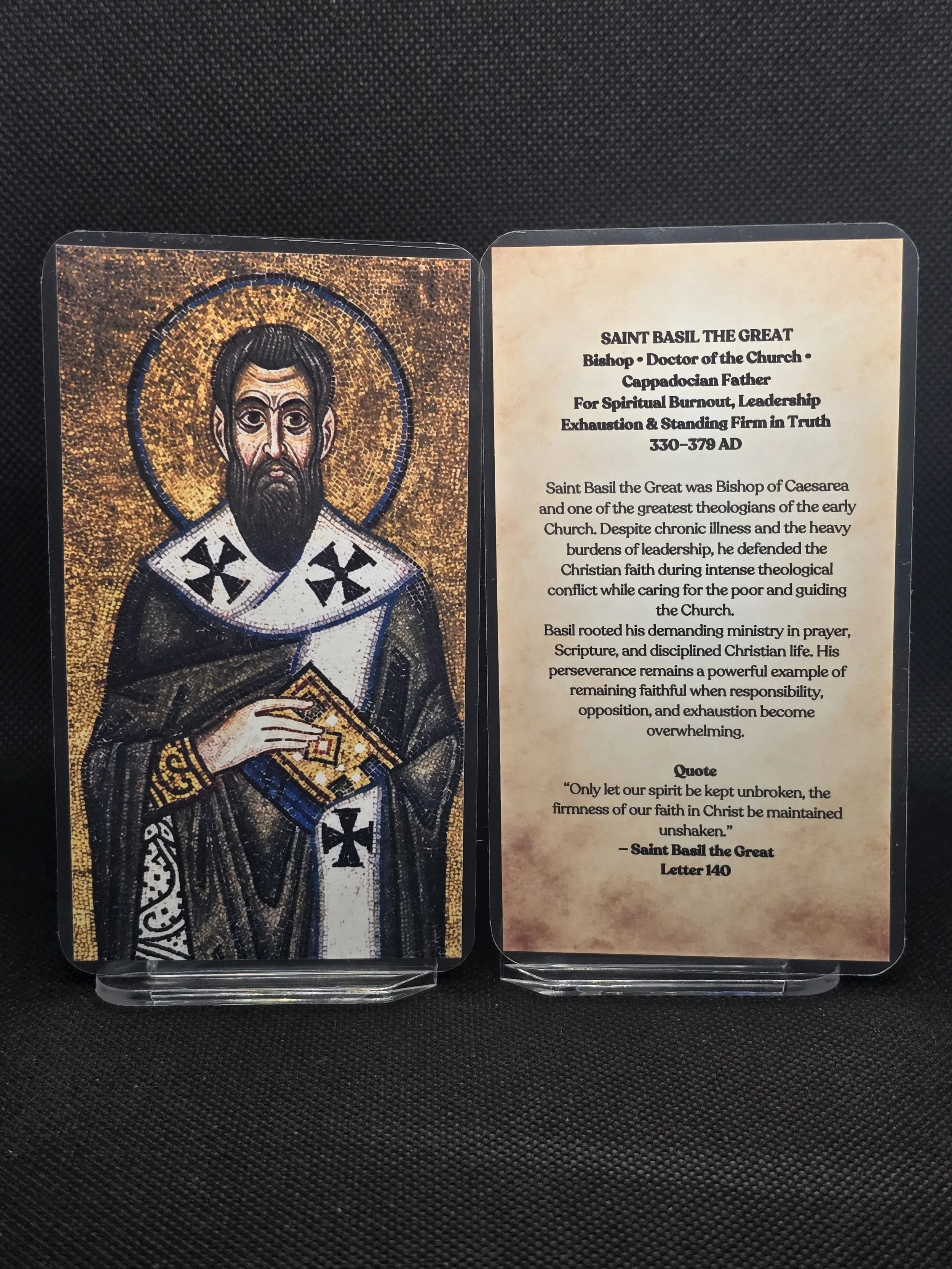
Saint Basil the Great is one of Christianity’s towering spiritual fathers, venerated deeply in the Eastern Orthodox Church, honored in Eastern Catholic tradition, and respected throughout the Roman Catholic world as a defender of truth, healer of communities, and shepherd of exhausted souls. His feast day is celebrated on January 1 in the East and January 2 in the West.
People pray to Saint Basil when responsibility feels crushing.
When leadership drains the soul.
When faith feels embattled.
When injustice demands courage.
When burnout threatens prayer itself.
Basil did not live a quiet contemplative life.
He lived inside crisis.
Born into a remarkable Christian family in fourth-century Cappadocia, Basil possessed brilliant intellect and could have pursued prestige or comfort. Instead, he chose ascetic discipline, radical charity, and relentless service to others. He became a monk, then a priest, and eventually bishop of Caesarea during one of the most volatile periods in Church history.
Heresy fractured communities. Political pressure threatened believers. The poor crowded the streets. Disease ravaged cities.
And Basil carried it all.
He organized famine relief. He confronted emperors. He defended orthodox faith when compromise would have been safer. He built hospitals, shelters, and food centers for the forgotten. He wrote theology late into the night while tending to human suffering by day.
His body broke down under the weight of responsibility.
His spirit did not.
Today, Saint Basil is prayed to by pastors, parents, business owners, caregivers, and anyone bearing invisible burdens. He is especially sought by those experiencing spiritual burnout, emotional exhaustion from leadership, and the quiet despair that comes from standing alone in truth.
This prayer card honors the saint who teaches us how to remain faithful when everything depends on us.
Each card is handmade in Austin and created to order. We do not keep stock, because every prayer card is treated as a unique devotional offering. They are printed on museum-quality photo paper, not cardstock, and each one is made during prayer. The saints are venerated throughout the entire process, and prayers are intentionally offered for the person who will receive the card. These are not mass-produced items. They are created slowly, reverently, and with spiritual intention, because every soul and every prayer matters.
Saint John Chrysostom
The Voice That Refused Silence
Saint John Chrysostom, whose name means Golden-Mouthed, is remembered for his preaching, pastoral care, and uncompromising commitment to truth. He is one of the most frequently commemorated saints in Eastern Christianity, not because he was agreeable, but because he was faithful.
John’s sermons confronted injustice, hypocrisy, and moral complacency, even when doing so cost him his position and ultimately his life. He understood preaching not as performance, but as accountability before God. His words were sharp because his love for the Church was deep.
In Orthodox spirituality, Chrysostom represents courage rooted in humility. He did not preach to dominate, but to heal. His exile and suffering are understood not as tragedy, but as witness.
Those who struggle with speaking truth in difficult circumstances often turn to Saint John Chrysostom in prayer. His life encourages fidelity without bitterness and conviction without cruelty.
Prayer cards honoring Saint John Chrysostom can be incorporated into daily prayer, especially for clergy, teachers, and parents.
https://www.theeasternchurch.com/eastern-catholic-eastern-orthodox-prayer-cards
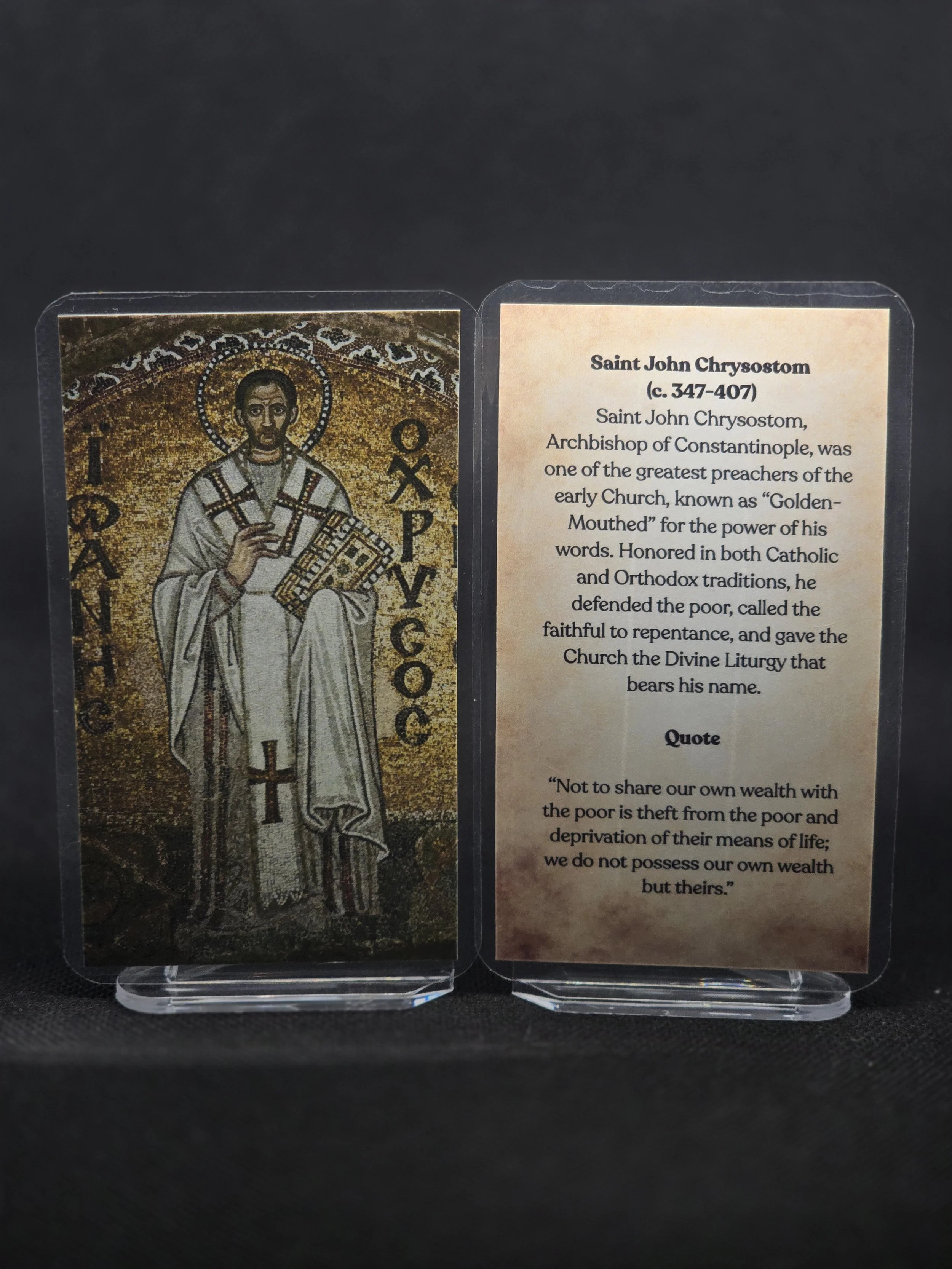
Saint John Chrysostom is the Church’s fearless voice of truth, especially sought by those praying for confidence in public speaking, courage to confront injustice without fear, and strength for discipline and self-control in daily life.
Unlike many saints known for silence or solitude, John stood in pulpits before emperors and crowds. His words exposed corruption, defended the poor, rebuked vanity, and called Christians to radical holiness. So powerful was his preaching that the people named him Chrysostomos — “Golden-Mouthed.”
He was not a comfortable bishop.
He challenged wealth.
He confronted political power.
He reformed corrupt clergy.
He simplified his own lifestyle so he could feed the poor.
For this boldness, he was slandered, deposed, and exiled — not once, but twice. Driven across harsh terrain under guard, his health broken, he died whispering: “Glory to God for all things.”
His feast is commemorated on November 13.
To this day, people turn to Saint John Chrysostom before giving speeches, teaching classes, preaching sermons, defending truth in hostile settings, or fighting personal weakness and lack of discipline. He is especially powerful for those who must speak when silence would be easier.
This handmade prayer card presents a stronger, more authoritative depiction of the saint — ideal for prayer desks, study spaces, lecterns, or parish offices. It is not merely devotional art. It is a reminder that truth spoken in love carries eternal weight.
Saint Nicholas of Myra
Hidden Generosity and Quiet Authority
Saint Nicholas is widely known, often misunderstood, and deeply loved. In Orthodox Christianity, his legacy is not rooted in folklore, but in pastoral care, generosity, and defense of truth.
Nicholas served as a bishop who protected the poor, defended the innocent, and intervened quietly in the lives of those in need. His generosity was often hidden, offered without recognition. His authority was not imposed, but trusted.
Orthodox devotion to Saint Nicholas emphasizes his nearness. He is prayed to in ordinary needs, family struggles, travel, and financial hardship. His life teaches that holiness is often expressed through practical love rather than dramatic gestures.
Saint Nicholas remains one of the most approachable saints in Eastern Christianity. His presence in the liturgical calendar anchors charity in everyday life.
Prayer cards of Saint Nicholas are commonly used for family prayer and personal devotion.
https://www.theeasternchurch.com/eastern-catholic-eastern-orthodox-prayer-cards
Saint George the Great Martyr
Courage Without Compromise
Saint George is venerated throughout the Orthodox world as a martyr who refused to compromise his faith under pressure. His story, often symbolized through iconography of victory, is not about conquest, but about endurance.
George’s martyrdom reflects a core Orthodox conviction: faithfulness matters more than survival. His courage is not celebrated as bravado, but as steadfast trust in Christ even when faced with death.
Orthodox Christians often turn to Saint George in times of spiritual battle, fear, or persecution. His life teaches that courage is not the absence of fear, but obedience in spite of it.
Prayer cards honoring Saint George are often kept by those seeking strength, protection, or perseverance.
https://www.theeasternchurch.com/eastern-catholic-eastern-orthodox-prayer-cards
The Theotokos
The Measure of All Saints
No discussion of Orthodox saints is complete without the Theotokos, the Mother of God. While she stands apart in honor, she is also understood as the fullest expression of what every saint becomes through grace.
The Orthodox veneration of the Theotokos is not sentimental. It is theological. She represents complete cooperation with God, humility without passivity, and obedience without fear. Her presence in Orthodox prayer is constant, woven into liturgy, hymns, and personal devotion.
The Theotokos is approached as intercessor, protector, and model of faith. Her life reveals that holiness is not self-assertion, but surrender.
Prayer cards depicting the Theotokos are central to Eastern Christian prayer corners and daily devotion.
https://www.theeasternchurch.com/eastern-catholic-eastern-orthodox-prayer-cards
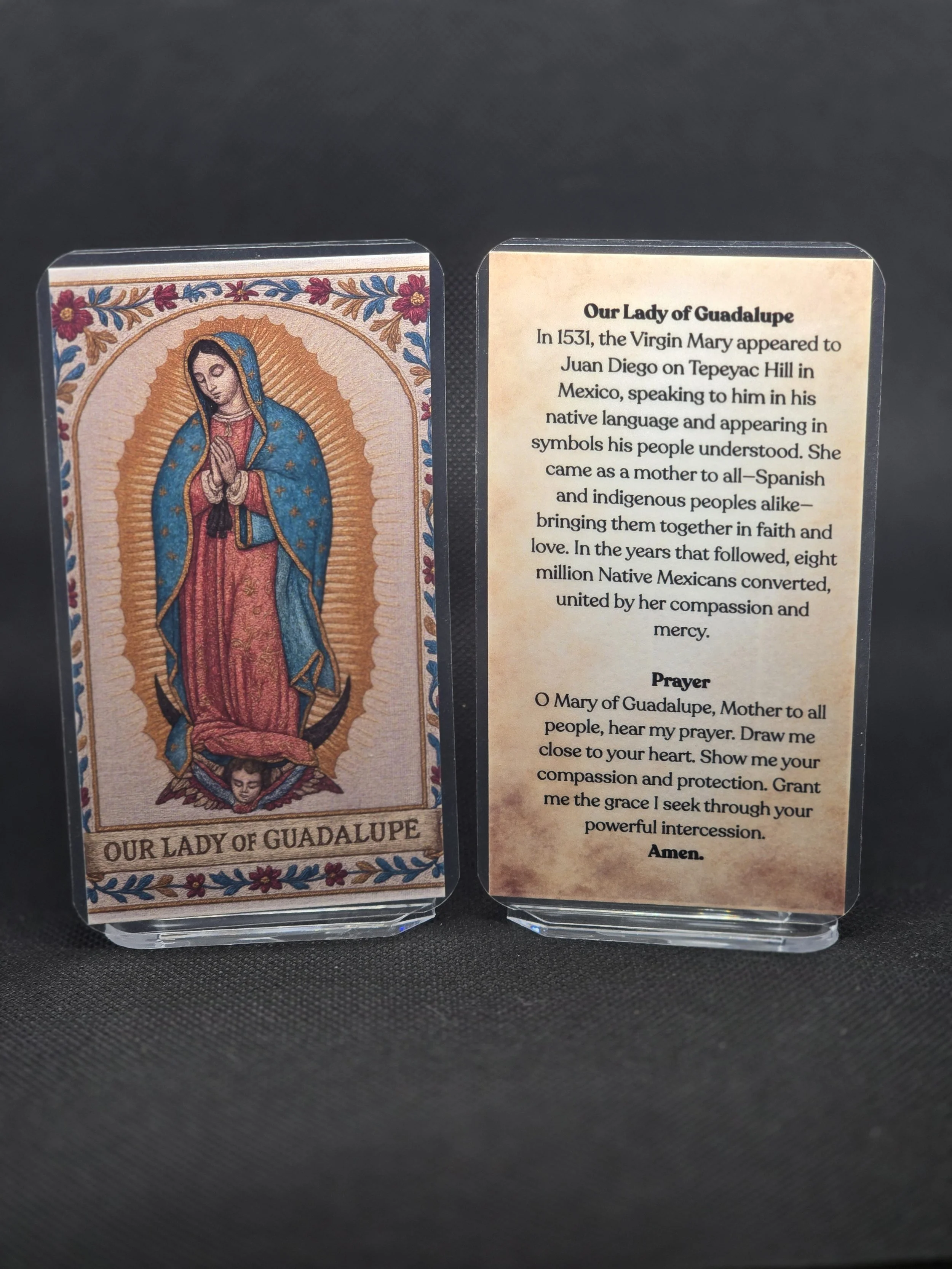
Our Lady of Guadalupe is not simply a Marian apparition. She is a living refuge for mothers, fathers, and families standing at the edge of despair.
She is especially sought by those praying for fertility after years of disappointment, safe pregnancy during medical uncertainty, and protection of unborn children when doctors give little hope.
She comes to people who feel invisible.
She comes when prayers feel unanswered.
She comes when life itself feels fragile.
In 1531, she appeared quietly on Tepeyac Hill to a poor indigenous convert, Juan Diego, speaking to him with maternal tenderness and calling him “my little son.” She did not arrive with thunder or fire. She arrived pregnant, clothed with stars, bearing Christ beneath her heart.
Her feast is celebrated on December 12.
Today, couples struggling to conceive, mothers facing complicated pregnancies, and parents praying over hospital cribs still turn to Guadalupe. She understands miscarriage. She understands fear-filled waiting rooms. She understands what it means to carry hope when everything feels uncertain.
This handmade prayer card honors her quiet strength and maternal mercy with museum-quality craftsmanship. Created for prayer during fertility journeys, high-risk pregnancies, and family crises, it is meant to live on a prayer corner, not in a drawer. It is not merely devotional art. It is a spiritual heirloom.
Bringing the Saints Into Daily Life
In Orthodox Christianity, saints are not encountered only on feast days. They are present in daily prayer, icons, and the rhythm of the Church year. One of the simplest ways to integrate their presence is through consistent, quiet devotion.
A prayer card placed intentionally, used daily, and approached with reverence becomes more than an object. It becomes a reminder that the Church is larger than the present moment and that holiness is not abstract.
Choosing one saint and praying with their prayer card for a season allows their life and witness to shape the heart gradually. The Orthodox tradition values depth over quantity. One faithful relationship matters more than many passing interests.
Conclusion
The saints of Orthodox Christianity are not distant heroes. They are living witnesses who continue to shape the Church through prayer, example, and presence. Their stories matter because they reveal how the Gospel takes root in real lives.
Interest in Orthodox saints continues to grow because their lives address questions that never disappear. How do we remain faithful in difficult times? How do we unite prayer and action? How do we live with courage, humility, and love?
The saints answer these questions not through theory, but through lived faith. To learn their stories is to encounter the Church as it truly is: a living communion stretching across time, inviting every generation to holiness.