Abba Paul the Simple: The Complete Life of the Desert Father Who Outdid His Own Teacher
Abba Paul the Simple: The Complete Life of the Desert Father Who Outdid His Own Teacher
A sixty-year-old farmer who walked into the desert the same day he found his wife with another man. A door Saint Anthony the Great shut in his face for three days straight. A demon that could resist Anthony himself but broke under the prayer of a man too simple to know he should be afraid. This is the most complete account anywhere of Abba Paul the Simple — his full life, his most famous sayings, the documented miracles of his discipleship, and everything he is remembered, and unofficially venerated, for in the wisdom literature of the Desert Fathers.
Abba Paul the Simple — At a Glance
- Lived
- 3rd–4th century AD, Egypt (exact dates uncertain)
- Background
- A peasant farmer (husbandman), uneducated, married
- Conversion Moment
- Discovered his wife's infidelity; left the same day, age 60
- Spiritual Father
- St. Anthony the Great, "Father of Monasticism"
- Feast Day
- March 7 (Eastern) • commemorated with Desert Fathers tradition
- Title Given by Anthony
- "The Simple" — a term of highest praise, not insult
- Defining Trait
- Total, literal obedience without question or hesitation
- Famous Miracle
- Cast out a demon that even St. Anthony could not expel
- Primary Sources
- Palladius (Lausiac History), Rufinus, Sozomen — three independent ancient accounts
- Praised By
- St. John Climacus, in "The Ladder of Divine Ascent"
- Officially/Traditionally Honored As
- Model of monastic simplicity and perfect obedience
- Unofficially Invoked For
- Late vocations • betrayed spouses • those who feel "too simple" for holiness
A Farmer's Life Before the Desert
Long before he became one of the most beloved figures in the literature of the Desert Fathers, Paul was, in the words of Palladius of Helenopolis, simply "a peasant farmer of transparently innocent and simple life." He worked the land in Egypt as an ordinary husbandman, married to a woman every ancient source agrees was strikingly beautiful — and, by every account, just as morally lax as she was beautiful. Sozomen's fifth-century Ecclesiastical History confirms the same basic picture: Paul "dwelt in the country, and was married to a beautiful woman."
Nothing in any surviving account suggests Paul possessed any particular education, eloquence, or worldly distinction before his conversion. This is, in fact, the entire point of every story told about him afterward: he arrived at sanctity not through learning or natural brilliance, but through an almost total absence of the qualities the ancient world typically prized in a holy man. He was, simply, a man of his word and of his work, with no apparent guile in him at all — a character trait that would define every single episode of his later life as a monk.
Part II
The Discovery and the Laugh
The defining moment of Paul's life arrived, according to Palladius, almost by providence. He returned home unexpectedly from the fields one day and walked in on his wife in the act of adultery with another man. What happened next has struck readers for sixteen centuries as one of the strangest and most genuine conversion reactions in the entire literature of the saints: Paul did not rage, weep, or strike anyone. He laughed — a forthright, heartfelt laugh — and said simply: "Fine, fine. This means that she is no longer any responsibility of mine. In Jesus' name I acknowledge her no longer. Go, take her with you, and her children, for I am leaving to become a monk."
Rufinus of Aquileia's separate account, drawing on different testimony, paints a somewhat different emotional register for the same event: in his version, Paul saw the same scene "with his own eyes," but rather than laughing, left "without saying anything to anyone... overwhelmed with sadness in his heart," and fled into the desert in genuine grief rather than dry amusement. Both versions agree on every essential fact — the discovery, the immediate and total departure, the total absence of any attempt at confrontation or reconciliation — while disagreeing on Paul's precise emotional tone in the moment. This article presents both, since neither account claims to be eyewitness testimony, and the discrepancy itself says something honest about how quickly a single dramatic life event accumulates differing details even among contemporaries.
What is not in dispute is the outcome: without negotiation, without recrimination, and without a single word to any other family member or neighbor, Paul walked away from his entire former life that same day, at the age of sixty.
Part III
An Eight-Day Journey to a Door That Would Not Open
Paul made his way, on foot, an eight-day journey to the cell of Anthony the Great — already, by this point in his life, the most famous and most revered ascetic in the Egyptian desert, sought out by emperors and peasants alike. He knocked on Anthony's door.
"What do you want?" Anthony asked when he came to the door.
"To become a monk," Paul replied.
Anthony's response was not encouragement but flat refusal. "You must be at least sixty. You can't become a monk," he told him. "Live in the town, work for your living, trusting in the grace of God. You would not be able to cope with all the trials of solitude." When Paul insisted he would do anything Anthony told him, Anthony tried again to turn him away, suggesting he instead join a cenobium — a communal monastery with many brothers to support a man of his age and frailty — rather than attempt the far harsher life of a solitary hermit like Anthony himself, who at that time was fasting for five full days between meals.
Anthony then simply shut the door in Paul's face. For three full days afterward, Anthony did not go outside at all — not even, the source specifies bluntly, to answer the call of nature — apparently hoping that Paul would simply give up and leave on his own.
Part IV
Three Days Outside Anthony's Cell
Paul did not leave. He simply stayed exactly where he was, outside the sealed door, for the entire three days, with nothing to eat or drink. On the fourth day, when Anthony was finally forced by physical necessity to open the door and step outside, he found Paul still there, now in his fourth day without food or water.
"Go away, old man," Anthony said again. "Why do you keep on bothering me? You can't stay here."
"I don't intend to stay anywhere else except here," Paul answered.
It was at this point that Anthony's own calculation shifted. Looking at Paul, he realized the old man had nothing with him to sustain life at all, and had now gone four full days without food. "He is so unused to fasting he might die," Anthony reasoned to himself, "and I will be to blame." Rather than risk Paul's death on his doorstep, Anthony finally relented and took him in — on one condition. "If you can be obedient and do what I tell you," he said, "you'll be all right." Paul's answer was immediate and unconditional: "I will do whatever you say."


Part V
The Trials: Rope, Bread, and Silence
Anthony's testing of Paul had only begun. His first instruction was deceptively simple: "Stay here and pray, while I go in and fetch something for you to work with." Anthony then withdrew into his inner room and secretly watched Paul through the window for the rest of the week, to see whether the old man would move from the spot. He did not, remaining standing in place, scorched by the desert heat, the entire time.
At the end of the week, Anthony finally emerged with palm branches soaked in water and instructed Paul to weave a rope, as he demonstrated. Paul worked until the ninth hour, completing roughly fifteen arms-lengths of rope with great difficulty — only for Anthony to inspect the result and declare it badly done, ordering him to undo the entire thing and start over. This came on the seventh consecutive day of Paul's fast. Palladius notes explicitly that Anthony was treating him this harshly specifically to test whether he would give up. Paul simply took the branches and rewove them, without grumbling, without becoming downcast, and without the slightest trace of resentment. It was at this point, witnessing this, that Anthony "began to feel sorry for him."
That evening brought a final, almost comic test built entirely around food and patience. Anthony prepared a meager meal of soaked bread and put Paul through an elaborate, repeated cycle of prayers and psalms before allowing him to eat anything at all — pushing the meal back through midnight prayers, more psalms until dawn, and round after round of waiting. When Anthony finally offered Paul a second roll of bread, Paul's answer perfectly captured the spirit that would define his entire monastic life: "If you have another one, I will, but not if you won't." When Anthony explained that one roll was sufficient for a monk, Paul immediately agreed that one was sufficient for him too, "since I want to be a monk." He had passed every test not through cleverness, but by refusing, at every single turn, to want anything more or different than exactly what his teacher wanted for him.
Part VI
Taking Every Word Literally
The single most famous episode illustrating Paul's character comes from Rufinus's account, and it concerns a moment when Anthony, embarrassed by what he considered a foolish theological question from Paul during a visit from other senior monks, brushed him off carelessly: "Get away with you, say no more," he said, in what Rufinus describes as the tone reserved for scolding idiots.
Paul took the rebuke completely literally, as a direct command from God transmitted through his spiritual father. He returned to his cell and began keeping absolute silence, refusing to speak a single word to anyone. When visiting brothers eventually asked him directly why he would not speak, he said nothing at all in reply, continuing to obey what he understood as Anthony's instruction with total fidelity. It took three full weeks before Anthony, puzzled and unaware he had given any such command, finally ordered him outright to break his silence and explain himself.
"You, father," Paul said simply, "told me to get away and say no more."
Anthony was reportedly amazed that Paul had taken so literally words he himself had spoken carelessly and without real intention. "This man puts us all to shame," Anthony is recorded as saying. "For we fail to hear what is spoken to us from heaven, whereas he observes whatever comes out of our mouth." Anthony went on to use Paul explicitly as a teaching example for his other disciples on the nature of true obedience, arguing that anyone who wishes to come quickly to spiritual perfection must not be their own master, even in matters where they believe themselves to be in the right — precisely the lesson Christ himself modeled in seeking not his own will but the will of the Father.
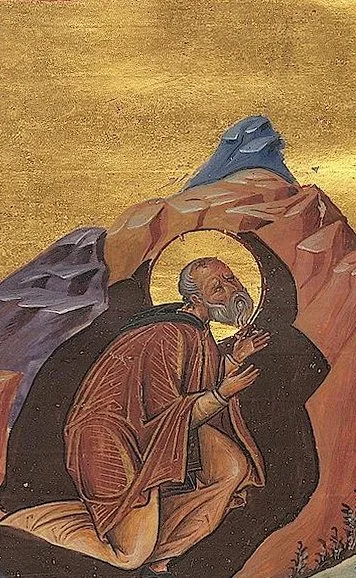
Part VII
Anthony Builds Him His Own Cell
Paul continued to live under Anthony's direct instruction through a long series of further trials, many of them deliberately arbitrary: ordered to draw water all day for no apparent purpose, told to break open a jar of honey and then scrape every drop back up without mixing in any dirt, instructed to unravel woven baskets and weave them again, to tear his garment apart and sew it back together, over and over. Rufinus is explicit that the entire point of these exercises was not practical usefulness but the deliberate training of Paul's mind in the habit of total obedience — and that in every single instance, Paul carried out the instruction without contradiction.
After several months of this regimen, Anthony became convinced that Paul's soul, despite what Anthony himself called his "somewhat simple" nature, had become "almost perfected in all things." Moved, in Palladius's account, by the grace of God, Anthony built Paul his own separate cell, three or four miles from his own. "See now, by the help of the grace of Christ you have become a monk," Anthony told him. "Now live by yourself, and even take on the demons." Exactly one year after Paul the Most Simple had first arrived at Anthony's door, he was, in the words of the text, "highly experienced in a disciplined way of life and was found worthy to battle against the demons and against all kinds of diseases."
Part VIII
The Demon Even Anthony Could Not Cast Out
The single most dramatic episode of Paul's entire life as a monk involves a young man brought to Anthony, possessed by what the text describes as one of the most powerful and savage demons in existence, railing against heaven itself with curses and blasphemies. Anthony examined the young man and, in a moment of remarkable humility for the most famous holy man in Egypt, admitted plainly to those who had brought him: "This is not a task for me. I have not yet been given the grace to deal with this very powerful type of demon. Paul the Simple has the gift of dealing with this one."
Anthony personally brought the group to Paul. "Abba Paul," he said, "cast out this demon from this person so that he may return home cured and glorify God."
"Why not you?" Paul asked.
"It is not for me," Anthony replied. "I have other concerns." And with that, Anthony simply left the young man there and returned to his own cell.
What followed was an extended, genuinely fierce confrontation. Paul commanded the demon to depart in Anthony's name; the demon refused with violent curses, mocking both Paul and Anthony as "disgusting old men, lazy and greedy." Paul, in his sheepskin garment, struck the possessed man's back, repeating the command. The demon raged on, cursing even Christ himself and refusing to leave. This finally provoked Paul to genuine anger. He went outside into the full force of midday Egyptian heat — described as comparable to the biblical furnace of Babylon — and stood upright on a rock like a statue, praying: "O Jesus Christ, you were crucified under Pontius Pilate, take note that I will not come down from this rock, nor will I eat or drink even if I die, until you hear me and cast out this demon from this man and liberate him from the unclean spirit."
Before Paul had even finished praying, the demon cried out in defeat: "I'm going, I'm going, driven out by force, overcome by tyranny. I'm getting out of this man and won't come back any more. It is the simplicity and humility of Paul which has driven me out and I don't know where to go." At the moment of its departure, the demon reportedly transformed into an enormous dragon, roughly seventy cubits long, and fled toward the Red Sea. The text draws the lesson explicitly: although lesser demons can be cast out by the faith of men in positions of authority, it takes genuinely humble men to put to flight the demons of greatest power.
Part IX
The Man With Rabies and a Child's Demand
Rufinus records a second, quite different miracle that reveals an entirely different, almost endearing side of Paul's character. A man suffering from what the source describes as rabies was brought to him, biting like a dog at anyone who tried to approach. Paul persisted in prayer that the demon troubling the man be driven out, but for some time nothing seemed to happen.
What Paul did next has no parallel anywhere else in Desert Father literature that approaches its sheer childlike directness. Growing indignant at the lack of an immediate result, he is recorded crying out to God exactly like an upset child making a demand of a parent: "If you don't cure him, I am not going to get anything to eat today!" According to Rufinus, God granted the request immediately, "as if he were a favourite child," and the man's affliction was instantly cured.
This single anecdote captures something essential that every source agrees on about Paul: his relationship with God was not built on theological sophistication or carefully measured petition, but on a kind of total, unselfconscious trust that more polished holy men sometimes struggled to access precisely because they were too aware of how such prayers might sound.


Part X
Three Ancient Sources, Three Different Emphases
Few figures from the Desert Father tradition are documented across as many independent ancient sources as Abba Paul the Simple, which gives this article unusually solid ground to stand on for a fourth-century monastic figure. Three separate historians, writing within roughly a century of each other and drawing on at least partially independent oral testimony, each preserved his story:
Palladius of Helenopolis (Lausiac History, Chapter 28)
Writing in the early fifth century, Palladius states explicitly that his account comes from named eyewitness sources: "The Servant of Christ, Hierax, as well as Cronius and several other brothers, told me the story." This is the most detailed and dialogue-rich of the three accounts, including the full exchange at Anthony's door, the rope-weaving and bread trials, and the complete account of the demon and the dragon.
Rufinus of Aquileia (History of the Egyptian Monks, Book 2, Chapter 31)
Rufinus's account, also from the early fifth century, shares the same basic narrative but adds the literal-obedience episode involving Anthony's careless rebuke, the honey jar and basket-weaving trials, and the rabies healing story — material absent from Palladius's version entirely. Rufinus also explicitly frames Paul as a teaching example Anthony used with his other disciples on the theology of obedience.
Sozomen (Ecclesiastical History, Book 1, Chapter 13)
The historian Sozomen's account is the briefest of the three, summarizing the core conversion story and noting specifically that Paul went on to demonstrate, through his deeds, that he had become "greater than even his teacher in vexing and expelling demons" — an extraordinary claim to find recorded about any disciple of Anthony the Great, made all the more credible by appearing independently in a formal ecclesiastical history rather than only in monastic storytelling.
The existence of three separate ancient writers, each adding distinct details while agreeing on every major point of the narrative, gives Paul's story a level of historical corroboration that is genuinely unusual among Desert Father figures, many of whom survive in only a single source or scattered, anonymous sayings.
Part XI
"The Rule and Type of Blessed Simplicity"
Paul's reputation did not fade with the generation that knew him. Saint John Climacus, the seventh-century author of the immensely influential monastic text "The Ladder of Divine Ascent," singled him out by name centuries later as the supreme embodiment of a specific monastic virtue: "Paul the Simple was a clear example for us, for he was the rule and type of blessed simplicity."
This is a significant endorsement within the specific vocabulary of Eastern Christian spirituality. "Simplicity" in this tradition is not synonymous with foolishness or lack of intelligence; it refers to a particular, highly prized virtue — an undivided, uncomplicated directness of soul before God, free from the layers of calculation, self-justification, and inner duplicity that more sophisticated or worldly-wise people often accumulate without realizing it. Climacus's choice of Paul, of all the Desert Fathers available to him, as the defining "rule and type" of this virtue placed Paul's story permanently into the core curriculum of Eastern monastic formation for every generation that followed.
Part XII
Sayings Attributed to Paul the Simple
Unlike many Desert Fathers whose names are attached to long collections of pithy aphorisms in the Apophthegmata Patrum, Paul the Simple's recorded words come almost entirely embedded within narrative episodes rather than as standalone sayings — itself a fitting reflection of a man whose holiness was expressed through action and obedience rather than instruction. The most representative and frequently cited of his recorded words include:
- His declaration upon discovering his wife's infidelity: "Fine, fine. This means that she is no longer any responsibility of mine."
- His answer to Anthony's repeated attempts to send him away: "I don't intend to stay anywhere else except here."
- His perfectly matched response on the question of the second roll of bread: "If you have another one, I will, but not if you won't."
- His explanation, after three weeks of silence, for why he had not spoken: "You, father, told me to get away and say no more."
- His prayer of total, almost reckless commitment before casting out the powerful demon: "I will not come down from this rock, nor will I eat or drink even if I die, until you hear me."
- His childlike demand to God during the rabies healing: "If you don't cure him, I am not going to get anything to eat today!"
Read together, these sayings form less a body of teaching than a portrait of a single, consistent disposition carried into every circumstance: total presence, total honesty, and a complete absence of strategic calculation about how his words or actions might be perceived.
Part XIII
Legacy in Monastic and Orthodox Spirituality
Paul the Simple occupies a distinctive and enduring place in the literature of the Desert Fathers precisely because his story functions as a deliberate counterweight to a particular spiritual danger the tradition was always alert to: the temptation to treat asceticism as an intellectual or competitive achievement. Figures like Evagrius Ponticus brought genuine philosophical sophistication to desert spirituality; Paul brought none of that, and the tradition preserved his story specifically to demonstrate that sophistication was never the actual prerequisite for sanctity.
His example is frequently invoked in Orthodox catechetical and monastic writing today as a corrective against what is sometimes called "rational" or overly cerebral approaches to the spiritual life — a reminder that direct, unhesitating obedience and radical honesty before God can outpace decades of theological study or ascetic technique. The fact that Anthony the Great himself, already recognized in his own lifetime as the father of Christian monasticism, openly admitted that Paul possessed gifts and graces he himself lacked, gives this counter-example unusual institutional weight: it is not a folk legend undermining the authority of the great monastic founders, but a story the great monastic founders themselves told about each other, preserved and passed down by their own immediate disciples.
Part XIV
What Abba Paul Is Traditionally Honored and Invoked For
Unlike many later Western saints, Abba Paul the Simple does not carry a list of formally assigned Vatican-style patronages, since the Desert Father tradition predates that later devotional system. Instead, his veneration takes the form of being held up as a living "type" or model — a recognized spiritual archetype that the faithful are invited to imitate in specific circumstances:
- Late vocations — anyone who feels called to a deeper spiritual life later in life, after decades spent in an entirely different, ordinary path, finds in Paul's conversion at age sixty a direct precedent rather than an obstacle.
- Those betrayed by a spouse — Paul's story offers an unusual model of response to marital infidelity: total, immediate release without bitterness, rather than prolonged conflict or self-destructive grief.
- Those who feel intellectually or spiritually "too simple" — perhaps his most enduring informal patronage, since his entire story exists specifically to reassure ordinary, unsophisticated believers that holiness was never reserved for the educated or naturally gifted.
- Obedience and spiritual direction — Paul remains one of the strongest recorded examples in the entire tradition of total trust in a spiritual father, cited specifically in teaching on the discipline of obedience within monastic formation.
- Deliverance ministry and exorcism — given his recorded power, exceeding even Anthony's own, over the most severe demonic affliction.
Part XV
A Note on Sources and the Many "Pauls"
Careful research into Abba Paul the Simple requires distinguishing him clearly from several other figures who share his name within the same body of literature, since conflation between them is a genuine and common source of confusion online. He is not the same person as Paul of Thebes (also called "Paul the First Hermit"), an earlier and entirely separate ascetic whom Anthony famously sought out near the end of Paul of Thebes's life, as recorded by Saint Jerome — a meeting involving a raven bringing bread, distinct from anything in Paul the Simple's story. He is also distinct from the otherwise unidentified "Abba Paul" mentioned briefly elsewhere in the Sayings of the Desert Fathers as a disciple of Abba Or, and from a separate "Abba Paul, from Lower Egypt," remembered for a different miracle involving handling snakes.
Of the three primary ancient sources for Paul the Simple's own story — Palladius, Rufinus, and Sozomen — modern scholarship, including a detailed 2016 academic study of the story's later Ethiopic recension published in Orientalia Christiana Periodica, confirms that Palladius's version in particular was translated with notably high fidelity into other ancient languages, suggesting the core narrative was treated with unusual textual care and stability as it spread across the wider Christian world in the centuries following his death. This stands in contrast to many other Desert Father narratives, which often shifted more freely in transmission. Exact dates for Paul's birth and death are not preserved in any source; what can be stated with confidence is that he was a contemporary and direct disciple of Anthony the Great, placing his active monastic life within the late third or early-to-mid fourth century AD.
Part XVI
A Prayer Inspired by Abba Paul
Abba Paul, you who left everything behind in a single day, without bitterness and without delay, teach us to release what no longer belongs to us, and to walk toward God without looking back.
You who stood outside a closed door for three days rather than abandon your calling, and who took every word spoken to you as if it came from heaven itself, grant us a portion of your undivided heart.
You who cast out what even your own teacher could not, not by cleverness but by simplicity, intercede for those of us who feel too ordinary, too late, or too simple for the life God is calling us to.
Through your prayers, O God, have mercy on us and save us. Amen.
This composed devotional prayer draws on the documented episodes of his life as recorded by Palladius, Rufinus, and Sozomen; it is not a historical liturgical text.
Part XVII
Complete Timeline of His Life and Legacy
FAQ
Frequently Asked Questions About Abba Paul the Simple
"I Will Do Whatever You Say"
Abba Paul the Simple never wrote a treatise. He never founded an order. By his own teacher's repeated admission, he was not especially clever, not formally educated, and not, by any worldly measure, an obvious candidate for sanctity at the age of sixty. And yet the same teacher who tried three separate times to turn him away at the door eventually stood beside him and openly told a desperate family that the most powerful demon they had ever encountered was a task Paul could handle and Anthony himself could not.
That is the whole of his witness, condensed: not brilliance, not eloquence, not even, particularly, courage in the conventional sense — just an utterly undivided willingness to do whatever was asked of him, for as long as it took, without ever once calculating whether it was worth it.
Get the Abba Paul the Simple Prayer Card →