Saint Drogo of Sebourg: The Complete Life of the Hermit Who Walled Himself Away
Saint Drogo of Sebourg: The Complete Life of the Hermit Who Walled Himself Away
An orphan who blamed himself, at ten years old, for a death he could not have caused. A shepherd reportedly seen in two places at once. A man so disfigured by illness that he sealed himself inside a narrow stone cell for roughly forty-five years rather than let his own face frighten the children of his village. A church fire he refused to flee, on a vow he refused to break. This is the most complete account anywhere of Saint Drogo of Sebourg — his full life, the documented legends both before and after his death, where his relics rest today, and everything he is patron, and unofficially patron, of.
Saint Drogo of Sebourg — At a Glance
- Born
- March 14, 1105 (or c. 1102–1120), Epinoy, County of Flanders
- Died
- April 16, 1186 (some sources: 1189), Sebourg, France
- Also Known As
- Druon, Dreux, Dron, Droon, Drogon, Drugo
- Feast Day
- April 16
- Status
- Venerated by vox populi (popular acclaim); relics formally elevated 1612
- Occupations
- Shepherd (6 years) • Pilgrim (9 journeys to Rome) • Anchorite (c. 45 years)
- Defining Legend
- Bilocation — reportedly seen in the fields and at Mass simultaneously
- Famous Miracle
- Survived unharmed inside his cell during the burning of Sebourg's church
- Officially Patron Of
- Shepherds • orphans • the unattractive • hernia & bodily ills
- Unofficially Invoked For
- Coffee house keepers • expectant mothers • the deaf & mute • the insane
- Primary Relics
- Church of Saint Martin, Sebourg, France
- Living Tradition
- Annual Trinity Sunday procession to Saint Drogo's Cross, Sebourg
Born of a Death He Never Caused
Saint Drogo — known across the centuries and across two languages as Druon, Dreux, Dron, Droon, and Drogon — was born on March 14, 1105, in the village of Epinoy, in the County of Artois within the French portion of the County of Flanders. Today this village forms part of the modern commune of Carvin, in the extreme north of France near the Belgian border. Some sources place his birth slightly earlier, anywhere between 1102 and 1120, reflecting the genuine uncertainty that surrounds nearly every date in his life.
He was born into a wealthy, quite possibly noble, Flemish family, but tragedy had already marked his arrival before he ever drew breath. His father died several months before Drogo was born, leaving the household in mourning even as it awaited his birth. His mother's labor proved severely complicated; several accounts specify that the child had to be delivered by what amounted to a Caesarean operation, a desperate and dangerous procedure in the twelfth century. She did not survive it. Drogo was, in the most literal sense, an orphan from the moment of his own birth, having never known either parent.
Relatives took him in and raised him according to the customs and etiquette expected of Flemish nobility. For a time, the privileged circumstances of his upbringing gave no outward sign of what was forming within him.
Part II
Childhood Guilt and Early Asceticism
When Drogo was about ten years old, he learned the full circumstances of his mother's death — that she had died bringing him into the world. The discovery struck him with a force entirely disproportionate, by any ordinary measure, to anything a child could be reasonably held responsible for. He was, in the words of one of the more detailed accounts of his life, a sensitive soul, deeply touched by what he heard of his mother's suffering, and was afterward often seen to weep bitterly for her. In his innocent simplicity, the boy reproached himself for what felt to him like a grave personal offense, and began to implore God's pardon with what witnesses described as great contrition — the language used here matters, because this is not a child's passing sadness being described, but the early formation of a guilt that would govern the entire shape of his adult life.
Even before adulthood, this guilt expressed itself in concrete physical practice. Drogo began fasting, practicing abstinence, and performing other austerities as a boy, devoting himself to acts of charity that he understood, even then, as a kind of expiation for what he believed was his own fault. One later French-language account adds a specific, almost startling detail: that Drogo, finding ordinary penance "too light," took to placing dried peas inside his own shoes — a small, private act of self-imposed suffering carried out, by every indication, entirely on his own initiative and without any adult prompting him to it.
Part III
Giving Away Everything at Twenty
Around the age of twenty, in approximately 1125, Drogo's accumulated remorse reached a decisive turning point. He resolved to renounce his entire inheritance and his noble standing outright. Multiple sources connect this act directly to Christ's words to the rich young man in the Gospel of Matthew: "If thou wilt be perfect, go sell what thou hast, and give to the poor, and thou shalt have treasure in heaven: and come follow me" (Matthew 19:21). Whatever specific circumstance precipitated the decision, Drogo distributed his entire considerable inheritance to the poor of the region, keeping for himself nothing beyond the clothes he was wearing.
He then set out on foot, entrusting himself entirely to Providence, and never returned to Epinoy again. This was not a brief gesture followed by a return to comfort; it was a complete and permanent severing of every tie to the life he had been born into.
Part IV
The Shepherd of Sebourg
Drogo's wandering eventually brought him to the small village of Sebourg, roughly thirty-five miles from Epinoy, in what was then the independent County of Hainaut bordering France, near the city of Valenciennes. There he found employment tending sheep for a pious, comfortably well-off woman named Elizabeth de la Haire — solitary work that suited both his temperament and his deepening spiritual inclination.
The humble surface of a shepherd's life in twelfth-century Europe concealed a genuinely skilled and economically vital occupation. Flocks supplied the wool that fed a booming international textile trade and the parchment that supported the period's rising book production. A 1379 treatise on shepherding, written nearly two centuries after Drogo's death by a writer named Jean de Brie, describes the wide-ranging expertise a competent shepherd of this era needed: month-by-month care of a flock, the treatment and prevention of the illnesses and injuries sheep commonly suffer, weather prediction by observing wind, sky, and the behavior of wildlife, and the ability to recognize which plants were beneficial and which harmful to grazing animals. Drogo, by every account, mastered this craft so completely and so quickly that, despite his relative youth, he became known as an able tutor to other shepherds in the surrounding region.
He spent much of his time in prayerful contemplation while tending the flock, and gave away most of whatever wages or gifts he received to the poor, exactly as he had done with his original inheritance. His humility, gentleness, and generosity earned him the genuine admiration of the villagers around him, and particularly of Elizabeth de la Haire herself.


Part V
The Bilocation Legend
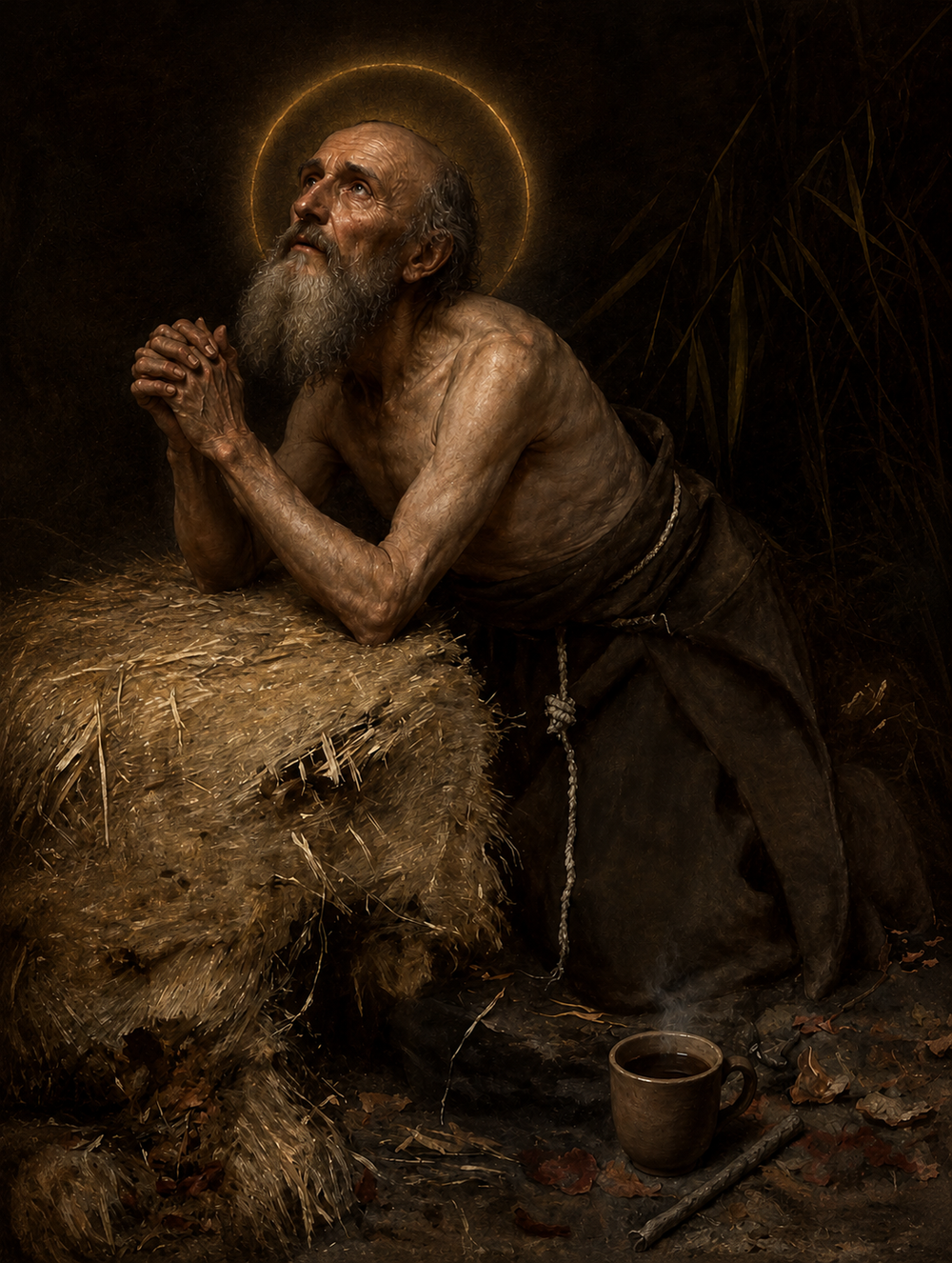
It was during his years as a shepherd that the single most distinctive legend of Drogo's entire life began to circulate. A constant tradition, repeated across nearly every surviving account of his life, holds that Drogo could be seen out in the fields tending his flock and, at the very same moment, attending Mass inside the village church — some versions specify that he was seen ringing the church bell for Mass while also walking in a religious procession. This phenomenon, known in theological terms as bilocation, was understood by medieval hagiography as a sign of exceptional divine favor granted in recognition of his purity and devotion, a category of miracle later associated with other saints as well, including Saint Anthony of Padua.
What makes this particular legend unusually well-documented, for a figure as obscure as Drogo, is the longevity of the popular saying it produced. According to multiple independent sources, a common adage persisted among the rural folk of the Hainaut and Flanders region for the better part of eight centuries, used whenever someone was asked to be in two places doing two different things at once: "I'm not Saint Drogo; I can't ring the church bell for Mass and be in the procession!" Several sources specifically note that this saying was still in active local use into the twentieth century — meaning ordinary people in northern France and Belgium were still invoking Drogo's name in everyday speech roughly eight hundred years after his death, very likely without most of them knowing any other detail of his biography.
Part VI
Nine Pilgrimages to Rome
After roughly six years tending sheep in Sebourg, Drogo felt called to take up the pilgrim's staff. He set out walking, in deliberate imitation of the Apostles, and traveled all the way to Rome, where he visited the tombs of Saints Peter and Paul, stopping along the route at numerous other renowned holy sites scattered across France and Italy.
He repeated this entire journey nine separate times over a period of roughly nine years, traveling entirely on foot each time and returning briefly to Sebourg between voyages. Some accounts speculate that Drogo specifically believed only the pope himself could grant him absolution for what he still considered his role in his mother's death — though if this was his hope, it was never fulfilled, since he never actually succeeded in meeting any pope in person despite nine journeys to the city where the pope resided. During these travels he occasionally supported himself using his shepherding skills along the way, and consistently used what little he had to assist other impoverished travelers he encountered, offering spiritual counsel as he went. He gladly endured the hunger, thirst, harsh weather, and genuine physical danger of medieval pilgrimage as part of his pursuit of holiness.
These years of relentless, repeated travel eventually took a severe physical toll. Drogo developed a debilitating and disfiguring hernia, almost certainly aggravated by years of walking enormous distances while carrying what little he owned, and this affliction ultimately forced him to abandon pilgrimage altogether and return to Sebourg for the final time.
Part VII
The Affliction That Changed Everything
The condition Drogo developed during his pilgrim years was not a minor or easily concealed ailment. Multiple sources describe it as a severe, visibly disfiguring hernia that left him debilitated and altered in appearance to a degree that frightened those who saw him. Over time, in the years that followed, his condition worsened further still, developing into putrescent sores on the lower part of his body — a detail repeated with striking consistency across independent sources rather than appearing in only one account, which lends it more weight than a single colorful exaggeration might otherwise carry.
What happened next says as much about the people of Sebourg as it does about Drogo himself. Rather than driving him away, the villagers who had come to know and respect him during his years as a shepherd responded to his disfigurement with what every source describes as genuine compassion rather than rejection. It was specifically out of this combination of compassion and, honestly, evident discomfort at his appearance that the parishioners of Sebourg petitioned for and helped build a small anchorite's cell directly attached to the wall of their own parish church — not a structure of banishment built to remove him from the community, but a structure of accommodation built to let him remain close to it, and close to the Eucharist, while sparing both himself and others, particularly the village's children, from the distress his appearance reportedly caused.

Part VIII
Walled In: Forty-Five Years as an Anchorite
Around 1141, while still in his early thirties, Drogo entered the cell the villagers had built for him and vowed to remain there for the rest of his life. He would keep that vow for approximately forty-five years, until his death in 1186 — one of the longest documented periods of voluntary anchoritic enclosure attributed to any medieval saint.
The arrangement followed the standard medieval form for anchorite cells: two small openings connected him to the outside world. One faced into the church itself, allowing him to adore the Holy Eucharist and follow the divine offices without ever entering the church proper. The other opened to the outside, through which villagers passed him alms, food, and the occasional gift. Drogo sustained himself almost entirely on barley bread and warm water for the remainder of his life, supplementing this severe diet only with the Eucharist itself. When visitors brought him any other food or kindness, he consistently gave it away to the poor, keeping for himself only what was strictly necessary to survive.
Despite his complete physical enclosure, Drogo was never cut off from the spiritual life of his community in any meaningful sense. He never refused those who came seeking his counsel or the benefit of his prayers, and every account agrees that those who visited his cell left consoled and edified by the encounter. He became, in effect, a wise and trusted advisor to the entire village — sought out specifically because of, rather than despite, his physical confinement and suffering. Even amid the painful progression of his illness, he was remembered as maintaining what one source specifically calls a gay and serene disposition, never losing his characteristic cheerfulness despite everything his body endured.
Part IX
The Church Fire
Early accounts of Drogo's life are unanimous in relating one specific, extraordinary event from his later years that did more than perhaps anything else to cement his reputation among the local peasantry. The parish church of Sebourg — almost certainly, in that era, a modest structure of wood and thatch roofing — caught fire. The villagers raised the alarm and came running, only to discover the blaze was already beyond any hope of extinguishing, and that Drogo's cell, built directly against the church wall, stood in mortal danger alongside it.
The fourteenth-century Franciscan chronicler Jacques de Guyse, writing roughly two centuries after the event but drawing on the established local tradition, records the villagers calling out to him directly: "Drogo, man of God, come out lest you die, for your cell is engulfed in flames, and we cannot bring you aid!" Drogo's reported reply has been preserved with remarkable consistency across the centuries: "I have made a vow to God, and I will fulfill it! If it pleases the Divine Goodness that I should escape the flames, His will be done!" He then fell to his knees inside his burning cell and began offering prayers of thanksgiving to God, rather than any prayer for his own deliverance.
A short time later, the fire burned itself out, having reduced most of the church to ashes. The villagers, searching through the smoldering ruins, found Drogo placidly at prayer amid the wreckage of his cell — completely unscathed. De Guyse records that the witnesses to this event immediately recalled the Old Testament story of the three men preserved unharmed in Nebuchadnezzar's furnace, exclaiming, "How great is the Savior's mercy, to preserve a man from such a danger!" The villagers rebuilt both the church and Drogo's dwelling on the very same site, and he resumed his life of prayerful seclusion there for the remainder of his days.
Part X
Death and the Ox-Cart That Would Not Move
Drogo died on April 16, in either 1186 or 1189 depending on the source consulted, having reached what was, for his era and for a body that had endured decades of illness and self-imposed hardship, a genuinely advanced age — somewhere between his late seventies and mid-eighties.
Upon learning of his death, Drogo's relatives back in Epinoy, his birthplace, came forward to claim his body, wishing to bring him home for burial, in keeping with the customs of the period. The people of Sebourg, according to the tradition, acceded to this request. Drogo's body was placed in a fine casket and set upon an ox-drawn cart for the journey back to Epinoy. According to the consistent account preserved across multiple independent sources, as the procession attempted to leave Sebourg, the casket seemed to grow steadily heavier, until the cart reached the very boundary of the village and could advance no further at all — as though halted by some force beyond the natural strength of the oxen pulling it.
The attempt to move Drogo's remains to Epinoy had to be abandoned entirely. His body was brought back into Sebourg to general acclaim and interred within the village church with what one source specifically calls rustic pomp. The villagers erected a stone cross at the precise spot where the ox-cart had been forced to stop — a monument that, although replaced several times across the intervening centuries, still stands today in a field on the outskirts of Sebourg, and which gives its name to the parish's central annual commemoration to this day.
Part XI
Veneration by Vox Populi and the 1612 Elevation
Not long after Drogo's death, accounts of miraculous healings attributed to his intercession at his tomb began spreading through the surrounding countryside and beyond. According to de Guyse's chronicle, the miracles multiplied to such an extent over time that it became genuinely difficult for pilgrims to approach the saint's tomb at all, given the sheer volume of sick visitors converging on Sebourg seeking his help.
By the time Pope Gregory XIII approved the first edition of the official Martyrologium Romanum in 1584, Drogo had already long been acclaimed a saint in his homeland through what is technically called vox populi — recognition by the spontaneous, sustained devotion of the ordinary faithful, rather than through any formal papal canonization process, a pathway to sainthood common for medieval figures venerated before the Church's modern canonical procedures were fully centralized. That 1584 edition, and every edition published since, includes a modest entry: "Saint Drogo, confessor," under the sixteenth day of April.
The most significant formal ecclesiastical recognition of his cult came in 1612, when Jean Richardot, Archbishop of Cambrai, ordered the official elevation of Drogo's relics at Sebourg — some sources specify the precise date of June 11 for this ceremony. This act of "raising the relics" to the altar formally approved the veneration that had, by that point, already been ongoing among the local population for well over four centuries.
Part XII
Where His Relics Are Today
Saint Drogo's relics have never left the small village that adopted him eight and a half centuries ago.
Church of Saint Martin
Sebourg, Hauts-de-France, FranceDrogo's body has remained enshrined in this church since his original burial in 1186, following the failed attempt by his Epinoy relatives to relocate his remains. His relics, including a separate arm reliquary, are kept today in the sacristy and main altar area, formally elevated in 1612 by order of the Archbishop of Cambrai. The church remains the focal point of his cult and the destination of the annual Trinity Sunday procession.
Saint Drogo's Cross
Outskirts of Sebourg, FranceA stone cross, replaced several times across the centuries but maintained continuously on the same site, marking the precise spot where the ox-cart carrying his body was reportedly unable to proceed any further toward Epinoy. Each year on Trinity Sunday, the parish reliquary chasse is carried in procession from the Church of Saint Martin to this cross, accompanied by confraternities and by village children dressed as shepherds and shepherdesses, during which blessings for livestock and shepherds are specifically invoked.
Beyond Sebourg itself, devotion to Drogo historically extended across a notably wide swath of northern France, Flanders, and parts of modern Belgium, with dedicated chapels recorded in numerous towns including Duisans, Vis-en-Artois, Clary, Oisy-le-Verger, Cambrai, Condé-sur-Aisne, Roucourt, Cottenchy, and Warmeriville. In Cambrai specifically, an annual "Shepherd's Mass" continues to be held in his honor, at which sheep farmers and their lambs are blessed. Confraternities dedicated to Saint Drogo remain active today in both Sebourg and Carvin (the modern commune that includes his birthplace of Epinoy), maintaining an unbroken devotional thread stretching back to the twelfth century.
Part XIII
What Saint Drogo Is Patron — and Unofficial Patron — Of
Officially Recognized
Saint Drogo's most consistently attested and longest-standing patronage, documented from the medieval period forward, is over shepherds and their flocks, reflecting his own years of skilled, devoted labor in that profession. He is also recognized as a patron of orphans, a patronage that follows directly and obviously from his own birth circumstances. His personal affliction has made him patron of those suffering hernias, ruptures, gallstones, and similar abdominal and bodily ailments. And, in one of the more distinctive and frequently discussed patronages attached to any saint, he is widely venerated as patron of the unattractive — those whom others find physically repulsive or unappealing — a patronage that emerged specifically from the disfigurement he endured and from the way medieval and later devotional writing framed his radiant inner holiness as transcending, rather than being diminished by, his outward appearance.
Widely Invoked, Without Formal Declaration
Beyond these core patronages, an unusually long and varied list of additional invocations has attached itself to Drogo over the centuries, some traceable to specific details of his biography and others more loosely associated through analogy or local custom:
- Expectant mothers and midwives — tied to his own difficult birth and, by some accounts, his particular sympathy and gratitude toward the mother he never knew.
- The deaf and the mute — appearing across multiple devotional patronage lists, though the precise origin of this connection is not clearly documented in any single surviving source.
- The mentally ill and those described in older sources as "insane" — another long-attested but loosely sourced patronage, likely connected to the broader medieval category of "bodily ills" his cult addressed.
- Cattle and livestock more broadly, beyond sheep specifically — a natural extension of his core shepherd patronage.
- Coffee house keepers and owners — the most famous and most historically debated of all his patronages, examined in full detail below.
- Bachelors and those who feel undesired or unloved — a modern, informal extension of his "patron of the unattractive" title into the broader territory of social rejection and loneliness.
Part XIV
The Coffee Mystery
No discussion of Saint Drogo would be complete without addressing the single detail that has done more than anything else to spread his name in the English-speaking world today: his widespread modern identification as the patron saint of coffee and coffeehouse keepers.
This patronage is genuinely strange on its face, and serious historians, including the author of the definitive English-language history of coffee, Mark Pendergrast, are entirely upfront about the underlying problem: there is no possible historical connection between a Flemish pilgrim of the twelfth century and a beverage that did not reach Western Europe until the seventeenth century at the earliest. As Pendergrast writes in his scholarly study Uncommon Grounds: The History of Coffee and How It Transformed Our World, even the earliest medical writers sometimes cited in connection with coffee's origins, the Persian physicians Rhazes and Avicenna, "were not describing our brew," and it likely wasn't until sometime in the fifteenth century that anyone roasted and ground coffee beans into the drink recognizable today. The patronage is, by any honest accounting, anachronistic.
And yet it is not a recent internet-era invention either, which is part of what makes the question genuinely interesting rather than simply dismissible. A Belgian almanac from 1860 already documents that, in the city of Mons — just across the modern Franco-Belgian border from Sebourg — the city's coffeehouse keepers (cafetiers) had already specifically claimed Drogo as their patron. This places the association at least a century and a half before any modern coffee-culture revival could plausibly explain it.
Several competing theories attempt to explain the connection, none of them conclusively. One points to a specific, minor detail recorded in some biographical sources: that during his decades of reclusion, Drogo drank nothing but warm water rather than cold — a detail some have speculated might have suggested, to later coffeehouse owners looking for an appropriate patron, a saint whose habits already vaguely resembled the brewing and drinking of a hot beverage. Others have noted, somewhat more tongue-in-cheek, that a saint famous for bilocation might fittingly be invoked by harried workers wishing they too could be in two places at once, much as coffee helps people push through long or doubled-up shifts. A further theory connects the patronage to the church fire: just as coffee beans are transformed by fire without being destroyed by it, Drogo himself miraculously survived a fire that should have destroyed him. One source notes that the patronage's popularity specifically surged again in the 1950s through Catholic publications, which extended it further into the modern, secular world of baristas and coffeehouse culture that exists today. None of these explanations is fully satisfying, and that honest gap in the historical record is, in its own way, a fitting match for a saint about whom so much else also remains uncertain.
Part XV
Living Confraternities and Folk Traditions
Drogo's connection to the rural shepherding culture of Hainaut, Artois, and Flanders runs deeper than formal religious veneration alone; it extends into the region's folk musical traditions. The Confrérie des Muchards de Saint-Druon (the Confraternity of the Muchards of Saint Drogo) is a real, still-active modern organization in Belgium dedicated to preserving the traditional small bagpipe historically known as the muchosá or muzelzak, an instrument that shepherds in this region carried with them into the fields for centuries. Historical research into this confraternity's roots documents that, until the outbreak of the First World War, most villages along the Walloon bank of the Scheldt river and in the surrounding Pays des Collines still had local muchards — primarily shepherds, though also craftsmen and livestock breeders — many of whom belonged to this same Drogo-affiliated guild of pipers.
A 19th-century shepherding manual specifically recommended that shepherds play a musical instrument, ideally a bagpipe, while tending their flocks, both to keep the sheep calm and to give them an audible point of reference for where their shepherd was at any given moment — a practical detail that adds an unexpectedly concrete dimension to Drogo's own patronage of the profession he practiced for six years in Sebourg. Devotional pilgrimage processions in the region, including an annual walk to a shrine at Bon-Secours and another to Oostakker near Ghent, were historically accompanied by these same shepherd-pipers, sometimes three or more playing together in polyphony, drawing a direct line between Drogo's own life as a working shepherd and a living folk-music tradition that persisted, in diminished form, into the twentieth century and is being actively revived today by enthusiasts and instrument-makers connected to his confraternity.
Part XVI
A Note on Sources and Historical Reliability
Honest treatment of Drogo's life requires acknowledging directly what serious researchers of his cult openly state: there are no primary, contemporary sources documenting his life as it was actually lived. The earliest substantial written account comes from the fourteenth-century Franciscan chronicler Jacques de Guyse, writing roughly a century and a half after Drogo's death, drawing on oral tradition and local memory rather than any documentary record contemporary with Drogo himself. Much of what circulates in English-language sources today traces back specifically to the work of the twentieth-century Catholic writer Joan Carroll Cruz, particularly her books "Lay Saints: Ascetics and Penitents" and "Mysteries, Marvels and Miracles in the Lives of the Saints," which themselves offer brief overviews without extensive scholarly sourcing of their own.
This does not mean Drogo's cult or his veneration as a saint rest on nothing. The continuous local devotion at Sebourg, the documented 1612 formal elevation of his relics by the Archbishop of Cambrai, his consistent inclusion in the official Martyrologium Romanum since 1584, the still-standing physical monument of Saint Drogo's Cross, and the still-active confraternities bearing his name all represent genuine, verifiable historical continuity. What cannot be verified with the same confidence are the specific narrative details of his life — the exact year of his birth, the precise nature of his affliction, the literal historicity of the bilocation reports, or the exact wording attributed to him during the church fire. This article presents these details as the tradition records them, while being transparent that, as with many medieval saints venerated through popular acclaim rather than documented historical record, the line between remembered fact and centuries of devotional elaboration cannot always be drawn with certainty.
Part XVII
Prayers to Saint Drogo
O Saint Drogo, patron of shepherds and of those whom others find unlovely to look upon, we ask for your intercession and protection.
You who carried a guilt that was never truly yours, and turned it into a lifetime of quiet service; you who were disfigured by illness and chose enclosure over abandonment, sealing yourself away not in despair but in unbroken prayer — teach us to find meaning in what we cannot change about our own bodies and our own histories.
May we, like you, embrace our own imperfections rather than be ruled by them, and find joy and purpose in quietly serving others, even from places the world considers hidden or small.
Saint Drogo, pray for us. Amen.
This is a traditional-style devotional prayer drawn from widely published Catholic sources honoring his life and witness.
Part XVIII
Complete Timeline of Saint Drogo's Life and Legacy
FAQ
Frequently Asked Questions About Saint Drogo
"I Have Made a Vow to God, and I Will Fulfill It"
Saint Drogo's entire life resists easy summary, which is exactly why so few articles attempt to tell the whole of it. He is not a martyr with a single dramatic death scene. He is a man who spent ten years carrying a guilt that was never rightly his, six years learning to be quietly excellent at an unglamorous trade, nine years walking to Rome and back without ever once meeting the man he sought, and then roughly forty-five years behind a wall he built himself, by choice, rather than let his own body become a burden to the people who had been kind to him.
Even the most famous thing about him today — his patronage of coffee — turns out, on close inspection, to be a genuine historical mystery nobody has ever fully solved. That seems, in its own way, fitting. Saint Drogo of Sebourg was never a saint of easy answers. He was a saint of staying anyway.
Get the Saint Drogo Prayer Card →