Eastern Catholic Churches • Priesthood • Pope Leo XIV • November 2026
Can Catholic Priests Be Married? What Pope Leo Said and How Eastern Catholic Ordination Works
A Catholic priest can be married, if he is a married man ordained in an Eastern Catholic Church. A Latin Church priest almost always is not. This article explains the rule, the history behind it, and what Pope Leo said on the flight home from Peru.
Married Priests at a Glance
- Short answer
- Yes in the Eastern Catholic Churches, with limits. Rarely in the Latin Church.
- Before ordination
- A married man may be ordained a deacon and a priest in an Eastern Church.
- After ordination
- A priest or deacon cannot marry. A widowed priest stays unmarried.
- Bishops
- Chosen only from celibate men, East and West.
- Latin Church exceptions
- Permanent deacons, and some former Anglican clergy ordained priests.
- Pope Leo, Nov 16, 2026
- No imminent change. He called married priests one proposed solution, not the only one.
- 2014 ruling
- Lifted the ban on ordaining married men in Eastern Catholic Churches outside their traditional lands.
- Doctrine or discipline?
- Discipline. Vatican II says celibacy is not demanded by the nature of the priesthood.
The Short Answer
Catholic priests can be married, but only if they are married men who were ordained in an Eastern Catholic Church, or in a few narrow exceptions in the Latin Church. The Catholic Church has two traditions about its clergy living side by side. In the Latin (Roman) Church, priests are normally celibate. In the Eastern Catholic Churches, such as the Ukrainian, Ruthenian, Melkite, Romanian, Maronite and others, a man may marry and then be ordained a deacon and a priest.
The Catechism of the Catholic Church puts it plainly. It says that in the East, bishops are chosen only from among celibate men, while married men may be ordained deacons and priests, and that this has long been accepted. It also says that in both East and West, a man who has been ordained cannot marry afterward (Catechism 1579 and 1580).
That is the whole structure in one paragraph: marry first, then be ordained; never marry after ordination; and for bishops, celibate men only. Everything else in this article, including what Pope Leo said last week, is a question about how and where that structure applies.
Discipline is a rule the Church can set differently in different places. Doctrine is what the Church teaches as true. Clerical celibacy is a discipline. That is why one Church can hold both traditions without contradicting itself, and why a Pope's remarks about it are about the Latin Church's rule, not about what a priest is.

Part II
What Pope Leo Said
The question came on the papal plane on November 16, after Pope Leo XIV's trip to Uruguay, Argentina and Peru. America Magazine reports that its senior Vatican correspondent asked about ordaining older married men, a proposal often called viri probati. The question followed remarks Leo had made the day before in Pucallpa, Peru, about the shortage of priests in that region.
According to America and Vatican News, the Pope answered along these lines. He said the Spirit works in many ways and that the door is not closed to more priests, including Peruvian priests who could serve missionary areas, noting that some Peruvian dioceses are already producing vocations. He called ordaining mature married men one proposed solution, not the only one, and said it can cause division in some parts of the Church because it is not universally accepted. He said his first priority is unity and communion, that the Pope does not change doctrine, and that the whole question of married men as clergy is complicated and will take time.
Two things are worth noticing. First, he did not say no forever. Reports quote him as leaving open that things may change in the future. Second, he did not say anything, as far as these reports show, about the Eastern Catholic Churches, where married priests are not a proposal at all but an old practice. The reporter was asking about the Latin Church in a missionary region. The Vatican has published its own transcript page of the press conference.
The same press conference included a question from a French journalist about the Latin Mass. Leo said he would continue to follow Pope Francis's motu proprio Traditionis custodes, noted that it already allows dispensations for celebrating the Tridentine Mass, and framed the matter as one of Church unity. That topic is separate from this one, but the two answers came together in the news.
If the Latin Church ever ordains married men in a mission territory, it would be doing, for its own needs, something the Eastern Catholic Churches have done for centuries. Until then, the Pope's answer leaves the Eastern discipline exactly where it was: protected, and recognized by the Catholic Church as legitimate.
Part III
The Rule in the Eastern Catholic Churches
Eastern Catholic law is clear and short. Four rules do the work.
1. A married man may be ordained. Canon 373 of the Code of Canons of the Eastern Churches says that clerical celibacy chosen for the sake of the Kingdom of Heaven is to be held in high esteem everywhere, and that the practice of married clergy in the early Church and in the Eastern traditions through the ages is likewise to be honored (text of canon 373). Canon 758 adds that particular law, or the norms of the Apostolic See, governs the admission of married men to orders (canons 758 to 763).
2. A man cannot marry after ordination. Canon 804 states that persons in holy orders invalidly attempt marriage. The Catechism says the same for East and West. So the timing is fixed: a man who wants to marry has to marry before he is ordained a deacon.
3. A priest who is widowed stays unmarried. The National Catholic Register's explanation of the rules says that a married priest must remain celibate after his wife dies (National Catholic Register).
4. Bishops are celibate. The Catechism says Eastern bishops are chosen only from celibate men. In the Eastern tradition that has usually meant monastics.
In practice, most Eastern Catholic Churches have both married and celibate priests. The same Register report says the Syro-Malabar and Syro-Malankara Churches have long made celibacy the norm, and that traditionally celibate priests lived as monastics while married men served as diocesan clergy. Father Thomas Loya is quoted there saying that monasticism and marriage are interwoven in Eastern spirituality.
The Eastern Code asks Catholics to value two things at once: the gift of celibacy, and the ancient practice of married clergy. It does not rank one as a mistake. That balance is the official Catholic position.
Part IV
What Scripture and the Early Church Show
The question reaches back to the New Testament. The Gospel of Mark records that Jesus healed Simon Peter's mother-in-law (Mark 1:30), which tells us Peter was married. Saint Paul asks, in 1 Corinthians 9:5, whether he has no right to take along a believing wife, as the other apostles and Peter do. In the pastoral letters, Paul says a bishop must be the husband of one wife (1 Timothy 3:2), and tells Titus to appoint elders who are the husband of one wife (Titus 1:6).
Those verses do not settle the Latin and Eastern disciplines by themselves, and Catholic and Orthodox writers read them differently. What they do show is that married men served as leaders in the first Christian communities, which is exactly what the Second Vatican Council meant when it said celibacy is not demanded by the very nature of the priesthood.
The Council's Decree on the Ministry and Life of Priests, paragraph 16, says that perfect and perpetual continence for the sake of the Kingdom is recommended by Christ, and that it commends ecclesiastical celibacy. But it also notes that celibacy is not required by the nature of the priesthood itself, as shown by the practice of the early Church and the tradition of the Eastern Churches. It adds that the Council in no way intends to change the different discipline that is lawfully in force in the Eastern Churches (Presbyterorum Ordinis 16).
Reading these verses is a conversation among Church Fathers, councils and scholars, not a single proof text. We are giving the Church's own summary, in Vatican II, rather than a private argument.
Part V
How East and West Went Different Ways
The two traditions did not split in one day. They drifted apart over about a thousand years, and each side made decisions that look different from the other's vantage point.
In the West, regional councils began asking clergy to give up marital relations after ordination. The Council of Elvira in Spain, around the year 305, is one of the earliest to require that bishops, priests and deacons abstain from relations with their wives. Later reform pushed the rule further. The Second Lateran Council in 1139 declared that marriages attempted by those in holy orders were invalid, which turned a rule about conduct into a legal bar to clerical marriage. The Council of Trent later reaffirmed celibacy against Protestant objections and set up seminaries to form priests. One summary of that history is available from Vectree's clerical celibacy timeline.
In the East, the key text is the Council in Trullo (the Quinisext Council) of 692, held in Constantinople. According to the Orthodox Church in America's summary, canon 6 reaffirmed that unmarried priests, deacons and subdeacons may not marry after ordination. Canon 12 reinforced that only celibates, normally from among the monks, may serve as bishops. Canon 13 noted that the Roman Church required candidates for the diaconate or priesthood to promise to stop living with their wives, and rejected that for the East, ruling that the lawful marriages of clergy should stay intact. The Orthodox Church gives these canons great weight. The OCA page also notes that Rome kept pressing clerical celibacy and had not fully achieved it until about the twelfth century.
Those two paths explain what we see today. The West chose universal celibacy for priests. The East kept married parish clergy and drew its bishops from monasteries. Both are recognized inside the Catholic Church. Vatican II says plainly that it does not intend to change the Eastern discipline, although, as the next section shows, Rome did not always allow that discipline to be lived outside the East.
- About 305: Council of Elvira (Spain)Early regional council asking bishops, priests and deacons to abstain from relations with their wives.
- 692: Council in Trullo (Constantinople)Married clergy keep their marriages; no marriage after ordination; bishops from celibates.
- 1139: Second Lateran CouncilMarriages of those in holy orders declared invalid in the Latin Church.
- 1545 to 1563: Council of TrentCelibacy reaffirmed; seminaries established.
- 1965: Vatican II, Presbyterorum Ordinis 16Celibacy not demanded by the nature of the priesthood; Eastern discipline respected.
Part VI
When Rome Banned Eastern Married Priests
The story gets harder in North America. When Eastern Catholic immigrants, especially Ruthenians from the Carpathian region, arrived in the United States in the late nineteenth century, their married priests came with them. Latin-rite bishops objected. According to the Congregation for the Eastern Churches' own history in its 2014 ruling, the Holy See acted in steps (ruling and history).
- October 1, 1890The Congregation for the Propagation of the Faith barred married Ruthenian clergy from living in the United States.
- 1913The Holy See required that only celibates be ordained priests in Canada.
- March 1, 1929: Cum data fueritBarred ministry by married Ruthenian clergy who had emigrated to North America.
- December 23, 1929: Qua sollertiExtended the ban to all married Eastern clergy emigrating to North or South America, Canada or Australia.
- May 24, 1930: Graeci-RutheniOnly celibate men could be admitted to seminary and holy orders.
- February 20, 2008The Congregation for the Doctrine of the Faith allowed dispensations in specific, exceptional cases reserved to the Holy See.
- June 14, 2014Pontifical ruling signed by Cardinal Leonardo Sandri restores the faculty to ordain married men outside the traditional territories.
The cost was real. The 2014 decree notes that soon after the 1929 rule, an estimated 200,000 Ruthenian faithful became Orthodox, according to Catholic News Service. In the 1970s and 1980s some married men were ordained secretly outside North America and received suspension notices from the Holy See. By the mid-1990s Ukrainian Catholic bishops in Canada were ordaining married men and the notices stopped.
The 2014 ruling lets Eastern Catholic bishops outside their traditional territories ordain married men to the priesthood, with conditions depending on the jurisdiction. Where an Eastern eparchy, metropolia or exarchate exists, the Eastern hierarch holds the faculty and must notify the local Latin bishop in writing beforehand and obtain his opinion. Ordinariates for Eastern faithful without their own hierarchs may also use the faculty and must inform the bishops' conference and the Congregation. Where Eastern faithful live in a territory with no Eastern structure under a Latin bishop, the faculty stays reserved to the Congregation, which handles specific and exceptional cases after consulting the bishops' conference. In other words, the ruling is broad but not unlimited, and some headlines overstated it as “worldwide.”
Reaction at the time was warm. Melkite Bishop Nicholas Samra said he was overjoyed, Ruthenian Bishop John Kudrick saw it as recognition of the Eastern Churches' integrity, and Jesuit Father Brian Daley said he expected a very positive effect on Catholic and Orthodox relations, since the ban had been a source of resentment on both sides. Benedict XVI had already affirmed married Eastern priests as part of ancient tradition in his 2012 exhortation Ecclesia in Medio Oriente.
If you want to understand why Eastern Catholics care about this question, this is the history. For a generation, a married man could not be ordained for them in North America, and a large community left. The 2014 ruling closed that chapter.
Part VII
Exceptions in the Latin Church
Even in the Latin Church, the answer is not a flat no.
Permanent deacons. The Catechism's statement about celibacy in the Latin Church carves out permanent deacons. A married man can be ordained a permanent deacon, but, as in the East, he cannot marry again if his wife dies.
Former Anglican and Episcopal clergy. Under the Pastoral Provision of 1980, some married Episcopal priests have been ordained Catholic priests for dioceses in the United States, and under Anglicanorum coetibus in 2009 Anglican clergy can seek ordination through a personal ordinariate. The U.S. bishops' conference states that a married priest in these cases may serve as an ordinary but may not be ordained a bishop (USCCB explanation). The U.S. ordinariate was set to be established on January 1, 2012.
The Amazon proposal. In October 2019 a synod of bishops about the Amazon region proposed criteria to ordain as priests suitable and esteemed men with a fruitful permanent diaconate, formation and a stable family, to serve remote areas. Religion News Service reports that 41 votes were cast against that section, though every paragraph reached the two-thirds needed. Pope Francis did not adopt the proposal in his 2020 apostolic exhortation Querida Amazonia. That is the background to the reporter's question to Pope Leo this week.
The Latin Church has not changed its general discipline. What exists are narrow exceptions and an open conversation that Pope Leo says needs time.
Part VIII
How the Orthodox Compare
The Orthodox Church follows the same discipline as the Eastern Catholic Churches, because both inherit the same Byzantine canonical tradition. Parish priests may be married, but must be married before ordination. A man who is unmarried at ordination to the subdiaconate or higher may not marry afterward, in line with Trullo canon 6. Bishops are chosen from celibates, and in practice this means monks.
This is why the practical difference between an Orthodox and an Eastern Catholic parish is not usually the priest's marital status, but communion with the Pope. If you want to understand the larger picture, see our guides to Eastern Catholic vs Orthodox and Eastern Catholic vs Roman Catholic differences.
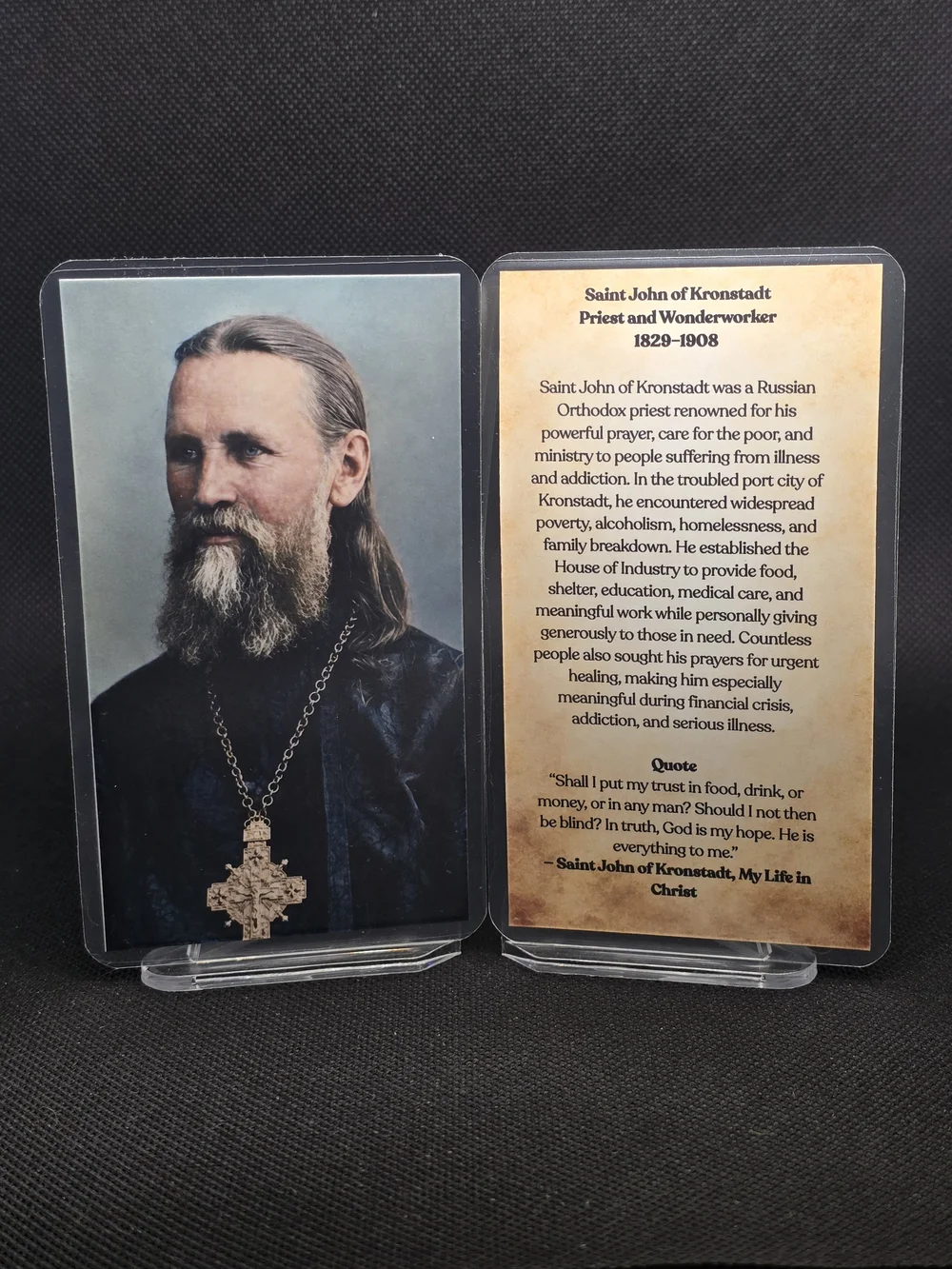
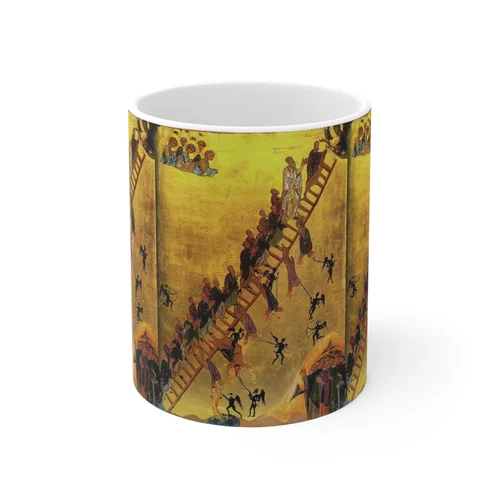
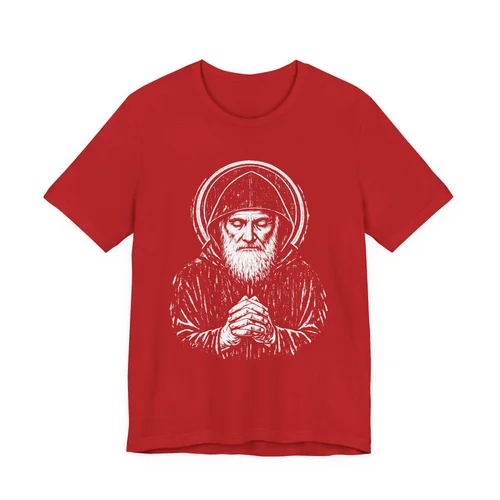
A few items that fit a parish priest, a seminarian, or a family that wants to honor the Eastern tradition. Prayer cards are handmade; mugs and shirts are print on demand.

Part IX
What This Looks Like in a Parish
What does all this look like for a family? A seminarian who wants to marry does so before he is ordained a deacon. After ordination he serves the parish, and his wife and children are part of parish life. If his wife dies, he does not remarry. If he is unmarried at ordination, he stays celibate. If a bishop is needed, he is chosen from the celibate, often a monastic.
For lay Catholics who are new to the Eastern Churches, one practical point: you can ask any Eastern Catholic parish how its clergy are arranged. Some eparchies have more married priests than others, and some countries, like India, have long had celibacy as the norm even in Eastern Churches. The Eastern Churches are not a single block. That is one reason we wrote our guide How to Choose the Right Eastern Catholic Church.
Part X
What We Could Not Confirm
We tried to say only what our sources support. These points are open:
The full transcript. Our account of the flight press conference comes from America Magazine and Vatican News. The Vatican's own transcript page is linked above, but the page itself did not open for us, so we have not checked every phrase against it.
Any mention of the Eastern Churches. The reports we read do not record Pope Leo mentioning Eastern Catholic practice. If he did, it was not in those accounts.
How many married Eastern Catholic priests there are. We found no current count of married priests in the United States. The sources describe the rule, not the numbers.
The scope of the 2014 ruling. The decree itself describes three categories, and some headlines said “worldwide.” We follow the decree, not the headlines.
Biblical interpretation. We cite the verses and Vatican II's summary. The exegesis is debated by scholars on both sides.
Two Traditions, One Church
A Catholic priest can be married, if he belongs to an Eastern Catholic Church and married before ordination. Pope Leo has not changed anything, and he has said the wider question will take time. The Eastern discipline itself is old, official and secure. If you want a face for it, begin with Blessed Omelian Kovch.
Get the Omelian Kovch Prayer Card →Sources
- America Magazine: Pope Leo says no changes on Latin Mass restrictions, married priests on flight back to Rome (November 17, 2026), the question and answer on married priests.
- Vatican News: Pope Leo's press conference on the return flight (November 2026), with the Pope's wording on unity and doctrine.
- Vatican: Press conference during the flight to Rome, 16 November 2026 the Holy See's own transcript page.
- Catechism of the Catholic Church, paragraphs 1579 and 1580 on celibacy in the Latin Church and married clergy in the East.
- Second Vatican Council, Presbyterorum Ordinis, paragraph 16 on celibacy and the Eastern practice.
- Code of Canons of the Eastern Churches, canon 373 on honoring both celibacy and the married clergy of the East.
- Code of Canons of the Eastern Churches, canons 758 to 763 and 804 on admission to orders and the impediment of marriage.
- Congregation for the Eastern Churches: Pontifical Ruling Regarding Married Eastern Clergy (June 14, 2014), the decree text and history.
- Catholic News Service via America: Vatican lifts ban on married priests for Eastern Catholics in diaspora (November 17, 2014).
- National Catholic Register: Eastern married priesthood authorized in North America (2014), on how the rules work in practice.
- Orthodox Church in America: The Council of Trullo (Quinisext Council) on canons 6, 12 and 13 of 692.
- U.S. Conference of Catholic Bishops: Anglicanorum coetibus questions and answers on married former Anglican clergy.
- Religion News Service: As synod closes, bishops ask the pope to allow married deacons to become priests in the Amazon (October 26, 2019).
