Saint Christopher: Patron Saint of Travelers, and Why His Icons Sometimes Show a Dog's Head
Patron of Travelers, Motorists & Safe Journeys • The Real Story Behind His Dog-Headed Icons
Saint Christopher: Patron Saint of Travelers, and Why His Icons Sometimes Show a Dog's Head
Nearly everyone recognizes the medal. Far fewer know that some of the oldest icons of this same saint show him with the head of a dog, and that the real explanation has nothing to do with a curse or a miracle at all.
Saint Christopher — At a Glance
- Lived
- Late 3rd – early 4th century • Martyred c. 308 AD
- Name Meaning
- Christophoros (Greek) — “Christ-bearer”
- Origin
- Marmarica, North Africa, west of Egypt
- Martyred At
- Antioch, under the Diocletianic persecution
- Feast Day (West)
- July 25
- Feast Day (East)
- May 9
- Invoked For
- Travelers, motorists, sailors, pilgrims, storms
- Eastern Iconography
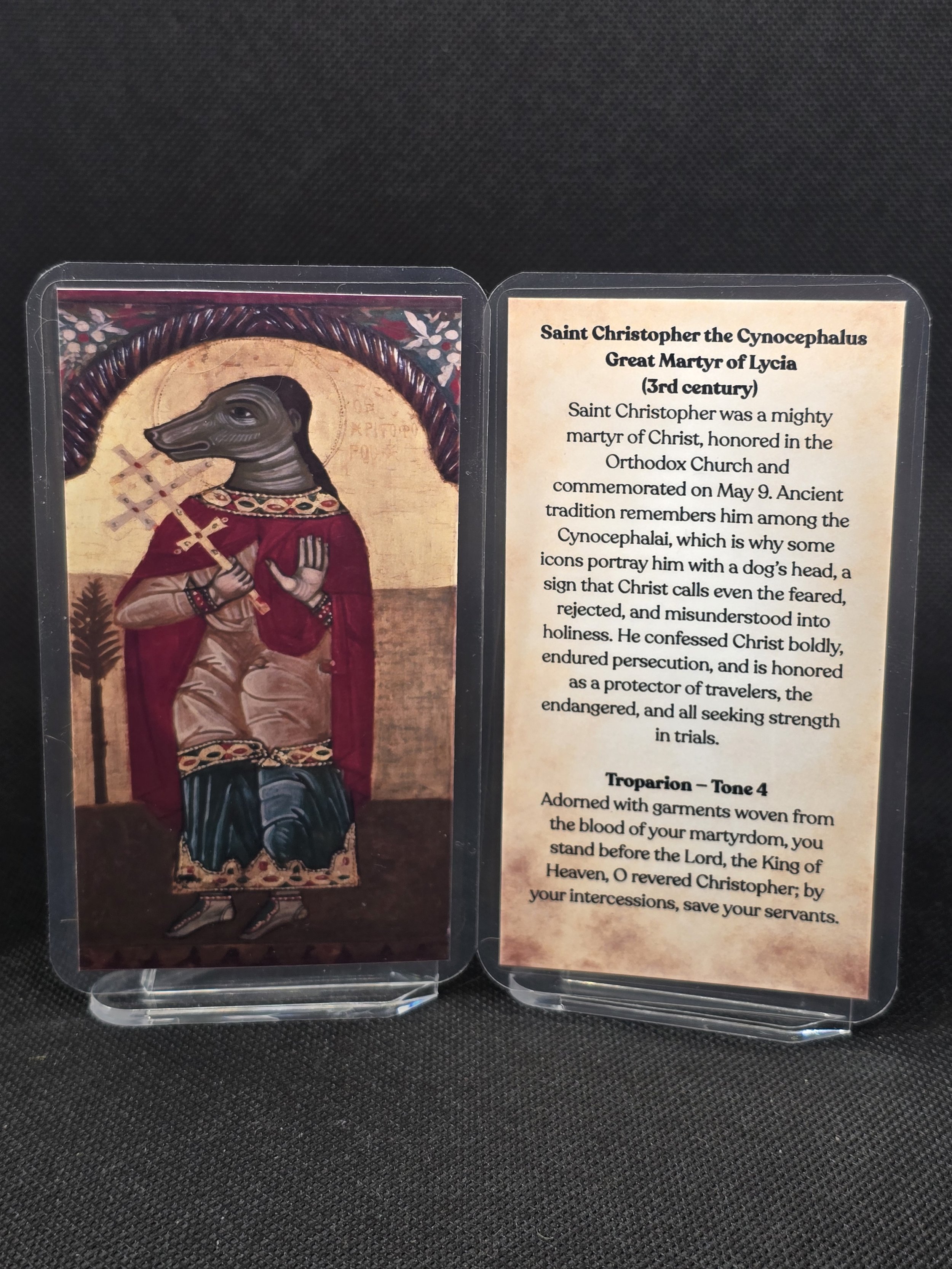
- Sometimes depicted as a cynocephalus (dog-headed man)
Who Was Saint Christopher?
Stripped of centuries of legend, the historical core of Saint Christopher's life is thinner than his fame would suggest, and that gap between fame and record is itself part of his story. Scholarly reconstruction, drawing on the earliest surviving Greek accounts of his martyrdom, places him as a member of the Marmaritae, a tribe from Marmarica, the region west of Egypt in modern Libya. Captured during a Roman military campaign against his people around 301 or 302 AD, he was conscripted into a Roman unit, later transferred to Antioch in Syria, and there baptized by a bishop before being martyred during the Diocletianic persecution, traditionally dated to 308 AD.
Almost everything else attached to his name, the giant stature, the encounter with the Christ child, the river crossing, belongs to the realm of pious legend rather than documented history. That does not make the tradition worthless; it makes it what most ancient hagiography actually is, a devotional memory shaped and reshaped by generations of retelling, carrying real spiritual weight even where it cannot carry the weight of a modern biography.
Part II
The Legend of Carrying Christ Across the River
The story most people actually know comes from medieval sources like the Golden Legend, compiled centuries after Christopher's death. In it, a man of enormous size, formerly named Reprobus, vows to serve only the single greatest king in existence. After searching and finding even powerful kings wanting, he settles into a humble but essential ministry: using his great strength to carry travelers across a dangerous, currentless river with no bridge.
One night a child asks to be carried across. Partway through the crossing, the child grows heavier with every step, until Christopher, straining under a weight that feels impossible for a single small body, finally reaches the far bank and says the child felt as though he had carried the weight of the entire world. The child answers that this is exactly what happened: he was Christ, bearing the weight of the world and its Creator, and Christopher had unknowingly carried God across the water on his own back. It is from this encounter that the name Christopher, from the Greek Christophoros, “Christ-bearer,” entered the tradition, and it is this image, the giant with a staff wading through water with a child on his shoulder, that became the standard depiction of the saint across the Western Church.
Part III
Why Some Icons Show Him With a Dog's Head
The dog-headed icon type has a far more concrete explanation than any curse or punishment, and it begins with simple ancient geography rather than miracle or myth. Greek and Roman writers had a long-standing habit of describing peoples who lived beyond the edges of the civilized world, in their view, in exaggerated and monstrous terms: cannibals, giants, and cynocephali, dog-headed men, among them. This was less biology than rhetoric, a way of marking a people as foreign and remote, the same impulse behind maps that once labeled unexplored regions with sea monsters.
The earliest Greek accounts of Christopher's martyrdom describe him as coming from the Marmaritae, a real North African tribe living in exactly the kind of frontier region this rhetorical tradition attached such descriptions to. When his story passed into Latin, translators handled the term inconsistently. Some rendered it close to its literal Greek sense of dog-headed; others softened it toward caninus, dog-like, which over further transmission and copying eventually shifted toward Cananeus, Canaanite, since it seemed more plausible that a martyr would come from a biblical people than a literally dog-headed one. Centuries later, the German bishop and poet Walter of Speyer took the earlier, more literal reading and ran with it, portraying Christopher outright as a cynocephalic giant from the land of the Chananeans who ate human flesh and barked before his conversion. That poetic embellishment helped cement the image in parts of the medieval imagination even as most of Western art was moving toward the river-crossing giant instead.
Notably, even within Byzantine tradition itself, the literal reading was never universal. The tenth-century Synaxarion of Constantinople describes Christopher only as “wild and fearsome looking,” not literally canine, and the earliest Byzantine artistic depictions from this period show him as an ordinary young, beardless man. The dog-headed icon type persisted alongside this more conventional image for centuries in parts of the Greek, Slavic, and Coptic worlds, a visual echo of an ancient geographic metaphor that later generations increasingly took literally.
Part IV
How East and West Remembered Him Differently
By the later Middle Ages, the Western Church had almost entirely settled on the giant-carrying-the-Christ-child image, the version that eventually adorned church walls, medals, and dashboards across the Catholic world. The Eastern Orthodox and Oriental Orthodox traditions preserved a more varied visual memory for longer, with the dog-headed type surviving in a minority of icons well into the early modern period, particularly in Greece and Russia, alongside the more conventional human depiction that was always more common even there.
That variation eventually narrowed from the Orthodox side as well. The dog-headed icon type was formally restricted by the Moscow church authorities in the eighteenth century, and it never regained wide circulation. What survives today, on both sides of the historic East-West divide, is overwhelmingly the human image of a giant crossing water with the Christ child on his shoulder, though the older dog-headed icons remain a striking and historically rich footnote for anyone who looks closely at how differently the same saint could be remembered.
Part V
Why He Was Removed From the Universal Calendar
In 1969, Pope Paul VI's post-Vatican II reform of the General Roman Calendar removed a number of saints, Christopher among them, from the list of universally obligatory feasts, largely because so little of their lives could be historically verified compared to more securely documented saints. This is frequently, and incorrectly, described as the Church “removing” or “decanonizing” Saint Christopher. In fact, his cultus was never suppressed. Local and optional celebration continued to be permitted in the Latin Church, and the Eastern Orthodox, Oriental Orthodox, and Eastern Catholic Churches, which were not affected by this Latin calendar reform at all, have kept his feast without interruption to this day.
Part VI
Patron of Travelers & Safe Journeys
Whatever the historical uncertainty around his life, Christopher's popular devotion has never wavered. He is invoked today as patron of travelers broadly, and more specifically of motorists, sailors, and pilgrims, along with athletes, bachelors, gardeners, and protection from storms and sudden death. The Saint Christopher medal, worn or displayed in vehicles, remains one of the most recognizable devotional objects in the Catholic world, carried by people who may know almost nothing else about the saint's actual history.
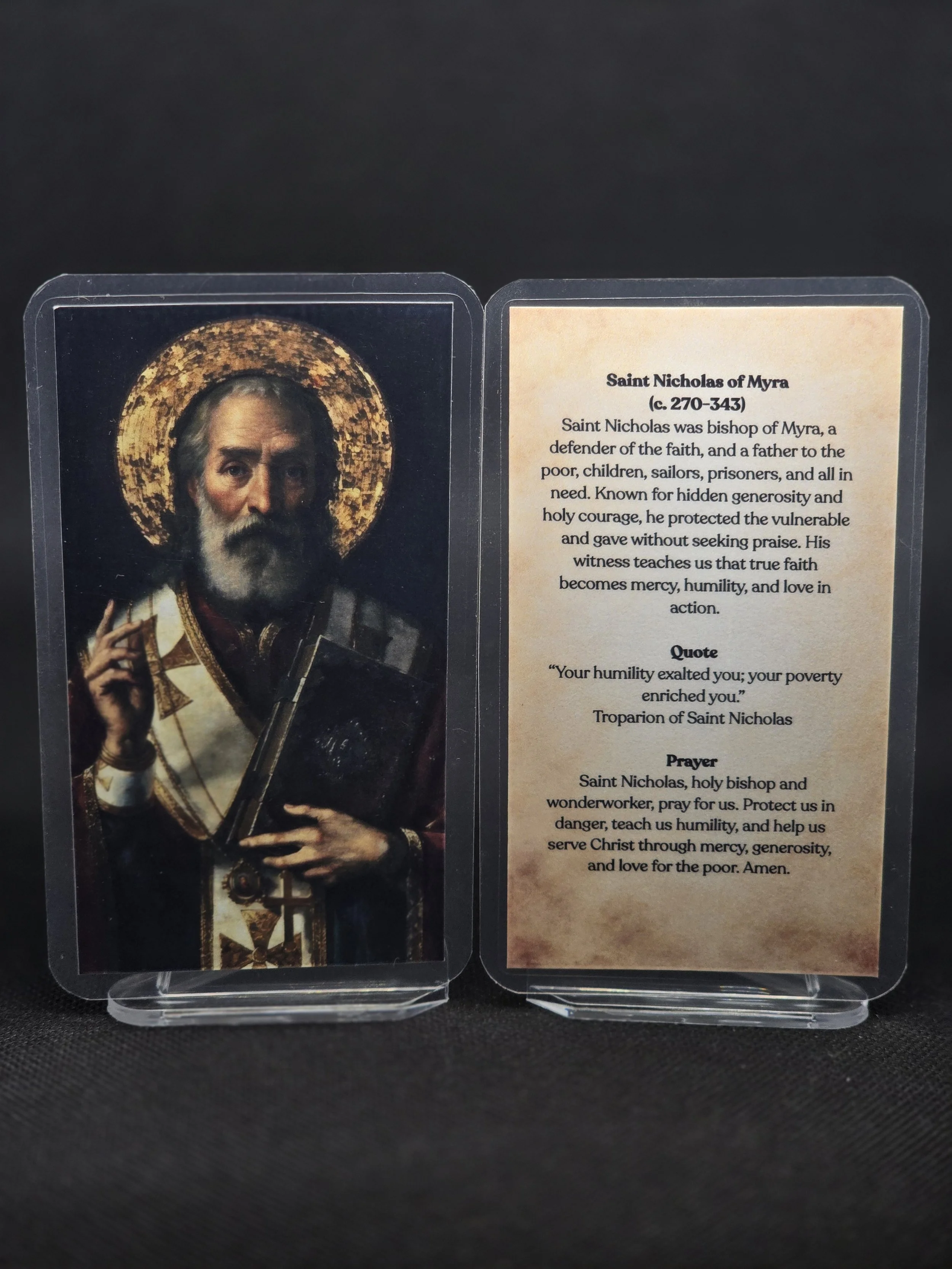
Saint Nicholas of Myra, better known today for his connection to gift-giving, carries an older and lesser-remembered patronage of his own: calming storms and rescuing sailors, a devotion rooted in miracles attributed to him at sea long before the modern Santa Claus legend absorbed most of his popular image. Households building a devotional focus on travel and protection often pair the two saints together.
FAQ
Frequently Asked Questions
One Saint, Two Faces, the Same Devotion Underneath
Whether pictured as a giant wading through water with a child on his shoulder or as a dog-headed warrior from the far edge of the ancient world, Saint Christopher has been asked the same thing for over a thousand years: carry this person safely to where they are going. The image changed. The prayer never did.
Get the Saint Christopher Prayer Card →