Which Eastern Catholic and Eastern Orthodox Saints to Pray to in Times of Suffering, Fear, and Discernment
When someone searches for a saint to pray to, it is rarely out of curiosity. Most often, it is because something in life feels heavy, uncertain, or broken. The Eastern Catholic and Eastern Orthodox traditions approach this reality with honesty. Suffering is not denied, fear is not minimized, and prayer is not reduced to quick answers. Instead, the Church offers the witness of the saints: men and women who lived fully human lives, endured real hardship, and learned how to remain faithful to God in the midst of it.
This guide is meant to serve those moments. Each saint included here is presented with historical context, spiritual meaning, and practical guidance for prayer. Where available, links are included to authentic Eastern Catholic and Eastern Orthodox prayer cards that can be used as tools of devotion, remembrance, and daily prayer.
Saints to Pray to for Illness, Chronic Suffering, and Endurance
Saint Rafqa
Maronite Catholic Church
Saint Rafqa is one of the most powerful witnesses to redemptive suffering in the Eastern Catholic tradition. Born in Lebanon in the 19th century, her life unfolded quietly through religious obedience, physical pain, and prolonged illness. Unlike saints whose stories center on public ministry or dramatic miracles, Saint Rafqa’s sanctity was shaped almost entirely in hiddenness.
Over time, Saint Rafqa suffered from severe physical ailments that gradually stripped her of mobility and sight. What distinguishes her is not simply that she suffered, but how she suffered. Her writings and testimony reveal a deep interior consent to God’s will. She did not treat suffering as punishment, nor did she spiritualize it away. Instead, she consciously united her pain to Christ’s suffering, offering it for the Church and for others.
In Eastern theology, suffering becomes transformative when it is joined to love. Saint Rafqa’s life teaches that endurance is not passive resignation. It is active trust, renewed daily, often without emotional consolation. This makes her an especially meaningful saint for those living with chronic illness, long recovery, degenerative conditions, or pain that has no clear resolution.
Prayer card for Saint Rafqa:
https://www.theeasternchurch.com/eastern-catholic-eastern-orthodox-prayer-cards/p/saint-rafqa-prayer-card-maronite-catholic
How to pray with Saint Rafqa:
Her intercession is often sought not primarily for immediate healing, but for perseverance, peace, and the ability to remain gentle and faithful under prolonged strain. A simple devotion is to pray briefly each day before her prayer card, offering your suffering without explaining it away, and asking for the grace to remain rooted in Christ even when relief does not come.
Our Lady of Lebanon
Maronite Catholic Marian Title
Our Lady of Lebanon represents Mary as protector, intercessor, and spiritual mother for a people shaped by endurance. The shrine of Our Lady of Lebanon at Harissa overlooks both land and sea, symbolizing Mary’s watchful presence over families, travelers, the sick, and those living in uncertainty.
In Eastern Christianity, Mary is never distant or abstract. She is Theotokos, the God-bearer, the one who freely consented to God’s will and stood at the foot of the Cross without fleeing suffering. This makes her a powerful intercessor in moments of fear, illness, and vulnerability. Her presence in prayer is not meant to replace trust in Christ, but to draw the believer more deeply into it.
Devotion to Our Lady of Lebanon is especially meaningful for those facing anxiety about the future, illness within the family, displacement, or fear that cannot be easily named. She is invoked not only for protection, but for interior stability and trust when circumstances feel fragile.
Prayer card for Our Lady of Lebanon:
https://www.theeasternchurch.com/eastern-catholic-eastern-orthodox-prayer-cards/p/our-lady-lebanon-maronite-catholic-prayer-card
How to pray with Our Lady of Lebanon:
A traditional Eastern approach is quiet, wordless prayer before her image. Rather than listing requests, the believer places their fear, illness, or uncertainty into her care, asking for the grace to remain faithful and calm within whatever God permits.
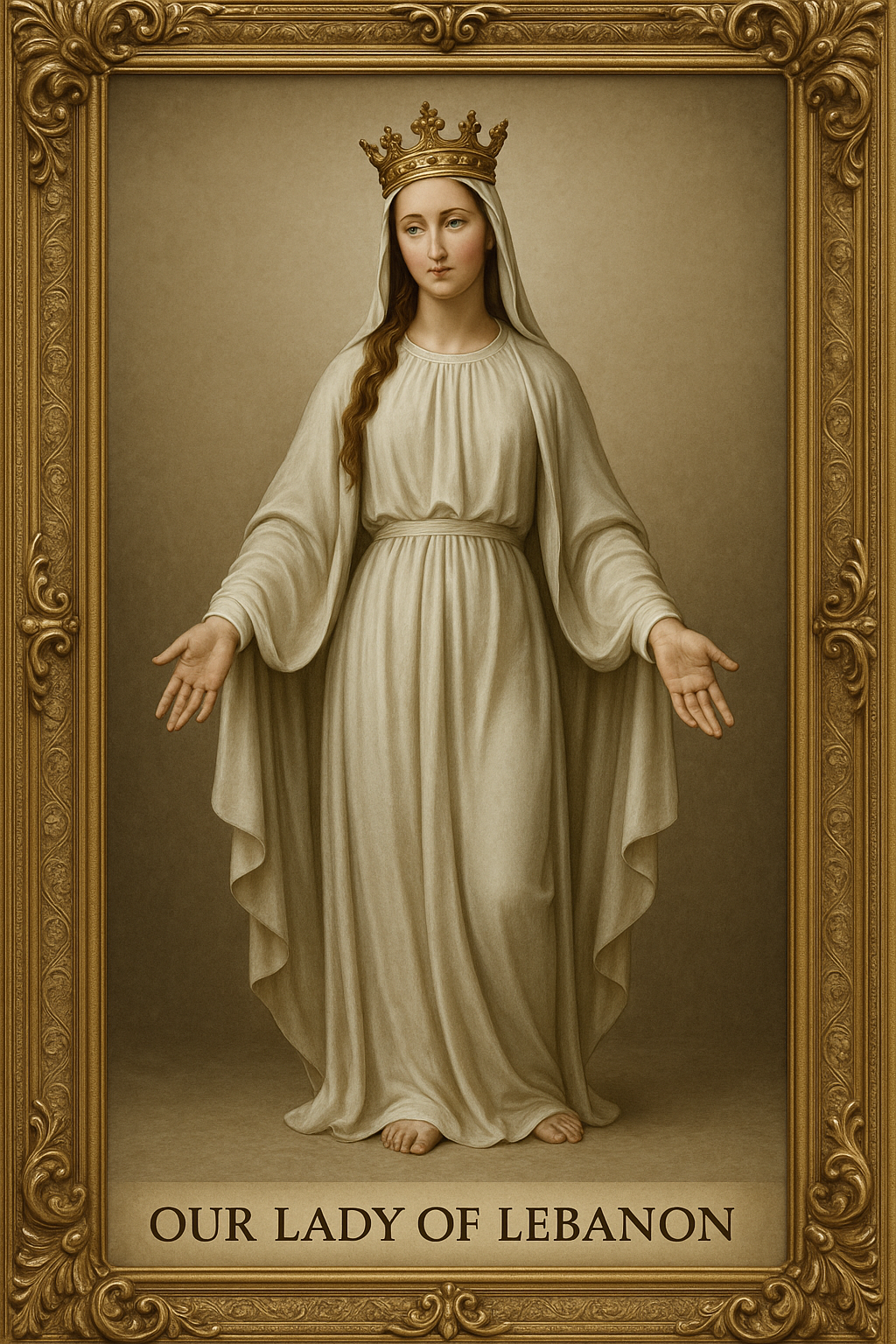
Celebrate the profound devotion to the Virgin Mary under the title of Our Lady of Lebanon with this beautifully designed prayer card.
Since 1908, the towering statue of Our Lady of Lebanon at Harissa, Lebanon has been a national and spiritual symbol for Catholics across the Middle East and beyond. Standing with open arms overlooking the Mediterranean, the shrine has become a place of pilgrimage for millions of Christians and people of all faiths, who come seeking peace, healing, and the intercession of the Blessed Mother.
For the Maronite Catholic Church, Our Lady of Lebanon is more than a patroness—she is the Mother who protects the faithful of Lebanon and unites the community in Christ. Her feast day is celebrated each year on the first Sunday of May, when thousands gather to honor her with processions, Mass, and heartfelt prayer.
This Our Lady of Lebanon prayer card captures that same devotion in a form you can carry with you daily. Perfect for personal prayer, parish use, or as a meaningful gift, it is a reminder of Mary’s maternal love and the hope she brings to the world.
Printed with care and reverence, this holy card serves as a spiritual keepsake connecting you to the Maronite tradition and the global devotion to the Mother of God.
Saints to Pray to for Family Life, Marriage, and Generational Healing
Saint Anne
Melkite and Byzantine Catholic Tradition
Saint Anne holds a unique place in Eastern Christianity because her sanctity is expressed almost entirely through family life. She is honored not for public miracles or recorded teachings, but for her faithfulness, patience, and trust in God’s timing. According to tradition, Saint Anne and her husband Joachim endured years of childlessness, a deep source of sorrow and social shame in their time. Their faithfulness in prayer, even without visible answers, became the soil in which the Mother of God was formed.
Eastern theology places great importance on formation within the home. Saint Anne’s life teaches that holiness is often cultivated quietly, through daily faithfulness, perseverance in prayer, and trust when God’s plans unfold slowly. She is a powerful intercessor for parents, grandparents, marriages under strain, and families seeking healing across generations.
Prayer card for Saint Anne:
https://www.theeasternchurch.com/eastern-catholic-eastern-orthodox-prayer-cards/p/saint-anne-prayer-card-melkite-byzantine-catholic-mother-of-mary
How to pray with Saint Anne:
Saint Anne is often invoked for patience in parenting, healing of family wounds, and trust in God’s timing. A meaningful devotion is to pray for loved ones by name before her prayer card, asking not for control over outcomes, but for wisdom, gentleness, and perseverance in love.
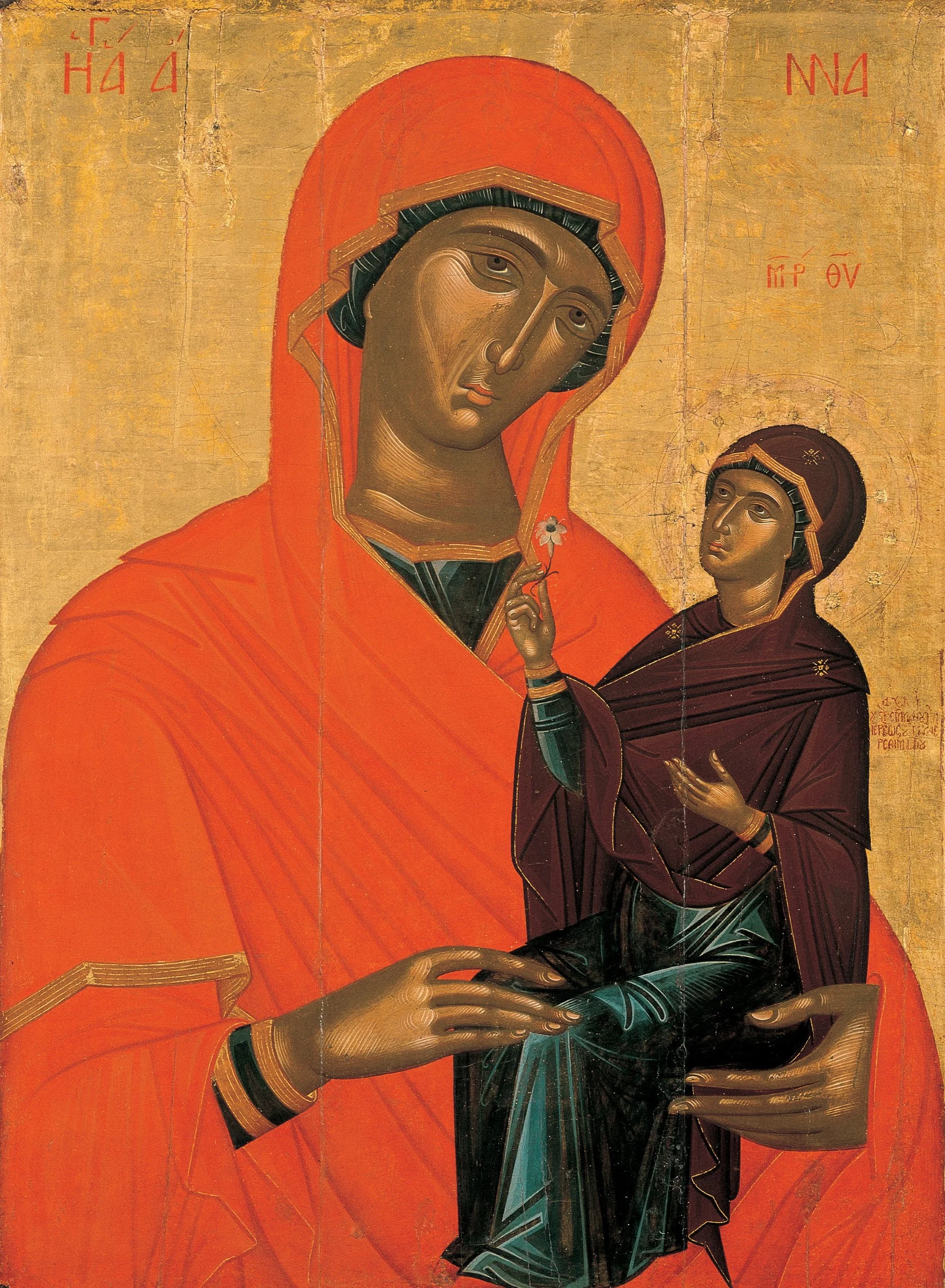
Saint Anne is one of the most tender intercessors in all of Christian devotion, venerated deeply in the Eastern Orthodox Church, honored in Eastern Catholic tradition, and beloved in Roman Catholic prayer as the holy mother of the Virgin Mary. Her feast day is celebrated on July 25 in the Eastern calendar and July 26 in Western tradition.
People come to Saint Anne when pregnancy does not come.
When miscarriage has left quiet rooms behind.
When years pass without answers.
When children drift from faith.
When mothers carry silent grief while continuing to hope.
Anne knows this ache personally.
She lived most of her married life childless in a culture that treated infertility as shame. She prayed faithfully. She gave generously. She remained obedient to God even when nothing seemed to change. While others whispered and religious leaders questioned her worth, Anne carried her sorrow privately, pouring it out before God in tears.
She did not grow bitter.
She did not abandon prayer.
She waited.
In time, God answered her longing with a daughter who would become the Mother of Christ. But Anne never lived to see the full meaning of that gift. Her holiness unfolded quietly, long before fulfillment arrived.
Today, Saint Anne is prayed to by women struggling with infertility, mothers grieving pregnancy loss, parents interceding for children who feel distant, and anyone enduring long seasons of waiting. She is especially sought by those navigating IVF, miscarriage recovery, delayed conception, and the emotional exhaustion that comes from hoping month after month.
This prayer card honors her quiet perseverance and her witness that God still works inside unanswered prayer.
Each card is handmade in Austin and created to order. We do not keep stock, because every prayer card is treated as a unique devotional offering. They are printed on museum-quality photo paper, not cardstock, and each one is made during prayer. The saints are venerated throughout the entire process, and prayers are intentionally offered for the person who will receive the card. These are not mass-produced items. They are created slowly, reverently, and with spiritual intention, because every soul and every prayer matters.
Saints to Pray to for Anxiety, Fear, and Interior Unrest
Anxiety is not a modern invention, even if its language feels modern. The Eastern Christian tradition does not treat anxiety merely as a psychological condition, nor does it reduce it to moral failure. Anxiety is understood as a disruption of inner stillness, a fragmentation of trust, and a suffering that touches both body and soul. The saints below are especially meaningful for those who struggle with fear, restlessness, intrusive thoughts, or a persistent lack of peace.
Saint John Chrysostom
Byzantine and Eastern Catholic Tradition
Saint John Chrysostom is one of the most influential voices in Eastern Christianity, not because he lived an easy life, but because he spoke clearly in the midst of suffering, exile, and injustice. His nickname Chrysostom, meaning golden-mouthed, reflects the depth and precision of his preaching, but his sanctity was forged through hardship rather than acclaim.
John lived under constant pressure. His uncompromising call to repentance angered political leaders and clergy alike, leading to exile, public humiliation, and eventual death far from his people. Yet his writings reveal a man deeply anchored in interior peace. He understood anxiety not as something conquered through control, but through surrender. For Chrysostom, peace came from aligning the soul with truth rather than circumstances.
He is especially meaningful for those whose anxiety comes from moral confusion, constant mental noise, or fear rooted in injustice or instability. His prayers emphasize God’s nearness, God’s patience, and the danger of allowing fear to distort one’s perception of reality.
Prayer card for Saint John Chrysostom:
https://www.theeasternchurch.com/saints/category/Eastern%2BOrthodox%2BSaints%2BPrayer%2BCards
How to pray with Saint John Chrysostom:
His intercession is especially powerful when paired with stillness. Choose a short prayer and repeat it slowly before his prayer card, allowing anxious thoughts to pass without engaging them. Chrysostom’s spirituality teaches that peace is not the absence of struggle, but the refusal to let fear become the governing voice of the soul.
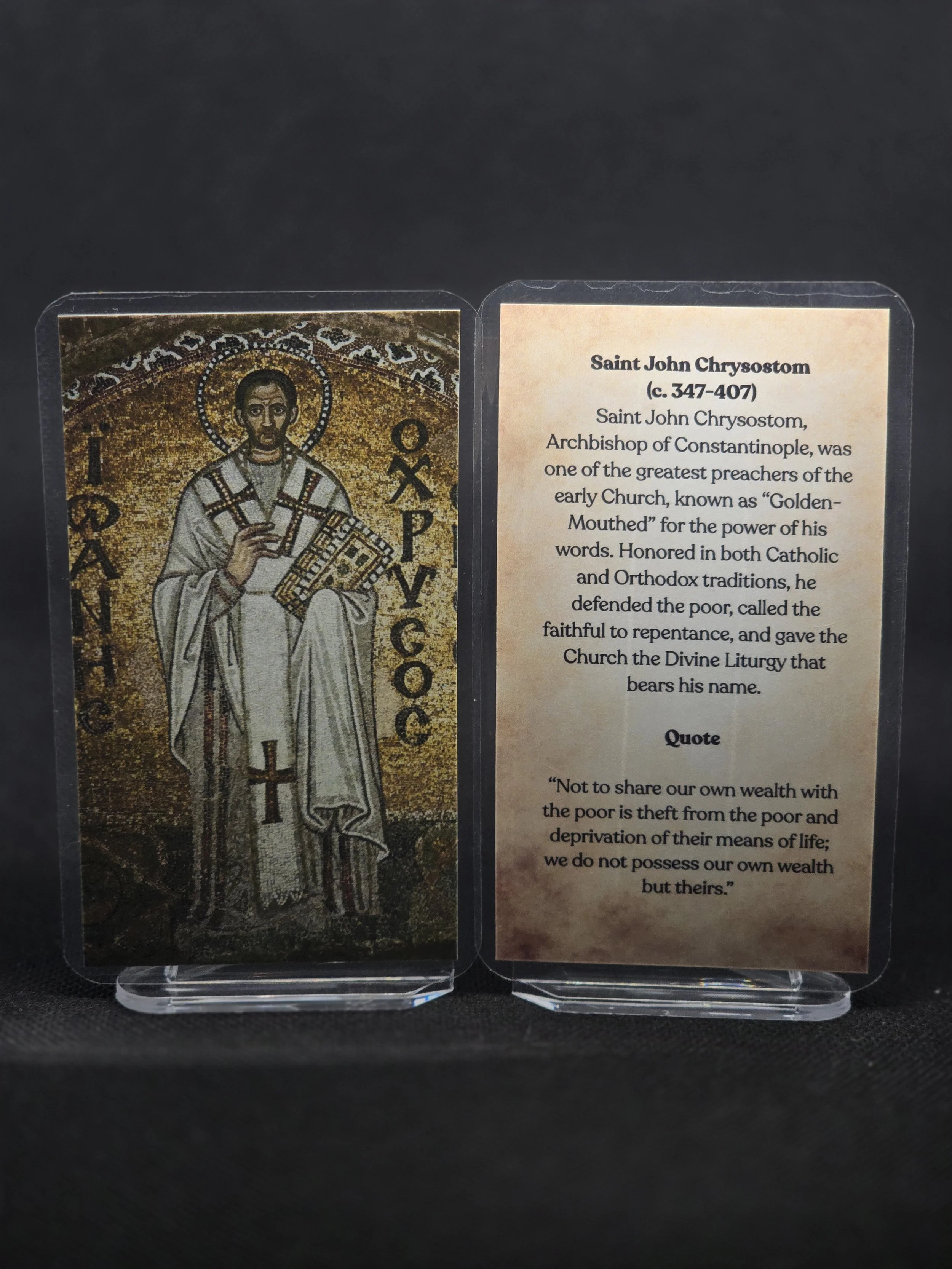
Saint John Chrysostom is the Church’s fearless voice of truth, especially sought by those praying for confidence in public speaking, courage to confront injustice without fear, and strength for discipline and self-control in daily life.
Unlike many saints known for silence or solitude, John stood in pulpits before emperors and crowds. His words exposed corruption, defended the poor, rebuked vanity, and called Christians to radical holiness. So powerful was his preaching that the people named him Chrysostomos — “Golden-Mouthed.”
He was not a comfortable bishop.
He challenged wealth.
He confronted political power.
He reformed corrupt clergy.
He simplified his own lifestyle so he could feed the poor.
For this boldness, he was slandered, deposed, and exiled — not once, but twice. Driven across harsh terrain under guard, his health broken, he died whispering: “Glory to God for all things.”
His feast is commemorated on November 13.
To this day, people turn to Saint John Chrysostom before giving speeches, teaching classes, preaching sermons, defending truth in hostile settings, or fighting personal weakness and lack of discipline. He is especially powerful for those who must speak when silence would be easier.
This handmade prayer card presents a stronger, more authoritative depiction of the saint — ideal for prayer desks, study spaces, lecterns, or parish offices. It is not merely devotional art. It is a reminder that truth spoken in love carries eternal weight.
Saint Mary of Egypt
Eastern Orthodox and Eastern Catholic Tradition
Saint Mary of Egypt is one of the most profound witnesses to inner healing in the Christian tradition. Her early life was marked by compulsion, disordered desire, and spiritual emptiness. Her conversion did not occur through gradual improvement, but through sudden confrontation with grace that exposed the emptiness beneath her habits.
After her conversion, Mary withdrew into the desert for decades of solitude, prayer, and repentance. This withdrawal was not an escape from anxiety, but a confrontation with it. In the desert, stripped of distraction and identity, she faced fear, regret, and spiritual instability directly. Over time, through repentance and prayer, her interior chaos was transformed into deep peace.
Mary is especially meaningful for those whose anxiety is tied to past choices, shame, addiction, or the sense of being internally divided. Her life demonstrates that peace is not reserved for those with clean beginnings. It is formed through repentance, honesty, and perseverance.
Prayer card for Saint Mary of Egypt:
https://www.theeasternchurch.com/eastern-catholic-eastern-orthodox-prayer-cards
How to pray with Saint Mary of Egypt:
Her intercession is powerful when anxiety is rooted in guilt or unresolved past wounds. A helpful practice is to pray honestly before her prayer card, without minimizing or dramatizing your struggles, asking for the courage to face the truth and trust God’s mercy to heal what fear cannot.
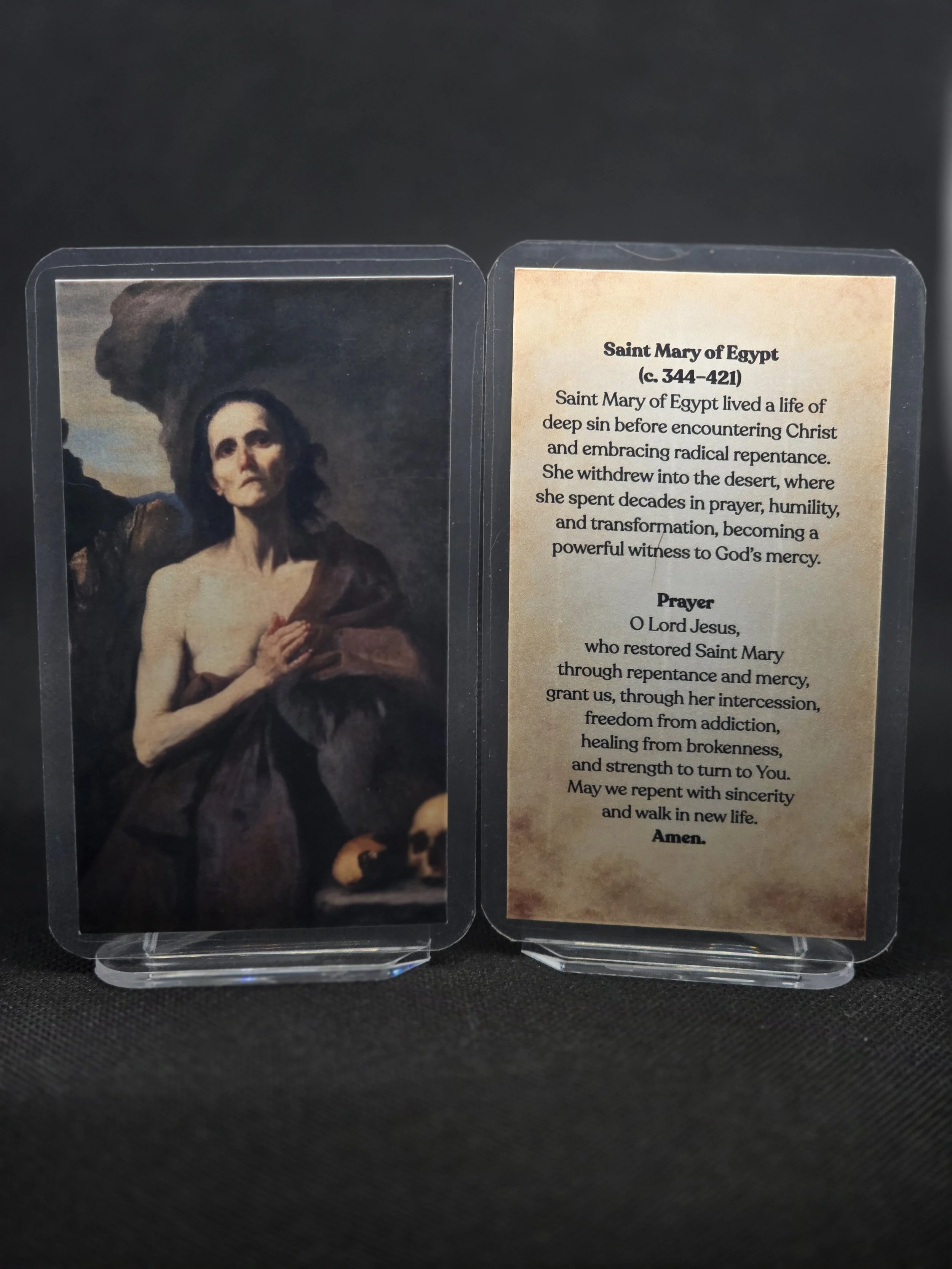
Saint Mary of Egypt is one of Christianity’s most shocking and powerful stories of conversion, especially sought by those praying for freedom from addiction, healing from sexual brokenness, and radical repentance after years of destructive living.
Her life did not begin in holiness.
It began in chaos.
Born in the 5th century, Mary left home as a young girl and lived recklessly in Alexandria, giving herself over to lust and compulsive behavior. For seventeen years she lived in total disregard of God, not even for money, but simply for pleasure and compulsion.
Then everything changed at the door of a church.
Attempting to enter the Church of the Holy Sepulchre in Jerusalem, she found herself physically prevented from crossing the threshold. An unseen force stopped her. In that moment, she understood the state of her soul.
She fell to her knees. She wept. She begged the Mother of God for mercy.
And she was allowed in.
Mary immediately fled into the desert, where she spent forty-seven years in extreme repentance, fasting, prayer, and solitude. Her body withered. Her soul burned with divine love.
Her feast is commemorated on April 1, and she is also remembered on the Fifth Sunday of Great Lent in the Orthodox tradition.
Today, Saint Mary of Egypt is invoked by those battling addiction, compulsive sin, sexual wounds, shame, and despair. She is proof that no one is beyond redemption.
This handmade prayer card honors her fierce repentance and radiant holiness with museum-quality craftsmanship. It is not simply devotional art. It is a reminder that conversion is always possible.
Saints to Pray to for Protection, Courage, and Perseverance
Fear often intensifies when life feels unsafe, unstable, or spiritually hostile. The Eastern tradition understands protection not as insulation from difficulty, but as strength to remain faithful within it. The saints below model courage that flows from trust rather than aggression.
Saint George
Eastern Orthodox and Eastern Catholic Tradition
Saint George is venerated as a martyr and protector, but his story is frequently misunderstood. In the Eastern tradition, George is not honored primarily as a warrior who defeats enemies, but as a witness who refused to deny Christ under extreme pressure. His courage was not rooted in physical strength, but in clarity of allegiance.
George faced torture, intimidation, and the certainty of death, yet remained immovable. His courage did not remove fear, but subordinated it to truth. This makes him a powerful intercessor for those facing intimidation, moral pressure, or fear of loss due to faithfulness.
Prayer card for Saint George:
https://www.theeasternchurch.com/eastern-catholic-eastern-orthodox-prayer-cards
How to pray with Saint George:
Saint George is often invoked when courage is needed to act rightly rather than safely. Pray before his prayer card when facing decisions that require moral clarity, asking not for comfort, but for steadfastness and the strength to remain faithful regardless of outcome.
Saint Nicholas of Myra
Eastern Orthodox and Eastern Catholic Tradition
Saint Nicholas is widely known, but his deeper spiritual significance is often overlooked. As a bishop, he was known for quiet acts of protection, intervention, and generosity. His concern was always concrete. He protected the vulnerable, defended truth at great personal risk, and intervened where injustice threatened harm.
Nicholas is especially meaningful for those who feel responsible for protecting others, parents, leaders, caregivers, and those burdened by responsibility. His life shows that protection often takes the form of faithful presence rather than dramatic action.
Prayer card for Saint Nicholas:
https://www.theeasternchurch.com/eastern-catholic-eastern-orthodox-prayer-cards
How to pray with Saint Nicholas:
Pray before his prayer card when responsibility feels heavy or overwhelming. Ask for wisdom to act quietly and justly, and for the grace to protect without controlling.
Saints to Pray to for Repentance, Discernment, and Spiritual Clarity
Some seasons of life are not defined by crisis, but by confusion. In these moments, the question is not how to escape suffering, but how to understand God’s will more clearly.
Saint Ephrem the Syrian
Syriac and Maronite Tradition
Saint Ephrem is one of the greatest theological poets of the Church. His hymns and prayers reflect a spirituality shaped by humility, repentance, and awe before mystery. He resisted rigid definitions, believing that truth must be approached with reverence rather than certainty.
Ephrem is especially meaningful for those struggling with pride, confusion, or the temptation to reduce faith to concepts rather than encounter. His famous prayer during Lent remains one of the most profound expressions of self-knowledge and dependence on God.
Prayer card for Saint Ephrem the Syrian:
https://www.theeasternchurch.com/eastern-catholic-eastern-orthodox-prayer-cards
How to pray with Saint Ephrem:
His intercession is powerful when paired with self-examination. Pray slowly and attentively, asking God to reveal not just answers, but the movements of your own heart.
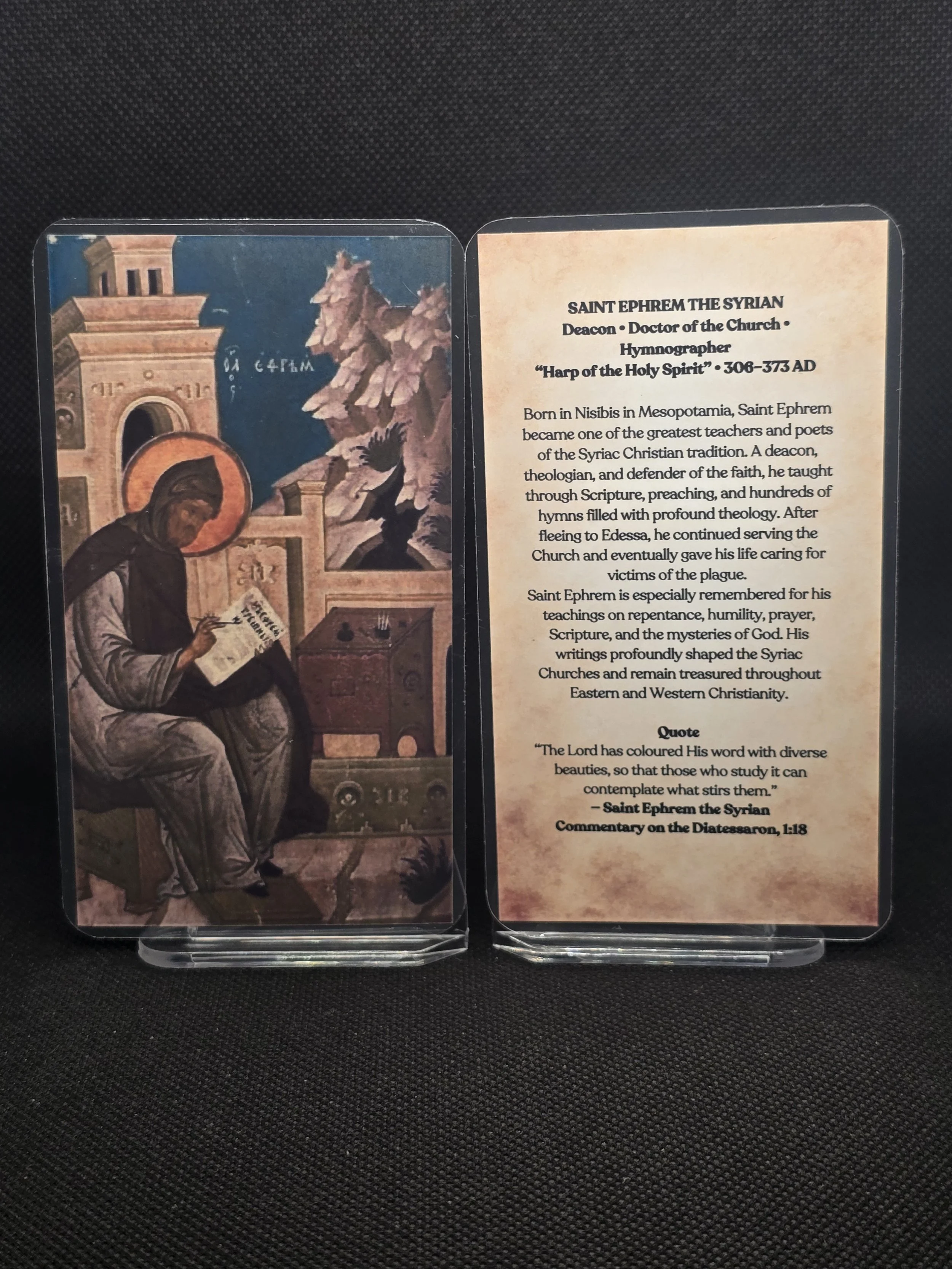
Saint Ephrem the Syrian is one of the most luminous voices in early Christianity, venerated deeply in the Eastern Orthodox Church, honored throughout Eastern Catholic tradition, and revered in Roman Catholic devotion as a Doctor of the Church. His feast is celebrated on January 28 in Eastern tradition and June 9 in Western calendars.
People come to Saint Ephrem when prayer feels empty.
When sin weighs heavy on the conscience.
When grief will not lift.
When faith feels dry and distant.
When the heart longs to return to God but does not know how.
Ephrem understood this struggle intimately.
He did not begin life as a saint.
Early accounts describe him as impulsive, sharp-tongued, and spiritually restless. His conversion came through suffering, false accusation, and imprisonment. Alone in darkness, Ephrem encountered Christ not through comfort, but through repentance. That moment reshaped everything.
He emerged with a heart set on humility.
He became a deacon, a teacher, a poet, and eventually one of the greatest spiritual voices the Church has ever known. His hymns carried theology into the mouths of ordinary people. His prayers taught generations how to weep over sin without despair. His writings revealed how beauty can heal the soul.
Ephrem did not argue people back to God.
He sang them home.
Today, Saint Ephrem is prayed to by those struggling with spiritual dryness, deep guilt, emotional heaviness, and the quiet ache of being far from God. He is especially sought by people yearning for repentance, healing tears, renewed prayer, and gentle restoration after inner collapse.
This prayer card honors the saint who teaches that broken hearts are not rejected by Christ.
They are transformed.
Each card is handmade in Austin and created to order. We do not keep stock, because every prayer card is treated as a unique devotional offering. They are printed on museum-quality photo paper, not cardstock, and each one is made during prayer. The saints are venerated throughout the entire process, and prayers are intentionally offered for the person who will receive the card. These are not mass-produced items. They are created slowly, reverently, and with spiritual intention, because every soul and every prayer matters.
Living with the Saints Beyond a Single Prayer
Prayer cards are not talismans, and saints are not shortcuts. In the Eastern tradition, devotion to the saints is relational. It is sustained through repetition, patience, and honest prayer. Carrying a prayer card, returning to it daily, or placing it in a prayer corner is a way of remembering that sanctity is possible in ordinary life, suffering, and uncertainty.
Choosing a saint is not about finding the most powerful intercessor. It is about finding a witness whose life resonates with your current struggle, and allowing their faithfulness to shape your own.
The saints of the Eastern Catholic and Eastern Orthodox traditions are not distant figures preserved in history. They are living members of the Church who reveal what faithfulness looks like under pressure, in suffering, in confusion, and in quiet endurance. Turning to them in prayer is not an escape from reality, but an invitation to face it with courage, humility, and hope.
To explore prayer cards for these saints and many others, visit:
https://www.theeasternchurch.com/eastern-catholic-eastern-orthodox-prayer-cards