The Secret Saint: The Incredible True Story of Marina the Monk
Maronite • Orthodox • Eastern Catholic • Desert Monasticism • The Saint Who Disappeared
St. Marina the Monk: The Saint Who Disappeared
She gave up her name, her gender, and her reputation to serve God in silence — and she did not defend herself even when falsely accused of the one sin she had fled the world to avoid.
St. Marina the Monk — At a Glance
- Lived
- 5th century • Lebanon, Qadisha Valley region
- Also Known As
- Brother Marinos • St. Mary of Alexandria • St. Mary the Monk
- Known For
- Living disguised as a male monk • bearing false accusation in total silence
- Feast Day
- June 18 (Orthodox) • July 17 in some calendars
- Venerated By
- Maronite • Eastern Orthodox • Coptic • Eastern Catholic traditions
- Patroness Of
- The falsely accused • victims of gossip • single parents • kidney sufferers
- Central Lesson
- Holiness sometimes looks like silence, not self-defense
- Prayer Card
- Traditional icon depicting Marina with the child she raised • $3.00
A Daughter's Sacrifice: Entering the Monastery
Imagine loving God so much that you would give up not just your home, but your very identity. This is the story of St. Marina, one of the most extraordinary and least-known figures in Eastern Christian monasticism.
Marina was born in Lebanon in the 5th century, during the great flowering of desert monasticism that drew men and women into caves, valleys, and remote communities across the Christian East. Her father felt the same call. He longed to enter a monastery in the Qadisha Valley, the rugged mountain region that would later become the spiritual heartland of the Maronite Church. But he faced an impossible choice: he could not bear to leave his only daughter behind, and the monastery he sought to enter accepted men only.
Marina's solution was as radical as it was loving. She cut her hair, dressed in the robes of a boy, and entered the monastery beside her father under the name "Brother Marinos." No one suspected. For years, she lived the full monastic life: the fasting, the night vigils, the manual labor, the unceasing prayer. Her devotion became so evident that the other monks regarded "Brother Marinos" with quiet awe, never imagining the truth hidden beneath the habit.
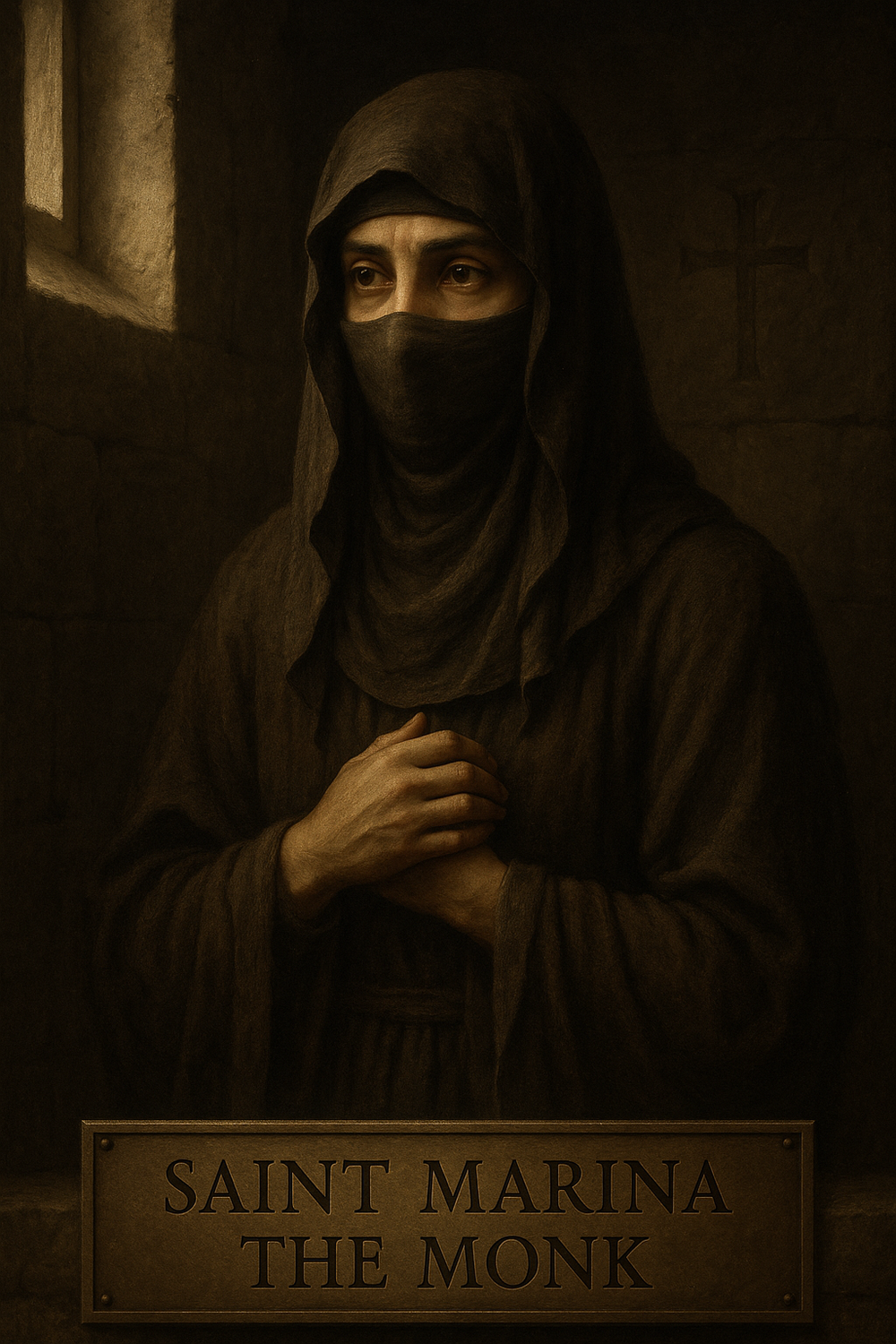
Part II
The Scandal: Falsely Accused
Marina's sanctity was about to be tested by a scandal that would define the rest of her life. Near the monastery stood an inn, and the innkeeper's daughter visited the grounds with some regularity. In time, the girl became pregnant. Desperate and afraid, she searched for someone to blame, and her accusation landed on the gentle, devout monk known as Brother Marinos.
The charge could not have been more devastating. Marina, who had fled the world precisely to escape sins of the flesh, now stood accused of the gravest one. The brothers who had revered her holiness turned on her in disgust. The monastery she loved, the life she had built at such cost, collapsed around a lie.
One word would have ended it. A single revelation of her true identity would have cleared her name instantly and beyond question. She said nothing.
Part III
The Silence of Holiness
Marina did not defend herself. She did not reveal she was a woman. She accepted the shame to protect the innkeeper's daughter's reputation, choosing mercy for another over justice for herself. The monks expelled her from the monastery, and she was forced to live at its gates, begging for scraps of food in the cold.
Then came the most astonishing part of her story. When the innkeeper's daughter gave birth, Marina took the infant and raised him herself, alone, outside the very walls that had once been her home. The woman wrongly accused of fathering a child now became, in every practical sense, that child's parent. She bore the cold ground as her bed for years, an endurance later traditions connect to her patronage of those who suffer from kidney ailments.
A Cross She Did Not Choose
This is what the monastic tradition calls the cross of the falsely accused: a suffering not chosen by the one who bears it, but placed there by another's sin and accepted anyway, out of love. Marina's silence was not weakness or passivity. It was a deliberate act of mercy toward a young woman whose lie, if exposed, might have destroyed her entirely. Marina chose to absorb the consequence rather than let it fall on someone more vulnerable than herself.
Part IV
Revealed Only in Death
Marina lived at the monastery gates for years before her body finally gave way. Only after her death, as the monks prepared her for burial according to custom, did they discover the truth: the disgraced monk they had cast out was a woman, and she had borne false witness against herself in total silence rather than expose another's sin.
The monks fell to their knees in weeping. They had lived for years alongside a living saint and had judged her by the worst possible account of her character. The shame they had heaped on her, she had carried without complaint, without bitterness, and without a single word in her own defense.
Her story spread quickly through the monasteries of Lebanon and beyond, carried by the same desert networks that preserved the lives of the great ascetics. Today she is venerated across the Maronite, Orthodox, and Coptic traditions alike, a saint whose holiness was hidden in plain sight until the moment it could no longer be denied.
Part V
Who St. Marina Protects
St. Marina Is Patroness Of
- The Falsely Accused
- Anyone bearing a slander or accusation they did not deserve
- Victims of Gossip
- Reputation attacks, workplace slander, character assassination
- Those in Legal Trouble
- Anyone facing unjust accusation in a formal or legal setting
- Single Parents
- She raised a child entirely alone, with no support and no recognition
- Kidney Sufferers
- Connected to her years sleeping on the cold ground
- The Hidden Holy
- Those whose true character will only be known to God, for now
St. Marina is a powerful intercessor for anyone dealing with legal trouble, workplace gossip, or reputation attacks. Her story speaks directly to a wound that has never gone away: the experience of being misjudged by people whose good opinion you valued, and having no easy way to clear your name. Keep her icon with you as a shield against what the old prayers call "the arrows of words."
For single parents in particular, Marina's example carries a weight that few other saints can offer. She did not raise that child as a burden to be endured or a debt to be repaid. She raised him as an act of pure love, asking nothing in return, not even her own vindication.
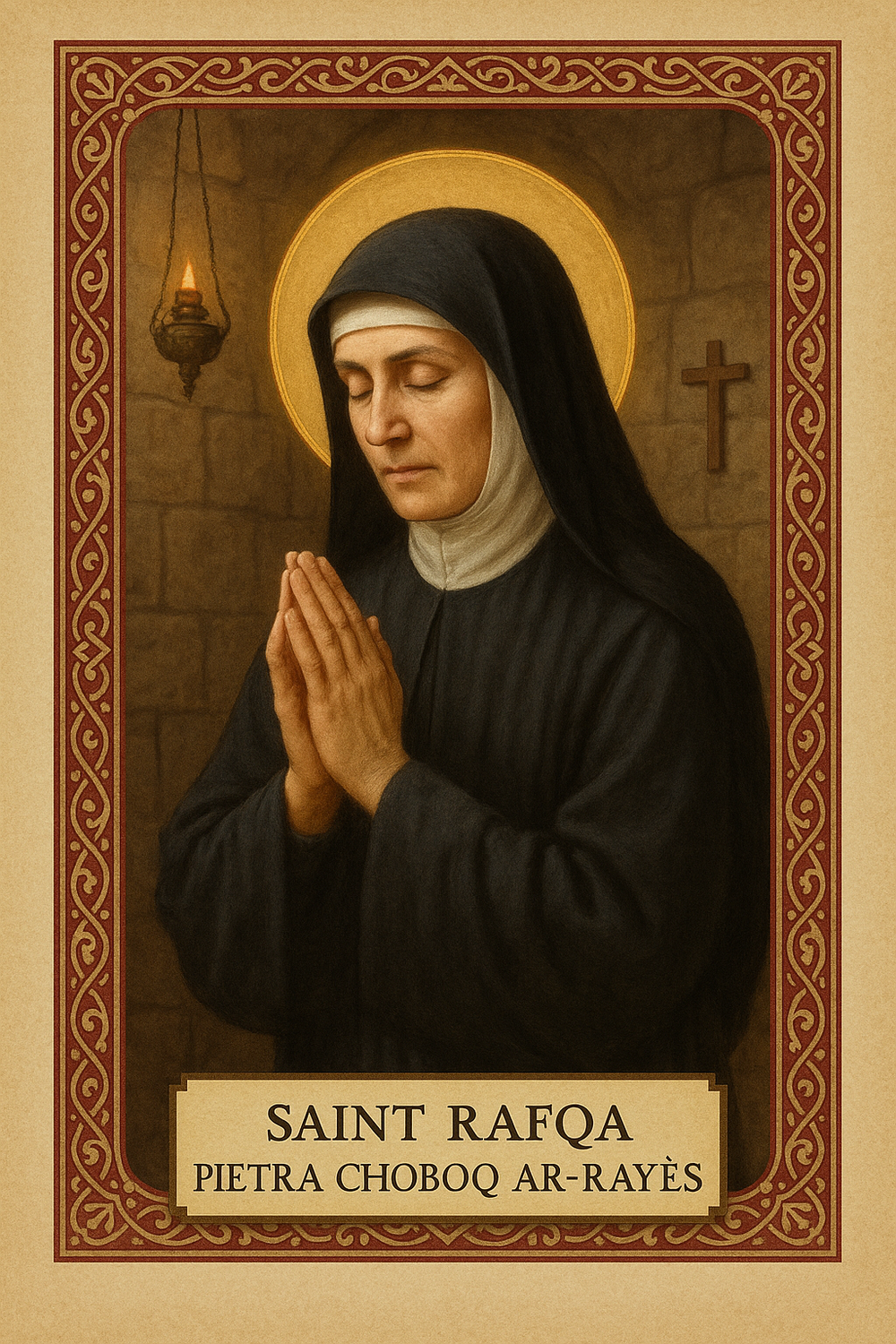
Devotion
Prayer to St. Marina the Monk
When we are misunderstood, help us to look to God alone. When we are judged, help us to forgive. When we are weary, lend us your strength.
Intercede for us before the Throne of Grace, that we may possess a heart as pure and courageous as yours.
St. Marina the Monk, pray for us. Traditional Devotion
Part VI
Carrying Her Protection With You
St. Marina is a powerful intercessor for anyone dealing with legal trouble, workplace gossip, or reputation attacks. Keep her icon with you as a shield against the arrows of words, whether that means carrying her prayer card in a bag, placing it on a desk at work, or setting it beside a bed during a season of difficulty.
We are one of the few places in the U.S. that carries a St. Marina the Monk prayer card. The design shows the traditional icon of Marina with the child she raised, printed on premium cardstock and finished with 5mil waterproof lamination so it can be carried daily without wearing down.
Questions & Answers
Frequently Asked Questions
St. Marina's life is preserved primarily through hagiographic sources from the desert monastic tradition, and her story appears consistently across Orthodox, Maronite, and Coptic sources. While exact historical verification of every detail is not possible by modern standards, the Church's continuous veneration of her for over 1,500 years across multiple Eastern traditions is itself a significant form of testimony.
St. Marina the Monk is commemorated on June 18 in the Orthodox tradition, with some calendars marking July 17 as well. The variation reflects differences in how Eastern liturgical calendars developed across regions and centuries.
Marina and Marinos are the same person. Marina was her birth name. Marinos is the masculine form she adopted when she entered the monastery disguised as a monk. Some traditions also refer to her as St. Mary the Monk or St. Mary of Alexandria.
No. Marina's silence was a specific response chosen to protect a vulnerable young woman from greater harm, not a universal command to never seek justice. The spiritual principle her life teaches is discernment: examine whether speaking serves truth and mercy, or only your own vindication, before deciding whether to speak or remain silent. If you are facing a genuine situation involving accusation or injustice, a conversation with a pastor or spiritual director can help you discern the right response in your own circumstances.
St. Marina's veneration was historically stronger in the Christian East than in the post-Schism Catholic West. Her story also unsettles modern readers because of her cross-dressing disguise and because her model of hidden, silent holiness runs counter to a culture oriented toward visible achievement and self-defense.
A Saint Who Disappeared So That God Could Be Seen
St. Marina gave up her name, her reputation, and her place among the brothers who once revered her, choosing silence over self-defense and mercy over vindication. She was only recognized as a saint once she could no longer speak for herself. For anyone carrying a false accusation, a season of gossip, or the quiet weight of being misunderstood, she is a companion who has already walked that road, and who intercedes still for those who walk it now.
Get the St. Marina Prayer Card →