How to Grieve as a Christian: Scripture, the Communion of Saints & the Hope of Reunion
Personal Testimony • Scripture • Christian Spiritual Tradition
How to Grieve as a Christian: Scripture, the Communion of Saints & the Hope of Reunion
Grief does not care whether you lost a parent, a spouse, a child, or a friend who felt like family. It arrives the same way every time, uninvited, and it does not consult a schedule. I lost a daughter. I am writing what I learned from that loss, but everything in this article is meant for whatever grief you are actually carrying, whoever you have actually lost.
How to Grieve as a Christian — At a Glance
- The Question
- Does grieving mean my faith failed, or is grief itself part of faith?
- Scripture Anchor
- Matthew 5:4 • “Blessed are those who mourn, for they will be comforted”
- Christ’s Own Example
- John 11:35 • “Jesus wept” — knowing He was about to raise Lazarus
- The Key Distinction
- Grieving is not the same as grieving “as those who have no hope” (1 Thessalonians 4:13)
- What Doesn’t Change
- The communion of saints • you are still in contact through prayer
- Where This Is Going
- Not an ending. A reunion, on the far side of what feels unbearable now
When Grief Arrives
I lost a daughter to bone cancer. She was diagnosed at thirteen. She was sixteen when it took her. I am going to tell you some of that story, because it is the loss I actually know from the inside, and because I do not think it is honest to write about grief in the abstract when I have a specific one of my own to draw from. But I want to say clearly, before any of that, that this article is not really about losing a child specifically. It is about grief itself, whatever shape it took when it arrived at your door. Maybe you lost a spouse who was supposed to grow old beside you. Maybe you lost a parent and only realized afterward how much of your own sense of steadiness had been quietly resting on theirs. Maybe you lost a friend nobody else quite understood the size of, because they were not related to you by blood, only by every important thing that actually held your life together. Grief does not rank these. It does not care what the relationship was called on paper. It simply arrives, at the size the loss actually was to you, and it does not ask permission first.
For a long time after my daughter died, I was angry at God. My faith was badly shaken. I stopped believing in miracles altogether, and I remember wondering, with real bitterness, that if some people truly had the power to heal in Christ’s name, why weren’t they standing in every hospital in the world, every single day. It took years of maturing, and I am not going to pretend the process was fast or clean, to work my way through that anger to where I stand now. I say that up front because I do not want this article to read like grief is a math problem you solve once and never revisit. It is not. What follows is not a formula for skipping the pain. It is what I have actually come to believe is true, underneath the pain, and why I no longer think grieving and trusting God are two different postures fighting each other for space in the same heart.
Part II
What Convinced Me This Was Real
None of what follows in this article works as mere philosophy for me. It works because of something that happened to me once, a mystical experience that I will not try to reconstruct blow by blow, because the value of it was never in the specific details. The value was in what it left behind: I no longer had room for doubt that God is real.
That single certainty rearranged everything else, and it rearranged how I hold grief in particular. If God is real, then everything He has told us about what comes after this life must be real as well. If Heaven is real, and I believe it is, then we are not creatures who live for seventy or eighty years and then stop existing. We are eternal beings having a temporary human experience. For however briefly I was in that presence, the things of this world that had been gripping me simply stopped gripping me the same way. Not because the losses stopped mattering. They still matter enormously. It was that I had seen, or sensed, something large enough that the grief could sit inside it without needing to be explained away first. That is the closest thing I have to a starting point for the rest of what I believe about loss.
I do not say this to convince you that you should have had the same experience I had, or that faith requires one. Most Christians throughout history have grieved deeply and trusted God fully without ever receiving anything like what I received, and their faith is not lesser for it. I only say it because it explains where the rest of this article comes from. I am not describing a coping mechanism I invented to survive a hard season. I am describing what I actually believe to be true about reality, and trying to work out what it means for grief that used to feel like it had no floor underneath it.

Part III
What Scripture Actually Says About Grief
I used to think grief was something a strong enough faith was supposed to shrink or shorten. I do not think that anymore, and Scripture is a large part of why. The Beatitudes, some of the most concentrated moral teaching Jesus ever gave, include this: “Blessed are those who mourn, for they will be comforted” (Matthew 5:4). Notice what that verse does not say. It does not say blessed are those who manage to avoid mourning. Mourning itself is named as the condition that receives the blessing and the comfort. Grief is not the obstacle to blessedness in that verse. It is the doorway to it.
Then there is the shortest verse in the entire Bible, two words in English, and I think its brevity is part of its power: “Jesus wept” (John 11:35). He said this standing outside the tomb of His friend Lazarus, and here is the detail that changes everything about how I read it. He was minutes away from raising Lazarus back to life. He knew that. He was not uncertain about the outcome, He was not afraid death would win, and He wept anyway. His grief was not based on not knowing how the story ended. He wept because loss is genuinely sorrowful, because He loved Lazarus and his sisters Mary and Martha, and because entering fully into human grief was part of what it meant for Him to enter fully into human life. If the Son of God, holding certain knowledge of the resurrection He was about to perform, still wept at a tomb, then grief was never evidence of insufficient faith. It was evidence of love working exactly as it is supposed to.
Ecclesiastes gives grief the same dignity in a quieter way, simply listing it among the ordinary seasons of a human life: “A time to weep, and a time to laugh; a time to mourn, and a time to dance” (Ecclesiastes 3:4). Mourning is not framed there as a malfunction. It is framed as a season, arriving in its own time the same way laughter and dancing arrive in theirs, each one proper to its moment.
What makes Christian grief distinct is not the absence of grief but what sits beside it. Saint Paul writes to the Thessalonians about believers who had died, and he does not tell the living not to grieve. He tells them something more precise: “We do not want you to be uninformed about those who sleep in death, so that you do not grieve like the rest of mankind, who have no hope” (1 Thessalonians 4:13). Grieve. Just not as those who have no hope. That single phrase reframed the entire experience for me. The command was never to stop grieving. It was to grieve with something underneath the grief that people without Christ do not have access to.

Part IV
Is Grieving a Sin or a Failure of Faith?
I have asked myself, in the middle of the worst of it, whether grieving as hard as I was grieving meant something was wrong with my faith. I do not believe that anymore, and I want to walk through why, because I suspect other grieving Christians carry the same quiet guilt I used to carry.
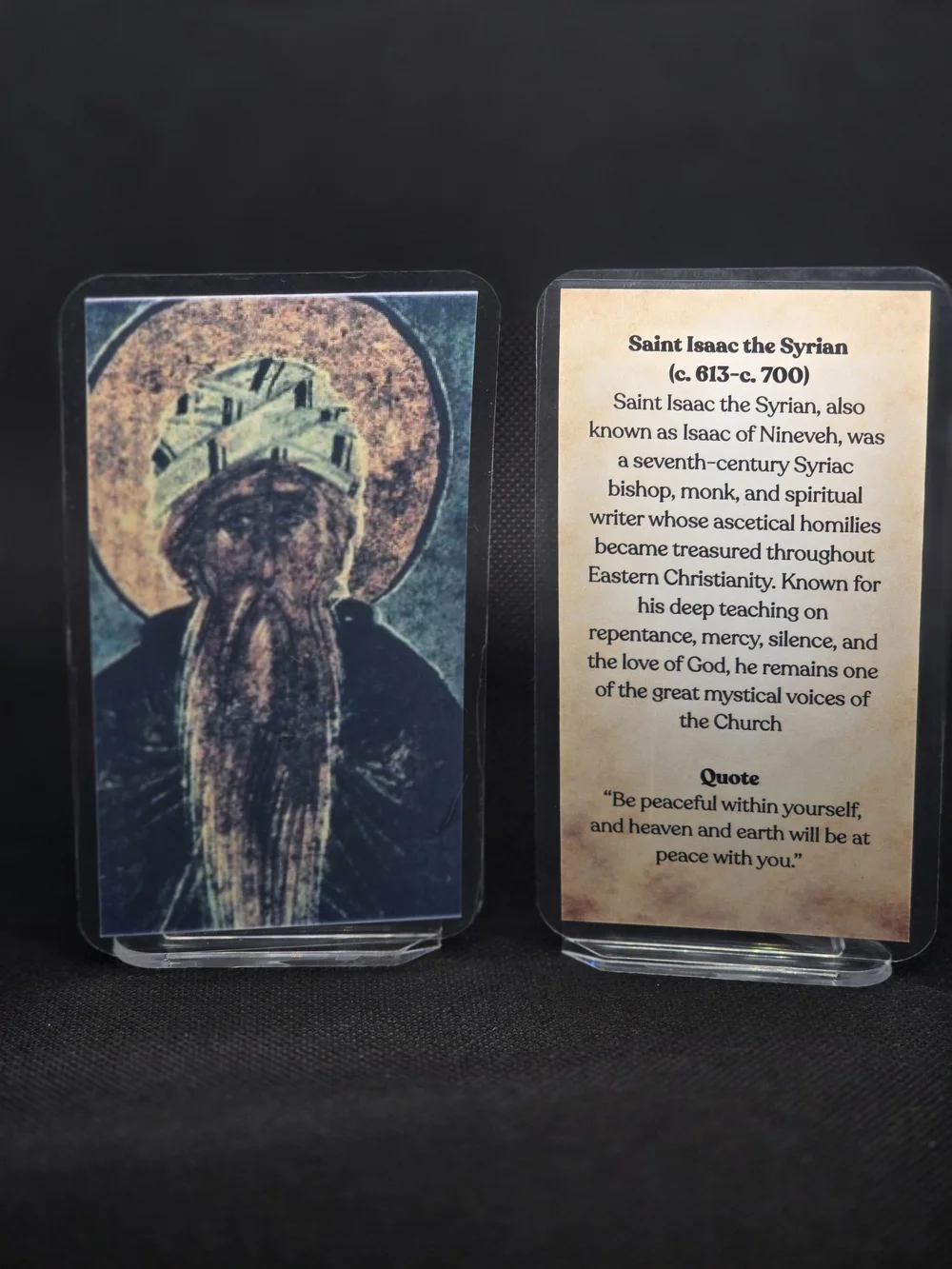
Christian moral theology, worked out with particular precision by Saint Maximus the Confessor in the seventh century, distinguishes the first involuntary wave of a feeling from a settled passion that forms only once the will consents to build a permanent home inside that feeling. The first is not a choice. It happens to infants, to saints, to Christ Himself, who was described in Gethsemane as “overwhelmed with sorrow to the point of death” (Matthew 26:38), sweating drops like blood, hours before His arrest. That is not a minor emotional flicker. That is a Person fully God and fully man in genuine anguish. If sorrow that intense could be present in Christ without being sin, then sorrow, even devastating sorrow, is not itself the thing Scripture warns against.
What Scripture actually warns against, in 1 Thessalonians 4:13, is grieving as those who have no hope, which is a different thing entirely from grieving hard. Grief becomes something else, something closer to what the desert fathers would call a passion, when it hardens into a settled refusal, a permanent verdict that God has failed, that comfort is not coming, that trust is no longer available. That hardening is not the same thing as the wave of sorrow that hits you doing the dishes eight months later because a song came on that they used to sing. The wave is love, still doing exactly what love does when its object is gone. The hardening is despair, and despair is the actual danger Scripture is naming, not the tears themselves.
There is a hinge point between the two, often no longer than a breath, where sorrow either stays sorrow or curdles into a settled conviction that nothing good remains possible. Nobody teaches you to notice that hinge point by accident. You have to be told it exists before you can catch yourself standing on it. Once I knew it was there, I started noticing it in myself, the exact instant grief arrived and the exact instant, sometimes much later, when I either turned toward God with it or let it settle into something closer to bitterness. Feeling the grief is not the failure. Letting it become a permanent argument against God’s goodness is the part Scripture actually calls us away from.

Part V
Why This Actually Works: Grace, Providence & the Communion of Saints
I want to slow down here, because this is the part that explains why any of the rest of this actually holds up. Scripture says something startling in 2 Peter 1:4, that believers are called to “become partakers of the divine nature.” Not admirers of God from a safe distance. Partakers. Christian writers across every branch of the Church have tried to put words to what that means. Some call it participation in divine life through grace. Some call it theosis. The vocabulary differs by tradition, the underlying claim does not: God does not intend merely to comfort you from the outside and leave you exactly as you were. He intends to fill you with His own peace and His own hope until they stop being borrowed and start being genuinely yours, even while the grief is still there.
This is also where divine providence belongs in the conversation, because providence is a stronger claim than simply noticing. Romans 8:28 says “we know that in all things God works for the good of those who love him.” That is not passive observation of your loss from a distance. That is active governance, God genuinely working even the worst thing that has happened to you toward a good end, while still leaving what happened real and the grief over it real. And Matthew 10:29-31 makes the scale of that care almost absurdly small and personal: not even a sparrow, the cheapest animal sold at market in Jesus’s day, falls to the ground outside the Father’s knowledge. If God’s attention reaches something with no market value at all, then your grief, however private, however long ago the loss, however small it might feel next to someone else’s tragedy, was never too minor for Him to notice or too ordinary for Him to care about.
And here is the part I have come to lean on most heavily of all. Hebrews 12:1 describes believers as “surrounded by so great a cloud of witnesses.” The Christian understanding of the communion of saints, held across Catholic and Orthodox tradition and echoed in Protestant teaching on the church triumphant, is that death does not sever a believer’s connection to those who love them. It changes its shape. The person you lost is not simply gone and remembered. They are present in a different mode, one that prayer still reaches across. That is not even a separation without contact. You can still speak to them every day in prayer. You may not hear them back, not yet, but the connection was never actually cut. It changed forms. It did not end.

Part VI
Living Inside the Unknowing
Job never got an explanation. I want to sit with that for a moment, because it is easy to read past it. He lost his children, his servants, his flocks, and his health, all of it, seemingly all at once, and none of it because he had done anything to deserve it. He asked for a reason, repeatedly, across chapter after chapter, and when God finally answers him out of the whirlwind, God does not explain a single thing about why the suffering happened. He asks Job questions instead, about the foundations of the earth, the storehouses of snow, the wild donkey and the ostrich, question after question Job cannot answer. And Job’s response afterward is not satisfaction at finally understanding. It is something else entirely: “I had heard of you by the hearing of the ear, but now my eye sees you” (Job 42:5). He did not receive an answer. He received an encounter, and the encounter was enough. That is close to what happened to me in my own mystical experience, the one I described earlier without trying to reconstruct the details. For however briefly I was in that presence, the things of this world that had been gripping me simply stopped gripping me. Not because anything had been explained. Nothing was explained. It was that I had seen, or sensed, something large enough that the grip those things had on me could not survive being that close to it. Job’s questions did not get answered either. They got outweighed.
And before God ever spoke a word to him, in the very moment he learned his ten children were dead, Job said something I try to hold onto whenever loss visits my own life: “Naked I came from my mother’s womb, and naked I will depart. The Lord gave and the Lord has taken away; blessed be the name of the Lord” (Job 1:21). Notice the order there. He did not wait for his grief to resolve before he trusted God. He said this in the same breath as the grief itself, grief and trust arriving together rather than one waiting politely for the other to finish first. That is the posture I try to start each morning in now, before the day has a chance to hand me anything at all.


Part VII
The Reunion That’s Coming
Here is where I have arrived with my own daughter, and I believe it applies just as fully whoever you have lost. Instead of grieving that she is in Heaven, I have come to believe she is the one who should be grieving that I am not there with her yet. She is with Jesus. Forever. And I will be there too. I think of it this way now: imagine we had planned a trip to Disney World together, and she got to go a full week ahead of me, waiting there while I finish getting ready to leave. Would I be upset that she arrived early? Of course not. I would be thrilled for her, genuinely thrilled, that she got an extra week in a place that good. What I would feel is not grief that she is there. It is simply my own eagerness to arrive and be with her again. And when I finally do get there, I already know what I am looking forward to first. I want to hear about it. All of it. Every adventure, everything she has seen and done and experienced in the time before I arrived, however long that ends up being by our earthly clock. That is not how you picture someone you have lost. That is how you picture someone you are about to catch up with. Whoever it is you have lost, I believe the same is true. They got there first. You are not saying goodbye. You are the one still packing.
Christ describes almost exactly this image Himself, in words that comforted His own disciples the night before His death: “Do not let your hearts be troubled… I go to prepare a place for you… that you also may be where I am” (John 14:1-3). Sit with the timing of that for a moment, because I think it is the whole point and it is easy to miss. This is not a general life philosophy Jesus is teaching from a position of comfort. He says this hours before His own arrest, His own torture, and His own execution. He knows exactly what the next day holds for Him, in more physical and psychological detail than any of the men listening to Him that night. And what He chooses to say to them, knowing all of that, is not a warning to brace themselves. It is a command not to be troubled. He is not telling them the crucifixion will not be terrible. He is telling them that even the worst thing that will happen this week, the death of God Himself, is not the end of the story, and that He is already thinking past His own execution to the place He is going to prepare for them. If the Son of God could say don’t let your hearts be troubled while walking toward His own Cross, then the instruction was never conditional on circumstances being manageable. It was given at the least manageable moment in human history, on purpose, so that we would know it still applies to whatever the worst moment of our own grief happens to be. He went ahead. He is preparing the place. The point was never separation. It was always reunion. Saint Paul felt the same pull toward that reunion so strongly that he wrote, “My desire is to depart and be with Christ, for that is far better” (Philippians 1:23). Not despair at leaving this world. Something closer to eagerness for what comes after it. Scripture’s final word on the matter is blunt and triumphant: “Death has been swallowed up in victory… Where, O death, is your victory? Where, O death, is your sting?” (1 Corinthians 15:54-55). The last enemy Scripture names is death itself, and it has already lost.

Part VIII
Loving Fully While Grieving
There is a word Christian writers across many centuries have used that I think grieving people need to hear more often, because it is almost always misunderstood: detachment. It does not mean what it sounds like. It does not mean loving someone less, or holding them at arm’s length while they were alive so the loss would hurt less when it came. Nobody who has actually grieved someone they loved with an open, undefended heart believes detachment could mean that, and Scripture does not ask it of us either.
What detachment actually means, in the sense writers like Thomas à Kempis and Ignatius of Loyola meant it, is holding a person, or an outcome, with an open hand rather than a closed fist. Ignatius built an entire spiritual method around what he called holy indifference, the freedom to genuinely trust God’s will above every other outcome, whether that meant health or sickness, a long life or a short one. That freedom was never coldness. It is what let a person love completely while trusting that their own peace, and the ultimate good of the person they loved, did not depend on that person’s life on earth continuing on their own schedule. You can grieve with your whole heart and still trust that the one you lost, and you yourself, are held by something larger than the loss. Detachment does not soften the grief. It gives the grief somewhere to stand that is not despair.
A hermit monk in the desert owns nothing, and is full of joy anyway, because what he has was never on the list of things that could be taken from him. Grief is different from that kind of loss in one important way: the person you lost was never a possession to begin with. They were a gift, held loosely the entire time whether you realized it or not, and grief is what it feels like when a gift this large is returned to the One who gave it. That does not make the loss smaller. It gives the loss a place to rest that is not the same as bitterness.


Part IX
Grief and Joy Can Coexist
I used to think joy and grief could not be in the same room together, that feeling one meant I was betraying the other. I no longer believe that, and I think the confusion comes from mixing up joy with happiness. Happiness is generally tied to circumstance. It rises when things go well and falls when they do not, which means it genuinely cannot coexist with grief, not for a while. Joy is different. Scripture lists joy as fruit of the Holy Spirit, alongside love, peace, and patience (Galatians 5:22-23), which means it grows out of abiding in God rather than out of favorable circumstances. That is precisely why it can survive grief instead of being canceled by it.
James makes the actual claim precisely: “Consider it pure joy, my brothers and sisters, whenever you face trials of many kinds” (James 1:2-4). Joy sits alongside the trial. It does not require the trial, or the grief, to be absent. The prophet Habakkuk says the same thing in the most extreme terms available to him, after listing total agricultural collapse, no fruit on the trees, no flocks in the fields: “Yet I will rejoice in the Lord, I will be joyful in God my Savior” (Habakkuk 3:17-18). And the Apostles lived this out directly. After being flogged by the Sanhedrin for preaching Christ, Scripture records that they left “rejoicing because they had been counted worthy of suffering disgrace for the Name” (Acts 5:41). Not despite the suffering. Alongside it, and because of what it meant.
I want to be careful here, because this truth can be misapplied in a way Scripture never intends. The point is not that grief means the Holy Spirit has left you, or that a grieving Christian who cannot feel joy on a given day is doing something wrong. Some days there will be only the grief, and that is not a spiritual failure either. The claim is simply that joy remains available, underneath and alongside the grief, without requiring the grief to be denied or minimized first. Both can be true in the same heart, on the same day, sometimes in the same hour. The eternal has a way of breaking into the middle of ordinary grief when we least expect it, the same way it has broken into ordinary history before, in ways that still comfort people who read about them generations later.

For the Days the Loss Feels Fresh Again
Lord Jesus Christ, Son of God, have mercy on me. You wept at a tomb even knowing the resurrection that was coming. Let that be permission for my own tears today. Remind me that the one I have lost is not gone, only held in a way I cannot yet see, and that I am not grieving as one without hope. Give me the patience of Job, who blessed Your name in the same breath as his grief, and the eagerness of Paul, who longed for the reunion waiting on the other side of this life. My joy, Christ is risen. Amen.
A short prayer for daily use, drawn from Matthew 5, John 11, 1 Thessalonians 4, and Job 1.


FAQ
Frequently Asked Questions
Not an Ending. A Reunion Still Coming.
Whoever it is you have lost, a parent, a spouse, a child, a friend, I believe this the same way I believe it about my own daughter: they are not gone. They are ahead. The grief is real, and Scripture never asks you to pretend otherwise. But the grief is not the last word, and it is not the only thing true about your loss.
Whatever is heaviest in your grief today, bring it to the God who wept at a tomb He was about to empty, and who tells you, even now, not to let your heart be troubled. He went ahead to prepare a place. So did the one you are grieving. You are simply the one still packing.
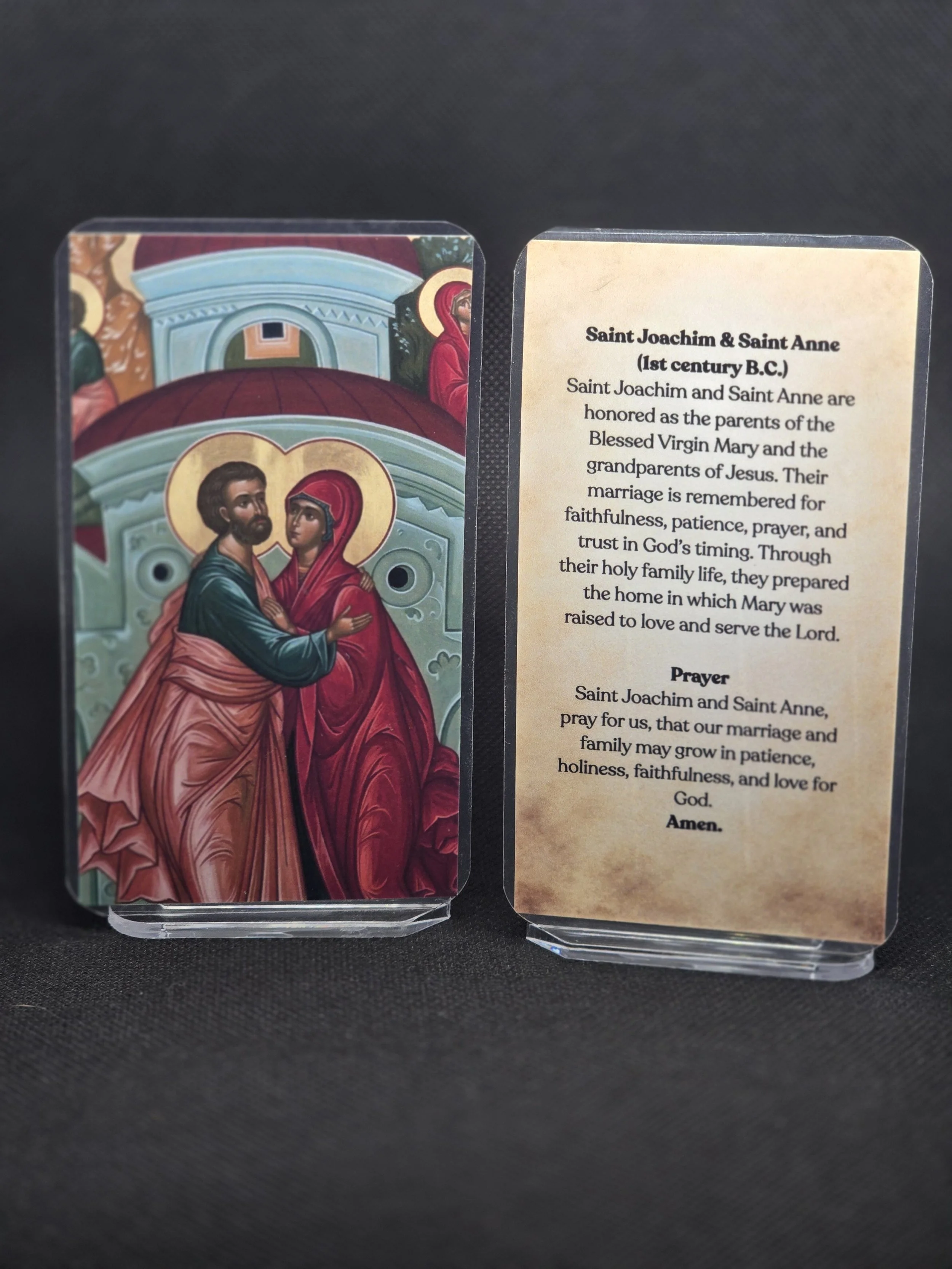
Get the Saints Joachim & Anne Prayer Card →