Unofficial Patron Saints for Mental Health, Anxiety & Trauma
Unofficial Patron Saints for Mental Health, Anxiety & Trauma
No saint on this page was ever formally declared a patron of anxiety, despair, or the mind under siege. But seven of them lived through exactly that — and what they wrote, said, and survived still reaches the same darkness today.
At A Glance
- What This Is
- Seven lesser-known Catholic and Orthodox saints whose lives speak directly to anxiety, despair, intrusive thought, and trauma
- What This Is Not
- A list of officially decreed patrons of mental health
- Why These Seven
- Each one is largely absent from existing "saints for mental health" lists, despite living through the exact suffering those lists describe
- Traditions Covered
- Roman Catholic, Eastern Orthodox, Syriac, Armenian
- How To Use This
- Find the saint whose suffering matches yours, read their story, carry their prayer card
- A Note On Care
- These saints are companions in prayer, not a substitute for medical or psychological treatment
Search "saints for mental health" and the same handful of names appear every time: Dymphna, Paisios, Porphyrios, Seraphim of Sarov, Thérèse of Lisieux. They earned that visibility honestly, and if one of them is who you need, we have full guides on them elsewhere. But seven other saints lived through suffering just as real — documented in their own writings, their own biographies, their own recorded breakdowns — and almost nobody has written about their connection to anxiety, trauma, or the mind that will not settle. This guide exists so they are not lost to the people who need exactly what they survived.
One
Saint Christina the Astonishing
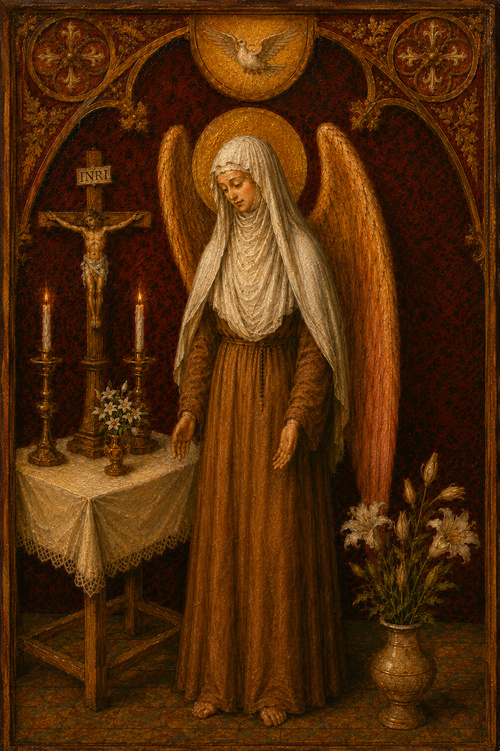
Saint Christina the Astonishing
Catholic Unofficial Patron of:Bipolar Disorder & Dissociative SufferingBorn in Brustem, in present-day Belgium, around 1150, Christina's biography reads as strange even by the standards of medieval hagiography. Accounts describe episodes resembling apparent death, followed by violent physical reactions and behavior her own community struggled to interpret or categorize. Her contemporaries did not have psychiatric language for what they were watching. They had only the vocabulary of sanctity, sin, and miracle — and they reached for all three trying to explain a woman whose inner experience clearly did not fit any of them cleanly.
Read charitably, and without forcing a modern diagnosis onto a 13th-century life that cannot consent to one, Christina has become a quiet point of identification for people whose own inner experience defies easy explanation to the people around them — including those living with bipolar disorder, dissociative episodes, or any condition where behavior during an episode looks nothing like behavior between episodes. Her community's confusion is, in a strange way, the most relatable part of her story. They loved her. They also did not know what to do with her. That combination is familiar to almost anyone who has tried to explain a mental health condition to family members who care deeply but cannot follow what is happening.
What makes her worth remembering is not that the Church ever resolved the question of what was happening to her. It is that her community kept her, kept loving her, and the Church eventually recognized something holy in a life that never stopped looking strange from the outside. For a person whose own mind frightens the people who love them, that refusal to walk away is itself a kind of intercession.
Two
Abba Poemen the Great
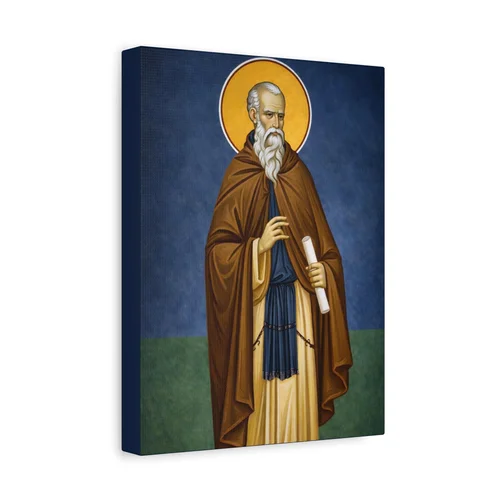
Abba Poemen the Great
Orthodox & Catholic Unofficial Patron of:Anger Control & Healing Reactive RelationshipsOne of the most frequently quoted Desert Fathers in the entire Sayings of the Desert Fathers tradition, Poemen lived in the Egyptian desert of Scetis in the 5th century, leading a community of monks through decades of patient, unglamorous spiritual direction. His sayings circle back again and again to the same theme: that the person provoking you is rarely the real battlefield, and that real strength is the discipline not to answer fire with fire.
Poemen never claimed anger simply disappears for the holy. His sayings are full of acknowledgment that the passions — anger chief among them — remain active in even advanced monks for their entire lives. What he taught instead was a discipline of the pause: noticing the rise of anger before it becomes action, and choosing silence or withdrawal rather than the sharp word that cannot be unsaid. For people whose trauma or anxiety expresses itself as a short fuse — the kind of reactive anger that arrives fast and leaves shame in its wake — his teaching offers something genuinely rare: a path that does not require pretending the anger isn't there.
This distinction matters pastorally. A great deal of popular spiritual advice about anger amounts to "don't feel it." Poemen's desert tradition assumes you will feel it, repeatedly, for the rest of your life, and teaches the much harder and more honest skill of what to do in the three seconds between the feeling and the response.
Three
Saint Isaac the Syrian

Saint Isaac the Syrian
Syriac & Orthodox Unofficial Patron of:Despair, Scrupulosity & ShameBriefly a bishop of Nineveh in the 7th century before resigning to live as a hermit, Isaac left behind a body of theological writing whose central theme is the breadth of God's mercy — a mercy he describes as wider than human sin could ever exhaust. His writings were so influential they were copied and preserved across Syriac, Greek, Arabic, and Slavonic Christianity for over a thousand years, carried by monastics who found in them exactly what despairing people still need today.
Isaac's theology speaks with unusual directness to a specific shape of suffering: the conviction that you have done too much wrong, failed too many times, or fallen too far to still be loved. This is not garden-variety sadness. It is the particular despair that often accompanies trauma and chronic anxiety — the sense that you are fundamentally disqualified from grace, that your failures have used up whatever patience God or the people around you had left. Isaac's entire theological project pushes directly against that conviction, insisting that no measure of human failure could ever outpace the mercy God has already extended.
What makes Isaac different from generic comfort is that his writing does not minimize sin or suffering to get there. He does not say your failures don't matter. He says they matter less than you think they do to the question of whether you can still be loved. That is a finer and more durable form of comfort than simple reassurance, because it survives contact with real guilt instead of asking you to pretend the guilt isn't there.
Four
Saint Gregory of Narek
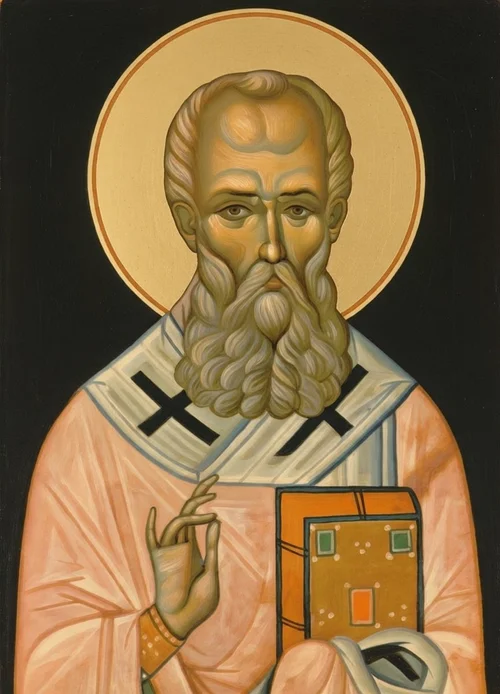
Saint Gregory of Narek
Armenian Unofficial Patron of:Depression, Scrupulosity & Wordless GriefA 10th-century Armenian monk, theologian, and mystical poet, Gregory wrote the Book of Lamentations, a sprawling work of penitential prayer that gave the Armenian Church a vocabulary for anguish that ordinary speech could not supply. In 2015, Pope Francis declared him a Doctor of the Church — only the second such recognition extended to a saint from outside full communion with Rome, a sign of how seriously his writing on suffering has been taken across both traditions.
Gregory wrote for people who freeze in prayer because they do not know where to begin — people too ashamed to name what is wrong, too overwhelmed by grief to construct a sentence, too convinced of their own unworthiness to ask for anything directly. The Lamentations supply the words other people cannot find on their own, which is precisely why Armenian Christians have carried his book to deathbeds, sickrooms, and moments of personal collapse for over a thousand years. It is less a book of theology to study than a voice to borrow when your own voice has gone silent.
His relevance to depression and scrupulosity in particular comes from how unflinchingly he names his own unworthiness without ever concluding that unworthiness disqualifies him from speaking to God. That combination — total honesty about how bad things feel, paired with the conviction that prayer is still possible anyway — is exactly the bridge that depression and scrupulosity tend to destroy in a person.
Five
Saint John Climacus
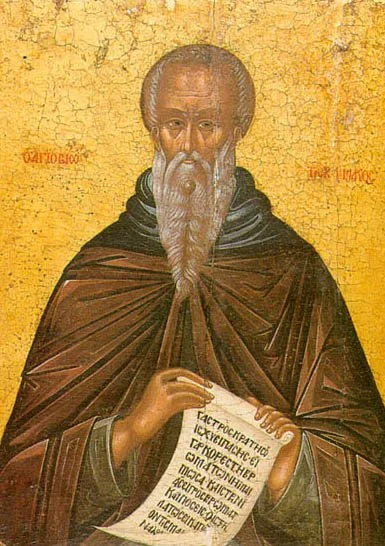
Saint John Climacus
Orthodox Unofficial Patron of:Step-by-Step Healing, Recovery & Spiritual WarfareA monk of Mount Sinai in the late 6th and early 7th centuries, John wrote The Ladder of Divine Ascent at the request of a neighboring abbot, organizing the spiritual life into thirty distinct steps moving from renunciation of the world to the perfection of love. The image of the ladder is so central to Orthodox spirituality that it is read aloud in monasteries every Great Lent, and John's feast falls on the fourth Sunday of Lent specifically because of it.
What makes the Ladder unusually useful for anxiety and trauma recovery is the structure itself: thirty distinct, sequential steps, none of which can be skipped to reach the top faster. Recovery from anxiety, trauma, or any long mental health struggle rarely moves in a straight line, and people in the middle of it often torture themselves with the belief that healing should be faster than it is. John's image insists otherwise. Climbing a ladder happens one rung at a time, and falling back a rung does not mean starting over from the ground — it means finding your footing again and continuing.
This is less a self-help framework than a genuinely ancient piece of pastoral wisdom: that spiritual and emotional healing has stages, that skipping stages does not actually work, and that the person two rungs below you is not behind in some race, just earlier in the same climb you are on. For someone exhausted by the slowness of their own recovery, that reframing carries real weight.
Six
Saint John the Silent
Saint John the Silent
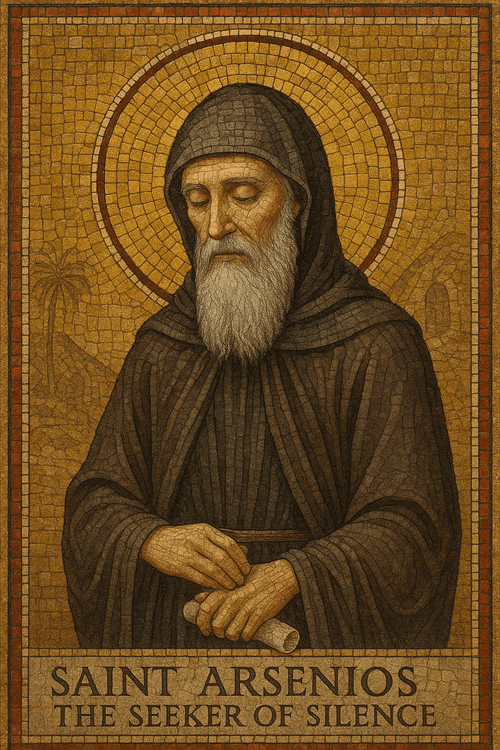
Orthodox Unofficial Patron of:Racing Thoughts & Compulsive TalkingJohn served as a bishop in Colonia, Armenia, during the 6th century before eventually resigning his see to live as a hermit and monk in pursuit of deep silence — a vocation so total that history remembers him almost entirely by that single word. After decades of public, administratively demanding church leadership, John chose to spend the rest of his life in a discipline of quiet that the noisiest periods of his earlier life had never allowed him.
There is a particular kind of anxious mind that copes by talking — filling silence with words, arguing compulsively online, narrating its own worry out loud because stopping feels more frightening than continuing. John's deliberate turn toward silence, after a life that had been anything but quiet, stands as a pointed counter-witness to the instinct that more words will calm an anxious mind. His life argues, gently but firmly, that the opposite is often true: that the cure for racing thoughts is not more talking but the much harder discipline of letting the noise stop.
This is not a teaching about introversion or personality type. It is a teaching about what an anxious mind actually needs in its worst moments, which is frequently not more processing, more talking, more argument, but a deliberate, chosen quiet long enough for the noise to settle on its own.
Seven
Saint Arsenius the Great
Saint Arsenius the Great
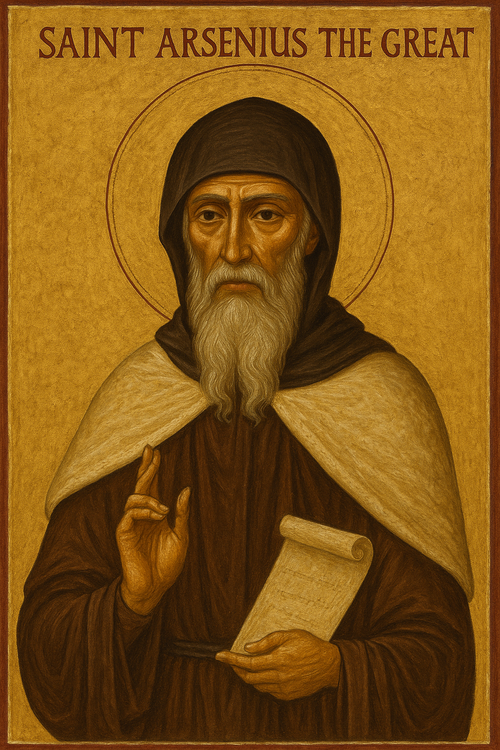
Orthodox Unofficial Patron of:Phone Addiction, Noise & OverstimulationOnce a tutor to the sons of the Roman Emperor Theodosius the Great, holding genuine influence and access at the imperial court in Constantinople, Arsenius walked away from that life entirely in the late 4th century to pursue solitude in the Egyptian desert. He is remembered for a single, famous prayer — asking to be delivered from the temptation to keep talking — offered by a man who had spent years at the center of the most consequential conversations in the empire.
Arsenius's relevance to a smartphone-saturated 21st century is almost uncomfortably direct. He had access to constant stimulation, constant relevance, constant conversation with the most powerful people of his age — and he gave it up, deliberately, because he recognized what it was doing to his interior life. For anyone caught in compulsive scrolling, notification anxiety, or the low hum of constant digital noise, Arsenius is the saint who already lived the experiment of walking away from exactly that kind of stimulation and found something better waiting in the silence.
His desert contemporaries described him as severe with himself but gentle with others, a combination that suggests the silence was never about withdrawal from people. It was about withdrawal from noise, so that the people in front of him could finally be met with real attention rather than divided focus. That distinction is worth sitting with for anyone whose phone has quietly replaced presence with distraction.
This bundle brings together five saints already carrying deep devotion for anxiety and mental health — Saint Dymphna, Saint Paisios, Saint Porphyrios, Saint Seraphim of Sarov, and Saint Silouan the Athonite. Pair it with any of the seven saints above to carry a fuller circle of intercession through a hard season.
View Bundle →When Anxiety Touches a Marriage or a Family
Anxiety and trauma rarely stay contained to one person. They ripple into marriages, into how a parent shows up for their children, into the small daily exchanges that either carry a household through a hard season or wear it down further. None of the saints above lived inside a marriage themselves, but if anxiety, depression, or trauma is reshaping your home and not just your own mind, that is worth naming directly rather than carrying alone.
Jeremy works directly with husbands, and Ashley works directly with wives, through Christian marriage coaching grounded in the same Eastern Christian spirituality as everything in this guide.
FAQ
Frequently Asked Questions
None of Them Were Ever Declared Patrons of This. All of Them Lived It Anyway.
Christina's community could not explain her. Poemen spent a lifetime managing anger he never claimed to be free of. Isaac argued for a mercy wider than any failure. Gregory wrote the words for people who had none left. John Climacus insisted healing happens one rung at a time. John the Silent walked away from talking. Arsenius walked away from the noise of an empire. None of them have a Vatican decree or a Patriarchal confirmation behind their name. All of them are still worth carrying into whatever this season holds.
View the Mental Health Prayer Card Bundle →