When the Orthodox Agreed to End the Schism, Rome Instead Let the Muslims Kill Them
Church History • The Great Schism • Byzantine Empire • 1204–1453
When the Orthodox Agreed to End the Schism, Rome Instead Let the Muslims Kill Them
This is a two-part betrayal, and most accounts only tell you the second half. In 1204, Western Roman Crusaders sacked the Orthodox capital of Constantinople and broke the empire that had stood as Christendom’s eastern wall for eight centuries. Two hundred and forty-nine years later, that same crippled empire agreed to end the schism and submit to Rome — twice — in exchange for military protection against the Ottoman Muslims. Rome took the submission. The empire got two hundred archers. Then it died. This is the complete, sourced history of both halves of that story.
The Betrayal, In Two Acts — At a Glance
- Act One
- Fourth Crusade sacks Constantinople, April 1204 — a Christian army destroys the Christian capital of the East
- Who Diverted the Crusade
- Doge Enrico Dandolo of Venice, exploiting Roman Crusader debt and Byzantine succession politics
- First Warning Sign
- Sack of Zara, November 1202 — a Roman Catholic city attacked by a Roman Catholic Crusader army
- The Cost to Orthodox Byzantium
- Nine centuries of wealth, art, and relics looted; the empire permanently weakened; never restored to its former strength
- Act Two
- Council of Florence, bull Laetentur Caeli signed July 6, 1439, by the now-diminished empire
- Who Refused
- Mark of Ephesus — the only Orthodox bishop who would not sign
- The Second Proclamation
- Hagia Sophia, December 12, 1452, presided by Cardinal Isidore of Kiev
- Rome’s Military Response
- Approximately 200 Neapolitan archers — the entire organized aid tied to the union
- The Fall
- Constantinople captured May 29, 1453; Constantine XI died in the fighting; the empire ended
- Rome’s Apology
- Pope John Paul II formally apologized for the 1204 sack in 2004 — 800 years later
The Empire Before the Betrayal
Before you can understand what was taken from Orthodox Byzantium, you have to understand what Orthodox Byzantium was. In the year 1200, Constantinople was the largest, wealthiest, and most sophisticated city in the entire Christian world — larger than Paris, richer than Venice, home to perhaps four hundred thousand people at a time when most Western European capitals numbered in the tens of thousands. It held the greatest library of the ancient world still standing, the greatest cathedral in Christendom in Hagia Sophia, and reliquary treasures accumulated across nine unbroken centuries since Constantine the Great had founded the city in 330 AD as the new Rome of a Christian empire.
The Byzantine Empire, for all its internal politics and periodic weakness, had functioned for eight hundred years as something the West rarely credited it for: the buffer that absorbed the shock of Persian, Arab, and Seljuk Turkish expansion so that Western Europe never had to. While Western Christendom fought its own wars and built its own cathedrals in relative safety, Constantinople stood in the path of every eastern power that wanted to push into Europe, and it held that line at enormous cost, for centuries, largely alone.
This is the empire that a Crusading army, called by Pope Innocent III with the explicit goal of liberating Jerusalem from Muslim control, would instead attack, loot, and permanently cripple in the spring of 1204. Not weaken by accident. Not damage as collateral effect of some other war. Attack directly, deliberately, and thoroughly — the single wealthiest Christian city on earth, taken apart by a Christian army carrying the cross.
A Crusade for Sale: Debt, Zara, and a Christian City Sacked First
The Fourth Crusade began, on paper, as a straightforward continuation of Christendom’s wars against Muslim control of Jerusalem. Pope Innocent III called for it in 1198. French barons negotiated with Venice in 1201 to transport an army of over thirty thousand men to Egypt, the planned staging point for an eventual assault on the Holy Land, at a price of eighty-four thousand silver marks, to be paid before the fleet ever left port.
The Roman Crusaders overestimated their own numbers badly. When the appointed sailing date arrived, fewer than a third of the anticipated army had actually assembled at Venice, and the force that did show up could not come close to paying what had been promised. Venice had already built an enormous fleet specifically for this contract and stood to be financially ruined if the expedition simply collapsed. The Venetian Doge, Enrico Dandolo — a man in his nineties, blind, and one of the shrewdest political operators of the medieval Mediterranean — offered the Roman Crusaders a way to work off their debt instead of walking away from it.
The price was Zara, a rebellious port city on the Dalmatian coast that had thrown off Venetian control and placed itself under the protection of the Roman Catholic King of Hungary. Zara was, in other words, a Roman Catholic city, under the protection of a Roman Catholic king, and Dandolo asked a Crusading army raised to fight Islam to attack it instead. In November 1202, they did. Zara was besieged, taken, and sacked. Pope Innocent III, when word reached Rome, was furious and excommunicated the entire Crusading army for attacking a fellow Christian city under papal protection — then quietly lifted the sentence within months, unwilling to let the scandal derail the expedition entirely.
The Byzantine Prince and the Deal That Doomed a City
While the Crusading fleet wintered at Zara, it was approached by a young Byzantine prince named Alexios Angelos. His father, Emperor Isaac II Angelos, had been deposed and blinded in 1195 by his own brother, who took the throne as Alexios III. The younger Alexios had escaped to the West and now offered the Roman Crusaders a proposal almost too good to refuse: restore his father to the Byzantine throne, and he would pay off the entire Venetian debt, supply the Crusade with troops and provisions for its eventual assault on Egypt, and — critically, given everything that would follow two and a half centuries later — place the Byzantine Church under the authority of Rome.
Doge Dandolo, who had his own long-standing grievances against Constantinople from an earlier diplomatic posting there, backed the plan enthusiastically. Roman Crusader leadership, badly in debt and with its moral authority already compromised by Zara, agreed. In the spring of 1203, the fleet that had been raised to fight Muslims in the Holy Land sailed instead for the Bosphorus, to install a client prince on the Byzantine throne in exchange for money, troops, and the Orthodox Church’s submission to Rome — the exact same trade, in miniature, that would define the entire Council of Florence two hundred and thirty-six years later.
The Siege and the Betrayal of an Ally
The Roman Crusader fleet arrived outside Constantinople in the summer of 1203. Faced with the prospect of a Western army at the walls, Alexios III fled the city without a real fight, and the Roman Crusaders restored the blinded Isaac II to nominal rule alongside his son, who was crowned co-emperor as Alexios IV. The new emperor now had to make good on everything he had promised in Zara — and discovered almost immediately that the Byzantine treasury did not remotely contain the sums he had guaranteed. He resorted to stripping gold and silver from churches and melting down sacred vessels to try to pay the Roman Crusaders, an act that inflamed the same anti-Latin sentiment among the Constantinopolitan populace that would recur, in different form, two centuries later during the union debates.
Alexios IV’s position collapsed within months. A palace official named Alexios Doukas, known as Mourtzouphlos, led a coup, had the young co-emperor strangled in prison, and took the throne himself as Alexios V, explicitly on an anti-Latin platform, rejecting the debts and the union his predecessor had promised. For the Roman Crusaders camped outside the walls, unpaid and now facing a hostile emperor who owed them nothing and wanted them gone, this was the final justification they needed. What had begun as a mission to restore a rightful claimant became, in the words of the Crusade’s own chroniclers, a mission to take by force what could not be collected by agreement.
Three Days That Broke an Empire
On April 12, 1204, the Roman Crusaders breached Constantinople’s sea walls along the Golden Horn, the weaker of the city’s two defensive fronts, and poured into the city. What followed has been described by historians on both the Latin and Byzantine sides as one of the most thorough and deliberate sacks of a major city in medieval history. The plunder was not chaotic looting by an undisciplined mob; Roman Crusader leadership had agreed in advance on how the spoils would be divided, and for roughly three days the army and its Venetian allies systematically stripped Constantinople of nine centuries of accumulated Christian and classical civilization.
Churches and monasteries were emptied of gold, silver, and jewels. Private homes were ransacked and their occupants, fellow Christians, robbed and in many cases killed or assaulted in the streets. Libraries containing manuscripts found nowhere else on earth — the last surviving copies of works from the ancient Greek and Roman world — were burned or scattered, an intellectual loss historians have never been able to fully calculate. Hagia Sophia itself, the holiest church in Eastern Christendom, was stripped of its gold altar furnishings, its sacred vessels used as drinking cups by soldiers, and its sanctuary defiled in ways contemporary Byzantine chroniclers, most notably the eyewitness historian Niketas Choniates, recorded with undisguised horror and grief.
Relics accumulated in Constantinople across nine centuries — some tied to the earliest generations of Christianity — were carried west and never returned. The four bronze horses that once stood over Constantinople’s Hippodrome were shipped to Venice, where they still crown the facade of St. Mark’s Basilica today. Fragments of the True Cross, the Crown of Thorns, and other relics ended up scattered across cathedrals and treasuries in France, Belgium, and Italy, some of which remain there eight centuries later. The Pala d’Oro, a Byzantine gold and enamel altarpiece, was carried to Venice and installed in St. Mark’s, where it remains on display.
The Partitio Romaniae: Rome’s Reward
What followed the sack was not restitution. It was partition. Under an agreement known as the Partitio Romaniae, the Crusade’s leadership divided the conquered Byzantine Empire among themselves like spoils of ordinary conquest, because that is exactly what it had become. Baldwin of Flanders was crowned the first Latin Emperor of Constantinople on May 16, 1204 — in Hagia Sophia itself, the same cathedral his own army had just finished looting. Venice took roughly three-eighths of the city along with a chain of the most valuable ports and islands across the Aegean, transforming the Republic almost overnight into a genuine maritime empire. The Doge of Venice began styling himself, without apparent irony, lord of a quarter and a half of the Roman Empire.
The rest of Byzantine territory was carved into feudal crusader states on the Western European model — a Kingdom of Thessalonica, a Principality of Achaea in the Morea, a Duchy of Athens — ruled by Western knights who had arrived as Roman Crusaders and stayed as conquerors. A Latin Patriarch was installed in Constantinople under Rome’s authority, in place of the Orthodox Patriarchate, and the Frankokratia, the period of Western Latin rule over former Byzantine lands, began. It would last, in Constantinople itself, for fifty-seven years.
Byzantine resistance did not disappear. Aristocratic refugees established rival successor states at Nicaea, Epirus, and Trebizond, each claiming to be the legitimate continuation of the empire the Roman Crusaders had just dismembered. It was the Empire of Nicaea, under Michael VIII Palaiologos, that finally recaptured Constantinople in 1261 and formally restored Byzantine rule. But the empire that came back was a shadow of what had been broken apart in 1204 — territorially diminished, financially exhausted, and never again capable of functioning as the buffer power it had been for eight centuries before the Roman Crusaders arrived.
The Wound That Never Healed
Here is the argument this article is built around, and it is not a fringe reading of the sources: a substantial body of historians treats 1204, not 1453, as the true point of no return for the Byzantine Empire. The reasoning is straightforward. Constantinople in 1200 had functioned as Christendom’s eastern shield for eight hundred years, absorbing the pressure of Persian, Arab, and Turkish expansion so that Western Europe rarely had to. The 1204 sack destroyed the wealth, the fleet, the administrative unity, and the manpower base that made that role possible. Even after the 1261 reconquest under Michael VIII Palaiologos, the restored empire never rebuilt what had been taken. It spent the following two centuries fractured, impoverished, and increasingly dependent on Western mercenaries and Western goodwill — the very goodwill that had just demonstrated, in the most brutal way imaginable, exactly how far it could be trusted.
If you’ve watched Game of Thrones, you understand the Wall — that ancient defense holding back the darkness so the kingdoms to the south could survive. Constantinople was Christendom’s Wall. For eight hundred years it absorbed the pressure of Persian, Arab, and Turkish expansion so Western Europe wouldn’t have to. In 1204, Rome didn’t reinforce the Wall. Rome breached it from inside. The Wall never recovered from that wound. Two centuries later, when the real darkness finally broke through in 1453, the West stood behind their own fortifications and watched the Wall fall.
Meanwhile, on the other side of Anatolia, the very disorder the Fourth Crusade helped unleash across the wider region created an opening. The weakening of the Seljuk Sultanate of Rum in the decades after 1204 allowed a scattering of smaller Turkish beyliks to break away as independent states — among them a minor frontier principality founded by a warlord named Osman I. That small beylik, born into the power vacuum of a region the Fourth Crusade had helped destabilize, would become the Ottoman Empire. By the time the Ottoman Muslims turned their full attention to Constantinople in the fifteenth century, they were not conquering the wealthiest city in Christendom. They were conquering the exhausted remnant of an empire that Western Roman Crusaders had gutted two and a half centuries earlier and never helped rebuild.
In 2004, on the eight-hundredth anniversary of the sack, Pope John Paul II issued a formal apology to the Orthodox Church for the actions of the Fourth Crusade, and Ecumenical Patriarch Bartholomew I accepted it on behalf of Orthodox Christians (Catholic Culture News, April 14, 2004). It took eight centuries for Rome to say, officially, that what happened in 1204 had been wrong. By then the empire it happened to no longer existed to hear it.

Centuries of Pleading: Constantinople Begs the West Again
By the time Constantine XI took the throne in 1449, the empire that Rome’s Fourth Crusade had broken two and a half centuries earlier had never recovered enough strength to face what came next. The Ottoman Muslims, expanding for a hundred and fifty years through the very regional instability the sack had helped create, had swallowed Bulgaria, Serbia, and most of Byzantine Anatolia. Thessaloniki, the empire’s second city, fell to them in 1430. What remained of Orthodox Byzantium by mid-century was Constantinople itself, a scattering of islands, and a fragment of the Peloponnese — not an empire in any meaningful sense, but a single fortified city surrounded on every side by the power that would eventually take it.
Byzantine emperors had been pleading with the West for meaningful help since long before Constantine XI ever wore the crown. His grandfather, John V Palaiologos, traveled personally to Rome in 1369 and converted to Roman Catholicism as a private act specifically to try to unlock Western military support. It did not work. The Papacy itself was consumed by its own crisis, the Western Schism that had split the Latin Church into rival popes, while England and France exhausted each other in the Hundred Years’ War and Hungary struggled against its own Ottoman Muslim pressure on the Danube frontier.
What Rome offered, across generation after generation of these appeals, was never simple indifference. It was a conditional answer, repeated with remarkable consistency: aid is possible, but only after the schism is healed on Rome’s terms. Union first. Military support maybe, and later, and never guaranteed. This is the precise deal that would be formalized at the Council of Florence — the same trade Alexios IV had offered the Fourth Crusade in 1203, this time offered from Constantinople’s side of the table, out of the same desperation the Roman Crusaders themselves had helped manufacture two centuries earlier.
The Council of Florence: The Second Price Rome Demanded
The council that produced the Union of Florence began at Ferrara in April 1438, under Pope Eugene IV, and relocated to Florence in January 1439 after plague broke out and the city of Florence offered to finance the council’s continuation. Emperor John VIII Palaiologos brought roughly seven hundred delegates, an enormous Byzantine delegation maintained the entire time at papal expense, including bishops, theologians, and the Patriarch of Constantinople himself, Joseph II, who died before the council concluded.
Months of debate followed on the issues that had divided East and West since 1054: the filioque clause added to the Latin creed, the nature of purgatory, the use of unleavened bread in the Eucharist, and above all the question of papal primacy — whether the Bishop of Rome held direct, universal jurisdiction over the entire Church, including the East. These were not minor liturgical disagreements being papered over for diplomatic convenience. They were the actual substance of four centuries of schism, and the council was asking the Greek delegation to concede Rome’s position on essentially all of them, in exchange for a promise of military help against a threat that Rome’s own Roman Crusaders had, two centuries earlier, made dramatically worse.
On July 6, 1439, the union was proclaimed in the document Laetentur Caeli — “Let the Heavens Rejoice” — read aloud in both Latin and Greek in the cathedral of Florence. Pope Eugene IV signed it. Emperor John VIII Palaiologos signed it. Nearly every Greek bishop present signed it, some out of genuine theological conviction, like Isidore of Kiev, who would go on to suffer greatly for his conviction, and others under what contemporaries described as unmistakable political pressure from an emperor desperate for any path toward Western military support.
All but one bishop present signed. That one bishop would go home to a hero’s welcome and become the rallying point for Orthodox resistance to the entire agreement.
Saint Mark of Ephesus: The Man Who Would Not Sign
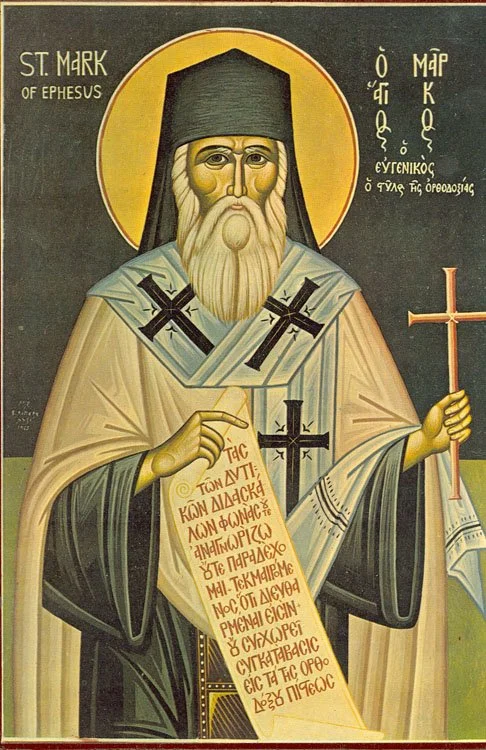
Saint Mark of Ephesus (Mark Eugenikos)
c. 1392–1444 • Commemorated January 19Mark Eugenikos, Metropolitan of Ephesus, arrived at Ferrara as one of the Byzantine Church’s most respected theologians and departed from Florence as the only Orthodox bishop who refused to place his signature on the union decree. Throughout the council’s theological debates, Mark argued that the Latin position on the filioque, on purgatory, and above all on papal primacy could not be reconciled with the patristic tradition the Orthodox Church had received. He was not a fringe voice shouting from the margins — he was one of the council’s principal Orthodox theologians, and his refusal to sign, after everyone else present had, was a deliberate and costly act.
According to a tradition long repeated in Orthodox accounts of the council, when Pope Eugene IV was informed that every bishop had signed except Mark of Ephesus, he is said to have remarked that nothing had therefore been accomplished. Whether or not the pope used those exact words, the sentiment captures something true: Mark’s single refusal became the seed around which the entire Orthodox rejection of the union eventually crystallized. He returned to a Constantinople that had not yet heard the details of what had been signed in his name, and he spent the remaining years of his life writing treatises against the union, corresponding with fellow anti-unionist clergy including George Scholarius, and refusing every attempt to bring him back into communion with the unionist party.
Mark of Ephesus died in 1444, nine years before Constantinople fell, and did not live to see the second proclamation of the union in Hagia Sophia or the city’s destruction. He is venerated in the Orthodox Church as a defender of the faith who held the line when an emperor, a patriarchate, and nearly every bishop of his generation had already conceded it. His feast is kept on January 19. For his complete life, theology, and role at the Council of Florence, see our full biography of Saint Mark of Ephesus.
Going Home to a Union Nobody Wanted
The Greek delegation that returned from Florence discovered almost immediately that signing a union decree in Italy and imposing it on Constantinople were two entirely different projects. The clergy, monks, and lay faithful of the city, many of whom carried living memory or family memory of the Fourth Crusade’s sack two centuries earlier, treated the returning bishops less as heroes of reconciliation and more as men who had traded the faith for a promise of soldiers that had not yet arrived and might never come.
An anti-unionist party, sometimes called the Synaxis, formed around clergy and monastics who refused to accept Florence’s terms regardless of who had signed them or under what pressure. Monasteries on Mount Athos rejected the union outright. Ordinary Constantinopolitans avoided churches where unionist clergy served the liturgy. The Patriarchal throne itself became contested territory between pro-union and anti-union candidates for years afterward. The emperors who followed John VIII — first his brother John, then eventually Constantine XI — inherited a signed treaty that their own capital city refused, in practice, to live under.
This is the central, brutal irony of the entire episode: the diplomatic problem the union was supposed to solve — securing Western military aid against an existential Ottoman Muslim threat — required the Byzantine emperor to implement a policy that his own people would not accept, in a city whose historical memory of Latin Christians arriving in force was a memory of pillage, not rescue. Every emperor from John VIII onward was caught between an external threat that could only, according to Rome, be addressed through submission, and an internal population that regarded that submission as itself an existential threat to the faith they were being asked to die defending.
December 12, 1452: The Last Liturgy in Hagia Sophia
By the summer of 1452, the Ottoman Muslims under Sultan Mehmed II had completed the fortress of Rumeli Hisarı on the Bosphorus, a clear signal that the final assault on Constantinople was being prepared. Constantine XI, out of options, wrote to Pope Nicholas V promising to fully implement the Union of Florence at last, in exchange for whatever aid Rome could actually deliver. Nicholas V had already made his position plain: further military support depended on the union being made real, not merely signed thirteen years earlier and then ignored in practice. The pope specifically required that his name be commemorated in the churches of Greece and that a pro-union patriarch be reinstated.
Nicholas V dispatched Cardinal Isidore of Kiev — the same Isidore who had signed the union at Florence out of sincere conviction and later been imprisoned by Russian authorities for trying to implement it in Moscow — as papal legate to Constantinople. Isidore arrived on October 26, 1452, accompanied by the Latin Archbishop of Mytilene, Leonard of Chios, and a small force of roughly two hundred Neapolitan archers, the actual military content of the mission.
On December 12, 1452, in a ceremony inside Hagia Sophia itself — the great cathedral built by Justinian eight centuries earlier, the same cathedral Latin soldiers had looted and desecrated in 1204 — Cardinal Isidore formally proclaimed the union of the Greek and Latin Churches, in a liturgy attended by Constantine XI, the Byzantine nobility, the Venetian and Genoese colonies in the city, and a court that historians describe as accepting the act more out of desperate political necessity than theological conviction. That evening, in what would be the last Divine Liturgy ever celebrated in Hagia Sophia as a Christian church, Latins and Greeks together received the Eucharist. Many in attendance were reported to be in tears, asking forgiveness of one another, aware on some level of exactly what was closing behind them.
Most of the city’s clergy, monks, and ordinary people stayed away from that liturgy or opposed it outright, still carrying, in the words of contemporary accounts, memory of the Fourth Crusade’s sack and a conviction that submission to the “heretics and schismatics” of the West was too high a price even for survival.
Two Hundred Men: What Rome’s Second Promise Was Worth
Set the number plainly against what it was meant to answer. Sultan Mehmed II would bring a besieging force historians estimate at sixty to eighty thousand men, including a corps of roughly twelve thousand Janissaries, along with an enormous siege train built around the massive bronze cannons cast by the Hungarian engineer Orban — guns capable, for the first time in history, of breaking down the Theodosian walls that had protected Constantinople for a thousand years. Against that, the entirety of the organized military assistance tied to Rome’s demand for church union was approximately two hundred archers, brought by Cardinal Isidore, funded in part from his own resources rather than papal treasury.
Pope Nicholas V was, by most accounts, personally sympathetic to Constantinople’s plight. But he held, and communicated directly to Constantine XI, that the papacy could not organize meaningful military relief unless the union was fully implemented and his authority as pope was formally recognized in the Greek liturgies. Even setting aside whether that condition was fair, Nicholas V also privately understood something else: the papacy alone did not have the political leverage to compel the crowned heads of Western Europe into a new crusade. France and England were only recently finished exhausting each other in the Hundred Years’ War. Spain was consumed by the Reconquista. The Holy Roman Empire was fractured by internal conflict. Hungary and Poland had already tried and catastrophically failed to check the Ottoman Muslims at the Battle of Varna in 1444, an earlier crusade that ended in the death of the young Polish-Hungarian king Wladyslaw III and the destruction of the last major Western field army sent east in a generation.
Venice, for its part, offered assistance only on the condition that other Western powers joined as well — a condition that guaranteed inaction, since no other major power was prepared to commit first. Genoa’s support came not from the Republic itself but from private individuals, most notably the soldier of fortune Giovanni Giustiniani Longo, who arrived with roughly seven hundred men at his own initiative and ended up commanding the city’s land defenses — a private contractor’s contribution outweighing anything Rome or Venice organized as a matter of state policy.
The Siege of 1453
Mehmed II opened the siege on April 2, 1453, positioning his massive cannons against the Theodosian land walls that had protected Constantinople since the fifth century and had never, in a thousand years, been breached by direct assault. The Ottoman Muslim fleet blockaded the sea approaches, though the defenders managed one notable success early in the siege, sinking or driving off Ottoman Muslim ships attempting to force the boom across the Golden Horn — until Mehmed had his fleet dragged overland on greased rollers to bypass the barrier entirely, a logistical feat that stunned the defenders and effectively closed the last gap in the blockade.
Inside the walls, Constantine XI personally organized the defense alongside Giovanni Giustiniani’s Genoese troops, a mixed force of Venetians, and whatever Byzantine Orthodox soldiers and armed civilians the depleted city could muster — a defending garrison historians place at somewhere between seven and eight thousand men, stretched across nearly four miles of land and sea walls, against an Ottoman Muslim force many times that size. Days and nights of bombardment gradually opened breaches in sections of the outer wall. The defenders worked through the nights rebuilding what the cannons tore down during the day, an exhausting and unsustainable rhythm that could not continue indefinitely against an enemy that never had to sleep in shifts the way the vastly outnumbered defenders did.
Appeals continued to go out from the city throughout the siege — to Venice, to the pope, to any Western power that might still intervene. None arrived in time. No relief fleet came. No relief army marched. The two hundred archers Isidore had brought the previous October, and Giustiniani’s several hundred Genoese volunteers, remained the entire extent of organized Western manpower present when the final assault came.
The Roman Catholics were begged, repeatedly and to the last possible hour, to protect the Orthodox Christians of Constantinople and the Hagia Sophia itself. They chose not to. They let the city fall to the Muslim invaders. Today, because of that choice, Hagia Sophia is a mosque.
May 29, 1453: The Fall
In the early hours of May 29, 1453, Mehmed II launched his final assault, throwing wave after wave against the walls — first irregular troops, then Anatolian regulars, and finally his elite Janissary corps, roughly twelve thousand strong, against the exhausted defenders. Giovanni Giustiniani, commanding the critical section of wall near the St. Romanus Gate, was severely wounded and had to be carried from the field. His departure, whether from the wound itself or the panic it triggered among his Genoese troops, opened a gap in the defense at the exact moment the Ottoman Muslims needed one.
Compounding the collapse, a small postern gate known as the Kerkoporta had apparently been left unlocked or was forced open, and Ottoman Muslim soldiers began pouring through it into the city while the main walls were still contested elsewhere. Within hours the defense disintegrated. Constantine XI, according to the most credible contemporary accounts, tore off his imperial regalia so as not to be recognized and captured alive, and threw himself into the fighting at the breach alongside his remaining soldiers. His body was never conclusively identified afterward. The last Roman emperor, ruling from the last fragment of an empire that had endured for over a thousand years since Constantine the Great, died anonymously in the chaos of his own city’s final hours, sword in hand, rather than survive its capture.
What Happened to the People
Under the conventions of siege warfare in the period, a city taken by storm after refusing surrender was subject to sack, and Mehmed II permitted his troops three days of plunder, though he cut the sack short after a single day once he entered the city and moved quickly to secure it as his new capital. Even in that compressed window, the destruction was severe. Muslim Ottoman soldiers looted churches, monasteries, and private homes. Thousands of Orthodox lay residents were killed in the initial chaos of the breach and the fighting that followed, and thousands more were taken captive and enslaved, a standard and expected consequence of a besieged city’s fall in this era, on every side of every conflict, not unique to the Ottoman Muslims, and not meaningfully different in kind from what Constantinople had already suffered once before, in 1204, at the hands of fellow Christians, the Roman Catholics.
Contemporary and near-contemporary accounts describe crowds of Constantinopolitans, including many who had refused the union just months earlier, fleeing to Hagia Sophia in the final hours, apparently believing or hoping that an old prophecy held the cathedral would be miraculously defended by an angel once the enemy reached the Column of Constantine nearby. No angel came. Ottoman Muslim soldiers broke down the cathedral’s doors and took the congregation captive along with everyone else sheltering inside. Hagia Sophia, the site of the last union liturgy just five months earlier, the greatest church in Christendom for nine centuries, was converted into a mosque within days of the conquest, a transformation that has remained, in one form or another, the subject of dispute and controversy into the present day.
Mehmed II, once the initial sack subsided, worked quickly to repopulate and rebuild the city as Istanbul, his new imperial capital, offering incentives for Christians, Jews, and Muslims from across his empire to resettle there. Constantinople the Orthodox Byzantine capital was gone. Istanbul the Muslim Ottoman capital had begun.
Constantine XI: Uniate, Martyr, or Both
Constantine XI presents a genuinely uncomfortable question. He allowed the Union of Florence to be proclaimed again in Hagia Sophia in December 1452. He reportedly received the Eucharist from Cardinal Isidore’s hands hours before the final assault began. He never, in any recorded statement before his death, repudiated the union he had permitted. By the strict terms of what he outwardly professed and practiced in his final months, he died in communion with Rome, and some historians and Eastern Catholic writers have on that basis referred to him as having died a Greek Catholic.
And yet the Orthodox people of Constantinople and the wider Greek world never treated him as a traitor to their faith. No anti-unionist chronicler of the period accused him of being “Latin-minded” in the way they readily condemned other pro-union clergy and officials. He is remembered in Greek historical memory overwhelmingly as a hero and a martyr-emperor, the last Roman, who chose to die fighting at the wall rather than flee the city he could not save. Many Orthodox Christians today informally venerate him as an ethnomartyr — one who died for the nation and the faith together — even though the Orthodox Church has never officially canonized him. Political reality under four centuries of Ottoman Muslim rule made any formal glorification of a fallen emperor a dangerous act the Church was in no position to undertake, and the question has never been definitively revisited since.
Whether Constantine XI’s acceptance of union under total military desperation constitutes genuine apostasy from Orthodoxy, a forgivable act of political necessity, or something that defies the neat categories entirely, is a question this article poses rather than resolves. It is precisely the kind of question the entire Union of Florence created and never actually answered for anyone forced to live inside it — an emperor whose empire had already been broken once by the same power now asking him to submit to it a second time in exchange for help it would not fully deliver.
Gennadius Scholarius and the Verdict of History
Perhaps the single most telling detail in this entire history comes after the fall, in the choice Mehmed II himself made about who would lead the surviving Orthodox Church under his new rule. The sultan installed George Scholarius — who took the monastic name Gennadius and had been, alongside Mark of Ephesus, one of the leading anti-unionist voices at and after the Council of Florence — as the first Patriarch of Constantinople under Ottoman Muslim sovereignty.
This was not an accident or a gesture of religious tolerance for its own sake. It was calculated statecraft. Mehmed II and the sultans who followed him understood clearly that anti-unionist Orthodox clergy, precisely because they rejected any dependence on or loyalty to Rome, would never appeal to Western Roman Catholic powers for military intervention on the Church’s behalf. By deliberately elevating anti-union bishops into positions of ecclesiastical leadership across the conquered Byzantine territories, the Ottoman Muslims effectively severed any remaining institutional link between their new Orthodox subjects and the Latin West that might otherwise have provided a pretext for future crusades.
The Union of Florence, signed in 1439 and proclaimed a second time in 1452, has never been implemented by the Orthodox Church in the nearly six centuries since. It remains, formally, a rejected agreement — a treaty two emperors accepted and an entire Christian people refused to live under, in the years when living under it might have meant real Western soldiers on the walls, and in the centuries since when the question became purely theological rather than existential.
What Rome Got. What Constantinople Lost. Twice.
Lay the whole story end to end and the pattern is not subtle. In 1204, an army carrying the cross, called to fight Islam, instead attacked and destroyed the wealthiest Christian city on earth, looting nine centuries of treasure, breaking the empire that had held Christendom’s eastern frontier for eight hundred years, and installing a Latin ruler in Hagia Sophia over the wreckage. That empire never recovered the strength it lost in those three days. Two and a half centuries later, the crippled successor of that same empire, facing the Ottoman Muslim power that Rome’s own Crusade had helped create the conditions for, was told that its survival depended on formally submitting its Church to the very authority whose army had broken it in the first place. It agreed. Twice. In 1439 and again in 1452. In exchange, over the intervening years, Rome successfully organized and delivered a single cardinal, roughly two hundred archers paid partly from his own funds, and the private initiative of a Genoese soldier of fortune acting on his own account rather than his republic’s.
Constantinople lost its emperor, its independence, its cathedral, thousands of its people killed or enslaved in a matter of days — for the second time in two hundred and fifty years — and its status as the capital of Eastern Christendom, a status it would never hold again. Whether Rome’s failure to deliver more meaningful aid in the fifteenth century reflected genuine institutional incapacity in a fractured, war-exhausted Western Europe, or a deeper unwillingness to expend real resources on an Eastern Church whose doctrinal submission had already been extracted on paper, is a question historians continue to debate honestly and without a settled consensus. What is not in dispute is the sequence of events, start to finish: Rome’s own Roman Catholic Crusaders broke the Orthodox Christian empire first. Roman Catholic Rome then demanded that broken Orthodox Christian empire submit doctrinally as the price of the help it needed to survive the approaching Muslim invaders, what that same breaking had helped make possible. The Orthodox Christian empire submitted to the Roman Catholics and agreed to end the schism and become unified. And the “help,” when it came at all, was an embarrassingly disrespectful two hundred men against eighty thousand Muslims.

For readers who want to go deeper into the broader sweep of Eastern Christian history that produced this moment — the schism, the empire, and everything that came after 1453 — the following is a well-regarded starting point for further reading.
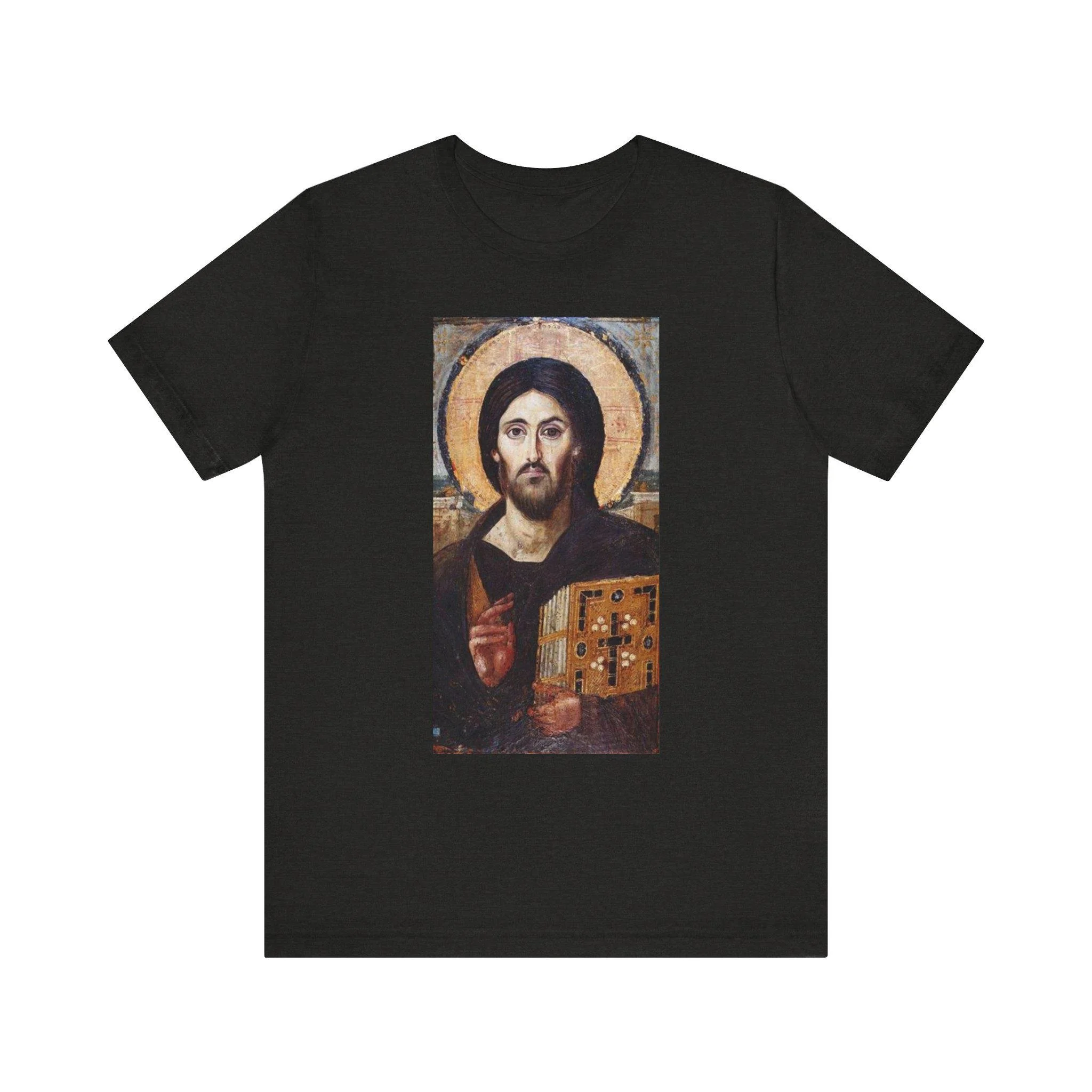
Prayers to Saint Mark of Ephesus
For Saint Mark, Archbishop of Ephesus, Defender of Orthodoxy
Instructed in the divine oracles from thy youth, O all-wise Mark, thou didst show thyself an inspired vessel of the All-Holy Spirit, refuting all falsehood and confirming the true doctrines of piety. Wherefore, having preserved the flock of Christ from the wolves, thou wast rightly glorified as a rule of faith. O Father, entreat Christ God to grant us great mercy.
A traditional Orthodox troparion. Consult your parish priest or spiritual father for the fullest liturgical text used in your jurisdiction.
Complete Timeline: The Fourth Crusade to the Fall
- November 1202 Roman Crusaders sack Zara, a Roman Catholic city, to pay off debt to Venice; Pope Innocent III excommunicates them, then lifts the sentence.
- 1203 Roman Crusader fleet diverts to Constantinople on Alexios IV’s promise of money, troops, and church union with Rome.
- April 12–15, 1204 Roman Crusaders sack Constantinople; Hagia Sophia desecrated; the Byzantine Empire permanently weakened.
- May 16, 1204 Baldwin of Flanders crowned first Latin Emperor of Constantinople in Hagia Sophia.
- 1261 Michael VIII Palaiologos recaptures Constantinople for Orthodox Byzantium, ending the Latin Empire but not restoring the empire’s former strength.
- 1369 Emperor John V Palaiologos converts to Roman Catholicism privately in Rome seeking aid; no meaningful support follows.
- 1430 Ottoman Muslims capture Thessaloniki, the empire’s second city.
- 1438–1439 Council of Ferrara-Florence convenes; roughly 700 Byzantine delegates attend at papal expense.
- July 6, 1439 Bull Laetentur Caeli proclaims union; Mark of Ephesus is the only bishop who refuses to sign.
- 1444 Crusade of Varna, the West’s last major field army sent east, is destroyed; Saint Mark of Ephesus dies.
- 1449 Constantine XI crowned emperor at Mistra.
- Summer 1452 Ottoman Muslims complete the fortress of Rumeli Hisarı; Constantine writes to Pope Nicholas V pledging full union.
- October 26, 1452 Cardinal Isidore of Kiev arrives with roughly 200 Neapolitan archers.
- December 12, 1452 Union proclaimed again in Hagia Sophia; Latins and Greeks receive communion together for the last time.
- April 2, 1453 Siege of Constantinople begins.
- May 29, 1453 Constantinople falls; Constantine XI dies in the fighting; the Byzantine Empire ends.
- 1454 Sultan Mehmed II installs the anti-unionist Gennadius Scholarius as the first Patriarch of Constantinople under Ottoman Muslim rule.
- 2004 Pope John Paul II formally apologizes for the 1204 sack, 800 years later; Ecumenical Patriarch Bartholomew I accepts.
Frequently Asked Questions
Rome Broke the Empire in 1204. Rome Priced Its Rescue in 1439. The City Fell Anyway.
This is not a story about a single betrayal. It is a story about the same pattern twice. In 1204, an army carrying the cross broke the empire that stood between the Ottoman Muslims and Europe, looting it so thoroughly that it never recovered the strength to defend itself again. Two and a half centuries later, that same empire, having nowhere else to turn, agreed to submit its Church to the authority whose Roman Crusaders had done the breaking — and received, in exchange, two hundred archers. Rome got the union it demanded on paper, twice. Constantinople got an emperor dead in the street, a cathedral turned into a mosque, and an empire erased from the map, twice.
Saint Mark of Ephesus refused to sign what everyone around him signed, and history vindicated the refusal in the cruelest possible way: not because the union brought disaster by itself, but because it delivered nothing at all in exchange for what it cost, from a power that had already taken everything it wanted once before. Carry his memory, and carry the Jesus Prayer that Byzantine Christians whispered through eleven centuries of schism, siege, and finally defeat — not as decoration, but as the same plea for mercy that rose from Hagia Sophia in 1204 and again from the walls of Constantinople on the morning of May 29, 1453.