Fools for Christ (Holy Fools): history, meaning and the saints who embraced holy foolishness
What it means to be a fool for Christ
Sure. Here’s a greatly expanded version that you can drop directly into your article. I kept it dense, theological, historical, and spiritual, not surface-level.
In the New Testament, the Apostle Paul delivers one of Christianity’s most paradoxical teachings when he writes: “If anyone among you thinks that he is wise in this age, let him become a fool that he may become wise. For the wisdom of this world is foolishness with God” (First Epistle to the Corinthians 3:18–19). Paul is not offering poetic exaggeration. He is describing a radical inversion of values. The Christian life, from its very foundation, stands in direct opposition to the systems of honor, success, power, and reputation that govern human society.
To follow Christ is to accept misunderstanding. It is to relinquish control over how one is perceived. It is to embrace humility so complete that it appears irrational to the world. Paul himself lived this reality. He was beaten, imprisoned, mocked, and treated as refuse, yet he considered these losses gains. He understood that divine wisdom is not discovered through intellectual achievement or social status, but through surrender, obedience, and self-emptying love.
Eastern Christianity took this teaching with literal seriousness.
Out of this Pauline foundation emerged one of the most startling spiritual vocations in Christian history: holy foolishness. Known in Greek as salos and in Russian as yurodstvo, the Fool for Christ deliberately adopts the outward appearance of madness in order to live the Gospel without compromise. These men and women did not merely practice humility privately. They weaponized it publicly. They chose ridicule over respect. They chose invisibility over influence. They chose shame over comfort.
Holy fools renounced ordinary social identities. Many abandoned careers, families, and possessions. They wandered cities barefoot in winter, wore rags or nothing at all, slept in streets or church porches, spoke in riddles, shouted prophetic warnings, and behaved in ways that made them objects of laughter or disgust. Some pretended to be drunk. Others hurled stones at themselves or performed strange symbolic acts. Nearly all accepted abuse silently. They allowed themselves to be beaten, mocked, and dismissed as mentally unstable.
This was not random eccentricity.
It was intentional spiritual warfare.
By appearing insane, they avoided praise. By becoming contemptible, they escaped vanity. By breaking social conventions, they exposed hypocrisy. Their strange behavior stripped away polite religious masks and confronted people with uncomfortable truth. Kings were rebuked. Clergy were corrected. Merchants were shamed for greed. The powerful were reminded of death. The comfortable were reminded of judgment.
At the same time, their apparent madness concealed a hidden interior life of extreme asceticism and ceaseless prayer. Most spent long nights in vigil. Many secretly fasted for days. Some practiced interior prayer constantly while outwardly performing foolish antics. Their humiliation protected their humility. Their disguise guarded their intimacy with God.
Holy foolishness became a living icon of Christ Himself.
Jesus was mocked, spat upon, crowned with thorns, stripped naked, and executed as a criminal. He was called possessed, insane, and dangerous. The Fool for Christ consciously imitates this pattern. Just as Christ concealed divine glory beneath suffering flesh, the holy fool conceals spiritual authority beneath disgrace.
In Orthodox spirituality, this vocation is understood as one of the highest and most dangerous paths. It requires profound discernment, spiritual maturity, and divine calling. It is never self-appointed. Many fools for Christ lived quietly in monasteries before being commanded by spiritual elders or inner revelation to take up this public cross. Without deep humility and obedience, such a path would destroy a person psychologically and spiritually.
Historically, holy foolishness appears first in the early Byzantine world, with figures like Symeon of Emesa in the sixth century, and later flourished especially in Russia between the fourteenth and nineteenth centuries. Russian society, with its strong sacramental worldview and reverence for suffering saints, proved uniquely receptive to this form of witness. Holy fools became part of the spiritual fabric of cities. People sought their prayers. Merchants asked their blessings. Mothers brought sick children to them. Even tsars sometimes trembled at their words.
After their deaths, many were revealed to be prophets, healers, and miracle-workers. Their relics became pilgrimage sites. Their cryptic sayings were remembered as spiritual instruction. What had once looked like madness was understood, in hindsight, as profound wisdom.
The Fool for Christ stands as a permanent rebuke to comfortable Christianity.
They remind the Church that holiness is not respectability. That spiritual authority does not come from titles. That God often hides His greatest servants beneath the appearance of weakness. They expose the lie that faith can be domesticated or made socially acceptable. Their lives declare that the Gospel is not a lifestyle accessory. It is a total surrender.
This article explores the spiritual meaning of holy foolishness and presents detailed biographies of the most well-known Fools for Christ. The goal is not merely historical documentation, but spiritual understanding. Each life reveals a different facet of this radical vocation: how these saints entered holy foolishness, how they behaved in public, what distinguished their witness, and how God confirmed their sanctity through miracles, prophecy, and enduring devotion.
The list that follows is not fully exhaustive. Many locally venerated fools are sparsely documented, especially women and rural ascetics whose stories were preserved only through oral tradition. However, this survey aims to cover the major saints across Greek, Russian, Georgian, and related Eastern Christian traditions, offering the most complete picture possible of this extraordinary category of holiness.
What emerges is a single, consistent message across centuries and cultures:
To become wise in Christ, one must first become a fool.
And sometimes, that foolishness changes the world.
Early Byzantine and Near‑Eastern holy fools
Symeon of Emesa (6th century)
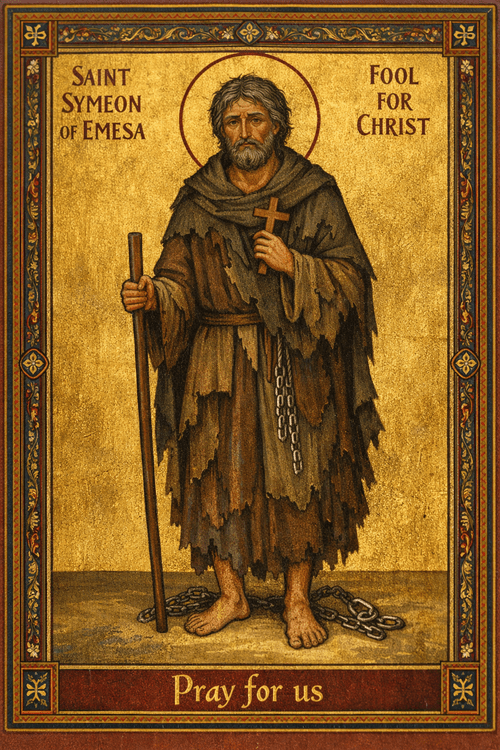

Early life and the long desert formation
Symeon was born into a wealthy Christian family in Syria during the early sixth century. From a worldly perspective, he had access to education, comfort, and social standing, yet from an early age he felt drawn toward radical discipleship rather than prosperity. Together with his close friend John the Hermit, he renounced inheritance and entered monastic life, seeking a path that would strip away every attachment except God.
After a brief period in communal monasticism, the two companions withdrew entirely into the desert. There they lived as hermits for nearly twenty nine years, practicing extreme asceticism through fasting, vigils, silence, and continuous prayer. Their lives were hidden, severe, and disciplined, marked by long nights of watchfulness and days of manual labor. This was not a romantic retreat but a prolonged interior crucifixion, where ego, ambition, and self identity were steadily dismantled.
These decades in solitude are essential for understanding Symeon’s later ministry. Holy foolishness does not arise from impulse or instability. It emerges only after deep purification, when a soul has learned obedience, humility, and discernment in obscurity.
Near the end of this desert period, Symeon and John prayed together, asking God whether they should remain in contemplation or return to serve people directly. According to tradition, they drew lots to discern divine will. John was instructed to remain in the wilderness, while Symeon was commanded to return to the world.
Symeon wept openly.
He understood that leaving the desert meant entering spiritual danger. Cities bring temptation, misunderstanding, praise, and distraction, yet in obedience he accepted the calling, knowing that God sometimes sends His servants back into chaos for the sake of others.
Entering Emesa and embracing deliberate disgrace
Symeon traveled to Emesa, now modern Homs, and immediately adopted behavior designed to annihilate any possibility of admiration. He did not arrive preaching repentance or performing visible miracles. Instead, he began acting like someone completely deranged.
His first public act was dragging a dead dog through the marketplace by its leg. He disrupted church services by extinguishing lamps during vigils, threw nuts at women, overturned tables, ran through streets half naked, and pretended drunkenness in taverns. He allowed children to beat him, accepted insults without defense, and spoke in riddles that appeared nonsensical.
To everyone watching, Symeon was simply mad.
In reality, every action was calculated.
By presenting himself as contemptible, he shielded his inner life from pride and protected himself from praise. By behaving foolishly, he gained access to places unreachable by conventional religious authority. Taverns, brothels, and criminal spaces opened to him because no one guarded themselves around a fool. This gave him proximity to sinners who would never approach a respected monk or priest.
Behind closed doors, Symeon lived an entirely different existence. He secretly fed the poor, paid debts for those in distress, healed the sick through prayer, reconciled broken marriages, and intervened to save adulterers from execution. He moved quietly through the city performing works of mercy that no one attributed to him.
His apparent chaos concealed intense prayer.
His mockery hid compassion.
His disgrace protected holiness.
Prophetic discernment hidden beneath madness
Symeon possessed extraordinary spiritual insight and frequently revealed people’s hidden sins or intentions, though always in ways that preserved his disguise. Rather than preaching directly, he exposed hypocrisy through symbolic actions. When merchants cheated customers, he disrupted their stalls. When citizens grew spiritually complacent, he staged shocking antics that forced uncomfortable reflection.
He also worked miracles, though he immediately buried them beneath foolish behavior. On one occasion his prayers saved a child who was choking. On others he healed illnesses, cast out demons, and foretold future events that unfolded exactly as spoken. Yet whenever people began suspecting sanctity, he intensified his outward madness to destroy their expectations.
This is a defining trait of the Fool for Christ.
They do not merely tolerate humiliation.
They actively seek it.
Symeon even pretended to commit sins he secretly abhorred, solely to preserve humility and avoid spiritual danger. His goal was never reputation. His goal was repentance, both his own and that of others.
Those who encountered him privately described him as gentle, penetrating, and filled with divine clarity. Those who encountered him publicly saw only chaos. This double life allowed Symeon to move freely between heaven and street corners, between prayer and provocation, between solitude and service.
Death in obscurity and posthumous revelation
After approximately twenty years of living as a holy fool, Symeon sensed his death approaching. One day he quietly lay down near the city gate and began praying, unnoticed by the crowds who passed him daily. There were no attendants and no solemn witnesses, only another apparent episode of madness in the eyes of the city.
He died alone in prayer.
Still believing him insane, locals threw his body onto a dung heap rather than offering burial. It was only when a possessed man suddenly cried out, proclaiming Symeon’s sanctity, that the people realized what they had done. Stricken with fear and remorse, they retrieved his body and buried him honorably.
Immediately, miracles began occurring at his tomb.
Only after his death did Emesa understand who had lived among them. The man they mocked had been their intercessor. The fool they ignored had been their protector. The lunatic they dismissed had quietly carried their sins before God.
Symeon’s life stands as one of the clearest expressions of holy foolishness in Christian history. He reveals that true wisdom often wears the mask of madness, and that God’s greatest servants sometimes walk unnoticed through city streets, bearing ridicule so others might find mercy.
Thomas the Fool of Syria (6th–7th century)
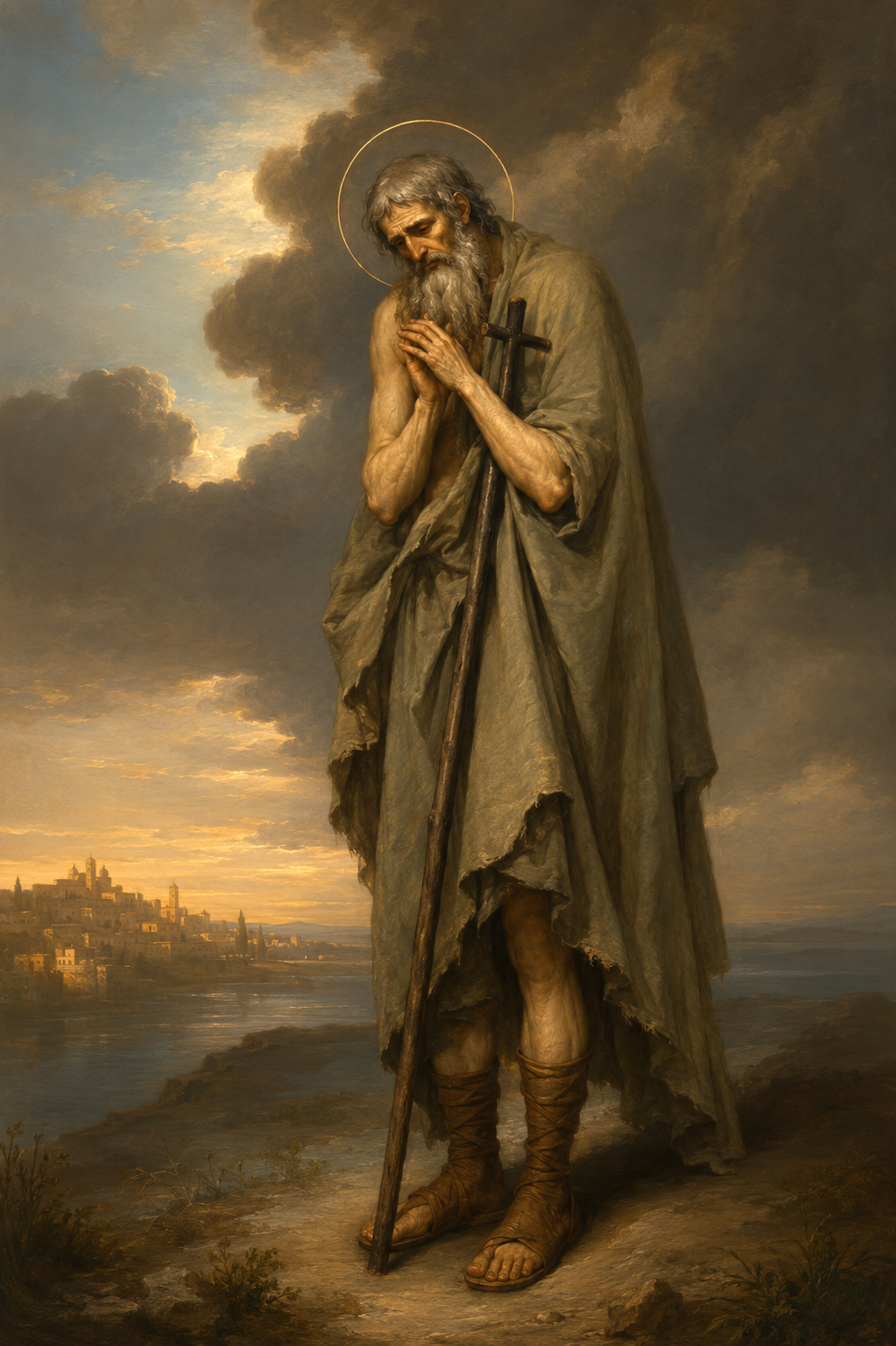
Fool for Christ | Hidden Ascetic | Witness of Radical Humility
Saint Thomas the Fool of Syria is one of the earliest hidden saints of the Christian East, especially sought by those crying out for deliverance from extreme poverty, spiritual clarity during deep confusion, and peace during emotional collapse and despair.
Living as a holy fool in the deserts and towns of ancient Syria, Saint Thomas deliberately erased himself from society, embracing ridicule, hunger, and obscurity so completely that history barely remembers his earthly details. Yet heaven remembers him clearly. Through radical humility and hidden prayer, he became a quiet intercessor for the broken, carrying unseen burdens before God.
His feast is traditionally commemorated on July 6. To this day, the faithful turn to Saint Thomas when life feels stripped bare, when the soul feels lost, and when only God’s mercy can restore hope.
This handmade prayer card honors his vanished holiness with museum-quality craftsmanship, created for prayer in moments of desperation and silence. It is not merely devotional art. It is a spiritual heirloom.
Early life and monastic obedience
Thomas was born in Syria sometime during the late sixth century and entered monastic life while still young, eventually joining a monastery in Cappadocia. From the beginning, he distinguished himself not through dramatic ascetic feats but through extraordinary compassion. He was obedient, quiet, and deeply attentive to the suffering of others, particularly the poor and forgotten.
Within the monastery, Thomas was assigned the role of almoner, placing him in charge of distributing food and charity to those in need. Rather than rationing assistance cautiously, Thomas gave with reckless generosity. He routinely emptied storehouses to feed the hungry, clothing the destitute and providing for widows and orphans without regard for institutional preservation.
His charity was not inefficient.
It was absolute.
Thomas believed that anything held back from the poor was already stolen from Christ. As a result, he frequently exhausted the monastery’s provisions, prioritizing human suffering over administrative order. While his actions sprang from genuine love, they created tension among the brethren, who worried about sustainability and discipline.
Eventually, his superiors concluded that Thomas was too disruptive to remain.
He was ordered to leave the monastery.
Rather than resisting, Thomas accepted this expulsion in silence. He gathered nothing for himself and departed without bitterness, seeing the rejection as another step in obedience.
Arrival in Antioch and adoption of holy foolishness
After leaving Cappadocia, Thomas traveled to Antioch, one of the great cities of the Christian world at the time. There, having already tasted rejection and humiliation, Thomas embraced the vocation of holy foolishness.
Like other Fools for Christ, he deliberately concealed his spiritual depth beneath behavior that appeared irrational. He pretended insanity, wandered the streets, spoke cryptically, and gave away whatever money or food came into his possession. People saw only a harmless madman. Few suspected that he was living a life of constant prayer and inner vigilance.
Thomas made no attempt to defend himself from ridicule. He allowed mockery to become his cloak. By appearing unstable, he avoided praise. By embracing shame, he protected humility.
Yet beneath this outward disorder, Thomas functioned as a prophetic presence within Antioch.
He fearlessly confronted injustice, exposed greed, and warned individuals of approaching judgment. His words often appeared nonsensical at first, but later proved precise. His foolishness gave him freedom to speak truth where respected clergy could not.
Prophecy, discernment, and confrontation with corruption
One of the most well-known episodes from Thomas’ life involved a steward named Anastasius, who had hoarded grain during a period of scarcity while the poor starved. Thomas publicly rebuked him and foretold his death, declaring that Anastasius would soon answer for his cruelty.
The steward dismissed Thomas as insane.
Shortly afterward, Anastasius died exactly as Thomas had predicted.
This event deeply unsettled Antioch. People who had ignored Thomas began to reconsider him. Some repented. Others grew fearful. Thomas, however, responded by intensifying his foolish behavior, refusing to allow prophetic accuracy to turn into admiration.
Like Symeon of Emesa, Thomas intentionally destroyed any growing reputation. Whenever people began to treat him with respect, he acted more erratically. His goal was never recognition. His goal was repentance, both his own and that of others.
He continued distributing alms indiscriminately, even when it meant he went hungry himself. He prayed quietly for the sick. He warned sinners in cryptic phrases. He walked unnoticed among beggars while carrying the burdens of the city in prayer.
Death, relics, and deliverance of Antioch
Thomas eventually died in obscurity, still regarded by many as a harmless madman. Only after his passing did the depth of his sanctity begin to emerge.
His relics soon became a source of healing, with numerous reports of illnesses cured through prayer at his resting place. Even more dramatically, when Antioch was later struck by a devastating plague, the faithful carried Thomas’ relics in procession through the city. According to tradition, the epidemic ceased shortly afterward, and Antioch credited Thomas’ intercession with their deliverance.
The man expelled from his monastery for excessive charity became the unseen protector of a major Christian city.
Thomas’ life reveals a quieter form of holy foolishness than Symeon’s, yet no less radical. His path was marked less by shocking antics and more by relentless generosity, prophetic courage, and complete detachment from reputation. He demonstrates that holy foolishness does not always roar through marketplaces. Sometimes it walks silently through streets, emptying its pockets for strangers and whispering warnings that echo only after death.
Thomas stands as a witness to the spiritual power of surrender. He shows that when a soul relinquishes control, comfort, and credibility for Christ, God can work through even the most disregarded lives to bring healing to entire cities.
Isidora (Isidore) the Fool of Tabenna (4th century)
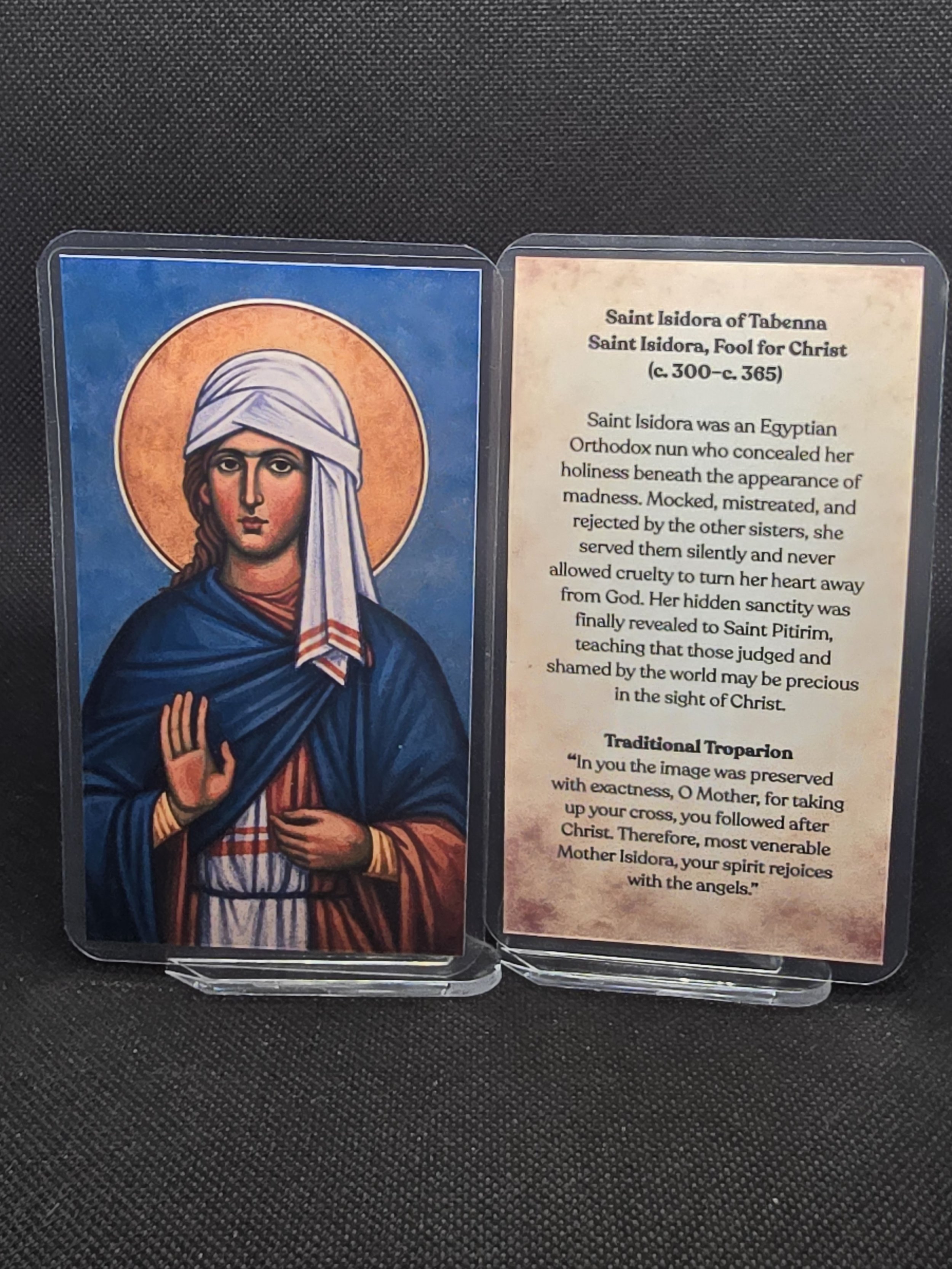
Holy Fool for Christ | Desert Ascetic | Hidden Saint of Humility
Saint Isidora of Tabenna was a Coptic Christian nun of fourth-century Egypt whose holiness was concealed beneath mockery, misunderstanding, and deliberate humiliation.
She lived inside a women’s monastery at Tabenna, founded under the rule of Saint Pachomius the Great, within the early Coptic Orthodox tradition that shaped Egyptian desert monasticism. While the other sisters followed structured ascetic discipline, Isidora chose a far more hidden path. She intentionally presented herself as mentally unstable and spiritually useless, allowing herself to be treated as a servant, a fool, and an outcast within her own community.
She cleaned floors.
She washed dishes.
She accepted scraps of food.
The other nuns mocked her openly. Some struck her. Others cursed her. She was excluded from communal meals and prayers, treated as a burden rather than a sister. Isidora never defended herself. She never explained. She never asked to be understood.
She absorbed humiliation as prayer.
Her entire spiritual life was built on radical humility, self-emptying, and silent endurance. While the world around her interpreted her behavior as madness, Isidora was quietly offering every insult and rejection to God, stripping herself of ego so completely that nothing remained but obedience and love.
Her sanctity remained hidden until Saint Pitirim of Scetis was divinely instructed to visit the monastery. Upon seeing Isidora, he immediately recognized her as a great saint and bowed before her. When the other sisters protested, he rebuked them sharply, revealing that the woman they had despised was far spiritually superior to them all.
Only then did they understand.
Overwhelmed with repentance, the sisters begged Isidora for forgiveness. She quietly left the monastery soon afterward, desiring once again to remain unknown.
Her feast is commemorated on May 10 (May 23 on the Old Calendar).
Today, Saint Isidora is sought by those suffering under mental health stigma, those crushed by shame or rejection, and those struggling with spiritual pride or invisibility. She is especially prayed to by people who feel misunderstood, judged, or discarded, and by those carrying emotional wounds from being treated as “less than.”
This prayer card honors her hidden sanctity and her courage to disappear so Christ could be revealed.
Each card is handmade in Austin and created to order. We do not keep stock, because every prayer card is treated as a unique devotional offering. They are printed on museum-quality photo paper, not cardstock, and each one is made during prayer. The saints are venerated throughout the entire process, and prayers are intentionally offered for the person who will receive the card. These are not mass-produced items. They are created slowly, reverently, and with spiritual intention, because every soul and every prayer matters.
Hidden holiness in the desert monasteries of Egypt
Isidora lived during the fourth century, a period when Egyptian monasticism was flourishing and the deserts were filling with ascetics seeking radical union with God. She entered the women’s monastery of Tabenna, a community associated with the Pachomian tradition, where communal discipline, obedience, and manual labor shaped daily life.
From the beginning, Isidora chose the lowest possible place.
Rather than pursuing visible ascetic feats, she deliberately embraced humiliation. She dressed in torn rags instead of the proper monastic habit and wrapped a filthy cloth around her head, giving the appearance of mental instability. She volunteered for the most degrading chores, cleaning latrines, sweeping refuse, and serving in the kitchen. She drank leftover dishwater and ate scraps discarded by others. When insulted or mocked, she responded with silence. When struck or verbally abused, she offered no defense.
To the other nuns, she was not merely strange.
She was considered possessed or mentally broken.
They treated her with contempt, assigning her the most unpleasant tasks and using her as an outlet for irritation and frustration. She was excluded from meals, spoken to harshly, and regarded as a burden on the community. Yet Isidora accepted every humiliation without resistance, turning each insult into prayer and each rejection into an offering.
Her outward behavior concealed an interior life of deep communion with God.
Revelation through divine intervention
Isidora’s hidden sanctity might have remained unknown had God not intervened directly. A hermit named Pitirim received a divine vision revealing that one of the women in the monastery of Tabenna possessed extraordinary holiness. He was instructed to go and meet her.
When Pitirim arrived, the abbess brought all the sisters before him. As each nun passed, he shook his head, sensing that none matched the revelation he had received. Finally, Isidora was summoned. She approached shyly, still wearing her filthy head covering, still appearing deranged.
At that moment, Pitirim fell to the ground in prostration before her.
The monastery was stunned.
The sisters were horrified, believing the holy elder had made a mistake. They protested that Isidora was disturbed and unworthy of attention. Pitirim, however, insisted that she was spiritually greater than all of them. He declared that her humility, endurance, and hidden prayer had surpassed theirs, and he begged her to intercede for him before God.
Only then did the community begin to understand.
Overwhelmed with shame, the nuns fell at Isidora’s feet, confessing how they had mocked and mistreated her. They asked her forgiveness for every insult, every act of cruelty, and every assumption they had made about her.
Isidora responded not with reproach but with quiet withdrawal.
She fled the monastery immediately.
Flight from honor and final disappearance
Like all true Fools for Christ, Isidora could not tolerate recognition. The moment her holiness became visible, she escaped. She left the monastery secretly, choosing anonymity over admiration and obscurity over honor.
Her departure was not dramatic.
It was final.
No historical record preserves where she went or how she died. Tradition holds that she reposed around the year 365, but nothing certain is known. What remains is the witness of her life and the transformation she left behind in the hearts of those who had once despised her.
Isidora’s story represents one of the earliest and purest expressions of holy foolishness. Unlike later urban Fools for Christ who confronted cities through public antics, her foolishness unfolded quietly within the walls of a monastery. Her battleground was not the marketplace but the human heart. Her warfare was waged through silence, obedience, and humiliation.
She teaches that holy foolishness does not always look dramatic.
Sometimes it looks like washing floors while being mocked.
Sometimes it looks like drinking dishwater while praying for those who insult you.
Sometimes it looks like disappearing the moment God reveals your holiness.
Isidora stands as a living rebuke to spiritual pride. She reveals that sanctity often hides beneath the forms we instinctively reject. Her life demonstrates that the lowest place, when chosen freely for Christ, becomes the highest throne in heaven.Medieval and early modern Greek and Russian holy fools
Andrew the Fool‑for‑Christ of Constantinople (10th century)
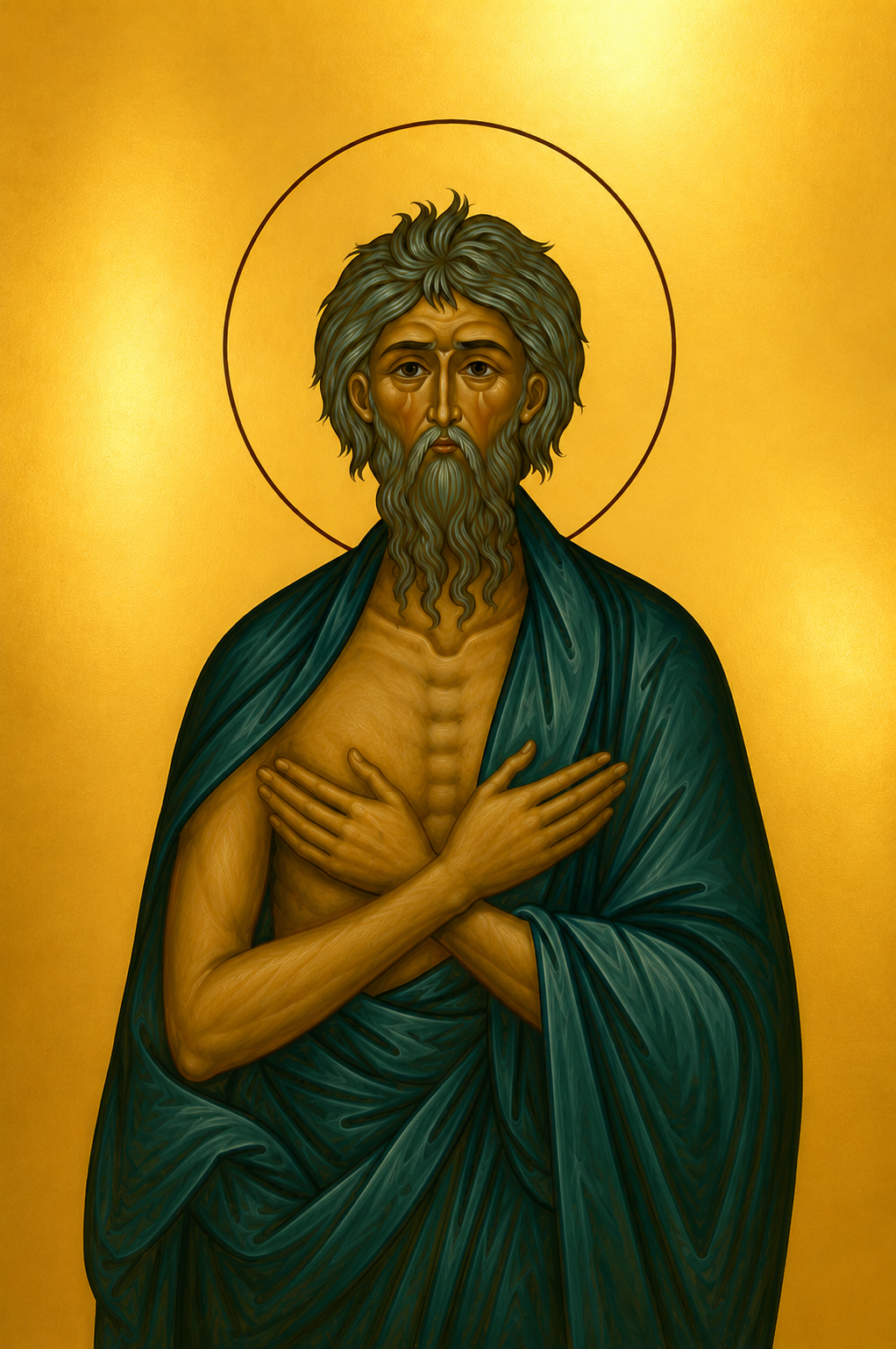
Holy Fool for Christ | Hidden Ascetic | Witness of the Theotokos
Saint Andrew the Fool-for-Christ of Constantinople is one of the Church’s most luminous hidden saints, especially sought by those crying out for protection of the home and family, deliverance from extreme poverty and homelessness, and spiritual clarity during seasons of confusion or despair.
Living as a holy fool in the streets of Istanbul, Saint Andrew embraced ridicule, hunger, and total obscurity while secretly carrying entire neighborhoods before God in prayer. He is remembered most for witnessing the miraculous appearance of the Mother of God spreading her veil over the faithful, revealing heaven’s protection over a suffering world.
His feast is traditionally commemorated on October 2 (Old Style) / October 15 (New Style). To this day, families turn to Saint Andrew when shelter feels uncertain, when finances collapse, or when only God’s mercy can restore peace.
This handmade prayer card honors his radiant hidden holiness with museum-quality craftsmanship, created for prayer in moments of fear and need. It is not merely devotional art. It is a spiritual heirloom.
From slavery to spiritual freedom
Andrew was born among the Scythian peoples and came to Constantinople not as a pilgrim or seeker, but as a slave. His early life was marked by captivity and service within the imperial capital, then the heart of the Christian world. Through his household connections he encountered the Christian faith, and after receiving instruction he was baptized, embracing Christ with a depth that quickly surpassed outward circumstance.
Although legally bound to earthly masters, Andrew inwardly discovered freedom.
As his faith deepened, he became increasingly withdrawn from ordinary concerns and developed a profound inner prayer life. Over time, he discerned a calling that few would dare to follow. Like Symeon and Isidora before him, Andrew deliberately chose the path of holy foolishness, concealing spiritual maturity beneath the appearance of madness.
He abandoned normal dress and behavior, clothed himself in rags, and wore chains to heighten the impression of insanity. He wandered the streets of Constantinople begging for food, sleeping outdoors, and accepting mockery as his daily companion. Whatever alms he received were immediately given away to those poorer than himself. He endured beatings, insults, and rejection without complaint, responding to cruelty with prayer.
To the city, he was another deranged vagrant.
To God, he was being refined through humiliation.
Life among the forgotten and hidden spiritual warfare
Andrew lived among beggars, criminals, and outcasts, moving freely through places respectable clergy rarely entered. His foolish exterior allowed him access to broken lives while protecting his own humility. He fasted secretly, prayed constantly, and maintained strict interior discipline while appearing outwardly chaotic.
Like other Fools for Christ, Andrew often behaved in strange and disruptive ways, sometimes entering homes uninvited or speaking in riddles that seemed meaningless until later events revealed their prophetic nature. He rebuked sin indirectly, exposed hypocrisy through symbolic acts, and quietly interceded for those who mistreated him.
He possessed the gift of discernment and frequently perceived people’s hidden struggles, offering guidance cloaked in absurd language. Those who encountered him privately often sensed something extraordinary beneath his madness, while those who observed him publicly saw only disorder.
Andrew never attempted to clarify the misunderstanding.
He actively preserved it.
Whenever people began treating him with reverence, he intensified his foolish behavior, ensuring that admiration could not take root. His entire life became an offering of obscurity, modeled after Christ’s own hidden suffering.
The vision of the Protection of the Mother of God
Andrew’s most enduring legacy comes from a profound spiritual vision that shaped Eastern Christian devotion for centuries.
During an all-night vigil at the Blachernae Church, Andrew stood praying among the faithful when he suddenly beheld a radiant vision of the Mary, Mother of God entering the church, surrounded by angels and saints. In the vision, she removed her veil and spread it over the gathered people as a sign of divine protection and intercession.
Andrew, overwhelmed by what he saw, turned to his disciple Epiphanius and asked whether he too could see her. When Epiphanius confirmed the vision, Andrew fell into silent awe.
This moment became the foundation for the Feast of the Protection of the Theotokos, also known as Pokrov, celebrated throughout Eastern Christianity as a testimony to Mary’s active care for the Church. The vision affirmed what Andrew’s life already proclaimed: that heaven is not distant, and that divine mercy continually surrounds those who seek God in humility.
For Andrew, this revelation was not a reward.
It was confirmation.
His hidden prayers, his suffering, and his chosen disgrace were already participating in the unseen reality of God’s kingdom.
Final years and repose
Andrew continued his life of holy foolishness until his death, never abandoning the disguise that protected his humility. He reposed around the year 936, still regarded by many as a harmless madman and by a few as a living saint.
Only after his passing did the full measure of his spiritual stature become widely recognized.
Andrew’s life demonstrates that holy foolishness is not primarily about strange behavior. It is about radical surrender. It is about choosing invisibility over honor, poverty over security, and humiliation over praise. His journey from slavery to sanctity reveals that true freedom is found not in circumstances, but in complete abandonment to God.
Andrew stands as a bridge between early Byzantine holy foolishness and its later flowering in Russia. His witness shows that God often hides His greatest servants beneath forms the world cannot understand, and that divine glory frequently travels disguised as disgrace.
Basil the Blessed of Moscow (1468 – 1557)


Early life and the call to holy foolishness
Basil was born in December 1468 in the village of Elokhovo, just outside Moscow, into a poor but devout family. As a boy, he was apprenticed to a shoemaker, where his quiet temperament and unusual sensitivity to spiritual matters quickly became apparent. Even in adolescence, Basil showed signs of prophetic insight. According to tradition, while still working in the shop he once warned a customer that his new boots would never be worn, a statement that proved true when the man died shortly afterward.
These early moments revealed that Basil possessed spiritual perception far beyond his years.
At the age of sixteen, Basil made a decisive break from ordinary life. He abandoned his trade, renounced material security, and embraced the radical vocation of holy foolishness. He began wandering Moscow barefoot in every season, even through snow and ice, wearing only rags and heavy chains. He slept in streets or church porches, fasted severely, and subjected himself to constant exposure and discomfort.
This was not youthful recklessness.
It was deliberate self-emptying.
Basil chose humiliation as his spiritual armor, believing that praise endangered the soul and that disgrace preserved humility. From that point forward, he lived as a visible contradiction to wealth, comfort, and social respectability.
Prophetic acts and fearless confrontation
Basil’s holy foolishness took dramatic and often unsettling forms. He performed shocking public actions that appeared irrational but later revealed deep spiritual meaning. These symbolic acts functioned as living prophecies, calling the city to repentance.
On one occasion, when a baker sold bread that had been improperly prepared, Basil overturned the loaves in the marketplace. People initially mocked him, assuming he was simply disruptive. Later, it became known that the bread had been adulterated in a way that endangered consumers, and Basil’s act was understood as a divine warning.
He confronted wealthy merchants who gave alms merely for reputation rather than compassion. When they offered donations with visible pride, Basil sometimes threw their gifts into the mud, exposing the vanity behind their generosity. At the same time, he quietly redirected true charity toward the genuinely poor, ensuring that help reached those who had no voice.
His boldness extended even to the throne.
Basil openly rebuked Ivan IV of Russia, criticizing the tsar for allowing his thoughts to wander during the Divine Liturgy while outwardly maintaining royal decorum. Rather than punishing Basil, Ivan accepted the rebuke, recognizing the spiritual authority hidden beneath the saint’s madness.
Basil also foretold disasters. Most famously, he predicted the great fire of Moscow, warning citizens beforehand through cryptic behavior and anguished prayer. When the catastrophe occurred exactly as he had indicated, public perception began to shift. The fool wandering barefoot through the streets was increasingly recognized as a prophet walking among them.
Despite growing respect, Basil never altered his behavior to accommodate admiration. He continued sleeping outdoors, wearing chains, and embracing ridicule. Whenever reverence threatened to arise, he intensified his foolishness, determined to remain hidden in Christ.
Miracles, clairvoyance, and spiritual authority
Throughout his life, Basil displayed gifts of clairvoyance and healing. He perceived hidden sins, warned individuals of spiritual danger, and comforted the grieving. Many sought his prayers for illness, family crises, and inner torment, often receiving relief through his intercession.
Yet Basil never allowed miracles to define him.
He redirected attention away from himself and toward repentance, constantly reminding people that external wonders meant nothing without interior transformation. His entire witness emphasized that holiness is measured not by power but by humility.
Even Moscow’s ruling elite gradually recognized his sanctity. Tsar Ivan himself reportedly assisted in carrying Basil’s coffin at his funeral, an extraordinary gesture that revealed how deeply the holy fool had penetrated the conscience of the empire.
Death and enduring legacy
Basil reposed on August 2, 1557, after decades of public humiliation freely embraced for Christ. He was buried at the Trinity Church in Moscow, which was later renamed St. Basil’s Cathedral in his honor.
The cathedral’s colorful domes, now one of the most recognizable symbols of Russia, stand as a visual echo of Basil’s life. Just as the building defies architectural convention, Basil defied spiritual complacency. His legacy endures not merely in stone but in the Orthodox understanding of holy foolishness as a prophetic vocation.
Basil the Blessed reveals the spiritual power of vulnerability. He demonstrates that truth does not require polish, that holiness does not need respectability, and that God sometimes speaks most clearly through those the world refuses to take seriously.
His life stands as a permanent challenge to comfortable faith.
He reminds every generation that the Gospel cannot be contained within social norms, and that divine wisdom often walks barefoot through city streets, wrapped in rags, carrying chains, and calling humanity back to repentance.
Saint Nicholas of Pskov (Nicholas Salos, + 1576)
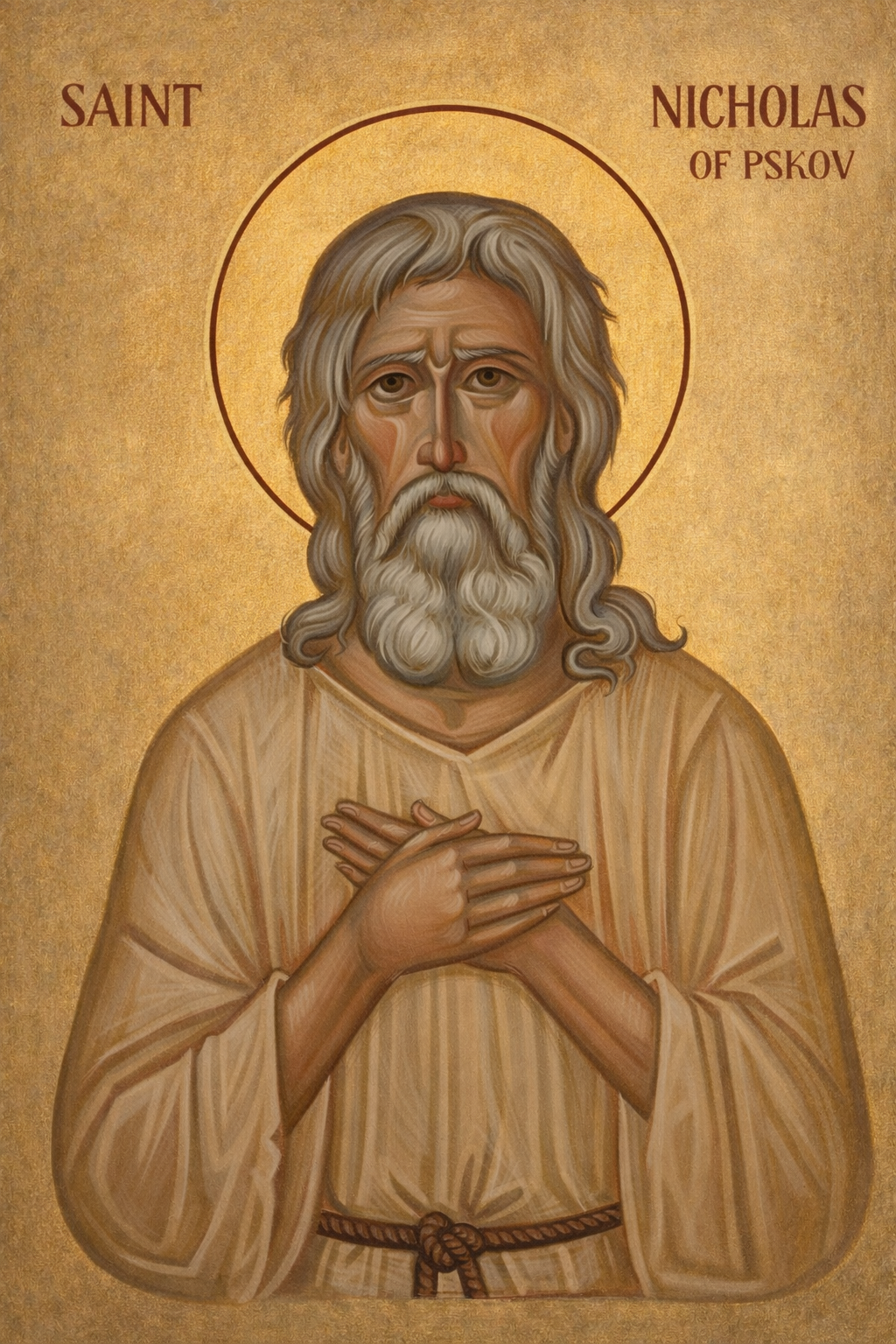
Holy Fool for Christ | Defender of the City | Prophet of Repentance
Saint Nicholas of Pskov is one of Holy Russia’s most fearless Fools-for-Christ, especially sought by those praying for protection from violent danger and disaster, peace during political or family turmoil, and deliverance from fear when life feels threatened.
Living openly among the poor of Pskov, Saint Nicholas embraced homelessness, ridicule, and radical humility while secretly carrying his entire city before God in prayer. He is remembered most for standing face-to-face with tyranny itself, boldly confronting Ivan the Terrible and turning away destruction through spiritual authority rooted in holiness.
His feast is traditionally commemorated on February 28 (Old Style) / March 13 (New Style). To this day, people turn to Saint Nicholas when danger feels close, when conflict threatens peace, or when courage is needed to face overwhelming fear.
This handmade prayer card honors his brave holiness with museum-quality craftsmanship, created for prayer in moments of crisis and kept as a reminder that God raises protectors from among the forgotten. It is not merely devotional art. It is a spiritual heirloom.
A hidden ascetic in a threatened city
Nicholas lived in the ancient city of Pskov during one of the most violent periods of Russian history. Little is known about his early life, but by adulthood he had already embraced the radical vocation of holy foolishness. For more than thirty years he wandered Pskov as a Fool for Christ, rejecting comfort, reputation, and safety in order to live entirely for God.
He walked barefoot through ice and snow, wore minimal clothing even in brutal winters, and carried a heavy wooden cross through the streets as a visible sign of repentance. Like other holy fools, Nicholas accepted mockery as his daily bread. Children taunted him. Adults dismissed him. Many assumed he was mentally unstable.
Yet beneath this appearance of madness, Nicholas lived a life of intense prayer and interior discipline.
He fasted severely, kept long night vigils, and silently interceded for the people of Pskov. His foolish exterior allowed him to move freely through every layer of society, from beggars to nobles, while preserving complete humility. Those who encountered him privately often sensed spiritual authority beneath the chaos, though Nicholas never allowed such recognition to take root.
The confrontation with Ivan IV
Nicholas’ most famous moment came in 1570, when Ivan IV of Russia arrived in Pskov during his campaign of terror against Russian cities. Ivan had already massacred thousands in Novgorod, and Pskov’s citizens fully expected the same fate. The city waited in silent dread as the tsar entered with his troops.
It was then that Nicholas stepped forward.
Ignoring soldiers, protocol, and the danger to his own life, the holy fool approached Ivan directly. Acting like a child riding a stick horse, Nicholas mocked the tsar’s power and offered him a piece of raw meat. When Ivan recoiled in disgust, Nicholas told him that this was fitting food for someone so hungry for blood.
The symbolism was unmistakable.
Nicholas accused the tsar openly of cruelty and warned him that God would judge him for innocent lives. Rather than responding with rage, Ivan reportedly trembled. He recognized something beyond ordinary madness in Nicholas’ words and demeanor. The fool who stood before him carried no fear, no flattery, and no concern for survival.
Ivan withdrew his forces.
Pskov was spared.
In that moment, holy foolishness accomplished what armies and negotiations could not. A barefoot ascetic with a wooden cross halted imperial violence through fearless truth.
Continued witness and quiet miracles
After the tsar’s departure, Nicholas returned to his ordinary pattern of life, wandering the streets, praying in secret, and embracing humiliation. He never referred to his confrontation with Ivan and made no attempt to claim credit for saving the city. His vocation remained what it had always been: hidden intercession wrapped in public disgrace.
Nicholas continued bearing insults without defense and endured physical hardship with patience. He offered guidance to those who sought him, often speaking in riddles that revealed their meaning only later. Many residents of Pskov began quietly asking for his prayers, particularly during illness or family crisis, and numerous healings were attributed to his intercession even during his lifetime.
Yet Nicholas resisted growing reverence, frequently intensifying his foolish behavior whenever people began treating him as a saint. Like all true Fools for Christ, he regarded honor as a greater danger than suffering.
Death and enduring intercession
Nicholas reposed on February 28, 1576, after decades of hidden service to his city. By the time of his death, many already regarded him as a protector of Pskov, though he himself had never accepted such titles.
After his burial, miracles began occurring at his tomb, including healings and answered prayers. The citizens who had once dismissed him as insane now venerated him as their intercessor before God. His grave became a place of pilgrimage, and his memory was preserved in the liturgical life of the Church.
Nicholas of Pskov stands as one of the clearest examples of prophetic holy foolishness in Russian history. His life reveals that God sometimes places His strongest witnesses in forms the world cannot recognize. Through voluntary humiliation, fearless truth, and relentless prayer, Nicholas transformed disgrace into deliverance.
He reminds the Church that holiness does not negotiate with power.
It confronts it.
And sometimes, it does so barefoot in the snow.
John “the Hairy” (Merciful) of Rostov († 1580)
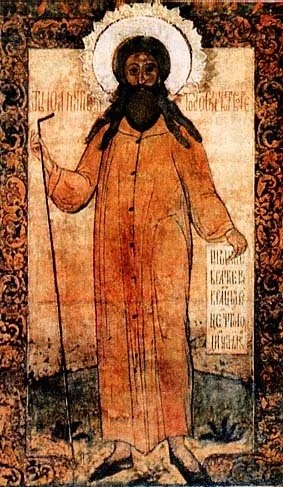
Holy Fool for Christ | Merciful Ascetic | Hidden Intercessor
Saint John the Hairy of Rostov is one of Holy Russia’s most striking hidden saints, especially sought by those crying out for deliverance from extreme poverty and homelessness, healing from emotional or mental suffering, and protection during dangerous or unstable seasons of life.
Living as a Fool-for-Christ in the ancient city of Rostov Veliky, Saint John embraced radical humiliation, cold, hunger, and complete obscurity. He wore no proper clothing, allowed his body to be covered in hair like a wild man, and wandered the streets in silent prayer. Many recoiled from him. Few realized that a powerful intercessor was walking beside them.
His feast is traditionally commemorated on May 12 (Old Style) / May 25 (New Style). To this day, the faithful turn to Saint John when shelter feels uncertain, when despair overwhelms the heart, or when only God’s protection can carry them forward.
This handmade prayer card honors his hidden holiness with museum-quality craftsmanship, created for prayer in moments of desperation and quiet endurance. It is not merely devotional art. It is a spiritual heirloom.
A hidden ascetic in the streets of Rostov
John lived in the city of Rostov Veliky during the sixteenth century, embracing a life of radical poverty and prayer that placed him among Russia’s holy fools. Almost nothing is known of his early years, which itself reflects the nature of his vocation. John deliberately erased personal history in order to belong entirely to God, allowing his life to unfold anonymously among beggars, laborers, and the forgotten.
He wandered the streets without permanent shelter, sleeping wherever night found him and accepting hunger, cold, and exhaustion as daily companions. His appearance was wild and unkempt, with long tangled hair and beard, which earned him the nickname “the Hairy.” To most citizens, he looked like another destitute vagrant. Few initially suspected that beneath this exterior lived a man of deep interior stillness and unceasing prayer.
John never attempted to correct these assumptions.
He welcomed invisibility.
His foolish exterior allowed him to pass unnoticed through every level of society while guarding his humility. He avoided conversation unless necessary and preferred silence, communicating spiritual truth more through presence than through words.
Mercy practiced in secrecy
Though John possessed almost nothing, he gave constantly. Whatever alms he received were quickly passed on to those poorer than himself, often in secret so that no one could praise him. He would slip coins into the hands of widows, leave food at doorsteps, or quietly assist families in distress before disappearing again into the streets.
He was known not for dramatic public gestures, but for steady, hidden mercy.
Unlike some Fools for Christ whose vocation involved shocking behavior or prophetic confrontation, John’s holy foolishness was quieter. His witness took the form of relentless humility, voluntary homelessness, and anonymous charity. He avoided attention whenever possible and became visibly uncomfortable if anyone attempted to honor him.
Those who encountered him privately often sensed a deep peace in his presence. Many sought his prayers, especially during illness or hardship, and began to notice that comfort and healing frequently followed his quiet intercession.
John’s life demonstrates that holy foolishness does not always announce itself loudly.
Sometimes it simply walks barefoot through ordinary streets, praying for strangers.
Refusal of honor and perseverance in obscurity
As John’s reputation slowly grew among a small circle of believers, he responded in the way characteristic of true Fools for Christ. He withdrew further into anonymity, changing where he slept, avoiding familiar faces, and intensifying his simplicity. He understood that admiration endangered the soul, while obscurity preserved spiritual freedom.
He continued living without possessions, without fixed residence, and without concern for physical comfort. His days were shaped by prayer, fasting, and acts of mercy performed quietly and without witnesses. He endured mockery without resentment and accepted hardship without complaint.
For John, suffering was not something to escape.
It was something to offer.
Death and posthumous witness
John reposed on September 3, 1580, after many years of wandering service to Rostov. Even in death, he left behind no personal legacy beyond the memory of compassion and humility. Yet soon after his burial, miracles began occurring at his grave, including reports of healings and answered prayers.
Only then did the wider community begin to recognize who had lived among them.
The man they had dismissed as a homeless eccentric had been a quiet intercessor for their city. The one who refused honor had been storing treasure in heaven. His resting place became a site of veneration, and his memory was preserved in the life of the Church.
John the Hairy stands as a witness to the gentler form of holy foolishness. His life shows that sanctity does not require dramatic gestures or prophetic confrontation. Sometimes it is expressed through persistent humility, silent generosity, and the willingness to remain unseen.
He reminds us that God often works most powerfully through those who choose to disappear.
Lawrence the Fool of Kaluga († 1515)
A hidden ascetic on the outskirts of Kaluga
Lawrence lived near the city of Kaluga in the early sixteenth century, embracing the path of holy foolishness through radical poverty, isolation, and continuous prayer. Rather than dwelling within the city itself, he made his home in a small hut near the Trinity Church, Kaluga, choosing a place that balanced solitude with proximity to worship.
His manner of life was severe even by ascetic standards. Lawrence wore only a thin shirt and a simple sheepskin, regardless of season. He walked barefoot throughout the year, including during Russia’s brutal winters, exposing himself to snow and ice without complaint. He owned nothing of significance, slept on bare ground, and accepted hunger and cold as companions in prayer.
To those who passed by, Lawrence appeared destitute and mentally unstable.
In reality, he lived in near-constant communion with God.
Like other Fools for Christ, he deliberately embraced physical discomfort and social invisibility as spiritual protection. His isolation was not withdrawal from humanity but intercession for it. He spent long hours in prayer, often standing outdoors through the night, offering his suffering silently for the city and its people.
Healing ministry and quiet compassion
Lawrence became especially known for the gift of healing, with numerous accounts describing the restoration of sight and relief from eye diseases through his prayers. People suffering from blindness or severe visual impairment sought him out, often traveling significant distances to receive his blessing.
He did not perform healings theatrically.
He prayed quietly, touched gently, and sent people away without drawing attention to himself.
Beyond physical healing, Lawrence offered spiritual comfort to those burdened by grief, fear, or despair. He spoke little, but his presence carried peace. Many reported that simply standing near him brought calm, even when his outward appearance seemed strange or unsettling.
As his reputation slowly spread, Lawrence took care to avoid honor. Whenever people attempted to treat him as a holy man, he withdrew further into solitude, reinforcing his simplicity and intensifying his ascetic discipline. Like all true Fools for Christ, he regarded admiration as a spiritual danger greater than hardship.
The miracle during the Tatar raid
Lawrence’s most famous miracle occurred during a Tatar raid in 1512, when enemy forces threatened Kaluga and panic gripped the region. As Russian defenders prepared for battle, morale was low and fear widespread.
At the height of the conflict, Lawrence was suddenly seen aboard one of the Russian ships, though he had not physically traveled there.
His appearance astonished the defenders and emboldened them, strengthening their resolve at a critical moment. At the same time, panic spread among the attacking forces, who were confused and unnerved by what they perceived as supernatural intervention. The tide of the encounter shifted, and Kaluga was spared devastation.
Afterward, Lawrence was found once again in his hut near Trinity Church, as though he had never left.
The miracle confirmed what many already suspected.
The barefoot ascetic praying in obscurity was also standing invisibly in defense of his city.
Final years and legacy as protector of Kaluga
Lawrence continued his life of hidden prayer and bodily hardship until his death on August 10, 1515. By the time of his repose, many residents of Kaluga already regarded him as their spiritual guardian, though he himself had never accepted such titles.
Following his burial, miracles continued at his grave, particularly healings related to vision and chronic illness. His memory became inseparably linked to the protection of Kaluga, and he was venerated as a heavenly intercessor for the city.
Lawrence represents a form of holy foolishness rooted more in silent endurance than public confrontation. His witness shows that spiritual warfare does not always take place in marketplaces or before kings. Sometimes it unfolds in freezing fields beside small churches, through barefoot prayer and unseen sacrifice.
He teaches that holiness does not require recognition.
It requires surrender.
Lawrence of Kaluga stands as a reminder that God often entrusts entire cities to souls who appear broken, forgotten, or strange. Beneath rags and silence, such lives carry extraordinary spiritual authority, shaping history through prayer rather than power.
Saint Maximus of Moscow († 1434)
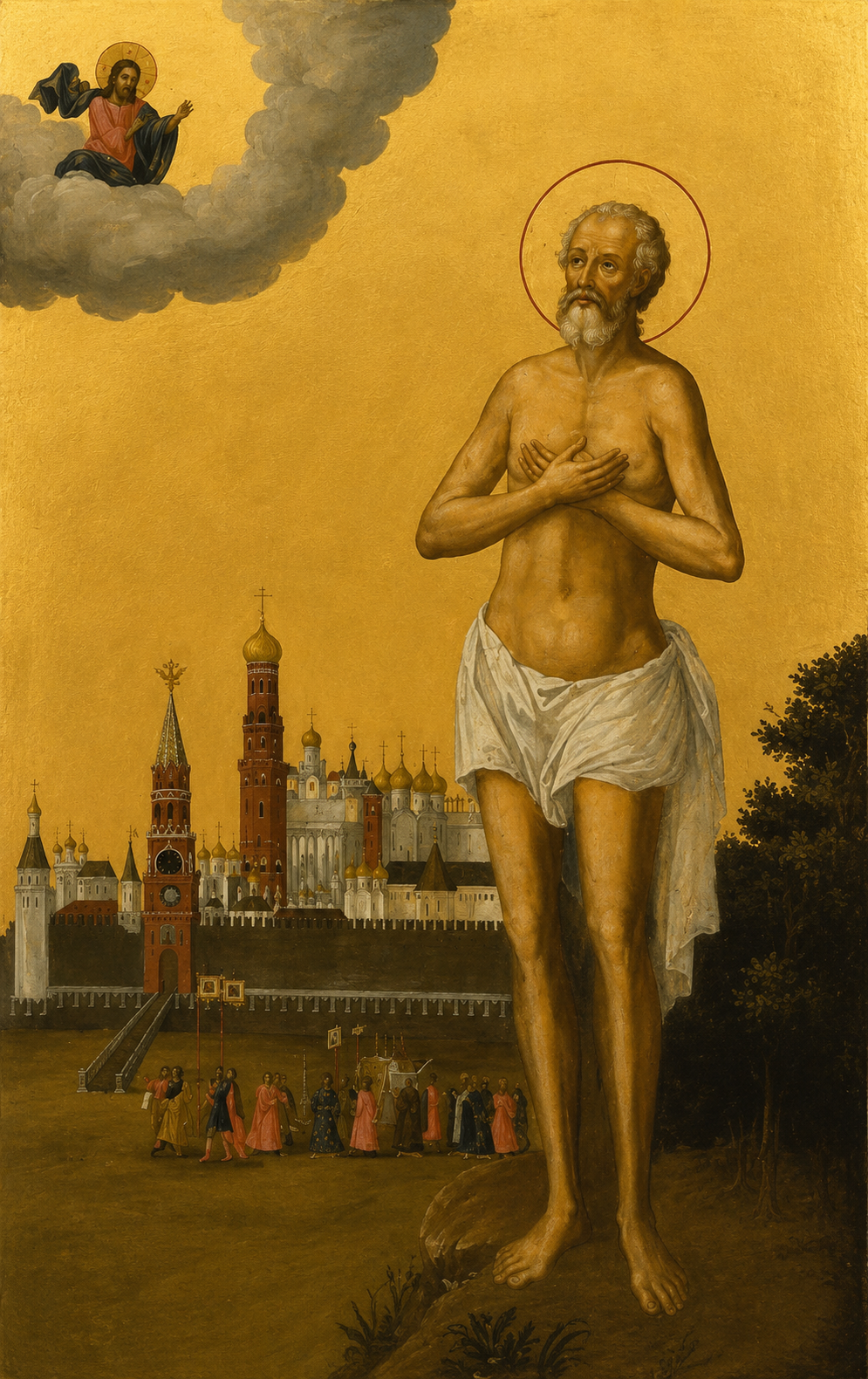
Saint Maximus of Moscow is one of Holy Russia’s most hidden protectors, especially beloved by those facing extreme poverty and financial desperation, homelessness or housing instability, and emotional suffering when life feels completely broken.
Living as a Fool-for-Christ in the heart of Moscow, Saint Maximus embraced cold, hunger, ridicule, and total obscurity so completely that most people never realized a saint walked beside them. He carried the burdens of the poor, interceded for families on the brink, and quietly poured out his life in prayer for a city filled with suffering.
His feast is traditionally commemorated on January 11 (Old Style) / January 24 (New Style). To this day, people turn to Saint Maximus when money has run out, when shelter feels uncertain, and when only God’s mercy can restore hope.
This handmade prayer card honors his unseen holiness with museum-quality craftsmanship, created for prayer in moments of desperation and quiet trust. It is not merely devotional art. It is a spiritual heirloom.
From merchant’s son to barefoot prophet
Maximus was born into a merchant family in Moscow during the late fourteenth or early fifteenth century. His upbringing provided material stability and access to trade networks, yet from an early age he showed little interest in wealth or social advancement. As he matured, Maximus became increasingly disturbed by the spiritual emptiness he observed among the prosperous classes and began withdrawing from ordinary life.
Eventually, he renounced comfort entirely and embraced the vocation of holy foolishness.
He abandoned family expectations, stripped himself of possessions, and took up life as a wandering ascetic. Like many Fools for Christ, he adopted outward behavior meant to repel admiration. He wore heavy iron chains against his bare skin and walked nearly naked through Moscow’s streets, enduring snow and freezing winds without shelter. His body bore the marks of prolonged exposure, yet he accepted suffering willingly, regarding physical hardship as a means of spiritual vigilance.
To most citizens, Maximus appeared deranged.
To God, he was offering his entire being in silent prayer.
Prophetic rebuke and enigmatic wisdom
Maximus did not preach sermons or deliver structured teachings. Instead, he spoke in brief, cryptic sayings and symbolic proverbs that often seemed incoherent at first. These utterances carried sharp moral insight, particularly directed toward the wealthy and powerful.
He condemned greed and vanity through riddles that unsettled listeners, exposing the fragility of earthly security. Merchants who trusted in profit rather than mercy found themselves confronted by Maximus’ strange declarations. Noble households were disturbed when he foretold illness or death among their members, predictions that repeatedly proved accurate.
Rather than seeking authority, Maximus allowed truth to surface through paradox.
He also warned Moscow’s residents of coming trials, urging repentance during periods of sickness and famine. During outbreaks of plague, he walked through affected neighborhoods telling people to prepare their souls, reminding them that suffering without repentance only deepened spiritual blindness.
His words were rarely comforting.
They were clarifying.
Yet even as he rebuked sin, Maximus quietly interceded for the same people he confronted. He prayed for the sick, offered counsel to those willing to listen, and endured insults without defense. His foolish exterior granted him freedom to speak truth directly, while his hidden prayer sustained the city in ways few understood.
Bearing suffering as intercession
Maximus’ life was defined by voluntary vulnerability. He slept outdoors or in church porches, accepted hunger as routine, and allowed himself to be mocked or struck without retaliation. His chains were not symbolic accessories but instruments of continual remembrance, binding his body to the reality of the Cross.
He never sought recognition for prophetic accuracy or endurance.
Whenever people began treating him with reverence, he intensified his foolish behavior, deliberately undermining any growing reputation. He understood that admiration could corrupt the soul faster than hardship, and he guarded his humility fiercely.
Those who approached him privately often sensed deep spiritual clarity beneath the chaos. Many asked for prayers during illness or family crisis, and numerous healings were attributed to his intercession even while he lived. Still, Maximus refused to acknowledge such outcomes publicly, redirecting attention toward repentance and prayer.
His vocation was not to be admired.
It was to be hidden.
Death and miraculous witness
Maximus reposed in 1434 after years of wandering asceticism in Moscow. By the time of his death, a quiet awareness of his sanctity had spread among the faithful, though he himself had never accepted honor or position.
After his burial, miracles began occurring at his relics, including healings and answered prayers. Those who had once dismissed him as mad gradually recognized that the barefoot man in chains had been carrying their city before God.
His resting place became a site of veneration, and his memory entered the liturgical life of the Church.
Maximus of Moscow represents the prophetic dimension of holy foolishness. His life reveals how God confronts injustice not always through institutions or authority, but through individuals willing to surrender dignity, comfort, and safety for truth. He reminds us that divine wisdom often speaks through riddles, and that repentance is sometimes delivered by voices the world refuses to respect.
Maximus stands as a witness that when a soul abandons everything for Christ, even chains and winter streets can become instruments of salvation.
Saint Maximus of Tot’ma († 1650)
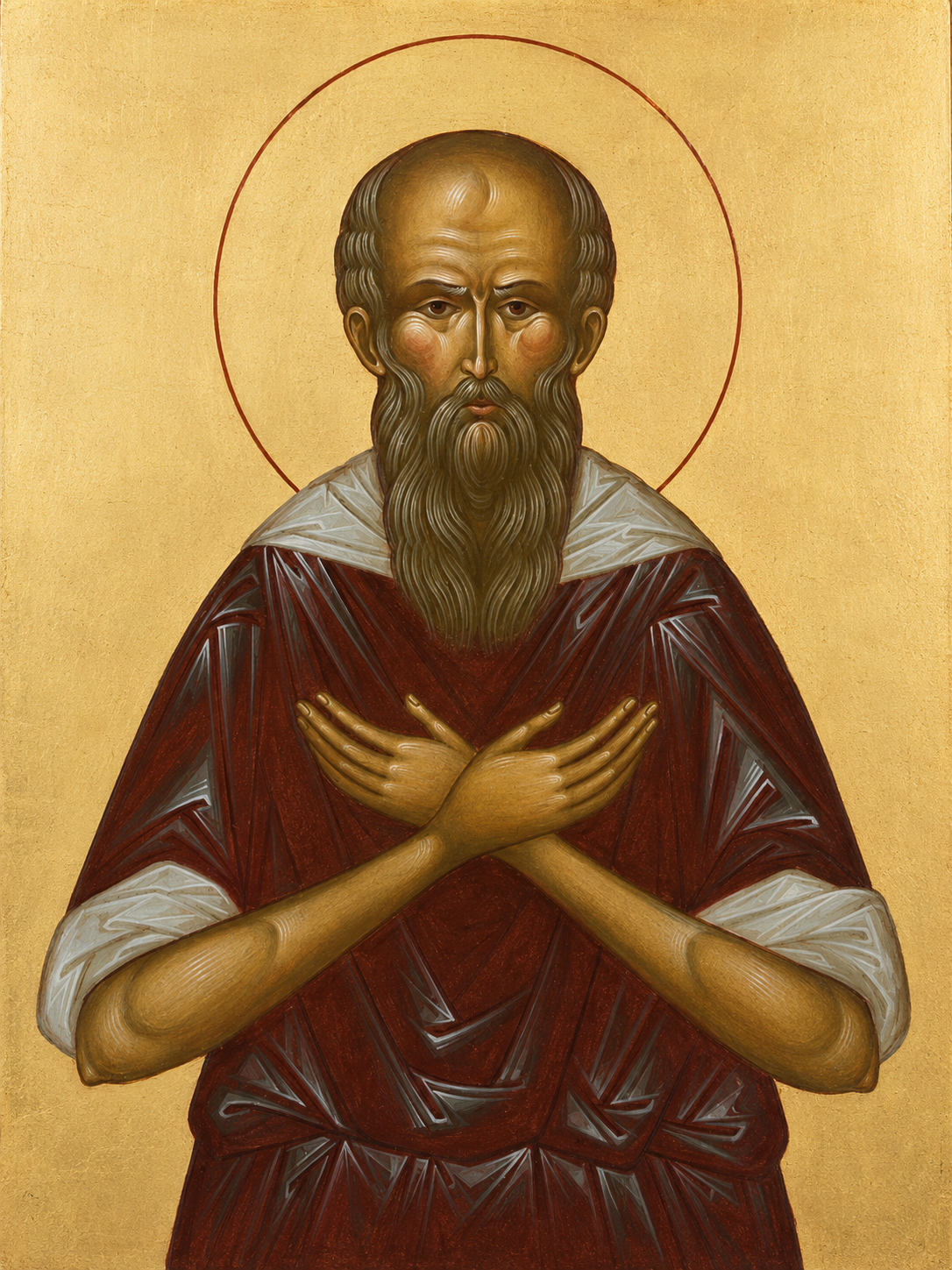
Saint Maximus of Tot’ma is one of Holy Russia’s hidden guardians, especially sought by those crying out for financial desperation and sudden poverty, protection of the home during unstable times, and peace during emotional or spiritual collapse.
Living as a Fool-for-Christ in the northern town of Totma, Saint Maximus embraced obscurity, homelessness, and relentless prayer so completely that most people never understood who walked among them. He carried the burdens of families, interceded for the poor, and quietly protected households through repentance and hidden sacrifice.
His feast is traditionally commemorated on January 29 (Old Style) / February 11 (New Style). To this day, the faithful turn to Saint Maximus when money is gone, when fear hangs over the home, and when the heart can no longer find rest.
This handmade prayer card honors his unseen holiness with museum-quality craftsmanship, created for prayer in moments of desperation and quiet trust. It is not merely devotional art. It is a spiritual heirloom.
From parish priest to wandering ascetic
Maximus began his spiritual life in a conventional and respected role, serving as a parish priest in the northern Russian town of Tot’ma. He was known as a faithful shepherd, attentive to liturgical life and pastoral care, and outwardly appeared destined for a quiet ministry within the normal structures of the Church.
Around the age of thirty, however, Maximus experienced a profound interior calling that altered the entire course of his life.
Without warning or explanation, he renounced clerical comfort and embraced the radical vocation of holy foolishness. He laid aside proper clothing, often wearing only rags or nothing at all, and began wandering Tot’ma’s streets barefoot in every season. He placed iron chains on his body, slept outdoors through northern winters, and abandoned all claims to stability or dignity.
For the next forty five years, Maximus lived this way.
To townspeople, his transformation was incomprehensible. A former priest had become a half-naked wanderer. Many assumed he had lost his mind. Children mocked him, adults avoided him, and few remembered his former ministry. Yet beneath this apparent collapse of identity was a deliberate spiritual descent into humility.
Maximus had chosen disgrace as his altar.
Life of prayer beneath mockery
Maximus spent his days moving silently through Tot’ma, praying continuously while appearing chaotic and broken. He accepted hunger, cold, and exhaustion as daily realities, offering each discomfort as intercession for the town and its people. His chains were not theatrical symbols but instruments of remembrance, anchoring his body to suffering while his heart remained fixed on God.
Though publicly ridiculed, Maximus lived in deep interior stillness. He kept long night vigils outdoors, often standing in prayer while snow accumulated on his shoulders. He spoke little, but when he did, his words frequently carried prophetic weight. Like other Fools for Christ, he communicated through cryptic phrases or symbolic gestures rather than formal teaching.
Over time, residents began to notice that his strange utterances often proved accurate.
He warned individuals of approaching illness or hardship. He called people to repentance before unforeseen trials. He discerned hidden sins and quietly encouraged reconciliation. Those who approached him privately encountered gentleness and clarity rather than madness.
Yet Maximus never permitted admiration to grow.
Whenever townspeople showed signs of reverence, he intensified his foolish behavior, ensuring that honor could not attach itself to his person. He understood that praise endangered the soul more than frostbite or chains.
Perseverance in voluntary suffering
Maximus’ holy foolishness was not marked by dramatic public confrontations or symbolic theatrics like some of his predecessors. Instead, his witness unfolded through relentless endurance. Year after year, he remained exposed to the elements, sleeping outdoors, walking barefoot through snow, and carrying his chains in silence.
His vocation was one of perseverance.
He bore mockery without resentment and physical hardship without complaint. He did not attempt to justify himself or explain his actions. His entire life became a prolonged act of self-emptying, a living prayer offered for the spiritual healing of his community.
In this sense, Maximus represents one of the most severe forms of holy foolishness. His ministry was not primarily prophetic speech or miraculous intervention, but radical availability to suffering. He allowed his body to become a vessel of intercession, absorbing hardship so others might receive mercy.
Death and miraculous testimony
Maximus reposed in 1650 after nearly half a century of wandering asceticism. By the time of his death, many residents of Tot’ma had come to regard him as a hidden saint, though he himself had never accepted such recognition.
After his burial, miracles began occurring at his tomb. One of the most well-known accounts involves a blind boy whose sight was restored when his eyes were washed with snow gathered from Maximus’ footprints. Other healings followed, confirming what prayerful observers had long suspected.
The former priest who had wandered half naked through winter streets had been quietly carrying his town before God.
Maximus of Tot’ma reveals a dimension of holy foolishness rooted in endurance rather than spectacle. His life teaches that sanctity does not always manifest through dramatic gestures or public prophecy. Sometimes it takes the form of forty five years of cold nights, silent prayer, and unwavering surrender.
He stands as a witness that God often entrusts profound spiritual authority to those willing to disappear entirely.
Saint Theodore of Novgorod († 1392)
From privilege to voluntary poverty
Theodore was born into a wealthy family in Veliky Novgorod during the late fourteenth century, a time when the city stood as one of Russia’s most powerful commercial and political centers. Surrounded by privilege and opportunity, Theodore nevertheless felt drawn toward a radically different life. As a young man, he distributed his inheritance to the poor and abandoned every claim to comfort or status, choosing instead the path of holy foolishness.
His renunciation was not impulsive.
It was deliberate.
Theodore understood that wealth creates distance from suffering, and he desired proximity to those forgotten by society. He embraced homelessness, wore rags, and wandered Novgorod’s streets barefoot, accepting hunger and ridicule as companions in prayer. Like other Fools for Christ, he intentionally dismantled his former identity so that nothing would remain but dependence on God.
To the city, he appeared unstable.
In truth, he had entered a life of profound interior discipline.
Holy foolishness as prophetic confrontation
Theodore’s vocation unfolded within a divided city. Novgorod was frequently fractured by political rivalries and social factions, with tensions simmering beneath outward prosperity. Rather than addressing these divisions through formal preaching, Theodore employed the symbolic language of holy foolishness.
He pretended to engage in loud public quarrels with his fellow Fool for Christ, Nicholas Kochanov, staging dramatic arguments in marketplaces and streets. To casual observers, the two appeared to be merely insane men shouting at each other. In reality, their feigned hostility mirrored the city’s internal conflicts, exposing how pride and rivalry were tearing Novgorod apart.
Their performance was not entertainment.
It was spiritual diagnosis.
By acting out division, Theodore forced citizens to confront their own fractured relationships. Many who witnessed these encounters later reflected on their meaning and began seeking reconciliation, recognizing that the holy fools were calling them to repentance through living parable.
Prophecy and warning through humiliation
Theodore also possessed the gift of foresight and frequently warned Novgorod of approaching calamity. He foretold a severe famine and later predicted a destructive fire that would consume part of the city. Both events occurred exactly as he had indicated, deeply unsettling residents who had dismissed him as mad.
Yet Theodore did not use prophecy to elevate his reputation.
He continued wandering in rags, sleeping outdoors, and submitting to mockery even as his words proved true. He spoke in riddles and symbolic gestures, rarely offering direct explanations, allowing meaning to unfold over time. His aim was not fear but repentance, not recognition but transformation.
Those who approached him privately often encountered gentleness and spiritual clarity. He prayed for the sick, comforted the grieving, and quietly interceded for families in crisis. Still, whenever people began treating him with reverence, Theodore intensified his foolish behavior, safeguarding humility with intentional obscurity.
Foretelling his death and final repose
Near the end of his life, Theodore calmly foretold his own death, preparing spiritually while continuing his ordinary pattern of wandering prayer. He reposed in 1392, having spent years carrying his city before God through humiliation and intercession.
He was buried at the Church of Saint Paraskeva, where many later came to pray, remembering the barefoot ascetic who had walked their streets warning them of danger and calling them back to unity.
After his death, Theodore’s sanctity became more widely acknowledged, and accounts of answered prayers and quiet miracles began circulating among the faithful.
A saint who mirrored his city
Theodore of Novgorod represents a distinct expression of holy foolishness, one shaped by civic conflict and communal fracture. His life reveals how God sometimes places His servants directly inside social tension, using their humiliation as a mirror for collective sin.
Theodore did not build monasteries or write theological treatises.
He embodied repentance.
Through staged quarrels, cryptic prophecy, and voluntary poverty, he confronted division without violence and exposed pride without authority. His witness reminds us that God often speaks to cities not through institutions, but through individuals willing to become living symbols.
Theodore stands as proof that holy foolishness is not chaos for its own sake. It is ordered surrender, prophetic humility, and sacrificial love offered for the healing of entire communities.
Saint Nicholas Kochanov of Novgorod († 1340s)
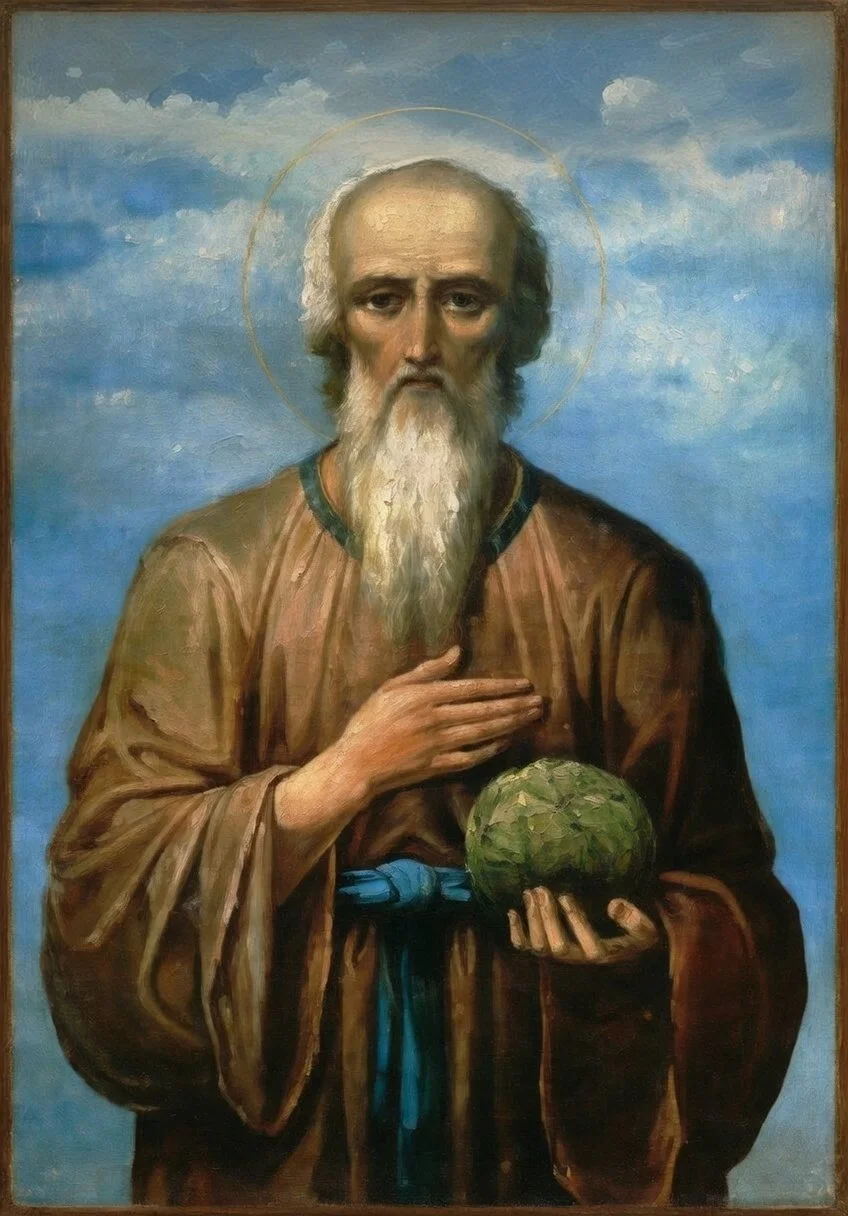
Holy Fool for Christ | Peacemaker | Hidden Intercessor
Saint Nicholas Kochanov of Novgorod is one of Holy Russia’s most beloved Fools-for-Christ, especially sought by those desperate for financial provision and food insecurity, peace during family conflict or emotional crisis, and protection of the home during unstable times.
Living openly among the poor of Veliky Novgorod, Saint Nicholas embraced homelessness, hunger, and public humiliation so completely that many dismissed him as mad. Yet beneath that outward poverty lived a man of ceaseless prayer whose intercession softened hardened hearts, reconciled enemies, and brought practical help to families who had nothing left.
His feast is traditionally commemorated on July 27 (Old Style) / August 9 (New Style). To this day, people turn to Saint Nicholas when cupboards are empty, when family peace feels impossible, or when fear threatens their household.
This handmade prayer card honors his hidden holiness with museum-quality craftsmanship, created for prayer in moments of real need and kept as a sacred reminder that God sends help through the humble. It is not merely devotional art. It is a spiritual heirloom.
From privilege to prophetic poverty
Nicholas was born into a wealthy family in Veliky Novgorod during the early fourteenth century, a time when commerce and political influence shaped much of urban life. Surrounded by material comfort and opportunity, Nicholas nevertheless felt a deep interior call toward renunciation. As a young man, he rejected inheritance and status, distributing his wealth and deliberately choosing the path of holy foolishness.
His decision marked a complete rupture with ordinary expectations.
Nicholas clothed himself in rags, abandoned stable housing, and began wandering the city barefoot, embracing hunger, exposure, and ridicule as part of his spiritual discipline. Like other Fools for Christ, he dismantled every visible marker of success so that nothing would remain but dependence on God. To many citizens, he appeared unstable or deranged. In reality, he had entered a life of continuous prayer hidden beneath humiliation.
Holy foolishness as living parable alongside Theodore
Nicholas’ vocation unfolded in close spiritual parallel with Theodore of Novgorod, with whom he shared a unique prophetic partnership. The two holy fools deliberately staged public quarrels, shouting at one another in marketplaces and streets, feigning hostility in ways that unsettled passersby.
These confrontations were not personal disputes.
They were enacted parables.
By acting out division, Nicholas and Theodore mirrored the internal factions tearing Novgorod apart. Their apparent enmity exposed civic pride, political rivalry, and social fragmentation. Citizens who initially laughed or dismissed them gradually began to recognize that the fools were dramatizing the city’s own spiritual sickness.
Through ridicule and symbolic conflict, Nicholas called Novgorod to repentance.
He did not lecture. He embodied the message.
Those who encountered him privately often found him gentle and prayerful, with a quiet clarity beneath his madness. Yet whenever admiration threatened to arise, Nicholas intensified his foolish behavior, safeguarding humility through intentional disgrace.
Signs, prophecy, and spiritual authority
Nicholas also manifested prophetic insight through symbolic acts that appeared absurd until later events revealed their meaning. One of the most well-known episodes occurred when he walked across the frozen Volkhov River during winter, astonishing witnesses with his fearless passage over the ice.
After crossing, he threw a cabbage into the air and declared that a monastery would one day rise where it landed.
At the time, people laughed.
Years later, a monastery was indeed built at that exact location, transforming mockery into reverent remembrance.
Nicholas frequently spoke in riddles, warned of approaching hardships, and revealed hidden sins through cryptic gestures. His prophecies were not delivered for spectacle but for repentance, and he consistently avoided any personal elevation when his words proved true.
Alongside these prophetic signs, Nicholas quietly interceded for the sick and suffering. Many who sought his prayers experienced healing or spiritual consolation, though Nicholas himself never acknowledged such outcomes. His aim remained constant: to disappear behind Christ.
Death and continuing intercession
Nicholas reposed sometime in the 1340s after years of wandering asceticism and prophetic witness. By the time of his death, a small but growing number of believers recognized that the ragged fool who had walked their streets had been quietly carrying Novgorod before God.
After his burial, miracles began occurring at his relics, particularly healings from chronic illness and affliction. His resting place became a site of prayer, and his memory was preserved alongside Theodore as one of Novgorod’s spiritual guardians.
Nicholas Kochanov represents the communal dimension of holy foolishness. His life shows how God sometimes sends saints not merely to individuals, but to entire cities, using humiliation as a language of truth and symbolic action as a call to repentance.
He reminds us that holiness does not always speak in sermons.
Sometimes it shouts in marketplaces.
Sometimes it walks across frozen rivers.
And sometimes it throws cabbages into the air to reveal God’s future.
Isidore the Fool‑for‑Christ and Wonderworker of Rostov († 1474)
From Western Europe to voluntary exile in Russia
Isidore was born in Western Europe, traditionally identified with Germany, into a Catholic Christian environment far removed from the spiritual world he would later inhabit. Little is preserved about his early life, yet tradition records that he consciously left his homeland and traveled east, eventually arriving in Rostov Veliky. His journey was not motivated by commerce or opportunity, but by a desire for radical repentance and total surrender to God.
Upon reaching Rostov, Isidore rejected any attempt to establish himself socially or economically. Instead, he embraced the vocation of holy foolishness, deliberately placing himself among the poorest and most disregarded members of society. He constructed a crude hut for shelter, dressed in rags, and wandered barefoot through the city in every season, exposing himself to hunger, cold, and mockery.
To the townspeople, he appeared to be a foreign madman.
In reality, he had chosen exile from comfort in order to belong entirely to Christ.
A double life of prayer and apparent madness
Isidore organized his life around a hidden rhythm of prayer and asceticism. He spent nights standing in vigil, offering intercession for Rostov and its people, and passed his days wandering the streets while pretending insanity. Like other Fools for Christ, his outward disorder concealed a disciplined interior life shaped by fasting, silence, and continual remembrance of God.
He allowed himself to be ridiculed and dismissed, accepting insults without response and refusing to correct false assumptions about his mental state. This voluntary humiliation protected him from praise and preserved humility. Whenever anyone showed signs of reverence, Isidore intensified his foolish behavior, ensuring that admiration could not take root.
His poverty was absolute.
Whatever food or money he received was quickly given away to others in need, leaving him dependent on divine providence alone. He slept outdoors when necessary, endured harsh winters without complaint, and carried his physical weakness as an offering for the city.
Yet beneath this apparent fragility, Isidore possessed extraordinary spiritual strength.
Miracles born from humility
Because of his radical humility and hidden prayer, God granted Isidore the gift of wonderworking. Numerous healings were attributed to his intercession, both during his lifetime and after his repose. The sick who approached him in faith often departed restored, while those burdened by despair found unexpected consolation in his presence.
Isidore never drew attention to these miracles.
He deflected gratitude and redirected hearts toward repentance and trust in God. His entire life testified that divine power flows most freely through souls that have emptied themselves of pride.
Those who encountered him privately often sensed deep peace beneath his madness. He offered quiet counsel, spoke gently to the grieving, and carried the suffering of Rostov in prayer, even as most citizens passed him by without recognition.
Death and enduring witness
Isidore reposed in 1474 after years of wandering asceticism and hidden intercession. Only after his death did many in Rostov begin to understand who had lived among them. His grave quickly became a place of pilgrimage, with continued reports of healing and answered prayer.
In time, a church was built over his burial site, honoring the foreign wanderer who had become Rostov’s unseen protector.
Isidore of Rostov represents the pilgrim dimension of holy foolishness. His life shows how God sometimes calls souls to leave homeland and identity behind in order to become spiritual citizens of places that will never fully understand them. He reveals that holiness does not depend on cultural roots or public acceptance, but on willingness to disappear for Christ.
Through rags, barefoot wandering, and feigned madness, Isidore carried a Russian city before God.
He reminds us that divine wisdom often arrives as a stranger.
And sometimes, that stranger chooses to live in a hut, pray through the night, and save souls while the world looks away.
Saint John of Ustiug († 1494)
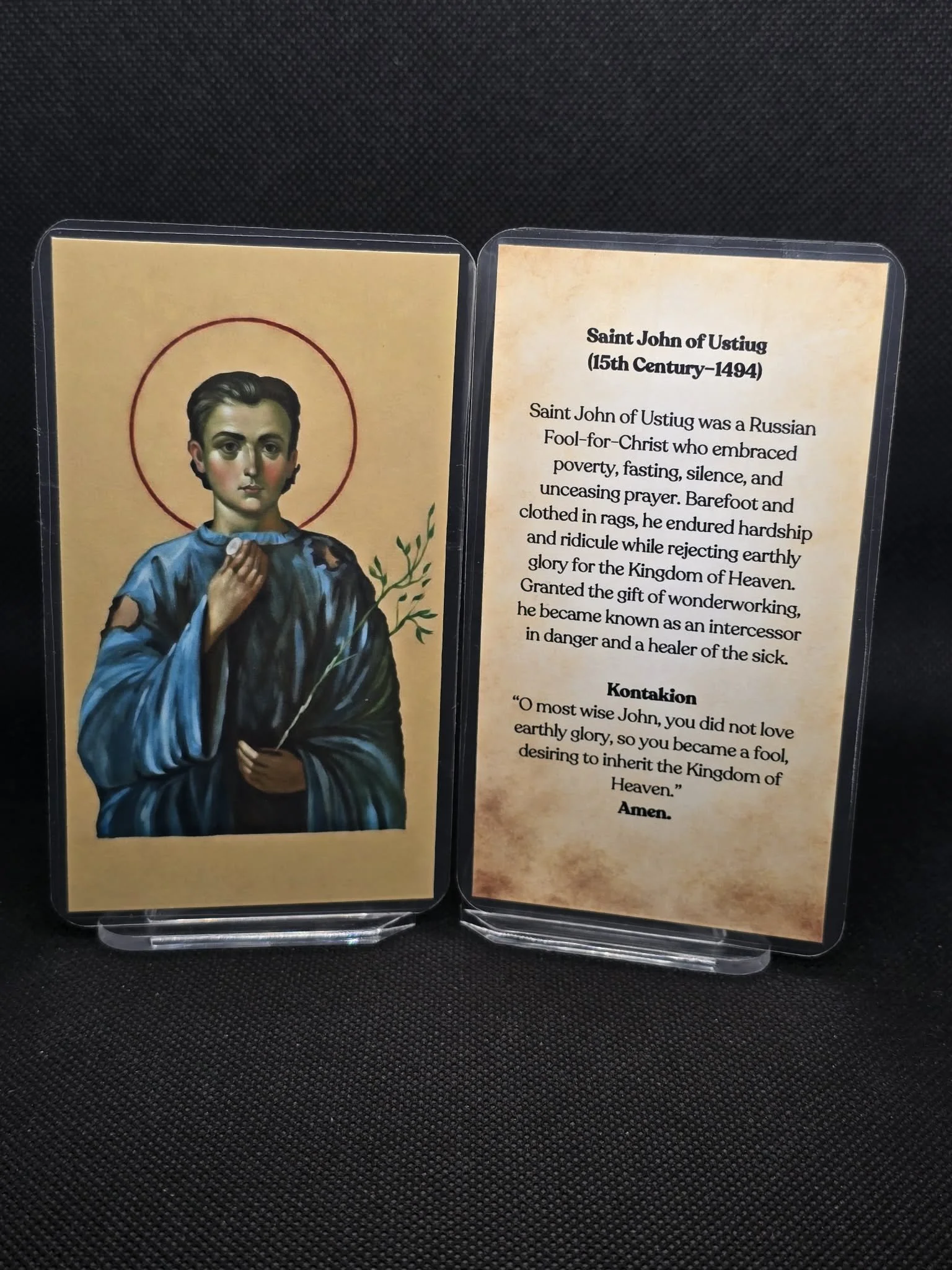
Holy Fool for Christ | Wonderworker | Hidden Intercessor
Saint John of Ustiug is one of Holy Russia’s hidden wonderworkers, a Fool-for-Christ whose life of poverty, prayer, and prophetic courage made him a powerful intercessor for protection from disasters and fires, repentance and spiritual awakening, and families facing hardship and uncertainty.
Living in radical humility in the northern city of Veliky Ustyug, Saint John wandered barefoot, endured ridicule, and offered himself completely to God for the salvation of others. Though many dismissed him as mad, heaven revealed his sanctity through miracles that saved entire communities.
His feast is traditionally commemorated on October 25 (Old Style) / November 7 (New Style). To this day, the faithful turn to Saint John especially in times of danger, emotional despair, and when seeking God’s mercy for their homes and loved ones.
This handmade prayer card honors his hidden holiness with museum-quality craftsmanship, created to be prayed with in moments of fear or need and passed down as a sacred keepsake. It is not merely devotional art. It is a spiritual heirloom.
From village solitude to urban holy foolishness
John was born in the small village of Pukhovo and spent his early adult years in quiet ascetic struggle. Drawn to solitude, he first lived as a hermit, withdrawing from ordinary society to cultivate prayer, fasting, and interior stillness. These hidden years formed the foundation of everything that followed, shaping his humility and preparing him for a far more exposed calling.
After this period of solitude, John discerned that God was leading him back among people. He traveled to the northern city of Veliky Ustiug, where he deliberately embraced the path of holy foolishness. Rather than seeking shelter or stability, he chose homelessness, wandering the streets by day begging for scraps while dedicating the nights to prayer.
His life became divided between public humiliation and private communion with God.
To townspeople, he appeared as another destitute wanderer. In reality, he carried Ustiug before God through continuous intercession.
Daily mockery and hidden spiritual labor
John accepted ridicule as part of his spiritual discipline. Children taunted him, adults dismissed him, and some struck him outright, assuming he was mentally unstable. He endured beatings without resistance and responded to insults with silence, allowing suffering to pass through him as prayer rather than resentment.
By day, he begged only what was necessary to survive. By night, he withdrew to quiet places to stand in vigil, offering tears and supplication for the city and its people. Like other Fools for Christ, his outward poverty concealed an interior life marked by discipline, repentance, and deep attentiveness to God.
He did not seek conversation or attention.
He sought disappearance.
Whatever alms he received were frequently shared with those poorer than himself, leaving him dependent on divine providence alone. His foolishness protected him from praise, while his homelessness kept him spiritually alert.
Miracles and prophetic insight
Despite his desire for obscurity, God revealed John’s sanctity through miracles and spiritual insight. He healed illnesses through prayer and offered guidance to those who approached him in sincerity. Many who encountered him privately described a gentleness and clarity that contrasted sharply with his public persona.
John also possessed prophetic awareness. He warned individuals of approaching hardship and spoke cryptically about future events that later unfolded exactly as foretold. Near the end of his life, he calmly predicted his own death, preparing spiritually while continuing his daily rhythm of begging and prayer.
Even as miracles occurred around him, John never allowed reverence to take root. Whenever people began treating him with respect, he intensified his foolish behavior, ensuring that honor could not attach itself to his person. He understood that admiration threatened humility more than hunger or violence.
Death, relics, and enduring witness
John reposed on May 29, 1494, after years of wandering asceticism in Ustiug. By the time of his death, a quiet awareness of his holiness had begun spreading among the faithful, though he himself had never accepted recognition.
His relics were later enshrined, and miracles continued through his intercession, including healings and answered prayers. The city that had mocked and beaten him came to recognize that the barefoot beggar who prayed through the night had been its unseen protector.
John of Ustiug represents the contemplative dimension of holy foolishness. His life shows how God sometimes sends saints not to preach loudly or confront rulers, but to walk quietly among the poor, absorbing suffering and offering it back to heaven.
He teaches that holiness does not require eloquence or authority.
Sometimes it looks like begging by day, praying by night, and forgiving every blow.John “Big Cap” of Moscow († 1589)
John was born near Vologda and worked at saltworks before moving to Rostov. He adopted holy foolishness, wearing heavy iron chains and an iron cap – hence his nickname “Big Cap.” He walked barefoot and nearly naked even in winter. He fearlessly reproached Tsar Boris Godunov and predicted the Time of Troubles. He died around 1589; his relics were uncovered in 1672.
Blessed Andrew of Totma († 1673)
Holy Fool for Christ | Hidden Ascetic | Quiet Intercessor
Blessed Andrew of Totma is one of Holy Russia’s quiet Fools-for-Christ, especially beloved by those praying for financial hardship and sudden poverty, protection of the home and family, and clarity when life feels hopeless or directionless.
Living as a wandering ascetic in the northern town of Totma, Blessed Andrew embraced homelessness, ridicule, and radical humility so completely that many dismissed him as unstable. Yet beneath that outward weakness lived a man of deep prayer and prophetic insight whose hidden intercession brought comfort to the poor and protection to entire households.
His feast is traditionally commemorated on October 4 (Old Style) / October 17 (New Style). To this day, families turn to Blessed Andrew when money runs out, when danger threatens the home, and when only God’s mercy can restore peace.
This handmade prayer card honors his hidden holiness with museum-quality craftsmanship, created for prayer in moments of desperation and hope alike. It is not merely devotional art. It is a spiritual heirloom.
From monastic obedience to holy foolishness
Andrew was born in 1638 and entered monastic life near the northern town of Tot’ma while still young. His early years were shaped by prayer, obedience, and the quiet rhythm of monastery life. Those who knew him during this period remembered him as gentle, disciplined, and deeply sincere in his desire to serve God.
As Andrew matured spiritually, he began to feel drawn toward a more radical form of self-emptying. After seeking counsel, he received the blessing of his abbot to embrace the path of holy foolishness, a decision that marked a complete departure from structured monastic stability.
He did not leave the Church.
He descended into humility.
With his superior’s blessing, Andrew abandoned ordinary shelter and took up residence along the riverbank outside Tot’ma. He went barefoot throughout the year, including during the region’s severe winters, and adopted a life of voluntary homelessness. Whatever food or money he received was immediately given away to the poor, leaving him dependent entirely on God’s providence.
To townspeople, he appeared fragile and irrational.
In reality, he was entering a deeper obedience.
Life on the riverbank and hidden intercession
Andrew’s days were spent wandering quietly through Tot’ma and its outskirts, offering silent prayer for the city while appearing confused or unstable. He slept outdoors, endured hunger, and accepted mockery without protest. His body absorbed cold and exhaustion, while his soul remained anchored in continual remembrance of God.
Like other Fools for Christ, Andrew maintained a double life.
By day, he appeared destitute and disoriented.
By night, he stood in prayer along the riverbank, lifting Tot’ma and its people before heaven.
He spoke rarely, but when he did, his words carried surprising spiritual clarity. Those who approached him privately found compassion rather than madness, and many sensed deep peace in his presence. Still, Andrew guarded his humility fiercely. Whenever admiration threatened to arise, he withdrew further into foolishness, ensuring that no honor attached itself to his name.
His generosity was absolute.
He owned nothing he would not give away.
Even when visibly weakened by hunger, he would hand his last piece of bread to someone else, trusting that God would provide what was necessary.
Healing and quiet miracles
Though Andrew sought obscurity, God revealed his sanctity through acts of healing. One of the most well-known accounts involves a blind man who washed his eyes with snow gathered from Andrew’s footprints and received his sight. The miracle echoed similar wonders associated with earlier Fools for Christ and confirmed Andrew’s hidden spiritual authority.
Other healings followed, along with testimonies of answered prayer and spiritual consolation. Andrew never claimed responsibility for these miracles and avoided any acknowledgment of them. He redirected attention away from himself, encouraging repentance and trust in God rather than fascination with signs.
His foolishness protected him from becoming a spiritual spectacle.
His humility preserved his intercessory power.
Death and remembrance
Andrew reposed on October 10, 1673, after years of wandering asceticism and quiet prayer along Tot’ma’s riverbanks. By the time of his death, many residents had come to recognize that the barefoot fool who lived outdoors had been carrying their town before God.
Following his repose, devotion grew among the faithful, and accounts of healing and answered prayers continued. His memory joined that of other northern Russian holy fools whose lives testified not through sermons or authority, but through endurance, generosity, and surrender.
Andrew of Tot’ma represents the obedient dimension of holy foolishness. Unlike some who entered this path through sudden inner calling, Andrew stepped into it under spiritual guidance, demonstrating that even radical asceticism can unfold within the bounds of ecclesial obedience.
His life teaches that holiness does not always rise from dramatic prophecy or confrontation.
Sometimes it flows quietly from bare feet on frozen ground, empty hands offering everything away, and nights spent praying beside a river while the world sleeps.
Saint Procopius of Vyatka († 1627)
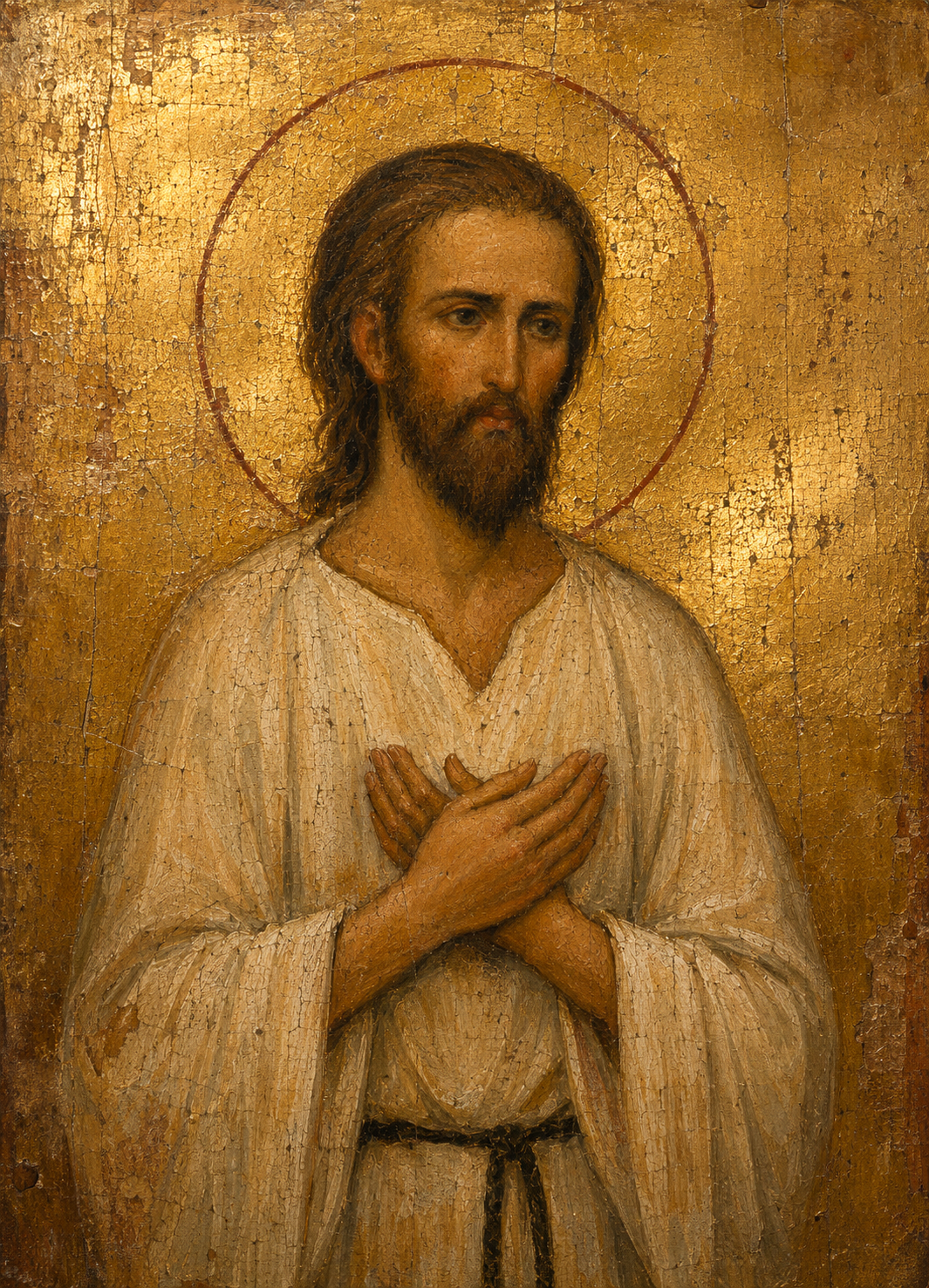
Holy Fool for Christ | Hidden Ascetic | Quiet Intercessor
Saint Procopius of Vyatka is one of Russia’s hidden Fools-for-Christ, especially beloved by those crying out for protection from disasters and sudden tragedy, help during extreme poverty or financial collapse, and healing from emotional or mental suffering.
Living as a wandering ascetic in the northern Russian city of Kirov (historically called Vyatka), Saint Procopius embraced homelessness, ridicule, and radical humility so completely that many mistook him for mad. Yet beneath that outward weakness lived a man of deep prayer, prophetic insight, and fierce love for the poor.
His feast is traditionally commemorated on December 8 (Old Style) / December 21 (New Style). To this day, families turn to Saint Procopius when their homes feel unsafe, when finances collapse, and when inner peace feels impossible to recover.
This handmade prayer card honors his hidden holiness with museum-quality craftsmanship, created for prayer in moments of fear and desperation, and kept as a sacred reminder that God sends help even through the forgotten. It is not merely devotional art. It is a spiritual heirloom.
From village devotion to radical renunciation
Procopius was born to devout peasant parents in rural Russia, raised in a household shaped by prayer, simplicity, and reverence for God. From an early age, he demonstrated unusual spiritual seriousness and a strong resistance to ordinary worldly ambitions. When the time came for marriage, Procopius refused, sensing that God was calling him to a life of complete surrender rather than family life or economic stability.
Leaving his village behind, he traveled to the town of Kirov, historically known as Khlynov or Vyatka. There he deliberately embraced poverty and obscurity, choosing homelessness and voluntary suffering as his spiritual path. Rather than seeking shelter or work, he adopted holy foolishness, placing himself among society’s most disregarded and misunderstood.
To the townspeople, Procopius appeared unstable and broken.
In truth, he had consciously stepped into spiritual exile.
He dressed poorly, wandered barefoot in harsh northern weather, and accepted hunger as a constant companion. His outward disorder concealed a disciplined interior life grounded in prayer, fasting, and continual remembrance of God.
Twenty years of humiliation and hidden prayer
For roughly twenty years, Procopius lived as a Fool for Christ in Vyatka, enduring relentless hardship. He slept outdoors or wherever he could find momentary refuge, often exposed to snow, rain, and bitter cold. He begged only enough to survive and frequently gave away what little he received to others even poorer than himself.
Mockery became routine.
Children taunted him, adults dismissed him, and some struck him outright, assuming he was mentally ill or worthless. Procopius accepted every insult without resistance, allowing humiliation to become his teacher. Like other holy fools, he understood that disgrace protected humility and that invisibility safeguarded prayer.
By day, he wandered the streets in apparent confusion.
By night, he withdrew to quiet places to stand in vigil, interceding for Vyatka and its people.
He spoke little, but when he did, his words often carried unexpected depth. Those who approached him privately encountered gentleness and spiritual clarity rather than madness. Though he avoided attention, many began to notice that his presence brought peace, and that his cryptic remarks sometimes revealed hidden truths.
Clairvoyance, healing, and spiritual authority
Despite his desire for obscurity, God granted Procopius spiritual gifts that could not remain entirely hidden. He possessed clairvoyance, discerning unspoken struggles and revealing sins or dangers with quiet precision. He also received the gift of healing, and numerous people experienced restoration through his prayers.
These miracles were never theatrical.
Procopius prayed softly, touched gently, and sent people away without drawing attention to himself. Whenever gratitude or reverence began to surface, he intensified his foolish behavior, deliberately undermining any reputation that might threaten humility.
He warned individuals of approaching trials, offered comfort to the grieving, and quietly carried the suffering of the city before God. His entire life became a prolonged act of intercession, offered through cold nights, aching hunger, and voluntary invisibility.
Procopius did not seek to reform Vyatka through words or authority.
He bore it through surrender.
Death and remembrance
Procopius reposed in 1627 at the age of forty nine after two decades of wandering asceticism and hidden spiritual labor. Only after his death did many residents begin to understand who had lived among them. The barefoot fool who had endured their mockery had been praying for their salvation.
Accounts of healing and answered prayer followed, and his memory entered the spiritual consciousness of the region as that of a hidden saint who had chosen suffering over comfort and obscurity over recognition.
Procopius of Vyatka represents the endurance dimension of holy foolishness. His life shows that sanctity does not always arrive through dramatic prophecy or confrontation with rulers. Sometimes it comes through years of cold streets, quiet prayer, and forgiveness of cruelty.
He teaches that God often entrusts entire communities to souls willing to disappear completely.
Through hunger, humiliation, and silence, Procopius became a vessel of mercy for a forgotten town. His witness stands as a reminder that the most powerful intercessors are often the ones no one notices.
Women fools for Christ
Saint Xenia of St Petersburg (c. 1731 – 1803)
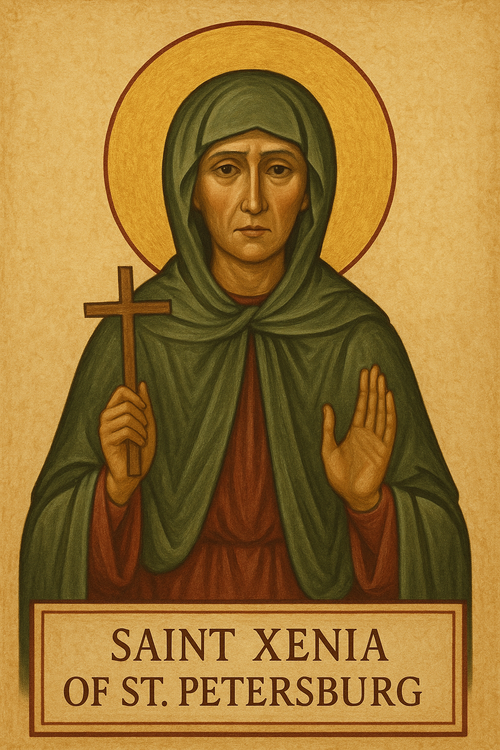


From young widow to living sacrifice
Xenia was born around 1731 and lived an ordinary life until early adulthood, when she married Colonel Andrei Petrov, a military officer serving in imperial Russia. Their marriage was brief. At the age of twenty six, Xenia was suddenly widowed when her husband died without having prepared spiritually for death, a loss that shattered her world and permanently altered the direction of her life.
Rather than retreating into conventional mourning, Xenia responded with radical surrender.
She gave away nearly all of her possessions, distributed her remaining money to the poor, and renounced her former identity entirely. She dressed herself in her late husband’s military uniform and insisted on being called by his name, declaring that Xenia had died and that only Andrei remained alive.
To family and friends, this behavior appeared to be a psychological collapse.
In reality, Xenia had entered the path of holy foolishness.
She believed that by bearing humiliation and symbolic death, she could offer her own life as repentance on behalf of her husband and as intercession for others. This was not escapism. It was deliberate spiritual substitution.
Wandering homelessness in Saint Petersburg
Xenia began wandering the streets of Saint Petersburg with no permanent shelter, embracing homelessness and exposure to the elements. She begged only what was necessary to survive and spent her nights in prayer, often standing in open fields outside the city, lifting her hands toward heaven through freezing winds and snow.
By day, she wandered quietly among markets and neighborhoods, appearing confused or unstable.
By night, she carried the city before God.
People mocked her unusual clothing and strange declarations. Children threw stones, adults dismissed her, and some openly ridiculed her apparent madness. Xenia endured every insult without retaliation, responding to cruelty with silence and prayer. Her humility gradually softened even the hardest hearts, and many began to sense peace simply by being near her.
Though she possessed almost nothing, Xenia became known for quiet generosity. Whatever food or money she received was quickly shared with others in need, leaving her dependent entirely on divine providence. She avoided comfort intentionally, believing that suffering accepted freely became prayer.
Hidden service and the building of a church
One of the most beloved traditions surrounding Xenia tells of her secret labor at Smolensk Cemetery. When a church was being built there, workers noticed that stacks of bricks mysteriously appeared overnight. Eventually they discovered that Xenia had been carrying heavy bricks by herself in the dark, assisting the construction while no one was watching.
She did this quietly, without acknowledgment.
Her entire life followed this pattern.
She served invisibly, prayed secretly, and allowed others to believe she was useless or broken. For Xenia, holiness meant disappearance.
Prophecy, healing, and spiritual consolation
Over time, it became impossible to ignore the spiritual gifts flowing through her humility. Xenia possessed clairvoyance and prophetic insight, often revealing future events through cryptic remarks or symbolic actions. She foretold major occurrences, including the death of Empress Elizabeth of Russia, astonishing those who had dismissed her as mad.
She also healed children through prayer, helped people locate lost possessions, and offered comfort to the grieving and troubled. Families began quietly seeking her blessing, knowing that her presence brought peace and that her words carried unexpected accuracy.
Yet Xenia never accepted reverence.
Whenever admiration arose, she intensified her foolish behavior, reinforcing her outward instability to protect humility. She understood that honor endangered the soul more than cold nights or hunger.
To those who approached her privately, she showed warmth and compassion.
To the world at large, she remained a wandering mystery.
Death, pilgrimage, and canonization
Xenia likely reposed around 1803 after decades of homelessness, prayer, and hidden intercession. By the time of her death, many residents of Saint Petersburg already regarded her as a living saint. Her grave at Smolensk Cemetery quickly became a place of pilgrimage, with countless reports of answered prayers, healings, and spiritual consolation.
Even generations later, people continued visiting her resting place, writing petitions, and walking barefoot around her chapel in acts of devotion. Her witness endured not through writings or sermons, but through living memory.
In 1988, Xenia was officially canonized by the Russian Orthodox Church, confirming what the faithful had known for nearly two centuries.
The feminine heart of holy foolishness
Xenia of Saint Petersburg reveals the deeply relational dimension of holy foolishness. Her path was shaped not by dramatic public prophecy or confrontation with rulers, but by grief transformed into sacrificial love. She became a holy fool not to reject humanity, but to carry it.
Her life teaches that suffering offered freely can become intercession.
That humiliation can become healing.
And that a homeless widow in military clothing can become the spiritual mother of an entire city.
Xenia stands as proof that God entrusts immense spiritual authority to those willing to vanish for love. Through barefoot wandering, silent prayer, and hidden service, she transformed personal tragedy into communal mercy.
She reminds us that holiness does not always look strong.
Sometimes it looks like grief wrapped in a uniform, carrying bricks through the night, praying while the world sleeps.
Saint Pelagia Ivanovna Serebrennikova (Pasha of Sarov, † 1915)
Called into holy foolishness through spiritual obedience
Pelagia was born in the early nineteenth century into a humble Russian family, raised within the ordinary rhythms of Orthodox village life. From an early age she displayed a deep sensitivity to spiritual matters, often withdrawing into quiet prayer and showing unusual compassion for those who suffered. As she matured, this inner pull toward God intensified, and she began searching for guidance on how to offer her entire life in service.
Her decisive turning point came through the counsel of Seraphim of Sarov, one of Russia’s greatest spiritual elders. Recognizing Pelagia’s interior readiness, Saint Seraphim directed her not toward standard monastic life but toward the far more severe path of holy foolishness. This guidance was given soberly and deliberately, for holy foolishness requires the surrender of reputation, comfort, and personal identity.
Pelagia accepted this calling in full awareness of what it demanded. She understood that this path would lead not to admiration but to misunderstanding, ridicule, and lifelong invisibility.
Entering humiliation as spiritual discipline
Following Saint Seraphim’s blessing, Pelagia began deliberately feigning madness in public. She behaved erratically, spoke in riddles, and performed strange or socially inappropriate actions that unsettled those around her. These behaviors were not signs of instability but conscious spiritual discipline, adopted to destroy pride and protect humility.
People mocked her openly, assuming she had lost her mind. Others avoided her entirely, uncomfortable with her unpredictable presence. Pelagia endured these reactions silently, allowing herself to be treated as foolish and unstable while maintaining a disciplined interior life shaped by fasting, vigilance, and continuous prayer.
Like all authentic Fools for Christ, she lived a double existence. Outwardly she appeared chaotic and broken, while inwardly she remained deeply attentive to God. Her foolishness became spiritual armor, freeing her from approval and allowing her to love without recognition.
Preventing violence through voluntary disgrace
One of the most striking episodes from Pelagia’s life reveals how holy foolishness operates as hidden intercession. Through divine insight she became aware of a murder being planned in a local tavern. Rather than alerting authorities or confronting anyone directly, Pelagia entered the tavern herself and remained there for three consecutive days.
She behaved in ways that ensured constant disruption and attention, drawing focus entirely onto herself. To observers, this appeared scandalous and senseless, reinforcing their belief that she was mentally unstable. In reality, her presence dismantled the conditions necessary for violence to occur, and the planned murder was quietly prevented.
Pelagia never explained what she had done. She simply returned to obscurity, having absorbed disgrace so another life could be spared.
Spiritual motherhood at Diveyevo
Later in life Pelagia moved to Diveyevo Convent, where her vocation gradually shifted from wandering foolishness to hidden spiritual guidance. Although she retained her outwardly strange behavior, those who lived nearby began recognizing that she carried deep spiritual authority beneath her eccentric exterior.
She became a quiet spiritual mother to many who sought her counsel during illness, grief, or confusion. Pelagia possessed gifts of prophecy and healing, often discerning unspoken struggles and offering guidance that proved remarkably accurate. The sick found relief through her prayers, and the troubled discovered peace simply by sitting near her.
Even as people began sensing her sanctity, Pelagia guarded humility fiercely. Whenever admiration arose, she intensified her foolish behavior, ensuring that reverence could not take root. She understood that spiritual power remains pure only when it remains hidden.
Death and continuing witness
Pelagia reposed on September 22 / October 5, 1915, after decades of offering humiliation as prayer and prayer as service. By the time of her death, many already regarded her as a living saint, though she herself had never accepted such recognition.
Her cell at Diveyevo has been preserved as a shrine, and pilgrims continue visiting it to seek comfort and intercession. Accounts of healing and answered prayer followed her repose, confirming what those closest to her had long perceived during her life.
Pelagia had carried countless burdens in silence, allowing herself to appear broken while quietly ministering to souls.
A hidden theology of sacrificial love
Pelagia of Diveyevo reveals a deeply relational expression of holy foolishness. Her path was not shaped by public confrontation or dramatic prophecy, but by spiritual intuition, voluntary disgrace, and willingness to absorb suffering on behalf of others. She entered places few would go, bore shame others avoided, and transformed humiliation into intercession.
Her life teaches that holy foolishness is not chaos. It is cruciform love lived without witnesses.
Through ridicule, strange gestures, taverns, and quiet counsel, Pelagia embodied a hidden theology of redemption. She reminds us that God often entrusts His most delicate work to souls willing to look broken, and that salvation sometimes arrives not through sermons or authority, but through a woman sitting three days in a tavern so someone else can live.
Parasceva of Diveyevo (also known as Pasha of Sarov)

Holy Fool for Christ | Wonderworking Eldress | Hidden Intercessor
Saint Parasceva of Diveyevo is one of Holy Russia’s most tender Fool-for-Christ saints, especially loved by those seeking help with infertility and motherhood, healing from mental and emotional suffering, and guidance during overwhelming life decisions.
Living in the sacred women’s monastery of Holy Trinity Seraphim-Diveyevo Monastery, she embraced radical simplicity, childlike humility, and prophetic prayer. Though she appeared weak and simple-minded to many, God revealed her inner holiness through uncanny spiritual insight and powerful intercession.
Her feast is traditionally commemorated on September 22 (Old Style) / October 5 (New Style). To this day, pilgrims turn to Saint Parasceva when longing for children, struggling with emotional pain, or standing at crossroads where only God’s direction will suffice.
This handmade prayer card honors her gentle holiness with museum-quality craftsmanship, created for quiet prayer in moments of vulnerability and hope. It is not merely devotional art. It is a spiritual heirloom.
A brief and overwhelming calling
Parasceva Semyonovna, often affectionately called Pasha of Sarov, was another woman drawn into the severe spiritual world surrounding Diveyevo Convent during the nineteenth century. She lived within the orbit of great spiritual elders and was deeply influenced by the ascetic atmosphere that surrounded the convent and its pilgrims.
Like Pelagia, Parasceva sought guidance from Seraphim of Sarov, whose discernment shaped the lives of many souls called to radical paths of repentance. Recognizing her sincerity and longing for total surrender, Saint Seraphim advised her to attempt holy foolishness, knowing both its spiritual power and its extreme cost.
Parasceva accepted the guidance with humility and obedience, believing that this path would allow her to offer herself completely to God.
Entering holy foolishness and its immediate toll
Upon beginning holy foolishness, Parasceva embraced the outward signs associated with the vocation. She adopted strange behaviors, accepted ridicule, and allowed herself to be treated as unstable or broken. Like other Fools for Christ, she surrendered dignity and comfort almost instantly, stepping into public misunderstanding and voluntary humiliation.
However, unlike those whose bodies and spirits had been gradually prepared for this calling, Parasceva was overwhelmed by its severity. Holy foolishness is not merely symbolic behavior. It requires profound interior strength, long ascetic conditioning, and extraordinary spiritual resilience.
Within days, the physical and emotional strain began to take its toll.
After only nine days on this path, Parasceva collapsed and died, unable to bear the full weight of the vocation she had attempted to embrace.
A sobering witness to the cost of holy foolishness
Parasceva’s death was not viewed as failure by those who understood the spiritual realities involved. Instead, her brief attempt became a powerful testimony to the immense burden carried by true Fools for Christ. Her passing revealed that holy foolishness is not a devotional exercise or dramatic gesture, but a total offering that consumes body and soul.
Her life stands in quiet contrast to saints like Xenia or Pelagia, who endured decades of humiliation and exposure. Parasceva’s experience shows that not every sincere heart is physically or spiritually equipped to survive such radical surrender, even when guided by great spiritual elders.
Her nine days of holy foolishness illuminated what others lived for fifty years.
The hidden lesson of her short life
Parasceva of Sarov teaches an important truth often overlooked in stories of holy fools. This vocation is not chosen lightly, and it cannot be entered through enthusiasm alone. It demands extraordinary grace, long preparation, and complete abandonment to God’s will.
Her brief journey underscores that holy foolishness is among the most severe ascetic callings in Christian tradition. It strips away identity, safety, reputation, and bodily comfort all at once, leaving nothing but naked dependence on God.
Parasceva’s life reminds us that even attempting this path is an act of immense courage and obedience.
Though her time as a Fool for Christ lasted only days, her witness stands alongside the longer lives of others as a solemn reminder of what this vocation truly costs. She reveals that holy foolishness is not romantic spirituality. It is cruciform existence, and sometimes the cross is simply too heavy for fragile human flesh.
Saint Isidora of Tabenna (4th century)
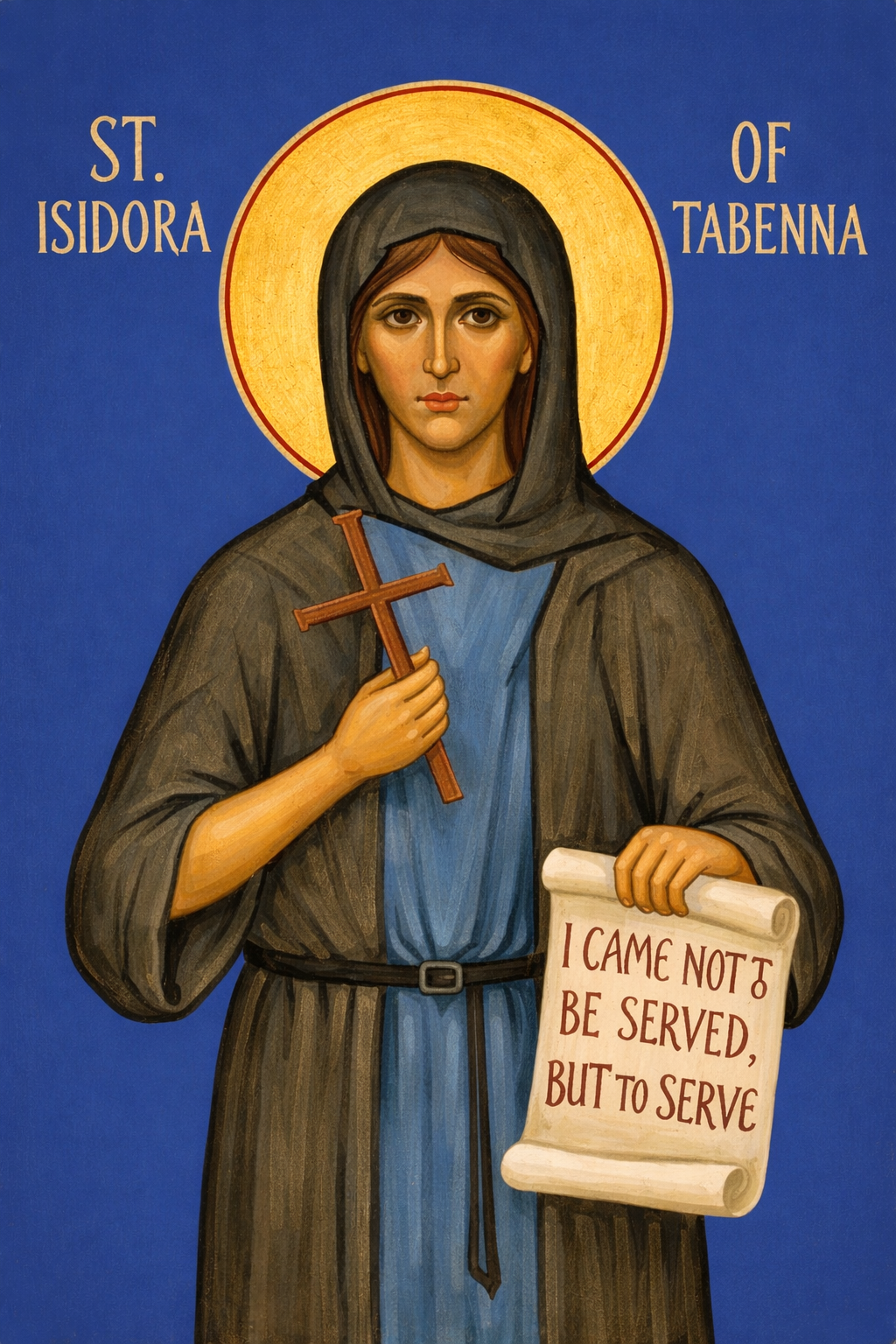
Holy Fool for Christ | Desert Ascetic | Hidden Saint of Humility
Saint Isidora of Tabenna is one of the most quietly powerful saints of the early Christian desert, especially beloved by those seeking healing from emotional wounds, deliverance from humiliation or abuse, and inner peace after long seasons of rejection.
Living in a women’s monastery in fourth-century Egypt, Saint Isidora deliberately took upon herself the appearance of madness and degradation. She became the servant of all, endured ridicule without protest, and hid her holiness beneath silence and humility. Only after a holy monk was divinely sent to expose her sanctity did the world learn what heaven already knew.
Her feast is traditionally commemorated on May 1.
Saint Isidora teaches that God sees what others despise, and that hidden suffering offered in love becomes radiant in eternity.
This handmade prayer card honors her profound humility with museum-quality craftsmanship, created for quiet prayer, healing reflection, and remembrance. It is not merely devotional art. It is a spiritual heirloom.
A hidden saint among desert nuns
Isidora’s life offers one of the earliest recorded examples of holy foolishness within Christian monasticism, and her witness is especially important because it unfolds entirely within a women’s community. Living at a monastery in Tabenna, Isidora deliberately placed herself at the very bottom of communal life, choosing invisibility over recognition and humiliation over comfort.
She dressed in rags, wore a cloth on her head to appear deranged, and accepted only the most degrading tasks within the convent. She cleaned refuse, washed dishes, and drank leftover dishwater, allowing herself to be treated as a servant rather than a sister. The other nuns regarded her as mentally unstable and frequently mocked her, assigning her work no one else wanted while excluding her from ordinary fellowship.
Isidora never defended herself.
Instead, she transformed rejection into prayer.
Beneath her outward degradation lived a profound interior discipline shaped by fasting, vigilance, and unceasing remembrance of God. She carried insults silently, offered her labor as worship, and embraced obscurity as spiritual shelter.
Her sanctity remained hidden until the hermit Pitirim received a divine vision revealing her holiness. When he arrived at the monastery and prostrated himself before Isidora, the community was stunned. Only then did the nuns realize that the woman they had dismissed as insane had been spiritually superior to them all.
Overwhelmed with shame, they begged her forgiveness.
Isidora responded not with explanation or vindication, but by fleeing the monastery entirely, disappearing into obscurity to avoid praise.
A foundational witness for women in holy foolishness
Isidora’s life establishes that holy foolishness was never exclusively male, nor limited to public street ascetics. Her vocation unfolded quietly behind convent walls, expressed through menial labor, silent endurance, and deliberate invisibility. She did not wander marketplaces or confront rulers. Instead, she practiced holy foolishness through radical humility inside structured religious life.
Her example demonstrates that this calling transcends gender, culture, and external form.
What defines holy foolishness is not dramatic behavior, but the willingness to be misunderstood for Christ.
Isidora reveals that women, no less than men, embraced this severe path in the early Church. Her story also shows that holy foolishness does not require public spectacle to carry spiritual authority. Sometimes it lives in kitchens, laundry rooms, and forgotten corners of monasteries, quietly reshaping communities through hidden sacrifice.
Isidora of Tabenna stands as a foundational witness that God entrusts immense spiritual power to those willing to disappear completely. Through rags, ridicule, and silence, she became a living sermon on humility, proving that the deepest sanctity often wears the least impressive face.
Later and modern holy fools
Saint Feofil (Theophilus) of Kiev († 1853)
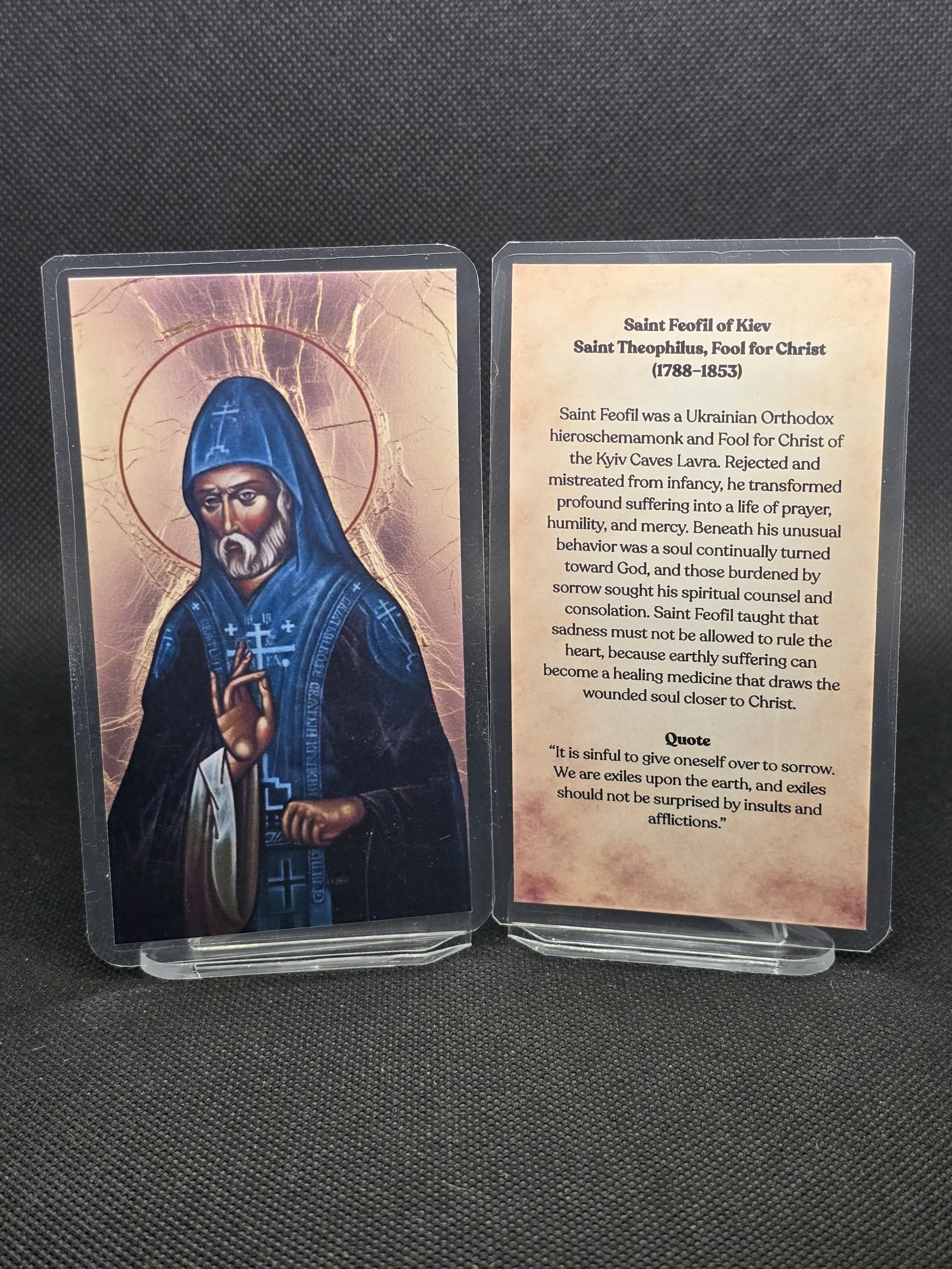
Holy Fool for Christ | Hidden Ascetic | Wonderworking Intercessor
Saint Feofil (Theophilus) of Kiev stands among the hidden giants of Eastern Christianity, a Fool-for-Christ whose entire life became a living sermon of humility, repentance, and fearless truth. Dwelling in spiritual proximity to the holy caves of Kyiv Pechersk Lavra, he embraced poverty, ridicule, and obscurity so completely that many mistook him for mad. Yet behind that outward simplicity burned a soul fully consumed by God.
His feast is traditionally commemorated on October 28 (Old Style) / November 10 (New Style), and faithful Christians continue to seek his intercession for healing, spiritual clarity, and deliverance from deception. Saint Feofil is powerful not because he held titles or preached from pulpits, but because he crucified pride daily and allowed Christ to live openly through weakness.
This handmade prayer card honors that hidden holiness through museum-quality craftsmanship, created to be prayed with, contemplated, and passed down. It is not merely a devotional card. It is a spiritual heirloom.
From disciplined monk to radical interior repentance
Feofil began his spiritual journey within the ordered life of Orthodox monasticism. He was tonsured a monk at the Kitayev Hermitage, where he devoted himself to prayer, fasting, and obedience under spiritual guidance. Later, he entered the Kiev Pechersk Lavra, immersing himself in one of Eastern Christianity’s most venerable centers of ascetic life.
As his inner struggle deepened, Feofil developed a strong desire for greater solitude and requested permission to withdraw into a cave for uninterrupted prayer. His abbot, discerning that Feofil’s calling would unfold differently, refused this request. Rather than resisting or becoming discouraged, Feofil accepted the decision in obedience and began seeking another way to empty himself before God.
Instead of retreating into physical isolation, he descended into spiritual obscurity. He embraced holy foolishness as his new form of asceticism, choosing symbolic humiliation and visible disorder over hidden withdrawal.
Embodying disorder as spiritual medicine
Feofil deliberately adopted behaviors that appeared irrational to the outside world. He wore mismatched clothing, intentionally presenting himself as disheveled and strange. He allowed his cell to remain cluttered and chaotic, explaining that this visible disorder reminded him continually of his own interior sins and spiritual fragmentation.
At times he rode through Kyiv in a cart pulled by an unyoked bull, chanting psalms aloud as startled passersby watched in confusion. To ordinary citizens this looked absurd and humiliating. For Feofil, it was embodied repentance, a living sermon against pride and self-importance that proclaimed Scripture while dismantling his ego.
His foolishness was never random.
By day he appeared eccentric and unstable, while by night he stood before God in prayer and tears. He accepted mockery without explanation, allowing himself to be misunderstood so that praise could never attach itself to his soul.
Hidden charity beneath strange behavior
Despite his outward eccentricity, Feofil lived a life of quiet mercy. He knitted stockings for iconographers and artisans, then sold them discreetly and gave the proceeds to the poor. He avoided recognition for these acts, preferring that his charity remain invisible.
His generosity was steady and intentional. He sought out those in need, assisted struggling families, and offered material help wherever possible, all while maintaining the appearance of a confused ascetic. His foolishness served as protection, ensuring that compassion never became a source of pride.
Those who encountered him privately often discovered gentleness and clarity beneath his strange exterior. He listened attentively, prayed sincerely, and offered comfort without theatrics. His humility made people feel safe, and many sensed that he carried no judgment, only quiet concern for their souls.
Clairvoyance, prophecy, and spiritual discernment
God granted Feofil extraordinary spiritual gifts that gradually became impossible to conceal. During confession, he sometimes named people’s sins before they spoke, doing so gently and with compassion, always leading them toward repentance rather than shame. He foretold personal hardships and larger disasters, not to frighten others, but to prepare them spiritually.
He also helped people recover lost belongings, guiding them with remarkable accuracy to items they had abandoned hope of finding. These manifestations of clairvoyance were consistently paired with humility. Feofil avoided discussion of such gifts and redirected attention away from himself, encouraging prayer and trust in God.
Miracles unfolded quietly around him, yet he remained hidden within them. His aim was never to impress, but to heal.
Death and continuing intercession
Feofil reposed on October 28, 1853, after years of living holy foolishness through symbolic humiliation and unseen prayer. By the time of his death, many faithful already recognized that the strange monk who rode through Kiev chanting psalms had been spiritually carrying their city.
After his repose, people continued experiencing his help through visions, healings, and answered prayers. His intercession did not cease with death, confirming that his outward foolishness had been the vessel of genuine spiritual authority. Devotion to Feofil spread among those who remembered his humility, charity, and quiet compassion.
His memory became woven into Kiev’s spiritual landscape, standing as a testimony to a life surrendered entirely to God.
A theology of embodied repentance
Feofil of Kiev represents the inward-facing dimension of holy foolishness. Unlike saints who confronted rulers or dramatized civic sin, Feofil turned disorder inward, using physical symbolism to wage war against pride and spiritual complacency. His cluttered cell, mismatched clothing, and strange journeys through the city were all expressions of embodied repentance.
His life teaches that holy foolishness does not always manifest through dramatic prophecy or public confrontation. Sometimes it unfolds through symbolic self-abasement, hidden charity, and unwavering obedience. God denied Feofil the cave he requested, but gave him the streets instead, allowing his prayer to move among ordinary people rather than remain hidden underground.
Through humility, disorder, and unseen love, Feofil became a living prayer for Kiev. His witness reminds us that God often entrusts His deepest work to those willing to look ridiculous for Christ, transforming confusion into repentance and humiliation into grace.
Saint Abd el‑Masih al‑Manahry (1892 – 1963)
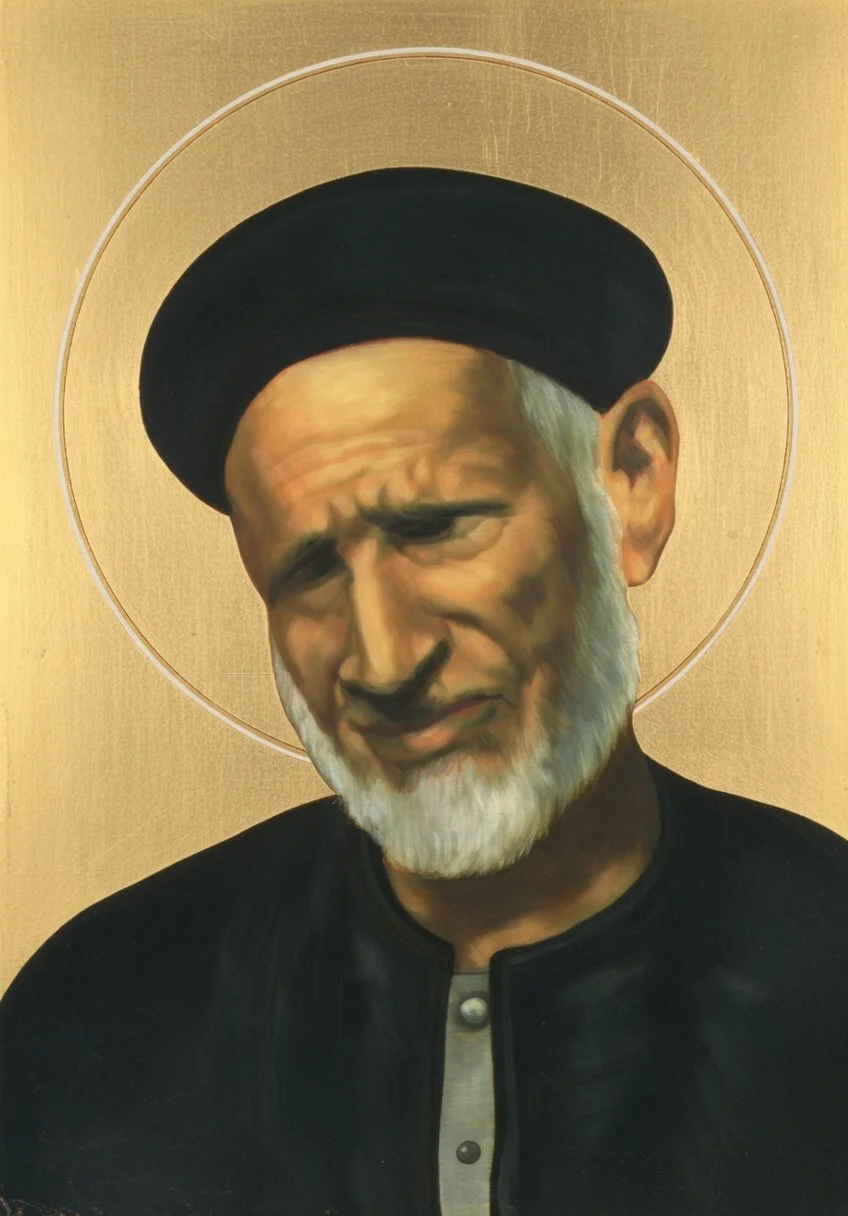
Ascetic of Egypt | Hidden Servant | Witness of Radical Devotion
Saint Abd el-Masih al-Manahry is one of the modern wonderworking martyrs of Egypt, beloved today for powerful intercession in incurable disease and cancer, impossible medical cases, and desperate family crises. A quiet government clerk who lived an ordinary life of prayer and charity, he was martyred in the early 20th century and almost immediately became known throughout Egypt for miraculous healings that doctors could not explain.
His feast is traditionally commemorated on June 16 (Coptic Calendar).
People come to Saint Abd el-Masih when medicine has failed, when diagnoses feel final, and when families are overwhelmed by suffering. Again and again, testimonies speak of tumors disappearing, paralysis lifting, and terminal cases reversing through his prayers.
This handmade prayer card honors this modern healer of Christ with museum-quality craftsmanship, created for those moments when faith is all that remains. It is not merely devotional art. It is a spiritual heirloom.
A modern witness from the Coptic desert tradition
Abba Abd el-Masih represents one of the rare modern expressions of holy foolishness within the Coptic Orthodox Church, showing that this ancient vocation did not disappear with medieval Russia or Byzantium. He was born in the village of Manahra, Egypt, into a traditional Christian family shaped by prayer and simple devotion. From early adulthood he demonstrated a deep attraction to monastic life, eventually entering the monastery and embracing ascetic discipline.
After years of spiritual formation, he was sent to serve in the village of Tamouh, where his quiet holiness began drawing attention. Like many authentic Fools for Christ before him, Abd el-Masih became concerned that growing respect might endanger humility. Rather than allowing admiration to take root, he deliberately adopted holy foolishness as spiritual protection.
He chose obscurity over honor.
He chose misunderstanding over praise.
Feigned madness as spiritual concealment
To hide his sanctity, Abba Abd el-Masih began behaving in ways that appeared irrational and childish. He publicly asked to be married despite having embraced monastic life, confusing villagers and reinforcing the impression that he was unstable. He encouraged children to sing songs mocking him as a fool and even distributed money to them so that they would continue ridiculing him openly.
These actions were not signs of psychological instability.
They were deliberate acts of spiritual self-emptying.
By inviting mockery, Abd el-Masih dismantled any growing reputation for holiness and ensured that people would not elevate him. He understood that humiliation preserved purity of heart, and that ridicule could serve as armor against pride.
Outwardly, he appeared foolish.
Inwardly, he lived in continual prayer.
Like earlier holy fools, he maintained a double existence. In public he cultivated disorder and absurdity, while in private he practiced intense asceticism, fasting, and silent communion with God. His foolishness allowed him to move freely among people without being burdened by expectations or honor.
Prophetic insight and spiritual authority
Despite his efforts to remain hidden, God granted Abba Abd el-Masih gifts that could not remain entirely concealed. He possessed prophetic insight and foretold significant historical and ecclesial events. Among his most notable predictions were the exile of Farouk of Egypt and the ordination of Pope Kyrillos VI, both of which later occurred exactly as he had indicated.
He also offered spiritual counsel to those who approached him sincerely, often discerning unspoken struggles and quietly guiding souls toward repentance and peace. Like all true Fools for Christ, he never used prophecy to elevate himself. He avoided discussion of his insights and redirected attention toward prayer and trust in God.
Miracles and answered prayers were reported through his intercession, though he consistently refused acknowledgment. His goal remained unchanged: to disappear behind Christ.
Death and continuing veneration
Abba Abd el-Masih reposed in 1963, having spent years offering humiliation as prayer and prayer as service. By the time of his death, many Coptic Christians already recognized that the man who had invited children to mock him had been quietly carrying their burdens before God.
After his repose, devotion to him continued, and he became widely venerated as a Fool for Christ within the Coptic tradition. Faithful believers sought his intercession, remembering his humility, prophetic clarity, and hidden compassion.
His life stands as powerful testimony that holy foolishness is not limited to any single culture or era.
A bridge between ancient and modern holy foolishness
Abba Abd el-Masih reveals that the vocation of holy foolishness persists even in the modern world. His life mirrors the patterns seen in Simeon of Emesa, Xenia of Saint Petersburg, and Pelagia of Diveyevo, demonstrating the same rhythm of humiliation, concealment, prayer, and prophetic insight.
He teaches that holy foolishness is not theatrical eccentricity.
It is spiritual warfare fought through humility.
Through childish songs, strange requests, and deliberate ridicule, Abd el-Masih carried an entire community before God. His witness reminds us that sanctity does not require medieval streets or imperial cities. It can flourish in small Egyptian villages, expressed through laughter, mockery, and quiet tears offered in secret.
He stands as living proof that God still entrusts profound spiritual authority to souls willing to look ridiculous for Christ, transforming embarrassment into intercession and foolishness into grace.
St Gabriel (Goderdzi) Urgebadze of Georgia (1929 – 1995)


Monastic calling under Soviet persecution
Gabriel Urgebadze entered monastic life in Soviet-controlled Georgia during one of the most openly hostile periods toward Christianity in modern history. From the beginning, his spiritual journey unfolded beneath surveillance, pressure, and constant threats against religious expression. Despite this environment, Gabriel devoted himself to prayer, fasting, and obedience with unusual intensity, refusing to compromise his faith for safety or acceptance.
His devotion soon moved beyond quiet monastic discipline into visible confession. In 1965, during a public state celebration, Gabriel set fire to a banner bearing the image of Vladimir Lenin, openly condemning communism as godless tyranny. Authorities expected execution, but instead declared him mentally unstable and confined him to a psychiatric hospital, where he endured harsh treatment designed to crush both body and spirit.
Rather than breaking him, this experience deepened his resolve. He emerged physically weakened but spiritually unshaken, carrying persecution as part of his vocation and understanding that his path would require humiliation rather than honor.
After his release, church authorities were pressured to forbid him from serving publicly as a priest. Cut off from normal ministry, Gabriel did not retreat into bitterness. Instead, he embraced holy foolishness as his new form of witness, choosing apparent madness as his means of proclaiming Christ.
Entering holy foolishness in an atheistic state
Once barred from priestly service, Gabriel deliberately adopted the outward behaviors associated with holy foolishness. He began preaching loudly in public streets, rebuking passersby, and behaving erratically in ways that unsettled observers. At times he drank wine openly, reinforcing the impression that he was unstable or irresponsible, fully aware that such actions would invite mockery and dismissal.
These behaviors were not spontaneous. They were chosen.
Gabriel understood that appearing broken granted him freedom to speak truth in a society where formal religious authority was tightly controlled. His foolishness became spiritual camouflage, allowing him to confront atheism and call people to repentance while officials dismissed him as harmless.
By day, he appeared chaotic and unpredictable. By night, he stood in prayer, interceding for Georgia and its people. He accepted ridicule without defense and allowed himself to be treated as disturbed so that pride could never gain a foothold in his soul.
Like earlier Fools for Christ, he lived a double existence. Outwardly disordered, inwardly disciplined, he fasted rigorously, wept in repentance, and carried hidden suffering for others.
Life at Samtavro and radical poverty
Later in life, Gabriel became associated with Samtavro Convent, where he eventually served as spiritual father and abbot. Despite this position, he rejected comfort and authority completely. Instead of living in proper quarters, he chose a tiny hut with no heat, enduring Georgian winters in near-total poverty.
His cell contained almost nothing, and his personal possessions were virtually nonexistent. He slept on bare boards, wore worn clothing, and continued his strange public behavior, ensuring that honor never attached itself to his role. Nuns and pilgrims who approached him often encountered sharp rebukes followed by unexpected tenderness, as he spoke in riddles, jokes, and prophetic fragments that forced listeners to engage spiritually rather than intellectually.
Though outwardly abrasive, Gabriel carried deep compassion. He prayed constantly for the sick, the possessed, the addicted, and the spiritually lost. Many experienced healing through his intercession, while others received piercing insight into hidden struggles they had never voiced.
Clairvoyance, prophecy, and healing ministry
Gabriel possessed extraordinary spiritual discernment. He revealed unspoken sins, foretold personal hardships, and warned of coming trials with unsettling accuracy. People who came seeking miracles often left with repentance instead, discovering that Gabriel cared more about salvation than spectacle.
Nevertheless, healings occurred repeatedly. The sick were restored, the despairing found hope, and those burdened by demonic oppression received relief through his prayers. Gabriel never allowed fascination with miracles to replace conversion, and whenever admiration grew, he intensified his foolish behavior until people recoiled again.
He understood that spiritual authority survives only when protected by humility.
Near the end of his life, Gabriel calmly foretold the exact day of his death, preparing those close to him while continuing his daily rhythm of prayer and voluntary humiliation.
Death, relics, and modern pilgrimage
Gabriel reposed on November 2, 1995, exactly as he had predicted. After his death, devotion spread rapidly among the faithful, carried through personal testimonies of healing and spiritual consolation. In 2014, his relics were uncovered, and pilgrims began arriving in great numbers, reporting miracles and profound encounters through his intercession.
Those who visit his resting place frequently speak of peace, repentance, and renewed faith. His legacy continues not through writings or institutions, but through transformed lives and quiet testimonies of grace.
Holy foolishness in the modern world
Gabriel Urgebadze stands as one of the clearest modern examples that holy foolishness did not vanish with medieval Russia or Byzantium. His life shows that this vocation can flourish even under atheistic regimes, manifesting through ridicule, psychiatric confinement, homelessness, and prophetic courage.
Unlike earlier holy fools who confronted emperors or walked frozen rivers, Gabriel confronted communism itself. He used madness as armor, humiliation as ministry, and poverty as protest, revealing that holy foolishness remains a living tradition rather than a historical curiosity.
His witness teaches that sanctity does not depend on favorable conditions. It emerges wherever souls are willing to become nothing for Christ.
Through burning banners, shouting sermons, freezing huts, and hidden tears, Gabriel carried an entire nation before God. His life reminds us that God still entrusts profound spiritual authority to those willing to look broken, transforming ridicule into repentance and apparent insanity into grace.
Saint Agathon of Kavsokalyvia (Mount Athos, 20th century)
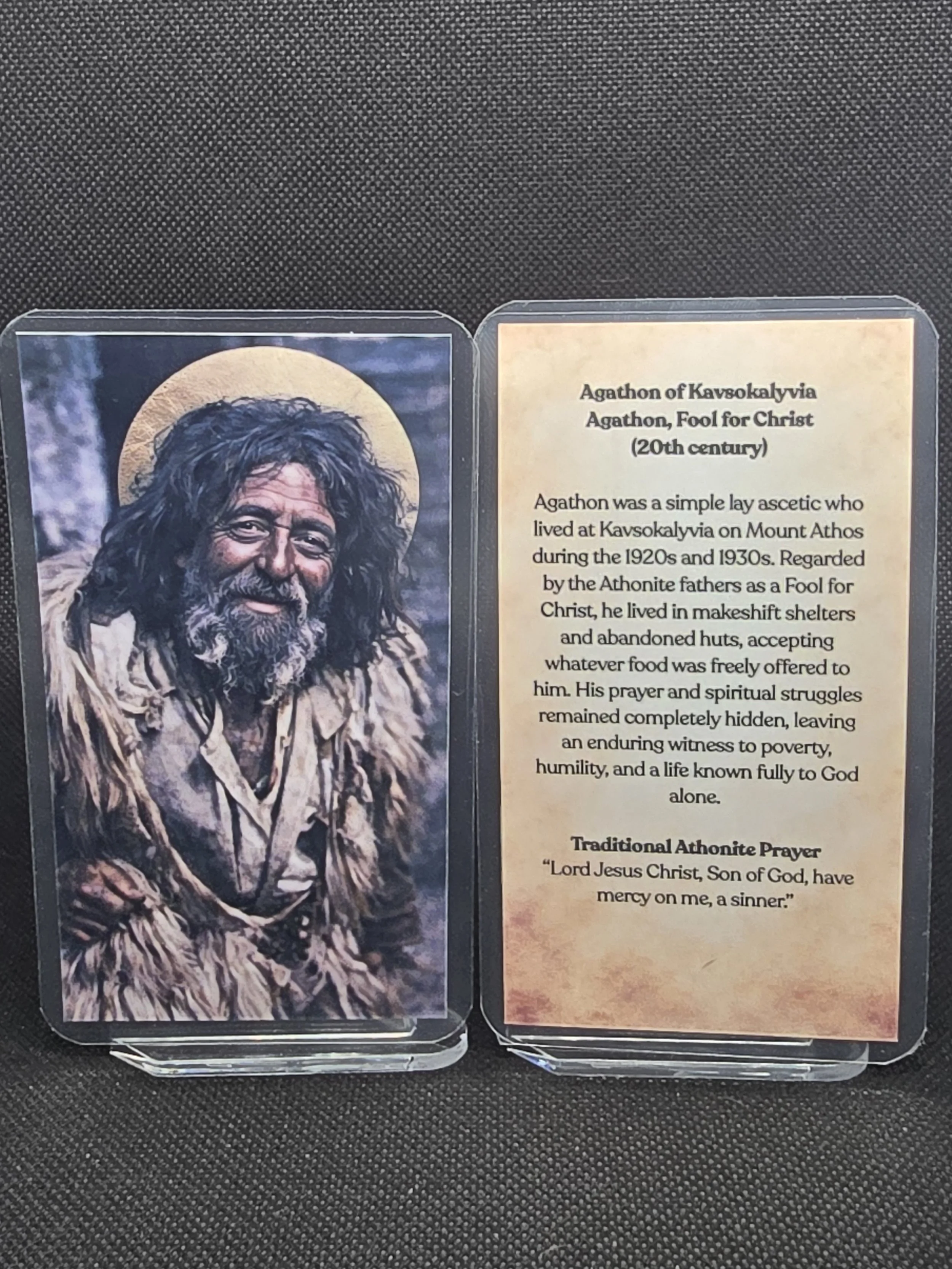
Hidden Ascetic | Hesychast Monk | Servant of Interior Prayer
Saint Agathon of Kavsokalyvia is one of Mount Athos’s quiet miracle workers, a humble hesychast whose hidden life of prayer made him a powerful intercessor for healing from serious illness, deliverance from demonic oppression, and inner peace during anxiety and spiritual darkness.
Living in deep solitude at the rugged skete of Kavsokalyvia on Mount Athos, Saint Agathon embraced poverty, silence, and continual prayer, offering his entire life for the suffering of others. Though unknown to the world, he became known in heaven.
His feast is traditionally commemorated on January 8 (Old Style) / January 21 (New Style). To this day, those battling illness, spiritual attacks, or overwhelming anxiety turn to Saint Agathon seeking Christ’s mercy through his intercession.
This handmade prayer card honors his hidden holiness with museum-quality craftsmanship, created to be prayed with in moments of weakness and kept as a sacred reminder of God’s nearness. It is not merely devotional art. It is a spiritual heirloom.
A hidden lay ascetic on the Holy Mountain
Agathon lived on Mount Athos during the 1920s and 1930s, not as a monk formally tonsured into one of the great monasteries, but as a layman dwelling on the margins of the Holy Mountain’s structured communities. His life unfolded quietly among abandoned huts and remote corners of Athos, places where few pilgrims ventured and even fewer remained.
He deliberately avoided stable residence within the established monastic houses. Instead, he moved between deserted dwellings, living in conditions that were harsh even by Athonite standards. He wandered barefoot across rocky paths and through seasonal extremes, wearing ragged clothing that reinforced his chosen invisibility.
To many who glimpsed him from a distance, Agathon appeared eccentric or unbalanced.
In truth, he was cultivating obscurity as protection for his interior life.
Concealed prayer and radical simplicity
Agathon concealed his prayer life carefully. He avoided public displays of piety and did not seek spiritual conversations or recognition from the monks around him. Those who encountered him often found him silent, withdrawn, and outwardly strange, as though detached from ordinary awareness.
His asceticism was severe. He seldom ate cooked food, sustaining himself primarily on simple, uncooked provisions and whatever minimal nourishment he could find. He accepted hunger as discipline and regarded bodily discomfort as a teacher rather than an enemy.
Though he lived on Mount Athos, a place renowned for visible ascetic feats, Agathon’s holiness was almost entirely hidden. He did not preach, write, or gather disciples. He chose instead to disappear into poverty and neglect, embodying the paradox at the heart of holy foolishness.
His strangeness was intentional.
His humility was guarded.
Recognized by elders despite obscurity
While little written documentation survives about Agathon, Athonite elders who encountered him reportedly regarded him as a Fool for Christ. These elders discerned beneath his ragged exterior a life of intense prayer and self-denial. Their recognition did not result in formal titles or public acclaim, but it preserved his memory within the spiritual consciousness of the Holy Mountain.
Agathon’s life illustrates a quieter form of holy foolishness than that of urban prophets or politically confrontational saints. He did not burn banners or rebuke rulers. He did not stage symbolic public acts. Instead, he embraced disappearance so completely that even history struggled to record him.
His witness survives primarily through oral tradition. Stories passed between monks preserved fragments of his life, suggesting a man who deliberately erased himself from visibility so that only Christ would remain.
The theology of forgotten holiness
Agathon of Mount Athos represents the most hidden edge of holy foolishness. His life demonstrates that sanctity does not require dramatic confrontation or visible miracles. It can unfold in abandoned huts, through barefoot wandering and unrecorded tears.
The absence of detailed documentation is itself part of his testimony. Holy foolishness seeks erasure of reputation, and Agathon achieved it so fully that only faint echoes of his existence remain. His memory challenges modern expectations that holiness must be cataloged, archived, or widely known to be authentic.
He reminds us that some saints are meant to be remembered clearly, while others are meant to be remembered only as whispers.
Through poverty, obscurity, and concealed prayer, Agathon embodied a living paradox. The more completely he disappeared, the more deeply he belonged to God.
Saint Asenatha of Goritsky († 1892) and other little‑known fools
A hidden witness at Goritsky Monastery
Asenatha was associated with Goritsky Monastery, where she lived during the late nineteenth century and embraced the difficult vocation of holy foolishness. She reposed in 1892, leaving behind very little written record of her life. What remains is preserved primarily through local memory and devotional tradition rather than formal biography.
Those who knew of her remembered her as a woman who chose obscurity and humiliation over comfort, quietly bearing the marks of holy foolishness within the boundaries of convent life. Like Isidora of Tabenna centuries earlier, Asenatha’s witness appears to have unfolded largely in silence, expressed through strange behavior, voluntary poverty, and hidden prayer rather than public confrontation.
Although details of her ascetic practices have been lost, the faithful in the region continue commemorating her on April 19, a testimony to the lasting impression she made on those who encountered her. Her life stands as a reminder that not all holy fools leave behind dramatic miracles or extensive documentation. Some simply leave transformed hearts and a quiet legacy of prayer.
Saints remembered by name alone
Asenatha is not unique in this regard. Throughout Orthodox history, there have been numerous regional Fools for Christ whose names survive in synaxaria and martyrologies, even though their biographies have faded with time. These saints were known locally during their lifetimes, often remembered for strange behavior, radical humility, and spiritual insight, yet their stories were never formally recorded or were lost through war, persecution, or neglect.
Among these are figures such as Anthony Alexseevich of Zadonsk (†1851), whose name appears in ecclesial lists despite the near-total absence of surviving narrative about his life. Others include Anthony Ivanovich associated with Valaam, as well as Athanasius Andreevich of Orel, whose remembrance persists only through sparse liturgical references.
These individuals likely lived in the same pattern seen across the tradition: wandering poverty, feigned madness, relentless prayer, and voluntary humiliation offered as intercession for their communities. The lack of documentation does not diminish their sanctity. Instead, it reflects the very essence of holy foolishness, which seeks erasure rather than remembrance.
The forgotten majority of holy fools
The existence of these barely remembered saints reveals something profound about the nature of this vocation. Holy foolishness does not aim to create legacy. It aims to destroy ego. Many Fools for Christ succeeded so completely in disappearing that history itself struggled to retain them.
Their lives unfolded in villages, convents, marketplaces, forests, and forgotten corners of society. They absorbed mockery, hunger, cold, and misunderstanding without leaving journals or disciples behind. Their sanctity was known primarily to God and to the few whose lives they touched directly.
In this sense, Asenatha of Goritsky and the unnamed holy fools represent the majority of this spiritual lineage. For every Xenia of Saint Petersburg or Gabriel Urgebadze whose stories spread widely, there were dozens who vanished into silence, remembered only by a feast day or a single line in a church calendar.
A theology of sacred obscurity
These little-known fools remind us that holiness does not require visibility. In fact, holy foolishness often reaches its fullest expression when a soul disappears almost entirely from historical record. Their forgotten lives embody Christ’s teaching that the greatest in the Kingdom are those who become least in the world.
Asenatha and her unnamed companions teach that sanctity does not depend on miracles being recorded or biographies being preserved. It depends on surrender. Their obscurity is not failure. It is fulfillment.
They stand as quiet witnesses to a deeper truth.
Holy foolishness is not performed for memory.
It is offered for love.
And sometimes, the most authentic saints are the ones history barely notices, whose names flicker briefly in synaxaria before returning to silence, having already accomplished everything God asked of them.
Themes and significance of holy foolishness
Holy fools share several common traits:
Radical humility – They renounced social status, wealth, and even rational reputation to battle pride. Their bizarre behaviour deflected praise and allowed them to rebuke sin without appearing self‑righteous.
Prophetic witness – Many foretold events (fires, wars, famines) and confronted rulers like Tsar Ivan IV and Emperor Boris Godunov with fearless admonitions.
Hidden charity and miracles – Despite outward foolishness they secretly fed the poor, healed the sick and interceded for the oppressed. After their deaths their relics often produced miracles.
Embodying the paradox of the cross – By becoming “fools” they embodied the paradox that God’s wisdom is folly to the world (1 Cor 3:18‑19). Their lives remind believers that true holiness often appears foolish according to worldly standards.
Conclusion
The phenomenon of the fool for Christ represents one of the most striking ascetic practices of Eastern Christianity. Holy fools like Simeon of Emesa, Andrew of Constantinople, Basil of Moscow, Xenia of St Petersburg and Gabriel Urgebadze chose to renounce not only material comforts but even their reputations to live the Gospel radically. By feigning madness they confronted injustice, comforted the suffering and manifested God’s power. Though their behaviour seemed bizarre, their lives were characterised by intense prayer, compassion and prophetic insight. Their stories continue to inspire Christians to embrace humility and remember that “the wisdom of this world is foolishness with God.”
Offer a Dedication
If this page was meaningful to you, you’re welcome to dedicate this or any educational page in memory of a loved one, for a prayer intention, or in gratitude for blessings received.
Each dedication quietly supports the continued sharing of Eastern Christian history, prayer, and the lives of the saints.