Why Orthodox and Catholics Celebrate Easter on Different Dates
Julian • Gregorian • Nicaea • Dates to 2040 • The Popes • The Orthodox Response
Why Orthodox and Catholics Celebrate Easter on Different Dates
Easter and Pascha fall on the same Sunday in some years and up to five weeks apart in others. This article explains the calendar behind the gap, lists the dates through 2040, and reports what the popes and the Orthodox have said about a shared date, including a Marian apparition that is said to ask for one.
The Answer at a Glance
- The Cause
- Most Orthodox Churches work out Pascha on the Julian calendar, and the Catholic Church and most Protestants use the Gregorian calendar • Both follow the same rule, but they apply it to different calendars
- The Gap
- The two dates are the same, 7 days apart, or 35 days apart • The Orthodox date is never earlier
- The Offset
- The Julian calendar is 13 days behind the Gregorian one from 1900 to 2099 • Julian March 21 falls on April 3
- Same Date
- 2028, 2031, 2034, 2037, and 2038 • Five weeks apart in 2027, 2032, 2035, and 2040
- Eastern Catholics
- Most keep the date of their own tradition, which for Byzantine-rite Churches is usually the Orthodox date, though practice varies by Church and region
- A Shared Date?
- Pope Francis and Pope Leo XIV have said they want one, and Patriarch Bartholomew has joined them • Other Orthodox Churches have objected
- Our Lady of Soufanieh
- A Damascus apparition not formally approved by the Church • Supporters report that it asks for one Easter
The Short Answer
Catholics and Orthodox do not disagree about whether Christ rose or about what Easter is. They compute the date on different calendars. Western Christians, Catholic and Protestant, use the Gregorian calendar. Most Orthodox Churches still compute Pascha with the older Julian calendar.
The Julian calendar has drifted from the sun, and from 1900 to 2099 it runs 13 days behind. Because the Orthodox count the spring equinox as March 21 on the Julian calendar, which is April 3 on the Gregorian, their calculation starts about two weeks later than the Western one. That is enough to push Pascha one week or five weeks after the Western Easter in most years.
The Orthodox Churches also hold that Pascha must come after the Jewish Passover, a point discussed below. The Western computation no longer ties Easter to the Jewish calendar in that way, and the two sometimes diverge.
Part II
The Rule Both Sides Follow
Both traditions keep the rule that Easter is the first Sunday after the first full moon on or after the spring equinox. The differences are in the inputs.
- The equinox. The Gregorian calendar corrected the drift of the Julian calendar in 1582, so its March 21 matches the real equinox. The Julian March 21 now falls on April 3 by the Gregorian count.
- The full moon. The Western Church uses tables of ecclesiastical moons updated with the Gregorian reform. The Orthodox use the older Julian tables, which have also drifted.
- Passover. Orthodox canons, including the Apostolic Canons and the practice of Antioch, are understood to require that Pascha follow the Jewish Passover. Modern Orthodox computation is built to respect this, and the Western method does not strictly guarantee it.
Because the Orthodox start later and use different moon tables, their Pascha can only be the same as, or later than, the Western Easter. When the two calculations land on the same Sunday the dates match. When they do not, the full moon falls just before the Western Sunday, and the Orthodox must wait for the next one. That is why the gap is either 0, 7, or 35 days, and never anything else in the current cycle.
Part III
How the Split Happened
The early dispute. In the second century some churches in Asia Minor kept Pascha on the 14th of Nisan, whatever the weekday, while Rome and others kept it on the Sunday. The Quartodeciman controversy was settled in favor of Sunday.
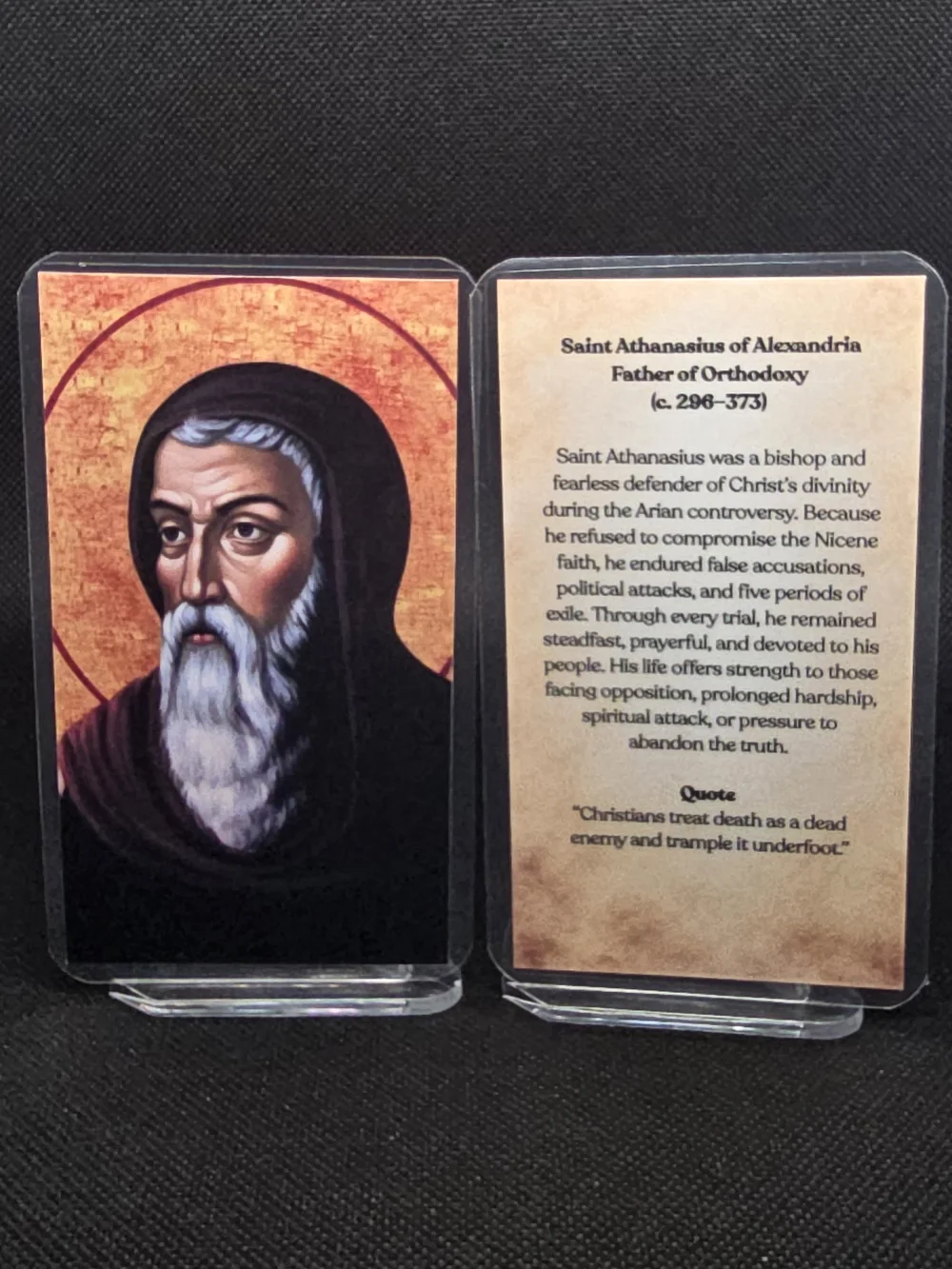
Nicaea, 325. The First Council of Nicaea is the council usually credited with fixing the date of Easter. The record is thinner than most people assume. The council's surviving canons do not give a computation, and the best evidence is the letter of the emperor Constantine, which urges one common day for all and not to follow the Jews. In practice Alexandria, with its astronomers, came to be relied on for the calculation, and the Festal Letters of its bishops announced the date each year.
Gregory XIII, 1582. By the sixteenth century the Julian calendar had drifted about ten days, so the equinox no longer fell on March 21. Pope Gregory XIII reformed the calendar, and Catholic countries adopted it quickly. Protestant and Orthodox countries took much longer, and the Orthodox Churches, with a few exceptions, never changed the Easter computation.
The Revised Julian calendar, 1923. A meeting in Constantinople proposed a calendar for the fixed feasts, such as Christmas, which matches the Gregorian one until the year 2800. Some Orthodox Churches adopted it for the fixed feasts. The same meeting left Pascha on the traditional computation, which is why a Church can keep Christmas on December 25 on the Gregorian calendar and still keep Pascha on the Orthodox date.
The split grew from the slow adoption of a reform, and after 1054 and the later divisions neither side was in a position to impose a date on the other.
Part IV
Easter and Pascha Dates, 2025 to 2040
The table below gives the Western Easter and the Orthodox Pascha for each year, with the Gregorian date used for both. The dates were computed with the standard Gregorian and Julian algorithms.
| Year | Western Easter | Orthodox Pascha | Gap |
|---|---|---|---|
| 2025 | April 20 | April 20 | Same day |
| 2026 | April 5 | April 12 | 7 days later |
| 2027 | March 28 | May 2 | 35 days later |
| 2028 | April 16 | April 16 | Same day |
| 2029 | April 1 | April 8 | 7 days later |
| 2030 | April 21 | April 28 | 7 days later |
| 2031 | April 13 | April 13 | Same day |
| 2032 | March 28 | May 2 | 35 days later |
| 2033 | April 17 | April 24 | 7 days later |
| 2034 | April 9 | April 9 | Same day |
| 2035 | March 25 | April 29 | 35 days later |
| 2036 | April 13 | April 20 | 7 days later |
| 2037 | April 5 | April 5 | Same day |
| 2038 | April 25 | April 25 | Same day |
| 2039 | April 10 | April 17 | 7 days later |
| 2040 | April 1 | May 6 | 35 days later |
In this window the two dates match in 2025, 2028, 2031, 2034, 2037, and 2038. They are five weeks apart in 2027, 2032, 2035, and 2040, and one week apart in every other year. The pattern is not a simple cycle, so check the table for the year you need.
Part V
Who Keeps Which Date
The picture is more varied than “East versus West.” As far as the sources I checked agree:
- Most Orthodox Churches keep Pascha by the Julian computation, including the Churches of Russia, Serbia, Georgia, and Jerusalem. Even Orthodox Churches that use the Revised Julian calendar for fixed feasts keep this date for Pascha.
- The Orthodox Church of Finland uses the Western date for Easter, an exception that dates from the 1920s.
- The Coptic and Ethiopian Orthodox Churches follow their own calendars but, as far as I can tell, the same Pascha date as the Orthodox in most years. The Armenian Apostolic Church is reported to follow the Gregorian computation for Easter, except in Jerusalem, so it often keeps the Western date.
- Eastern Catholic Churches generally follow the date of their own tradition, which for Byzantine-rite Churches such as the Melkite, Ukrainian, and Ruthenian is usually the Orthodox date. Practice in the diaspora and in individual parishes can vary, so ask your own parish. In the Holy Land, the Catholic communities have largely adopted the Orthodox date for common celebration, as reported by the National Catholic Register.
This is one of the practical differences between Eastern Catholics and Latin Catholics. See our beginner’s guide to Eastern Catholics and Orthodox and how Eastern Catholics differ from Roman Catholics for more, or the side-by-side comparison of all four.
Part VI
The Popes on a Shared Date
Earlier proposals. The question is old. In 1997 a consultation of the World Council of Churches in Aleppo proposed that all Christians compute Easter by the astronomical equinox and full moon as observed from Jerusalem, a formula that would remove the calendar problem. It was not adopted by the member Churches.
Pope Francis. Pope Francis repeatedly said he was ready to agree on a common date. In June 2015 he said, in remarks reported by the Catholic press, that he was willing to accept any reasonable proposal from the Orthodox. In 2025 Easter fell on the same day for both traditions, which many commentators took as a reason to press for a common date. Francis died on April 21, 2025, the day after that Easter.
Pope Leo XIV. In 2025, the 1,700th anniversary of Nicaea, Pope Leo XIV traveled to Turkey. On November 29, 2025, at the Phanar in Istanbul, he and Ecumenical Patriarch Bartholomew signed a joint declaration. As reported at the time, the declaration spoke of their desire for unity and for a common date of Easter.
Jerusalem, 2033. Many commentators have noted that 2033 will mark 2,000 years since the Passion and Resurrection of Christ, and that this would be a fitting year to keep Easter together. Whether the Churches will be ready by then is an open question.
What Rome has offered. The Catholic side has said repeatedly that it is willing to adjust, and has offered to accept the date of the Orthodox if they would agree to one. The difficulty has never been Rome’s willingness to change, but whether the Orthodox Churches can act together.
Part VII
The Orthodox Response
The Orthodox are not of one mind, and no one Church can speak for all of them. What has been reported:
- Constantinople. Ecumenical Patriarch Bartholomew has welcomed a shared date, and has linked it to the Nicaea anniversary. He has said that the question could not be decided by Constantinople alone.
- Antioch. Syriac Orthodox Patriarch Ignatius Aphrem II has spoken in favor of a common date.
- Alexandria. Pope Tawadros II of the Coptic Orthodox Church has been reported as open to the idea, with the condition that the date respect the tradition of the Fathers.
- Moscow. In 2015 Father Nikolai Balashov of the Russian Church’s department for external relations was reported to say that there was no prospect of a change in the Russian Church, and that a change would need a Pan-Orthodox decision. The Russian Church was also not represented at the Nicaea anniversary event in Iznik.
The objections fall into three groups:
- The canons. Many Orthodox believe that Pascha must follow Passover, and that the Western method breaks that rule. A shared date that ignores Passover would not be acceptable to them.
- Unity of the calendar. Changing the Julian reckoning of Pascha would split many Orthodox communities, as the 1920s calendar changes did, and the memory of those divisions is strong.
- Primacy and trust. Some fear that a shared date would look like submission to Rome. Where Eastern Catholics have been seen as having been pulled away from the Orthodox, the suspicion is deeper.
For that reason most proposals now seek a date that both sides could accept for reasons of their own, usually by the Jerusalem-based astronomical method, or by the Orthodox date. Neither has yet been agreed.
Part VIII
Our Lady of Soufanieh and the Unity of Easter
Several readers have asked about a Marian apparition that is said to call for one date for Easter. The case that fits is Our Lady of Soufanieh, in a neighborhood of Damascus, Syria.
The facts, as the sources give them. On November 22, 1982, an icon of Our Lady in the home of Nicolas and Myrna Nazzour began to exude oil. Myrna, a Melkite Greek Catholic married to an Orthodox man, then reported visions and messages. Supporters describe the phenomenon as an Eastern ecumenical sign, with Orthodox and Catholic clergy and faithful involved from the start.
The Easter message. According to the sources that publish the messages, the appearances emphasize the unity of Christians, and they include a call that Christians celebrate Easter together on one day. I could not verify the exact wording from an authoritative source, so please treat the wording as reported and not as certain.
Church status. I could not find a formal approval of the apparitions by the Melkite Church, the Greek Orthodox Patriarchate of Antioch, or the Holy See. Church leaders in Syria have shown interest and, according to supporters, visited, but interest is not approval. Under the 2024 norms of the Dicastery for the Doctrine of the Faith, the Church may permit devotion without judging the apparition supernatural, as it did for Medjugorje.
Are they still occurring? The latest message listed on the sources I found is dated 2014, and I could not confirm that apparitions continue today. If you know of a recent report, check it against the visionary’s own community and the local bishop.
How to weigh it. Since the Church has not approved the phenomenon, you are not required to believe it. A call for Christian unity and for a shared Easter is in line with what the popes and patriarchs have said, so one need not accept the apparition to pray for the same thing. See our guide to testing a spirit, Our Lady of Zeitoun for an Eastern apparition that the Coptic Orthodox Church did affirm, and our article on Marian apparition prophecies.
Part IX
Prayers
Christ is risen from the dead, trampling down death by death, and upon those in the tombs bestowing life.
Sung by Orthodox and Byzantine Catholic Christians from Pascha until the Ascension, whichever date they keep.
Lord Jesus Christ, risen from the dead, You prayed that Your disciples might be one. Heal the divisions that keep us from rejoicing on the same day, and give our shepherds humility and patience. Where we cannot agree on a calendar, let us agree on love.
Mother of God, who stood by the Cross and rejoiced at the Resurrection, pray that Your Son's Church may sing together one day, Christ is risen. Through the prayers of the myrrh-bearing women and all the saints, have mercy on us. Glory to You, with the Father and the Holy Spirit, now and forever. Amen.

Part X
Cards and Shirts
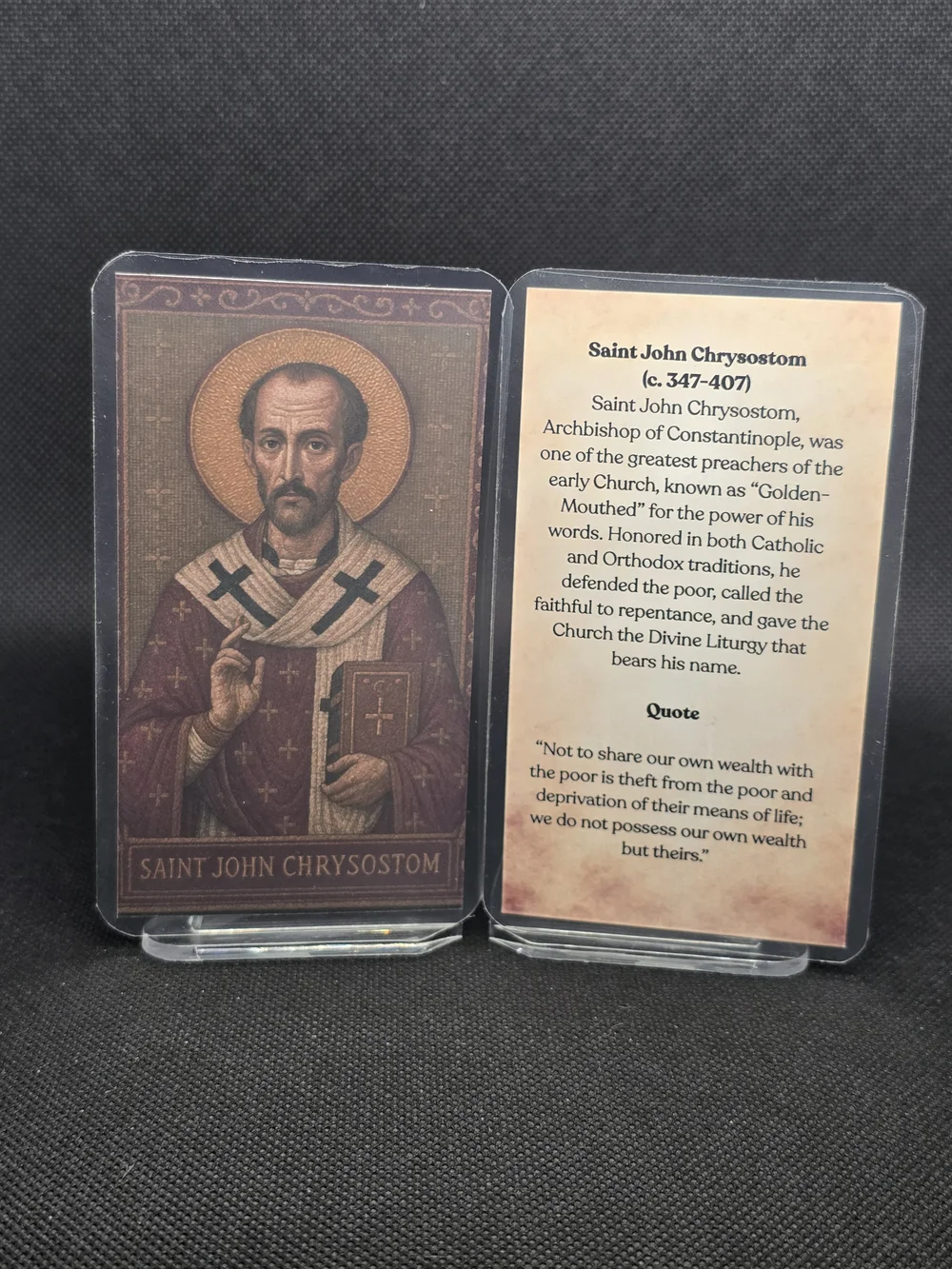
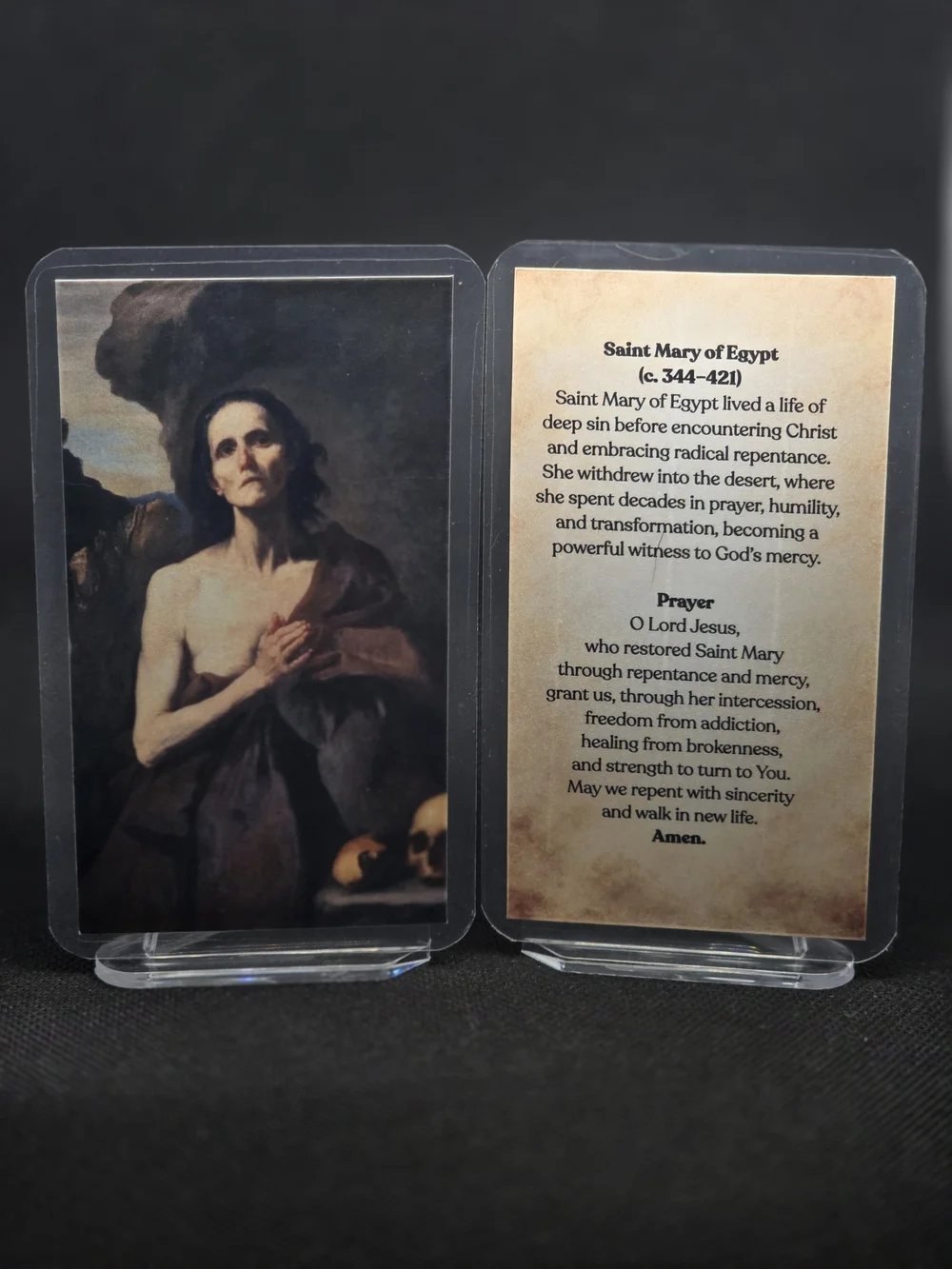
These cards honor the witnesses of the Resurrection and the saints of the Paschal season. If you want a book on the wider story, A History of Eastern Christianity is a good place to start.
Three handmade cards for those who saw the empty tomb and the risen Lord.
The preacher of the Paschal homily, the desert mother of the Great Fast, and the Alexandrian bishop who announced the date of Easter.
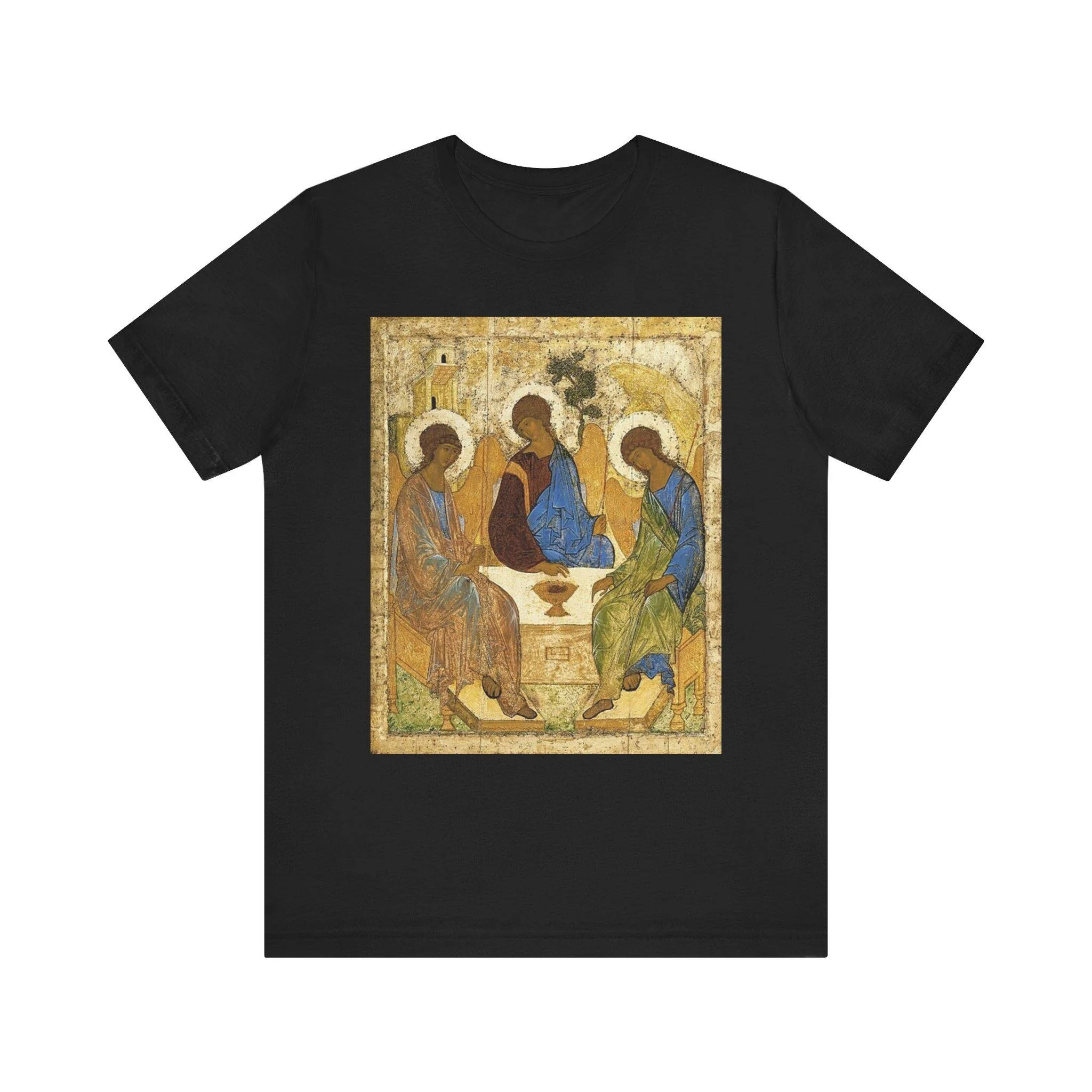
Three shirts for the faith that Orthodox and Catholics share.
The book link on this page is an Amazon affiliate link. If you buy through it we may earn a small commission at no extra cost to you.
One Lord, Two Calendars
Whichever date your parish keeps, the feast is the same: Christ is risen. If you are building a prayer corner for the Paschal season, our handmade prayer cards are a good place to begin.
Appendix