Dementia and the Catholic Faith: How to Pray With a Parent Whose Memory Is Fading
Caring for Aging Parents • Catholic & Eastern Catholic • For Families Who Are Grieving While They Care
Dementia and the Catholic Faith: How to Pray With a Parent Whose Memory Is Fading
If you are mourning someone who is still alive, you are not alone and you are not failing. The Church has prayers that need no memory, sacraments that do not depend on understanding, and a settled conviction that your parent is still known and loved by God.
At a Glance
- Who This Is For
- Adult children and spouses of Catholic and Eastern Catholic parents with dementia
- Core Truth
- A person with dementia keeps full human dignity and remains a baptized child of God
- Best Prayers
- Short and familiar: Sign of the Cross, Our Father, Hail Mary, rosary, old hymns
- Holy Communion
- Generally given if the person can tell the Eucharist from ordinary food, shown by gesture or reverence. Doubt favors the person.
- Confession
- Absolution possible if the person can have some sense of contrition, even without words
- Anointing of the Sick
- Not dependent on understanding. Call the priest early.
- Eastern Catholics
- Same Catholic teaching, with your own rite’s practices. Section included below.
- For You
- Free help: Alzheimer’s Association Helpline 1-800-272-3900, available 24 hours
The Grief No One Warns You About
The hardest part of dementia is that the person you love is still here, and also is not. Your mother asks the same question for the fifth time in an hour. Your father looks at you kindly and calls you by your brother’s name. A woman who once ran a household, a parish bake sale and half a neighborhood cannot find the word for “spoon.” You grieve, and then you feel guilty for grieving, because she is not dead. Many caregivers describe it as mourning in installments.
If that is where you are, we want to say first what we hope no one has said badly: this is not your failure, and it is not a failure of faith. It is one of the heaviest crosses a family can carry, and the Church has not left you without help. She has prayers that need no memory, sacraments that do not depend on being able to explain them, and a settled conviction that your parent is still a person made in the image of God, loved by Him and known by Him, whatever the disease takes.
This article is a practical companion for praying with a Catholic parent whose memory is fading. It covers what the Church teaches, how to pray in a way your parent can still join, what to ask of the priest, and how to take care of yourself while you do it.
Part II
What Is Still There: The Person Behind the Disease
The Church’s teaching on the human person does not depend on what a person can do. A man with advanced dementia has the same dignity as the man who once chaired the meeting, because that dignity comes from God, not from memory, speed or usefulness. He remains a baptized child of God, and nothing the disease does can undo what Baptism did.
Many families notice something that confirms this in daily life. A mother who no longer knows the year may still sing every verse of a hymn she learned as a girl. A father who cannot dress himself may stand reverently when the rosary starts. The Hail Mary, the Our Father and the Sign of the Cross were learned so early and repeated so often that they live deeper than ordinary memory, and they are often among the last things to go. Caregivers who pray with people with dementia commonly report that many join in the familiar prayers even when they cannot say their own name.
There is a theological comfort here too. We do not rely on our own memory of God. He remembers us. The Church has always understood that our relationship with Him rests on His fidelity, not on how well we are able to hold onto Him.
Part III
How to Pray With a Parent Whose Memory Is Fading
Caregiving guidance on dementia is remarkably consistent: speak slowly, use short sentences, one idea at a time, stay calm, and don’t quiz. The same principles make prayer easier. You are not teaching, testing or correcting. You are simply keeping company.
- Pray short and familiar. The Our Father, the Hail Mary, the Glory Be and the Sign of the Cross are better than a long novena. One decade of the rosary, or even a single Hail Mary, counts.
- Pray the same prayer at the same time. Routine is calming, so link prayer to something that already happens: after breakfast, before the evening meal, at bedtime.
- Use the senses. Hold a rosary or a crucifix in their hand. Light a candle if it is safe. Keep a familiar holy picture where they can see it. Familiar music, scents and objects are among the most dependable ways to reach a person with dementia.
- Sing. Old hymns and Marian songs often outlast almost everything else. Even humming a tune can bring peace to a restless afternoon.
- Let them lead, or not. If your parent wants to pray, join. If they are agitated or tired, simply sit with them, hold their hand, and pray silently yourself.
- Do not quiz. Avoid “Do you remember this prayer?” Just begin it, and see whether they join.
- Watch the time of day. Many people with dementia become restless and confused as daylight fades, a pattern called sundowning. Plan prayer and activities earlier in the day when your parent is calmer, and keep the late afternoon quiet and gentle.
Part IV
The Sacraments When Your Parent Can No Longer Explain Them
Families often worry that a parent with dementia has “lost” the right to the sacraments, or that receiving them without understanding does harm. The Church’s guidance is generous. In 1995 the U.S. bishops published guidelines for celebrating the sacraments with persons with disabilities, and priests commonly apply the same principles to dementia. What follows is the general pattern. Because every case differs, your parent’s priest is the one to decide.
Holy Communion
The usual test is whether the person can tell the Eucharist from ordinary food, in other words, whether they seem to recognize that this is something special and holy. That recognition does not have to be put into words. A gesture, a reverent silence, or a calm and attentive manner is enough. The guidelines add that in cases of doubt the matter should be resolved in favor of the baptized person’s right to receive. If your parent wants to receive and shows reverence, they should be given the benefit of the doubt. If a person repeatedly takes the host in and out of their mouth without swallowing it, a priest will usually offer a blessing instead, which is a gift of its own.
Confession
A priest may give absolution to a person who is capable of having some sense of contrition for sin, even if they cannot name their sins in words. The Church has always taught that responsibility for an act is lessened when a person’s understanding or freedom is impaired, and a person with dementia is not held accountable for what the disease causes. Priests often use a brief, gentle form: a simple examination of conscience, a prayer of sorrow, and absolution. Near death the priest may also give the Apostolic Pardon. The ultimate judgment of a soul belongs to God, who sees into the heart.
Anointing of the Sick and Viaticum
The Anointing of the Sick is a sacrament of strength and comfort for the seriously ill and the frail elderly, and it does not depend on the person understanding it. The Catechism notes that it can bring forgiveness of sins to a sick person who was not able to obtain it through Confession (CCC 1532). Do not wait for the final hours. For a fuller explanation of what the sacrament is, who may receive it, and how to call a priest, read our article on the Anointing of the Sick. When death is near, Viaticum, Holy Communion for the journey, completes the Church’s care.
Mass at Home or in the Facility
If your parent cannot get to church, ask the parish about a regular visit from a priest, deacon or extraordinary minister of Holy Communion. Many parishes have a homebound ministry. If your parent lives in a care facility, ask about its chaplain and Mass schedule. Our article on choosing a Catholic or Orthodox care home lists the questions to ask.
Part V
For Eastern Catholic Families
If your parent belongs to an Eastern Catholic Church, everything above about dignity, prayer and the sacraments still applies, because you are in full communion with Rome and the same Catholic moral teaching governs. What differs is the style of prayer and the details of the rites.
The Eastern Churches have always held that the Eucharist is not reserved for those who can explain it. They give Holy Communion to the newly baptized and chrismated, even infants (CCC 1244). That conviction often makes Eastern priests especially welcoming toward parishioners with dementia. Eastern Catholic prayer also suits memory loss well: the Jesus Prayer, the Trisagion, the Sign of the Cross made slowly, familiar hymns in the language of childhood, a prayer rope or icon held in the hand. If your parent grew up praying in Ukrainian, Arabic, Slavonic, Syriac or Greek, hearing it can reach them when English no longer does.
Call your own Eastern Catholic priest about Communion, Confession and the Anointing, since he will follow the practice of your church. If no Eastern priest is available nearby, a Latin Catholic priest can minister to an Eastern Catholic under Catholic law, though many families work hard to keep their parent connected to their own tradition.
Part VI
The Hard Moments: Agitation, Accusations, and Not Being Recognized
Every family reaches the day a parent does not know them. It can feel like a bereavement on a Tuesday afternoon. It can also come with anger, suspicion, accusations of theft, or words that wound. Please hear this: the disease is speaking, not your parent’s heart.
- Do not argue or try to reason. Correcting an impossible belief usually increases distress. Stay calm, offer reassurance that they are safe and you are there, and change the subject or the setting.
- Look for the unmet need. Check for pain, hunger, thirst, an uncomfortable position or a bathroom need. Agitation is often the only way a person can say something hurts.
- Acknowledge the feeling. “You sound worried.” “That must be frightening.” Naming the emotion often does more than answering the question.
- Introduce yourself gently. If they don’t know you, say your name and your relationship without making it a test: “It’s Anne, your daughter. I’m so glad to see you.”
- Step away if you need to. If your parent is safe, it is acceptable to leave the room for a few minutes to breathe and pray.
- Call the doctor if hitting, biting, deep depression or hallucinations get worse. Sudden changes can also signal infection or a medication problem, which are treatable.
You may be tempted to tell a suffering parent to “offer it up.” Most days, don’t. They may not be able to hold the thought. Offer it up yourself on their behalf, and let your prayer carry what they cannot. The Church has always taught that we can pray and suffer for one another. Quietly give your tired afternoon, your patience and your tears to God for your parent.
Part VII
For the Caregiver: Guilt, Burnout and Asking for Help
Caregivers of people with dementia carry one of the highest burdens of any family role. They lose sleep, friends, income and often their own health. Many feel they must do everything themselves or they are failing the Fourth Commandment. The Church does not teach that. Honoring your parents means ensuring they are safe, loved and accompanied, and it can include admitting that you need help or that your parent needs a level of care you cannot provide alone.
Help is available and using it is not a failure. The Alzheimer’s Association runs a free 24/7 Helpline at 1-800-272-3900 that offers information, care planning, help finding services and emotional support. Ask your parish about a respite program, a Saint Vincent de Paul conference, or a parishioner who could sit with your parent for a few hours. Tell your priest how you are really doing. If the exhaustion becomes hopelessness, please speak to a doctor or counselor as well.
If the time comes when memory care or a nursing home is safer than home, read our article on choosing a Catholic or Orthodox care home. Choosing good care is not abandonment. It is one of the ways love acts when love alone is no longer enough.
Part VIII
Prayers You Can Say With Your Parent, and for Yourself
Lord Jesus, you know my mother (father) by name. You have never forgotten her (him). Be near today. Quiet every fear. Send your angels to keep watch. Let her (him) know she (he) is loved by you and by us.
Hail Mary, full of grace, the Lord is with thee. Blessed art thou among women, and blessed is the fruit of thy womb, Jesus. Holy Mary, Mother of God, pray for us sinners, now and at the hour of our death. Amen.
Lord, you see how tired I am. You see the repeated questions, the sleepless nights, the days when I wonder who I have become. I give you my patience and the lack of it. I give you my tears. Do not let me be hard when I am worn out. Make me gentle, as you are gentle.
Be my strength where I am weak, and be memory for the one who has lost it. Remember her (him) when she (he) cannot remember herself (himself). Remember me too. Give us both peace.
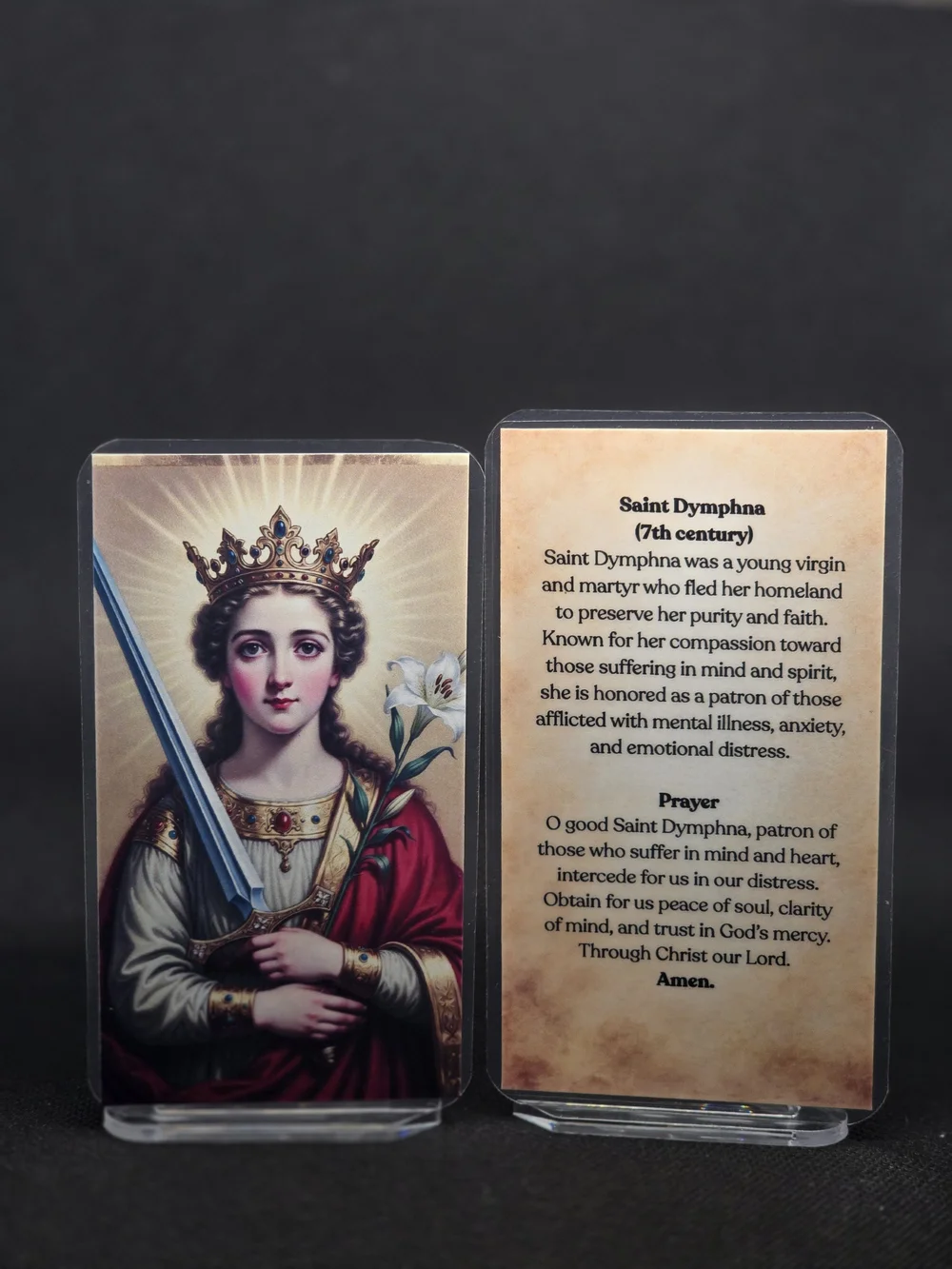
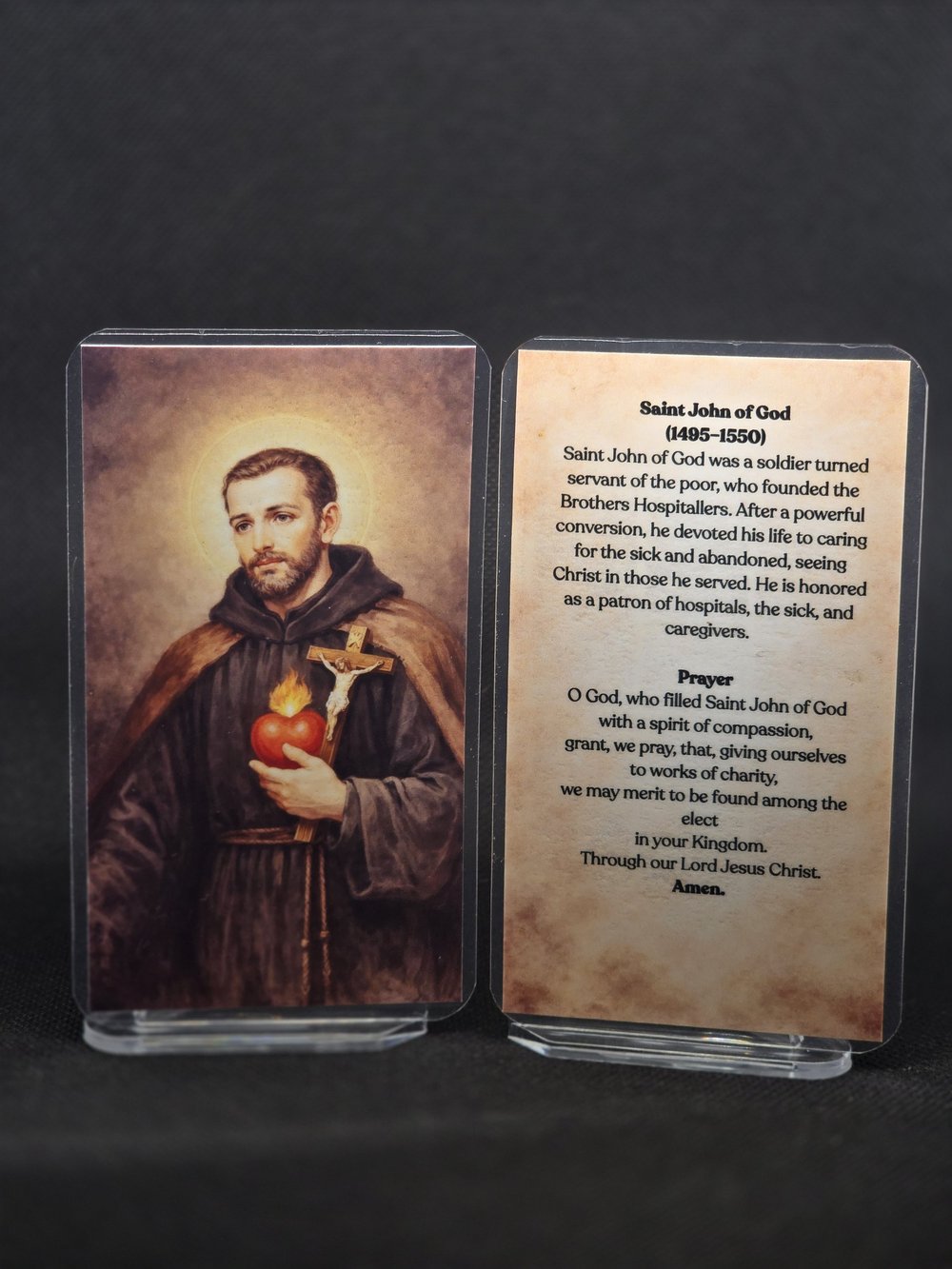
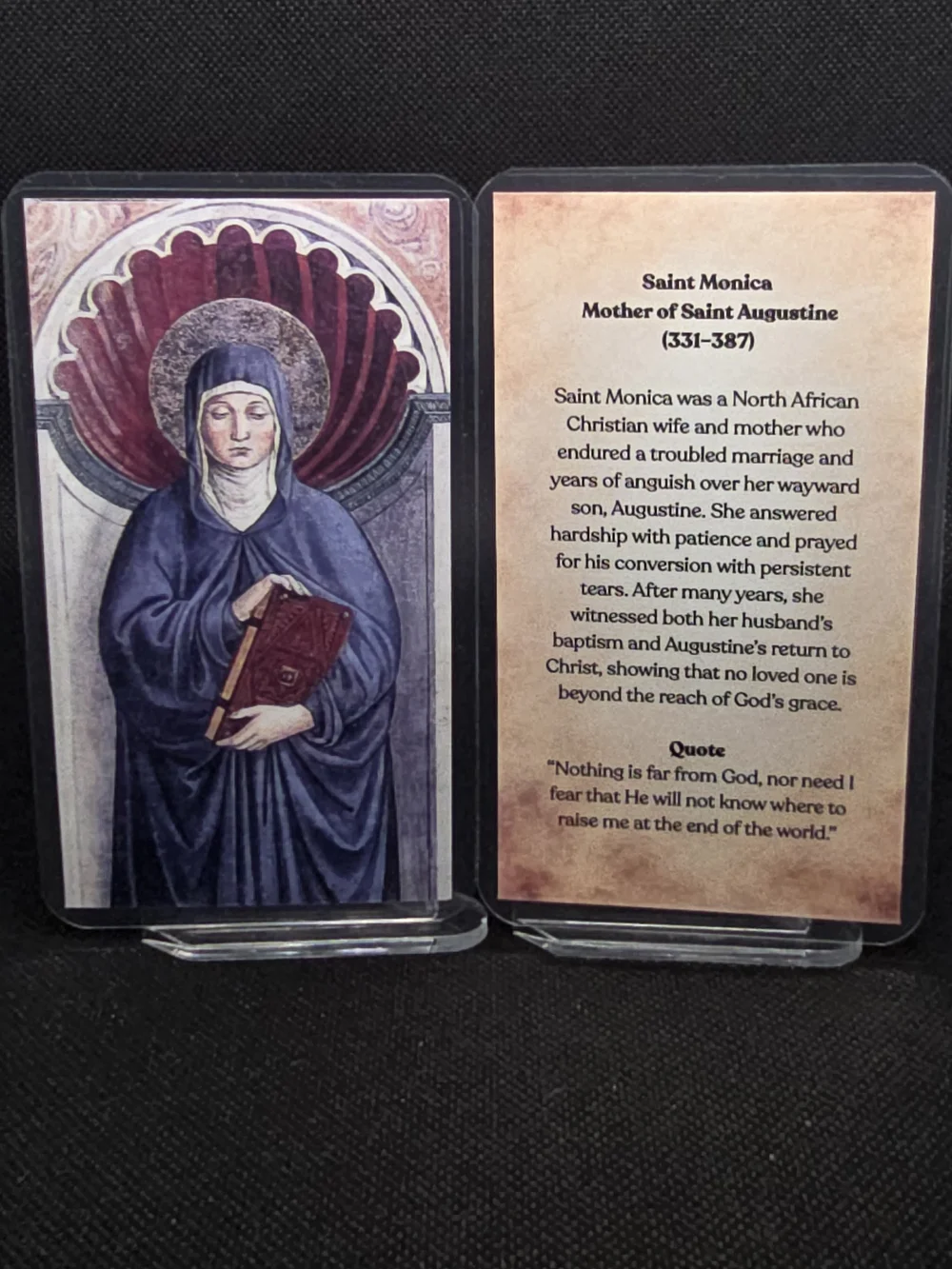
Saint Dymphna, pray for us. Saint John of God, pray for us. Saint Monica, pray for us. Amen.
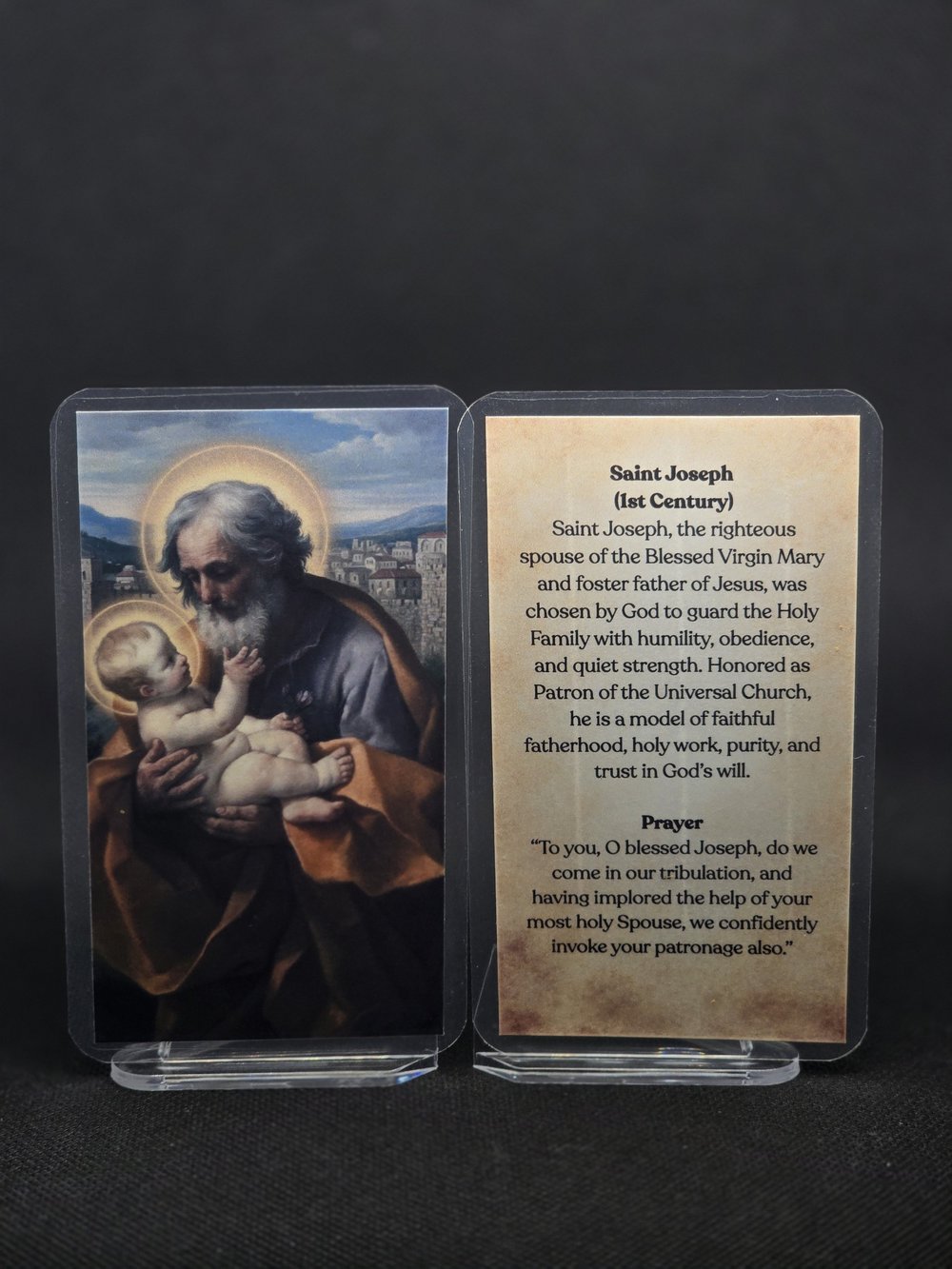
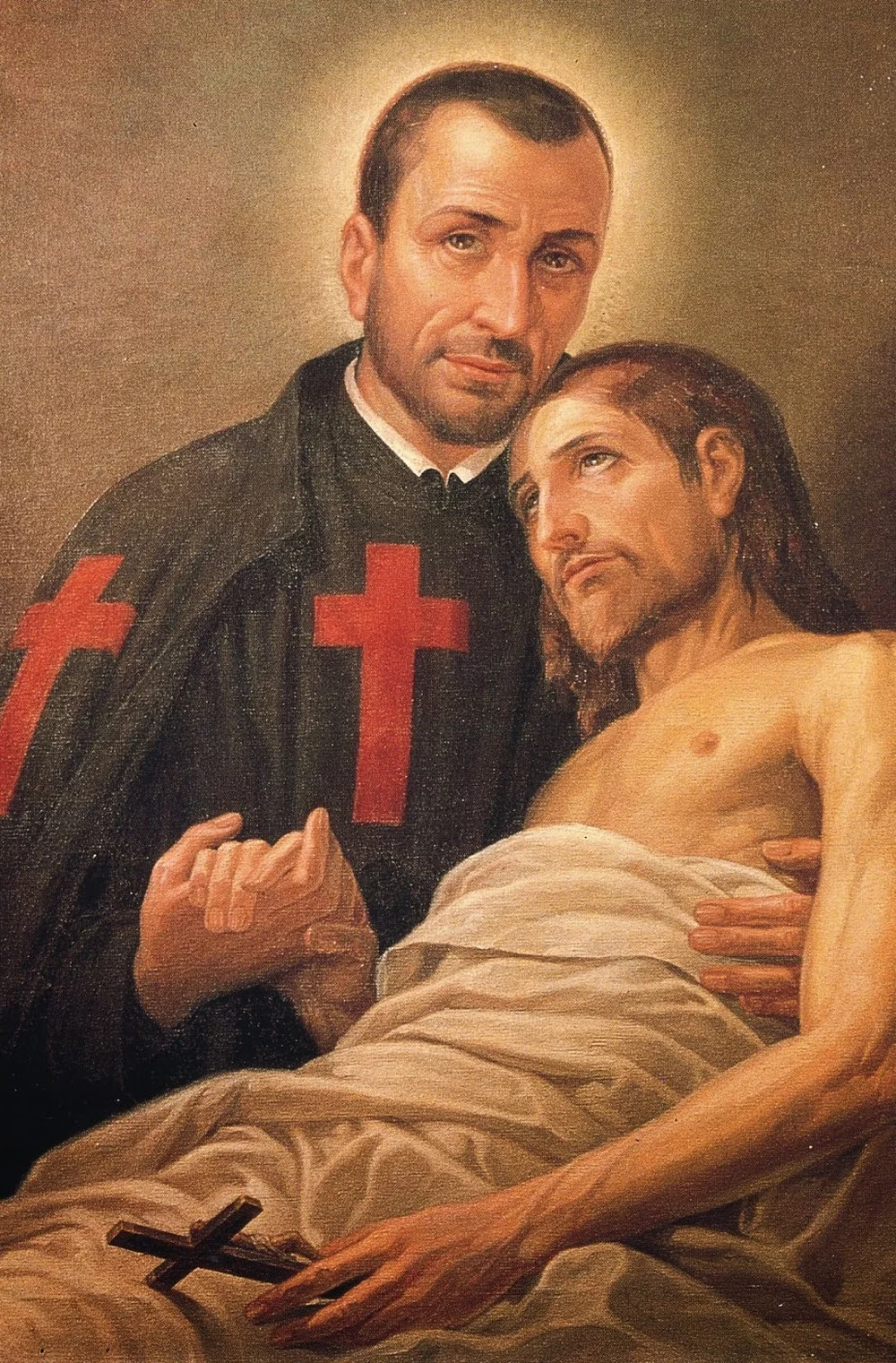
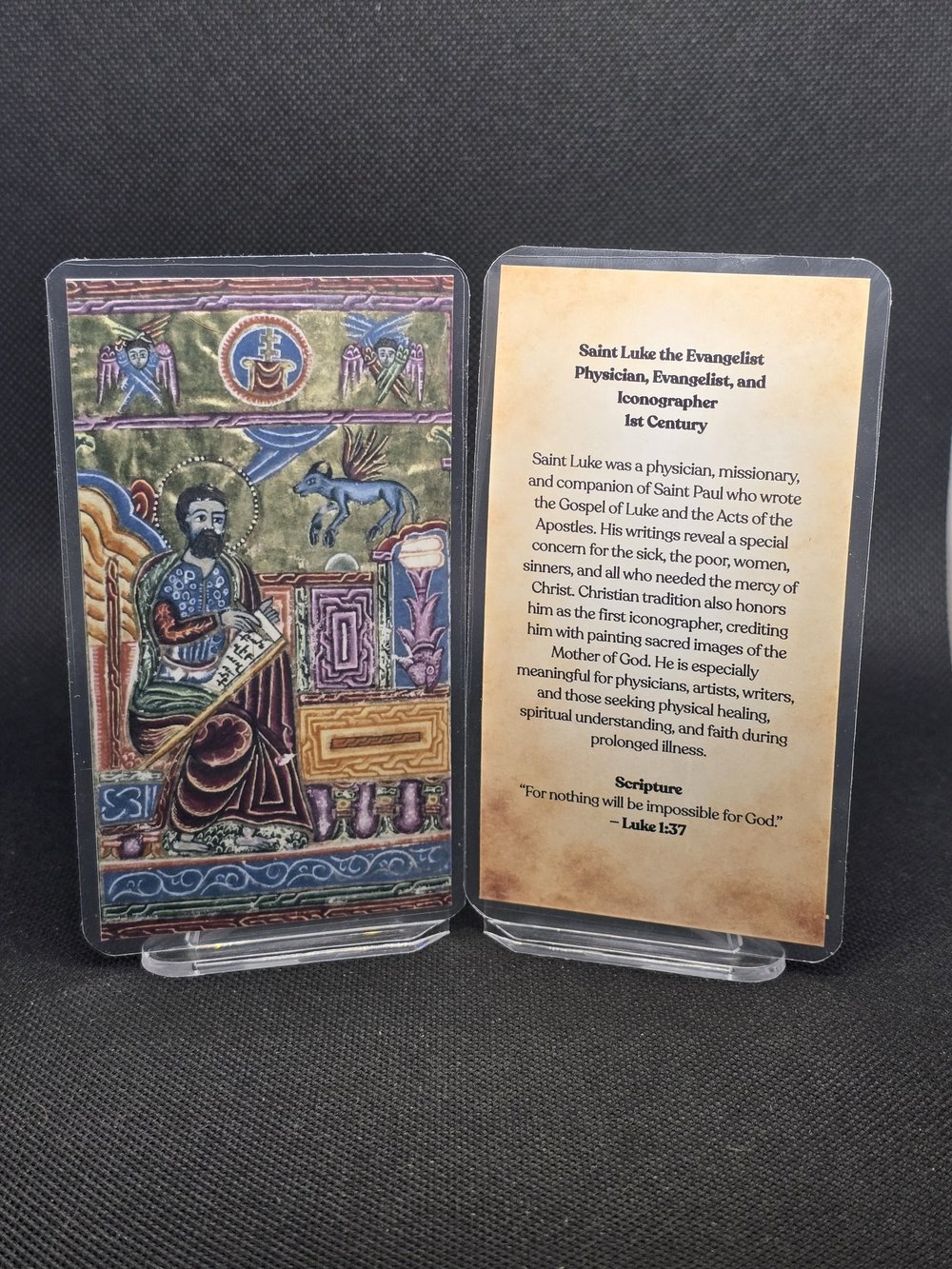
A prayer card is small enough to tuck into a Bible, a wallet, the frame of a mirror, or a pocket in a care-home room. They are a quiet way to put the saints beside your parent when you cannot be there, and beside you when you have to walk out of the building and go on.
He Has Not Forgotten Her, and He Has Not Forgotten You
Dementia takes a great deal. It does not take Baptism, it does not take the love of God, and it does not take the prayers of the Church. A mother who can no longer remember her children is still remembered by the One who counted every hair on her head.
Keep praying, even in six words. Ask the priest to come. Accept the help that is offered. And when you cannot find the words, let the saints speak for you.
Get the Saint Dymphna Prayer Card →