Ethiopian Orthodox Tewahedo Church Beliefs: What the Church Teaches, How It Worships, and Where It Came From
Oriental Orthodoxy • Aksum • Beliefs • Worship • Saints • History
Ethiopian Orthodox Tewahedo Church Beliefs: What the Church Teaches, How It Worships, and Where It Came From
One of the oldest Christian Churches in Africa, and the largest of the Oriental Orthodox Churches. Born in the kingdom of Aksum in the fourth century, shaped by monks, chanters, and kings, and led today by the sixth Patriarch. This is what the Ethiopian Orthodox Tewahedo Church actually teaches, in plain language, with the history behind each belief.
The Ethiopian Orthodox Tewahedo Church: At a Glance
- The Church
- Ethiopian Orthodox Tewahedo Church • One of the Oriental Orthodox Churches • Self-governing since 1959
- Meaning of Tewahedo
- A Ge’ez word meaning “united as one,” for the union of Christ’s divinity and humanity in one nature
- Origins
- The kingdom of Aksum under King Ezana, around AD 330, through Saint Frumentius
- Current Patriarch
- Abune Mathias I, sixth Patriarch • Elected February 28, 2013
- Christology
- One united nature of God the Word incarnate (miaphysite) • Does not accept the Council of Chalcedon
- Scripture
- A larger canon than any other Church, including 1 Enoch and Jubilees • Sources describe it as an 81-book canon
- Sacred Furniture
- The tabot, a replica of the Ark of the Covenant, in every church
- Liturgical Language
- Ge’ez, alongside Amharic, Tigrinya, Oromo, and other local languages
- Fasting
- About 250 fast days a year, about 180 of them obligatory for all • Great Fast 55 days
- Calendar
- Thirteen months • Ethiopian year 2019 began September 11, 2026 • Christmas January 7 • Timkat January 19 • Meskel September 27
- Size
- About 36 million Orthodox Christians in Ethiopia, about 43 percent of the population (Pew Research)
- Monastic Centers
- Debre Damo • Abba Garima • The rock-hewn churches of Lalibela
Who the Ethiopian Orthodox Tewahedo Church Is
The full name of the Church is Ethiopian Orthodox Tewahedo Church, and each word matters. Orthodox means right belief and right worship. Ethiopian names the land. And Tewahedo, a word in the ancient Ge’ez language, means “united as one” or “made one.” It is the Church’s way of saying what it believes about Christ: that His divinity and humanity are united in a single nature without division, mixture, or change. The same word is part of the name of the sister Church in Eritrea.
The Church belongs to the Oriental Orthodox family, which also includes the Coptic Orthodox Church, the Syriac Orthodox, the Malankara Indian Orthodox, and the Armenian Apostolic Church. These Churches share the faith of the first three ecumenical councils and did not accept the Council of Chalcedon in 451. They are a separate family from the Eastern Orthodox Churches (Greek, Russian, Serbian and others), and from the Ethiopian Catholic Church, which is in communion with Rome. Our article on Oriental versus Eastern Orthodoxy sorts out the first difference, and Ethiopian Orthodox versus Ethiopian Catholic sorts out the second.
For most of its history the Ethiopian Church was a daughter of Alexandria. Its bishop, the abun, was an Egyptian sent from the Coptic Pope until the twentieth century. That changed in 1959, when Pope Cyril VI of Alexandria crowned the first Ethiopian Patriarch. Today the Church is led by Abune Mathias I, the sixth Patriarch and Catholicos of Ethiopia. According to his reference biography, he was born in 1941 in Tigray and was elected on February 28, 2013, receiving 500 of the 806 votes cast by an electoral college.
How large is the Church? By the count of the Pew Research Center, about 36 million Orthodox Christians live in Ethiopia, which is roughly 43 percent of the country and the second-largest Orthodox population in the world after Russia. Pew also found that Ethiopian Orthodox Christians are unusually observant: 87 percent said they fast during holy times such as Lent, and 78 percent said they attend church weekly. Other sources give figures from about 36 to over 50 million, so treat any single number with care. A reference summary puts the worldwide figure around 60 million, citing the World Council of Churches.

Book and jewelry links on this page are Amazon affiliate links. If you buy through them we may earn a small commission at no extra cost to you.
Part II
Frumentius, Ezana, and the Roots of Aksum
The Ethiopian Church claims a beginning even earlier than the Aksumite kings. In the Acts of the Apostles, Philip meets and baptizes a high official of the queen of the Ethiopians on the road to Gaza. The Ethiopian Church holds that this man carried the faith home, and reads him as the first fruits of a land that would one day turn to God.
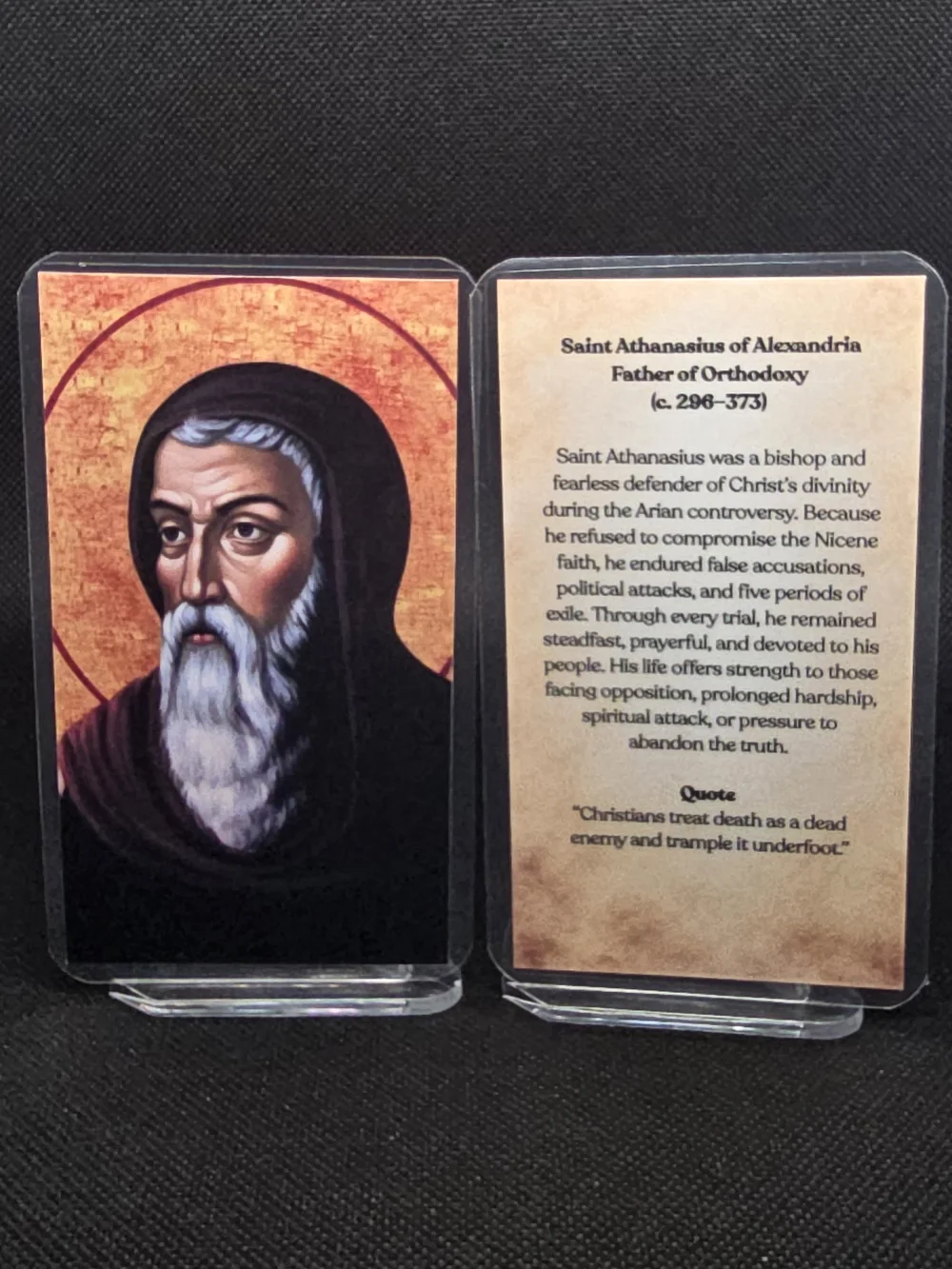
The documented story begins in the fourth century. A Roman Christian from Tyre named Frumentius was shipwrecked on the Red Sea coast as a boy and taken to the royal court at Aksum. According to the historian Rufinus, he served the royal house and gained the trust of the young king Ezana. When he later traveled to Alexandria, Athanasius, the Pope of Alexandria, consecrated him as the first bishop of Aksum. Ezana adopted Christianity as the state religion around AD 330, as CNEWA summarizes. Ethiopians remember Frumentius as Abba Selama, the Father of Peace.
Archaeology has begun to fill in the picture. A fourth-century basilica excavated at Beta Samati in 2016 is described in reference sources as the earliest known physical evidence of a church in sub-Saharan Africa. The Ethiopian Church was administratively part of the Coptic Church from the fourth century until 1959, which is why the stories of Mark, Athanasius, and Cyril belong to both Churches.

A second wave came in the late fifth century. Nine monks, the Nine Saints, arrived in the highlands and are credited with spreading Christianity beyond the narrow corridor between Adulis and Aksum, founding monasteries that followed the rule of Pachomius, and shaping the monastic character of the Church. The best-known are Abba Aregawi, to whom the monastery of Debre Damo is attributed, and Abba Garima, whose monastery lies north of Adwa. Historians suspect they were refugees from the religious conflicts that followed Chalcedon, but their origins, sometimes called Syrian, are disputed, as the reference article notes.
Part III
What the Ethiopian Church Teaches About Christ
The Church confesses one God in three Persons, Father, Son, and Holy Spirit, the Holy Trinity. It prays the Nicene Creed, and in the Church’s language, the persons of the Trinity are called by the Ge’ez word sellase. The Ethiopian Church, like the Coptic and Eastern Orthodox, does not use the Latin filioque.
The distinctive mark of the Church is in its name. Tewahedo means that the Word of God, when He became man, was united with human nature in one nature, without confusion, without mixture, and without alteration. The Church follows the formula of Cyril of Alexandria, one nature of God the Word incarnate. Scholars call this teaching miaphysite, from the Greek for “one nature,” to distinguish it from the Monophysite position that Christ’s humanity was absorbed into His divinity. The Ethiopian Church does not teach that. It confesses that Christ is perfect God and perfect man, with a real human body and soul.
The Church did not accept the Council of Chalcedon in 451, whose language of “two natures” seemed to the Alexandrian tradition too close to the Nestorian error. The Coptic and Ethiopian Churches stand together on this. Since the twentieth century, Oriental and Eastern Orthodox theologians have agreed that much of the old dispute was about words. If you want the full story of Cyril and Dioscorus, the companion piece is our article on Coptic Orthodox Church beliefs.
Part IV
Scripture and the Larger Canon
The Ethiopian Church has the largest Biblical canon of any Christian body. Its Old Testament includes the books accepted by the Orthodox, together with 1 Enoch, Jubilees, the three books of Meqabyan (the Ethiopian Maccabees), and others. Its New Testament adds a group of works on Church order that are not found in other Bibles. Reference sources speak of an 81-book canon, but the actual count varies between authorities and printings, so it is better to speak of a narrower canon and a broader one, as scholars do. The broader canon includes the Sinodos, the Books of the Covenant, Ethiopic Clement, and the Didascalia.
The Scriptures were first translated into Ge’ez from the Greek Septuagint around the time of the Nine Saints. Ge’ez remains the language of worship, though the Bible has been translated into Amharic and other tongues since the nineteenth century. For the full list of books and how the ancient Churches compare, see our article on the Ethiopian Bible and the guide to Eastern Catholic and Orthodox Bibles.
Part V
The Book of Enoch in Ethiopia
For many readers, the Book of Enoch is the first thing that comes to mind when they think of the Ethiopian Church, and with good reason. The Ethiopian and Eritrean Churches are the only Christian bodies that count 1 Enoch as Scripture. Outside Ethiopia the book was largely lost to Christians after the early centuries. The only complete surviving text is the Ge’ez translation preserved by the Ethiopian Church, which is why Western scholars first read the full book from Ethiopian manuscripts. Aramaic fragments among the Dead Sea Scrolls and Greek and Latin fragments have since confirmed that the book is far older than its Ethiopian copies.
The New Testament itself quotes from the tradition. The Epistle of Jude cites a prophecy of Enoch, the seventh from Adam, and the line matches a passage in 1 Enoch.
“And Enoch also, the seventh from Adam, prophesied of these, saying, Behold, the Lord cometh with ten thousands of his saints.” (Jude 14, KJV)
The Ethiopian Church has treated the book as inspired and part of the Old Testament for well over a thousand years. Other Churches never put it into the canon, and some early Fathers quoted it with respect while others rejected it. We have written about this elsewhere on the site. Our long article, The Book of Enoch, walks through the text itself. The Church Fathers and the Book of Enoch and What the Church Fathers Thought of the Book of Enoch follow the quotations and the arguments, and the article on the Ethiopian Bible places Enoch among the other books of the Ge’ez canon.
If you want a copy to read alongside those articles, we use this edition of the Book of Enoch as our default recommendation. It is an affiliate link. A word of caution for beginners: many editions of Enoch are sold with commentary added by modern authors. Start with the text and with the Church’s own use of it, and treat the commentary as commentary.
Part VI
Mary, the Angels, and the Saints
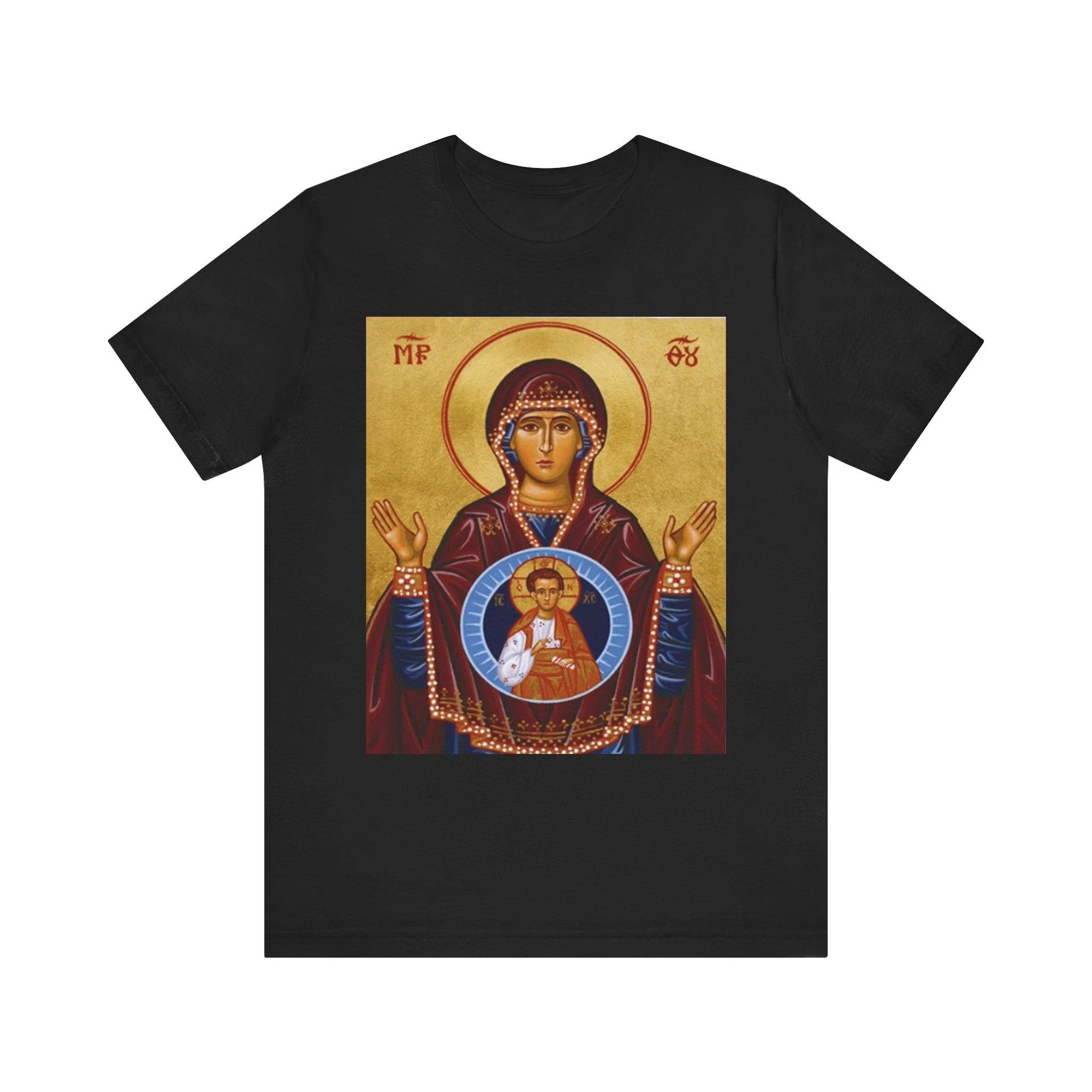
The Ethiopian Church honors the Virgin Mary with a warmth that surprises many visitors. She is the Theotokos, the Mother of God, a title confirmed at the Council of Ephesus in 431. Churches are dedicated to her in every region, her feasts fill the calendar, and the Church keeps a fast in August before the feast of her Assumption. Her name is on the oldest and most sacred church in the country: Our Lady Mary of Zion in Axum, which we return to in Part XV. A collection of stories called the Miracles of Mary has long been read in Ethiopian churches.
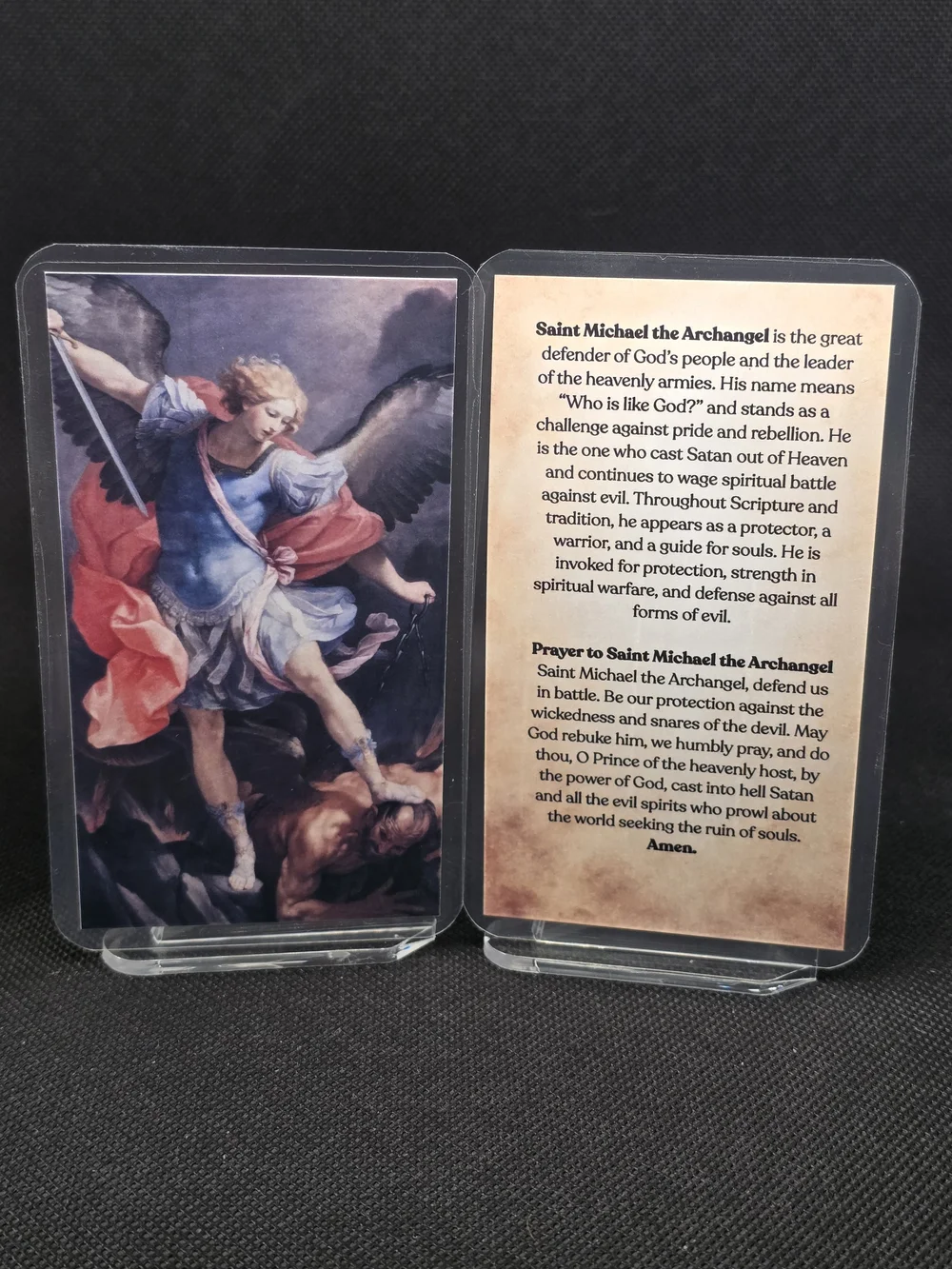
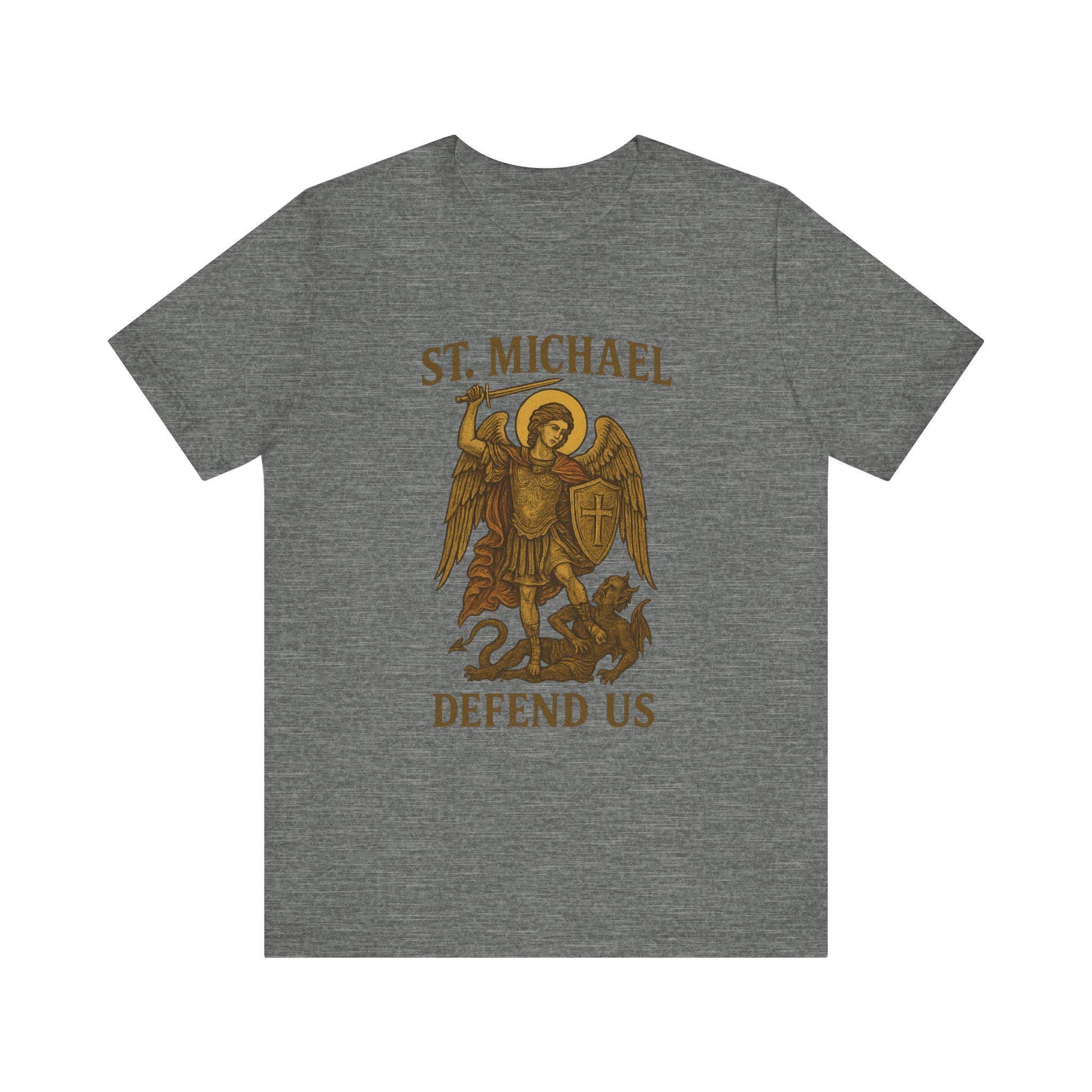
The Church also honors the angels, and the archangel Michael has a special place in devotion. Ethiopians ask the prayers of the saints, in the same way they might ask the prayers of a friend, and they believe the saints pray for the Church from Heaven. The Church does not teach the Latin doctrine of purgatory, though it prays for the departed.
Part VII
The Seven Sacraments
The Ethiopian Church celebrates seven sacraments, which it calls mysteries. They are the way the life of the Church becomes real in the life of the believer.
1. Baptism
Baptism is the new birth, and it is given to infants and adults. The priest immerses or pours water in the name of the Trinity, and the rite is joined to anointing with the holy oil. Tradition marks the day of baptism by the age of the child, with boys baptized at forty days and girls at eighty. Each year at Timkat, the feast of the Epiphany, the whole community renews its baptism, as we describe in Part XIII.
“Except a man be born of water and of the Spirit, he cannot enter into the kingdom of God.” (John 3:5, KJV)
2. Chrismation
The newly baptized is anointed with the holy chrism (myron), which is consecrated by the bishops, and receives the gift of the Holy Spirit. In the Ethiopian tradition, as in the Coptic, baptism and chrismation are celebrated together.
3. The Eucharist
The Eucharist is the center of the Church’s life, and in Ge’ez it is called qurban, the Offering. The Church teaches that the bread and wine become the true Body and Blood of Christ. Preparation matters: the faithful fast before Communion and come in a state of repentance.
“Except ye eat the flesh of the Son of man, and drink his blood, ye have no life in you.” (John 6:53, KJV)
4. Repentance and Confession
Each believer is expected to have a spiritual father, a confessor to whom they confess regularly. The priest hears the confession and gives absolution in the name of Christ. The goal is healing, not guilt.
“Whose soever sins ye remit, they are remitted unto them; and whose soever sins ye retain, they are retained.” (John 20:23, KJV)
5. Unction of the Sick
The sick are anointed with blessed oil, as James describes: “Is any sick among you? let him call for the elders of the church; and let them pray over him, anointing him with oil in the name of the Lord” (James 5:14, KJV).
6. Matrimony
Marriage is a sacrament, the lifelong union of one man and one woman, blessed by the Church. The Sunday after Easter, Dagme Tensae, begins the main wedding season.
7. Priesthood
The Church has three orders, bishops, priests, and deacons. Bishops are celibate and are drawn from the monks. Parish priests are usually married men, married before ordination. The Church also has a large class of trained cantors and lay scholars who carry the music and learning of the Church, which we mention in Part X.
Part VIII
The Tabot and the Ethiopian Church Building
No Ethiopian church is a church until it has a tabot. The tabot is a small tablet, a replica of the Ark of the Covenant or its tablets, made of wood or stone and consecrated by a bishop. According to the reference summary of the Church, a building is not considered a church until the bishop gives it a tabot, and only priests may see or touch it. It rests in the innermost part of the church, wrapped in cloth, and is carried out in procession only at certain feasts, above all Timkat. Each tabot is dedicated to a saint or to Mary, and the name of that dedication is the name of the church.
The building follows an old pattern: many Ethiopian churches are round or octagonal, with the sanctuary at the center and rings of space around it for the choir and the people. Shoes are removed at the door. Men and women generally stand apart, and women cover their hair. According to the OrthodoxWiki summary, women are also asked not to enter the church during menstruation.
The cross is everywhere. Ethiopian crosses are known for their elaborate interlaced openwork, and they are made in many forms, as hand crosses, processional crosses, and crosses worn at the neck. Many Ethiopian Christians wear a cross all their lives.

Part IX
The Divine Liturgy in Ge’ez
The Ethiopian liturgy is the Church’s greatest treasure, and it is among the oldest in the Christian world. Its roots are Alexandrian, with Syriac influence, as CNEWA notes. Historically it has been celebrated in Ge’ez, an ancient liturgical language that is no longer spoken but remains the language of prayer, much as Latin once was in the West. Amharic translations are used more and more in parishes, and sermons are given in the language of the people, whether Amharic, Oromo, or Tigrinya. The Ethiopic liturgy was also the first Oriental liturgy to be printed, in Rome in 1548, according to the Church’s own website.
The service is long and mostly sung. Chanting, incense, the sway of the priests, drums and sistrums, readings from the Epistles and the Gospel, and the Eucharist itself make up the order. The faithful who receive Communion have fasted and prepared.
The Church’s daily prayer is gathered in the Book of Hours, the Se’atat, composed by the fifteenth-century scholar Abba Giyorgis of Gascha, as the Church’s website records. Ethiopian Christians traditionally pray at set hours through the day and the night. If you want to follow the Church’s worship from the book itself, the liturgy book listed below is a good companion.

Part X
Saint Yared and Ethiopian Chant
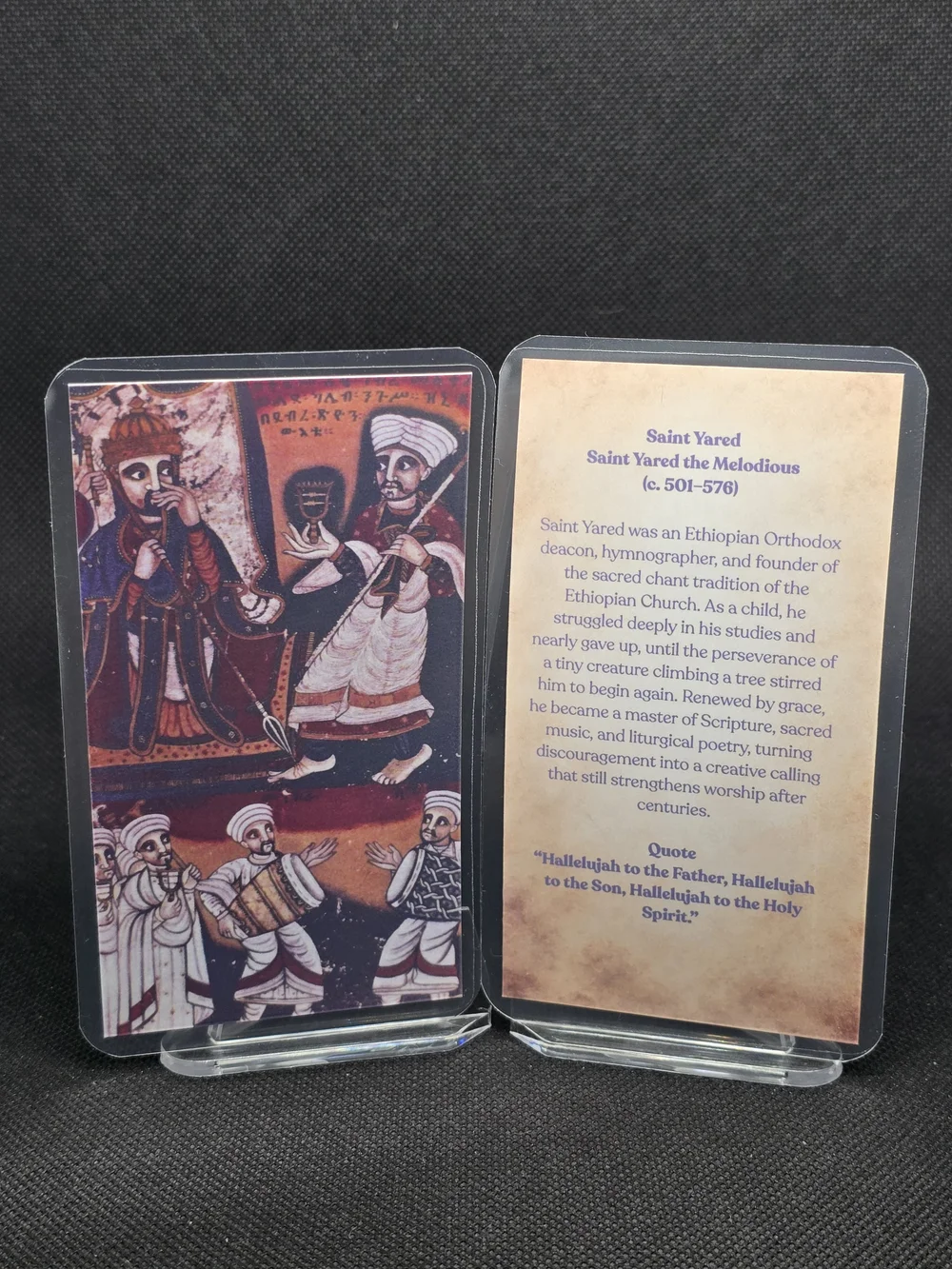
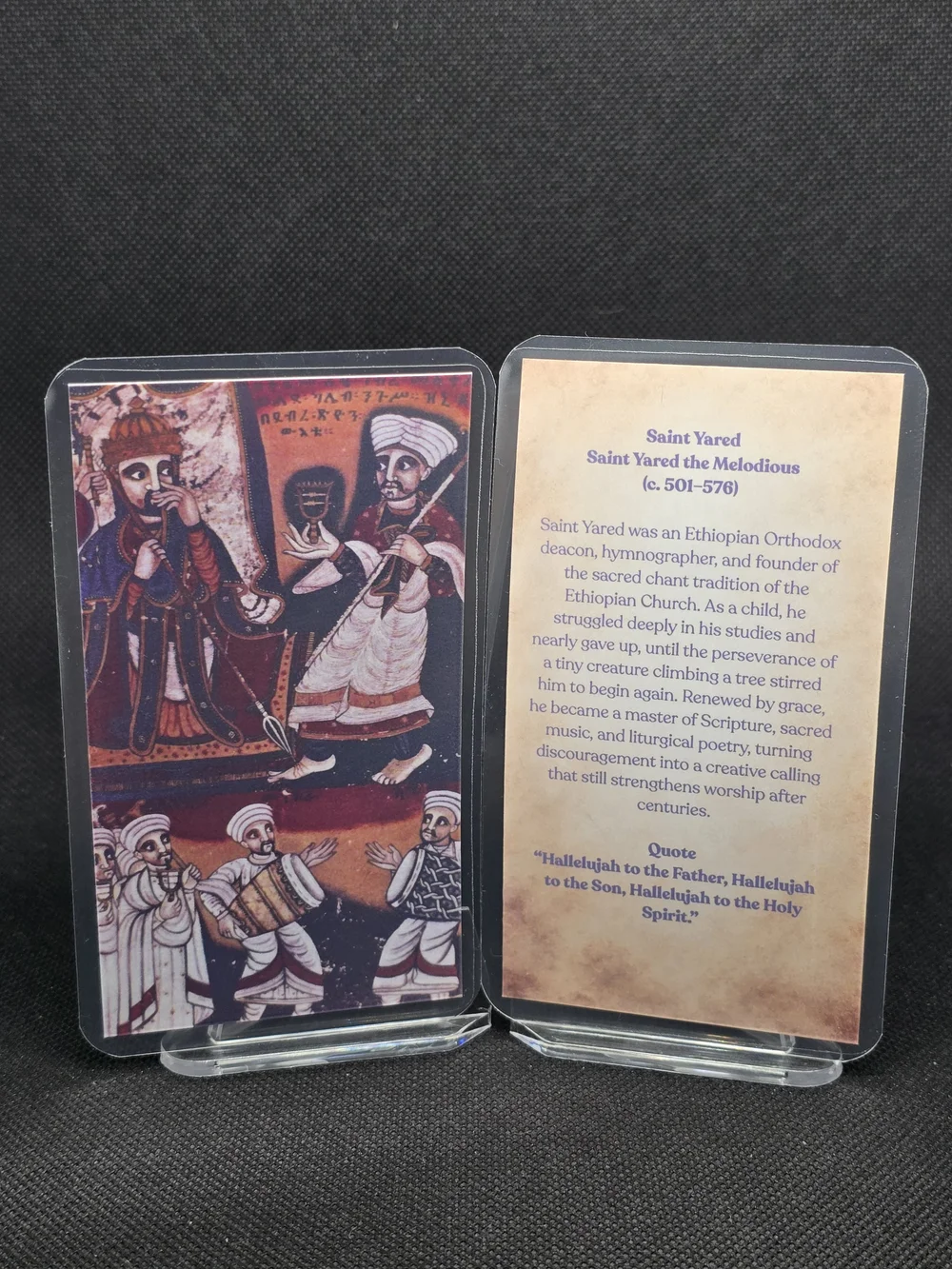
Ethiopian Christians credit the music of their Church to a sixth-century saint of Aksum, Yared. His life is recorded in the Gadla Yared. According to that account, he was struggling with his studies when he watched a worm try again and again to climb a tree until it reached the top. The worm’s persistence moved him to give himself to study of the Scriptures. He is traditionally credited with creating the chant tradition called zema, the notation that goes with it, and the hymnary called the Deggua. He served as a priest at the Church of Our Lady Mary of Zion, drew the attention of the king, and then withdrew to live as an ascetic in the Semien Mountains. His feast is May 19 (11 Genbot), according to the reference article on Yared.
The chant has three modes, which tradition says were given to him: Ge’ez, Ezel, and Araray. Ge’ez is used on ordinary days, Ezel for fast days and Lent, and Araray for the principal feasts, according to the Church’s description of its music. The singing is accompanied by the kebero, a large drum, the tsenatsil, a sistrum with a silvery sound, and hand bells. Priests sway rhythmically as they chant, a custom linked to the dance of David before the Ark, and carry richly decorated umbrellas and crosses. The cantors who learn the full system study for many years.
Part XI
Sabbath, Dietary Laws, and Jewish-Rooted Practice
Visitors often notice that the Ethiopian Church keeps customs that other Christians have mostly left behind. The Church observes both Saturday, the Sabbath, and Sunday, the day of the Resurrection, as holy days, with greater emphasis on Sunday. The Church also follows dietary rules that resemble the Old Testament laws, with no pork and a distinction between clean and unclean meats, and hand-washing customs that resemble Jewish practice, according to the OrthodoxWiki summary.
Circumcision is common in Ethiopia, and reference sources describe it as a cultural practice, not a religious requirement. These customs are old. The Sabbath controversy became sharp in the fifteenth century, when the monastic movement of Abba Ewostatewos pressed for Saturday observance and won recognition for it, as the reference summary records. Ethiopian Christians themselves treat these customs as an ancient inheritance, not as a rejection of the Gospel. They find support in the words of Christ about the purpose of the Sabbath.
“The sabbath was made for man, and not man for the sabbath.” (Mark 2:27, KJV)
Part XII
Fasting in the Ethiopian Church
Fasting is the thing Ethiopian Christians are best known for. The Church counts about 250 fasting days a year, of which about 180 are obligatory for all believers. The rest are kept by clergy and the especially devout. On fast days the faithful eat no meat, milk products, or eggs, so the fast is vegan. The Pew Research Center found that 87 percent of Ethiopian Orthodox Christians say they fast during holy times such as Lent. The fast is a central part of the Church’s identity, and it is shared across the whole community.
| Fast | Length | Notes |
|---|---|---|
| Wednesdays and Fridays | Weekly | Suspended for 50 days after Easter, until Pentecost. |
| Abiy Tsom (Great Fast) | 55 days | The longest and most important fast of the year. It begins on a Monday and leads to Holy Week and Easter. |
| Fast of Nineveh | 3 days | Kept before the Great Fast, recalling the repentance of Nineveh. |
| Advent Fast | 40 days | Ends at Genna (Christmas) on January 7. One vegan meal a day is allowed. |
| Holy Week | From Thursday night or Friday morning to Sunday | Priests begin the complete fast on Thursday night and the laity on Friday morning. It lasts until cockcrow on Easter morning. |
| Fast of the Apostles and Fast of the Assumption | Varies | The first follows Pentecost, and the second falls in August before the feast of Mary. |
Easter is the great reward of the fast. After the night service, people break the fast on Easter morning with a simple meal of linseed, honey, and water or milk, and then feast. The week before Lent has a feast of its own, Qibela, when meat is eaten. Fasting is not seen as a diet. It is understood as a way of making room for prayer, mercy, and repentance, and it is done quietly, as Christ taught.
“But thou, when thou fastest, anoint thine head, and wash thy face; That thou appear not unto men to fast, but unto thy Father which is in secret.” (Matthew 6:17-18, KJV)
For the way fasting works in practice across the Eastern Churches, including the oils question, see our article on how Eastern Christian fasting really works.
Part XIII
The Ethiopian Calendar and Its Feasts
Ethiopia keeps its own calendar. It has twelve months of thirty days and a thirteenth month, Pagume, of five or six days. The year is seven or eight years behind the Gregorian year, and its new year, Enkutatash, falls on September 11 (or September 12 before a Gregorian leap year). As the reference article on the calendar shows, the Ethiopian year 2019 began on September 11, 2026. If you are reading this in autumn 2026, that is the year in Ethiopia.
Meskel, September 27
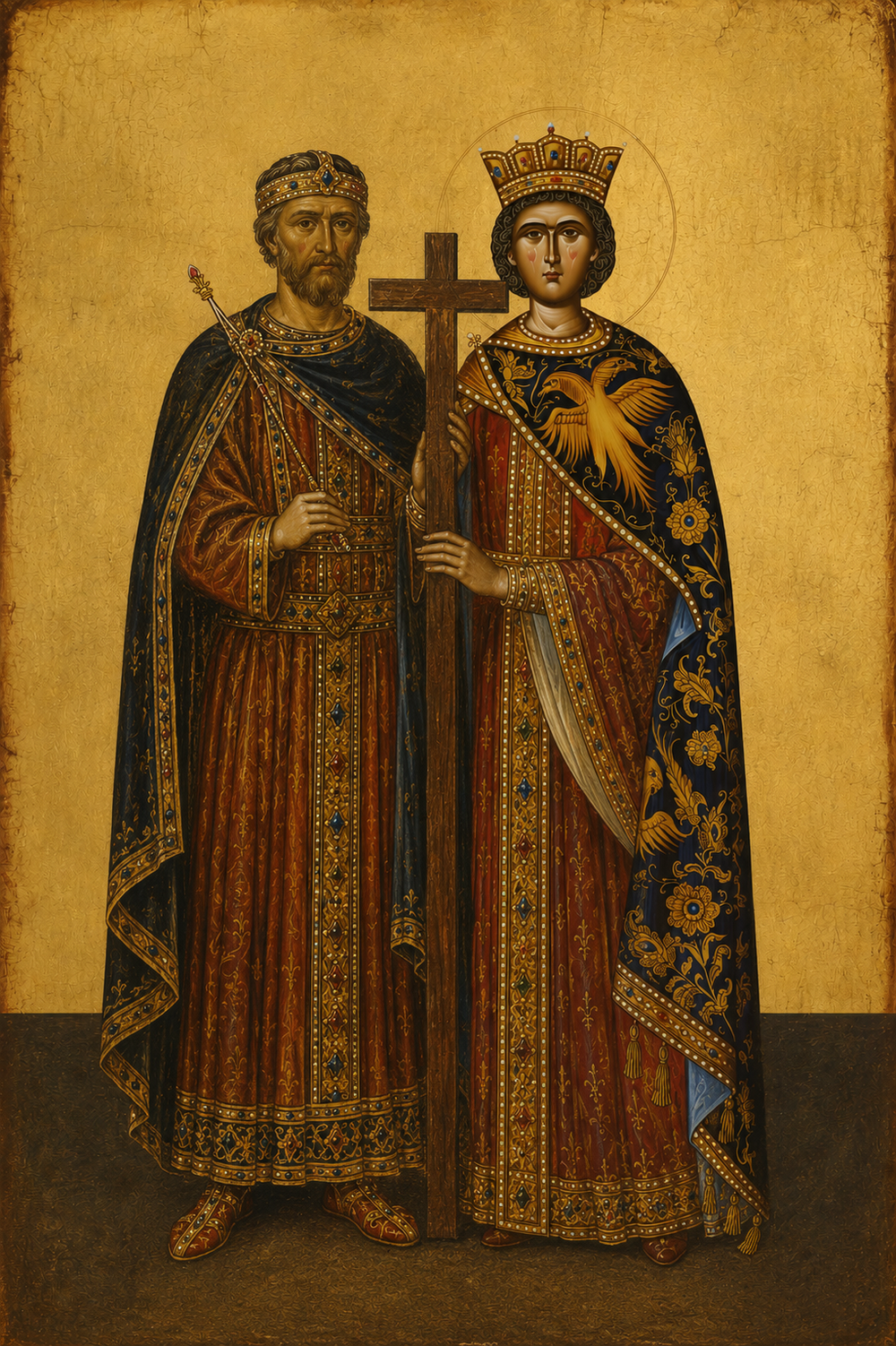
Meskel, the Feast of the Cross, falls on September 27 (September 28 in a leap year). It marks the finding of the True Cross by Saint Helena, the mother of Constantine. On the eve of the feast, a great bonfire called the Demera is lit. The story says that Helena dreamed that a fire would show her where the Cross was buried. She had the people gather wood, and when frankincense was added to the fire the smoke bent to the spot. Believers mark their foreheads with the ashes. UNESCO inscribed Meskel on the Representative List of the Intangible Cultural Heritage of Humanity in 2013, according to the reference account of the feast.
Genna, January 7
Genna, the Nativity of Christ, falls on January 7 and ends the forty-day Advent fast. Pilgrims gather in great numbers in places like Lalibela for Genna.
Timkat, January 19
Timkat, the Epiphany, is the great festival of the Ethiopian year. It falls on January 19 (January 20 in a leap year). The tabots of the churches are wrapped in rich cloths and carried in procession on the heads of priests to a stream or pool. There the water is blessed in an early-morning liturgy, and the people are sprinkled with it or enter it to renew their baptismal vows. The day closes with the tabots carried home with hymns and dancing, as the reference article on Timkat describes.
Part XIV
Monks and Saints of Ethiopia
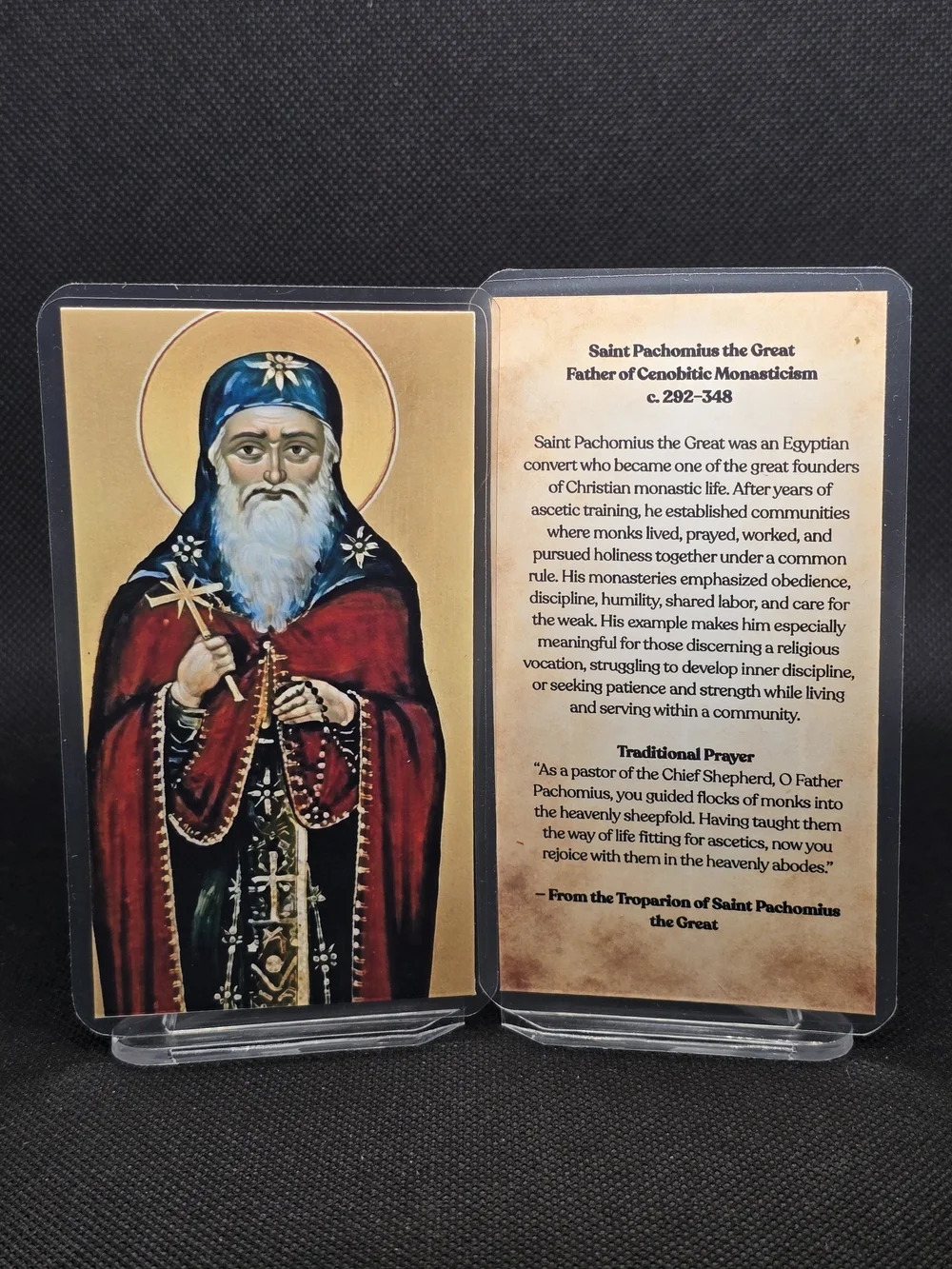
Monasticism has been the backbone of the Ethiopian Church since the Nine Saints, and monks have shaped its worship, its scholarship, and its leadership. The monasteries of the highlands, on cliff-tops and island peaks, are among the most remote Christian communities in the world. Debre Damo, attributed to Abba Aregawi, and Abba Garima are the oldest names, and they follow the Pachomian pattern of shared life. The great monk-saints of later centuries carried the faith into the south and west of the country, and the head of the Church still carries the title Ichege of the See of Saint Takla Haymanot, a mark of how deeply the saint is honored.
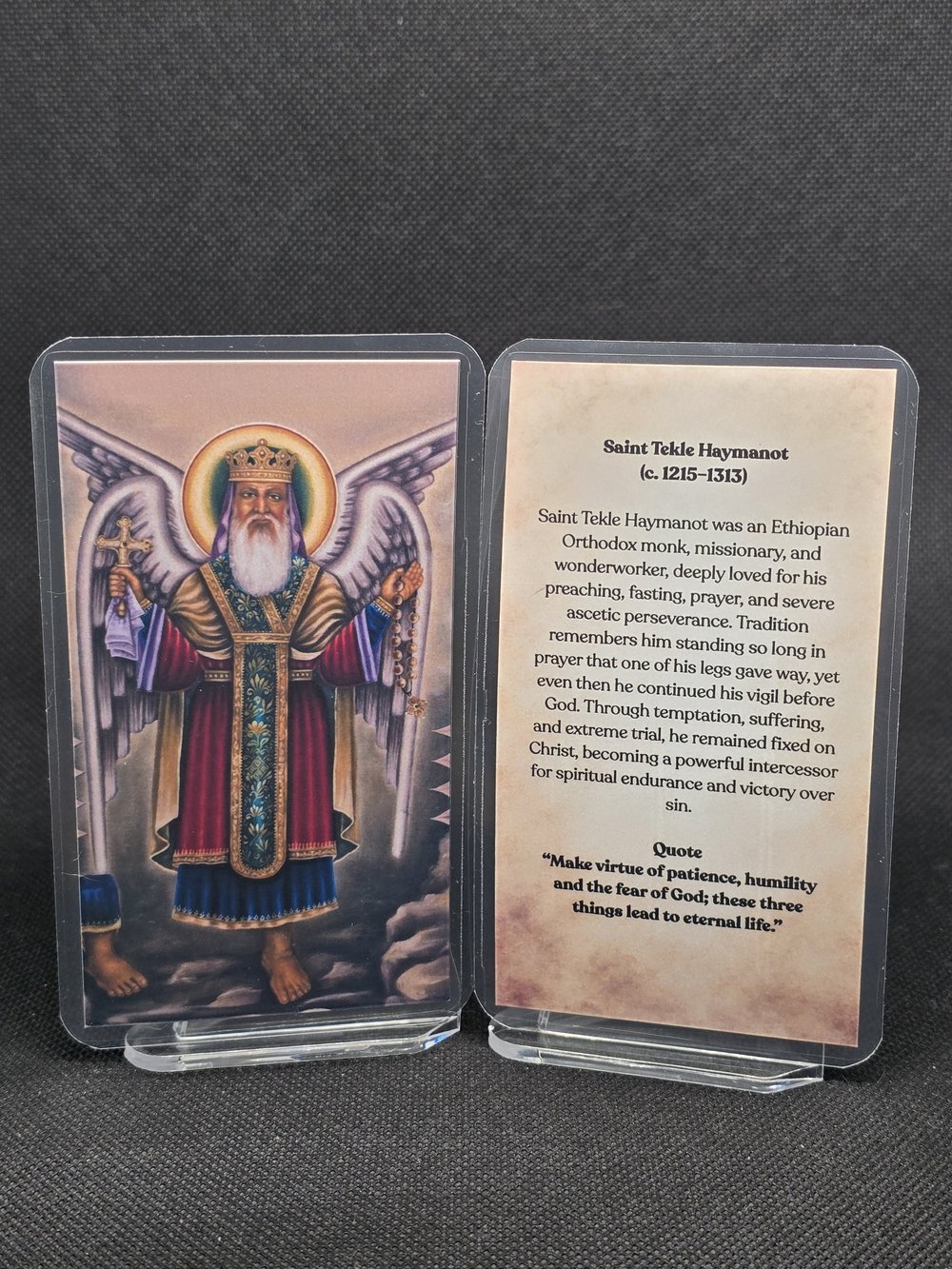
Takla Haymanot. One of the most beloved Ethiopian saints, a monk and missionary remembered for his long ascetic labors. His name is borne by churches and monasteries across the country and by many Ethiopians at baptism.
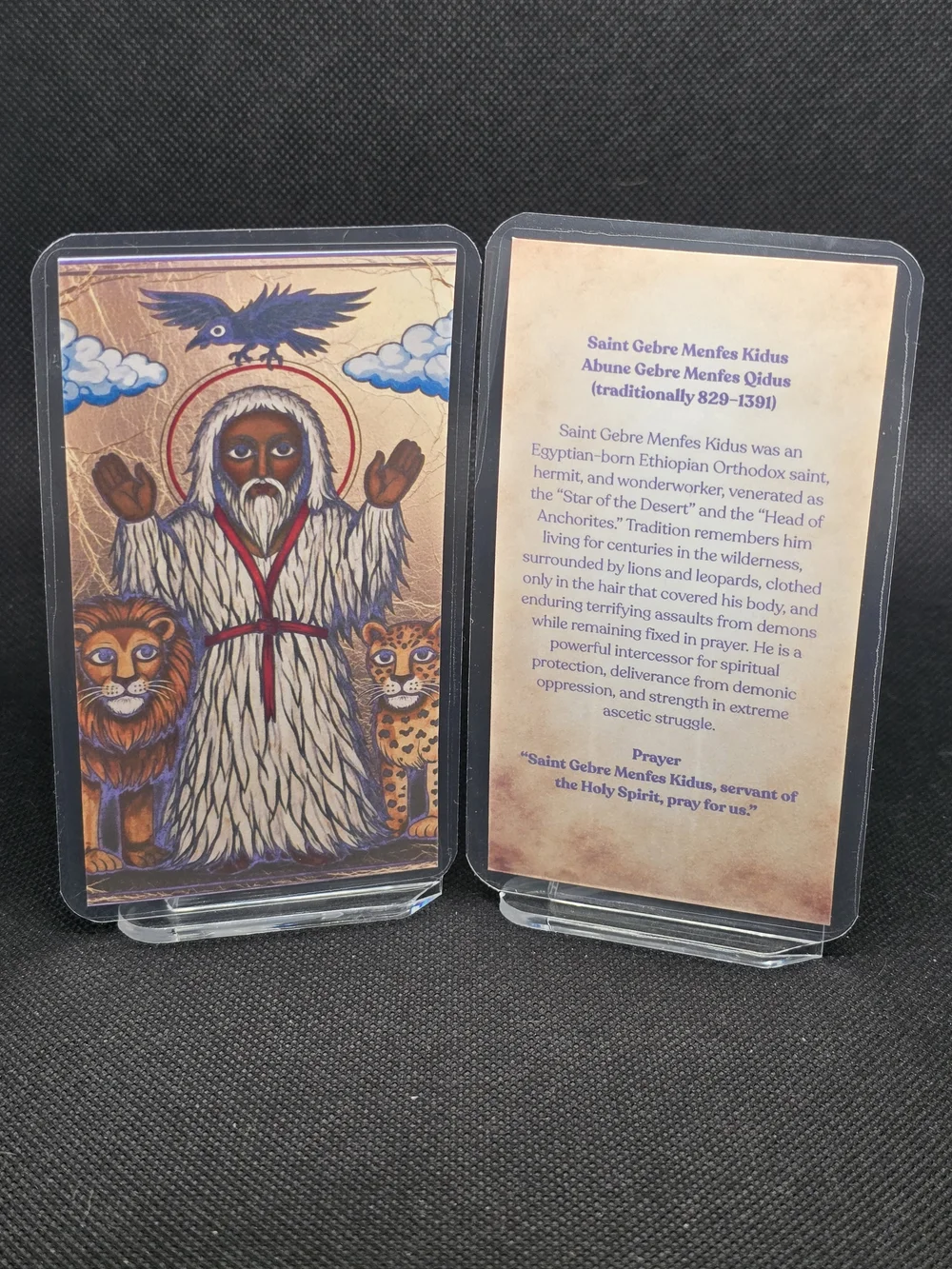
Gebre Menfes Kidus. An Ethiopian desert ascetic known for the severity of his fasting and prayer. Ethiopians pray to him for protection in spiritual struggle and for strength to endure hardship.
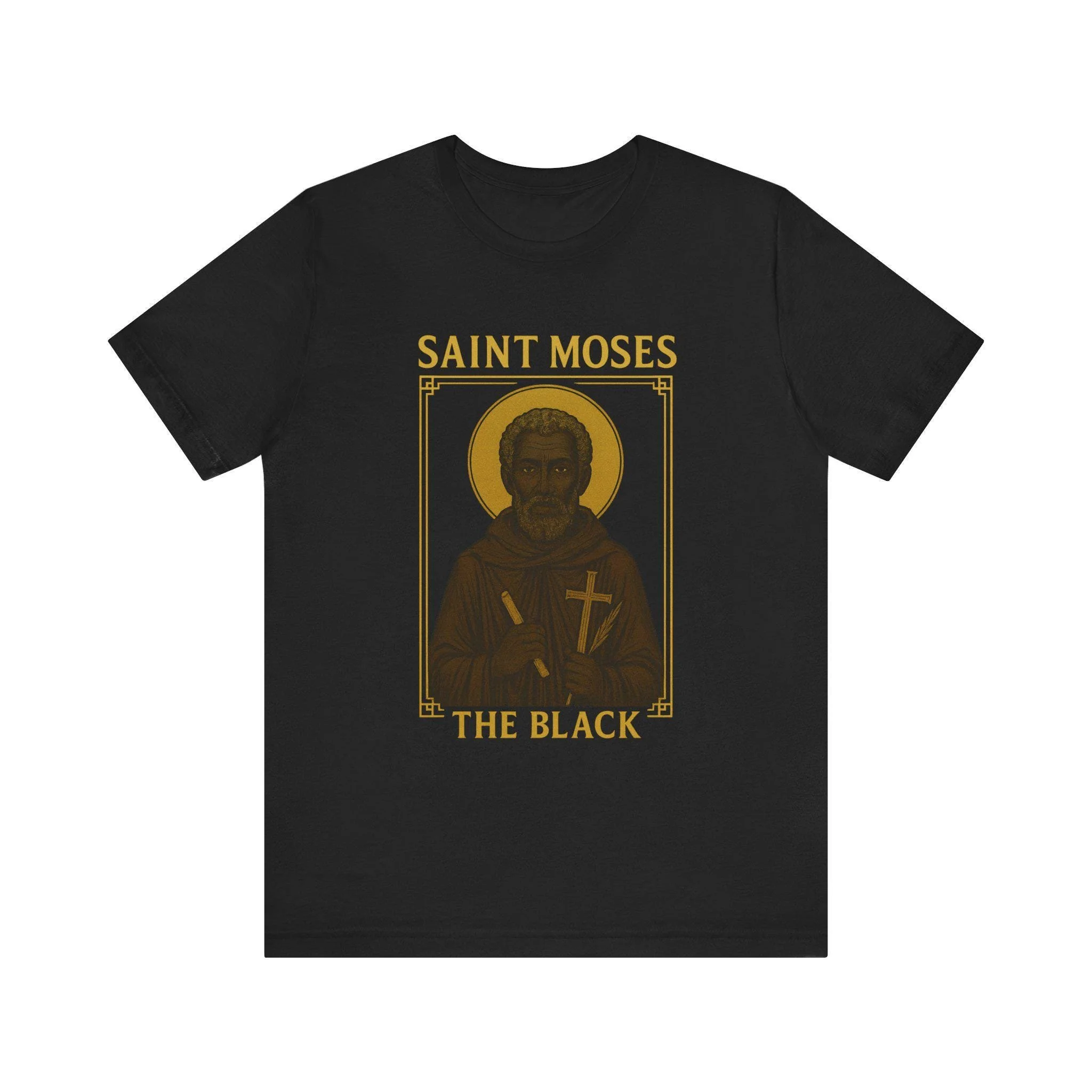
Moses the Black. Ethiopia shares in the great desert tradition of Egypt. Moses the Black, a man from Ethiopia who had been a slave and then a bandit, became a gentle monk of Scetis and is one of the most loved of all the Desert Fathers. Ethiopians and Egyptians both claim him. We tell his full story in our article on Saint Moses the Black, and the broader tradition in Desert Fathers and Mothers.

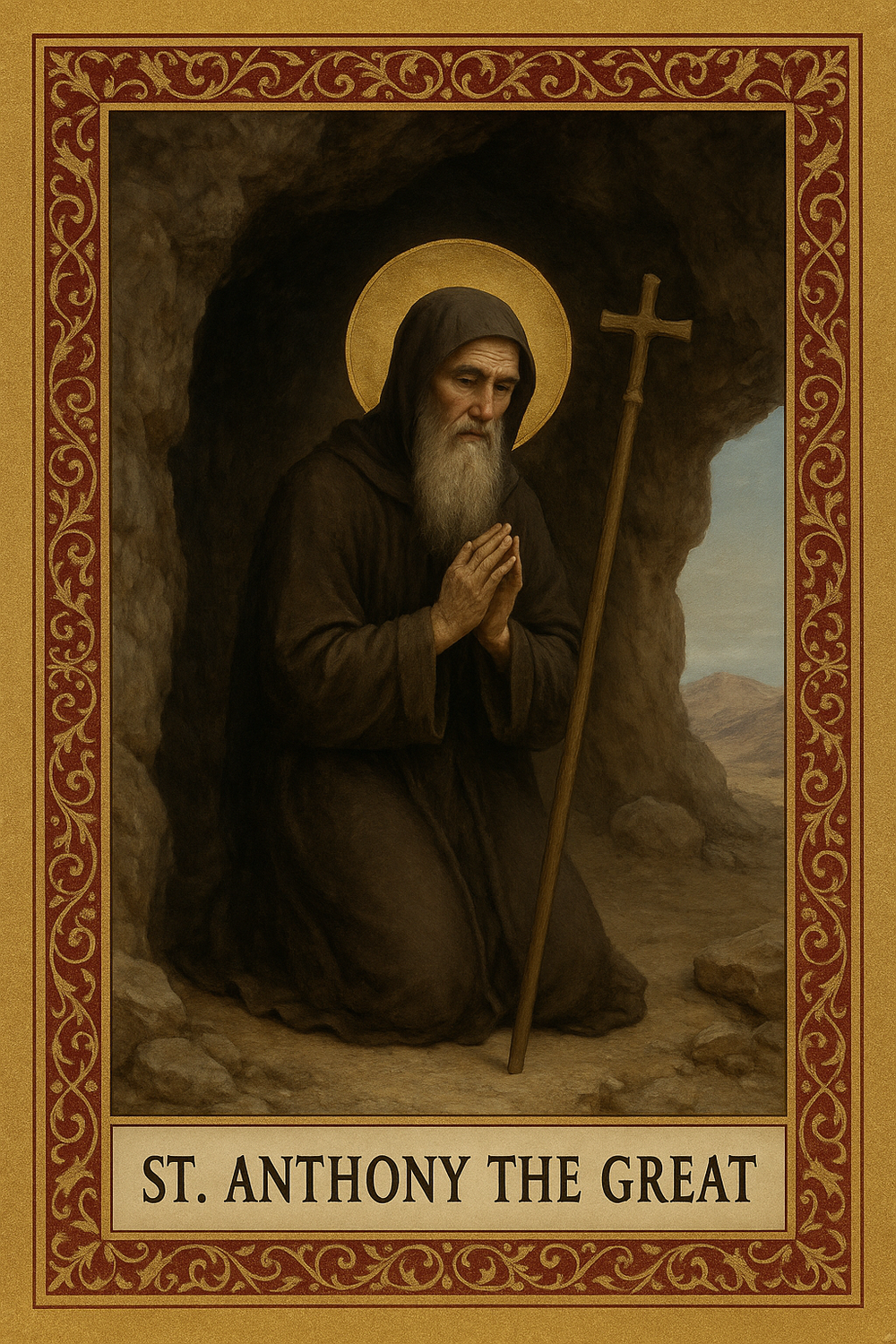
The Ethiopian monks followed the rule of Pachomius and the example of Anthony. These cards and the Ethiopian Saints Collection are good companions for a prayer corner.
Part XV
Lalibela, Axum, and the Kebra Nagast
Lalibela. In the highlands of northern Ethiopia, a medieval king ordered a network of churches carved down into the living rock. Tradition links the churches to the Zagwe king Gebre Meskel Lalibela, who reigned around 1181 to 1221. Dating is disputed, and some churches may be older. UNESCO recognizes eleven rock-hewn churches in four groups, and the site was inscribed as a World Heritage Site in 1978. The church of Saint George, Bete Giyorgis, is considered the most finely executed. Pilgrims come in tens of thousands at Genna and Timkat, as the reference article on Lalibela describes.
Axum and the Ark. The Church of Our Lady Mary of Zion in Axum is believed by Ethiopian Christians to hold the original Ark of the Covenant, kept in a small Chapel of the Tablet beside the old church. Only the guardian monk, who is appointed for life, may see it. The Ark has not been shown to outsiders, and scholars question the claim, so it cannot be tested. The reference article gives the full history.
The Kebra Nagast. The Ethiopian tradition of the Ark is told in the Kebra Nagast, the Glory of the Kings. It is a national epic in Ge’ez of 117 chapters, which scholars date to about 1314 to 1322. It tells how the Queen of Sheba, Makeda, visits King Solomon, bears him a son, Menelik, and how Menelik later brings the Ark to Ethiopia. It legitimized the Solomonic dynasty, which ruled Ethiopia until 1974, and many Ethiopians still hold it dear. It is not part of the biblical canon. Modern scholars see its stories as a medieval creation, as the reference article explains. It is best read as a national and religious epic, not as a source of doctrine.
Part XVI
Patriarchs and Modern History
For most of its life the Church received its chief bishop from Alexandria. Four Ethiopian bishops were consecrated in 1929, according to CNEWA. A July 13, 1948 agreement paved the way for self-rule, Abune Basilios was consecrated in January 1951, and in 1959 Pope Cyril VI of Alexandria crowned him the first Patriarch. Today the Ethiopian Church governs itself, while remaining in communion with the Coptic Church.
The twentieth century was hard. The 1974 revolution ended the monarchy and disestablished the Church, and the Marxist Derg nationalized most church land. The second Patriarch, Abune Theophilos, was arrested in 1976 and secretly executed in 1979, according to the reference summary. The fourth Patriarch, Merkorios, stepped down in 1991 when the Derg fell and later led a Church in exile. A schism lasted until July 25, 2018, when the two sides announced their reunion in Washington, D.C. The fifth Patriarch, Paulos, was elected in 1992 and died in August 2012.
The present Patriarch, Abune Mathias, was elected in February 2013. In January 2023, a group of 26 bishops in the Oromia region, led by Abune Sawiros, declared a rival synod, and the Patriarchate called their appointments illegal. Three archbishops were excommunicated, and the dispute was settled by an agreement on February 15, 2023. The Church lives in a country that has known conflict in recent years. In July 2026 Abune Mathias publicly condemned a drone strike on a monastery in South Wollo that reportedly killed two monks, and an attack on a place of worship in central Ethiopia, calling for investigation and for protection of religious sites, as reported by Addis Standard through allAfrica.
The Church in Eritrea became self-governing after Eritrean independence in the 1990s, and the two Churches remain in full communion. The Eritrean Orthodox Tewahedo Church is much smaller, about 3 million members according to the reference article, and its recent history has been difficult as well.
Part XVII
Relations With Other Churches
| Church | Relationship with the Ethiopian Orthodox Tewahedo Church |
|---|---|
| Coptic Orthodox | Mother Church until 1959 and a sister Church today, in communion. Relations were strained for a period after the Derg-era changes in the Ethiopian Patriarchate, and formal ties resumed on July 13, 2007, according to the reference summary. |
| Eritrean Orthodox | Sister Church in full communion, self-governing since the 1990s. |
| Other Oriental Orthodox | Full communion in the family of Churches that accepted the first three councils: Syriac, Armenian, and Indian. |
| Eastern Orthodox | Not in communion. Theological dialogue has narrowed the gap between Oriental and Eastern Orthodox on Christology. |
| Ethiopian Catholic | A separate Church in communion with Rome that shares the Ge’ez liturgical heritage. CNEWA puts the number of Catholics in Ethiopia at around 750,000. |
| Evangelical and Pentecostal | The fastest-growing group in Ethiopia, about 19 percent of the population in Pew’s count, living alongside the Orthodox majority. |
The Catholic neighbors are worth a note. The Ethiopian Catholic Church and the Eritrean Catholic Church share the Ge’ez heritage but accept the authority of the Pope. We compare the two in Ethiopian Orthodox versus Ethiopian Catholic, trace the Eritrean story in the history of the Eritrean Catholic Church, and introduce their saints in Who Are the Ethiopian Catholic Saints?
Part XVIII
Timeline of the Ethiopian Orthodox Tewahedo Church
- 4th century • Frumentius and EzanaFrumentius is consecrated bishop of Aksum by Athanasius of Alexandria. King Ezana adopts Christianity around 330.
- 431 • Council of EphesusMary is confirmed as Theotokos, a title Ethiopians treasure.
- 451 • Council of ChalcedonThe Church of Alexandria, and with it Ethiopia, does not accept its definition.
- Late 5th century • The Nine SaintsMonks arrive and found monasteries on the Pachomian pattern, including Debre Damo and Abba Garima.
- 6th century • Saint YaredThe chant tradition of the Church is traditionally credited to him.
- c. 1181 to 1221 • King LalibelaThe Zagwe king is linked to the rock-hewn churches.
- c. 1314 to 1322 • The Kebra NagastThe national epic of the Solomonic dynasty is composed in Ge’ez.
- 15th century • Abba EwostatewosHis followers win recognition for Sabbath observance.
- 1929 • Four Ethiopian bishopsThe first Ethiopian bishops are consecrated.
- 1951 • Abune BasiliosHe is consecrated, after the 1948 agreement for self-rule.
- 1959 • The first PatriarchCyril VI of Alexandria crowns Basilios Patriarch of Ethiopia.
- 1974 • The revolutionThe Church is disestablished and its land is nationalized.
- 1991 • The Derg fallsPatriarch Merkorios steps down, and later leads a Church in exile.
- 2007 • Coptic relations resumeFormal relations with the Coptic Church are restored on July 13.
- 2013 • Abune MathiasHe is elected sixth Patriarch on February 28.
- 2018 • ReunionThe Church in Ethiopia and the exile Church announce their reunion on July 25.
- 2023 • The Oromia schismA rival synod is declared in January and settled by agreement on February 15.
Part XIX
Prayers of the Ethiopian Church
The best way to understand a Church’s beliefs is to pray with it. These are short prayers that Oriental Orthodox Christians pray, followed by an original prayer for the Ethiopian Church. They can be prayed standing, facing east, with a cross in the hand.
Holy God, Holy Mighty, Holy Immortal, who was born of the Virgin, have mercy on us.
Holy God, Holy Mighty, Holy Immortal, who was crucified for us, have mercy on us.
Holy God, Holy Mighty, Holy Immortal, who rose from the dead and ascended into Heaven, have mercy on us.
Glory be to the Father, and to the Son, and to the Holy Spirit, now and forever, and unto the ages of ages. Amen.
The wording of the Trisagion varies between traditions and service books. This is the form used in the Alexandrian family of Churches.
Lord Jesus Christ, Son of God, have mercy on me, a sinner.
Lord, have mercy. Kyrie eleison. Lord, have mercy. Kyrie eleison. Lord, have mercy. Kyrie eleison.
The short prayers of the Desert Fathers, whose example shaped the monasteries of Ethiopia.
Lord Jesus Christ, true God and true man, we thank You for the Church You planted in the highlands of Ethiopia. We thank You for Frumentius, who came as a stranger and stayed as a shepherd, for the Nine Saints, for Yared and his song, for Takla Haymanot and every monk who prayed on a mountain, and for every mother and father who carried a child to the font and kept the fast.
Keep Your Church faithful, humble, and brave. Strengthen the Patriarch and all the bishops, priests, deacons, and monks. Comfort those who suffer from war and displacement, and protect the places where Your people gather to pray. Give peace to Ethiopia and Eritrea, and bring Your people everywhere into the unity for which You prayed.
Through the prayers of the Virgin Mary, the Mother of God, and of all Your saints, have mercy on us and save us. To You be glory, with the Father and the Holy Spirit, now and forever. Amen.
Part XX
Books, Shirts, and Prayer Cards for Your Study
If this article has made you want to read more, the books below are good places to go next. Wearing a saint is another way to keep one close, so we have also listed three shirts from our store, and three handmade prayer cards for the Ethiopian saints who appear in this article. If the Book of Enoch is what brought you here, our recommended edition is an affiliate link, and the long article on the text is the best place to begin.
The liturgy book to follow the Church’s worship, the history to understand how it got here, and a silver Abyssinian-style cross to wear.
Book and jewelry links on this page are Amazon affiliate links. If you buy through them we may earn a small commission at no extra cost to you.
Three designs for people who want to wear the saints: Our Lady of the Sign, the Desert Father of second chances, and the archangel Michael.
Handmade cards for the singer, the monk, and the desert ascetic you met in this article.
The Church of the Highlands
For well over fifteen centuries the Ethiopian Church has kept the same Creed, the same Ge’ez liturgy, and the same fasts. We hope this article has helped you meet it. Our Ethiopian Saints Collection is a good place to begin a prayer corner of your own.
Appendix