Mother Angelica: The Life of Rita Rizzo, the Cloistered Nun Who Built EWTN, and Where Her Sainthood Cause Actually Stands
Biography • Poor Clare of Perpetual Adoration • EWTN • Reported Healings • Sainthood Status as of September 2026
Mother Angelica: The Life of Rita Rizzo, the Cloistered Nun Who Built EWTN, and Where Her Sainthood Cause Actually Stands
From a rat-infested apartment in Canton, Ohio, to a monastery garage in Alabama, to a network now reaching hundreds of millions of homes. The documented life, the reported healings sorted by the strength of the evidence, the fights with bishops she did not hide from, and an honest answer to the question everyone asks: is she a saint?
Mother Angelica — At a Glance
- Birth Name
- Rita Antoinette Rizzo • Born April 20, 1923, Canton, Ohio • Only child of John Rizzo and Mae Gianfrancesco Rizzo
- Religious Name
- Sister Mary Angelica of the Annunciation, P.C.P.A. • Poor Clares of Perpetual Adoration
- Entered Religious Life
- August 15, 1944, Cleveland, Ohio • First vows January 2, 1947 • Solemn vows January 2, 1953
- The Promise
- July 31, 1956: before a risky spinal surgery, promised God a monastery in the American South if she could walk again
- Monastery Founded
- Our Lady of the Angels Monastery, Irondale, Alabama • Dedicated May 20, 1962
- EWTN Launched
- August 15, 1981 • From a converted monastery garage • About $200 in the bank by the network’s own account
- Stepped Down From EWTN
- March 2000, during an apostolic visitation • Deacon Bill Steltemeier succeeded her as chairman and CEO
- Stroke That Ended Her Broadcasting
- Christmas Eve 2001 • Cerebral hemorrhage and emergency brain surgery • Lived hidden in the cloister for 14 more years
- Death
- Easter Sunday, March 27, 2016, 5:00 p.m. CDT • Age 92 • Hanceville, Alabama
- Buried
- Crypt Church of the Shrine of the Most Blessed Sacrament, Hanceville, Alabama • Funeral April 1, 2016
- Canonical Status (Sept. 30, 2026)
- Not a saint, not Blessed, not Venerable • No publicly announced cause • Not a “Servant of God”
- Her Spiritual Mentor
- Servant of God Rhoda Wise • Her cause reached the Vatican with a Positio in July 2026
Who She Was, and the First Fact to Get Right
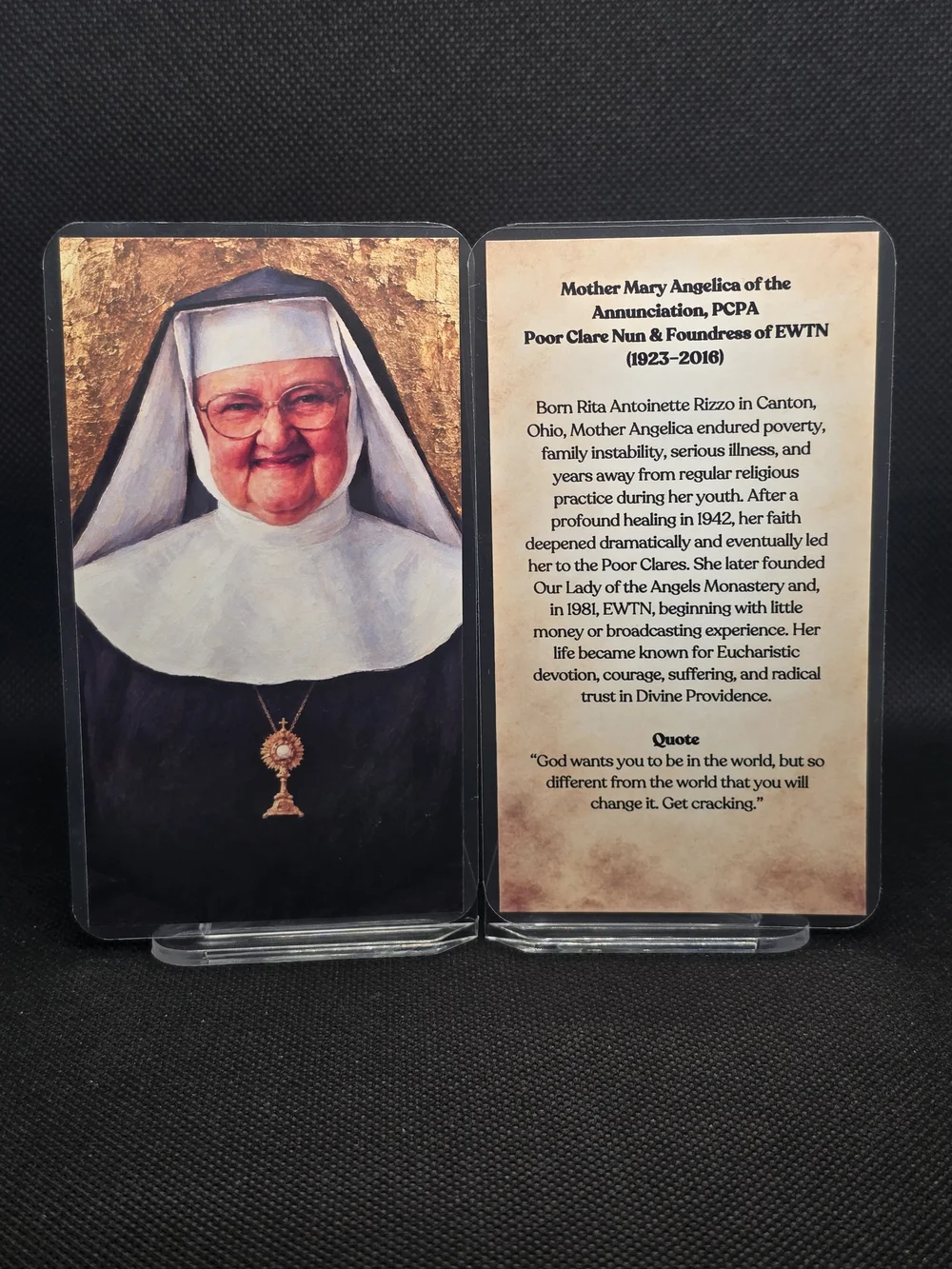
Mother Mary Angelica of the Annunciation, P.C.P.A., was born Rita Antoinette Rizzo in Canton, Ohio, on April 20, 1923, and died on Easter Sunday, March 27, 2016, in Hanceville, Alabama. In between, a poor, sickly, fatherless girl who spent roughly ten years away from regular Church practice became a cloistered Poor Clare nun, founded a monastery in a state where about two percent of the population was Catholic, and then, with a high school education and no television experience, launched the Eternal Word Television Network. By the time she died, EWTN reported eleven television channels in multiple languages reaching more than 264 million homes in 145 countries and territories, according to EWTN’s announcement of her death. TIME once called her arguably the most influential Roman Catholic woman in America.
The first fact to get right is her status. As of September 30, 2026, Mother Angelica is not a canonized saint, not Blessed, and not Venerable. She is also not publicly recognized as a Servant of God, because no cause for her beatification and canonization has been publicly announced by the Diocese of Birmingham in Alabama, EWTN, or the Holy See. The ordinary five-year waiting period after her death ended on March 27, 2021, so nothing in Church law prevents a cause from opening. It simply has not. If you see a page claiming otherwise, look for the diocesan decree. None has been published, and this article does not repeat unsourced claims.
That limit shapes everything below. A great deal of what is told about her is wonderful and some of it is unverifiable, and the Church has examined none of the extraordinary claims. So this account does what she would likely have demanded: it tells the plain truth, including the parts that are hard. It also tells the parts that are astonishing, because the documented facts alone are astonishing enough. She never claimed to be finished or perfect. She claimed to be obedient to what she believed God asked of her next, and then she acted.
The backbone is the detailed Mother Angelica life timeline kept by EWTN, checked where possible against independent reporting, funeral coverage, and the Church’s own procedures. When a story rests only on her word or on the memory of her network, the text says so in plain language and does not dress it up as settled fact.
Part II
Canton, Ohio: A Childhood Without Safety (1923 to 1937)
Rita was born in southeast Canton into what EWTN’s life chronology describes as a ghetto ruled by the Sicilian-based Black Hand. Her father, John Rizzo, was a tailor, and the chronology describes him as unemployed, abusive, and unwilling to have children. Her mother, Mae Helen Gianfrancesco Rizzo, was emotionally fragile. Both parents were of Italian descent and neither was religious.
The Attic Above the Saloon
In November 1928, when Rita was five, John left the family. Mother and daughter moved into the house of Mae’s parents, Anthony and Mary Gianfrancesco. With Mae’s four brothers also living there and only two bedrooms, the two of them took a renovated attic. Anthony ran a family-oriented saloon that served as a gathering place for the immigrant neighborhood. From its edges a little girl learned, by EWTN’s description, about prostitutes, the mob, devout Italian grandmothers, and the variety of a mixed neighborhood. She got her first taste of a stage in 1927 at an Italian festival connected with Saint Anthony’s Church, where she impersonated Al Jolson singing “Danny Boy.”
A Priest Shot Dead, and a Bank She Would Never Trust
On March 10, 1929, Father Joseph Riccardi, pastor of Saint Anthony’s, was gunned down. EWTN ties the killing to his effort to move the parish away from drug dealers who used the school grounds, and calls it a heavy blow to Mae and Rita. That October came the Great Depression. The chronology records that after what she saw, Rita never again deposited her money in a bank. Whatever one makes of that, it fits the financial style she later showed at EWTN, where she committed the network to large purchases before the money existed.
Divorce, Poverty, and Leaving the Church
John returned briefly in September 1930, but Mae filed for divorce on grounds of extreme cruelty and was awarded custody in March 1931. John seldom paid child support. A cousin later said Rita never had a childhood. From 1933 to 1937 Mae ran a dry-cleaning business, and the two moved through a series of rat-infested one-bedroom apartments that served as both home and workplace. When mother and daughter fought, Rita sometimes stayed with friends of the family.
In 1933 the cruelty of the nuns at Saint Anthony’s led Mae to pull Rita into public school. A priest persuaded her to re-enroll the child, but another incident of cruelty, together with the way a missionary treated Mae in confession because of her divorce, ended it. Mother and child left the Church for about a decade. This corrects a rumor that circulates about Mother Angelica. She was never Jewish and never a Protestant who converted. She was a baptized Catholic from an Italian family who spent years alienated from the practice of the faith, which is exactly why her later appeal to people who felt far from God had a ring of authority.
An Eleven-Year-Old Becomes the Parent
In 1934 poverty and depression pushed Mae to the edge. She cried constantly and threatened suicide, and eleven-year-old Rita took over the adult role, driving the delivery car to customers and collecting payments. It is a sobering detail, and it is worth saying plainly that Mae’s suffering was real illness and not a character flaw. Mae would later enter her daughter’s monastery as its first postulant.
That same year, as Rita ran for a bus, she froze when she saw a car speeding toward her, and she later said she felt two hands lift her to the median. The bus driver said he had never seen anyone jump so high. EWTN lists it as her first miraculous experience. There is no police, medical, or witness record, so it belongs in the category of her own testimony.
High School and Loneliness
In 1937, at fourteen, Rita moved back in with her grandparents and entered McKinley High School, where by EWTN’s account teachers quietly conspired to help an unhappy student. In summer 1939 she became a majorette and earned money teaching baton twirling, and she worked in a factory that made liturgical candles. She had no close friends and did not date. Her mother had the first of several nervous breakdowns that year and went to stay with Rita’s aunt Rose in Philadelphia. The teenager who would later speak to millions on television was, by her own telling, deeply alone.
Part III
The Illness, Rhoda Wise, and the Little Flower (1940 to 1943)
In December 1940 Rita’s physical trouble began. It would eventually be diagnosed as ptosis of the stomach, popularly a “dropped stomach.” Her hands shook, her left arm went numb, her stomach spasmed, and she struggled to sleep or eat. A homily at her 2016 funeral recalled that the ailment lasted nearly four years.
Even so, after Pearl Harbor she landed a job as secretary to the vice president of advertising at the Timken Roller Bearing Company. She wrote and edited copy, organized layouts for ad campaigns, and learned how to operate machinery. It is easy to skip past that entry in the timeline, but it may be the most important thing she did before entering the convent. She learned, at a factory desk, how a message is built and sent to an audience.
Rhoda Wise
In 1942 Rita visited Rhoda Wise, a Canton laywoman and mystic. Wise (1888 to 1948) was born in Cadiz, Ohio, and reported visions of Jesus Christ and Saint Thérèse of Lisieux; she also reported a healing from a stomach cancer in 1939. Hundreds of visitors to her Canton home reported unexplained healings. Wise encouraged Rita to pray a novena to Saint Thérèse, and Rita’s stomach ailment disappeared. EWTN says the experience changed her life: for the first time she understood that God loved her personally, and she began to love Him back.
That same funeral homily quoted Mother Angelica as saying that after the Little Flower’s intercession she had a whole different attitude, because she now knew there was a God and that He was interested in her. That is the center of the story. The physical cure mattered, but what she always pointed to was the discovery of being loved.
The relationship has a striking modern sequel. Rhoda Wise now carries the title Servant of God. Her diocesan phase was begun in 2017 by the late Bishop George Murry, and in July 2026 Father John Sheridan of the Diocese of Youngstown announced that the Positio documenting her life and virtues had been submitted to the Dicastery for the Causes of Saints. So the woman who sent young Rita to pray a novena is moving through the Church’s process while Rita, who became Mother Angelica, has no cause at all.
One small date discrepancy is worth flagging. EWTN dates the meeting and healing to 1942, while some later accounts say about 1943. Since Rita turned nineteen in April 1942 and twenty in April 1943, the difference is probably retrospective rounding. 1942 is EWTN’s figure and is used here.
Part IV
The Call and the Cloister (1943 to 1953)
In the fall of 1943, after finishing the Stations of the Cross at Saint Anthony’s and facing a statue of Our Lady of Sorrows, Rita suddenly knew she had a vocation. She kept it secret from Mae, whose emotional state made separation unthinkable. She sought out Monsignor George Habig, Rhoda Wise’s spiritual director, and visited Wise more often. Wise gave her a list of communities to contact, but her grades were so poor that finding one willing to accept her was hard.
On August 15, 1944, at age twenty-one, Rita entered a contemplative Franciscan community in Cleveland, Ohio, the order now known as the Poor Clares of Perpetual Adoration. About a year later she received the name Sister Mary Angelica of the Annunciation, a name her mother chose.
Convent Life Did Not Come Easy
Her brash personality and poor health made it hard. She had pneumonia, a tonsillectomy, and water on both knees, which made the kneeling required at the time extremely painful. In 1946 a retired business owner donated his home and estate to the order, forming a new foundation, Sancta Clara Monastery in Canton. Nuns normally could not transfer to their hometown or join a new foundation before being fully professed, but the abbess decided the five stories of steps in Cleveland were hurting Angelica’s knees and sent her to Canton anyway.
On October 2, 1946, she woke to find both knees normal. The community read it as confirmation of her vocation. No medical file has been made public, so it is a reported healing and not a verified medical event. She made her first profession of vows on January 2, 1947, and her solemn vows on January 2, 1953.
The Contractor Nun
The new convent and its Eucharistic shrine were barely standing in October 1951. Sister Angelica began to distinguish herself by persuading boys from her old neighborhood to donate labor, acting as general contractor, and doing construction work herself. Here, well before any camera or satellite, is the pattern that defined her: see the job, recruit whoever will help, improvise around the shortage, and refuse to treat a lack of expertise as a reason to stop.
In November 1953 she stood in for the novice mistress, who went on an eight-day retreat. She softened the harsh routine, stressed God’s love, and taught that the saints did not break the rules but rose above them. When the novice mistress returned, the abbess allowed Sister Angelica to give discreet spiritual guidance to some of the nuns. The future television teacher had already found her method.
Part V
The Fall, the Promise, and the South (1953 to 1961)
In late 1953 Sister Angelica fell while cleaning floors with an electric scrubber, beginning three years of back pain. Remedies included a body cast, leg and neck traction, and a back brace. None worked. On July 31, 1956, facing a risky operation, she promised God that if He let her walk again she would found a monastery in the South. The surgery was a medical failure, but she woke able to move both legs. She took this as binding, and it governed the next five years of her life.
A Monastery in Reparation
The idea had been forming since August 1953, when the Canton abbess left to found a monastery in Washington, D.C., and Angelica began to imagine a new foundation in the South. By late 1956 it had taken on a specific and surprising purpose. Even as the Supreme Court was affirming a ban on segregation in public schools, she envisioned a cloistered community of Black sisters who would make reparation for the insults and persecution suffered by Black Americans and ask God’s blessings on them. The language she used reflects the 1950s and should be read historically. The concern behind it, racial injustice in the South, is part of the original vision and is often left out of short biographies. The new abbess, Mother Veronica, supported her.
Permissions and Setbacks
On January 8, 1957, she wrote to the bishop of Mobile-Birmingham. Another nun wanted to found a monastery in St. Cloud, Minnesota, and the community could afford only one, so the abbess had each nun write to a bishop of her choice. Whoever received a positive answer first would proceed. Archbishop Thomas Toolen answered Angelica on January 12. But her own bishop, Emmet Walsh of Youngstown, said in February that Sancta Clara could not survive the loss of the six nuns canon law required.
The abbess pleaded her case in March. In April 1959 spasms in Angelica’s back and left leg sent her to the Cleveland Clinic, and in August she wrote Bishop Walsh with plans, income and expense sheets, and a plea that Birmingham’s warmer climate would help prevent disability in her left limb. In November 1959 the bishop approved the concept and began studying the waivers needed. At thirty-seven she was too young to be an abbess of a new monastery without a dispensation. In 1960 she became officially known as Mother Angelica.
On February 3, 1961, Rome granted permission for the Alabama foundation. On the drive south the nuns spent a night in a motel where, at thirty-seven, Mother Angelica saw a television set for the first time. They were housed by the Sisters of the Holy Trinity in Birmingham while they searched for land.
Part VI
Irondale: A Monastery on a Mountain (1961 to 1971)
In May 1961 a former mayor of Birmingham took Mother Angelica to see ten acres of mountainside in Irondale. Next to it stood a small two-bedroom house in foreclosure. She placed a contract on fifteen acres, the house, and another three and a half acres so that no one could build too close to the nuns. On July 24, 1961, Archbishop Toolen broke ground. By September the site was being vandalized every Saturday.
On November 22, 1961, worried about cost overruns, Toolen ordered her to stop building until she had the funds. She told the crew. The electrician answered that for her to owe him money was like having money in the bank, and he would finish the job. The rest of the crew agreed. Sancta Clara lent $25,000 to pay them, Mother Angelica and another nun pitched in on the work, and she scaled the monastery down. In later years she decided that the smaller plan had been providential.
Gunshots in the Rain
On February 21, 1962, Mother Angelica answered a pounding at the monastery door during a driving rainstorm, and five shots rang out. Two weeks later it happened again. The shootings brought media attention to a community that had hoped for quiet. The EWTN chronology does not name who fired the shots, so this article does not either. Later retellings sometimes assign blame to a specific group, but the public timeline does not.
Dedication Day
On May 8, 1962, Mother Angelica left Sancta Clara with the nuns who would populate the new house, and two days later they reached Birmingham. They hosted a ten-day open house. Our Lady of the Angels Monastery was dedicated on May 20, 1962. Five nuns had come from Ohio, and riding with them in a station wagon was Mae Francis, Mother Angelica’s own mother, who became the monastery’s first postulant and later Sister Mary David. Mother Angelica’s former abbess, Mother Veronica, transferred to the new foundation a few months afterward.
The sisters supported themselves by selling Saint Peter’s Fishing Lures, rosaries, and charcoal sketches. A newspaper story about the “Fishing Lure Nuns” helped raise enough to pay for the land, according to one of the original five sisters, Sister Mary Michael, speaking decades later. Money was still tight, and in December 1967 they ended the lure business and began roasting and selling peanuts, asking God to show them work that could be part of the Church’s mission.
The First Recorded Talks
In August 1962 Mother Angelica recorded her first talk, titled “God’s Love for You,” the same discovery that had changed her twenty years earlier. In September 1963 she felt pushed to record a second, “The Presence of God.” In October 1965 she had gallbladder surgery and doctors found fifty stones. Vatican II’s decree on the renewal of religious life came that month, and the monastery adapted. In 1967 she resumed speaking, at first only in the parlor, and that September gave her first local television interview to explain the changes underway.
On March 22, 1969, the pope’s delegate in the United States, Archbishop Luigi Raimondi, visited and promised to obtain formal permission for her parlor talks to continue as missionary activity, an exceptional waiver for a cloistered nun. In 1971 Bishop Joseph Vath of Birmingham encouraged her to accept invitations to speak outside the cloister to select Catholic groups. By mid-1971 the talks were being taped and sold, and in November she began recording a ten-minute radio program for WBRC.
Part VII
Parlor Talks, Mini-Books, and a Television Dream (1972 to 1980)
In 1972 the nuns bought secondhand recording equipment and a dubbing machine to mass-produce her talks. In August of that year she saw the need for a book on prayer, and her first book, Journey into Prayer, appeared. By December she had written three more: In the Shadow of His Light, In His Sandals, and The Father’s Splendor.
In October 1975 her publisher refused her latest book, To Leave and Yet to Stay. The nuns suspected the content was the problem. They faced a choice between abandoning the book ministry and doing the printing themselves. Mother Angelica bought a printing press, a cutter, and a stapler, and the nuns began producing their own mini-books. By 1976, according to the Encyclopedia of Alabama, the monastery had produced some fifty booklets and about 150 instructional audiocassettes. In June 1977 she founded the Catholic Family Missionary Alliance to get her books, tapes, and a five-step plan of renewal into parishes.
The pattern is the same as the one at Sancta Clara: when an existing channel would not carry what she wanted to say, she built a new one.
“Lord, I Gotta Have One of These”
In March 1978 she visited a Baptist-run television station atop a Chicago skyscraper. She looked at the studio and prayed the line that has come down as the origin of EWTN. It is one of the few moments in her story that is also tied to another witness: that same month, at a legal convention in Chicago, she met the lawyer who would become EWTN’s first president, R. William “Bill” Steltemeier Jr. When he heard her speak, he later said, he heard an inner voice say, “Until the day you die.” He spent the rest of his life at her side.
A Falling-Out and a Name
By the late 1970s she was making programs for a Birmingham television station and for the Christian Broadcasting Network, which wanted to expand its Catholic offerings. One of those relationships broke down, according to EWTN chaplain Father Joseph Mary Wolfe, in the same Catholic News Agency report, when a station manager planned to air a film called The Word, which questioned the divinity of Christ through a supposed ancient document. Mother Angelica told him not to air it. He brushed her off and warned that no one else would give her such a good deal. She answered that she did not need him, she only needed God. The garage became the studio, and Wolfe says that is why the network is called the Eternal Word Television Network: it was founded to defend the truth of the divinity of the Word. The garage still stands on EWTN’s Irondale campus as a control room.
Hiring a Lawyer by His Name
She was told she needed a satellite dish, a license, and a lawyer, and to get the lawyer first. Given a list of Washington communications attorneys, she picked Bob Corazzini because he had an Italian name. EWTN CEO Michael Warsaw told Catholic News Agency she phoned him, explained that she was a cloistered nun in Birmingham who wanted to start a cable and satellite network, and was met with stunned silence. Corazzini agreed to meet, and as it happened he was headed to Atlanta to see another client, Ted Turner, about a new network to be called CNN.
Part VIII
August 15, 1981: EWTN Goes on the Air
The Eternal Word Television Network began broadcasting on August 15, 1981, the Feast of the Assumption and exactly thirty-seven years after Rita Rizzo entered religious life. She had a high school education, no television experience, and about $200 in the bank, according to the network’s own account, and she refused to sell commercial advertising. EWTN was to live on donations from ordinary viewers. Her famous ask was that they keep the network between their gas and electric bill.
Her flagship call-in program, Mother Angelica Live, was launched in 1983 by EWTN’s own account and ran until her stroke in 2001. In December 1984 she won a Gabriel Personal Achievement Award from Catholic broadcasters and communicators, and Mother Angelica Live was the only religious program nominated for an Award for Cable Excellence. Dick Clark and Ed McMahon also gave her a Golden Blooper Award that month.
The $600,000 Satellite Dish
The best-known story of the early years goes like this, as EWTN’s chairman and CEO Michael Warsaw told it in 2021. Mother Angelica ordered satellite dishes and planned to pay when they were delivered. When the truck arrived, the driver said he needed a check before he could unload. She told him to come to the property, knowing she had no money, and went to the chapel before the Blessed Sacrament. She told the Lord she thought she had messed this up and asked whether He could help. A nun then told her that a man was on the phone. He was calling from a yacht in the Caribbean. His son, who was struggling with drug addiction, had come across one of her mini-books, entered rehab, and turned his life around. The father wanted to send $600,000, which was exactly the price of the dish. She asked whether he could wire it. The dish still stands on the Irondale campus and has served as EWTN’s principal uplink antenna.
Where the evidence stands: Warsaw knew her for decades and told the story publicly, and EWTN repeats it. No wire record, invoice, or name of the donor has been published, and the date is not given. Other EWTN accounts say the De Rance Foundation, connected through founding board member Richard DeGraff, helped finance early satellite infrastructure, so the $600,000 may be one piece of a larger financing. Nothing in it breaks a natural law, and the Church has never examined it. It is best described as a remarkable episode of Providence as EWTN remembers it, and not as a miracle in the technical sense.
The Close Calls of 1984
On July 14, 1984, EWTN was out of money. Mother Angelica spent six nights begging on the air while seven employees and six nuns manned the phones, and the crisis passed. On November 7 the Grace Foundation called in a $650,000 loan with interest. Two days later a retired lawyer and his wife agreed to advance $700,000 to pay it off. She said of episodes like this that they prove God’s Providence and that the point was to make people understand it was an act of God.
1985: A Real Studio and a National Audience
By early 1985 EWTN was carried on more than 220 cable systems and reached nearly two million homes, making it the fastest-growing cable network in the country by its own description. On April 14 the network dedicated a new 6,500-square-foot studio, which let it produce up to half of its own programming. On June 19, Cardinal Silvio Oddi told her that Pope John Paul II had said EWTN was the key to restoring the Catholic Church in America. EWTN’s chronology notes that, true or not, the remark shaped her thinking, and she began to see the network as a way to strengthen the Catholicism of the simple, the poor, and the elderly. In October, Morley Safer’s 60 Minutes aired a profile of her and the network, bringing her to an audience well beyond Catholics. By year’s end viewer gifts exceeded expenses by more than $1.5 million, even with $3.2 million in debt still on the books.
Part IX
The Network Grows, 1986 to 1992
In October 1986 EWTN lost its satellite lease for the following year. Competitors wanted only 24-hour networks. She could take a six-hour deal on a secondary satellite or go to 24 hours on Galaxy III, a new satellite few cable systems would consider. Either way the network would lose its affiliates and start from zero. Employees told her to go for it, and she did. Shortly afterward a group of cable networks bought out the satellite that served the nation’s 7,000 cable systems, and Galaxy III became the most popular satellite in cable television overnight.
On September 1, 1987, EWTN went to 24 hours a day and reached ten million subscribers. That month it carried complete, unedited, live coverage of Pope John Paul II’s visit to the United States, something no other American broadcaster had attempted, and its reach climbed above twenty million homes. The habit of covering papal trips, canonizations, beatifications, and funerals live and whole, instead of in a two-minute news clip, became one of her most durable contributions.
New Religious Communities
In May 1987 she founded two active communities to secure EWTN’s mission: the Order of the Eternal Word, priests and brothers now known as the Franciscan Missionaries of the Eternal Word, and the Sister Servants of the Eternal Word. In May 1992 the Sister Servants became a separate community with no formal tie to her cloistered order. On July 25, 1998, she founded a second men’s community, the Knights of the Holy Eucharist, to serve the Shrine.
Shortwave, the Pope, and a $1 Million Check
In August 1988 EWTN took delivery of its first mobile production truck, Gabriel I, carrying about $600,000 worth of equipment. That fall she heard a call in prayer to start a shortwave radio network. On January 28, 1989, she arrived in Rome with Bill Steltemeier and two nuns with nothing but her inspiration. At the pope’s private Mass on January 31 he saw her at the end of the receiving line and told her she was a strong woman. A little over a month later, at a general audience, he took her face in his hands and greeted her with a playful Italian title meaning great chief. She told him of her plan to beam radio into Russia and the Eastern Bloc, and EWTN says he was ecstatic.
On February 1, 1989, Dutch Catholic philanthropist Piet Derksen wired $2 million for what became WEWN. A villa north of Rome was bought to house equipment, but she had no license or permission to build. In September 1989 she phoned New Orleans developer Joseph Canizaro and asked what she would have to pray for so that he would give her a million dollars. He said that if he sold a hotel for enough, he would. The hotel did not sell, but he later won a court settlement with an oil company over a polluted plot that netted him about $35 million instead of the $15 million expected. On February 15, 1990, he and Archbishop Philip Hannan of New Orleans hand-delivered a $1 million check. It was the financial beginning of the U.S. shortwave network, and WEWN launched on December 28, 1992.
Saint Michael and a Shattered Wrist
In 1989 Mother Angelica says she felt the sword of Saint Michael touch her shoulder and heard a promise that he would stay at her side and that the two of them would fight together. On February 22, 1990, she was thrust to the sidewalk outside a mall by an unknown assailant and shattered her wrist, and she never regained full use of it. In May 1990, while looking for land for the U.S. shortwave station, she had a vision of Saint Michael and bought a rocky parcel others thought unsuitable. These are her own reports, with no outside confirmation and no judgment from the Church.
Daily Mass Becomes an Institution
In November 1990, working with the Military Archdiocese, EWTN produced the American bishops’ messages of encouragement for troops in the Gulf War. In February 1991 it began broadcasting daily Mass from the monastery during Lent as comfort for military families. When Lent ended, viewers asked that it continue. EWTN bought quiet robotic cameras so the broadcast would not disrupt the sacred atmosphere of the chapel. Daily Mass has been a cornerstone of the network ever since. On August 15, 1991, EWTN celebrated its tenth anniversary and reached 22 million homes, and by December 1992 it reached 31 million.
Live Television as a Mission
What she did with live television deserves more credit than it usually gets. When the Vatican wanted coverage of the Celebration of the Family from Saint Peter’s Square in October 1995, it asked EWTN. The network carried the pope’s 1995 visit to the United Nations, New York, New Jersey, and Baltimore live in English and Spanish, on television, radio, and the internet, and the coverage was seen in more than twenty countries. It offered live coverage of his visit to Cuba in January 1998, and of the canonization of Sister Faustina in April 2000, and it aired a live 35-hour salute to Mother Teresa in September 1997. The point was the same each time: ordinary Catholics who could not go to Rome or Denver or Havana could see the Church whole, without an anchor summarizing it in ninety seconds.
She used the same instinct on radio. In September 1998 there were only 14 Catholic radio frequencies in the United States, and on her live show she urged the laity to start more in their own communities. A businessman answered, and his station went on the air in 1999. EWTN now counts well over a hundred independent Catholic radio affiliates, most of which stay on the air because of the free programming the network supplies.
Part X
Braces, Habits, Bogotá, and Hanceville (1993 to 1999)
In the spring of 1993 severe asthma, coughing, and congestion put her in the hospital. The violence of her cough shattered a vertebra and damaged a nerve to her right leg, leaving her in excruciating pain. From then on she wore a back and leg brace and could walk only with crutches. Viewers watched it happen on camera. She did not hide her body from the people she taught about suffering.
In August 1993 EWTN covered World Youth Day in Denver, picking up more than 200 new cable affiliates, and a new producer named Michael Warsaw made his debut. He would one day become EWTN’s president, CEO, and chairman. On December 24, 1993, the nuns returned to their traditional habits, and Mother Angelica told her audience it was a witness to the Lord, to each other, and to obedience to the Church. In 1994 she restored abandoned cloister practices, including the stating of faults, strict silence, and prostration during the Consecration, and began spending three hours a day in adoration before the Blessed Sacrament.
EWTN Goes Global
In 1995 EWTN announced Intelsat carriage to 42 countries and launched a Latin American satellite service, reaching about 40 million homes. In 1996 it acquired a large Catholic online document service, launched a worldwide AM/FM radio service, and started a 24-hour Spanish network. On September 4, 1996, The World Over debuted with Raymond Arroyo, who would become her biographer. On May 1, 1996, Pope John Paul II, at the end of a receiving line, called her strong and courageous. Then he walked back, traced a cross on her forehead, and said she was weak in body and strong in spirit. EWTN launched in the Pacific Rim in December 1996, and Life on the Rock and The Journey Home debuted in 1997.
EWTN also became a live witness to the canonizations and beatifications of her era. In September 1997 it aired a live 35-hour salute to Mother Teresa after her death, and in October 2003 it covered her beatification. It carried Padre Pio’s beatification in 1999 and his canonization in 2002, and the canonization of Sister Faustina in 2000. Coverage of the saints in real time, instead of in a summary, became part of what the network was for.
The Farm Chapel That Became a Shrine
By 1995 the Irondale monastery was surrounded by the noise of a growing network. On October 12, 1995, she saw 200 acres of land in Hanceville, Alabama, an hour north of Birmingham, and three days later made an offer. She eventually acquired 403 acres to keep hotels and restaurants away. She wanted a thirteenth-century-style monastery that grew its own food, and privately called the plan a farm with a small farm chapel.
On June 20, 1996, in Bogotá, Colombia, she says she received a message from the Divine Child Jesus: “Build Me a Temple, and I will help those who help you.” She later read an inscription on Saint Peter’s in Rome that calls the Church “this temple,” and concluded that the Child wanted an elaborate one. The small farm chapel became the Shrine of the Most Blessed Sacrament.
The Encyclopedia of Alabama reports that an initial private gift of $1 million launched the project and that five families and a private foundation gave a total of about $48.6 million. It adds that she never raised money for the monastery on the air. EWTN has not named the families. The Shrine was consecrated on December 19, 1999, during a live broadcast, and the nuns moved from Irondale to Hanceville that year.
January 28, 1998: The Braces Come Off
While praying the Rosary with Paola Albertini, an Italian mystic, Mother Angelica removed the braces from her legs and began to walk. EWTN says three physicians independently examined her and found the healing real. The physicians’ names and records have not been published, and the Church has not examined the case. That makes it a strong claim from a source with a stake in the story, and not a canonically recognized miracle. It is also fair to note that her health declined sharply in the years that followed, and that in 2003 she made a secret pilgrimage to Lourdes hoping for healing and did not receive it.
Part XI
Mahony, Foley, and the Visitation (1997 to 2000)
An honest life of Mother Angelica has to include the fights. Her broadcasting was aimed at what she called the Catholicism of the simple, and in the 1990s she increasingly believed that some American bishops were confusing ordinary Catholics about the Mass. The clashes were public, sharp, and in one case she later admitted she had gone too far. A fair reader can hold two thoughts at once: she was sometimes right to worry, and she was sometimes wrong in how she spoke.
Cardinal Mahony, November 1997
In September 1997 Cardinal Roger Mahony of Los Angeles issued a pastoral letter on Sunday liturgy. On her program on November 12, Mother Angelica said the letter did not make clear enough that Christ is truly present in the Eucharistic bread and wine, and she told viewers her obedience in that archdiocese would be absolutely zero, adding that she hoped everyone else’s would be too. Mahony, then in Rome for the Synod for America, answered in a November 14 letter that denied any doubt about the Real Presence and called her request for disobedience shocking.
On her November 18 show she apologized to the cardinal for a remark she said must have seemed excessive, but she kept arguing that his letter was confusing. Mahony took his complaint to the Vatican, meeting with officials at the Congregation for Institutes of Consecrated Life and the Pontifical Council for Social Communications. His spokesman said the concern went beyond her remarks about him to how EWTN operated and to whom it was accountable. No formal Vatican reply was reported at the time. The episode shows both sides of her: the quick speech that could cause harm, and the willingness to say publicly that she had overstepped.
Bishop Foley and the Direction of the Mass, 1999 to 2000
As the Hanceville Shrine neared completion, Mother Angelica wanted the nuns’ daily televised Mass celebrated ad orientem, with priest and people facing the same liturgical direction. Her bishop, David Foley of Birmingham, objected. In October 1999 he issued a decree barring priests of the diocese from adopting the practice. She sent an aide to Rome, and within about a month a fax from the Vatican to Bishop Foley overturned the decree, as recounted in the National Catholic Register. But after further negotiation he issued a second directive that effectively prohibited celebrating the televised Mass ad orientem in his diocese. On March 12, 2000, EWTN stopped broadcasting the sisters’ Mass from Hanceville and moved it to the network headquarters in Irondale, about 45 minutes away.
The two eventually resolved the matter. Bishop Foley, by then retired, was among the bishops who concelebrated her funeral Mass in 2016.
A Monstrance from the Pope
In the middle of this, on February 14, 2000, a large white satin box with the papal insignia and no note arrived at the monastery. A caller later said it held a gift from the Holy Father in appreciation of EWTN’s work around the world and the sisters’ devotion to the Eucharist. She opened it on live television the next night and found a monstrance that the people of Nowa Huta had given the pope during his 1999 pilgrimage to Poland. A high-ranking Vatican official told Raymond Arroyo it was a sign of the pope’s solidarity with her.
The Visitation and Her Resignation
In spring 2000 Archbishop Roberto González Nieves, O.F.M., of San Juan, Puerto Rico, conducted an apostolic visitation to Our Lady of the Angels Monastery. According to EWTN anchor Raymond Arroyo, the purpose was to investigate the relationship between the monastery and the network. One critical account, drawing on the same events, says the visitor looked at the ownership of the network, the monastery’s right to give property to EWTN, and the legitimacy of her authority as abbess, since she had never been formally elected. Before the visitor could write his report, Mother Angelica resigned as EWTN’s chairman and CEO in early March 2000, and Deacon Bill Steltemeier succeeded her as chairman and CEO. The network moved to a lay board. the Global Sisters Report reports that, because she resigned first, no final report was ever issued, and outsiders still know little about what it would have said.
Accounts of her motive differ and cannot be settled from public evidence. Some say she acted under pressure from her bishop and Rome. A former EWTN board member has argued she was not forced out. A reference work says she resigned to transfer the network to a lay board beyond direct episcopal control. Anyone who claims to know what the visitor concluded, in either direction, is claiming more than the record allows. What is certain is the result: EWTN was governed by lay leaders, and that structure was already in place when her Christmas Eve 2001 stroke ended her broadcasting less than two years later.
Part XII
The Stroke and the Hidden Years (2000 to 2016)
On July 3, 2000, she had an episode she called a near-death experience and described to viewers on July 11. She said she felt she had died and come back, and that she no longer feared death. Whatever one thinks of such reports, it was the last year in which she spoke on camera with the old energy.
On September 5, 2001, a stroke paralyzed half her face. She told viewers she had never had such an awareness that God was choosing her to help people, and that suffering is how He makes us holy. On September 11 EWTN went to twenty-four hours of special programming on the attacks. On December 5 she recruited Father Mitch Pacwa as permanent guest host, to fill in whenever her health kept her off the air.
On December 11, with one eye patched because of the stroke, she missed a raised platform in a Books-A-Million store, fell on her face, and cracked her left arm above the elbow. EWTN states that the next day she was given the wrong plasma, which contributed to her dangerous condition. No hospital record has been published, so that claim rests on the network alone. She reported a vision of the souls in hell and being comforted by Saint Michael the Archangel.
On Christmas Eve 2001 she suffered a massive stroke and cerebral hemorrhage and needed emergency brain surgery. Doctors gave a grim prognosis. A week later she could move her legs, and feeling was returning to the left side of her face. She came home on January 25, 2002. Over the next two years seizures sapped her energy and confined her to bed for long periods, and her language skills declined. On February 13, 2002, she told Raymond Arroyo that the reason for the stroke was purification, and that just before it Jesus had told her she would suffer much for His sake.
The Last Public Traces
In October 2002 she taped a new Rosary video with her nuns, which began airing in March 2003. In December 2002 a pre-taped segment aired in which she tried to say her familiar tag line about keeping the network between the gas and electric bill and could not. EWTN aired the botched attempt deliberately, to acquaint viewers with her condition. Her voice had been her ministry. On October 12, 2003, she made a secret six-day pilgrimage to Lourdes hoping for another physical healing. According to EWTN, this time the answer was no.
Honors continued even as she withdrew. She was inducted into the Cable TV Pioneers in 2003 and named Alabama Broadcasters Association Citizen of the Year in 2004, and in April 2004 EWTN marked her eighty-first birthday with a day of programming from the Shrine. In March 2010, EWTN notes, she and Raymond Arroyo, her biographer and editor, reached the New York Times bestseller list for the fourth time. In 2009 Pope Benedict XVI awarded her and Deacon Steltemeier the Pro Ecclesia et Pontifice Cross for distinguished service to the Church. The papal medal recognized service. It is not a finding of heroic virtue. In October 2010 the City of Canton named a stretch of Market Avenue in front of Sancta Clara Monastery the Mother Angelica Memorial Corridor.
Through all of it she lived at the Hanceville monastery in the Poor Clare enclosure she had restored. The woman who had been the most recognized nun in America spent some fourteen years mostly out of sight, essentially bedridden according to Catholic News Service, while the network she founded grew into television, radio, publishing, digital media, and news. Of all the contrasts in her life, that may be the one she would most want noticed: the hidden contemplative she had been in Cleveland in 1944 was also who she was at the end.
Part XIII
Easter Sunday 2016
In February 2016, on the flight to Cuba, Pope Francis sent a special blessing to the gravely ill Mother Angelica and asked for her prayers. She died at 5:00 p.m. Central Time on Easter Sunday, March 27, 2016, at Our Lady of the Angels Monastery in Hanceville, at age ninety-two, surrounded by her Poor Clare sisters.
EWTN scheduled several days of rites beginning March 29 with the reception of her body at the Shrine and public visitation, a Rosary, Solemn Vespers chanted by the Franciscan Missionaries of the Eternal Word, and a vigil led by Bishop Robert Baker of Birmingham. The Mass of Christian Burial was celebrated on Friday, April 1, at the Shrine of the Most Blessed Sacrament. Archbishop Charles Chaput of Philadelphia, the longest-serving member of EWTN’s board, was the main celebrant, and eight archbishops and bishops took part. Among them were the Vatican nuncio, Archbishop Carlo Maria Viganò, who conveyed a message of condolence from Pope Francis, Bishop Baker, Bishop Thomas Olmsted of Phoenix, and retired Bishop David Foley, the man with whom she had clashed over the Mass. About 2,000 mourners filled the Shrine and the piazza outside, and the funeral was broadcast to millions.
Father Joseph Mary Wolfe, M.F.V.A., preached. He said EWTN had had many plans for this day, but that God was full of surprises when it came to Mother Angelica. One surprise was the calendar. Because she died on Easter Sunday, the Office of the Dead could not be used during the octave, and the first reading had to be changed to a passage from the Book of Revelation about a new Heaven and a new earth. Another surprise was that April 1 was the First Friday, which honors the Sacred Heart, and the next day was a First Saturday, with its emphasis on Mary and the Rosary. Two days after the funeral was Divine Mercy Sunday. After the Mass came a committal and burial in the Crypt Church of the Shrine, where she rests.
What She Left Behind
EWTN’s own press release at her death said the network then transmitted eleven television channels in multiple languages, reaching more than 264 million homes in 145 countries and territories, alongside radio, digital media, global news services, and a publishing group. Those numbers describe the institution she founded, not what she personally governed after 2000. She also left a Poor Clare community at Hanceville, the Franciscan Missionaries of the Eternal Word, the Knights of the Holy Eucharist, and a Shrine that remains among the most visited tourist sites in Alabama. Michael Warsaw, the producer who arrived in 1993, became the network’s chairman and CEO. In 2023 Bishop Steven Raica of Birmingham celebrated a special Mass for the centenary of her birth.
Part XIV
What She Taught
Mother Angelica never wrote a systematic theology, and she did not try. She moved between Scripture, stories, advice to callers, the saints, jokes, and her own experience. A future reviewer would have to read her spontaneous remarks in context, not judge her by a single clip. But certain convictions come up again and again.
God Loves You Personally
Her first recorded talk was titled “God’s Love for You,” and it was the discovery she made in 1942. She spoke to people who felt rejected, guilty, or far from God because she had been one of them.
Everything Flows From the Blessed Sacrament
She was a Poor Clare of Perpetual Adoration. She built a monastery and then a Shrine around the Eucharist and, from 1994, spent about three hours a day in adoration. The television network is best read as an outgrowth of a hidden life of prayer. When money failed or plans collapsed, her recorded instinct was to go to the chapel.
Peace of Heart
Father Joseph Mary Wolfe, who came to EWTN in 1985 and became one of the first members of the Franciscan Missionaries of the Eternal Word, sums up what she taught in the National Catholic Register as the way to peace of heart: a great confidence in God’s providential care whatever may come. He says she made it believable because her own interior peace was visible in her manner and in the tone of her voice. Her chapter on trusting God in the present moment makes the same point. Even when the present moment is tragic, she says, it is where God is meeting you, and it is the only place you can meet Him. That is an unusual thing to hear from a woman who had spent most of her life in pain, and it is a large part of why people believed her.
Providence and Risk
She taught that God often asks us to do the ridiculous so that He can do the miraculous. The life bears her out in many places: the dish she ordered without money, the 24-hour leap, the shortwave network, the Shrine. But she was not reckless in her own telling. In the satellite story she admits she might have misunderstood God’s will. The spirituality is to pray, discern, act, meet the impossible obstacle, return to prayer, and continue.
The Present Moment and Plain Speech
She urged ordinary people to be holy right where they were, in the duty and the people in front of them. She was funny, blunt, and sometimes furious, and she could turn from theology to a joke about herself in a sentence. She told people to be in the world but so different from it that they would change it, and then two words that became her motto: get cracking.
Suffering Without Sentimentality
Stomach disease, knees, a spine, gallstones, a wrist, asthma, strokes, seizures, and the loss of speech: her body paid for her work, and she taught that suffering united to Christ is fruitful. She also sought doctors, surgery, braces, and a pilgrimage to Lourdes. She did not teach that faith guarantees a cure, and her life shows that answers to prayer for healing were sometimes yes and sometimes no.
What Critics Say
Admirers credit her with restoring confidence in explicitly sacramental, Marian, Eucharistic, and papal Catholic broadcasting at a time they believed it was scarce. Critics argue that her tone, and later EWTN’s commentary, sharpened ideological division in American Catholicism, and that committing the network to large expenses before the money existed put enormous risk on one person’s discernment. Both points are fair subjects for a historian. It is also fair to separate what she directed from what EWTN became after she left the chair in 2000, and especially after her 2001 stroke.
Part XV
Her Books, Her Booklets, and Where to Find Them
Mother Angelica wrote the way she talked. There is no hidden academic apparatus in her books, no footnotes chasing an argument, and no pretense. There is a Poor Clare at a desk or in a chapel, speaking to one person about prayer, suffering, forgiveness, the Mass, and the present moment. That is why her books have outlived the television programs that made her famous.
From Parlor Talks to the First Books
Her writing began as an offshoot of her speaking. After she recorded her first talks in the early 1960s, people asked for something they could hold. Journey into Prayer came out in August 1972, followed that December by In the Shadow of His Light, In His Sandals, and The Father’s Splendor, according to EWTN’s life timeline. When a publisher turned down To Leave and Yet to Stay in October 1975, she bought a printing press, a cutter, and a stapler, and the nuns began printing their own mini-books in the monastery. By 1976 the monastery had produced about fifty booklets and some 150 instructional audiocassettes, according to the Encyclopedia of Alabama.
Those little booklets did more than teach. They carried her name to people who had never heard her speak, and they are the reason one of the most famous stories of her life exists at all: the man on the yacht who called about the satellite dish had first met her in one of them.
“Born of Light” in Adoration
When EWTN released a seven-book box set of her late-1970s pamphlets in 2018, the network’s chaplain, Father Joseph Mary Wolfe, explained that a good portion of them were written while she was in adoration before the Blessed Sacrament. She described the booklets as born of light, the inspiration that came to her there. She would write out a spiritual topic, and other sisters at Our Lady of the Angels would copy the text into pamphlets. Father Wolfe says the distribution of those booklets led to invitations for radio and television interviews, and from there to EWTN. He adds that her teaching was not high theology but something practical, meant to be lived out in a day-to-day life, and that she could speak to people because she had known suffering herself, beginning with her parents’ divorce.
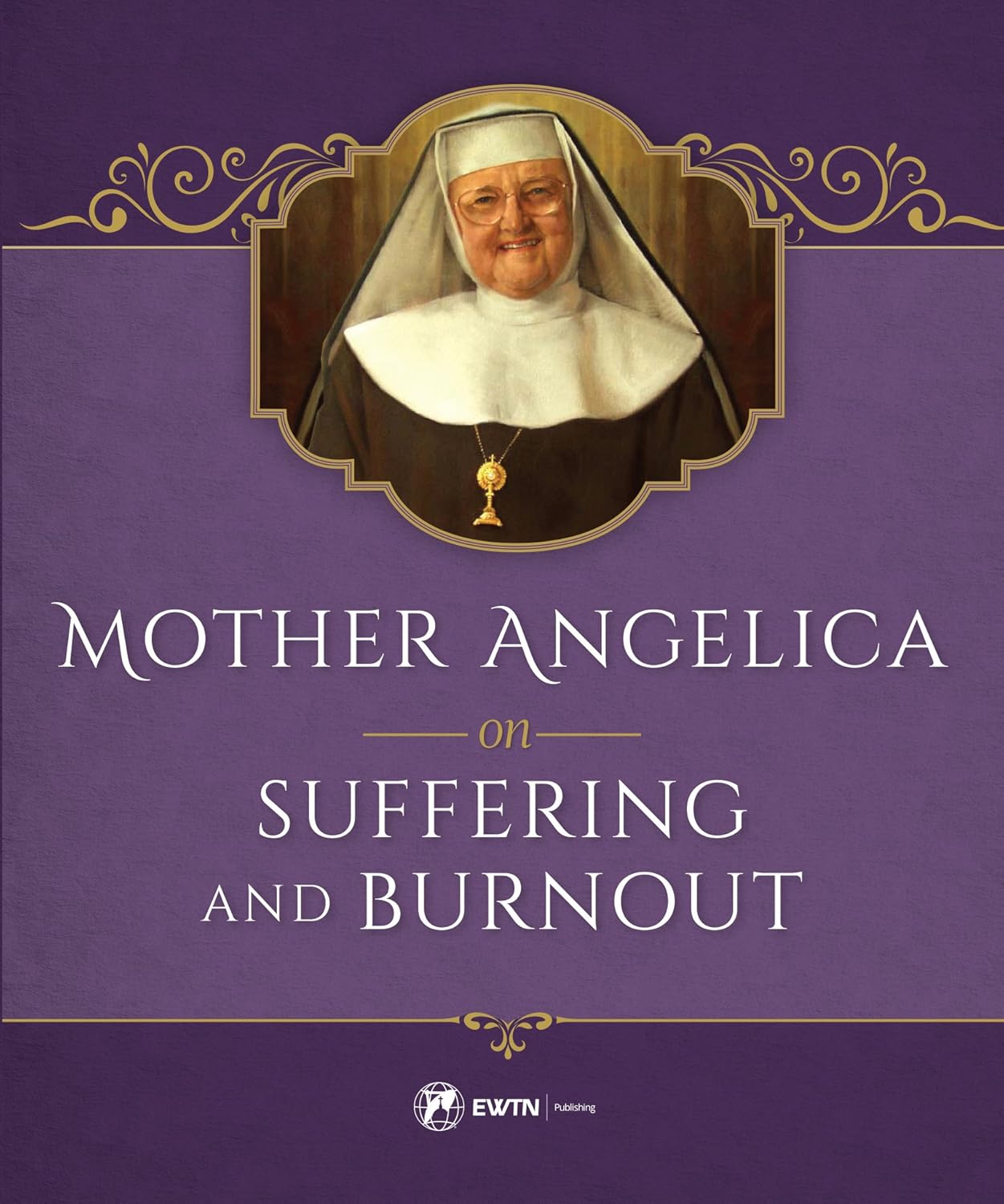
One of the seven titles in that set was Mother Angelica on Suffering and Burnout. It is worth reading for a reason that has nothing to do with television. She wrote from the body of someone who had lived with pain for decades, and she did not write as though suffering were simple.
The Collections: Her Words, Arranged for Today’s Reader
In August 2015 EWTN formed a publishing partnership with Sophia Institute Press, as EWTN News reported, with the stated focus of publishing her written works and editing material from Mother Angelica Live into books. Most of the titles below come from that effort. Each one is a different way into her voice.
- The Collected Spiritual Works of Mother Angelica gathers her devotional writings into one deluxe volume. It includes meditations on the Rosary, including the Luminous Mysteries, and on the Way of the Cross, along with conversational prayers, scriptural reflections, teaching on the sacraments, and consolation for seasons of suffering, burnout, and spiritual weariness. If you want only one book to begin with, start here.
- Mother Angelica’s Keys to the Interior Life is a 160-page paperback from EWTN Publishing. It covers how to love and forgive, how to live the faith in the modern world, and how to grow closer to God and to the Eucharist. Father Wolfe said in an interview about the book that she taught the way to peace of heart, which is confidence in God’s providential care whatever comes, and that she made it believable because her own interior peace showed in her manner and voice.
- Mother Angelica Talks It Over collects chats selected from Mother Angelica Live Classics on family life, faith, and forgiveness. It is the closest thing in print to sitting down across from her, including her talk about the wounds of strained relationships and what it takes to bring loved ones back to the Church.
- Mother Angelica’s Lessons on Genesis takes her conversational method to the first book of the Bible. She invites readers to stand in wonder at creation, connects stories such as Abraham’s to ours, and shows how the Old Testament is fulfilled in the New and in the sacraments.
- Advent and Christmas with Mother Angelica draws meditations from the best episodes of her show on setting Christ at the center of the season, including her suggestion that each of us add straw to His manger in preparation for His coming.
Earlier Sophia editions of older books, including Praying with Mother Angelica and Mother Angelica’s Answers, Not Promises, have also been republished, and the same publishers list further thematic volumes drawn from her writings, including ones on the sacraments, on God and the angels, and on prayer.
The Biography and the Edited Volumes
The major biography is Raymond Arroyo’s Mother Angelica: The Remarkable Story of a Nun, Her Nerve, and a Network of Miracles. Arroyo interviewed her at length and had access to people close to EWTN, which makes the book indispensable. He was also a senior figure at the network and her close associate, so it reads best alongside independent reporting, such as the articles linked throughout this one. He also edited several collections of her private notes and recorded lessons, including Mother Angelica’s Little Book of Life Lessons and Everyday Spirituality and The Prayers and Personal Devotions of Mother Angelica.
One caution on counting. The total number of her books and booklets has never been catalogued in a published bibliography, so round numbers you see online are approximations. Several modern titles are compilations assembled from older talks. If you plan to quote her, check the wording against the original recording or the printed booklet.
The titles below are discussed above. As an Amazon Associate, The Eastern Church earns from qualifying purchases made through these links, at no cost to you.


Part XVI
Healings, Visions, and Providence: What Is Claimed and What Is Known
A long list of events in Mother Angelica’s life were called miraculous, by her and by the network she founded. It is important to be precise about them, because the people who love her most are the ones most likely to overstate them. No cause has been opened, so the Church has not examined any of these events. Every account below rests either on her own word, on the memory of people close to her, or on EWTN’s account of what happened. Where outside records exist, they are noted. Where they do not, that is said plainly.
1934: Lifted Out of the Path of a Car
As an eleven-year-old running for a bus, Rita froze when she saw a car racing toward her and felt two hands lift her to the center median. The bus driver said he had never seen anyone jump so high. The only source is her own recollection as recorded in the EWTN timeline, and no police or witness record has been published. She understood it afterward as the first sign that God had been watching over her long before she knew Him.
1942: The Stomach Illness and the Novena
After years of a debilitating stomach ailment, Rita prayed the novena to Saint Thérèse that Rhoda Wise suggested, and the illness left. She said the healing meant less to her than what came with it: the certainty that God loved her personally. No medical file is public. The episode is also part of the record of Wise’s own cause. The diocesan phase was opened in 2017, and EWTN News reported in July 2026 that the Positio had gone to Rome. That is material on Wise and does not amount to a finding about Rita’s healing.
1946: The Knees
For two years she had suffered from water on both knees, which made the required kneeling painful. She was moved to Sancta Clara in Canton, in part because the stairs in Cleveland were hurting her, and on October 2, 1946, she woke to find both knees normal. Her community took it as confirmation that she had a vocation. As with the others, it rests on her testimony and on community memory, with no public medical report.
1956: Walking After a Failed Surgery
Before her risky spinal surgery she promised God a monastery in the South if she could walk again. The operation was a medical failure by EWTN’s description, but she woke able to move both legs. The surgical records have never been published, so there is no way to say from the outside what the surgeons expected or what changed.
Saint Michael, 1989 and 1990
In 1989 she said she felt Saint Michael’s sword touch her shoulder and heard a promise that he would fight beside her. In May 1990, while scouting land for the shortwave station, she reported a vision of the archangel and bought a rocky parcel that others thought unsuitable. Both are private experiences known only through her. The Church has issued no judgment on them.
Bogotá, June 20, 1996
Before an image of the Divine Child Jesus, she reported hearing the words that set the Hanceville Shrine in motion. She also told the story in a way that shows how she tested her own experiences: only later did she read the inscription at Saint Peter’s in Rome that calls the Church “this temple,” and conclude what the message meant. The Church has issued no decree on it. The Shrine itself, however, is a fact anyone can visit.
January 28, 1998: The Braces
This is the claim that sounds strongest and needs the most care. While praying the Rosary with Italian mystic Paola Albertini, Mother Angelica removed the braces she had worn since her 1993 injury and began to walk. EWTN says three physicians independently examined her and found the healing real. Their names and reports have not been made public, and the network is the only source. For a cause, those records would be among the first things asked for, along with the original diagnosis, imaging, and follow-up showing how long the improvement lasted. Her later years also complicate any simple reading. Her health declined sharply after 2000, and in October 2003 she made a secret pilgrimage to Lourdes hoping for healing and, in EWTN’s words, was told no.
2000 to 2002: Near-Death and the Strokes
On July 11, 2000, she told viewers that she felt she had died and come back and no longer feared death. After the September 2001 stroke she said she had never been so aware that God was choosing her to help people, and in February 2002 she told Raymond Arroyo that the stroke was purification and that Jesus had told her she would suffer much for His sake. She also reported a vision of the souls in hell, with Saint Michael at her side, after her December 2001 fall. These are subjective reports from a woman in grave illness, and they are best read as part of how she understood her suffering.
The Money Stories
The $600,000 dish, the $700,000 advance that paid off the 1984 loan, and the $1 million check in 1990 are remembered at EWTN as answers to prayer. They do not involve a violation of any natural law. What struck her and the people around her was the timing. For the dish, the only published source is Michael Warsaw’s account to Catholic News Agency in 2021. No donor’s name, wire record, or invoice has been shown. That does not mean it did not happen. It means it is a story of Providence as the EWTN family remembers it.
Why the Word “Miracle” Has to Wait
In Church usage a miracle is something the Church has investigated and judged, most often a medical healing supported by records from before and after, expert review, and the exclusion of adequate natural explanations. For a cause of heroic virtue, ordinarily one miracle attributed to the candidate’s intercession after death is required for beatification and a second for canonization. Mother Angelica herself used the word in its broad devotional sense, as most of us do. A future cause would be hurt, and not helped, by supporters who label every coincidence or recovery a miracle. Keeping the language exact is not a way of doubting her. It is the way to keep anything true about her from being discredited later.
Part XVII
Is Mother Angelica a Saint? The Cause, Step by Step
No. As of September 30, 2026, Mother Angelica has not been canonized, beatified, or declared Venerable, and no cause for her has been publicly announced. The correct ways to refer to her are Mother Angelica or Mother Mary Angelica of the Annunciation, P.C.P.A. Do not call her Saint, Blessed, or Venerable, and do not call her a Servant of God until the Church grants that title by formally opening a cause.
The Waiting Period Has Ended
Church law ordinarily requires five years to pass after a person’s death before a cause can open. For Mother Angelica that period ended on March 27, 2021. A piece published around that milestone for the Shrine and the Diocese of Birmingham’s magazine, “An Indelible Mark,” noted that opening a cause had become possible and that Birmingham would be the relevant diocese. The absence of a cause is therefore not caused by the calendar. It simply has not been started.
How a Cause Begins
A cause does not begin in Rome because someone famous has admirers. First there must be a genuine reputation for holiness and a reputation for intercessory power among a significant portion of the faithful. The Vatican’s instruction on diocesan inquiries, Sanctorum Mater, requires that this reputation be spontaneous and not artificially produced, stable, continuing, and widespread. A petitioner, which may be a diocese, a religious community, a recognized association, or a qualified group of the faithful, appoints a postulator trained in theology, canon law, and history. The postulator gathers evidence, including unfavorable evidence, and presents a formal petition to the competent bishop. The bishop consults, publicizes the proposed cause so people can come forward with information, and seeks the Holy See’s nihil obstat. Only when the cause is opened does the person receive the title Servant of God.
Why the Diocese of Birmingham
The competent bishop is ordinarily the bishop of the diocese where the candidate died. Mother Angelica died at her monastery in Hanceville, which is in the Diocese of Birmingham in Alabama. Its bishop is Most Reverend Steven J. Raica, appointed in March 2020 and installed on June 23, 2020. Before coming to Birmingham he served as vice postulator of the cause of Antonietta Meo, a six-year-old Italian girl who died of cancer in 1937 and who was declared Venerable in 2007, so he has hands-on experience with how a cause works. We found no public announcement from him, the diocese, EWTN, or the Holy See that a Mother Angelica cause has been opened.
The Rhoda Wise Parallel
The contrast with her mentor is worth noting. Rhoda Wise died in 1948, and her cause was opened in 2017 by the late Bishop George Murry, S.J., of Youngstown. In July 2026 the Positio on her life and virtues went to the Dicastery for the Causes of Saints, as EWTN News reported. The Positio is the stage at which Rome studies whether she lived the virtues to a heroic degree, and if she is declared Venerable, she would belong to a small group on the path to canonization. The woman who sent Rita Rizzo to pray a novena is moving through the process. Rita’s own path, if the Church ever judges it worth examining, has not started.
What a Cause Would Face
The strengths are obvious. She has a durable and widespread reputation among many Catholics. She spent more than seven decades in religious life. Her suffering is well documented. She left thousands of hours of her own speech, so investigators could study the candidate herself and not only what others say about her. Many people who knew her are still living. Benedict XVI honored her service in 2009.
The difficulties are just as real, and a serious cause would not look away from them. Investigators would have to review decades of spontaneous television remarks for faith and morals. They would have to examine the Mahony and Foley episodes for obedience, prudence, justice, and charity, including her apology and her later conduct. They would need the records of the 2000 visitation, which was never concluded. They would need to weigh her financial governance, in which she repeatedly committed the network before funds existed, and to ask whether it shows heroic trust in Providence, imprudence, or both at different times. They would have to examine every reported healing with real medical records. And they would need evidence that devotion to her arises among ordinary faithful and not simply from the promotional reach of a large network that loves its foundress. Church law looks for truth, including adverse truth. A cause that hid the hard parts would be weaker for it.
Part XVIII
How Ordinary Catholics Can Help, Properly
The Church requires a real reputation for holiness, so real support looks quiet. It does not look like merchandise calling her a saint, invented miracle stories, or mass-produced petitions.
Pray, and Use Accurate Language
You may pray that God’s will about a future cause become clear, and you may privately ask for her prayers. Do not advertise a privately written prayer as an official canonization prayer. No diocesan cause office has issued one.
Write Down How She Changed Your Life
A statement that she was a saint has devotional value but little evidentiary value. A dated, specific account has far more: what program, book, or event you encountered, what your life was like before, what changed, whether it involved Confession, Mass, Eucharistic adoration, a vocation, or perseverance in illness, and whether it has lasted. Ask someone who knows you to confirm it if possible.
Preserve Original Material
If you hold letters from her, photographs, recordings, diaries, early EWTN schedules, fundraising letters, or notes from meetings with her, keep the originals untouched. Do not trim, laminate, or rewrite. Record who created each item, when, and how it came to you. Send copies, not originals, if anyone asks.
Document Any Favor Carefully
If you believe you received help after asking for her prayers, write down exactly what you asked, when, who else knew, what happened, and whether others were asked to pray as well. The word to use is favor, not miracle. If the favor is a medical healing, collect the complete records now, before hospitals purge them: diagnosis, imaging, lab results, treatment history, the condition immediately before, the change itself, follow-up showing durability, the treating physicians’ names, and any treatment that could explain the recovery. Do not ask a physician to certify a miracle. A physician’s role is to describe the medical facts.
Write to the Bishop, Personally and Briefly
A short personal letter is reasonable and far more valuable than a form letter. Introduce yourself, say how her witness affected your life, describe any reported favor accurately, acknowledge that you understand no cause has been announced, and respectfully ask whether the diocese is discerning the possibility of one. Do not tell the bishop what he must do, and do not write as if canonization were a matter of public pressure.
Most Reverend Steven J. Raica, Bishop of Birmingham in Alabama. Offices: 2121 Third Avenue North, Birmingham, Alabama 35203. Mail: P.O. Box 12047, Birmingham, Alabama 35202-2047. Telephone: (205) 838-8322, Office of the Bishop extension 225. The Bishop’s Office has published two staff email addresses, dmealer@bhmdiocese.org and ksessions@bhmdiocese.org. No page we found names a dedicated Mother Angelica cause address, so use these to ask where testimony should be directed, and confirm current contact details on the diocesan website before sending anything.
Part XIX
Timeline: Mother Angelica’s Life at a Glance
- April 20, 1923 — Born Rita Antoinette RizzoCanton, Ohio, the only child of John and Mae Rizzo.
- November 1928 — Her father leavesRita and Mae move into an attic in her grandparents’ house.
- March 10, 1931 — Mae awarded custody after divorcePoverty and the stigma of divorce follow; mother and daughter leave Church practice about 1933.
- December 1940 — Stomach illness beginsLater diagnosed as ptosis of the stomach.
- 1942 — Rhoda Wise and the Thérèse novenaReported healing; Rita begins to love God back.
- August 15, 1944 — Enters the Poor Clares in ClevelandReceives the name Sister Mary Angelica of the Annunciation about a year later.
- January 2, 1947 — First profession of vowsAt Sancta Clara Monastery, Canton.
- January 2, 1953 — Solemn vowsLate that year, the fall with the floor scrubber.
- July 31, 1956 — The promiseA monastery in the South if she can walk again.
- February 3, 1961 — Rome grants permissionFoundation in Alabama approved; she sees television for the first time on the drive south.
- May 20, 1962 — Our Lady of the Angels Monastery dedicatedIrondale, Alabama; Mae is the first postulant.
- August 1962 — First recorded talk“God’s Love for You.”
- August 1972 — First bookJourney into Prayer.
- October 1975 — The printing pressAfter a publisher refuses her manuscript, the nuns print their own mini-books.
- March 1978 — ChicagoHer television prayer, and the meeting with Bill Steltemeier.
- August 15, 1981 — EWTN begins broadcastingFeast of the Assumption.
- July and November 1984 — Near collapse and rescueSix nights on air; the $650,000 loan called and $700,000 advanced.
- October 1985 — 60 Minutes profileBy Morley Safer of CBS.
- September 1, 1987 — 24-hour broadcastingTen million subscribers; live coverage of the papal visit follows.
- February 15, 1990 — $1 million for shortwaveDelivered by Joseph Canizaro and Archbishop Philip Hannan.
- February 1991 — Daily Mass begins on EWTNOriginally for families of soldiers in the Gulf War.
- December 28, 1992 — WEWN shortwave launches
- April to May 1993 — Fractured vertebraShe uses braces and crutches from then on.
- December 24, 1993 — The traditional habit returns
- June 20, 1996 — BogotáThe reported message to build a temple.
- November 12 to 18, 1997 — The Mahony controversyZero obedience, then an apology.
- January 28, 1998 — The braces come offReported healing with Paola Albertini.
- December 19, 1999 — The Shrine is consecratedLive broadcast from Hanceville.
- October 1999 to March 2000 — The Foley disputeThe televised Mass moves to Irondale on March 12, 2000.
- March 2000 — She steps down from EWTNDuring an apostolic visitation; Bill Steltemeier becomes chairman and CEO.
- September 5, 2001 — First stroke
- December 24, 2001 — Massive stroke and brain surgeryHer broadcasting ministry ends.
- October 2003 — LourdesA secret pilgrimage; no physical cure.
- 2009 — Pro Ecclesia et Pontifice CrossAwarded by Benedict XVI.
- March 27, 2016 — Dies on Easter SundayAge 92, Hanceville.
- April 1, 2016 — Funeral and burialShrine of the Most Blessed Sacrament.
- March 27, 2021 — Five-year waiting period endsA cause becomes canonically possible.
- July 2026 — Rhoda Wise’s Positio is submittedThe woman who led Rita to pray the novena advances toward Rome’s judgment.
- September 30, 2026 — StatusNo publicly announced cause for Mother Angelica.
Part XX
Prayers
Lord Jesus Christ, Eternal Word of the Father, I thank You for the life of Rita Rizzo of Canton, who became Mother Angelica. I thank You for the hidden hours she spent before You in the Blessed Sacrament, for her boldness and her humor, for her wounds and her weakness, and for the many people You drew back to Yourself through her.
If it is Your will, and for the good of Your Church, let the truth of her life be examined with honesty, with nothing hidden and nothing exaggerated. Give wisdom and courage to Bishop Raica, to her Poor Clare sisters, to the historians and witnesses, and to all who might one day be asked to judge.
Teach me to do the next thing You ask of me without fear, and to trust You when the money, the strength, and the answers have run out.
Amen.
Lord, You know what I cannot pay for, cannot carry, and cannot finish. I have prayed and I believe You are asking me to begin. Do not let me confuse my impulses with Your will, and do not let me hide behind my weakness. Show me the next step and give me the courage to take it.
Give me Mother Angelica’s confidence that You provide, and her honesty to admit when I have gotten it wrong. When I arrive at the edge, bring me to the chapel, and when I have nothing left to offer, let me offer that. Amen.
Part XXI
Sources and Where the Accounts Differ
The backbone of this article is EWTN’s detailed Mother Angelica life timeline. EWTN is the institution she founded and honors her, so its language about miracles and Providence is treated here as the network’s own account and not as an independent finding. Wherever possible, dates and events were checked against outside reporting, including America Magazine, the National Catholic Register, the Encyclopedia of Alabama, Religion News Service, and the Global Sisters Report.
Where the Accounts Differ
EWTN-linked obituaries of Bill Steltemeier and the reporting on the apostolic visitation put her departure from the chair in March 2000. One reference article dates her resignation to March 2002. That conflicts with the other sources and is not used here. The healing through Rhoda Wise is dated 1942 in EWTN’s timeline and about 1943 in some later accounts, and 1942 is used here. Her first vows are dated January 2, 1947, in EWTN’s announcement of her death. The timeline places them about two months after the October 1946 knee episode, so the two accounts are close to each other. Figures for the total given by Dutch philanthropist Piet Derksen vary widely between sources, so this article states only the documented $2 million wire in February 1989.
Frequently Asked Questions
Mother Angelica — Questions & Answers
She Said Get Cracking. The Church Will Decide the Rest.
Rita Rizzo was a lonely girl in a rat-infested apartment who became a cloistered nun, a monastery founder, and the face of a global network. She was funny, stubborn, sick for most of her life, sometimes wrong, and often brave. The Church has not yet said whether she lived the virtues to a heroic degree, and it may never be asked. Honoring her means telling the whole truth about her and leaving the verdict to those whose job it is.
Until then, the faithful thing is what she always asked of people: pray, go to the Blessed Sacrament, and do the next thing God puts in front of you, even when it looks ridiculous.
Get the Mother Angelica Prayer Card →