American Military and Warrior Saints: Eight U.S. Servicemen on the Path to Canonization
American Military and Warrior Saints: Eight U.S. Servicemen on the Path to Canonization
Eight American men who wore the uniform, then gave the rest of their lives, or gave their lives outright, in ways the Catholic Church is now formally examining for sainthood. Full biographies, their prayer cards, and direct links to the official guild promoting each man’s cause.
At a Glance
- Who this is for
- Veterans, active-duty families, military chaplains, and anyone who wants an American intercessor who understands combat, captivity, or sacrifice
- How many men
- Eight, spanning the Civil War through the Vietnam War
- Current highest title
- Venerable (Emil Kapaun and Nelson Baker); the rest are Servants of God
- What you can do
- Pray for each cause, request a prayer card, and report any favor received through their intercession to the official guild
- The Four Steps to Sainthood, Explained
- Venerable Nelson Baker — Civil War Veteran, Padre of the Poor
- Servant of God Joseph Dutton — Civil War Veteran, Servant of Kalaupapa
- Servant of God Bernard Quinn — WWI Army Chaplain, Champion of Racial Equality
- Servant of God Joseph Verbis Lafleur — WWII Chaplain, POW, Shinyo Maru
- Servant of God Brother Marinus LaRue — Merchant Marine Captain, Ship of Miracles
- Servant of God Irving “Francis” Houle — WWII Veteran, Stigmatist, Healer
- Venerable Emil Kapaun — Korean War Chaplain, POW, Medal of Honor
- Servant of God Vincent Capodanno — The Grunt Padre, Medal of Honor
- Get All Eight — America’s Next Saints Bundle
- Frequently Asked Questions
Every one of the men in this article once stood in a formation, took an oath, and put on a uniform. None of them are canonized saints. Not one of them has even reached Blessed. But all eight are currently open causes before the Catholic Church, at various stages between Servant of God and Venerable, and every one of their official guilds is actively asking the faithful to pray for their intercession and to report favors received through it, because that is precisely the evidence a cause needs to advance.
They served in every major American conflict from the Civil War through Vietnam, and their stories do not fit into a single mold. Two were Civil War veterans who never returned to a uniform but spent the rest of their lives in a different kind of combat. One was a WWI Army chaplain who came home and built the first Black Catholic parish in Brooklyn. Three were chaplains who died, or nearly died, ministering to wounded and dying men under fire in World War II, Korea, and Vietnam. One was a Merchant Marine captain who evacuated fourteen thousand refugees on a ship built for twelve passengers, then spent the rest of his life as a Benedictine monk washing dishes. One was a plant manager and Army veteran who, decades after his discharge, began praying over tens of thousands of people with hands that bore the wounds of Christ.
What follows is the full story of each man, in the order he was born, told from beginning to end rather than broken into disconnected facts. Each biography closes with that man’s prayer card and a direct link to the official guild promoting his cause, so if his story moves you, there is somewhere real to take that.
Before We Begin
The Four Steps to Sainthood, Explained
Canonization in the Catholic Church moves through four recognized stages, and every man in this article is currently sitting at one of the first two. A diocesan bishop, usually the bishop of the diocese where the candidate died, formally opens a cause, and from that moment the candidate is called a Servant of God. A tribunal spends years gathering testimony, writings, and documentation about the person’s life, virtues, and reputation for holiness. That material is eventually assembled into a document called the Positio and sent to the Dicastery for the Causes of Saints in Rome, where historical and theological consultants review it. If they conclude the candidate lived a life of heroic virtue, or in certain modern cases freely offered his life for others through a path called oblatio vitae, the Offer of Life, the Pope authorizes a decree and the candidate becomes Venerable.
From there, a miracle attributed to the Venerable’s intercession, occurring after death and surviving rigorous medical and theological investigation, is ordinarily required before beatification and the title Blessed, which permits public veneration on a limited, usually local basis. Martyrs are an exception and can be beatified on the strength of their martyrdom alone. A second confirmed miracle after beatification is ordinarily required before canonization and the title Saint, at which point veneration extends to the entire Church. Every cause below needs the same two things to keep moving forward: prayer, and documented reports of favors received. That is why each guild’s website has a place to submit exactly that kind of report.
Chapter One
Venerable Nelson Baker
February 16, 1842 – July 29, 1936 • Buffalo & Lackawanna, New York • Declared Venerable January 14, 2011Nelson Baker grew up behind a grocery counter in Buffalo, New York, the son of a Lutheran mariner-turned-shopkeeper and an Irish Catholic mother, received into the Catholic Church himself as a boy. There was nothing in his childhood that announced a future priest, let alone a future Venerable. What he learned instead, stocking shelves and keeping accounts for his father, was arithmetic, inventory, and how to talk to ordinary working people, skills that meant nothing spiritual at the time and everything decades later.
In 1863, at twenty-one, that ordinary life was interrupted. Confederate forces were pushing north into Pennsylvania, and Baker answered his state’s call for additional troops, enlisting in the 74th New York State Militia. His unit spent the Gettysburg Campaign protecting strategic infrastructure near Harrisburg, and when the crisis passed, rather than being sent home, the 74th was redirected to New York City to help put down the violent Draft Riots. His entire term of active duty lasted roughly thirty days, but those thirty days dropped him into two of the defining emergencies of the war within the same short stretch of 1863, and he returned to Buffalo on July 21 having seen more of the war’s chaos than his brief service record suggests.
He came home and went back to business, building a successful feed and grain company with a partner. This matters for understanding what happened next: when Baker entered Our Lady of the Angels Seminary at twenty-seven, an age he himself considered unusually late, he was not fleeing failure. He was walking away from something that was working. He was ordained a priest of the Diocese of Buffalo on March 19, 1876, and his first major assignment sent him back to the Limestone Hill institutions near Buffalo, an orphanage and protectory for boys that was buried in debt and barely functioning.
When Baker returned as superintendent in 1882, he did something unusual for a diocesan priest of his era: he ran the place like the businessman he had once been, while praying like the seminarian he still was. He had made a pilgrimage to Europe in 1874 and prayed at the shrine of Notre-Dame-des-Victoires in Paris, and from that point on, whenever an impossible debt somehow got paid, or a building somehow got built, or money appeared exactly when it was needed, Baker gave the credit to Our Lady of Victory rather than to himself. He became an early pioneer of direct-mail fundraising, inviting ordinary Catholics across the country to support the mission with small donations, and used the money to rebuild and expand what became known as his “City of Charity.”
The institutions he built reflected a specific, repeated conviction. His protectory housed boys society had already written off as troublemakers; Baker removed the bars from the windows and told frightened visitors, “There are no bad boys.” When he saw mothers abandoning infants out of desperation and fear, he built the Our Lady of Victory Infant Home so there would be somewhere safe to leave a child instead. When his growing institutions needed cheap fuel, he financed a natural gas drilling project that critics mocked as “Father Baker’s Folly” right up until it struck gas at 1,137 feet. And in thanksgiving for what he insisted, again and again, was Mary’s doing and not his own, he built Our Lady of Victory National Shrine and Basilica in Lackawanna, completed in 1925.
Father Baker died on July 29, 1936, at ninety-four, having spent sixty years as a priest and served through the Great Depression as the “Padre of the Poor.” An estimated 50,000 people came to his funeral. His remains were later moved from Holy Cross Cemetery into the Basilica he built, where pilgrims can still pray at his tomb today. His military service, a soldier at twenty-one who became a priest at thirty-four, gives him a particular resonance for veterans discerning what comes after the uniform, and for anyone who believes their most important years might already be behind them. His Cause for Canonization opened in 1987; Pope Benedict XVI declared him Venerable on January 14, 2011. His cause now needs a confirmed miracle to advance to beatification, and the OLV Charities organization that grew out of his own fundraising work continues to promote his cause today, alongside the ministry he founded, which still serves between 10,000 and 12,000 children and families a year.

Venerable Nelson Baker’s cause is promoted by Our Lady of Victory National Shrine & Basilica in Lackawanna, New York, together with the Father Baker legacy site. Both explain the cause’s history, publish the approved prayer for his intercession, and provide a way to report favors received.
olvbasilica.org → fatherbaker.org →Chapter Two
Servant of God Joseph “Ira” Dutton
Born Ira Barnes Dutton • April 27, 1843 – March 26, 1931 • Kalaupapa, Molokai, Hawaii • Cause opened 2022Ira Barnes Dutton was born in Stowe, Vermont, and raised Protestant in Wisconsin. In 1861 he enlisted in the 13th Wisconsin Infantry and served the Union through the Civil War, rising from private to first lieutenant and regimental quartermaster. When the fighting ended, his work did not; he took part in the grim task of recovering the remains of fallen soldiers and relocating them to what became Arlington National Cemetery, spending his early postwar years in close, daily contact with the war’s dead.
What came after that is the part of his story his own cause does not soften. A marriage collapsed within about a year. Dutton, by his own later admission, “took to drinking heavily,” and Bishop Larry Silva of Honolulu has described the years that followed as what Dutton himself called his “degenerate decade,” a period so troubled that much of it remains deliberately undocumented. He quit alcohol in 1876, but the divorce was not finalized until 1881, and he did not enter the Catholic Church until 1883, on his fortieth birthday, at Saint Peter’s Church in Memphis, Tennessee. Nothing about that timeline suggests a single dramatic conversion moment. It reads instead like a man rebuilding his life one difficult year at a time, taking the name Joseph as he did.
His first instinct as a new Catholic was not toward the mission field but away from the world entirely. He entered the Trappist Abbey of Gethsemani in Kentucky, the same monastery that would later produce Thomas Merton, seeking an austere and silent penance. He lasted about twenty months before the abbot helped him see that contemplative life was not, in fact, where God wanted him. He left with the abbot’s blessing and a genuine affection for the monastery that lasted the rest of his life; he would later direct his Civil War pension there for decades.
What he wanted, it turned out, was not withdrawal but work, and in 1886 he found it on the island of Molokai, Hawaii, where Father Damien de Veuster was caring for a community of Hansen’s disease patients forcibly segregated at Kalaupapa. Dutton introduced himself to Damien with words that became the defining sentence of his life: “My name is Joseph Dutton; I’ve come to help, and I’ve come to stay.” He meant it literally. He stayed forty-four years.
Damien was already visibly suffering from the disease he had spent his priesthood treating, and he trusted Dutton almost immediately with the wounds, the dressings, the supplies, the construction, and the boys under his care. When Damien died only three years later, in 1889, he had already told those around him, “I can die now. Brother Joseph will take care of my orphans.” Dutton kept that promise for another four decades, eventually alongside Saint Marianne Cope and her Franciscan Sisters, administering the Baldwin Home for Boys and Men, a facility for roughly 120 residents, learning rudimentary medicine on the job, and becoming known specifically for the exhausting, unglamorous labor of cleaning and dressing wounds day after day.
He never took a salary for any of it, directing his Civil War pension to the Trappists instead. He never contracted Hansen’s disease himself, despite four and a half decades of daily contact with patients, a detail both the National Park Service and the National Shrine of the Immaculate Conception specifically preserve in their accounts of his life. President Theodore Roosevelt was moved enough by his story to arrange for the Great White Fleet to salute Molokai in his honor, an honor Dutton did not use to build a public career; he simply went back to the daily work of the settlement.
Dutton died at Saint Francis Hospital in Honolulu on March 26, 1931, and is buried beside Saint Damien at Saint Philomena Church in Kalawao. Near the end of his life he was remembered saying, “It has been a happy place, a happy life,” an extraordinary line from a man who had chosen one of the hardest forms of service imaginable and stayed in it for almost half a century. The Diocese of Honolulu opened his Cause for Canonization in 2022; the diocesan phase, which produced roughly 2,000 pages of testimony gathered from Hawaii, Wisconsin, and his birthplace in Vermont, concluded in January 2024, and the material is now before the Dicastery for the Causes of Saints in Rome. A reported favor attributed to his intercession is currently under study, and in April 2026 the State of Hawaii established a civil Brother Joseph Dutton Day on his birthday, separate from and in addition to the Church’s own ongoing process.

Servant of God Joseph Dutton’s cause is promoted by the Joseph Dutton Guild under the Diocese of Honolulu. The site carries his biography, the approved intercessory prayer, and a way to report favors.
josephdutton.org →Chapter Three
Servant of God Bernard John Quinn
January 15, 1888 – April 7, 1940 • Brooklyn, New York • Cause opened 2008Bernard John Quinn was born in Newark, New Jersey, to poor Irish immigrant parents, on January 15, 1888, the same day Pope Leo XIII canonized Saint Peter Claver, the Jesuit missionary who had spent his priesthood defending the dignity of enslaved Africans in Cartagena. Quinn would not learn the significance of that coincidence for years, but he would eventually name his own most important parish after that same saint. He entered Saint John’s Seminary for the Diocese of Brooklyn in 1906 and was ordained in 1912, beginning what looked, at first, like an unremarkable assignment to ordinary parish work.
Quinn had already approached his bishop about starting a dedicated ministry to Black Catholics in Brooklyn when the First World War intervened and the diocese urgently needed military chaplains instead. He volunteered, was commissioned a First Lieutenant in 1918, and served American troops in France, where exposure to mustard gas damaged his health for the rest of his life. The war did more than wound his body. He personally witnessed the racism directed at Black American soldiers serving under the same flag, in one remembered incident ministering to a dying Black soldier after another chaplain had refused to do so, an episode that hardened a conviction he would carry into every year of his remaining priesthood: the Catholic faith could never be reconciled with excluding people because of their race.
It was also in France, in a barracks library, that Quinn discovered The Story of a Soul, the autobiography of Saint Thérèse of Lisieux. He realized he was stationed near Alençon, where she had been born, and obtained permission to visit; on January 2, 1919, her birthday, he became, as far as the record shows, the first priest ever to celebrate Mass in the room of her birth, years before the site became a major pilgrimage destination. Thérèse would remain central to his spirituality for the rest of his life, and when he later built an orphanage for Black children, he named it in her honor.
Quinn returned to Brooklyn in 1920 and found the Colored Catholic Club, a group of Black Catholics who had already organized to demand a parish of their own. Working alongside them rather than simply for them, he helped purchase and restore a former Protestant church, which was dedicated on February 26, 1922, as Saint Peter Claver Church, the first parish in the Diocese of Brooklyn established for African American Catholics. In his first pastoral letter to the new parish, he wrote a promise his cause continues to quote today: “I love you, I am proud of every one of you and I would willingly shed to the last drop of my life’s blood for the least among you.” He spent the next eighteen years proving those were not just words on paper, building the parish into a full community with religious education and recreation, and hosting a weekly novena to Saint Thérèse that drew reported crowds of ten thousand people a week, white Catholics traveling into a Black parish to pray beside Black Catholics at a time when much of American life remained segregated.
He also confronted the crisis of Black children who were orphaned, abandoned, or turned away by institutions that discriminated against them. He founded the Little Flower House of Providence on Long Island, and when the Ku Klux Klan burned it to the ground, he rebuilt it. When they burned it a second time, he rebuilt it again, this time in brick and concrete, deliberately harder to destroy. The permanent building was dedicated in 1930 and eventually developed into Little Flower Children and Family Services of New York, which still operates today, nearly a century later, continuing to serve children, families, and people with developmental disabilities.
Father Quinn died on April 7, 1940, at fifty-two, worn down by his wartime injuries, financial strain, and eighteen years of relentless pastoral labor. Roughly 8,000 people gathered around Saint Peter Claver Church for his funeral. When another priest once publicly argued against the growing presence of Black Catholics, Quinn had answered him directly: “No church can exclude anyone and still keep its Christian ideals.” The Diocese of Brooklyn opened his Cause for Canonization in 2008; a nine-year diocesan investigation concluded in 2019, and the full documentation was forwarded to Rome in 2024. If his cause eventually succeeds, Quinn would become the first person from Brooklyn ever canonized, and the Father Bernard John Quinn Guild continues an annual pilgrimage to his grave at Holy Rood Cemetery in Westbury, New York.

Servant of God Bernard Quinn’s cause is promoted by the Father Bernard John Quinn Guild, formed in 2009 under the Diocese of Brooklyn.
fatherquinn.org →Chapter Four
Servant of God Joseph Verbis Lafleur
January 24, 1912 – September 7, 1944 • Sulu Sea, Philippines • Cause opened September 5, 2020Joseph Verbis Lafleur was born in Ville Platte, Louisiana, the fourth of seven children, and was serving at the altar by the time he was seven years old. He entered Saint Joseph Minor Seminary and completed his theological formation at Notre Dame Seminary in New Orleans, and was ordained a priest for the Diocese of Lafayette in 1938. He was serving as assistant pastor at Saint Mary Magdalen Catholic Church in Abbeville when he did something that would define the rest of his short life: he volunteered for military chaplaincy before the United States had even entered the Second World War. His stated reason, preserved by his cause, sets the tone for everything that followed: “I am volunteering for the military service because the other men do not have a choice… I hope they send me to the farthest away places.”
He got his wish. He entered the Army Air Corps in 1941, was assigned as chaplain to the 19th Bombardment Group, and after a posting in Albuquerque, New Mexico, was transferred to Clark Field in the Philippines only months before the war caught up to him there. On December 8, 1941, hours after the attack on Pearl Harbor because of the International Date Line, Japanese aircraft struck Clark Field directly. Rather than take cover, Lafleur moved among the wounded and dying, helping injured men to safety and administering the sacraments while the attack was still underway, an action that earned him the first of two Distinguished Service Crosses he would ultimately receive, along with two Purple Hearts and the Bronze Star, an extraordinary military record for a Catholic chaplain even before the spiritual dimension of his story is considered.
In February 1942, offered a chance to be evacuated to safety, Lafleur first asked whether all of the men would be going with him. Told they would not, he gave the answer that has come to summarize his priesthood: “Then I shall stay here. My place is with the men.” He was captured when American and Filipino defenses in the Philippines collapsed shortly afterward and spent nearly two and a half years as a Japanese prisoner of war, enduring the same hunger, disease, and forced labor as everyone around him while continuing, wherever circumstances allowed, to function as their priest. His official cause records that he traded away his own possessions, including his eyeglasses, to secure things fellow prisoners desperately needed, and built a primitive prison chapel he named Saint Peter in Chains, a deliberate reminder that captivity could restrict a man’s body without ever touching his soul.
When roughly 650 prisoners were selected for a punishing forced-labor detail maintaining a Japanese airfield, no order required Lafleur to go with them. He voluntarily exchanged places with another prisoner anyway, explaining simply that “a Father should go.” Hundreds of men were being sent into worse conditions, and Lafleur decided they should not face it without a chaplain, even though nothing but his own conscience required it of him.
By 1944, with American forces closing on the Philippines, Japanese authorities began transporting POWs away from the advance. Lafleur and roughly 750 other prisoners were packed into the hold of the transport Shinyo Maru, one of the “hell ships” survivors remembered for their brutal conditions. On September 7, 1944, an American submarine, with no way of knowing Allied prisoners were aboard, torpedoed the unmarked vessel. As it burned and sank, and Japanese guards opened fire on men trying to escape, fellow prisoners urged Lafleur toward an open route to safety first. He refused, helped other men climb out ahead of him instead, and was last seen blessing a prisoner as the man escaped. His body was never recovered. He was thirty-two years old.
The words of Christ in John 15:13, “Greater love has no one than this, that someone lay down his life for his friends,” connect naturally to a life that had already given up safety, possessions, and freedom for others long before the ship went down. The Diocese of Lafayette formally opened Lafleur’s Cause for Canonization on September 5, 2020, and the U.S. bishops affirmed support for its advancement in 2021. Saint Landry Catholic Church in Opelousas, Louisiana, maintains a shrine in his memory, including a monument depicting his final act aboard the sinking ship, and Friends of Father Lafleur hosts a weekly Monday rosary at his monument and an annual memorial Mass each September 7, the anniversary of his death.

Servant of God Joseph Verbis Lafleur’s cause is promoted by Friends of Father Lafleur, under the Diocese of Lafayette. The site publishes prayers, a weekly rosary schedule at his monument, and a form for prayer requests and testimonies.
frverbislafleur.com →Chapter Five
Servant of God Brother Marinus LaRue, O.S.B.
Born Leonard LaRue • January 14, 1914 – October 14, 2001 • Newton, New Jersey • Cause opened March 25, 2019Anyone who has served at sea, in any seagoing branch, understands what the Merchant Marine has meant to this country in wartime. It has never been an official armed service in the way the Navy, Marine Corps, or Coast Guard are, and its sailors have too often gone without the recognition, benefits, and simple public awareness given to those who wore a uniform with a rank insignia. But in practice, the Merchant Marine carried the weight of nearly every American war effort of the twentieth century, moving the fuel, ammunition, food, and troops across oceans that no war could be fought without crossing, sailing unarmed or lightly armed cargo ships directly into submarine-hunted convoy lanes and taking some of the highest per-capita casualty rates of any American service in World War II, as civilians, not soldiers. Leonard LaRue’s story is that reality carried to its furthest possible extreme.
LaRue was born in Philadelphia and baptized at Saint Joachim Church. He graduated from the Pennsylvania Nautical School in 1934 and spent the next two decades as a professional American Merchant Mariner, including dangerous Murmansk convoy runs through Arctic waters during World War II, carrying desperately needed supplies to the Soviet Union through waters threatened by submarines, aircraft, and brutal weather. By the time the Korean War began, he was not an inexperienced sailor thrust unexpectedly into command; he was an accomplished ship’s master with years of practice making difficult decisions under real danger.
In December 1950, LaRue was captain of the SS Meredith Victory, a cargo vessel built to carry twelve passengers, when the port of Hungnam, North Korea, became the scene of one of the largest evacuations of the war. Chinese forces had overwhelmed the region, and tens of thousands of Korean civilians gathered at the docks with almost no way to escape advancing troops. When military officers asked whether his ship could help, staff officer Robert Lunney later remembered that LaRue did not hold a lengthy conference before answering; he simply said he would take the ship in and remove as many people as it could hold. The crew unloaded weapons and cargo to make room, and thousands of civilians packed into every available space in the holds and on deck, some positioned even around the drums of aviation fuel the ship still carried through a combat zone laced with mines.
Approximately 14,000 refugees boarded at Hungnam with almost no food, water, sanitation, or medical care, and no doctor at the start of the voyage. Against every reasonable expectation, not a single refugee died during the journey. Instead, five babies were born at sea, producing the traditional count of 14,005 people brought to safety and giving the ship its enduring nickname, the “Ship of Miracles.” When the vessel reached Pusan on Christmas Eve, the port was already overwhelmed and unable to take the refugees; the ship was redirected to Geoje Island, where they finally disembarked on Christmas Day, 1950. Among them were the parents of a boy named Moon Jae-in, born on that same island three years later, who would grow up to become President of South Korea.
LaRue later reflected on the voyage in explicitly religious terms: “God’s own hand was at the helm of my ship.” He meant it as more than a figure of speech. Four years after Hungnam, at the height of his public fame, the celebrated sea captain quietly walked away from his maritime career and entered Saint Paul’s Benedictine Abbey in Newton, New Jersey, taking the religious name Marinus in honor of the Blessed Virgin Mary, a detail his cause is careful to note was not simply a nod to his life at sea. He was received as a religious brother rather than a priest, and for the next forty-seven years his duties included washing dishes, working in the abbey gift shop, and rising early each morning to ring the bell that called his brother monks to prayer. Some of the men who lived beside him for decades did not know, until much later, what “the Christmas Miracle” even was, let alone that their dishwasher had commanded it.
Brother Marinus died at the abbey on October 14, 2001, at eighty-seven, and is buried in its Christ the King Cemetery. His cause must demonstrate heroic virtue across two very different lives lived by the same man, the decisive maritime hero of 1950 and the obscure, obedient monk of the next forty-seven years, which is part of what makes it unusual among American causes. Bishop Arthur Serratelli of Paterson opened his Cause for Canonization on March 25, 2019, and in June 2021 the U.S. bishops voted 99 percent in favor of advancing it, with Bishop Kevin Sweeney of Paterson noting that Brother Marinus would be the first contemporary mariner ever beatified. The Apostleship of the Sea, which sponsored the cause from the beginning, continues gathering testimony and promoting devotion through its published prayer for his intercession, one that asks God to remember how He “called Captain Leonard LaRue to recognize Your Son Jesus Christ in the faces of the Korean refugees.”

Servant of God Brother Marinus LaRue’s cause is promoted by the Apostleship of the Sea of the United States of America, which sponsored the cause from the beginning. The page carries the approved prayer for his intercession and cause updates.
aos-usa.org →Chapter Six
Servant of God Irving C. “Francis” Houle
December 27, 1925 – January 3, 2009 • Escanaba, Michigan • Cause opened November 7, 2018Irving Houle’s family traced his first encounter with the sacred to a childhood accident on the family farm in Wilson, Michigan, the sixth of seven children in a devoutly Catholic household that prayed the family rosary every Lent and walked the Stations of the Cross together after Mass each Sunday. At six years old, Houle was thrown from a galloping work horse and suffered a severe chest injury, coughing up blood and barely able to breathe; his doctor did not expect him to survive the night. The next morning his family found him breathing normally, with no evidence of the injury X-rays had shown hours earlier. Young Irving told his mother that a tall man in a white robe, with his hand raised, had stood at the foot of his bed in the dark. A bishop later told his parents the figure must have been Christ himself.
That early episode did not turn him into a visibly religious prodigy; it simply sat quietly in the background of an otherwise ordinary Michigan upbringing. Houle graduated from Saint Joseph High School in Escanaba in 1944 and entered the United States Army the very next day, serving overseas through the European, African, and Middle Eastern campaigns in the war’s final years and earning the European-African-Middle Eastern Theater Service Medal, the American Theater Service Medal, and the Good Conduct Medal before his honorable discharge on June 20, 1946. He met Gail LaChapelle the following year, married her at Saint Joseph Church in Escanaba in November 1948, and stayed married to her for over sixty years, raising five children while working his way from retail into manufacturing, eventually becoming plant manager at Engineered Machine Products. He became a Fourth Degree Knight of Columbus and prayed the Stations of the Cross every day after work for the rest of his life. By any outward measure, this was the entire story: a veteran, a husband, a father, a foreman.
Then, on Good Friday, 1993, at sixty-seven years old, everything changed. Houle reported that Christ spoke to him directly: “I’m taking away your hands and giving you mine, touch My children.” The wounds of the Passion appeared first on the palms of his hands and, over time, throughout his body. From that night forward, he suffered what he understood to be a nightly share in Christ’s Passion between midnight and three in the morning for the rest of his life, hours he associated with grave sin, offering the suffering specifically for the conversion of sinners.
What followed was a public healing ministry conducted almost entirely inside the ordinary structure of parish life, most often praying over pilgrims after Mass. Houle was notably deliberate about staying in communion with his diocese rather than building an independent following; Bishop James Garland and his successor, Bishop Alexander Sample, later Archbishop of Portland, both met with him personally and gave their blessing to his work. Sample would later reflect that Houle’s evident desire for his bishop’s approval, and his consistent refusal to draw attention to himself, was itself a signal that his ministry was authentic. He never charged for a healing and never solicited donations, telling everyone who came to him plainly, “I don’t heal anybody,” and, “Jesus is the one who heals.”
Over the next sixteen years, estimates of the number of people Houle prayed over individually range into the hundreds of thousands, gathered across Michigan, into South Dakota, and once as far as Fatima, Portugal. Deacon Terry Saunders, who would later be appointed vice-postulator of Houle’s cause, credits Houle’s intercession with his own recovery from a fatal cancer diagnosis in 1993 and became one of the first of what he now describes as thousands of reported spiritual and physical healings connected to Houle’s prayer.
Irving Houle died at Marquette General Hospital on January 3, 2009, at eighty-three. Church rules require a minimum of five years after death before a cause can open, and Bishop John Doerfler of the Diocese of Marquette formally opened his Cause for Canonization on November 7, 2018, appointing Deacon Saunders to lead the Irving C. “Francis” Houle Association. In June 2019, the U.S. bishops voted unanimously to support advancing the cause. Bishop Doerfler described him as “an example of holiness for the ordinary guy,” and his cause is genuinely unusual among the eight in this article: it rests not on martyrdom or the priesthood but on the ordinary, decades-long fidelity of a veteran, husband, father, and factory worker who happened, one Good Friday, to be asked for something extraordinary.
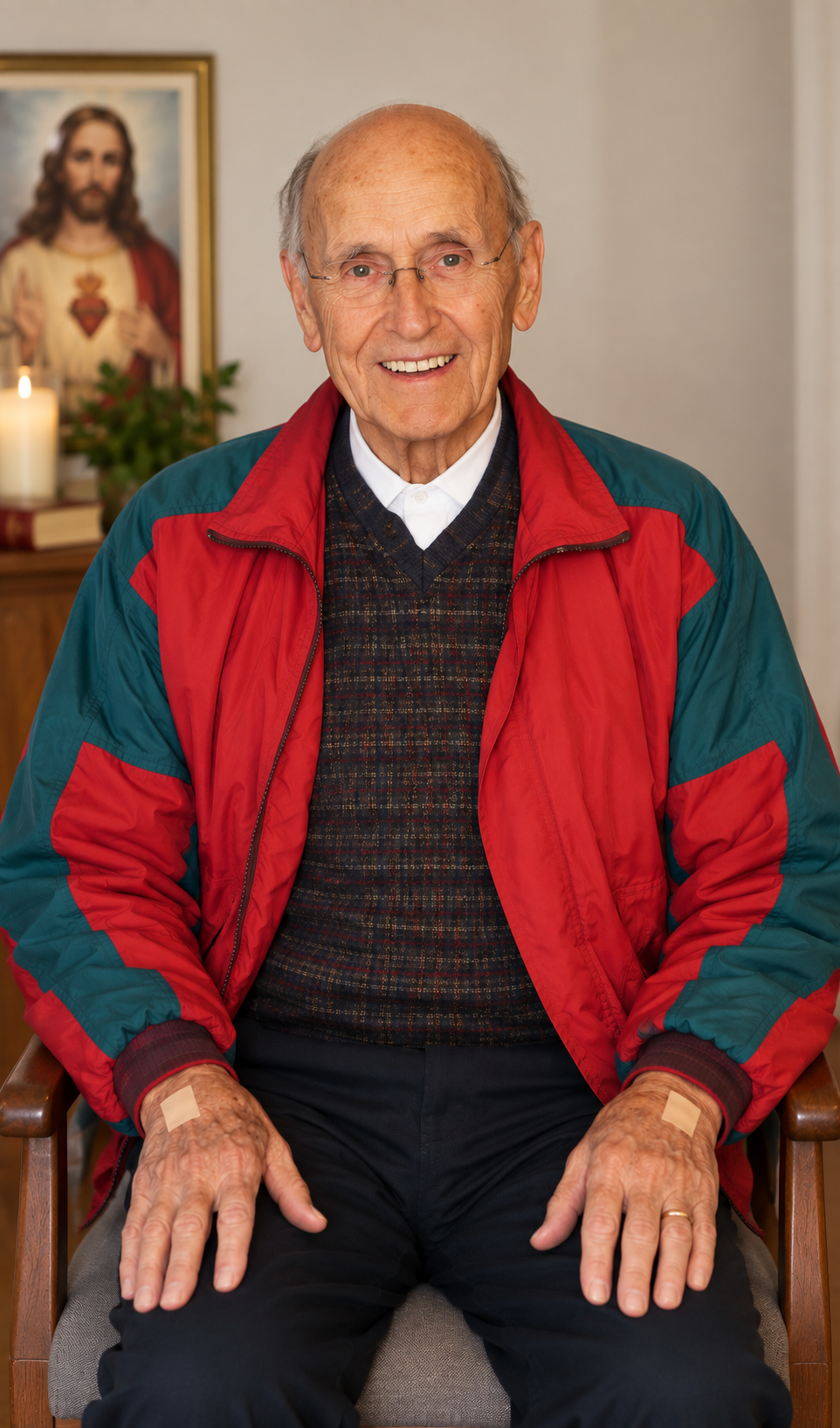
Servant of God Irving Houle’s cause is promoted by the Irving C. “Francis” Houle Association, established by the Diocese of Marquette in 2018 and led by vice-postulator Deacon Terry Saunders.
irvingfrancishoule.com →Chapter Seven
Venerable Emil Kapaun
April 20, 1916 – May 23, 1951 • Pyoktong Prison Camp No. 5, North Korea • Declared Venerable February 24, 2025Emil Kapaun grew up on a farm near Pilsen, Kansas, in a German-Bohemian Catholic family, learning early to repair machinery and improvise with whatever was on hand, ordinary rural skills that later saved lives in a place he could not possibly have imagined as a boy. He was ordained a priest for the Diocese of Wichita on June 9, 1940, and once described his vocation with a phrase that came to summarize his entire life: he intended to “spend myself” for God. He entered the Army Chaplain Corps in 1944 and served in Asia through the final stretch of World War II, then briefly returned to civilian parish life and graduate study before requesting permission to re-enter active service. By 1950 he was with the 1st Cavalry Division as the Korean War began.
One of the most reproduced photographs of Kapaun’s priesthood shows him celebrating Mass using the hood of his Jeep as a field altar, hearing confessions and praying with frightened soldiers wherever the front line happened to be. In August 1950, months before the action for which he is best remembered, he entered a dangerous area to help rescue a wounded soldier and received the Bronze Star for valor, establishing that his courage at the battle to come was not an isolated act but the continuation of a pattern already in place.
That pattern reached its defining moment in November 1950, when Chinese forces overwhelmed and surrounded American positions at the Battle of Unsan. Kapaun moved through the fighting to reach wounded soldiers and administer the sacraments. As the position collapsed, there were real opportunities to escape. He chose instead to remain with wounded men who could not withdraw on their own, a decision that would become the basis both of his eventual Medal of Honor and of the Church’s understanding of his sacrificial charity. Even after his capture he kept protecting the wounded, in one remembered episode intervening to stop an enemy soldier from killing an injured American outright.
On the forced march north to Pyoktong Prison Camp No. 5, Kapaun carried wounded men himself and pushed stronger prisoners to help those who were weaker. Inside the camp, his new parish became the prison itself. He gathered wood, built fires, melted snow into drinking water, improvised tools and containers from scrap, washed the clothing of the sick, and searched for extra food using the same resourcefulness he had learned as a boy on the Kansas farm. He openly challenged Communist indoctrination lectures at real personal risk, understanding that the loss of hope and faith could kill a man as surely as starvation, and survivors credited his presence with keeping prisoners treating one another as brothers rather than as competitors for survival.
By the spring of 1951, months of starvation, cold, illness, and constant self-sacrifice had severely weakened him. When his captors ordered him separated from the other prisoners for transfer, a move the men understood likely meant death, they tried to resist on his behalf. Kapaun refused to allow it, unwilling to let his friends risk injury or punishment protecting a dying man. He died in captivity on May 23, 1951, at thirty-five, having given away, in the end, nearly everything he had.
Kapaun was named Servant of God in 1993; the Diocese of Wichita took formal control of the cause in 2008, closing its diocesan phase in 2011 and sending thousands of pages of documentation to Rome. Review was delayed for over a year by the COVID-19 pandemic, and Rome later requested additional historical material before Pope Francis finally authorized the Offer of Life decree on February 24, 2025, making him Venerable. In a remarkable parallel development, forensic investigators identified Kapaun’s remains in 2021 among unidentified Korean War dead at the National Memorial Cemetery of the Pacific in Hawaii, and he was finally returned home to Kansas after roughly seventy years, now entombed at the Cathedral of the Immaculate Conception in Wichita. He was posthumously awarded the Medal of Honor in 2013. His cause now awaits a confirmed miracle for beatification, and the Father Kapaun Guild leads an annual sixty-mile pilgrimage to his hometown of Pilsen every summer.

Venerable Emil Kapaun’s cause is promoted by the Father Kapaun Guild under the Diocese of Wichita, the official home page of his cause, including cause status updates and the annual pilgrimage to Pilsen, Kansas.
frkapaun.org →Chapter Eight
Servant of God Vincent Robert Capodanno, M.M.
February 13, 1929 – September 4, 1967 • Quế Sơn Valley, Vietnam • Declared Servant of God May 19, 2006Vincent Capodanno was born on Staten Island into a large Italian-American Catholic family and entered Maryknoll seminary in 1949, expecting a life of foreign missionary work rather than combat. He was ordained a priest on June 14, 1958, and spent his first years among indigenous mountain communities in Taiwan, then in Hong Kong, learning the ordinary sacrifices of missionary life, unfamiliar language, unfamiliar culture, and long distance from home, years before a single shot fired in Vietnam ever concerned him. That formation matters to understanding what came later: Capodanno did not suddenly become self-giving the moment bullets started flying. He had already left his family and country once, to serve people on the other side of the world, and simply kept doing it.
By 1965, he had discerned a new mission field closer to a war rather than farther from one. He received his commission as a Lieutenant in the U.S. Navy Chaplain Corps on December 28, 1965, and reached Vietnam during Holy Week of 1966, assigned to Marine infantry. Marines nicknamed him “The Grunt Padre” because he insisted on living where the ordinary infantrymen, the “grunts,” lived, rather than staying near officer comforts and headquarters. Veterans who knew him remembered an unusual stillness in his eyes and the sense that when he spoke with someone, that person had his complete attention, an attentiveness suited to a ministry that had to function amid fear, exhaustion, grief, and the constant possibility of sudden death.
After completing a full tour with the 1st Battalion, 7th Marines, and the 1st Medical Battalion, Capodanno could have accepted a safer assignment somewhere else. Instead he requested an extension and returned to the field, eventually serving with the 5th Marine Regiment in the final months of his life. That decision matters to his cause: his presence at the battle that killed him was not something forced on him by circumstance. He had already seen what Vietnam cost, and he chose to go back into it anyway.
On September 4, 1967, during Operation Swift in the Quế Sơn Valley, North Vietnamese forces overwhelmed and nearly surrounded American positions. Learning that men were trapped and wounded, Capodanno crossed exposed ground under fire rather than remain at the relatively safe command post, moving among the wounded to administer last rites and give what medical assistance he could, entirely unarmed. A mortar round eventually wounded him seriously in the arms and legs and severed part of his right hand. His Medal of Honor citation records that he refused medical aid, directing corpsmen to treat other wounded men instead, and continued ministering to the Marines around him despite his own injuries.
One testimony remembered from the battle describes him calming a wounded Marine with words the Father Vincent Capodanno Guild has since placed at the center of his story: “Do not be afraid this day, for God is with us.” The words were not spoken from a comfortable chapel; they were proclaimed amid gunfire and blood, precisely where a frightened man might reasonably conclude God had disappeared. Capodanno’s final act was to rush, still bleeding from his own wounds, toward a Navy corpsman pinned near an enemy machine-gun position. He was struck by gunfire only inches from reaching him and killed instantly. He was thirty-eight years old.
Capodanno was posthumously awarded the Medal of Honor, presented to his family on January 7, 1969. The Church publicly recognized him as Servant of God in May 2006, and his cause is being pursued through the oblatio vitae, Offer of Life, path, recognizing the pattern of his entire priesthood: leaving comfort for missionary work, leaving safety for Vietnam, remaining with wounded men under fire, and finally dying while trying to reach one more man who needed help. His diocesan investigation closed in 2017, and his Positio was presented to the Dicastery for the Causes of Saints in March 2020. Roman theological consultants requested additional historical research in 2022, which the Guild has since completed and returned to Rome; by late 2025 Archbishop Timothy Broglio had met personally with the Dicastery’s Prefect, and a new panel of consultants was expected to take up the case. A canonical investigation in 2019 credited his intercession with the healing of a Florida woman’s multiple sclerosis, one of several reported favors currently under review. An annual memorial Mass is held each September at the Basilica of the National Shrine of the Immaculate Conception in Washington, D.C., and in 2026 Archbishop Broglio encouraged the faithful to join an approved novena written specifically for the advancement of his cause.

Servant of God Vincent Capodanno’s cause is promoted by the Father Vincent Capodanno Guild, established in 2013 as the official Petitioner of his cause, with donation, novena, and favor-reporting options.
capodannoguild.org →All Eight, One Set
America’s Next Saints Prayer Card Bundle
Each of these eight prayer cards is available individually, and all eight are also handmade together in the America’s Next Saints Prayer Card Bundle, a focused collection of specifically American Catholic military holiness, Civil War through Vietnam, for veterans, active-duty families, parish veterans’ ministries, and anyone who wants the complete set in one place.

Common Questions
Frequently Asked Questions
Eight Men, One Uniform Underneath the Cassock
A Civil War militiaman who spent sixty years building a City of Charity. A quartermaster who traded a failed marriage and heavy drinking for forty-four years on a leper colony. A gassed WWI chaplain who rebuilt a burned orphanage twice. A chaplain who gave up an escape route on a sinking hell ship. A ship’s captain who saved fourteen thousand lives, then spent the rest of his life washing dishes. A plant manager who bore the wounds of the Passion every night for sixteen years. A farm boy from Kansas who died protecting his fellow prisoners. A missionary priest who ran toward a wounded man under machine-gun fire and did not make it back.
None of them are canonized. All of them are being examined right now, by name, by the Church their uniforms all ultimately served under. Carry their prayer cards. Pray for their causes. And if you or someone you love has ever felt the intercession of any of these eight men, tell their guild. That report might be exactly what their cause needs next.
Get America’s Next Saints Bundle →