Advance Directives, Hospice and End-of-Life Decisions for an Orthodox Parent
Caring for Aging Parents • Orthodox Christian • For Families Facing Hard Decisions
Advance Directives, Hospice and End-of-Life Decisions for an Orthodox Parent
No one is ready to make these decisions, and the fear of choosing wrongly is its own kind of suffering. The Church does not ask you to fight death at any cost, and she does not permit you to cause it. You will not be asked to carry this alone.
At a Glance
- Who This Is For
- Adult children and spouses of Orthodox parents who are seriously ill or declining
- Not Blessed
- Euthanasia and assisted suicide (OCA end-of-life documents)
- Can Be Right
- Allowing a natural death without extraordinary measures, with your priest, doctors and family
- Pain Relief
- Approved by the Church, including narcotics (Archpriest Victor Potapov)
- Feeding Tubes and Ventilators
- No single ruling. The OCA documents let a person state wishes. Decide with your priest.
- Orthodox Forms
- OCA documents: A Gift for My Loved Ones, and a funeral directive
- Hospice
- Medicare covers comfort care for a terminal illness certified at six months or less. It can be revoked at any time.
- Call the Priest
- Early, and again when death is near
The Conversation Nobody Wants to Have
Somewhere in the last few months, a doctor probably used a phrase like “goals of care” or “comfort measures,” and your stomach dropped. Or a hospital social worker slid a form across a table and asked who will make decisions if your father cannot. Or you realized, driving home from another visit, that someone is going to have to decide things, and that someone is probably you.
No one is ready for this. Not the parent, who may not want to talk about it, and not the grown child who feels that even asking the question is a betrayal. Orthodox families often carry an extra fear on top of the grief: Who am I to decide when my mother’s life should end? Is stopping a treatment the same as giving up on her? Is continuing it the same as refusing to let her go?
Please start here: the Church has walked beside the dying for two thousand years, and you will not be asked to carry this alone. She does not ask you to fight death at any cost, and she does not permit you to cause it. Between those two lines lies a wide space of prayerful, loving, prudent decisions, made with your priest, the doctors and your family, and most of what families face fits inside it.
This article explains what Orthodox pastors and the Orthodox Church in America have said, walks through the practical pieces (the person who speaks for your parent, the paperwork, hospice and comfort care) and covers the spiritual care that matters most at the end. It is a guide for families and does not replace your priest, your parent’s doctors or an attorney in your state. Where a decision is yours to make, we say so.
Part II
What Orthodox Teaching Says, and Where It Asks for Discernment
Orthodoxy has no single catechism paragraph for every medical situation. Its answers come from the Fathers, the Church’s prayers, bishops’ statements and the pastoral experience of priests. That can feel less tidy than a rule, but the common ground is clear.
Life is a sacred gift. Archpriest Victor Potapov writes that it is the duty of each Christian “in every way possible to protect life as a sacred gift of God.” Orthodox writers hold that only God decides when life ends.
Causing death is not blessed. Potapov states that euthanasia, the deliberate cessation of human life, must be condemned as murder. The Orthodox Church in America’s end-of-life documents, which carry the blessing of its Holy Synod of Bishops, say that affirmative steps to cause death, including euthanasia or suicide, are not blessed by the Church, and that the Church does not condone physician-assisted suicide.
Allowing a natural death can be right. The same OCA documents describe allowing death to come naturally, without extraordinary measures, as potentially appropriate, and say that using extraordinary medical measures merely to maintain the body’s biological functioning may not be appropriate. Potapov writes that when death is clearly inescapable and a person is spiritually prepared, the Church blesses that person to die without artificial prolongation of life, and that each case needs prayerful discussion with relatives, the physician and the spiritual director.
Pain relief is welcome. Potapov says the Church approves the use of various medicines, even narcotics, to decrease the physical pain of the sufferer. Fr. John Breck, an Orthodox priest and bioethicist, writes that there is “no moral or spiritual obligation to bear anguish until the bitter end,” and that hospice care “can work wonders.”
Orthodox voices differ in emphasis. Some stress the duty to preserve life; others stress that death is not an enemy to be fought without limit. When a case is unclear, one Orthodox pastoral writer advises leaning toward life, though not necessarily by extreme measures. That is why the Church sends you to your spiritual father: not for a formula, but for wisdom about your parent’s situation. Call him early.
Part III
How to Think About Treatments: Benefit and Burden
Whatever vocabulary you use, the question underneath is a human one: for this person, now, does this treatment offer a reasonable hope of real benefit, and is the burden of it reasonable? The burden can be pain, fear, expense, or the sheer weight of what the treatment demands of a frail body. A treatment can be fine for one person and not for another, or fine at one stage of an illness and not the next.
Orthodox writers draw a line between killing and letting die. Stopping a treatment that can no longer help, so that the illness takes its course, is different in kind from acting to end a life. Value is never the question. Age, disability and “not going to get better” do not make someone less worthy of care. The question is whether this particular intervention does good at a cost the person can bear.
- What is the goal of this treatment? Cure, longer life, comfort, or time for something specific such as a visit or a Sacrament?
- What is the realistic chance it helps, and how would we know?
- What will it ask of my parent? Pain, hospital stays, being restrained, confusion, ambulance rides.
- What happens if we do not do it? And what comfort care would we still have?
- Can we try it for a set period and reassess? Many families find it easier to start a treatment with a clear date to review it.
- What would you do if this were your own mother or father? Doctors are people, and many will answer honestly.
- Can our priest speak with you? Many doctors welcome a conversation with the family’s pastor.
Part IV
Feeding Tubes, Ventilators and Resuscitation
Feeding tubes and life support cause more anguish in families than almost any other decision, because food, water and breath feel like the most basic acts of love. The Orthodox Church has not issued a single ruling on each machine, and anyone who tells you otherwise is claiming more than the Church has said. What exists is pastoral guidance and a set of documents the OCA prepared to help families decide.
The OCA’s living will and health care power of attorney list the very interventions families face: ventilators, dialysis, antibiotics, CPR and chemotherapy. They let a person say whether artificial nutrition and hydration should continue, stop, or continue until the agent and two physicians judge that the dying process has begun. The document notes that forced nutrition can interfere with the dying process and cause great discomfort, and states a preference for treatment that keeps the person comfortable even if such treatment may shorten life.
In plain terms, a person who simply needs help eating should be helped. A tube or a ventilator may be a reasonable means of keeping alive someone who can still benefit. But when a person is actively dying, or the body can no longer use nourishment, or the intervention itself is causing suffering, the Church’s pastors have said that allowing death to come naturally can be right. Because these decisions are delicate, involve your priest and the medical team early, and ask whether the hospital has an ethics consultation service.
Part V
Who Speaks for Your Parent: The Health Care Agent and the Paperwork
This section is general information. Rules, names and forms differ from state to state, so treat it as a map and get the actual documents locally.
Choose a person first. A health care power of attorney names the person who will decide when your parent cannot. Choose someone calm under pressure, who understands your parent’s faith, who will speak for your parent’s wishes rather than their own, and who is willing to ask hard questions of doctors.
Use the Orthodox documents. The OCA’s Department of Christian Service and Humanitarian Aid produced two downloadable documents with the blessing of the Holy Synod of Bishops, distributed from October 2015. A Gift for My Loved Ones includes a Health Care Power of Attorney and an Advance Directive for Health Care (a living will) written from an Orthodox perspective. Another Gift for My Loved Ones is an Advance Directive for Funeral Care. They are on the OCA website (oca.org), and the OCA urges people to print them, discuss them with loved ones and use them as legal declarations. They are a general template with blanks for state and county, so check your state’s witness and notary requirements, and consider having an elder law attorney review them.
Talk before the crisis. Orthodox pastoral presenters urge families to discuss wishes early, “before we are in an ICU, intubated, and possibly unconscious.” If your parent can still talk, sit down with them and the agent, and with your priest if possible. If your parent can no longer do that, you can still be a faithful agent: your task is to speak for what your parent would reasonably want, not for what you can bear.
Be thoughtful with orders signed in a hospital. Hospitals and nursing homes may ask a family to sign orders such as DNR or POLST-type forms. Ask exactly what they will mean in practice, ask for time, and talk to your priest. You are allowed to decline to decide on the spot.
Part VI
Palliative Care and Hospice: What They Are, and What They Are Not
Many families hear the word hospice and think it means giving up. Orthodox writers see it differently. Fr. John Breck writes that “proper care, when a cure is not possible, is the most appropriate response we can make,” and that hospice care “can work wonders.” Palliative care means treating pain and distress and can be provided alongside other treatment. Hospice is a particular kind of care for people near the end of life.
Here is how hospice works under Medicare in the United States, according to Medicare’s own information:
- Eligibility. The hospice doctor (and your parent’s regular doctor, if there is one) must certify a life expectancy of six months or less if the illness runs its normal course.
- The trade. The patient accepts comfort care instead of treatment meant to cure the terminal illness, and signs a hospice election statement. Medicare continues to pay for covered care of unrelated health problems.
- It is not a six-month limit. If the patient lives longer, care can continue when the hospice medical director recertifies after a face-to-face visit.
- You can change your mind. Under Medicare rules, the patient or representative may revoke hospice at any time with a signed written statement, and may re-elect hospice later if still eligible.
- Where. Usually wherever your parent lives: at home, in assisted living or in a nursing home, or in an inpatient hospice facility when needed.
- What it does not pay for. Medicare does not cover room and board at home, in a nursing home or in an assisted living, and if your parent lives in a facility you may still owe its room and board. Short respite stays arranged by the hospice are the exception.
On pain medicine. Families sometimes refuse morphine out of fear that it hastens death or shows a lack of faith. The Church approves medicines, even narcotics, to ease the sufferer’s pain, and the OCA document asks for comfort even if it may shorten life. Do not let guilt keep your parent in avoidable pain.
Ask the hospice about Orthodox care. Most hospices have chaplains and will welcome your own priest. Ask directly: May our priest visit at any hour? May we keep an icon and a vigil lamp (or an electric one) in the room? Will you call us if the nurse sees signs that death is near, so we can get the priest? Can meals follow the fasting calendar if my parent wishes? Our article on choosing a Catholic or Orthodox care home has more questions to ask a facility.
Part VII
Confession, Holy Communion, Holy Unction and the Prayers for the Dying
When the medical decisions are made, the spiritual work remains, and it is the most important. Orthodox pastoral guidance describes the Church’s ministry to the dying as confession, Holy Communion and Holy Unction. The OCA’s advance directive asks that an Orthodox priest visit to hear confession and bring Communion before death, be present near death for a final confession, and that Orthodox prayers for the departed be said right after death. Many families put the same requests in writing.
Call the priest early, and call again. Families wait until the last hours and then discover that the priest is two hours away or the parish phone goes to voicemail. Tell him your parent is declining, give him the name of the facility and the nurse’s number, and ask what he needs from you. Most priests would rather be called too early than too late, and many will come at night. For a full explanation of Holy Unction, including what to do if a parent is unconscious or has dementia, read our article on Holy Unction and the Anointing of the Sick, and for dementia in particular, praying with a parent whose memory is fading.
Ask for the prayers. The Church has prayers for each stage, including a prayer for one who is terminally ill, a prayer in preparation for death and the prayers at the departing of the soul. The OCA publishes a booklet of such prayers for the sick, dying and bereaved. Ask your priest which to use and when, and whether you may read them yourself at the bedside. Simple prayers are enough: the Jesus Prayer, “Lord, have mercy,” the Trisagion, the Our Father, the Sign of the Cross made over your parent.
Part VIII
Being There: What to Say, and What Not to Fear
Much of the guidance on end-of-life care comes down to something simple: stay, and speak. Hospice staff often encourage families to keep talking to a dying person, because hearing is thought to be one of the last senses to fade, and even if no one can be certain what a person perceives, your voice is a gift to you both.
Many hospice chaplains suggest four short sentences that families often find easier to say than to think of in the moment: Please forgive me. I forgive you. Thank you. I love you. You may add a fifth: It is all right to go. Say them to a parent who is awake, drowsy or unconscious.
Please also plan for yourself. Eat. Take turns. Ask the hospice nurse what to expect, because the final days can include changes in breathing and sleep that are frightening if you have not been warned. And if your parent dies when you stepped out for coffee, as happens to so many, you did not fail. Many people seem to die when the room is quiet.
When death comes, call the priest, even if it is night, and ask for the prayers after the departing of the soul. Then take a breath. The funeral and memorial prayers have their own order, and we will cover them in a separate article.
Part IX
Guilt, Second-Guessing, and Prayers for the Bedside
Almost every family second-guesses. Should we have tried the other treatment? Did we wait too long to call the priest? Hindsight is unfair, because it sees what no one could see then. If you decided prayerfully, with the best information you had, and without intending to cause death, you did what the Church asks. Take whatever remains to Confession and to God’s mercy, and let the matter rest there.
Lord Jesus Christ, you love my mother (father) more than I do. I place her (him) in your hands. Be with her (him) in every hour that remains. Ease her (his) pain, quiet her (his) fear, and send your angel to comfort her (him). Forgive whatever needs forgiving, and bring her (him) at last to the joy of your Heaven.
Lord Jesus Christ, Son of God, have mercy on your servant. Most holy Theotokos, save us. Amen.
Lord, I do not know what is right, and I am afraid of choosing wrongly. Give me clear eyes and an honest heart. Let me ask what is best for her (him), and not what is easiest for me. Make me brave enough to ask the hard questions and gentle enough to accept the answers. Where I fail, cover my failing with your mercy, and give me peace.
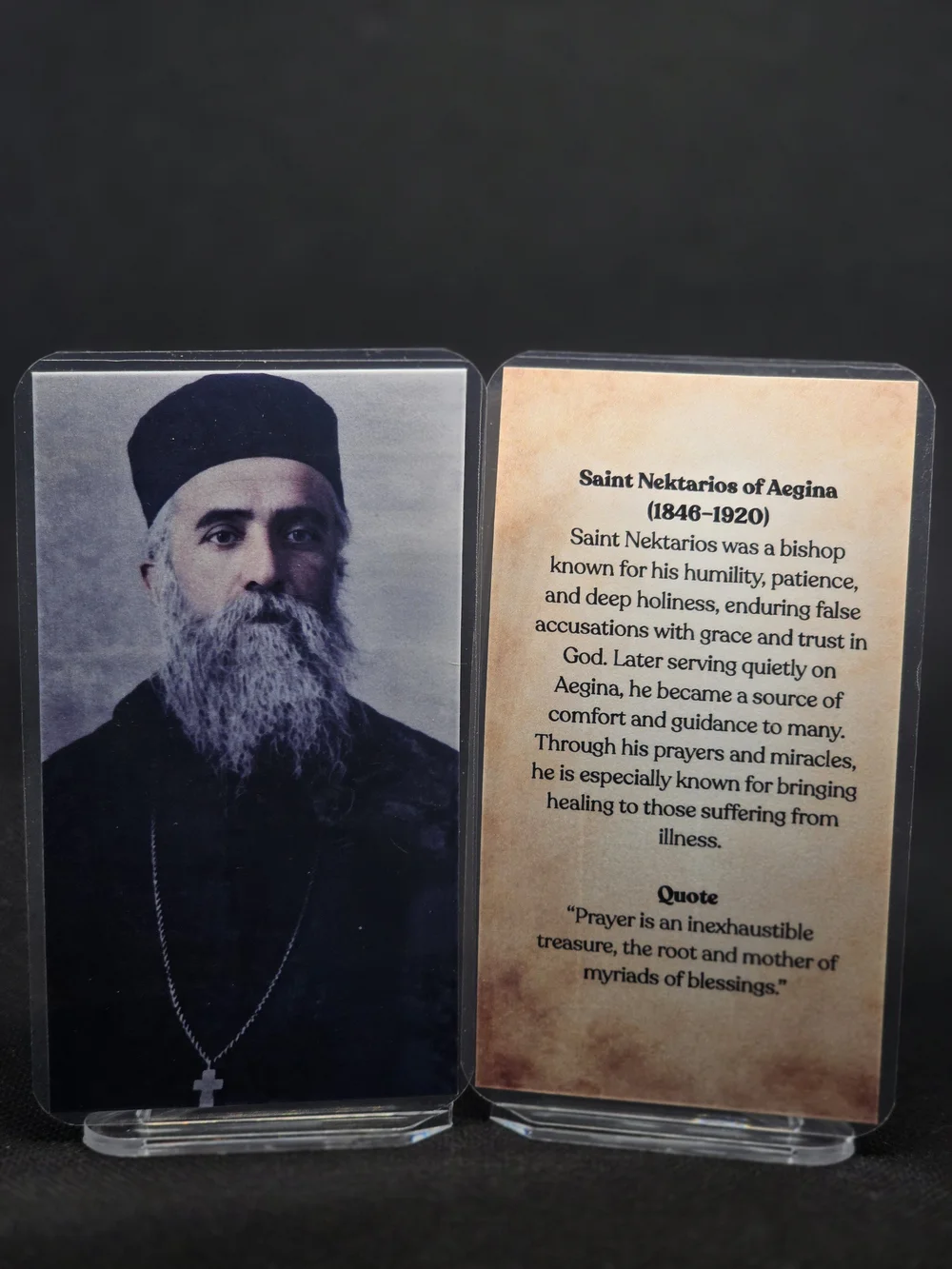
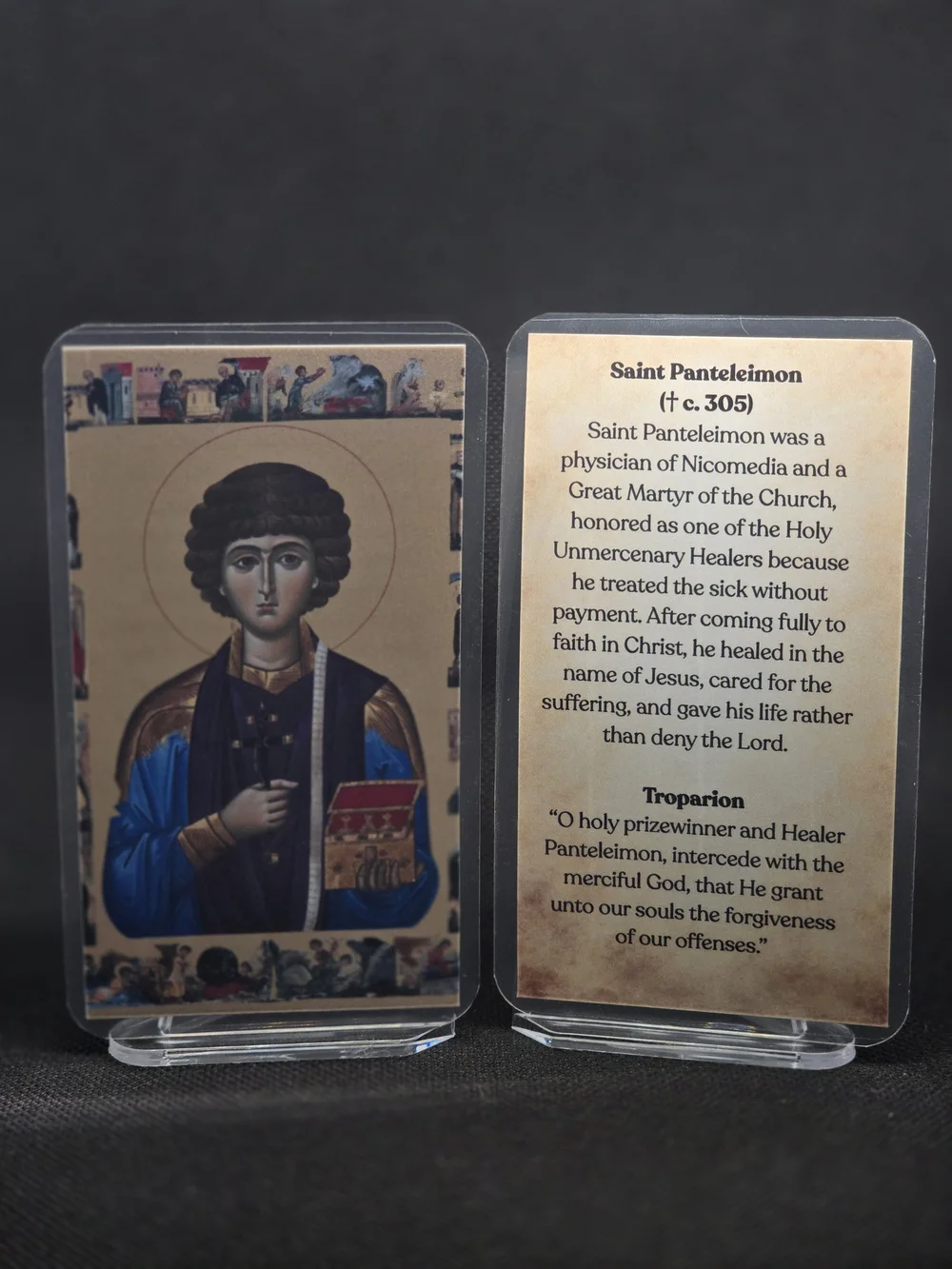
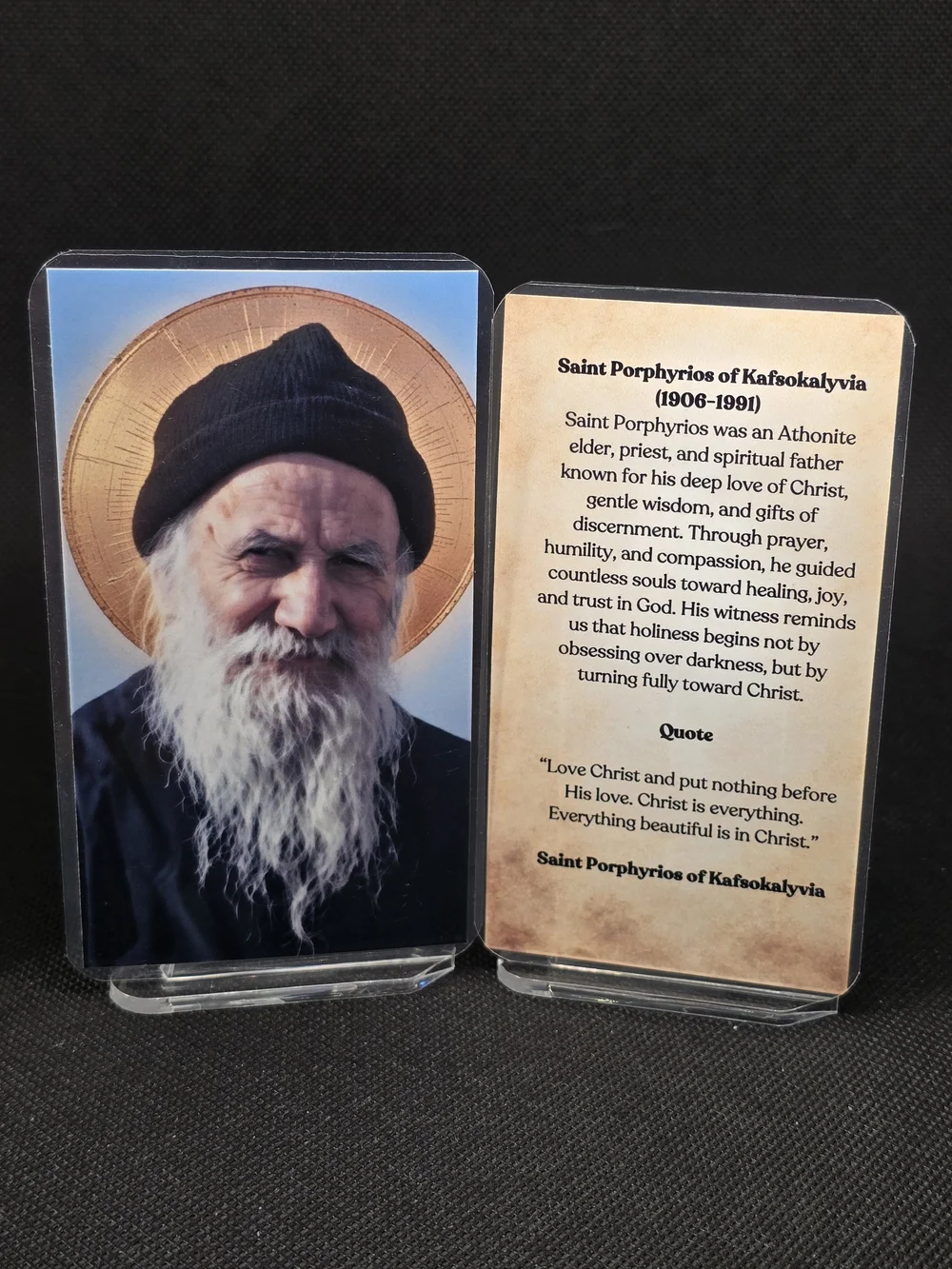
Holy Theotokos, save us. Saint Nektarios, pray for us. Saint Panteleimon, pray for us. Saint Porphyrios, pray for us. Amen.
A prayer card is small enough to tuck into a Bible, a wallet, or the frame of an icon in a hospital room. These are saints Orthodox Christians have long asked for the sick, the dying and the families who must make hard choices.
You Do Not Have to Be Certain. You Have to Be Faithful.
No one makes these decisions perfectly, and the Church does not ask for perfection. She asks that we never choose death, that we do not abandon the dying, and that we bring them the mysteries of the Church and our presence. If you do those things, you have done what love and faith ask.
Call the priest. Choose an agent. Ask the doctors your questions. And stay close, for as long as you are given.
Get the Saint Nektarios of Aegina Prayer Card →