Saint Lidwina of Schiedam: Complete Life, Miracles & Prayers | Patron Saint of Chronic Illness
Roman Catholic • Mystic • Patron of Chronic Illness & Chronic Pain • Netherlands • 1380–1433
Saint Lidwina of Schiedam: The Complete Guide to Her Life, Miracles, and Prayers
Thirty-eight years of unrelenting suffering. A body that destroyed itself from the inside. A soul that turned it all into intercession. Saint Lidwina of Schiedam is the patron saint of chronic illness, chronic pain, invisible illness, and ice skaters — and she may be the most important saint you have never fully encountered.
Saint Lidwina of Schiedam — At a Glance
- Full Name
- Lidwina (Lydwine, Liduina, Lidwida) of Schiedam
- Born
- March 18, 1380 • Schiedam, Holland (modern Netherlands)
- Died
- April 14, 1433 • Schiedam, Holland • Age 53
- Feast Day
- April 14 (Roman Catholic Calendar)
- Beatified
- March 14, 1890 by Pope Leo XIII
- Tradition
- Roman Catholic (also venerated by some Eastern Catholics & Orthodox)
- Patron Of
- Chronic illness • Chronic pain • Disability • Invisible illness • Ice skaters • The chronically ill
- Years of Illness
- 38 years (1395–1433)
- Key Mystical Gifts
- Stigmata • Visions • Eucharistic fast • Bilocation • Prophecy • Fragrant wounds
- Primary Biographers
- Jan Gerlach (confessor) • Johannes Brugman OFM • Johann Busch
- Modern Significance
- First saint proposed as a retrospective case of multiple sclerosis • Model for chronic illness spirituality
- Prayer Cards Available
- Two versions in our store • Candle • Canvas print
Who Is Saint Lidwina of Schiedam? The Patron Saint of Those Who Suffer Without Answer
If you have found this page because you are in pain — because you have an illness that medicine manages but cannot cure, because you have been told to learn to live with it, because the people around you have difficulty understanding something they cannot see — then you have arrived at the right place. Saint Lidwina of Schiedam is your saint. She lived your life for thirty-eight years, inside the same invisible war between the body and itself, and she offers her intercession now from the other side of it.
Saint Lidwina of Schiedam (1380–1433) was a young Dutch woman whose body was catastrophically damaged by a skating accident at age fifteen and never recovered. In the thirty-eight years that followed, she experienced progressive, multi-system illness that in modern terms would be diagnosed as some form of severe chronic autoimmune or neurological disease — likely multiple sclerosis, possibly lupus, possibly an overlapping condition with no single modern name. She lost the use of her right side. She lost sight in one eye. She developed open wounds on her skin that would not close. She became unable to tolerate light. She eventually ceased eating altogether. And through all of it — every flare, every lost function, every year in a darkened room — she became one of the most spiritually powerful figures in medieval Christian history.
She is the patron saint of chronic illness, chronic pain, disability, invisible illness, and ice skaters. She is the saint to invoke when you are suffering in ways that others cannot understand, when medicine has reached its limit, when the illness is the condition of your life rather than an interruption of it. She does not intercede from a position of health. She intercedes from inside.
This article covers everything about her: the full account of her life and illness, every documented miracle, every traditional and official prayer, a complete novena, and practical guidance on how to build a devotional relationship with her. If you have been searching for “prayer to saint lidwina” or “saint lidwina of schiedam miracles” or simply “patron saint of chronic illness” — everything you need is here.
Saint Lidwina is the patron of chronic illness — not of multiple sclerosis specifically, not of lupus specifically, not of fibromyalgia specifically. The Church canonized saints by their holiness and their relationship with God, not by their diagnosis. Her suffering was comprehensive enough, her intercession broad enough, to encompass every form of chronic bodily illness. If you have any condition that is long-term, painful, and resistant to cure, she is praying for you.

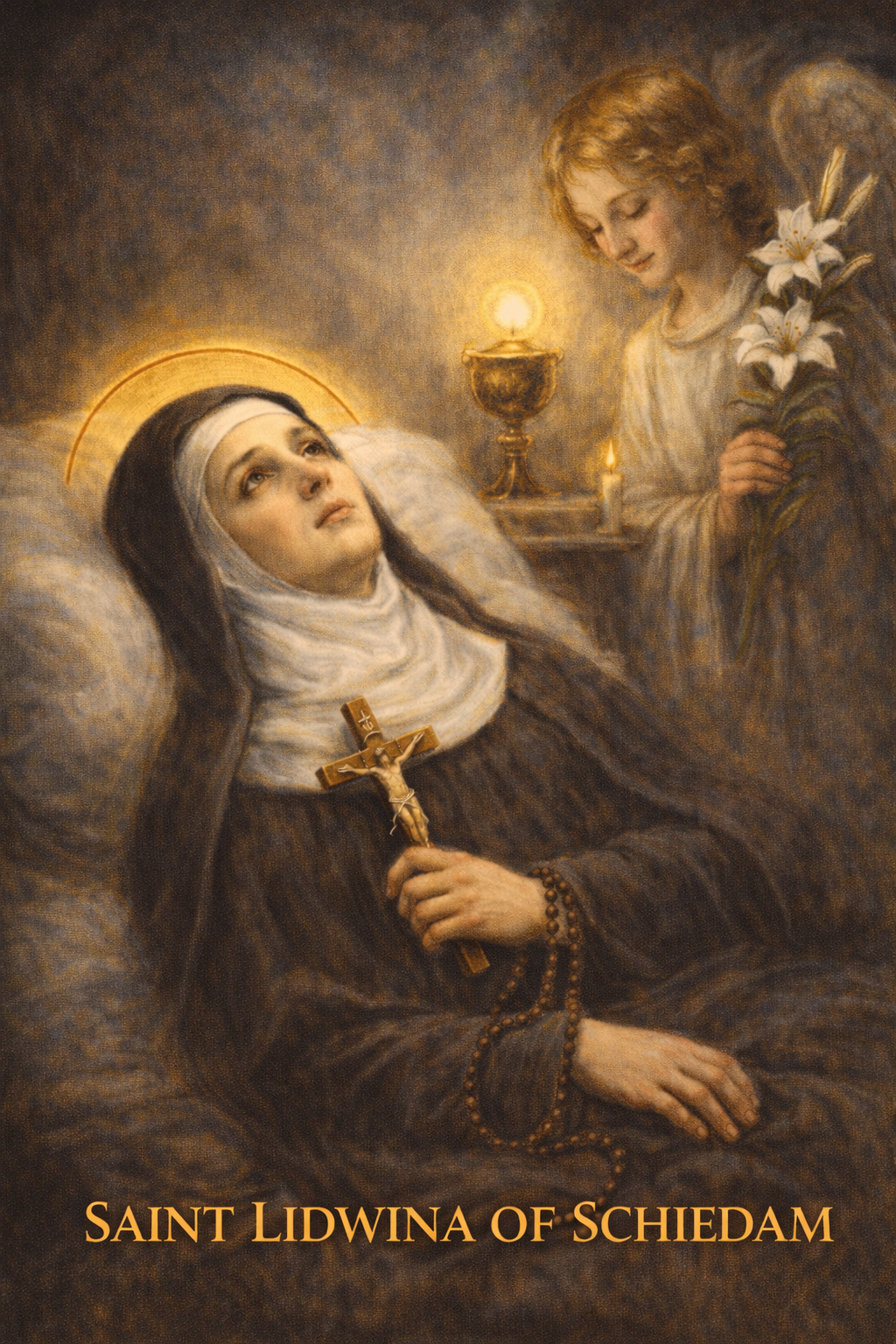
Part II
Early Life in Schiedam: The Girl Before the Ice
Lidwina was born on March 18, 1380, in the small Dutch town of Schiedam, located in what is today the western Netherlands near Rotterdam. Her father, Peter, was a minor civic official — a night watchman for the town — which meant the family was neither wealthy nor destitute but comfortably working class. Her mother was a woman of evident piety whose influence shaped her daughter's early religious sensibility. Lidwina was the only daughter among nine children.
The Holland into which Lidwina was born was a world of canals and flat water, cold winters and hard labor, and a Catholic faith that permeated everything from the calendar of the year to the structure of the town itself. The parish church of Saint John in Schiedam was the center of civic and spiritual life. The devotional culture of the late medieval Low Countries was intense and interior — it was the same world that would produce Thomas à Kempis, the Devotio Moderna movement, and the spiritual tradition of which Lidwina herself would become one of the great examples.
As a child, Lidwina was by all accounts healthy, physically robust, and exceptionally devout. Her biographers record that she was drawn to prayer and solitude from an early age in ways that distinguished her from her brothers and peers. She spent long periods before the parish cross, she sought the company of the church and its sacraments rather than of the market or the canal, and she developed a particular devotion to the Blessed Virgin Mary that would sustain her through the decades of suffering to come.
Her Vow of Chastity
At some point in her early adolescence — the accounts differ on the exact age, placing it between twelve and fifteen — Lidwina made a private vow of chastity. This was not unusual for devout young women in the medieval Catholic world; such vows were a recognized form of consecration that did not require entering a convent. What is significant is the context: by her early to mid-teens, Lidwina was said to be notably beautiful, and her family began receiving inquiries about her marriage. She prayed, according to her biographers, that she might be preserved from a marriage she did not desire and was not called to. It is within months of this prayer, as recorded in the accounts, that the accident occurred.
Whether one reads the timing as coincidence or as Providence — as Lidwina herself would come to read it — the convergence of her prayer and its apparent answer is one of the most striking features of her story. She asked to be preserved. She was preserved, at the cost of the health of her body and the entirety of her ordinary future.
Part III
The Skating Accident That Changed Everything: Winter 1395
In the winter of 1395 — Lidwina was fifteen years old — she went with a group of friends to skate on the frozen canals of Schiedam. Ice skating was a common winter activity in Holland, where the flat, interconnected waterways froze solidly each winter and served as highways, gathering places, and recreation grounds. There was nothing unusual about that afternoon, and nothing in what we know of Lidwina suggests she was anything other than a healthy, active young woman who had no reason to expect that this particular afternoon on the ice would be the last ordinary day of her life.
She fell. A companion — some accounts say she was pushed or knocked over by another skater — collided with her and she hit the ice hard, landing on her right side. A rib broke. This much is certain from all versions of the account. What happened next is what transformed an ordinary injury into the beginning of a life’s vocation.
The rib wound became infected. In the medical context of 1395, this was not automatically fatal, but it was serious: there were no antibiotics, wound care was elementary, and what began as a fracture and local infection began, over the weeks and months that followed, to propagate. The wound became gangrenous. The right side of her body, already affected by the fall, began to lose function. She developed severe pain. She was confined to bed.
Her father called physicians. Her family prayed for recovery. The community expected recovery. It did not come. Instead, the condition progressed — slowly, relentlessly, and in ways that her contemporaries could not explain and that modern medicine can only partially account for even now. What had begun as a broken rib was becoming, clearly, something else entirely. Something systemic. Something that was not going to heal.
Why She Is the Patron Saint of Ice Skaters
The patronage of ice skaters is direct and literal: her lifelong suffering began on the ice, and the Church's tradition has always recognized that the activity and the saint who suffered because of it belong together. Ice skaters, winter sports athletes, and those who work or play on frozen water have historically carried Lidwina’s medal or prayer card as a protection — asking her intercession for safety and for the grace to accept whatever Providence sends. This is not a sentimental association. It is a recognition that the moment on the ice that destroyed her life was also the moment from which her extraordinary spiritual fruitfulness grew. The saint who suffered it most is the most fitting one to stand between the skater and the ice.
Part IV
Thirty-Eight Years of Suffering: The Full Clinical and Spiritual Account
From a healthy, devout fifteen-year-old she became, over the course of thirty-eight years, one of the most comprehensively suffering and spiritually fruitful human beings of her century. Her illness involved virtually every system of her body. Her spiritual life involved experiences that drew pilgrims from across Europe. She offered everything, kept nothing for herself, and died peacefully at fifty-three having never walked again.
The progression of Lidwina’s illness over thirty-eight years was not linear. It moved in phases — periods of greater or lesser suffering, partial remissions followed by new losses of function — a pattern that modern readers familiar with multiple sclerosis or systemic autoimmune conditions will immediately recognize. What follows is a composite account drawn from all major biographies.
Phase One: 1395–1404 — The First Decade of Loss
In the first years after the accident, Lidwina’s right side continued to deteriorate beyond what the initial injury explained. Paralysis crept into the limb. The wound in her right side refused to close. She developed gangrene. Her biographers record that a piece of flesh — described variously as a piece of her rib or a portion of infected tissue — came away from the wound and was preserved as a relic by those around her. She also developed severe facial pain consistent with trigeminal neuralgia, a stabbing pain in the face that is one of the most excruciating of all known pain syndromes.
By approximately 1404, Lidwina had lost the ability to sit up. She was entirely bedridden. She could not be turned without great pain. The light hurt her eyes and was eventually blocked from her room almost entirely. Neighbors reported seeing a light emanating from her window at night — not a lamp, but something stranger — which they connected to the remarkable things they heard about what was happening spiritually to the bedridden girl in Peter’s house.
Phase Two: 1404–1413 — Deepening Illness, Deepening Prayer
In the second decade, new symptoms appeared. She developed what her biographers describe as severe abscesses — multiple open lesions on different parts of her body, wounds that produced a significant discharge and that were changed by those caring for her. She lost the sight in her right eye entirely. The sensitivity to light became so acute that even a small opening in the covered windows of her room was enough to cause her severe distress. She became wholly dependent on others for every physical need.
This was also the period in which her interior life underwent a profound transformation. Her confessor Jan Gerlach, who had known her since childhood, reported that her prayer, which had previously been of the ordinary pious variety, was becoming something he had never encountered before. She was having visions. She was entering states of ecstasy during which her body appeared insensible. She was receiving, she told him, visits from angels and from Christ himself, and these visits were the context in which she was learning to understand her suffering as something other than punishment or abandonment — as participation.
Phase Three: 1413–1433 — The Final Twenty Years
The last twenty years of Lidwina’s life were marked by two things that exist in extraordinary tension with each other: the most severe phase of her physical suffering, and the most intense and publicly significant phase of her spiritual ministry. From approximately 1413, she ceased eating altogether — or rather, she received only the Eucharist, which she did consume, and subsisted on that alone. She also reportedly received the stigmata — the wounds of Christ’s Passion — in her body, which added further wounds to a body already covered with lesions. She endured extreme cold sensitivity. She could no longer use either hand effectively. She suffered tooth loss. She lost the sight of the remaining eye, though accounts differ on whether this was total or partial blindness.
And yet. From this same period, pilgrims came in increasing numbers. The Duke of Bavaria — William VI of Holland — came to visit her. Clergy came. Scholars came. Ordinary people in desperate circumstances came and returned with things changed. Her counsel was sought, her prayers were requested, and her reputation as a holy woman whose suffering had been transformed into a channel of divine grace spread far beyond Schiedam.
A Complete Symptom Map of Lidwina’s Illness
Across all major biographies, the following symptoms are documented:
Part V
The Eucharistic Fast: Living on the Host Alone for Twenty Years
Of all the extraordinary phenomena associated with Lidwina, none drew more attention from her contemporaries — or from historians since — than the reported cessation of all ordinary food and water intake for the final twenty years of her life. Beginning around 1413 and continuing until her death on April 14, 1433, multiple witnesses under oath attested that Lidwina consumed no food, no drink, and no medicine of any ordinary kind. She received the Eucharist daily. By the accounts of those who nursed her, this was her only sustenance.
This claim was not made privately or without scrutiny. It was investigated during her lifetime by Church authorities who were understandably wary of such remarkable assertions. Her confessor Jan Gerlach attested to it under his own pastoral authority. Her local parish priest confirmed it. Her nurse, the woman who cared for her most intimately, attested to it. Neighboring clergy who visited regularly confirmed that there was nothing entering her room in the way of ordinary nourishment. The Duke of Bavaria’s own representatives, who visited on his behalf, were shown the conditions of her care and could not account for her survival on any ordinary basis.
The theological framing in which Lidwina and her spiritual directors understood this phenomenon was not that she was performing an act of will. It was that God was sustaining her directly through the Eucharist when her body had become incapable of sustaining itself in any other way. She was, in other words, not refusing food out of asceticism — she had attempted to eat and could not. What the Eucharist was doing was becoming, in the most literal possible sense, her food and drink. The Host was feeding what no human food could reach.
Comparable Phenomena in Catholic Mystical History
Lidwina was not the only mystic in Christian history to be reported as subsisting on the Eucharist alone. The phenomenon — sometimes called inedia when it involves total cessation of food intake — has been associated with a small number of other mystics across Catholic history, including Blessed Angela of Foligno (1248–1309), Saint Catherine of Siena (1347–1380), and in the modern era, Theresa Neumann of Konnersreuth (1898–1962). What makes Lidwina’s case particularly significant is the duration — twenty years — and the number of independent witnesses who attested to it, many of whom had no particular interest in making the claim and who stated it soberly as a fact of ordinary observation.
Saint Lidwina, you who were nourished for twenty years by Christ alone when your body could receive nothing else — intercede for those for whom eating has become impossible, painful, or taken from them by illness. For those with eating disorders, with Crohn’s disease, with conditions that prevent normal nourishment — ask Christ who fed five thousand with five loaves to feed those whose bodies cannot receive what others take for granted. Let the Eucharist be to them what it was to you: not a symbol, but a sustenance. Amen.
Part VI
Her Mystical Gifts: Visions, Stigmata, Bilocation, and Prophecy
The physical suffering of Lidwina was not, in her own understanding or in the understanding of those around her, the whole story. Alongside the illness, and in some ways because of the illness, she became the site of a spiritual life so intense and so externally verified that it drew the attention of theologians, bishops, and nobility across northern Europe. Her biographers record a sustained and consistent set of mystical phenomena that began in the second decade of her illness and continued until her death.
Visions of Purgatory, Heaven, and the Passion of Christ
From approximately 1405 onward, Lidwina reported, and her confessor recorded, a series of extraordinary interior experiences that her spiritual directors understood as mystical visions granted by God as consolation for her suffering and as a form of intercessory participation in the redemption. She reported seeing souls in Purgatory whom she recognized — people from Schiedam who had died — and receiving missions of intercessory prayer on their behalf. She reported visions of Paradise, of the saints, and of the Blessed Virgin Mary, who she described as appearing to her in the darkened room and providing comfort. She reported extended visions of the Passion of Christ so vivid and detailed that they were used by her biographer Johannes Brugman as a meditative resource in his own preaching — incorporated into what became a widely used Passion meditation text.
The Stigmata and the Wounds of the Passion
Lidwina’s biographers record that at some point in the later years of her illness, she received the wounds of Christ’s Passion in her body — the stigmata. The accounts are somewhat less detailed on this point than on others, but multiple sources confirm that she bore additional wounds corresponding to those of the crucifixion, and that these wounds shared the same mysterious fragrance that her other wounds had acquired. The Crown of Thorns wound — pain in the head corresponding to the crown — is specifically mentioned in the accounts of Jan Gerlach.
Bilocation
A small number of the accounts associated with Lidwina include claims of bilocation — her apparently being present in two places simultaneously. These accounts are fewer and less thoroughly attested than her other mystical phenomena, and they belong to a broader category of similar claims made about several medieval mystics. What gives them some historical credibility in Lidwina’s case is that they are attested by named witnesses, not anonymous tradition, and they are reported with the same sober tone that characterizes the better-documented aspects of her life.
Prophecy and Knowledge of Hidden Things
The gift of prophetic knowledge — knowing things about distant or hidden matters without natural means of information — is one of the most consistently and specifically attested of Lidwina’s mystical gifts. Her biographers record multiple named instances: knowledge of the state of the souls of the dead, knowledge of events occurring in other towns that was later verified, knowledge of the spiritual condition of those who came to visit her that they had not disclosed and were astonished to hear her speak of with precision. This gift was, practically speaking, one of the reasons people came to her: not only to ask for her prayers but to receive her counsel about situations whose outcome they could not see.
The Fragrance of Her Wounds
One of the most consistently reported phenomena associated with Lidwina — reported by her nurse, her confessor, her visitors, and independently confirmed by multiple sources — was that her wounds, which by any natural expectation should have produced foul odors given their nature, severity, and duration, instead emitted a fragrant scent. This phenomenon, known in Catholic mystical theology as the “odor of sanctity,” has been associated with a number of saints before and after her, but in Lidwina’s case it is particularly striking because the wounds themselves were extensive, longstanding, and attended by caregivers who would have been entirely familiar with what infected, chronic wounds normally smell like. The fragrance was not subtle or ambiguous; it was striking and repeatedly remarked upon.
Part VII
Her Biographers: The Historical Record of Saint Lidwina
Saint Lidwina is one of the best-documented medieval mystics because she was the subject of serious biographical attention during her own lifetime and immediately after her death. This is not common. The lives of many medieval saints are reconstructed centuries later from fragmentary sources, and the result is often legend far more than history. Lidwina’s biographers were contemporaries — men who knew her personally or who interviewed those who did within years of her death.
Jan Gerlach (Her Confessor)
Jan Gerlach was the parish priest of Schiedam who served as Lidwina’s confessor from approximately 1400 until shortly before his death. His account of her life — the first full biography — was written during her lifetime and is the foundational document on which all subsequent biographies depend. Gerlach’s perspective is that of a man who administered the sacraments to Lidwina for decades, who heard her confessions, who was present at her bedsides, and who was a close witness to the phenomena he records. His tone is that of a careful and somewhat cautious pastor who writes what he observed while acknowledging what he cannot fully explain. Historians of medieval hagiography consistently rate his account as among the more reliable primary sources for any medieval mystic.
Johannes Brugman OFM (c. 1400–1473)
Johannes Brugman was a Franciscan preacher of enormous popularity in the Low Countries — so famous for his preaching that a Dutch proverb about talking too much, still in use today (“to speak like Brugman”), preserves his memory. He wrote the second major life of Lidwina, the Vita Lidewigis, after her death, incorporating material from Gerlach, from direct interviews with those who had known her, and from his own thorough investigation of her case. His account is more literary than Gerlach’s — he was a preacher, and he wrote with a preacher’s eye for the moment that would move an audience — but it is grounded in the same factual witness base.
Johann Busch (1399–c. 1479)
Johann Busch was an Augustinian canon and reformer who included Lidwina in his chronicle of holy women of the Low Countries. His account adds additional detail about the physical conditions of her illness and the responses of Church authorities who investigated the claims made about her.
The Thomas à Kempis Connection
Thomas à Kempis (1380–1471), the author of The Imitation of Christ — one of the most widely read spiritual books in the history of Christianity — wrote a Latin life of Lidwina, Vita Lidewigis, likely drawing on Gerlach’s earlier work and perhaps on personal knowledge of her reputation within the Devotio Moderna movement of which he was a central figure. Thomas and Lidwina were near-contemporaries; they inhabited the same spiritual world, the same cultural moment, and the same vision of Christianity as a matter of interior union with the suffering Christ rather than external performance. His authorship of a life of Lidwina places her within the same spiritual tradition that produced one of Christianity’s most enduring texts.
Part VIII
Death, Beatification, and the Centuries of Veneration That Followed
On the morning of April 14, 1433, Palm Sunday, Lidwina of Schiedam died. She was fifty-three years old. She had spent thirty-eight of those years entirely bedridden. The accounts of her death describe a peaceful passing — a contrast to the decades of suffering that preceded it. Her nurse was present, her confessor was present, and multiple accounts describe the room as filled with a fragrance at the moment of her death that her witnesses connected with the fragrance that had characterized her wounds throughout her life.
After her death, her body was examined. Her biographers record that the body, ravaged by decades of open wounds and severe illness, appeared restored — peaceful, whole in appearance — in a way that those present found remarkable. The wounds were still present, but the distress that had characterized her living body was gone. Her body was preserved and displayed for veneration, and the pilgrimage that had begun during her lifetime to the bedridden mystic on her sickbed now continued to her tomb.
The Growth of Her Cult After Death
In the decades and centuries after her death, Lidwina’s reputation spread far beyond Schiedam and far beyond the Low Countries. She was venerated across Catholic Europe as a patron of those who suffered from chronic illness. Her story was translated, her prayers were copied, her image was carried. By the sixteenth century, accounts of her life had been printed and distributed widely — the invention of the printing press in 1450 meaning that her biographies were among the earlier books to be printed in the Low Countries and distributed across Catholic Europe.
The town of Schiedam maintained a cult around her memory throughout the centuries. A church was dedicated to her. Her image appeared in painting and sculpture. Her intercession was formally invoked in prayers for the sick in Dutch Catholic tradition.
Beatification by Pope Leo XIII, 1890
The formal process of beatification — the official Church investigation and confirmation of Lidwina’s holiness and her cult — was completed by Pope Leo XIII, who issued the apostolic brief of beatification on March 14, 1890. This confirmed the validity of her veneration, established April 14 as her feast day in the Roman Martyrology, and authorized her official title as Blessed Lidwina of Schiedam. In popular and liturgical usage she is frequently called “Saint Lidwina,” particularly in the Netherlands and in Catholic communities with Dutch heritage, reflecting a centuries-old popular recognition that predated the formal beatification process.
Her Church in Schiedam Today
The town of Schiedam in the Netherlands maintains an active devotion to Lidwina. A church — Saint Lidwina Church, Heilige Liduinabasiliek — was designated a minor basilica in her honor and contains relics associated with her. April 14 is a date of annual remembrance in the local Catholic community. Pilgrims continue to come, particularly those with chronic illness, seeking her intercession at the site where she suffered and from which she continues, in the Catholic tradition’s understanding, to pray.
Part IX
Documented Miracles During Her Lifetime
The miracles associated with Lidwina during her lifetime fall into two categories: the extraordinary phenomena of her own existence that were witnessed and attested by those around her, and the healings and interventions attributed to her intercession for those who came to her. Both categories are documented in her biographies.
- Sustenance on the Eucharist Alone — 1413–1433For approximately twenty years, witnessed by her confessor Jan Gerlach, her nurse, her parish priest, and independent visitors including representatives of secular authority, Lidwina consumed no food or ordinary drink. She received the Eucharist daily. Investigations by Church authorities during her lifetime could not account for her survival on any natural basis. This is the most thoroughly attested and investigated of all phenomena associated with her.
- The Fragrance of the WoundsHer open, chronic wounds — which by any natural expectation should have produced severe malodor — were consistently reported by all who attended her as emitting a fragrant scent. This was noted by her nurse (who changed and dressed the wounds regularly and would have had no incentive to overstate this), by her confessor, by clergy visitors, and by pilgrims. The specificity of the testimony — the nursing care context — makes this one of the most credible of the reported phenomena.
- Healing of a Visitor Through Her IntercessionAt least one case of a physical healing attributed directly to Lidwina’s prayers during her lifetime is recorded in the primary biographies — a woman who came to her in distress with a significant physical condition and left with it resolved after Lidwina prayed with and for her. The names and specific details are preserved in Brugman’s account.
- Prophetic Knowledge of a Parishioner’s DeathShe reportedly knew, before any natural means of information could have told her, of the death of a specific person in Schiedam and named the circumstances. Gerlach attested to this in his account as something he personally witnessed.
- Light Seen from Her RoomMultiple neighbors independently reported seeing a light emanating from Lidwina’s darkened room at night — not lamplight, but a different quality of illumination. These reports were consistent and came from people who had no reason to fabricate them and who reported them with apparent bewilderment rather than devotional enthusiasm.
- Knowledge of the State of Souls in PurgatoryOn multiple recorded occasions, Lidwina named specific deceased persons from Schiedam, described their condition in Purgatory, and requested specific prayers for them. In several cases, the persons named had died in circumstances that Lidwina could not have known about by ordinary means. Her confessor recorded these instances with the cautious precision of a man who was taking what he heard seriously and checking it as best he could.
- Counsel That Changed LivesMultiple visitors to Lidwina recorded in writing — some in letters, some in memoirs that survive — that what she told them in counsel affected the course of their lives in ways they attributed to grace rather than ordinary wisdom. This is less dramatic than the other categories but may be the most historically important: she was a spiritual director of unusual power who operated from a sickbed in Schiedam and whose influence extended across the Low Countries and beyond.
- Survival Through Conditions That Should Have Been FatalMultiple times during her illness, her biographers record that physicians attending her estimated she could not survive the night — and she survived it. The duration of her life itself, given the severity and extent of her wounds and illness, was considered by her contemporaries to be a miracle of sustentation, independent of the specific eucharistic fast account.
Part X
Miracles After Her Death: Intercession Through the Centuries
The miracles associated with Lidwina after her death form a pattern consistent with the best-documented healing saints of the Catholic tradition: they cluster heavily around her specific area of patronage (chronic illness, long-term suffering), they have been recorded continuously from the fifteenth century to the present, and they involve a disproportionate number of cases where medicine had reached its effective limit before the petitioner turned to her intercession.
Early Post-Mortem Miracles and the Pilgrimage Tradition
Within weeks of Lidwina’s death in 1433, pilgrims were reported at her tomb in Schiedam. The records of the period mention specific cases: individuals with chronic conditions of various kinds who came to her grave, prayed, and reported resolution or significant improvement in their condition. These accounts were preserved in the local church records and provided part of the evidentiary basis for the eventual beatification process. The pilgrimage tradition to Schiedam was active enough within a generation of her death to warrant official Church notice.
The Beatification Investigation (1880s–1890)
The formal process that led to her beatification in 1890 included an investigation of miracles attributed to her intercession — the standard requirement for beatification in the Catholic Church. The cases examined included healings of chronic conditions for which medical documentation was available and for which the Church’s consultors found the resolution inexplicable on natural grounds. The specific cases examined in the formal process are part of the Vatican’s archival record of the beatification proceedings.
Modern Accounts from Those with Chronic Illness
In the era of the internet, accounts of answered prayers through Lidwina’s intercession have proliferated in Catholic illness communities — online forums for those with MS, lupus, fibromyalgia, chronic pain conditions, and autoimmune diseases frequently include references to Lidwina as a saint whose intercession has been felt in meaningful ways. These accounts are not formal miracle reports and are not part of any official Church process, but they represent a consistent pattern of lived devotion that tells its own story about the continued relevance of this fifteenth-century mystic to those suffering from the twenty-first century's most prevalent and poorly understood chronic conditions.
What is striking in these modern accounts is not so much the dramatic resolution (though those are present) as the recurring description of something more interior: a sense, following sustained prayer through Lidwina, of being less alone in the suffering — of having, as one person with MS described it in a published account, “found someone on the inside who knew what the inside felt like.” This is perhaps the specific and irreplaceable character of Lidwina’s intercession: not primarily miraculous cure, though that too has been reported, but the grace of not being alone in the body’s slow war against itself.

Part XI
What People Pray to Saint Lidwina For: A Complete Guide to Her Patronage
Saint Lidwina’s patronage is unusually broad within the category of healing saints because her own illness was unusually broad — it touched effectively every system of her body over thirty-eight years. This means that virtually any chronic, painful, or difficult-to-treat condition has a legitimate basis for invoking her intercession. The following is a comprehensive guide to the specific conditions and circumstances for which she is most commonly invoked, and why.
Chronic Illness of Any Kind
Lidwina is the Church’s primary patron for chronic illness in the broadest sense — any condition that is long-term, recurring, and that defines the structure of daily life rather than interrupting it temporarily. If your illness is measured in years and decades rather than days and weeks, she is your patron. This applies regardless of specific diagnosis.
Chronic Pain
Her experience of pain was comprehensive and multi-system: the fracture, the gangrene, the skin lesions, the facial neuralgia, the stigmata wounds. She did not suffer from a single painful condition but from a sustained, complex, and evolving experience of pain in many forms over many years. For those with chronic pain conditions — whether fibromyalgia, neuropathic pain, complex regional pain syndrome, pain associated with autoimmune disease, or any other form of lasting pain — she is the saint who knows the full range of what pain can be.
Multiple Sclerosis (MS)
The association of Lidwina with MS is now well established in both Catholic devotional literature and in the medical-historical literature. The neurologist W. Snelder proposed in the early 1980s that her documented symptom profile — the episodic progression, the right-sided weakness, the visual disturbances, the optic involvement, the profound fatigue, the multi-system character, the possible post-traumatic triggering — matched multiple sclerosis more closely than any other modern diagnosis. Since then, Lidwina has been widely adopted by Catholic communities of people with MS as their specific patron, and organizations serving Catholics with MS have explicitly invoked her under this patronage. If you or someone you love has MS, Saint Lidwina is your saint in a particularly specific and historically grounded way.
Lupus and Autoimmune Disease
The case for invoking Lidwina for lupus and other autoimmune conditions rests on the same symptom analysis as the MS case, with particular weight given to the skin involvement, the multi-system nature, and the episodic character of her illness. Lupus — systemic lupus erythematosus — is characterized by precisely the kind of whole-body inflammatory attack that her account describes. Whether her primary diagnosis would today be MS or lupus or an overlap of both, the experience she describes — a body deploying its immune resources against itself, attacking skin, joints, nervous system, and organ function simultaneously — is the experience of autoimmune disease. For those with lupus, rheumatoid arthritis, Sjögren’s syndrome, psoriatic arthritis, or any other autoimmune condition, her intercession is directly relevant. See also our article on patron saints for lupus for the full guide to saints invoked for autoimmune illness.
Fibromyalgia
Fibromyalgia — chronic widespread pain, fatigue, and sensitivity to stimuli throughout the body — is one of the most directly parallel modern diagnoses to the cluster of symptoms Lidwina exhibited. The invisibility of fibromyalgia (no test definitively confirms it, no visible pathology accounts for it in the way cancer or a broken bone is visible), the way it affects multiple systems including the nervous system’s processing of pain signals, and the profound fatigue it produces all find their mirror in Lidwina’s experience. For those with fibromyalgia, she is particularly appropriate because she also carries the specific grace of having suffered from a condition that others did not fully believe or understand — which is the experience of many people with fibromyalgia.
Invisible Illness
This is perhaps Lidwina’s most significant and underappreciated patronage: the person whose illness is real and severe but invisible to others. She was confined to a darkened room in Schiedam for thirty-eight years. From outside the door, there was nothing to see. The people of Schiedam knew something extraordinary was happening in that room, but they could not see it. For everyone who has been told “you don’t look sick,” for everyone whose worst days leave no visible mark, for everyone whose suffering is real and whose life is structured around it but who cannot show anyone what it looks like — she is the saint who knows precisely that experience.
Disability and Dependence
From the first years of her illness, Lidwina was entirely dependent on others for every physical need. She could not wash herself, feed herself, move herself, or care for herself in any ordinary way. For those living with disability — whether from chronic illness, injury, or congenital condition — and for those navigating the particular spiritual and emotional landscape of radical dependence, she offers an intercession that is simultaneously practical and profound. She did not overcome her dependence. She sanctified it.
Depression and Spiritual Despair in Illness
Lidwina’s biographers are honest that there were periods in her illness — particularly in the earlier years, before the mystical consolations became consistent — when she experienced profound spiritual desolation. She struggled to accept what was happening to her. She prayed for relief that did not come. She was not, in the early years, the serene mystic she would eventually become. For those who are not only suffering physically but suffering spiritually — whose illness has darkened their faith, their sense of God’s presence, their ability to believe that what they are carrying has meaning — Lidwina’s intercession is particularly relevant because she traveled that road. She knows the desolation before the consolation. See also our guides to Orthodox saints for mental health and Catholic saints for mental health.
Caregivers of the Chronically Ill
Lidwina was cared for throughout her illness by a devoted nurse — a woman who dressed her wounds, managed her care, and remained with her for decades. The spiritual and physical cost of caring for a severely ill person over years and decades is immense, and it is often invisible in the same way the illness itself is invisible. For caregivers — spouses, parents, children, professional care workers — who are carrying the weight of someone else’s chronic illness alongside their own lives, Lidwina’s intercession extends to those who care for the sick as well as to those who are sick.
Ice Skaters and Winter Sports Athletes
The literal origin of her suffering gives her a specific patronage for those who skate, particularly for safety and for the grace to accept injury when it comes. Ice hockey players, figure skaters, speed skaters, and all who use the ice carry her name with them. See Part XVII of this article for the specific prayer for ice skaters.
Part XII
Saint Lidwina and Modern Medicine: The Retrospective Diagnosis Debate
Saint Lidwina occupies a unique position in the history of medicine as well as the history of sanctity. She is the first named historical figure to have been proposed as a retrospective case of multiple sclerosis, and her case has been discussed in peer-reviewed medical literature since the 1980s. This is not primarily relevant to her spiritual significance — the Church does not require a medical diagnosis to recognize a saint — but it is relevant to those who encounter her from a medical or scientific perspective and to those who carry a specific diagnosis and want to understand why this particular saint is associated with their condition.
The Multiple Sclerosis Hypothesis
The Dutch neurologist W. Snelder published in the early 1980s a detailed analysis of Lidwina’s documented symptom profile, arguing that it was consistent with multiple sclerosis. The case rested on the following correspondences:
- The episodic, relapsing-remitting course of her illness over decades
- The right-sided weakness and progressive paralysis consistent with demyelinating lesions affecting the motor pathways
- The severe optic involvement and photosensitivity consistent with optic neuritis, one of the hallmark presentations of MS
- The facial pain consistent with trigeminal neuralgia, which occurs in MS at a significantly elevated rate compared to the general population
- The profound fatigue, which is one of the most characteristic and debilitating features of MS
- The possible post-traumatic triggering: some clinical literature has discussed whether significant physical trauma can precipitate the onset of MS in susceptible individuals, which would explain the timing of the accident in relation to the onset of her multi-system illness
- The progressive course over decades ending in near-complete disability, consistent with secondary progressive MS
Snelder’s hypothesis was subsequently discussed by other medical historians and has been referenced in multiple texts on the history of neurology. It is now a well-established item in the historical literature of MS, and Lidwina is frequently cited in academic discussions of the pre-modern history of the disease.
The Lupus and Autoimmune Alternative
A minority of the medical-historical literature has noted that several aspects of Lidwina’s documented illness fit autoimmune disease as much as or more than MS. Specifically: the extensive skin involvement (open, chronic wounds affecting multiple areas of the body), the possible photosensitivity that extends beyond typical optic MS involvement, the multi-system nature that includes features resembling both skin disease and connective tissue disease, and the episodic inflammatory quality of her course. These features have led some to suggest systemic lupus erythematosus or an overlapping connective tissue disease as alternative or additional diagnoses. Modern medicine has increasingly recognized that MS and autoimmune connective tissue diseases can overlap — a possibility that would account for the full breadth of her documented symptoms.
What This Means for Her Patronage
The medical-historical debate has no practical resolution and probably never will — we cannot examine Lidwina and order an MRI. But the debate is spiritually significant for one reason: it confirms that her suffering was genuine, severe, and directly analogous to conditions that afflict millions of people today. She was not performing or exaggerating. The documented symptoms she carried for thirty-eight years are recognizable as the lived reality of some of the most difficult chronic conditions in modern medicine. Her intercession is sought by people with MS and lupus and fibromyalgia not on the basis of sentimental association but on the basis of a documented experiential commonality that spans six centuries.
Explore more about saints for these conditions in our full guides: Catholic Saints for Autoimmune Disease & Invisible Suffering and Orthodox Saints for Healing.
Part XIII
The Complete Collection of Prayers to Saint Lidwina of Schiedam
What follows is the most comprehensive collection of prayers to Saint Lidwina available in a single source. These include the traditional Catholic prayer used in devotional literature for centuries, prayers composed specifically for the conditions most associated with her patronage, and prayers for specific circumstances. Each prayer may be used in isolation, in combination, or as part of the novena that follows in Part XIV.
O Blessed Lidwina of Schiedam, who for thirty-eight years endured with heroic patience the most terrible sufferings that God in His providence permitted to fall upon your body, and who in the midst of such great trials received from His mercy so many extraordinary consolations — look upon me now in my own suffering.
Obtain for me from the God of all compassion the grace to bear with resignation and even with thanksgiving the crosses that Divine Providence has sent me. Help me to unite my suffering with the Passion of Our Lord Jesus Christ, offering it in love for the salvation of souls and for the glory of God’s name. And if it be His holy will, obtain for me the restoration of my health, so that I may serve Him more perfectly in this life and praise Him forever in the next.
Saint Lidwina, pray for me. Amen.
O Saint Lidwina, patron of the chronically ill, you who did not suffer for a season but for a lifetime — hear my prayer. I carry an illness that is not temporary, that does not resolve, that is the condition of my days rather than an interruption of them. I have good days and bad days, but I do not have days that are simply free.
You know this. You lived thirty-eight years inside it. You know the particular exhaustion of a body that fights itself, the particular loneliness of an illness that others struggle to understand, the particular grace required to receive each morning with something other than dread.
I ask you to bring my illness before Christ the Healer. Ask Him to strengthen my body according to His will. Ask Him to give me peace in what I cannot change, endurance for what I must carry, and enough relief on enough days to live the life He has given me with something like joy. And give me, if He wills it, a taste of what you had — the knowledge that nothing carried in union with His Cross is wasted. Amen.
O Blessed Lidwina, patron of those whose bodies turn against themselves, whose nerves misfire and whose strength fails without warning — you know what this is. The neurologists who have studied your life believe you lived with what we now call multiple sclerosis: the relapses, the progressive losses, the episodic character of a disease that retreats and returns, taking something with it each time.
I bring to you my MS — [speak your specific condition: the current relapse, the symptom you are managing, the fear of what comes next]. Intercede for me with Christ whose healing is not limited by what medicine can or cannot do. Ask Him to quiet the inflammation in my nervous system, to restore what can be restored, and to protect what remains. Give me the grace you had: to offer the damaged body as a prayer rather than simply a burden, and to find in it, as you did, a path to union with the One who suffered for love of us. Amen.
Saint Lidwina, I bring you my invisible illness. I am sick in ways that do not show. I live with pain that does not leave a mark, with exhaustion that does not look like exhaustion to anyone watching, with a body that is waging a war that no one else can see. I have been told I look fine. I have been doubted. I have been left to explain, again and again, something that resists explanation because it has no visible evidence.
You know this from the inside. Your darkened room in Schiedam was invisible to those who passed by outside. Your suffering was real and severe and almost entirely hidden from the world, and you bore that hiddenness as well as the suffering itself.
Give me the grace to stop needing to be understood by those who cannot understand. Give me instead the peace of knowing that God sees what they cannot — that He is the one Witness who needs no explanation and asks for none. Intercede for me with Him. Ask Him to see me clearly, to carry what I cannot carry, and to give me at least one person in my life who knows what I know about what this costs. Amen.
O Blessed Lidwina, you who were cared for so faithfully by those who loved you — a nurse who dressed your wounds for decades, a confessor who remained beside you through years of suffering — intercede now for those who are doing for others what was done for you.
For the spouse who has changed their entire life around a partner’s illness. For the parent who will care for a disabled child for as long as they live. For the child who is now caring for a parent. For the professional caregiver who gives their body and their attention day after day to someone whose needs are endless. For all who carry, quietly and without recognition, the weight of another person’s long suffering.
Give them strength when theirs runs out. Give them the grace of knowing that what they do is sacred — that the nurse who washed your wounds was doing holy work, and so are they. Protect them from bitterness, from burnout, from the collapse of compassion that comes when compassion is asked for without ceasing. And remind them, as you remind us all, that no act of love given to a suffering body is invisible to God. Amen.
O Saint Lidwina, patron of those whose immune systems have turned against their own bodies, whose inflammation attacks joint and skin and organ without ceasing, whose lives are structured around flares and remissions and the constant management of a war that begins inside — hear this prayer.
I have [lupus / rheumatoid arthritis / Sjögren’s / psoriatic arthritis / mixed connective tissue disease — state your condition]. My body does not know the difference between its enemies and itself. What should protect me is harming me. I am asking you, who lived this for thirty-eight years in the body, to bring my case before the God who made my immune system and who can quiet what it cannot quiet by itself.
Ask Him for healing — real healing, the kind that resolves rather than only manages. Ask Him for peace if healing is not His immediate will. And ask Him to give me the extraordinary gift you had: a life that is larger than the illness, a spirit that is stronger than the body that carries it, and the grace to be, despite everything, someone who gives life to others rather than only someone who suffers. Amen.
Blessed Lidwina, patron of the chronically ill, you who carried what I carry for thirty-eight years and offered it all to God — pray for me today. Intercede for my healing according to Christ’s will. Give me strength for this day. Give me peace in my suffering. And give me the grace to offer what I cannot change. Amen.
Lord, have mercy. Lord, have mercy.
Christ, have mercy. Christ, have mercy.
Lord, have mercy. Lord, have mercy.
Holy Mary, Mother of God, pray for us.
Saint Lidwina, patron of the chronically ill, pray for us.
Saint Lidwina, who bore thirty-eight years of suffering without bitterness, pray for us.
Saint Lidwina, who lived inside invisible illness, pray for us.
Saint Lidwina, patron of those with chronic pain, pray for us.
Saint Lidwina, patron of those with multiple sclerosis, pray for us.
Saint Lidwina, patron of those with autoimmune disease, pray for us.
Saint Lidwina, patron of the disabled and dependent, pray for us.
Saint Lidwina, who received the wounds of Christ in your own body, pray for us.
Saint Lidwina, who was sustained by the Eucharist alone, pray for us.
Saint Lidwina, whose wounds smelled of fragrance rather than corruption, pray for us.
Saint Lidwina, who counseled the suffering and gave life to those who came to you broken, pray for us.
Saint Lidwina, patron of ice skaters and winter athletes, pray for us.
Saint Lidwina, model of suffering offered in union with Christ, pray for us.
Lamb of God, who takes away the sins of the world, spare us, O Lord.
Lamb of God, who takes away the sins of the world, graciously hear us, O Lord.
Lamb of God, who takes away the sins of the world, have mercy on us.
Let us pray: O God, who in your wonderful providence chose Saint Lidwina to bear the Cross of bodily suffering for thirty-eight years and thereby made her a vessel of grace and intercession for all who suffer — grant, at her prayer, that those who are afflicted in body or spirit may find in their suffering a share in the Passion of your Son, and may come at last to the healing that no illness can undo. Through Christ our Lord. Amen.
Part XIV
The Nine-Day Novena to Saint Lidwina of Schiedam
A novena is nine days of intentional, sustained prayer to a specific saint or to God through a saint’s intercession. The nine-day structure comes from the nine days the disciples spent in prayer between the Ascension and Pentecost — the first Christian novena. For Saint Lidwina, the ideal time to begin a novena is April 5, finishing on her feast day of April 14. However, a novena to Saint Lidwina may be prayed at any time — the urgency of chronic illness does not wait for the calendar.
How to use this novena: Each day, find a quiet moment. If you have a prayer card, candle, or image of Saint Lidwina, place it before you. Begin with a moment of stillness. Then pray the day’s novena prayer. Follow with three Hail Marys. On the ninth day, pray the closing prayer that follows.
Saint Lidwina, you endured thirty-eight years without yielding to despair. Today I ask for the grace of endurance — not dramatic, heroic endurance, but the simple daily endurance of a person who gets up and tries again. Give me enough strength for this day. Intercede that God will meet me where I am and give me what I need to carry what today brings. Three Hail Marys.
Saint Lidwina, you know what it is to want your body back — to want the life that illness took. Today I pray for physical healing. I ask you to bring the specific condition I carry before Christ the Healer and ask Him, boldly and specifically, to restore my body. I am not resigned; I am asking. Pray with me for healing — real healing, the kind that resolves what medicine cannot resolve. Three Hail Marys.
Saint Lidwina, give me your peace. The peace that was not the absence of pain — you had pain every day — but the peace that exists within pain when a soul has been given God’s grace to bear it. I do not ask to feel nothing. I ask for the deeper gift: to be at peace with what I cannot change, so that my illness does not also destroy my spirit. Three Hail Marys.
Saint Lidwina, today I pray not for myself but for those my illness affects — those who care for me, those who love me and carry their own grief about what they cannot fix, those who have grown frustrated with what they cannot understand. Give them grace. Give them patience. Give them the ability to love me in my illness the way the faithful women of Schiedam loved you in yours — not despite the suffering but within it, and because of who you were inside it. Three Hail Marys.
Saint Lidwina, the physicians of your time did not know how to help you. The physicians of my time know more but still reach limits. Pray for those who care for me medically — that they will have wisdom, that they will have the humility to acknowledge what they do not know, that they will look at me and see a person rather than a case file, and that God will work through their skill and their hands in ways that exceed what their training alone can accomplish. Three Hail Marys.
Saint Lidwina, you transformed your suffering into intercession. You offered it for others, and in doing so found that it was not wasted but fruitful beyond anything your healthy life could have produced. Today I ask for that grace: not to understand why I suffer, but to have the faith that my suffering, offered to God in union with Christ’s Cross, is doing something I cannot see. Make my illness a prayer, even when I cannot pray. Three Hail Marys.
Saint Lidwina, there were years before the mystical consolations came when you struggled to believe that God was present in your room. I am in that kind of year — or that kind of week, that kind of day. The illness has darkened my faith as well as my body. Pray that God will make Himself known to me in my darkness. Not necessarily with visions and angels, but with the small, quiet, unmistakable sense that He is here and has not left. Three Hail Marys.
Saint Lidwina, today I bring you a specific petition. [Speak here the particular prayer you are carrying — a specific symptom, a medical decision, a relationship strained by illness, a fear, a hope, a diagnosis recently received. Be specific. She already knows; speaking it is for you, not for her.] I place this in your hands. Carry it for me to God. Ask Him to answer according to His wisdom and His mercy, and give me the grace to receive His answer with trust. Three Hail Marys.
Blessed Lidwina of Schiedam, I have brought you nine days of prayer. I have brought you my illness, my fear, my grief about what my body has cost me, and my hope that God hears and that His mercy is larger than what I can measure. I have also brought you gratitude — for your life, for what you endured, for the fact that you did not waste a single day of it and that the suffering of a bedridden woman in a darkened room in Schiedam in the fifteenth century is still, six centuries later, a living intercession on behalf of people who had not been born when you died.
Take everything I have prayed this week and lay it before God. Ask Him for the healing I need — in body, in soul, and in spirit. Ask Him, above all, to give me the one thing that cannot be taken by illness: union with Himself. And pray that I will arrive, in whatever state of body God wills, at the same destination you reached on April 14, 1433 — the peace that ends all pain and the presence that explains all suffering. Three Hail Marys. Amen.
Part XV
How to Pray to Saint Lidwina: A Complete Practical Guide
Many people who want to pray through Saint Lidwina’s intercession are uncertain about how to do it practically — how to begin, what to say, how to maintain a devotional relationship with a saint over months and years rather than a single prayer in a moment of crisis. The following is a practical guide drawn from the Catholic tradition of intercessory prayer and adapted specifically for those approaching Saint Lidwina for the first time or building a sustained devotional practice with her.
Understand What You Are Doing
Asking a saint to intercede is not praying to anyone other than God. It is asking a holy person who is alive in God’s presence — not dead, not sleeping, not merely historical — to pray on your behalf. This is exactly what you would do when you ask a trusted friend to pray for you, except that the saint’s prayer flows from direct union with God rather than through the same veil of faith that the living share. The Catholic and Orthodox traditions have always understood this as a normal and powerful dimension of Christian prayer, rooted in the conviction that the Body of Christ is not limited to the living. When you pray through Lidwina, you are asking someone who already knows the God you are trying to reach to speak for you.
Speaking Directly, Specifically, and Honestly
The greatest prayer texts in Eastern Christianity — the Lamentations of Gregory of Narek, the great prayer collections of the Orthodox tradition — are not polished or general. They are raw, specific, and honest. They name the actual condition, the actual fear, the actual loss. When you pray through Saint Lidwina, this is the model: be specific. She already knows what you are carrying; speaking it is not for her information but for the deepening of your own faith and the directness of your petition. I have MS. I had a relapse last month. I am afraid of losing function in my left hand. I am asking you to bring this before God and ask Him to intervene. That is the prayer. The more specific, the better.
Using a Prayer Card with Saint Lidwina
A prayer card is a physical anchor for a spiritual relationship. When you hold a prayer card of Saint Lidwina, you are holding the image of someone who is praying for you right now. Place the card on your nightstand. Carry it in your wallet or bag to every medical appointment. Some people tape it to the wall near their bed. Some keep it in their hand during particularly difficult flares, following the ancient tradition of placing a holy image against the body as a physical form of the spiritual request. The image is not an idol and carries no magic. It is a reminder — this person is real, she is present before God, and she knows what you are going through.
Visit our Eastern Orthodox and Eastern Catholic prayer card store for the full collection, or see our guide on how to use Orthodox and Catholic prayer cards effectively.
Using a Candle in Prayer to Saint Lidwina
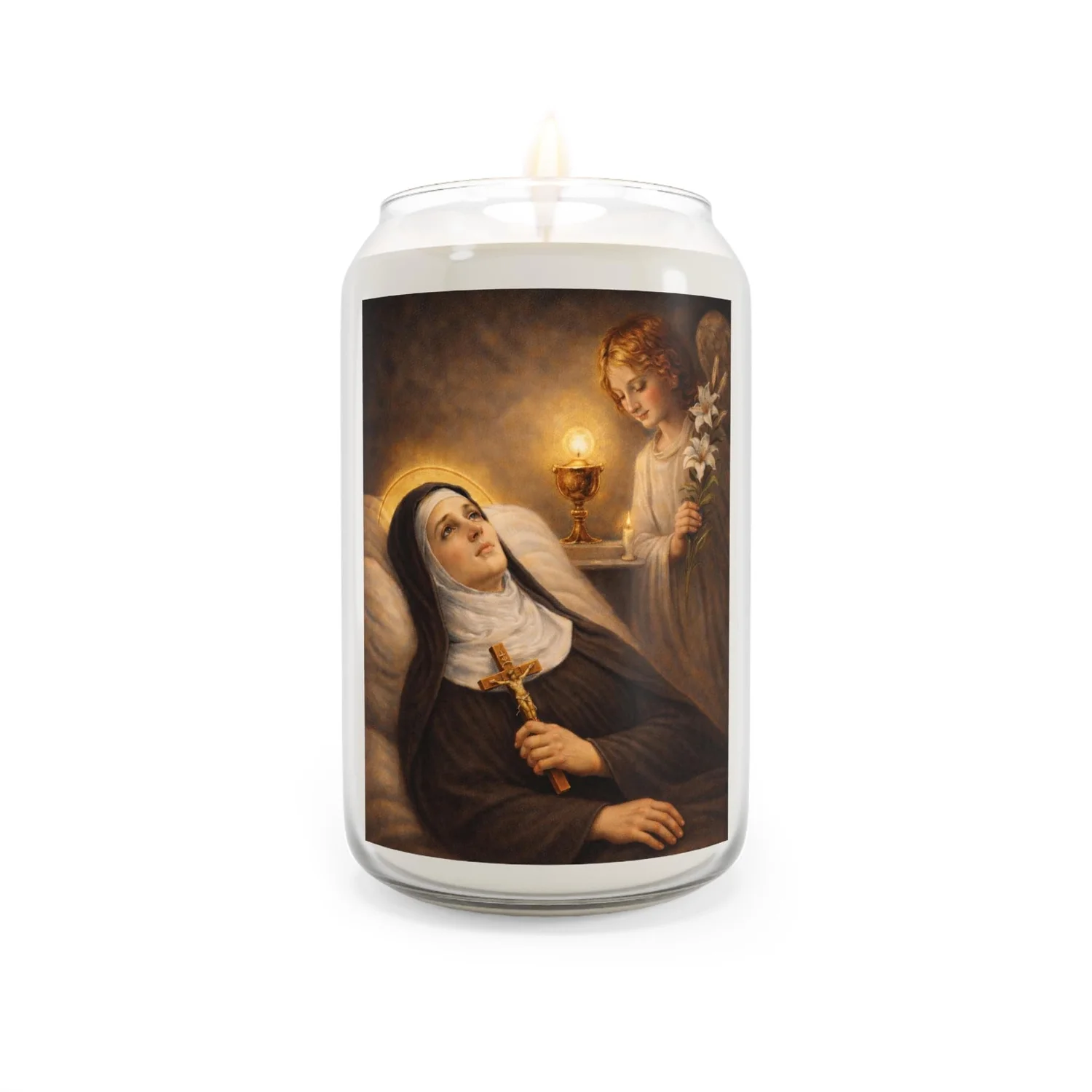
Lighting a candle before a saint’s image is one of the oldest forms of Christian devotion. The candle says what words sometimes cannot: I am here, I am present, I am asking. It is a small act of will that transforms the quality of prayer — the physical action of lighting the candle, placing it before her image, and sitting in the light it casts creates a physical environment that supports interiority and intentionality. For those praying through chronic illness, a Saint Lidwina candle at the bedside is particularly meaningful: lit when the pain is bad, lit during medical crises, lit during the novena as a daily visible offering.
Connecting Your Own Eucharist to Hers
For Catholic and Orthodox Christians who receive the Eucharist, there is a specific and powerful way to enter Lidwina’s intercession: in the moment of receiving the Eucharist, offer your suffering to Christ in the same act with which Lidwina received her daily nourishment. She was sustained by the Eucharist for twenty years when nothing else could sustain her. In the moment you receive it, you and she share the same food. This is one of the most intimate of all possible connections with a saint — the Communion that is both a sacrament and a shared meal across time.
Building a Long-Term Devotional Relationship
Chronic illness calls for a chronic devotion — not a single prayer in a crisis, but a sustained relationship over months and years with a saint who has been through what you are going through. To build this relationship: pray the novena at least once a year, ideally ending on her feast day of April 14. Keep her prayer card or image in your daily line of sight. Speak to her briefly each morning — not always with a long formal prayer, but with the directness of one friend speaking to another. Read her life at least once, slowly — not as hagiographic entertainment but as a serious encounter with a person who lived inside what you are living inside. And trust, over time, that the relationship deepens and that her intercession accumulates.
The Sacrament of Holy Unction (Anointing of the Sick)
For Catholic and Orthodox Christians living with chronic illness, one of the most powerful resources alongside intercessory prayer is the Sacrament of Holy Unction — the Anointing of the Sick. This sacrament, which is available to any person suffering from serious illness (not only to those who are dying), is the Church’s own medicine: anointing with blessed oil, prayer for healing of body and soul, the forgiveness of sins. Both the Catholic and Orthodox traditions offer this sacrament to those with chronic conditions. Ask your priest about receiving it, and consider receiving it annually or during particularly severe flares. Saint Lidwina, who received the sacraments faithfully throughout her illness, would recognize the importance of this immediately.
Part XVI
Setting Up a Saint Lidwina Prayer Corner for Healing
Both Catholic and Eastern Christian traditions encourage the creation of a prayer corner or home altar — a dedicated space in your home where icons, prayer cards, and candles create a physical environment that supports sustained prayer. For those with chronic illness like MS, lupus, or fibromyalgia, a healing prayer corner is especially valuable: when a flare makes it impossible to travel to church, when getting out of bed is the day’s victory, a prayer corner brings the sacred directly to your room.
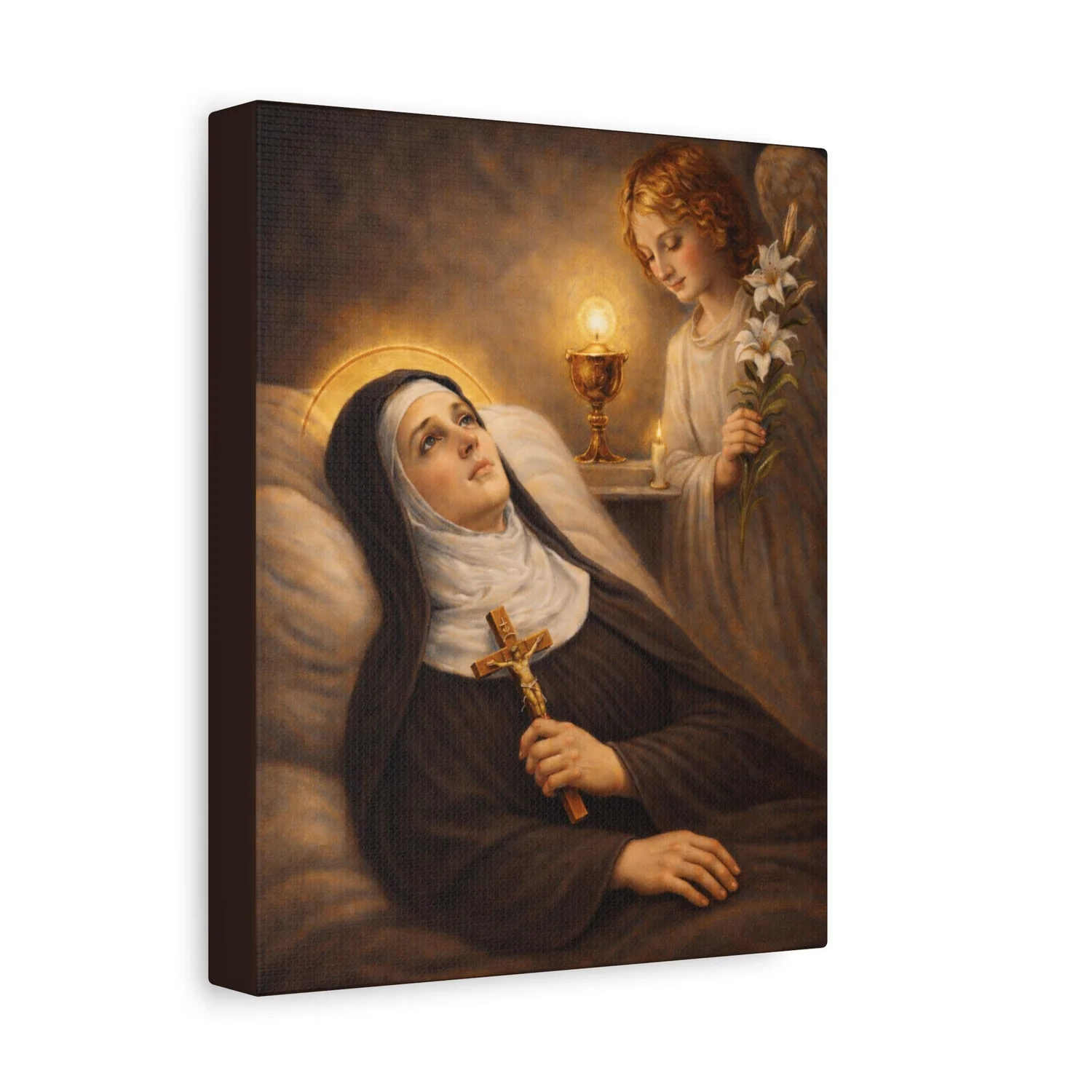
A Saint Lidwina prayer corner might include: her canvas print or prayer card at the center; a candle to be lit during prayer; a medal that can be held or placed nearby; and if you wish to expand it, prayer cards of the other healing saints — Saint Nektarios of Aegina, Saint Panteleimon, Saint Charbel. The physical arrangement matters less than the intention: this is a space where you come to pray, and its contents are anchors for your attention and your faith.
For a complete guide to building an Eastern Christian healing prayer space, see our article on creating a home intercession space for healing. For other healing saints to include alongside Lidwina, see our complete guide to Orthodox healing saints and saints for healing and intercession. See also the full profiles of Saint Nektarios of Aegina and Saint Paisios of Mount Athos for other healing saints commonly placed alongside Lidwina in healing prayer corners.
Part XVII
Saint Lidwina and Ice Skaters: Her Specific Patronage for Winter Sports
The patronage of Saint Lidwina for ice skaters is one of the most literal and direct patron-saint associations in the Catholic tradition. There is no symbolism, no loose metaphorical connection — the simple fact is that a healthy fifteen-year-old girl went ice skating on a frozen canal in Schiedam in 1395, fell, and her suffering began. The Church has recognized that the activity and the saint who suffered because of it belong together, and the tradition of carrying Lidwina’s protection onto the ice is centuries old.
Ice hockey players, figure skaters, speed skaters, curlers, and anyone who works, plays, or competes on ice has traditionally invoked her protection. Her medal or prayer card is carried in skate bags and team bags, kept in locker rooms, and worn under equipment by those who take this patronage seriously. The prayer for ice skaters asks not for the absence of falls — Lidwina herself fell — but for safety, for the grace to accept what comes, and for the protection of the body on ice.
O Saint Lidwina, whose vocation began on the ice of a frozen canal in Schiedam, hear my prayer as I go out to skate. You know better than any saint what the ice can cost. You paid that price for thirty-eight years. I do not ask you to guarantee my safety — you know that the ice makes no promises. I ask you to stand between me and harm, to intercede for the protection of my body, and to give me the grace to accept whatever God permits with the same faith you carried through decades of suffering that began the same way this begins.
Protect me today. Protect those I skate with. And if I fall — if any of us fall — let what follows be less than what you endured, and let us carry it with even a fraction of your courage. Amen.
Frequently Asked Questions
Saint Lidwina of Schiedam — Questions & Answers
She Knows What the Inside Feels Like
Lidwina of Schiedam did not observe chronic illness from the outside. She did not visit the sick, she did not pray for them from a comfortable distance, she did not write about suffering from the vantage of health. She was the sick person, for thirty-eight years, in a darkened room in a small Dutch town — and from inside that room, from inside that illness, she became one of the most powerful intercessors in the history of Christian prayer.
When you bring her your MS, your lupus, your fibromyalgia, your invisible illness that others do not believe, your chronic pain that does not show, your fear about what comes next — you are not bringing it to a saint who knew about these things from a library. You are bringing it to someone who knows them from the body. That is why she is your patron. That is why she has been sought for six centuries by people who carry what you carry. She is already interceding. She has been interceding since April 14, 1433. She is interceding now.
All Saints for Chronic Illness →