Saint Panteleimon: Complete Life, Miracles, Prayers & Relics | Patron Saint of Doctors & Healing
Eastern Orthodox • Eastern Catholic • Roman Catholic • Great Martyr • Unmercenary Healer • c. 275–305 AD
Saint Panteleimon the Great Martyr: The Complete Guide to His Life, Miracles, Prayers, and Relics
A physician who gave his skill away for free. A martyr who survived seven execution attempts. A healer whose relics on Mount Athos have drawn the sick for over a thousand years. Saint Panteleimon is the primary patron saint of doctors, physicians, and all who seek healing in the Orthodox Church — and this is everything you need to know about him.
Saint Panteleimon — At a Glance
- Full Name
- Panteleimon (Pantoleon at birth) — “All-Merciful” in Greek
- Born
- c. 275 AD • Nicomedia, Bithynia (modern Izmit, Turkey)
- Died
- July 27, 305 AD • Nicomedia • Age approx. 30
- Feast Day
- July 27 • Eastern Orthodox, Eastern Catholic & Roman Catholic
- Tradition
- Eastern Orthodox (primary) • Also: Eastern Catholic & Roman Catholic
- Title
- Great Martyr • Unmercenary Healer • Holy Anargyros
- Patron Of
- Physicians • Doctors • Surgeons • Midwives • Nurses • The Sick • All seeking healing
- Father
- Eustorgius — wealthy pagan nobleman of Nicomedia
- Mother
- Eubula — devout Christian who died in his childhood
- Teacher in Medicine
- Euphrosynos, chief physician of Nicomedia
- Teacher in Faith
- Hermolaus, elderly priest & confessor
- Martyrdom
- Survived seven execution attempts • Finally beheaded July 27, 305 AD
- Primary Relic Site
- Russian Monastery of St. Panteleimon (Rossikon), Mount Athos, Greece
- Canonization
- Ancient martyr — venerated from first centuries of Christianity
Who Is Saint Panteleimon? The Physician Who Charged Nothing and Suffered Everything
If you are looking for the Orthodox saint for healing — the one who has been invoked by the sick for seventeen centuries, whose relics are kept on Mount Athos by a monastery that has never closed, whose icon hangs in hospitals from Moscow to Melbourne to Chicago — you have found him. Saint Panteleimon the Great Martyr is the preeminent healing saint of Eastern Christianity. He is the patron of physicians, doctors, surgeons, midwives, nurses, and all who are sick. He is the one the Orthodox Church calls when the body is broken and medicine has reached its limit.
His story is one of the most extraordinary in all of Christian hagiography. Born around 275 AD in Nicomedia — a city in what is now northwestern Turkey, then the eastern capital of the Roman Empire — he was trained as one of the finest physicians of his generation, converted to Christianity by an elderly priest, and then spent his short adult life practicing medicine in the most radical possible way: for free, for everyone, in the name of Christ. He was arrested, tried before the Emperor Diocletian, survived seven different execution attempts through miraculous divine intervention, and was finally beheaded on July 27, 305 AD. He was approximately thirty years old.
That is the bare outline. What follows is the full account: the historical world he lived in, the miracles that marked every phase of his life, the relics that have not ceased to heal since his martyrdom, the churches that bear his name across four continents, and the complete collection of prayers through which the Christian faithful have approached him for seventeen hundred years.
When people search for an Orthodox saint to pray to for healing, they almost always arrive at Saint Panteleimon. This is not a modern marketing decision — it is seventeen centuries of consistent tradition. Every major Orthodox theological reference, every prayer book for the sick, every hospital chapel in the Orthodox world places Saint Panteleimon first among the healing saints. He is the doctor of souls and bodies to whom the Orthodox Church has always turned first when medicine fails.
Part II
Historical Context: Nicomedia, the Roman Empire, and the Great Persecution
To understand Saint Panteleimon, you need to understand where he lived. Nicomedia — modern Izmit in northwestern Turkey — was not a provincial backwater in the late third century. It was one of the most important cities in the Roman Empire. Diocletian, who became emperor in 284 AD, chose Nicomedia as his eastern capital and imperial residence. This was the city where the imperial court held permanent sessions, where the largest palace in the empire was constructed, where armies were organized and dispatched, and where the fate of the eastern Roman world was decided.
It was also a city with a significant and visible Christian population. Christianity had been spreading through the urban centers of Asia Minor for two centuries by the time Panteleimon was born. There were churches in Nicomedia, a bishop, an active community of the faithful who practiced their faith with varying degrees of openness depending on which emperor was on the throne. Panteleimon’s own mother Eubula was a Christian. That she practiced her faith while married to a pagan nobleman tells us something about the relative tolerance of the pre-persecution period.
The Diocletianic Persecution (303–313 AD)
In 303 AD, that tolerance ended. On February 23, 303, Diocletian issued the first of four edicts of persecution against the Christians — the most systematic and violent persecution the Church had yet faced. Churches were to be demolished. Sacred texts were to be burned. Christians in public office were stripped of their status. Those who refused to sacrifice to the Roman gods were imprisoned, tortured, and executed. The persecution was particularly intense in the eastern half of the empire, and particularly intense in Nicomedia — the imperial capital where Diocletian himself presided and where examples had to be made.
The Christian community in Nicomedia was tested severely. The bishop and many others were martyred in the first years of the persecution. It was into this context — not a general social environment of mild anti-Christian prejudice but a systematic, state-organized campaign to destroy the Church — that Panteleimon’s story unfolds. His arrest was not incidental. His trial before Diocletian was not a local matter. He was taken before the emperor himself, in the imperial capital, and what happened there was witnessed by the most powerful court in the world.
Part III
Early Life: Pantoleon of Nicomedia, Son of Eubula
Born Pantoleon (“lion of all”), he was given the name Panteleimon (“all-merciful”) as a reflection of the extraordinary compassion that marked his healing ministry. Son of a wealthy pagan nobleman and a devout Christian mother who died in his childhood, he became the finest physician of his generation, then spent his short adult life giving that skill away for free in the name of Christ. Martyred at approximately thirty years of age, he has never stopped healing.
Panteleimon was born around 275 AD in Nicomedia to Eustorgius, a wealthy nobleman of some standing in the city, and Eubula, a devout Christian woman. His birth name was Pantoleon — “lion of all” — which his father chose. The name Panteleimon — “all-merciful” — came later, associated with his healing ministry and his relationship with God’s mercy.
His mother Eubula was a Christian who practiced her faith and communicated it to her son. She died when Pantoleon was still a child — young enough that his formation was primarily thereafter in his father’s world, which was the world of Roman paganism, imperial society, and material success. Eustorgius was not cruel or indifferent to his son; he was ambitious for him in the manner of a Roman nobleman of means. He arranged for Pantoleon to study medicine under Euphrosynos, described in the accounts as one of the most celebrated physicians in Nicomedia and a man with connections to the imperial court itself.
Medical Training Under Euphrosynos
The training Pantoleon received under Euphrosynos was thorough and distinguished. Medical education in the late Roman Empire was apprenticeship-based — a student attached himself to a skilled practitioner and learned through direct observation and practice over years. The Galenic tradition, with its humoral theory, its sophisticated pharmacology, and its relatively advanced surgical technique, was the framework within which Pantoleon would have been formed. By the time he was a young man, he was sufficiently skilled that Euphrosynos was recommending him to patients at the imperial court — a connection that would later place him in direct contact with the Emperor Diocletian himself.
Pantoleon’s natural gifts as a physician were combined with something else: a quality of attention to the patient as a person rather than a case, a compassion that exceeded the ordinary professional manner, and a reputation for both skill and character that drew patients who could have gone to any physician in the city to seek out specifically this young man. His biographers record that even before his conversion to Christianity transformed his understanding of medicine, he practiced it with unusual care for those who came to him.
The Two Pulls: His Father’s World and His Mother’s Memory
The tension in Pantoleon’s early life was the tension between two inheritances. From his father he had wealth, social standing, access to the imperial court, and a future as one of the most successful physicians in the eastern Roman Empire. From his mother — though she died before she could complete his formation — he had the seeds of a faith he had heard about and half remembered. It was the encounter with Hermolaus that would bring those seeds to fruition.
Part IV
The Conversion: Hermolaus, the Dead Child, and the Beginning of Everything
The conversion of Pantoleon did not happen in a single dramatic moment but through a sustained relationship with an extraordinary figure: Hermolaus, an elderly Christian priest who had survived the earlier Diocletianic harassment and who lived quietly in Nicomedia, maintaining the sacraments for those who still practiced the faith in the city.
Pantoleon encountered Hermolaus in circumstances that the accounts do not fully specify — perhaps passing his house regularly on the way to Euphrosynos’ practice, perhaps through a mutual acquaintance in the Christian community that his mother had belonged to. What the accounts are clear about is what happened when they began to talk. Hermolaus spoke to the young physician about Jesus Christ: about the healings, about the teaching, about the death and resurrection. Pantoleon, trained in Galen and the rational medicine of the imperial world, was not immediately converted. He was interested. He came back. The conversations continued over a period of time. He was drawn toward something in what he was hearing but had not yet committed himself.
The Miracle of the Dead Child
The encounter that resolved the question happened on the street. Pantoleon came across a child who had died from the bite of a viper — the snake was still beside the body. He knelt beside the dead child, and what happened in that moment was a decision: he prayed over the child in Christ’s name. He called on the God Hermolaus had been describing and asked Him to do what he had heard He could do. The child reportedly rose. The viper reportedly died.
This was the conversion miracle — not a vision, not an intellectual argument, but a direct experience of the power he had been told about. He went home, told his father what had happened, and Eustorgius was baptized by Hermolaus. Pantoleon himself was baptized, taking the name Panteleimon — “all-merciful” — as his Christian name, a name that would come to define his entire ministry.
His father Eustorgius died shortly after his baptism, before the persecution broke out, leaving his fortune to Panteleimon. Panteleimon distributed it — freeing the enslaved people in his household, giving money to the poor, and from that point forward charging nothing for his medical practice. He was no longer Pantoleon the promising physician with connections to the imperial court. He was Panteleimon the Unmercenary Healer: the physician who asked nothing and gave everything.
Part V
His Ministry as the Unmercenary Healer: Medicine as a Form of Prayer
The title “Unmercenary Healer” — Anargyros in Greek, literally “without silver” — is both a description of practice and a theological statement. Panteleimon did not simply offer a sliding scale or occasionally treat indigent patients at reduced fees. He abolished the fee entirely. The wealthy who came to him were treated; they could make offerings to the poor if they chose. The poor who came to him were treated; they owed nothing. He worked in the tradition that Christ himself established — “Freely you have received, freely give” (Matthew 10:8) — and the tradition of the Apostles who modeled medicine as a form of love rather than commerce.
The practical effect of this was twofold. On one hand, he became extraordinarily beloved in Nicomedia — particularly among the poor, the enslaved, the prisoners, and all those who could not afford the services of a physician. He visited prisons, he treated those who could not come to him, he made the rounds of those who had no other advocate. His reputation was that of a man in whom skill and love were inseparable.
On the other hand, he became deeply threatening to his colleagues. In Nicomedia as in any city, medicine was a profession with economic interests. Physicians charged fees. A colleague who gave his services away was not merely practicing charity — he was disrupting the professional economy, draining patients who might otherwise pay for treatment, and making the others look mercenary by comparison. It was precisely this threat that led to his denunciation.
Healing as Sacramental Practice
What distinguished Panteleimon’s medicine from the Galenic practice of his training was not primarily the absence of a fee but the presence of a name. He healed in the name of Christ explicitly — praying over patients, invoking the name of Jesus as he treated them, making no secret that what he was doing was not simply pharmaceutical and surgical intervention but intercession. This made his healing ministry a form of what the Church would later call sacramental practice: the physical act of medicine as a vehicle of divine grace, the physician as a channel of divine mercy operating through natural means toward supernatural ends.
This understanding of medicine — that the doctor’s skill operates within a larger economy of divine mercy — has remained central to Orthodox medical theology from his time to the present. Panteleimon is not merely a patron of physicians because he was one. He is the patron of physicians because he showed what Christian medicine could be: technically excellent, economically radical, and spiritually transparent.
Part VI
Arrest, Trial, and the Healing Before the Emperor’s Court
The denunciation of Panteleimon came, as his biographers uniformly report, from fellow physicians. The motive was professional jealousy — his practice of treating all patients without fee had made him both beloved by the poor and threatening to those who depended on the fee-for-service economy of Roman medicine. His Christian faith, which he practiced and proclaimed openly, gave his accusers a legally actionable charge in the context of the Diocletianic persecution: he was a Christian, and Christians were required to sacrifice to the Roman gods or face legal consequences.
He was brought before the Emperor Diocletian himself — not a local magistrate but the highest authority in the empire, presiding in his palace at Nicomedia. The trial was a confrontation between a Roman emperor at the height of his power and a young Christian physician who had nothing left to lose after the distribution of his inheritance.
The Healing of the Paralyzed Man Before the Court
Diocletian’s initial approach was persuasion rather than force. He knew Panteleimon’s reputation and his connection to the court through Euphrosynos, and he offered him restoration of his social position, wealth, and imperial patronage if he would renounce Christianity and sacrifice to the Roman gods. Panteleimon declined.
At some point during the proceedings — the accounts differ on whether Panteleimon initiated this or was challenged by those present — a test was arranged. There was a paralyzed man at the court. Panteleimon was challenged or chose to demonstrate: he would pray over the man in Christ’s name, and the court would be witness to whatever happened. In front of the assembled court of the eastern Roman Empire, Panteleimon prayed. The paralyzed man recovered movement and stood up. The crowd that witnessed this included, according to the account, some who were converted on the spot — among them soldiers and imperial servants who paid for this conversion with their own martyrdom in the days that followed.
The healing did not change Diocletian’s decision. He interpreted it as magic rather than miracle — a charge frequently leveled at Christian healing in the ancient world — and ordered Panteleimon to be subjected to the full range of available torture and execution methods until he recanted or died. What followed has been recorded in exhaustive detail and celebrated in the Church’s liturgy for seventeen centuries.
Part VII
The Seven Miraculous Torments: When Every Execution Method Failed
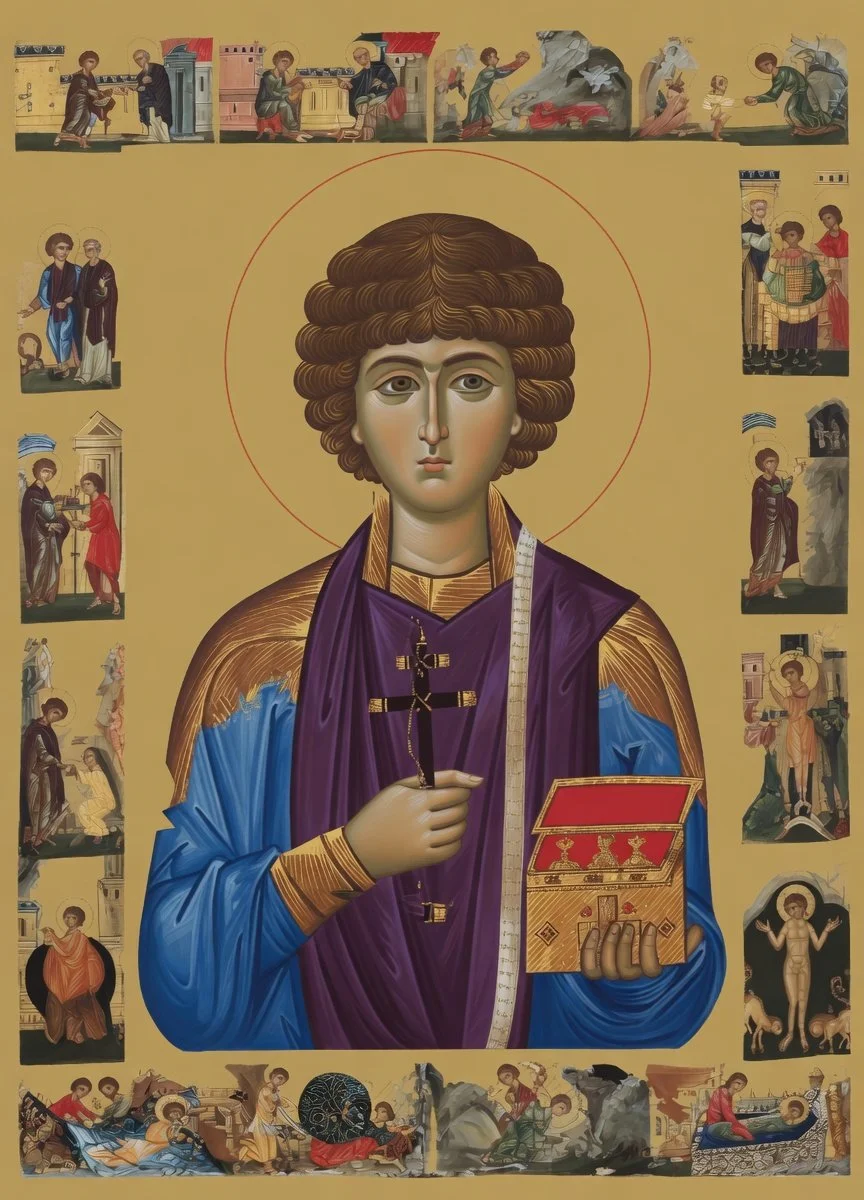
The passion narrative of Saint Panteleimon is one of the most dramatic in Christian hagiography: a systematic attempt by the most powerful government in the world to kill one man, using seven successive methods of execution, each of which failed in a way that was witnessed by crowds and that led, repeatedly, to the conversion of those who were watching. What follows is the account of each torment as preserved in the Church’s tradition.
- The Boiling Cauldron of Lead Panteleimon was placed in a large cauldron filled with molten lead and heated over fire. The accounts describe Christ appearing to him in the midst of the flames — in the form of Hermolaus, his spiritual father, by some accounts — and cooling the lead so that it did not burn him. He emerged unharmed. The executioners who watched this reported what they saw; some were arrested and martyred for their testimony.
- Drowning with a Millstone He was taken to the sea, bound with ropes, and thrown in with a heavy stone tied to him to prevent surfacing. According to the accounts, he walked on the surface of the water, the stone dropping away, while the soldiers looked on from the shore. This directly paralleled the Gospel accounts of Christ walking on water and of Peter doing the same — a parallel that was not lost on the witnesses.
- Exposure to Wild Beasts He was thrown into an arena with wild animals — the standard Roman method of execution for criminals, often combined with a public spectacle. The animals reportedly refused to attack him. Some accounts describe the beasts lying down before him, others describe them following him peacefully. The public nature of this failure was particularly striking: the arena was full, and the crowd saw what happened.
- The Breaking Wheel He was bound to a large wheel fitted with iron blades or spikes and set to turn, intended to break and cut the body. The wheel reportedly broke or stopped, leaving Panteleimon unharmed. The mechanism varied between different traditions — some describe the wheel breaking apart, others describe it stopping supernaturally — but the consistent element is that the instrument failed and its operators were witnesses.
- Molten Lead Poured Over the Body Separate from the first cauldron attempt, a second encounter with molten lead is described in several accounts: the metal being poured or applied directly to his body without the protective effect of immersion, a more targeted form of the same execution. He was again unharmed.
- Piercing with Iron Nails and Instruments He was subjected to piercing with iron implements — nails or hooks — intended to produce wounds that would kill by blood loss or shock. The accounts describe these instruments bending or failing to penetrate, or wounds that did not bleed in the expected manner. The physical impossibility of what was observed was again witnessed by those performing the execution.
- Beheading — The Final Martyrdom On the seventh attempt — beheading by sword — Panteleimon was finally martyred. But even this final act was attended by the extraordinary: his blood, when it fell, reportedly flowed white as milk rather than red. The olive tree to which he had been tied for the execution reportedly burst into flower and fruit the moment he died — in the middle of the summer, out of season, witnessed by all present. A significant number of the soldiers who had been his executioners across the seven attempts were, according to the accounts, converted by what they had witnessed and subsequently martyred themselves for refusing to continue serving the persecutors.
Part VIII
Martyrdom: July 27, 305 AD — The Death That Never Stopped Healing
The date of July 27, 305 AD became the date that would be observed by the Church as Saint Panteleimon’s feast day for as long as the Church endures. He was approximately thirty years old. In those thirty years he had been trained as one of the finest physicians of his generation, converted by an encounter with a dead child, distributed his inheritance to the poor, healed thousands without charge, stood before the emperor and refused to recant, survived seven execution attempts, and inspired the conversion of an unknown number of people who witnessed what happened each time the machinery of Rome’s power was turned against him.
When the sword finally took his life, the accounts record that he spoke to his executioners with peace rather than resentment — forgiving them, blessing them, asking Christ to receive his spirit. Several of the soldiers assigned to execute him, who had witnessed the entire sequence of failed attempts, asked his forgiveness and were themselves subsequently arrested for their profession of faith. Hermolaus, the elderly priest who had converted him, was martyred on the same day or very shortly after.
The Milk Blood and the Olive Tree
The two phenomena reported at the moment of his death — the blood that fell as milk and the olive tree that bloomed — have been interpreted in the Church’s tradition as signs of divine confirmation. The milk blood was understood as a sign of the purity of his martyrdom — the white of innocence rather than the red of guilt. The olive tree in full flower and fruit, appearing out of season at the moment of his death, was understood as a sign of the spiritual fertility of his sacrifice: that what appeared to be ending was, in fact, beginning. The tree that bore fruit at his death was a sign of what his intercession would continue to produce for all the centuries that followed.
The Christians of Nicomedia, who had been watching the entire passion — seven attempts and the final beheading — collected his body for burial. His relics were kept in Nicomedia for some time before the major distribution that would eventually place portions of them in monasteries and churches across the Christian world.
Part IX
The Relics of Saint Panteleimon: Where to Venerate Him Today
The relics of Saint Panteleimon are among the most widely distributed in Eastern Christianity. Over seventeen centuries, portions of his relics have been carried to monasteries, churches, and shrines across the Christian world as the Church grew and spread. The following are the confirmed, documented locations where his relics are venerated today — places where the faithful can come to pray at the physical remains of the Great Martyr and Unmercenary Healer.
The most significant collection of Saint Panteleimon’s relics in the world is held at the Russian Monastery of Saint Panteleimon on Mount Athos, Greece — known as the Rossikon. This monastery holds the saint’s head relic as well as multiple other portions of his relics. The monastery has been continuously inhabited since the 11th century and is one of the twenty ruling monasteries of the Holy Mountain. July 27 (the feast of Saint Panteleimon) is the monastery’s principal feast day, drawing pilgrims and clergy from across the Orthodox world. Note: Access to Mount Athos is restricted to men of Orthodox faith who obtain a special permit (the Diamonitirion). Women may venerate the saint’s memory at the monastery’s dependency, the Skete of Saint Andrew.
The Monastery of Kykkos in the Troodos Mountains of Cyprus — one of the most important Orthodox monasteries in the world and famous for its icon of the Theotokos attributed to Saint Luke — holds relics of Saint Panteleimon and venerates him as one of the great healing saints. The monastery is open to visitors and receives pilgrims year-round.
Ravello Cathedral, dedicated to the Assumption of Mary, on the Amalfi Coast of southern Italy has held relics of Saint Panteleimon since the medieval period. The cathedral has been a pilgrimage site for veneration of his relics among both Catholic and Orthodox faithful in the Italian tradition. The town of Ravello itself celebrates Saint Panteleimon’s feast day with particular devotion.
The ancient Church of Santa Prassede near the Basilica of Santa Maria Maggiore in Rome contains relics of numerous early Christian martyrs, including a particle of the relics of Saint Panteleimon. This church, one of Rome’s most important early Christian sites with its extraordinary Byzantine mosaics, is open for veneration and prayer.
Portions of Saint Panteleimon’s relics are held in Orthodox monasteries and cathedral churches across Greece, Russia, Serbia, Bulgaria, Romania, Ukraine, North Macedonia, and throughout the Orthodox diaspora. The distribution is too extensive to list comprehensively. Major Orthodox cathedrals in cities with significant Eastern Christian populations — including many in North America — typically hold at least a particle of his relics and celebrate his feast day with the Divine Liturgy on July 27.

Part X
The Monastery of Saint Panteleimon on Mount Athos: A Thousand Years of Healing Intercession
Of all the places in the world associated with Saint Panteleimon, none is more significant than the Russian Monastery of Saint Panteleimon on the Holy Mountain of Athos in northeastern Greece. Mount Athos — a monastic peninsula that has been continuously inhabited by monks since the 9th century, is self-governing under Greek sovereignty, and admits only male pilgrims with special permits — is the spiritual capital of Eastern Orthodox Christianity. Twenty monasteries govern the peninsula. The Russian monastery is one of them, and it bears the saint’s name and holds his head relic.
The monastery known as the Rossikon — “the Russian one” — was established as a Russian monastic presence on Athos during the 11th or early 12th century, at a period when Russia was newly Christianized and its monks sought to establish themselves on the Holy Mountain. It grew substantially in the 19th century when a flood of Russian monks arrived and it expanded to become one of the largest buildings on the peninsula. At its peak, the monastery housed over a thousand monks. The 20th century — the Russian Revolution, the Soviet suppression of the Church, the general crisis of Russian Orthodox monasticism — reduced the community to a handful. In recent decades the community has been recovering, and July 27 continues to be a major annual gathering.
The Feast of July 27 at the Rossikon
On July 27 each year, the feast of Saint Panteleimon, the monastery of the Rossikon becomes a significant pilgrimage destination. The Divine Liturgy is celebrated, the head relic of the saint is brought out for veneration, and clergy and faithful from across the Orthodox world gather. Monks who have spent years in solitude emerge for this feast. The Akathist and the Supplicatory Canon to Saint Panteleimon are chanted in full. Accounts of healing attributed to the saint’s relics and to his intercession are a consistent feature of these gatherings — both from the historical record and from contemporary pilgrims who report remarkable events following veneration of his relics.
The Healing Tradition of Mount Athos
Mount Athos as a whole has a long tradition of healing associated with the monks, the saints, and the relics held on the peninsula. Countless accounts across many centuries describe pilgrims arriving ill and leaving healed. The relics of Saint Panteleimon specifically have been associated with healing phenomena since the monastery was established — records in the monastery’s archives document cases going back centuries. For Orthodox Christians who can make the pilgrimage, a visit to the Rossikon on July 27 — or at any time of year to venerate the relics — is considered one of the most powerful forms of intercessory prayer for physical healing available within the living tradition of the Church.
Part XI
Churches Named After Saint Panteleimon: A Global Community of His Devotion
Saint Panteleimon is one of the most widely commemorated saints in the naming of Eastern Christian churches. From the Byzantine era to the present, parishes and monasteries across four continents have been dedicated to him. The following are some of the most notable.
Church of Saint Panteleimon, Nerezi, North Macedonia (12th Century)
Among the most historically significant structures bearing his name is the Church of Saint Panteleimon at Nerezi, outside Skopje in North Macedonia. Built in 1164, it is considered one of the finest examples of Comnenian Byzantine architecture and is celebrated for its interior frescoes — particularly the Lamentation of Christ, which is regarded by art historians as a masterpiece of pre-Renaissance emotional realism and one of the earliest expressions of the humanistic tendency in Byzantine art. The church is a UNESCO World Heritage Site candidate and remains an active place of Orthodox worship. It is accessible to visitors and represents one of the most beautiful buildings ever dedicated to this saint.
Monastery of Saint Panteleimon, Mount Athos, Greece (11th Century)
The Rossikon on Mount Athos, discussed fully in Part X above, remains the primary monastic community dedicated to the saint and the primary relic site. Access information: imspa.gr. Men of Orthodox faith may apply for a pilgrimage permit (Diamonitirion) through the Holy Epistasia of Athos.
Church of Saint Panteleimon, Moscow, Russia
The Church of Saint Panteleimon in Moscow is one of several churches in Russia dedicated to the Unmercenary Healer. Russian Orthodox tradition has maintained a particularly strong devotion to Saint Panteleimon, and his icon is found in virtually every Orthodox church in Russia. Moscow’s church dedicated to him serves as a regular pilgrimage destination for those seeking healing.
Cathedral Church of Saint Panteleimon, Feofania Monastery, Kyiv, Ukraine
The Feofania Monastery complex in Kyiv includes a Cathedral dedicated to Saint Panteleimon, which has been a site of pilgrimage and healing prayer for the Ukrainian Orthodox faithful. The monastery grounds outside Kyiv serve as a spiritual retreat and medical-spiritual healing center in the Ukrainian tradition of combining medicine and prayer.
Saint Panteleimon Orthodox Churches in North America
Numerous parishes across North America bear the name of Saint Panteleimon in various Orthodox jurisdictions. Among the most notable:
- Saint Panteleimon Greek Orthodox Church serves communities in multiple American cities, typically under the Greek Orthodox Archdiocese of America.
- Saint Panteleimon Russian Orthodox Church parishes exist in several major metropolitan areas under various Russian Orthodox jurisdictions in North America.
- Saint Panteleimon Orthodox Church, Chicago, Illinois — one of the longer-established American parishes in his name.
- Saint Panteleimon Serbian Orthodox Monastery, Monastery, Indiana — a monastic community that observes his feast with special solemnity.
If you are seeking a parish in his name near you, searching your local Orthodox jurisdictional website (Greek Orthodox Archdiocese, Orthodox Church in America, Antiochian Archdiocese, Serbian Orthodox Diocese, etc.) for “Panteleimon” will identify the nearest community celebrating his feast and name.
Part XII
Miracles During His Lifetime: The Complete Documented Account
The miracles of Saint Panteleimon during his lifetime fall into two distinct categories: the healing miracles he performed through prayer and the invocation of Christ’s name, and the miraculous events that attended his passion — the successive failures of execution that demonstrated the divine protection surrounding him.
- The Restoration of Sight — The First HealingThe first recorded miracle of Panteleimon’s ministry is described in several versions of his account: his encounter with a blind man to whom he gave back sight through prayer in Christ’s name. This miracle preceded his full public ministry and was one of the events that preceded the denunciation by his colleagues — the demonstration of a power that exceeded ordinary medicine was as threatening as the free treatment.
- The Raising of the Dead Child from the Viper’s BiteThis is the conversion miracle: a child killed by a viper’s bite, found by Pantoleon before his baptism, raised through prayer in Christ’s name while the viper simultaneously died. This miracle was witnessed and directly caused his own conversion and his father Eustorgius’ conversion. It is attested in all versions of his account with consistent detail.
- The Healing of the Paralyzed Man Before Diocletian’s CourtIn the presence of the imperial court, Panteleimon prayed over a man who had been paralyzed and the man recovered movement. This miracle was witnessed by the assembled court of the eastern Roman Empire — an audience that included Diocletian himself, his court officials, and the soldiers and servants of the imperial household. Multiple conversions resulted directly from this witnessed miracle.
- The Cauldron of Boiling Lead — First TormentPlaced in molten lead heated over fire, Panteleimon emerged unharmed. The appearance of Christ (or, in some accounts, a figure resembling Hermolaus) in the cauldron was reported by the executioners who observed it. This miracle led to the conversion and subsequent martyrdom of some of those present.
- Walking on Water with a Millstone — Second TormentThrown into the sea with a stone tied to him, he walked on the surface while the stone sank. The parallel with the Gospel accounts of walking on water was noticed by all who watched from the shore.
- The Taming of Wild Beasts — Third TormentThrown into an arena with wild animals before a public crowd, the beasts refused to attack. This public miracle, in a public arena with a crowd watching, was among the most widely witnessed of the seven failures.
- The Breaking of the Wheel — Fourth TormentThe wheel fitted with cutting instruments, to which he was bound, broke or stopped — sparing him the death it was designed to produce.
- Endurance Through Molten Lead and Iron Instruments — Fifth and Sixth TormentsRepeated encounters with metal intended to kill him — poured lead and piercing instruments — continued to fail, each failure witnessed and each witnessed failure deepening the account that was accumulating around him.
- The Milk Blood and the Olive Tree — Signs at MartyrdomAt the moment of his beheading, the blood that fell was reported to run white as milk. The olive tree to which he had been tied burst into flower and fruit out of season. Both phenomena were witnessed by soldiers and bystanders, some of whom were converted and subsequently martyred for it.
Part XIII
Miracles After His Death: Seventeen Centuries of Healing Intercession
The miracle record of Saint Panteleimon after his death spans seventeen centuries and every continent on which the Christian faith has been practiced. The following represents the documented and attested accounts by era.
Early Christian and Byzantine Period (4th–10th Centuries)
In the decades following his martyrdom, his relics were translated from Nicomedia with honor and distributed across the eastern Roman Empire. The early Church calendar preserved his feast on July 27 continuously from the 4th century onward — a sign of the active cultus maintained around his memory and his relics. Early Byzantine church records mention healing miracles at his relic sites, including remissions of fever, recovery from paralysis, and cures of conditions that had resisted medical treatment.
His veneration was particularly strong in Constantinople, where multiple churches and chapels were dedicated to him over the Byzantine centuries. The Emperor Justinian I (527–565 AD) is reported to have been healed of a serious illness through the intercession of Saint Panteleimon and subsequently built or restored a church in his honor. This imperial patronage significantly elevated his prominence in Byzantine devotional life.
Medieval Period (11th–17th Centuries): The Mount Athos Tradition
With the establishment of monastic communities on Mount Athos, the tradition of healing associated with Saint Panteleimon became concentrated at the Rossikon. The monastery’s archives — extensive but not fully published in accessible sources — document cases over centuries of pilgrims arriving ill and leaving with documented improvement or resolution of their conditions following veneration of the head relic. The pattern in these accounts is consistent across the centuries: the pilgrim arrives, spends time in prayer and fasting, venerates the relic, receives the oil blessed before the relic, and in a significant proportion of cases reports healing that either confirmed or exceeded medical expectation.
Early Modern Accounts (18th–19th Centuries)
The 18th and 19th centuries saw a significant increase in documented healing accounts associated with Saint Panteleimon, partly because of the increased literacy of the pilgrimage population and partly because the Russian church’s substantial documentation practices produced more accessible records. Notable accounts from this period include: healings of serious infectious disease (typhus and cholera epidemics in which individuals who prayed at Panteleimon’s icon were reported to have been spared or recovered while those around them did not), healings of eye diseases (given his patronage’s connection to the restoration of sight), and multiple accounts from military contexts in which soldiers who carried his icon or medal into battle survived wounds that should have been fatal.
Modern and Contemporary Accounts
In the modern era, the accounts associated with Saint Panteleimon fall into several consistent categories:
- Cancer RemissionsPerhaps the largest single category of modern accounts in the Orthodox world attributes unexpected cancer remissions to prayers through Saint Panteleimon, often combined with visits to his relics or sustained use of his Akathist and Supplicatory Canon. These accounts are not formally documented in the manner of the Lourdes medical bureau, but they are numerous, named, and consistent in the Orthodox pilgrimage literature and in the pastoral accounts of Orthodox clergy who serve the sick.
- Protection of Medical PersonnelA significant category of modern accounts specifically involves physicians, surgeons, and nurses who prayed to Saint Panteleimon in the context of their work — for guidance in difficult procedures, for protection in dangerous situations, for outcomes beyond what their own skill could guarantee — and who attributed successful outcomes to his intercession. This category is particularly active in Orthodox countries where the tradition of invoking him as a patron of the medical profession is culturally embedded.
- Healing at Icons and RelicsOrthodox parishes across North America, Europe, and Australia routinely receive accounts of healing attributed to the intercession of Saint Panteleimon from their parishioners. These accounts range from dramatic acute healings to the relief of chronic conditions that had resisted medical management. The pattern is too consistent across too many independent contexts to dismiss.
- Healing of ChildrenA sub-tradition within Panteleimon’s intercession specifically associates him with healing of sick children, rooted in the account of the dead child he raised before his own conversion. Orthodox parents have historically brought sick children to his icon and relics as a specific act of intercessory prayer, and the accounts of recovery from childhood illness attributed to his intercession form a consistent thread through the pilgrimage literature.

Part XIV
What People Pray to Saint Panteleimon For: A Complete Guide to His Patronage
Saint Panteleimon’s patronage is broad — the broadest of any healing saint in Eastern Christianity — because his own ministry was broad. He did not specialize. He treated everyone who came to him, from the most powerful courtiers of the imperial palace to the poorest prisoners in Nicomedia’s jails, from children to the elderly, from the acutely ill to the chronically disabled. The following is a comprehensive guide to the specific intentions for which he is most frequently invoked.
Physical Healing of Any Illness
The broadest and most universal application of his intercession is simply: bring him your illness. Any serious physical illness, any chronic condition, any acute emergency, any situation in which the body is failing and medicine is uncertain — these are all within the scope of his patronage. He is not a specialist saint. He is the patron of the sick in the fullest and most comprehensive sense.
Physicians, Surgeons, and Doctors
As a physician himself, Saint Panteleimon is the natural patron of those in the medical profession. Physicians invoke him for wisdom in diagnosis, for skill in the operating theater, for clarity of judgment in complex cases, for protection from error, and for the grace to practice medicine with the combination of technical excellence and human compassion that his own ministry embodied. Many Orthodox and Eastern Catholic physicians keep his icon in their office or wear his medal as a daily reminder of what their vocation is rooted in.
Surgeons Before and During Surgery
A specific sub-tradition within his patronage — particularly active in the Russian Orthodox world — invokes Saint Panteleimon specifically before surgical procedures. The prayer is for the surgeon’s hands (a specific petition for skill and steadiness), for the patient’s body (protection through the procedure), and for the outcome (wisdom in the decisions made in the operating theater when plans change). Patients facing surgery also pray to him for protection during the procedure and for recovery afterward.
Midwives and Those in Childbirth
Saint Panteleimon is the patron of midwives — those who attend at the beginning of life, who work in the liminal space where birth and its complications can mean the difference between life and death for mother or child. Midwives in the Orthodox tradition invoke him as a patron of their professional skill, and those in difficult labors or high-risk pregnancies also call on him alongside the saints specifically associated with pregnancy and childbirth. See our complete guide to Orthodox saints for pregnancy and childbirth for related intercession.
Nurses, Caregivers, and All Healthcare Workers
The unmercenary character of his healing ministry makes him a patron not only of those with medical degrees but of all who care for the sick — nurses, nursing assistants, hospice workers, home health aides, hospital chaplains, and the family members who perform informal care. His patronage extends to anyone whose work is the care of the body and the service of those who are suffering.
Cancer and Serious Illness
Saint Panteleimon is one of the primary healing saints invoked for cancer alongside Saint Nektarios of Aegina. His broad healing patronage and the documented tradition of cancer remissions attributed to his intercession in the Orthodox pilgrimage literature make him a natural figure to invoke for any serious, life-threatening diagnosis. He is invoked both at the moment of diagnosis and through the course of treatment — for the effectiveness of chemotherapy and radiation, for protection from side effects, for the wisdom of oncologists, and for the miraculous resolution that medicine cannot guarantee.
Medical Emergencies
In acute medical emergencies — heart attacks, strokes, serious accidents, acute illness of sudden onset — Saint Panteleimon is invoked as an immediate intercessor. The tradition of a short invocation (“Holy Panteleimon, pray for [name]”) in a crisis is common in Orthodox families. The prayer is not complex; it does not need to be. The relationship established through sustained devotion means that in the moment of crisis, the name alone carries the full weight of the relationship.
Sick Children
The account of his raising a dead child is not incidental to his spiritual profile — it is the miracle that converted him. Orthodox parents have historically brought their sick children to his intercession as a specific application of this founding miracle. For a child with a serious illness, a fever, a frightening diagnosis, or any condition that leaves a parent helpless, Saint Panteleimon is the first name invoked after the Theotokos in many Orthodox homes.
Those for Whom Medicine Has Failed
Perhaps the most theologically significant application of his intercession: he is the saint of last resort in the best sense of the phrase — not the saint you turn to when you have given up, but the saint you turn to when the medicine has done everything it can do and something more is needed. His own healings were concentrated precisely in cases where the natural medical options had been exhausted. This is consistent with the teaching of the Church that the purpose of miraculous healing is not to replace medicine but to act in the territory where medicine reaches its limits.
Those Suffering from Autoimmune Disease and Chronic Illness
For those with MS, lupus, fibromyalgia, or other chronic conditions, Saint Panteleimon is invoked alongside Saint Lidwina of Schiedam — where Lidwina intercedes from inside the experience of chronic illness, Panteleimon intercedes from the position of the physician who reached into those conditions with the healing power of Christ. See also our complete guide to patron saints for lupus and autoimmune disease.
Part XV
Saint Panteleimon and the Medical Profession: The Theology of Christian Healing
The significance of Saint Panteleimon to the medical profession is not merely devotional — it is theological. He embodies a specific vision of what medicine is and what it is for, and that vision has shaped Orthodox Christian medical ethics and vocation for seventeen centuries.
Medicine as a Spiritual Practice
In the Orthodox theological tradition, medicine — the care of the body — is inseparable from the care of the soul because the body and soul are inseparable. The Christian physician treats not just a body but a person, and the healing of the body is understood as participating in the larger divine economy of redemption and restoration. Panteleimon did not practice medicine and then pray separately — he practiced medicine as prayer, treating each patient as a person in whom the image of God was present and who deserved both technical skill and spiritual presence.
This vision — which he inherited from his Christian mother, absorbed from Hermolaus, and then embodied in his practice — is the vision the Orthodox Church holds up to Christian physicians today. His icon in hospital chapels and clinic offices is not a talisman but a statement of vocation: this is what medicine is rooted in, this is what it aspires to, this is the physician who showed what it looks like when skill and love are fully integrated.
The Free Clinic and the Unmercenary Tradition
The unmercenary tradition that Saint Panteleimon exemplifies has had direct practical influence on Orthodox Christian healthcare across the centuries. Byzantine hospitals — the xenodocheia and nosocomeia — were explicitly founded on the unmercenary model and were among the most advanced healthcare institutions in the medieval world. Russian Orthodox medical missions. Monastic infirmaries. The hospital chapels dedicated to Panteleimon and Cosmas and Damian in every Orthodox country. All of these are downstream expressions of the vision he embodied: that medicine is a ministry, that the sick have a claim on the resources of the Church, and that healing is one of the works through which the Body of Christ makes the Kingdom of God tangible in human history.
His Icon in Modern Orthodox Hospitals
In Russia, Greece, Serbia, Romania, Cyprus, and other Orthodox countries, it is standard practice for hospitals — both explicitly Orthodox-affiliated and general state hospitals in predominantly Orthodox cultures — to have icons of Saint Panteleimon in the wards, the operating theaters, and the hospital chapels. Patients receive blessings before surgery. Physicians pray before procedures. The icon is not decorative; it is a statement of what the institution is for and whose example it follows. For Orthodox Christians in North America who navigate general medical environments without this cultural context, carrying a prayer card or wearing a medal of Saint Panteleimon is a personal form of the same practice.
Part XVI
Official Liturgical Prayers: The Troparion, Kontakion, and Akathist of Saint Panteleimon
The Eastern Orthodox Church has a rich liturgical tradition of prayer to Saint Panteleimon that predates any modern devotion by many centuries. The following are the official liturgical texts — the Troparion, the Kontakion, and the beginning of the Akathist — that have been used in the Divine Liturgy and in personal devotion for over a millennium. These are not informal compositions. They are tested, consecrated texts that carry the weight of the Church’s sustained prayer.
O Holy Great Martyr and Healer Panteleimon,
entreat the merciful God
to grant our souls forgiveness of sins.
Imitating the Merciful One and having received the grace of healing from Him,
O holy Martyr and Healer Panteleimon,
by your prayers heal our spiritual infirmities
and continually drive away the temptations of our enemy
from those who faithfully cry:
Save us, O Lord.
We magnify thee, O holy Great Martyr and Healer Panteleimon,
and we honor thy sufferings
which thou didst endure for Christ.
An angel in the flesh wast thou, O holy martyr Panteleimon,
healing all who come to thee in faith;
for thou didst forsake the vain wisdom of the world
and didst receive true wisdom from Christ,
enriching the poor in body and spirit with thine ungrudging gifts.
Wherefore we cry to thee:
Rejoice, O fervent intercessor for those who suffer!
Rejoice, O physician who askest naught for thy healings!
Rejoice, O Panteleimon, Great Martyr and Healer!
Part XVII
Prayers to Saint Panteleimon for Specific Healing Intentions
O Holy Great Martyr and Unmercenary Healer Panteleimon, physician of soul and body, whose medicine cost nothing and whose compassion had no limit — hear my prayer.
I bring to you this illness that I carry: [speak the condition, the symptom, the diagnosis, the fear]. I am asking you, who healed the blind and raised the dead and stood unmoved through seven execution attempts because Christ was with you — intercede with Him now on my behalf.
Ask the Lord who works through the hem of a garment and the clay of the earth to work through whatever means He chooses for the healing of this body. Ask Him to direct the hands of those who treat me, to give wisdom to those who diagnose me, and to grant a result that exceeds what medicine alone can accomplish.
And if healing in fullness is not His immediate will — give me the grace to bear what remains with the faith you carried to your martyrdom. Amen.
O Holy Panteleimon, physician of souls and bodies, I am going into this procedure placing myself in the hands of those you guide. You practiced surgery and medicine with the same hands that healed through prayer — stand at the shoulder of those who operate today.
Give my surgeon skill, steadiness, and the clarity to make the right decisions when the unexpected happens. Give the anesthesiologists precision and attentiveness. Give the nurses and all who assist the care and competence that this moment requires.
Protect my body from infection, from unexpected complication, from the errors that even skilled hands can make. Bring me through this procedure in greater health than I entered it, and give me a recovery that honors the work of the surgeon and the grace of God who works through both skill and miracle. Amen.
Holy Panteleimon, my patron and my predecessor in this work — today I enter [the clinic / the hospital / the operating theater / the ward] to care for those who are suffering. Give me what I cannot give myself: the combination of technical skill and human compassion that you embodied. Keep my mind clear and my hands steady. Give me the humility to acknowledge what I do not know. Give me the courage to act when certainty is impossible. Give me the attention to notice what the hurried glance misses.
And in those moments when medicine has reached its edge and only God can do what needs to be done — give me the grace to pray, and to trust that my patient’s body is in hands more capable than my own. Amen.
O Holy Great Martyr Panteleimon, you who healed the sick without asking what their diagnosis was, who treated the terminal as readily as the recovering, who brought the power of Christ into the consulting room and the sickroom without apology — hear my prayer for [name] / for myself.
This diagnosis is serious. The doctors are doing everything medicine can do. I am asking you to add what medicine cannot: the intercession of a holy man whose miracles the Lord has been working for seventeen centuries and has not stopped. Bring this cancer / this illness before God. Ask Him to work through the treatment, beyond the treatment, and if necessary instead of the treatment. Ask Him for a result that the doctors will struggle to explain. Ask Him for healing.
And give us, in whatever comes, the peace that passes understanding — the peace you had in the cauldron of boiling lead, standing unmoved because Christ was there. Amen.
O Holy Panteleimon, the very miracle that converted you was the raising of a dead child — you knelt beside a body that had no life and you called on the God who could give it back. I bring to you my child / this child, who is sick and frightened and who does not understand why their body is doing what it is doing.
You understand children. You knelt beside one. You know what it looks like when a parent would give anything to take the illness into their own body instead. Intercede for this child. Ask Christ to reach into whatever is wrong and to restore what illness has taken. And give this child the peace that only He can give — the deep, embodied peace that even children can feel when God is present in their room. Amen.
O Holy Great Martyr and Healer Panteleimon, physician of soul and body, you who charged nothing and gave everything — pray for me today. Intercede for my healing according to Christ’s will. Protect those who care for me. And give me the grace to trust the Physician who is greater than all physicians. Amen.
Part XVIII
How to Pray to Saint Panteleimon: A Complete Practical Guide
The tradition of praying to Saint Panteleimon is one of the longest-established in Orthodox Christianity, which means there is a rich, tested, and practically detailed body of guidance on how to do it well. The following covers the different approaches depending on your situation, background, and the depth of devotion you want to develop.
The Icon as the Foundation
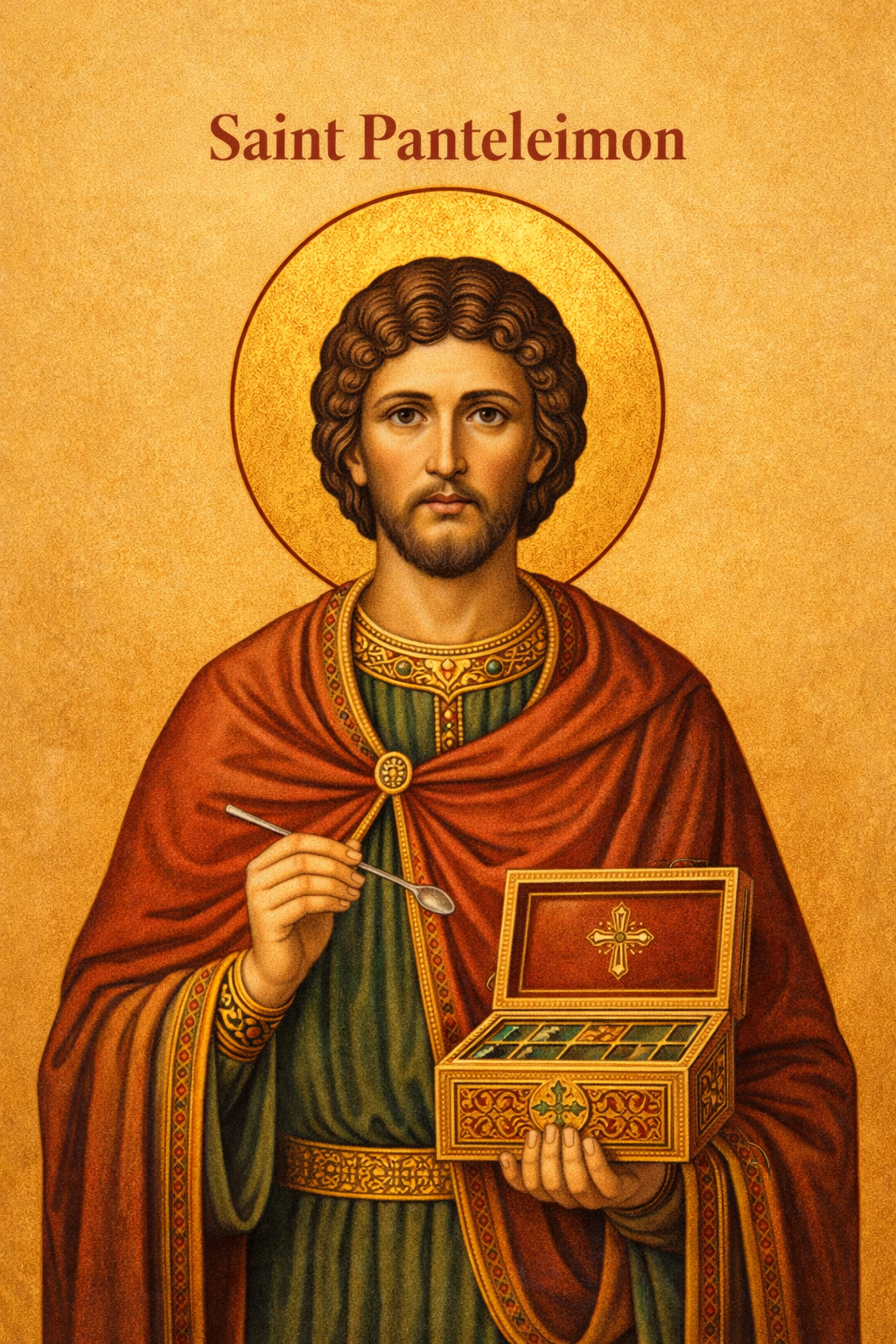
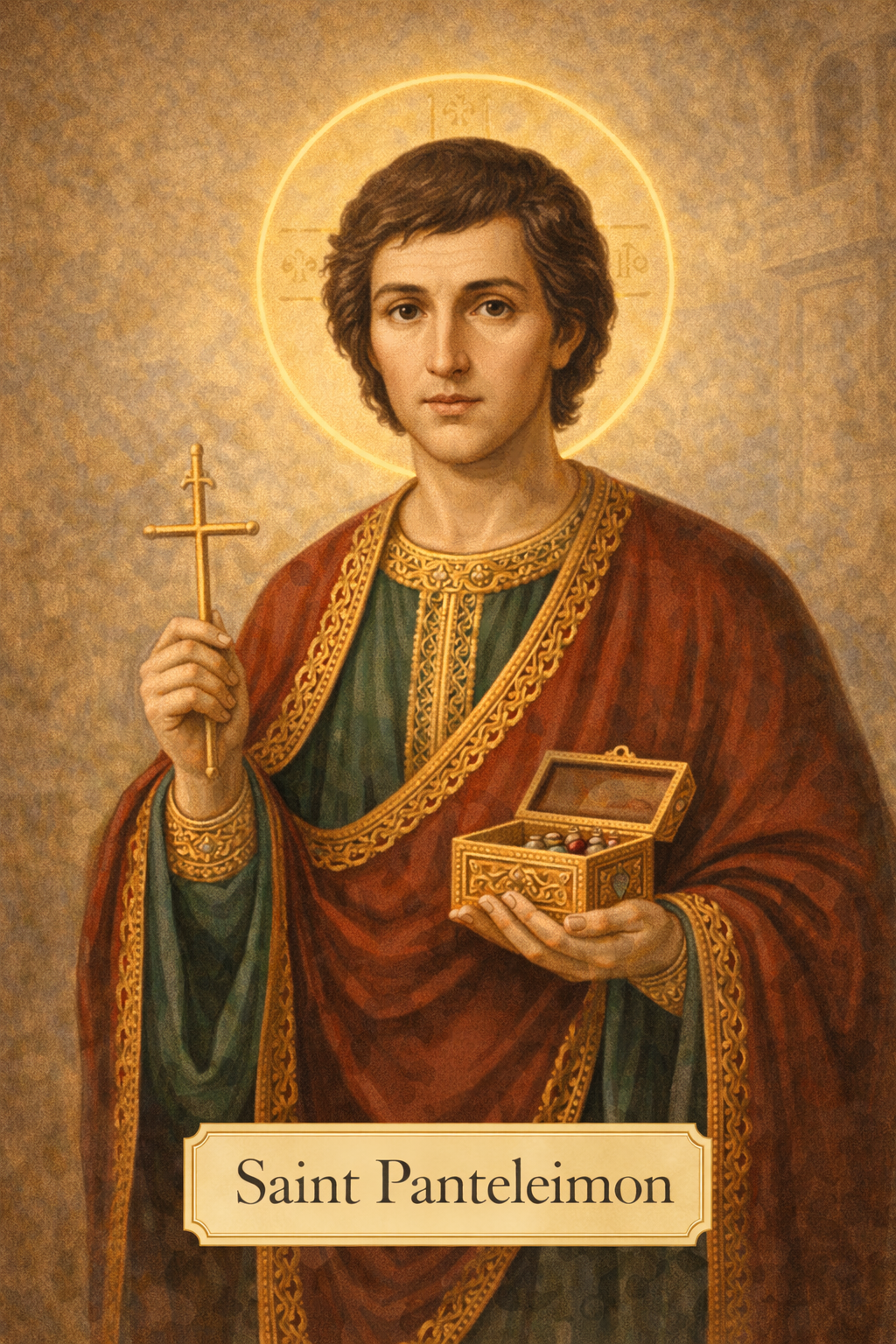
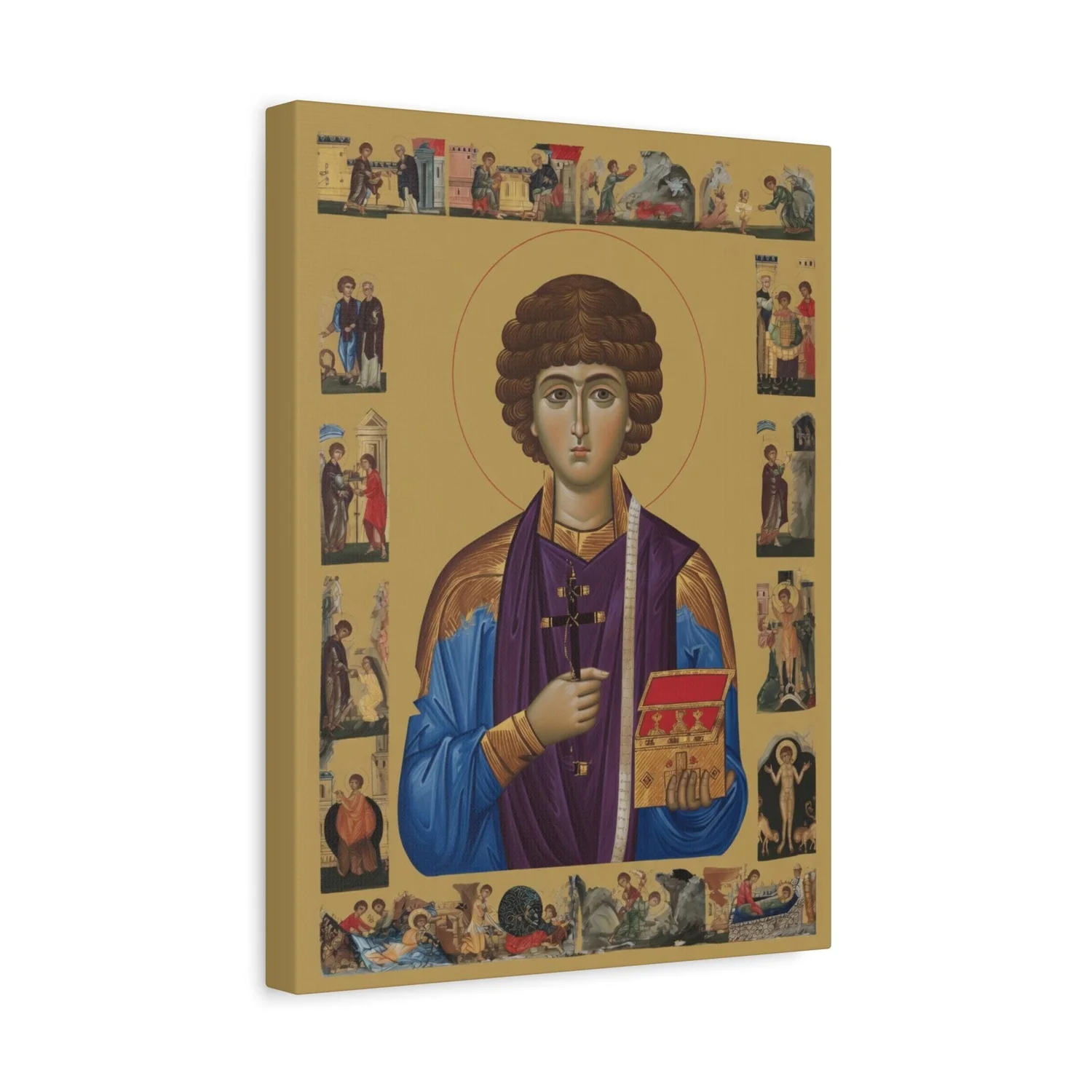
In the Orthodox and Eastern Catholic traditions, prayer to any saint begins with the icon — the sacred image that is understood not as a painting of a historical figure but as a window into the presence of the living saint. The icon of Saint Panteleimon is one of the most recognizable in Eastern Christianity: typically showing him as a young man with a medicine box and a small vessel of oil or medicine, often with a martyr’s cross, dressed in the garments of a Roman physician. To place his icon in your prayer space is to open that window — to acknowledge that the person depicted is real, present, and available to intercede.
Beginning with the Troparion
The simplest and most liturgically grounded way to pray to Saint Panteleimon is to memorize the Troparion — the official liturgical prayer quoted in Part XVI above — and use it as your daily invocation. Say it upon waking, before medical appointments, when you hear news of illness in someone you love, before surgery or procedures. It is seven words in the most basic form: “Holy Martyr and Healer Panteleimon, entreat the merciful God to grant our souls forgiveness of sins.” These seven words carry seventeen centuries of accumulated prayer.
Using a Prayer Card
For those who do not yet have an icon, a prayer card is the most accessible physical anchor for devotion to Saint Panteleimon. Carry it to every medical appointment. Keep it in your wallet or in your bag of medical supplies. Tape it in your clinic or hospital workspace if you are a medical professional. Hold it during prayer. The physical presence of the image is a constant reminder that the saint is present and interceding. Visit our prayer card store for all available options.
Praying the Akathist: The Most Complete Form of Devotion
For sustained, deep devotional prayer to Saint Panteleimon — particularly in the context of serious illness — the Akathist hymn is the most complete form of prayer the tradition offers. The full Akathist takes 30–45 minutes to pray and covers every dimension of his life, his martyrdom, and his healing ministry. It is used in monasteries on his feast day and in personal devotion by those who want to enter into the deepest possible intercessory relationship with him. The Supplicatory Canon and Akathist to Saint Panteleimon contains the full texts in English translation and is available in the format shown below. It is strongly recommended for anyone living with serious illness, for medical workers who want a structured devotional practice, and for family members praying on behalf of someone they love.
His Feast Day: July 27
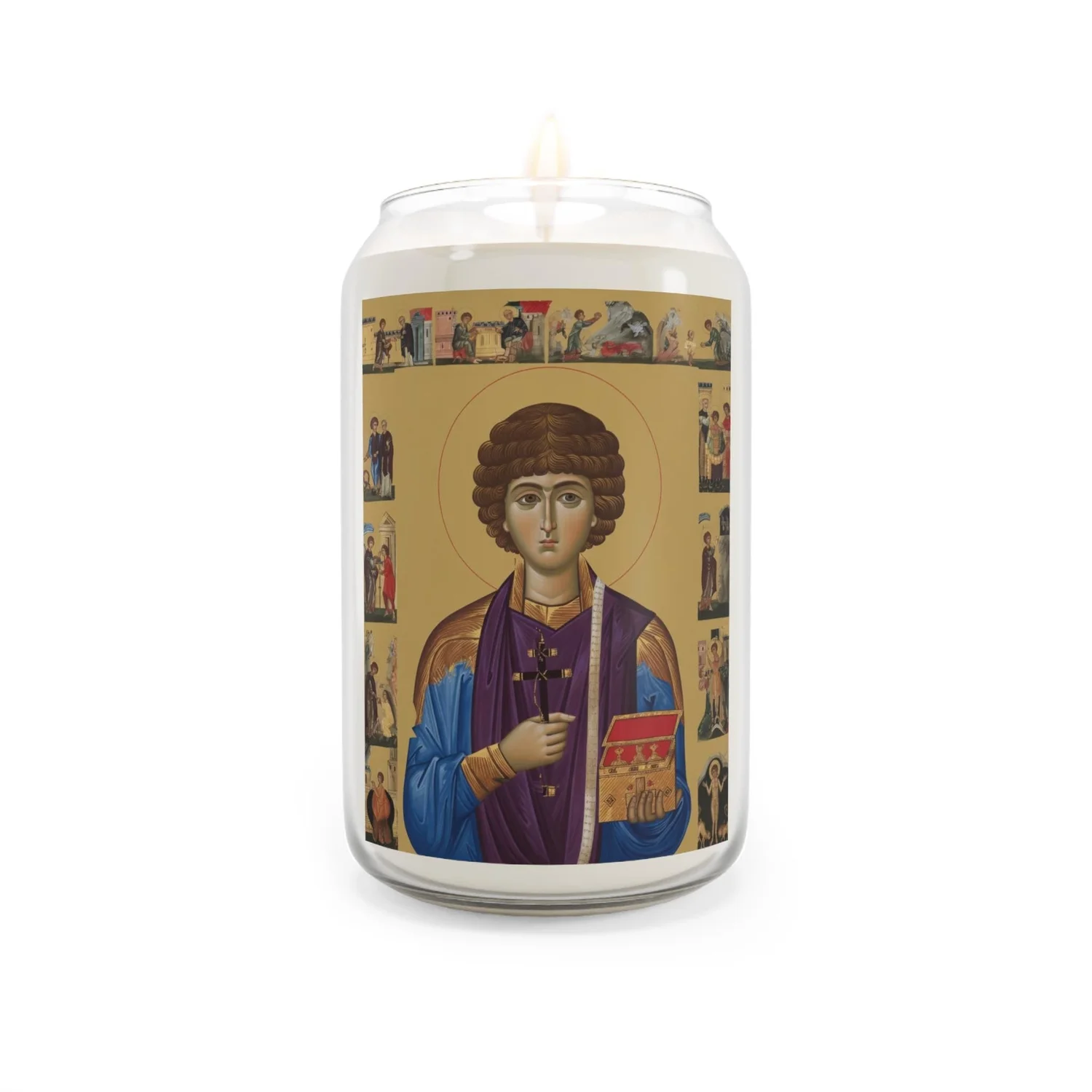
July 27 is the feast day of Saint Panteleimon and the single most important date in his liturgical year. If you attend an Orthodox or Eastern Catholic church that celebrates his feast, the Divine Liturgy on July 27 is the fullest form of devotion available. If you practice the faith privately, July 27 is the day to pray the Troparion and Kontakion in full, to pray the Akathist if you have adopted it as a regular practice, and to bring your specific health intentions to him in a special way. Light a candle. Place his icon prominently. Make the day one of particular attentiveness to what he accomplished and what he continues to do.
Connecting the Eucharist to His Intercession
For Catholic and Orthodox Christians who receive the Eucharist regularly, there is a specific way to connect Communion to the intercession of Saint Panteleimon: in the moment of receiving, offer your body to Christ in the same spirit in which Panteleimon placed his skill at Christ’s disposal — not as something you withhold but as something you give. Ask Christ to work through your body as He worked through the body of the physician-martyr: healing what needs to be healed, restoring what has been lost, and making the instrument of the body available for whatever He intends to do with it.
For a full guide to building an Eastern Christian healing prayer space, see our article on creating a home intercession space for healing.
Part XIX
Setting Up a Saint Panteleimon Prayer Corner
In the Eastern Christian tradition, the prayer corner (also called the “beautiful corner” or “icon corner”) is the dedicated space in a home where the sacred is given physical anchor. For a healing prayer corner built around Saint Panteleimon, the essential elements are: his canvas print or icon at the center; a candle to be lit during prayer; a prayer card that can be carried when you are not at the corner; and ideally the Supplicatory Canon and Akathist as a prayer book. The combination of image, light, and text creates the environment in which sustained intercessory prayer takes root and becomes a practice rather than an occasional petition.
For physicians and medical workers, a Saint Panteleimon prayer corner at home is complemented by his prayer card or a small icon in the clinical workspace — the place of actual practice sanctified by the presence of the patron of all who practice medicine in love.
See also our guides to other major healing saints who are placed alongside Saint Panteleimon in prayer corners: Saint Nektarios of Aegina, Saint Paisios of Mount Athos, Saint Charbel Makhlouf, and Saint Lidwina of Schiedam.

Frequently Asked Questions
Saint Panteleimon — Questions & Answers
The Physician Who Never Retired
Panteleimon was martyred at approximately thirty years of age. In those thirty years he healed more people, survived more execution attempts, and converted more witnesses than any ordinary biography should be able to contain. But the most extraordinary thing about him is not the thirty years of his life. It is the seventeen hundred years that followed. He has not stopped healing. The relics on Mount Athos still draw pilgrims who arrive broken and leave changed. The Troparion is still sung every July 27 in hundreds of languages by communities that could not be more different from each other but who share this one name. The prayer cards are still carried to appointments by people who need someone to speak to God directly on their behalf.
He was the physician who charged nothing. He is still practicing, and the fee has not changed.
All Orthodox Saints for Healing →