The Bible’s Unsolved Mystery: Why Didn’t God Let Elijah Die?
Old Testament Mystery • Biblical Enigmas • The Freedom of God • Elijah the Prophet
The Bible’s Unsolved Mystery: Why Didn’t God Let Elijah Die?
Every other prophet died. Elijah did not. Scripture states this plainly, offers no explanation — and then, centuries later, names him again as someone who is still coming. The Bible leaves this open on purpose. Here is why that matters.
Elijah’s Undying Departure — The Mystery at a Glance
- The Fact
- Elijah did not die • 2 Kings 2:11 • Taken alive in a whirlwind and chariot of fire
- The Witness
- Elisha saw it • 50 prophets searched 3 days • Found nothing
- The Company
- Only one other biblical figure shares this: Enoch (Genesis 5:24)
- What Is Different
- Enoch’s story concludes • Elijah’s is interrupted mid-mission • Israel not yet repentant
- The Old Testament’s Last Word
- Malachi 4:5 — “I will send you Elijah the prophet” • Not a type • The person
- Jesus’ Interpretation
- Matthew 11:14 — “He is Elijah who is to come” • Fulfilled in John the Baptist
- The Tradition’s View
- Elijah (and Enoch) widely identified as the two witnesses of Revelation 11
- What Scripture Does Not Do
- Does not explain the mechanism • Does not generalize • Preserves the mystery
The Fact Scripture States Without Apology
The Bible does not bury this fact. It does not soften it, surround it with qualifications, or offer a framework for understanding it before delivering it. It simply states it, in the most direct prose the biblical authors possess, and then moves on as though the reader should be able to bear the weight of what has just been said without assistance.
Elijah did not die.
That is not an interpretation. It is not a theological inference drawn from difficult language. It is what the text says. Second Kings 2:11: “And as they still went on and talked, behold, chariots of fire and horses of fire separated the two of them. And Elijah went up by a whirlwind into heaven.” There is no death scene. No burial. No mourning period. No grave. There is only a departure so absolute and so strange that the fifty prophets who heard about it immediately volunteered to spend three days searching, because their minds could not quite accept that a man had simply — vanished.
And their search found nothing.
This one event sits inside the Old Testament like a splinter that the text never removes. Elijah does not end. He exits. Every other prophet — Moses, Samuel, Isaiah, Jeremiah, Ezekiel — dies. Their deaths are recorded, their burials noted, their stories concluded. Elijah’s story is not concluded. It is interrupted. And the interruption, as this article will show, is not accidental, not cosmetic, and not meaningless. It is one of the most purposeful things the Bible ever does.
The question this article takes seriously is the one most readers eventually ask and most devotional resources quickly wave away: Why? Why did God spare Elijah from death when He did not spare Moses? Why leave a life unfinished? Why give a man a departure that Scripture itself describes with the language of continuation rather than conclusion? And why — most strangely of all — does the Bible end its entire first testament with that same man’s name, promising he is still coming?
The answer, as we will see, is that the Bible leaves this open on purpose. The mystery is not a deficiency. It is a doorway. And one book — written with uncommon theological care — exists specifically to walk through it.
Part II
The Scene: What 2 Kings 2 Actually Says
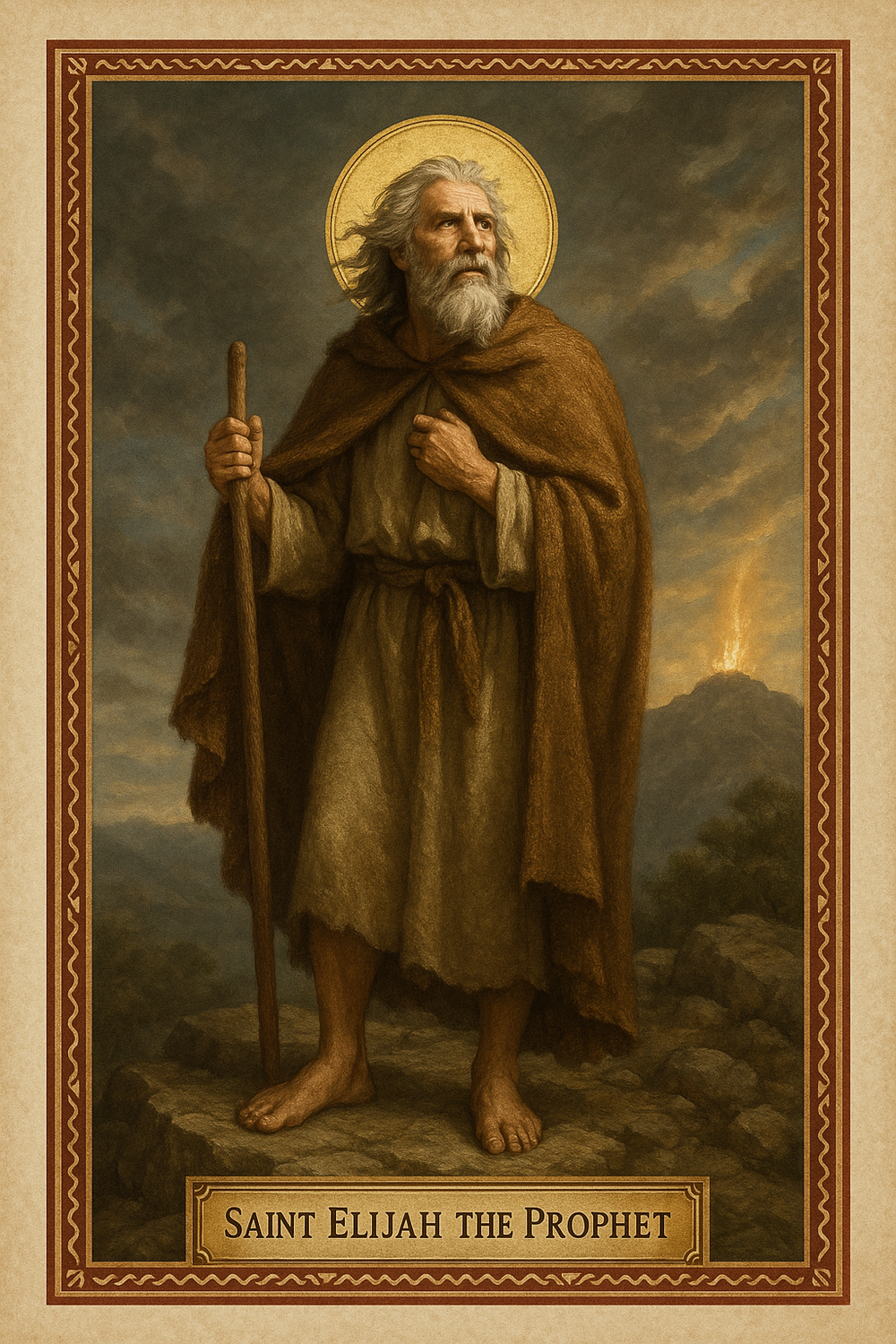
Called by some the greatest of the Old Testament prophets, Elijah confronted Ahab’s Baalism, called down fire on Carmel, fled in despair to Horeb, and heard God in the still small voice. He anointed Elisha as his successor and was taken alive in a chariot of fire. Scripture does not close his story — it leaves it unfinished and promises his return. He appears at the Transfiguration, representing the prophets alongside Moses. He is invoked by Jesus as the prototype of John the Baptist. He has never died.
To understand why Elijah’s departure is so theologically weighty, it helps to read 2 Kings 2 carefully, because the author has constructed it with remarkable deliberateness. The chapter opens with the narrator telling the reader something Elijah and Elisha already know but have not yet discussed openly: “Now when the LORD was about to take Elijah up to heaven by a whirlwind, Elijah and Elisha were on their way from Gilgal.” The destination is named before the journey begins. The reader knows what is coming before the characters say it aloud.
Three times along the way, Elijah tells Elisha to stay behind. Three times Elisha refuses, saying, “As the LORD lives, and as you yourself live, I will not leave you.” This threefold exchange is not narrative padding. It establishes Elisha as the authorized witness — the one whose presence confirms that what he is about to see is real, not rumor.
At the Jordan, Elijah takes his mantle, rolls it up, and strikes the water. It parts. The two men cross on dry ground. The company of prophets watching from a distance see this happen. They know. Something final and impossible is near.
Elijah asks Elisha what he wants. Elisha asks for a double portion of his spirit — the inheritance of the firstborn son, transferred in this case not through blood but through prophetic succession. Elijah tells him: if you see me as I am taken, your request is granted. If not, it is not.
Then it happens:
Elisha tears his clothes — mourning, but without a body to bury. He picks up Elijah’s mantle, returns to the Jordan, and strikes the water with it. It parts again. The company of prophets watching from Jericho see this and declare: “The spirit of Elijah rests on Elisha.” Then they make their request: let us send fifty men to search for Elijah, in case the Spirit of the LORD has cast him on some mountain or into some valley. Elisha says don’t go. They press until he is ashamed. He relents. They search for three days. They find nothing.
“Elisha said to them, ‘Did I not say to you, Do not go?’” (2 Kings 2:18)
The search is not a detail added for drama. It is a historical confirmation: the community around Elijah, including fifty trained prophets who knew the terrain, searched with full conviction that he might simply be somewhere nearby — and found nothing. Not a body. Not a trace. The narrative deliberately closes off the naturalistic explanations before they can take root.
Elijah was gone. Not dead. Gone.
- The Route Begins at GilgalElijah and Elisha travel together. Three times Elijah tells Elisha to stay. Three times Elisha refuses. The refusal establishes witness.
- The Jordan PartingElijah strikes the Jordan with his mantle; the waters part. Both men cross. The company of prophets watch from the far side. They know what is coming.
- The Request for a Double PortionElisha asks for the inheritance of the firstborn. Elijah grants it contingent on witness: if you see me taken, you receive it.
- The DepartureChariots and horses of fire. A whirlwind. Elijah goes up. Elisha sees it and cries out. The mantle falls. Elijah is gone.
- The Mantle Picked UpElisha takes the mantle, returns to the Jordan, strikes it, and the waters part again. The double portion has been granted. The spirit of Elijah now rests on Elisha.
- The Three-Day SearchFifty prophets search for three days. Nothing found. Elisha’s prior refusal to authorize the search is vindicated. Elijah is not somewhere on a mountain. He is simply gone.
Part III
The Silence That Follows: Why God Doesn’t Explain
After the departure, the Bible does something that should stop every reader cold. It says nothing about it.
There is no editorial reflection. No explanatory note from the narrator. No divine speech to Moses’ successor figure explaining what just happened and why. No theological category offered to help the reader process what they have just witnessed. The text records the event, records the search, records Elisha’s vindication — and then the chapter simply ends and the narrative moves on to Elisha’s ministry.
This restraint is not a failure of the biblical authors. They are capable of extended theological reflection when they want to provide it. Deuteronomy 34, the account of Moses’ death, devotes six verses to reflection on who Moses was and what his death meant. The deaths of the great patriarchs are noted with care, placed within chronology, and given weight. Elijah’s departure receives no such treatment. The text simply states what happened and stops.
This pattern is consistent with how Scripture handles its most profound theological moments. When Enoch was taken before that — also without dying, also without explanation — Genesis stated the fact in a single line and continued with the genealogy. The book of Job presents suffering and divine sovereignty without a tidy resolution of the intellectual puzzle it raises. The Song of Songs speaks of divine love through poetry it refuses to translate into doctrine. Scripture is not, in these moments, being careless. It is being deliberate. It preserves what is too large to explain by refusing to explain it.
What Scripture is doing here has a name in the Eastern Christian tradition: apophatic restraint. It is the posture of honoring a reality by refusing to domesticate it. By not explaining Elijah’s departure, the text ensures that readers across every century cannot reduce it to a settled category and move on. The open question forces continued engagement. The mystery stays alive precisely because it is never resolved.
This is worth saying directly: the Bible’s silence about Elijah’s departure is not an invitation to fill the space with speculation. It is an invitation to abide with the fact. To notice that a man who lived fully inside history — who argued with kings, who despaired in a cave, who anointed a successor — did not end his life as every other human being ends theirs. And then to ask what that fact, without any explanation attached, reveals about the God who permitted it.

Part IV
Elijah vs. Every Other Prophet: What Makes His Case Unique
To grasp the full weight of Elijah’s departure, it helps to place it against the ordinary texture of prophetic death in the Old Testament. These men did not live easy lives. They were rejected, imprisoned, beaten, and killed. Several died violently. All of them, without exception, died.
The Deaths of the Prophets: A Pattern Elijah Breaks
Moses — perhaps the greatest of the pre-Elijah prophets — died on Mount Nebo within sight of the Promised Land he was not permitted to enter. God Himself buried him, and no one knows where (Deuteronomy 34:6). His death is one of the most theologically weighted in all of Scripture, a statement about the cost of sin and the limits even the most faithful person faces before God’s holiness. Moses died. He was buried. His story concluded.
Samuel died and was buried at Ramah (1 Samuel 25:1). His death is recorded matter-of-factly. Israel mourned. Life continued.
Isaiah, according to ancient Jewish and early Christian tradition (cited in Hebrews 11:37), was sawn in two under King Manasseh — one of the most violent prophetic deaths in the tradition. He died. He did not exit history alive.
Jeremiah wept, suffered, was thrown into a cistern, and according to tradition died in exile in Egypt. He died. His laments are among the most searingly human writings in all of Scripture. He died thoroughly, fully, alone.
Ezekiel was taken into Babylonian exile, where he prophesied and eventually died.
None of them ascended. None of them were taken alive. None of them were promised by a later prophet to return. Their deaths were sometimes honored, sometimes violent, sometimes forgotten by the culture around them — but they died. The pattern is unbroken across the entire prophetic tradition of Israel.
Except once.
Elijah breaks the pattern so completely, so visibly, and with so many witnesses that the rupture cannot be attributed to legend or hagiographic embellishment. The fifty-prophet search is specifically designed, in the narrative, to rule that out. The biblical authors are aware that a careful reader will look for a natural explanation. They close that door deliberately.
Why Elijah and not Moses? This is one of the most genuinely difficult questions the Old Testament raises. Moses was arguably more faithful, more intimate with God, more central to the story of Israel. He spoke with God face to face. Yet he died. Elijah, for all his greatness — and Scripture makes no small claim about his greatness — was also a man of enormous failure. He fled from Jezebel in despair. He begged God to let him die. He sat under a broom tree and asked for his life to end (1 Kings 19:4). This is not the biography of a man who seems to have earned an exceptional exit through superior holiness.
The answer cannot be that Elijah was more faithful or more holy than Moses. Scripture does not support that reading. The answer must be something else. Something to do with purpose. Something to do with what was still left to be done.
Part V
Enoch: The Other Undying Man — And Why He Is Different
Before examining Elijah further, it is necessary to acknowledge that he is not alone in his deathless departure. One other figure in Scripture shares this distinction: Enoch, the seventh from Adam, of whom Genesis says only this: “Enoch walked with God, and he was not, for God took him.” (Genesis 5:24). Hebrews 11:5 confirms: “By faith Enoch was taken up so that he should not see death, and he was not found, because God had taken him.”
But to place Enoch and Elijah in the same category and leave them there is to miss the most important distinction in this entire meditation. Their departures share a surface similarity — neither man died — but they point in entirely different directions.
Enoch’s departure feels concluded. He walked with God, and God took him. There is no unfinished mission, no tension left unresolved, no promise of return. His story is complete in a way that simply does not resemble ordinary death. It is departure through communion. A life drawn fully into God’s presence, with no indication that it will re-enter history. Scripture does not promise Enoch’s return. It does not assign him a future role. His case is singular and self-contained.
Elijah’s departure feels interrupted. His prophetic career ends in the middle of unresolved tension. Israel has not repented. The confrontation with Baalism is not decisively won. His departure arrives before his work arrives at anything that feels like a conclusion. And then — centuries later — a prophet names him again as someone who is coming. Elijah’s story is not concluded. It is suspended.
This distinction matters because it shows that Scripture is not making a general claim about how God sometimes works. It is making specific claims about specific persons with specific purposes. Enoch demonstrates that God is free to hold a human life beyond the ordinary boundary of death. Elijah demonstrates that God is free to hold a human life in reserve for a mission that has not yet been completed. These are related but distinct revelations.
The Church Fathers who wrote about Enoch consistently recognized this difference. They honored Enoch’s departure as a sign of communion — a reward for walking with God — while treating Elijah’s departure as oriented toward future purpose. Enoch teaches us that God is not bound by death. Elijah teaches us that God is not bound by time. Together, they reveal a God whose relationship to human life and human history operates at a level our categories were not designed to contain.
Part VI
Why Elijah’s Story Was Left Unfinished
A careful reading of 1 Kings reveals something important about the state of Elijah’s mission at the moment of his departure. He has not succeeded, by any measurable standard, in the primary purpose he was given: to call Israel back to the God of their fathers and away from the Baalism Ahab and Jezebel had imported and institutionalized.
The fire on Carmel was real. The prophets of Baal were destroyed. The people on the mountain cried “The LORD, he is God!” (1 Kings 18:39) in a moment of overwhelming liturgical clarity. But within days, Elijah was fleeing for his life because Jezebel had sworn to kill him. The repentance on Carmel did not hold. The political power of idolatry was unbroken. By 1 Kings 19, Elijah is sitting under a broom tree in the wilderness, begging God to take his life because, as he says with raw exhaustion: “It is enough; now, O LORD, take away my life, for I am no better than my fathers.” (1 Kings 19:4)
This is not the narrative arc of a mission completed. This is a man in despair at an incomplete task. God does not rebuke him. He feeds him, rests him, sends him on, and eventually gives him a new assignment: anoint Hazael, anoint Jehu, anoint Elisha. The work continues. And when Elijah is taken, the work is still continuing. Israel has not turned. The dynasty of Ahab is still in power. The full turning of hearts — the thing Elijah was sent to accomplish — has not happened.
That incompletion is the key to understanding why he could not simply die. Death would close a chapter that God intended to leave open. Death would settle a story that God intended to continue. Elijah’s mission was not bound to his historical moment. It was bound to a purpose that would outlast every king he confronted, every dynasty he faced, and every century between his departure and the arrival of the one Jesus would later call his fulfillment.
God, as the book If You Are Willing to Accept It puts it with unusual precision, is not hurried by the lifespan of the one He calls. A mission may outlast a generation. A calling may not conform to a single historical window. The departure of Elijah is not an interruption of God’s plan. It is the plan, extended beyond the ordinary boundary of a single human life into the longer patience of divine purpose.
Part VII
The Last Words of the Old Testament
The Old Testament ends with a command and a name. The command is addressed to Israel. The name is Elijah. The final two verses of Malachi — the final two verses of the entire first testament of Scripture in most canonical orders — are among the most deliberately placed words in the Bible:
The placement of this promise is not accidental. The last thing the Hebrew prophetic tradition says, before four centuries of prophetic silence, before the New Testament begins, is: Elijah is coming. Not a prophet like Elijah. Not a figure in Elijah’s mold. Not someone who will carry Elijah’s torch. Elijah. The prophet. By name. Personal. Specific. Still coming.
This only makes sense if Elijah is understood to be available to be sent. A dead man cannot be sent. A man whose story has been concluded cannot be dispatched on a future mission. The promise in Malachi depends entirely on the fact established in 2 Kings 2: Elijah did not die. He is somewhere beyond the ordinary reach of history, held by God, still oriented toward a purpose that has not yet been fulfilled.
The mission Malachi assigns him is precisely the mission that was left unfinished at his departure. Turn the hearts of fathers to children and children to fathers. Prepare the people for the arrival of God’s decisive day. This is Elijah’s original calling, summarized and reissued as a future promise. The work is not abandoned. It is deferred. And the person who will complete it is not a replacement or a type. It is the same prophet, still alive, still held in reserve, awaiting his appointment.
By ending the Old Testament this way, Scripture does something structurally bold. It refuses to let the first testament feel complete. The last note it sounds is a name that has not yet been fully accounted for. The story it began in the books of Kings, the life it interrupted rather than concluded, is placed here at the hinge between the two testaments, pointing forward with unmistakable intentionality into whatever comes next.
What comes next, four hundred years of silence later, is a voice in the wilderness.
Part VIII
Four Reasons God May Have Spared Elijah Death
Scripture does not give us a single stated reason for Elijah’s deathless departure. But the shape of the biblical story — taken as a whole, from 2 Kings through Malachi through the Gospels — permits some careful theological inference. These are not doctrines. They are observations drawn from the pattern that Scripture itself creates.
1. The Mission Was Not Complete
The most structurally obvious reason is that Elijah was taken before his work was done. Israel had not repented. Hearts had not been turned. The confrontation between the God of Abraham and the imported Baalism of the Omride dynasty was not resolved. A man whose primary calling was to prepare Israel for God’s decisive intervention could not be allowed to simply die mid-assignment. His departure preserved the possibility of continuation. His life was not concluded because God’s purpose through him was not concluded.
2. To Demonstrate God’s Freedom Over Death
Elijah’s departure, like Enoch’s before it, reveals something about the kind of God Scripture describes. He is not obligated to conclude every human story the same way. Death is real, death is serious, death is the consequence of a broken world — but it is not a wall that constrains God. He works within the pattern of mortality that He permits human beings to inhabit. And when He chooses, He works beyond it, without explanation and without apology. Elijah’s deathless exit does not undo the reality of death for anyone else. It simply demonstrates, once, that the wall is not the ceiling.
3. To Create a Sign That Points Forward
A story that does not end is a story that remains in tension. That tension is productive. It keeps Elijah’s name alive in a way that a burial would not. By leaving Elijah’s departure unresolved, Scripture ensures that every generation of readers who encounters it is left with an open question. And open questions, when they arise from Scripture, are invitations — not to speculation, but to continued attention. The mystery of Elijah’s non-death kept Israel watching, kept the expectation alive, and prepared a people to recognize a voice in the wilderness when it appeared.
4. Because His Story Belonged to Two Covenants
Elijah stands at a unique junction in the biblical narrative. He is the last of the great pre-writing prophets, and he represents in his own person the tradition that the classical prophets — Isaiah, Jeremiah, Ezekiel, the Twelve — will carry forward. But he also appears at the Transfiguration, standing alongside Moses to represent the Law and the Prophets in the presence of Christ. He is named by the last voice of the Old Testament as coming again to prepare for the New. His life straddles both covenants in a way that no man who had simply died could. He was kept alive, it seems, because he belonged to both sides of the hinge on which all of Scripture turns.
Part IX
Elijah at the Transfiguration: He Was Still Somewhere
One of the most underappreciated confirmations of Elijah’s continued existence appears not in 2 Kings or Malachi, but in the Gospels — and it receives almost no attention in discussions of this mystery.
At the Transfiguration, Jesus takes Peter, James, and John up a high mountain. There, He is transfigured before them, His face shining like the sun and His clothes becoming dazzling white. And then two figures appear with Him: Moses and Elijah. The disciples see them. They speak with Jesus about His departure — His exodus, as Luke’s language puts it.
Think about what this event requires. Moses died on Mount Nebo. His appearance at the Transfiguration involves a resurrection — or at minimum, an appearance of the person who died, drawn back from the realm of the dead to stand with Christ. This is unusual and theologically weighty, but it is not impossible within a framework of divine power over death and resurrection.
Elijah’s appearance requires something different. He never died. His appearance at the Transfiguration does not require resurrection. It requires — simply — that he still be somewhere. That the man taken alive centuries earlier still exists in some state, still accessible to God, still capable of appearing within human perception, still knowable by the disciples who have presumably grown up hearing his name.
Peter, James, and John do not question who they are seeing. They do not ask, “Is that really Elijah? How is that possible?” They react to the event as overwhelming, but the identities of the two figures do not seem to be the source of the overwhelm. The brightness is. The divine voice is. The figures themselves — Moses and Elijah — are apparently simply recognizable as themselves.
This detail from the Transfiguration deserves to be placed at the center of any serious engagement with the Elijah mystery. The New Testament is not merely suggesting that Elijah’s influence continued through John the Baptist. It is presenting Elijah as a present, real, identifiable person who appeared on a mountain and spoke with Jesus about His impending death. He was not a ghost. He was not a vision without substance. He was the prophet, still himself, still capable of presence and speech and recognition, centuries after he had been taken alive from the Jordan valley.
Elijah was still somewhere. He still is.
Part X
Elijah and the Two Witnesses of Revelation
If the Old Testament raises the mystery of Elijah’s deathless departure and the Gospels confirm his continued existence, the book of Revelation provides what many in the Christian tradition have understood as its eventual resolution — though always with appropriate humility, since Revelation speaks in the language of vision rather than the language of historical report.
Revelation 11 describes two witnesses who prophesy for 1,260 days, clothed in sackcloth, with authority to stop rain and to call down fire on their enemies and to strike the earth with plagues. Their description is saturated with the imagery of two specific Old Testament figures: fire from heaven (Elijah’s sign at Carmel), stopping rain (Elijah’s deed in 1 Kings 17), and turning water to blood and striking with plagues (Moses at the Exodus). The ancient and patristic reading, consistent across Eastern Orthodox, Catholic, and many Protestant traditions, identifies these two witnesses as Elijah and Enoch — the only two figures in Scripture who never died.
The logic of this identification is not merely typological. It rests on the observation that Hebrews 9:27 says it is appointed for humans to die once. If Elijah and Enoch never died, that appointment remains outstanding. Revelation 11 describes the two witnesses being killed by the beast after their testimony is complete — their bodies lying in the street of the great city for three and a half days before God resurrects them and takes them up in a cloud. If the ancient identification is correct, this is the moment Elijah’s deathless departure finally reaches its conclusion. He entered history without dying; he will leave it by dying, but only after his appointed work is finally complete.
No Christian church has formally defined the identity of the two witnesses as Elijah and Enoch, and the symbolic/visionary character of Revelation warrants interpretive humility. The identification is the dominant ancient reading, widely held across traditions, and theologically coherent — but it belongs to the sphere of patristic reflection rather than binding doctrine. It is offered here as what the tradition has consistently seen, not as what every Christian is required to believe.
What this tradition adds to the Elijah mystery is a sense of completion. God does not leave stories structurally open forever. Elijah’s departure was not an ending — it was a deferral. His undying exit creates a narrative debt that must eventually be paid. The two witnesses of Revelation, if the ancient identification holds, represent that payment: the final assignment, the final witness, and the final crossing through death that was postponed for two and a half millennia of divine patience.
Part XI
How Jesus Said the Mystery Was Fulfilled — For Now
Everything built so far — the unfinished departure, the Malachi promise, the Transfiguration appearance — converges on a single statement Jesus makes, twice, in two different settings in Matthew’s Gospel. When asked about the scribal teaching that Elijah must come before the Messiah, He does not offer a caveat. He offers a declaration:
“If you are willing to accept it, he is Elijah who is to come.” (Matthew 11:14)
“Elijah has already come, and they did not recognize him.” (Matthew 17:12)
Jesus is not speaking metaphorically. He is not saying John the Baptist reminded people of Elijah or carried Elijah’s spirit as an inspiration. He is making a specific claim about the fulfillment of a specific prophecy: Malachi’s promise that Elijah would be sent before the great day of the Lord. That promise, Jesus says, was kept. John the Baptist was its fulfillment. The failure was not God’s failure to act but humanity’s failure to recognize the action when it occurred.
For a fuller treatment of this claim — what it means that John the Baptist was Elijah, why John himself denied the identity, and what the Church Fathers taught about the connection — see our companion article: John the Baptist and Elijah: What Did Jesus Really Mean When He Said “He Is Elijah”?
What matters here is the direct line the New Testament draws from 2 Kings to Malachi to the Jordan River. Elijah was taken alive. The Old Testament promised he would return. The New Testament declares that he did — and that the eyes that missed him were looking for a form rather than a presence. The whole arc is intentional. Every apparently open thread has been woven into a pattern. The mystery was not left open because God forgot to explain it. It was left open because the explanation required the full span of both testaments to be told.
Part XII
How the Eastern Church Has Always Venerated Elijah
In Eastern Orthodoxy, Elijah is not a historical curiosity. He is a living presence. His feast day, July 20, is one of the major celebrations of the liturgical year. In rural Orthodox cultures across Greece, Russia, Serbia, Romania, and the Middle East, the feast of Elijah (known as Prophet Ilias or Ilija) is celebrated with great solemnity, often on mountaintop chapels and churches dedicated to him — a direct echo of the Carmel tradition, the geography of encounter with the living God.
The Desert Fathers of Egypt and Palestine consciously modeled their spirituality on Elijah. His flight to the wilderness, his solitude, his prayer, his anguish, and his encounter with God in the still small voice became the template for the desert vocation. The monastic tradition did not choose Elijah as a patron because he was impressive. It chose him because he was broken and God met him anyway — and because his life demonstrated that the prophetic calling is not about visible success but about faithfulness to a God who works in ways the prophet cannot always see or measure.
The great theologians of the Eastern tradition — John Chrysostom, Ephrem the Syrian, John of Damascus — all engaged seriously with the theological weight of Elijah’s undying departure. They did not explain it. They contemplated it. They honored it through homily, hymn, and liturgy, passing it on to subsequent generations as a mystery that the Church is not required to resolve but is invited to inhabit.
In the Eastern Christian imagination, Elijah is always simultaneously past and present — the prophet of the ninth century BC whose voice shaped Israel, and the one who appeared at the Transfiguration, and the forerunner whose spirit moved in John the Baptist, and the figure who may yet appear before the final day. He is one of the most theologically complex persons in the entire biblical narrative, and the Eastern tradition has always honored that complexity rather than flattening it.
If you are drawn to this tradition and want to begin exploring it more deeply, our guide to the most important Orthodox books every Christian should read or the Orthodox prayer rule for beginners are good places to start.
Part XIII
What This Mystery Reveals About God
We have covered the event, the silence, the comparison, the pattern, the Malachi promise, the Transfiguration, the Revelation tradition, and the New Testament fulfillment. We are now in a position to ask the deepest version of the question this article has been building toward. Not “Why didn’t God let Elijah die?” but: What does the fact that God didn’t let Elijah die reveal about the kind of God we are dealing with?
The first thing it reveals is that God’s faithfulness to His purposes is not limited to the timescale of a single human life. Elijah’s mission was not abandoned when his historical moment passed. It was held — for centuries — until the moment when its completion would have the maximum resonance within the sweep of God’s larger story. God is not hurried. He does not improvise when a calling exceeds its human carrier. He holds the mission and the person together until their appointed fulfillment arrives.
The second thing it reveals is that God’s freedom over life and death operates at a level our categories cannot contain. Death is not a boundary God is unable to cross. It is a boundary He generally works within — not because He is constrained by it, but because the pattern of mortality is appropriate to the current shape of the world. When He steps outside that pattern, He does so purposefully, not randomly. Elijah’s departure is not a loophole. It is a signal. A signal that the line between life and death, while real and serious, is not absolute in the way we habitually assume.
The third thing — and perhaps the most personally challenging — is that God fulfills His promises in ways that human expectation cannot predict. Malachi promised Elijah. Israel expected Elijah. When Jesus declared that John the Baptist was that promised Elijah, most of those who had been most eagerly waiting could not receive it. Their image of what fulfillment must look like had become an obstacle to recognizing the fulfillment that was actually present.
This is the deepest reason the Bible leaves Elijah’s departure unresolved. It is not a puzzle to solve. It is a posture to develop. The willingness to stand before a God who acts beyond our categories, who fulfills His promises on His own terms, and who does not owe us an explanation for the ways He exercises His freedom over creation — this is not intellectual vagueness. It is mature faith. It is the faith of Elisha, who watched the impossible happen and then picked up the mantle and went back to work. It is the faith of John the Baptist, who pointed toward fulfillment he was not permitted to see completely. It is the faith Jesus names in Matthew 11:15: “He who has ears to hear, let him hear.”
The mystery of Elijah’s undying departure asks us, across the centuries, whether we have those ears. Whether we are willing to allow God to be larger than our understanding of Him — and whether, when He proves it, we will recognize what we are seeing.
Prayer
A Prayer to Elijah the Prophet
O Holy Prophet Elijah, fiery and zealous for the Lord of Hosts, you stood alone against the apostasy of your age and called down fire from heaven to show that God is God. You despaired in the wilderness and God fed you and sent you on. You heard the divine voice not in the earthquake or the wind or the fire, but in the still small voice — and you rose and went.
You did not die as men die. Your story was not finished. You were taken by God who had more for you to do, and kept in His care for purposes beyond what any single generation could see. You appeared on the mountain of the Transfiguration, still yourself, still present, still recognizable — a witness that those whom God calls do not slip away into nothing.
Pray for us who stand alone in faithfulness, who grow weary and sit under our own broom trees asking for the weariness to end. Pray for those who have despaired that their work is fruitless and that they have failed the God who called them. Pray that we would hear what you heard: that the God who calls is the God who feeds, who rests, who sends again.
And pray that we would have the courage to accept what Jesus offers those with ears to hear — that God’s ways are not our ways, and His freedom is not our prison, but the very foundation of our hope.
Amen.
Frequently Asked Questions
Your Questions About Elijah’s Undying Departure
From Our Store
Prayer Cards for the Prophets & Contemplative Saints

The Question Is Still Open. The Book Goes All the Way In.
This article has traced the mystery of Elijah’s undying departure from its source in 2 Kings through Malachi, the Transfiguration, Revelation, and the declaration of Jesus in the Gospels. But an article traces. A book inhabits.
If You Are Willing to Accept It: Elijah, John, and the Freedom of God is the complete, sustained, unhurried meditation this mystery deserves. Chapter by chapter, it sits with what Scripture opens and refuses to close. It does not deliver a resolution. It delivers something rarer: a theological imagination enlarged by the freedom of God and the willingness to receive mystery as a gift rather than a problem.
If Elijah’s story has ever left you with a question you couldn’t shake — this book was written for you.