John the Baptist and Elijah: What Did Jesus Really Mean When He Said 'He Is Elijah'?
Biblical Mystery • New Testament Theology • Eastern Christian Tradition • The Forerunner
John the Baptist and Elijah: What Did Jesus Really Mean When He Said “He Is Elijah”?
Jesus didn’t say John resembled Elijah. He didn’t say John carried Elijah’s spirit as a metaphor. He named identity directly — then added four words that changed everything: “If you are willing to accept it.”
The Elijah – John the Baptist Mystery — At a Glance
- The Key Question
- Was John the Baptist literally Elijah returned? What did Jesus mean?
- Jesus’ Statement
- Matt. 11:14 — “He is Elijah who is to come” • Matt. 17:12 — “Elijah has already come”
- John’s Response
- John 1:21 — When asked “Are you Elijah?” John answers: “I am not.”
- The Prophetic Source
- Malachi 4:5 — “I will send you Elijah the prophet” • Names the person, not a type
- Why Not Reincarnation
- Elijah never died • 2 Kings 2:11 • No death = no reincarnation framework
- The Angel’s Language
- Luke 1:17 — “in the spirit and power of Elijah” • Not metaphor but continuity
- Church Fathers
- Chrysostom • Ephrem the Syrian • Basil the Great • All affirm the connection
- The Deeper Issue
- God keeps His promises — but not always in ways our categories can predict
The Question Jesus Left Open
There is a moment in the Gospels where Jesus makes one of the most quietly radical identity claims of His entire ministry — and almost nobody notices it, because it is not about Himself. It is about John the Baptist. A crowd has just asked Jesus to explain John. Is he a prophet? More than a prophet? Jesus answers at length, praising John as greater than any person born of woman. Then He says it: “And if you are willing to accept it, he is Elijah who is to come.” (Matthew 11:14)
He does not soften it. He does not add qualifiers. He does not say John “represents” Elijah, or “reminds” people of Elijah, or “functions in the same role” as Elijah. He names identity. And then — uniquely, deliberately — He introduces it with a condition: if you are willing to accept it.
That conditional matters. Throughout the Gospels, Jesus speaks that way when what He is about to say cannot be received without spiritual openness. He speaks it when the truth He carries is disruptive, not because it is unclear, but because it is too large for categories people have already decided to inhabit. He is not uncertain of what He means. He is attentive to how it will be heard.
Later, He returns to the statement without prompting. When His disciples ask about the scribal teaching that Elijah must come before the Messiah, Jesus answers directly: “Elijah has already come, and they did not recognize him, but did to him whatever they pleased.” (Matthew 17:12) The disciples, Matthew tells us, then understood that He was speaking about John the Baptist. Twice, in two different settings, Jesus says the same thing. Elijah came. John was Elijah. The failure was not that the promise went unfulfilled — the failure was that people were watching for something they had already decided fulfillment must look like.
Against this stands a single verse in John’s Gospel, where the Baptist is asked point-blank: “Are you Elijah?” He answers, “I am not.” (John 1:21). For many readers, this feels like a contradiction requiring immediate resolution. Either Jesus is speaking loosely, or John is making an error. This article proposes that neither is true — and that the apparent contradiction, when examined carefully through the lens of Scripture and the Eastern Christian tradition, opens into something far more valuable than a solved puzzle.
What follows is not a claim of certainty. It is an act of attention. It is an invitation to sit with what Scripture itself refuses to flatten, and to let the question do what Jesus intended it to do: widen the soul.
Part II
Elijah: The Life That Did Not End
Elijah is the only prophet in Scripture — alongside Enoch — whose story does not end in death. He confronted idolatry, called down fire from heaven, fled in despair, heard the still small voice of God on Horeb, and was taken alive into the heavens by a whirlwind and chariot of fire. His disciple Elisha watched him go. Fifty prophets searched for three days afterward, knowing he had not died. Scripture does not close his story. It pauses it — and then, centuries later, promises his return.
Every argument about John the Baptist and Elijah rests on a single fact that must be established before anything else: Elijah did not die. This is not a metaphor, not a theological gloss, not a legend. Second Kings 2 narrates the event with witnesses, aftermath, and the reaction of a community that fully grasped what had happened. “As they still went on and talked, behold, chariots of fire and horses of fire separated the two of them. And Elijah went up by a whirlwind into heaven.” (2 Kings 2:11)
Elisha sees it. He tears his clothes in grief — a mourning gesture — but there is no body to bury. Immediately afterward, fifty prophets of the company at Jericho approach Elisha and ask to search for Elijah, saying perhaps “the Spirit of the LORD has cast him upon some mountain or into some valley.” Elisha tells them not to search. They press him. He relents. They search for three days and find nothing. The community knew: this was not an ordinary departure.
This matters with enormous force for everything that follows. When Israel began to expect Elijah’s return, they were not expecting the resurrection of a dead man. They were expecting the re-entry into history of a man who had never left through death. His story was not concluded. It was — in a word that the book If You Are Willing to Accept It uses with care — suspended.
That sense of incompletion is confirmed by the final words of the Hebrew prophets. Malachi 4:5–6, the last two verses of the Old Testament in most Christian canonical orders, reads:
Malachi does not say “a prophet like Elijah.” He does not say “someone who comes in Elijah’s spirit.” He names the person. This is crucial. Malachi’s promise is personal, not typological. And it is tied to a specific historical appointment: not just any coming, but the preparation for God’s decisive day. By ending the Old Testament on Elijah’s name — a living man held somewhere beyond ordinary history — Scripture itself creates the expectation that the first testament of God’s word is not finished until Elijah completes what he started.
- 9th Century BC — Elijah’s MinistryElijah confronts Ahab and Jezebel’s Baalism, calls down fire on Carmel, flees to Horeb, and hears God in the still small voice. His prophetic work is unfinished — Israel has not repented.
- c. 860 BC — The DepartureTaken alive in a chariot of fire. No death. No burial. Elisha receives a double portion of Elijah’s spirit. A fifty-man search party finds nothing.
- c. 420 BC — Malachi’s PromiseThe last Old Testament prophet names Elijah specifically as the one who will come before the great day of the Lord. The promise is personal, not symbolic.
- 1st Century AD — Jewish ExpectationElijah’s return is a living, urgent expectation — not a metaphor but a hoped-for presence. When new prophets appear, the question “Are you Elijah?” is asked immediately and literally.
- c. 27–30 AD — Jesus’ DeclarationJesus names John the Baptist as Elijah — twice — and says the failure was not absence but non-recognition. “Elijah has already come.”
Part III
Enoch and the Company of the Undying
Elijah is not the only person in Scripture whose story does not end in death. Enoch, the seventh from Adam, shares this distinction. “Enoch walked with God, and he was not, for God took him.” (Genesis 5:24) The New Testament confirms: “By faith Enoch was taken up so that he should not see death.” (Hebrews 11:5) Like Elijah’s departure, Enoch’s is narrated without explanation. Scripture states the fact and moves on, as though daring the reader to notice and then resist the urge to explain.
Understanding both figures together illuminates something important about Elijah specifically. Enoch’s story feels concluded. He walks with God; God takes him; the text continues without pause. There is no unfinished prophecy attached to him, no promise of return, no appointed future role. His life passed into God’s presence in a way that feels complete, however mysterious. He is a witness to God’s freedom — that a human life can be held beyond death — but he is not a figure oriented toward future history.
Elijah is entirely different. His departure does not feel concluded. His prophetic career ends in the middle of tension: Israel has not repented, the battle between faith and idolatry is not resolved, and his work has no natural stopping point. Then he is taken. And then — centuries later — he is named again by Malachi as one who is coming. Elijah is not a man whose life ended differently than we expected. He is a man whose life has not yet ended at all.
That difference — between a life concluded in communion and a life held in suspension for future fulfillment — is the theological key to the Elijah-John connection. Scripture is not making a general statement about how God works. It is making a specific statement about this particular person, with this particular unfinished mission, oriented toward this particular moment in history. The Church Fathers wrote extensively about Enoch and his unique status — and consistently distinguished his case from Elijah’s for exactly this reason.
Part IV
The World Waiting for Elijah’s Return
By the time the New Testament opens, the expectation of Elijah’s return is not a scholarly abstraction. It is alive, urgent, and personal. When people encounter a new prophetic figure, the question is not “does this man remind us of Elijah?” — the question is “is this man Elijah?” That phrasing is the language of identity, not analogy. You do not ask whether a symbol has arrived. Symbols are interpreted. Persons are recognized.
This expectation explains the intensity of the questioning John the Baptist faces from the very beginning of his ministry. The priests and Levites sent from Jerusalem do not approach him with academic curiosity. Their questions are urgent because they carry institutional weight: Who are you? Are you the Christ? Are you Elijah? Are you the Prophet? (John 1:19–21). The sequence reveals what they are working through. They are running through the eschatological checklist — not because they are pedantic, but because the stakes are enormous. If Elijah has come, history is moving again. The story that was paused is resuming.
This is why the wilderness setting amplifies the expectation rather than diminishing it. Elijah had confronted kings, withdrawn to desolate places, and spoken with an authority that did not come from institutional backing. When another figure appears in the wilderness, clothed in camel hair, eating locust and wild honey, calling kings to account and urging radical repentance, the memory of Elijah does not need to be forced. It rises naturally. The question “Are you Elijah?” is not a wild guess. It is a reasonable response to what they are seeing.
What makes this moment in history so charged is that expectation was not vague. Elijah’s return was tied to the most urgent category in the Jewish religious imagination: the Day of the Lord. The great and awesome day. The moment of decisive divine intervention. If Elijah has returned, that day is near. That is why John’s appearance does not produce mild academic interest. It produces crowds, controversy, and eventually violent opposition from those in power.

Part V
John the Baptist: Born at the Appointed Hour
When John enters the Gospel narrative, he does not arrive as an ordinary figure who gradually finds his purpose. From his very first appearance in Luke 1, Scripture frames his life as deliberate, purposeful, and timed within the movement of God in history. The announcement of his birth is not delivered to his parents casually. It is delivered by an angel in the Temple, accompanied by the muting of his father Zechariah, and surrounded by the language of preparation and eschatological appointment: “He will turn many of the children of Israel to the Lord their God, and he will go before him in the spirit and power of Elijah.” (Luke 1:16–17)
This is not the birth announcement of a child who will discover his vocation over time. It is the announcement of someone who is born already oriented. His calling is not something John grows into — it is something John is. The angel speaks it over him before he takes his first breath.
The moment that follows is perhaps the most extraordinary signal of all. When Mary, pregnant with Jesus, comes to visit her cousin Elizabeth, the infant John responds from within the womb. Elizabeth cries out prophetically: “For behold, when the sound of your greeting came to my ears, the baby in my womb leaped for joy.” (Luke 1:44) Scripture does not present this as coincidence or emotional projection. Elizabeth interprets it as recognition. Something in the child who had not yet been born already knew. Already responded. Already rejoiced.
This prenatal recognition is not a minor narrative detail. It belongs to the same pattern that runs through John’s entire life: he operates at a level of vocation that exceeds self-awareness. He knows before he knows. He responds before he understands. When he later appears publicly in the wilderness, his authority does not feel learned or negotiated. It is simply present. People come to him because something in his presence demands response.
And throughout it all, John never centers himself. He baptizes but points beyond baptism. He gathers followers but directs them toward another. He speaks with unmatched authority about the coming kingdom but consistently defines himself by what he is not. He is not the light. He is not the fulfillment. He is the voice. In a world waiting for Elijah, this posture — urgency without self-importance, authority without self-promotion — is not the denial of significance. It is its most fitting expression.
Part VI
In the Spirit and Power of Elijah
Before Jesus names John as Elijah, the angel Gabriel already points in that direction. He tells Zechariah that his son “will go before him in the spirit and power of Elijah.” (Luke 1:17) This phrase is often treated as explanatory — as though it provides a safe, metaphorical account of the relationship that tidily resolves the mystery before it can become one. But the phrase is far more demanding than that reading allows.
In biblical usage, “spirit” is not a synonym for personality, temperament, or style. It speaks to the deepest level of a person’s being — the place where vocation, identity, and life itself converge. When the spirit of Elijah rests on Elisha in 2 Kings 2, it is not a stylistic resemblance that follows. It is a real transfer of prophetic authority. Mission passes. Capacity passes. What is given is not an imitation but a continuation.
The phrase “spirit and power” together intensifies this. Power in Scripture is not raw force but effective presence — the ability to accomplish what God intends in a given moment. When Gabriel says John will come in the spirit and power of Elijah, he is not saying John will remind people of Elijah or be inspired by Elijah’s example. He is saying something of Elijah will be present and active in John’s life and ministry.
It is equally important to notice what Gabriel does not say. He does not say John will act like Elijah, or in the manner of Elijah, or in the tradition of Elijah. These would be metaphors. The language he uses points toward something more direct. Scripture is comfortable using this language without diagramming how it works. That discomfort we feel in reading it is not the text’s failure. It is the text’s challenge to our habits of explanation.
Part VII
“If You Are Willing to Accept It”
When Jesus names John as Elijah, the moment is quiet and easy to pass over in a speed-read of Matthew 11. It arrives embedded in a longer meditation on John’s identity and greatness, and it is preceded by those four words that serve as both warning and invitation: “If you are willing to accept it.”
That phrasing does not appear elsewhere in quite the same way. Jesus can be blunt, demanding, argumentative, and pressing. He does not generally soften claims that need to be heard. When He uses conditional language like this, it is not hesitation — it is attentiveness. He is naming something real and leaving space for the listener to decide whether to receive it. The willingness He invokes is not intellectual agreement. It is spiritual openness. The readiness to see what is present rather than insisting on what should be.
Jesus gives no explanation. He makes no argument. He offers no mechanism. He names identity, adds the invitation, and moves on — as though explanation would diminish rather than clarify what has been said. What He does next is equally significant: He quotes Malachi. “He who has ears to hear, let him hear.” (Matt. 11:15) This is the language Jesus uses for the most demanding of His sayings.
What follows in Matthew 17 deepens the claim rather than walking it back. The disciples, troubled by the scribal teaching that Elijah must come before the Messiah, ask Jesus directly. His answer is unambiguous: “Elijah has already come, and they did not recognize him, but did to him whatever they pleased. So also the Son of Man will suffer at their hands.” (Matthew 17:12) Two things emerge here that reshape the entire question. First, Jesus is not speculating — He is reporting. Elijah came. The promise was kept. Second, the failure was human perception, not divine action. The problem was not Elijah’s absence. It was his non-recognition.
This reframes the question in a way that has enormous implications. It means the question is no longer “Did God fulfill His promise to send Elijah?” According to Jesus, He did. The question becomes: “Were we prepared to see it when He did?” And the answer, for most of those present, was no. They were watching for Elijah in a form they had already decided fulfillment must take. When it arrived differently, they missed it.
That pattern — God fulfilling promises in ways that human expectation cannot accommodate — is one of the central themes of the Gospels. Jesus Himself is the primary example: the Messiah arrives, and many cannot receive Him because He does not conform to the image they were carrying. In this light, John’s case is not an isolated puzzle. It is a microcosm of the larger Gospel dynamic.
Part VIII
Elijah Has Already Come — And Was Not Recognized
The repetition of Jesus’ claim across two separate Gospel passages is not accidental. When Scripture repeats itself, it is rarely for simple emphasis. It is often because something important is being resisted. Jesus says it in Matthew 11, and then He says it again in Matthew 17. Between the two statements, nothing has changed in the disciples’ understanding. They still need to hear it twice before they grasp it.
“Elijah has already come.” That verb tense is decisive. Not “is coming,” not “will come,” not “is beginning to come.” Has come. Past tense. Completed action. Jesus is not talking about the future. He is interpreting the recent past. The event has already happened. The question of Elijah’s return is settled, in Jesus’ view, not an open expectation still awaiting resolution.
What is not settled — and this is where Jesus places the weight — is whether people were able to see it. “They did not recognize him.” Here is the tragedy. Not absence, but misrecognition. Not failure to send, but failure to receive. The promise was kept on God’s side. What was lacking was perception on the human side.
This raises an uncomfortable possibility that has deep resonance for Christian readers today. If Elijah could return and go unrecognized by those who were most eagerly expecting him — the scribes, the religious authorities, the people who knew the prophecy by heart — then familiarity with the promise is no guarantee of readiness to receive its fulfillment. Knowledge of what God has said does not automatically produce the openness to see how He has acted.
There is a parallel here with the response to Jesus Himself. The Messiah arrives. The people are expecting the Messiah. And many of them — precisely the people with the most developed, precise, studied expectation — cannot receive Him. Their image of what fulfillment must look like has become an obstacle to seeing the fulfillment that is actually present. Jesus connects His own non-recognition explicitly to John’s: “So also the Son of Man will suffer at their hands.” The same blindness. The same structural failure of expectation overwhelming recognition.
This is not a critique of Israel specifically. It is a mirror held up to anyone — in any century, in any tradition — who has decided that they already know the shape of how God works. The call to recognize is not a call to believe everything claimed in God’s name. It is a call to hold expectation loosely enough that when God acts beyond it, we do not mistake faithfulness for failure.
Part IX
John’s Refusal: Humility or Contradiction?
The apparent contradiction sits at the center of the mystery and demands direct engagement. Jesus says John is Elijah. John says he is not. Both speak with authority. Both speak truthfully. How can both be right?
The first thing to notice is the context of John’s denial. He is being questioned publicly by representatives of the religious establishment in Jerusalem — priests and Levites sent specifically to categorize him, to assign him a label, to determine what institutional response is appropriate. In that setting, to say “yes, I am Elijah” would not clarify his identity. It would hijack his mission. The question would immediately shift from “What is coming?” to “Who is John?” — exactly the inversion John’s entire life was designed to prevent. His whole calling was to point away from himself. His refusal of the title is not evasion. It is faithfulness.
The second thing to notice is the pattern. Throughout Scripture, God assigns roles and identities that exceed a person’s own awareness or willingness to claim them. Moses resists his calling and argues against it. Jeremiah protests that he is too young. Peter declares himself unworthy of Christ’s presence. In each case, God does not wait for clarity to emerge before acting. He acts first, and the called person often does not fully comprehend the magnitude of what they are living until long after — sometimes never within a single lifetime. Saints like Paisios of Mount Athos and Isaac the Syrian followed exactly this pattern — they were recognized by the Church as holy precisely because they refused to recognize it themselves.
Identity in Scripture is not self-declared. It is bestowed. God knows who John is before John does. Jesus names it from the outside, from above, from the fullness of divine knowledge. John speaks from within his lived experience — from humility, from duty, from the instinct of every truly holy person to deflect attention away from themselves and toward God. These two perspectives do not cancel each other. They operate at different levels. One is self-knowledge. The other is divine knowledge. Scripture holds both without collapsing them.
There is one more observation that is quietly decisive: John never contradicts Jesus. He denies the title to the priests and Levites. He never goes to Jesus and says, “You are wrong about who I am.” He continues, in silence, in the posture he has always occupied: decreasing so that another may increase. The tension between his silence and Jesus’ declaration is not a contradiction to resolve but a mystery to inhabit. In that space, something essential is revealed: God may name realities that those living within them do not claim for themselves.
Part X
What the Church Fathers Taught
The Eastern and Western Church Fathers did not approach the Elijah-John connection as a problem requiring philosophical containment. They approached it with the same reverence they brought to any mystery that Scripture preserves without resolving — that is, they honored it through contemplation, homily, and liturgy, rather than forcing it through the grid of systematic definition.
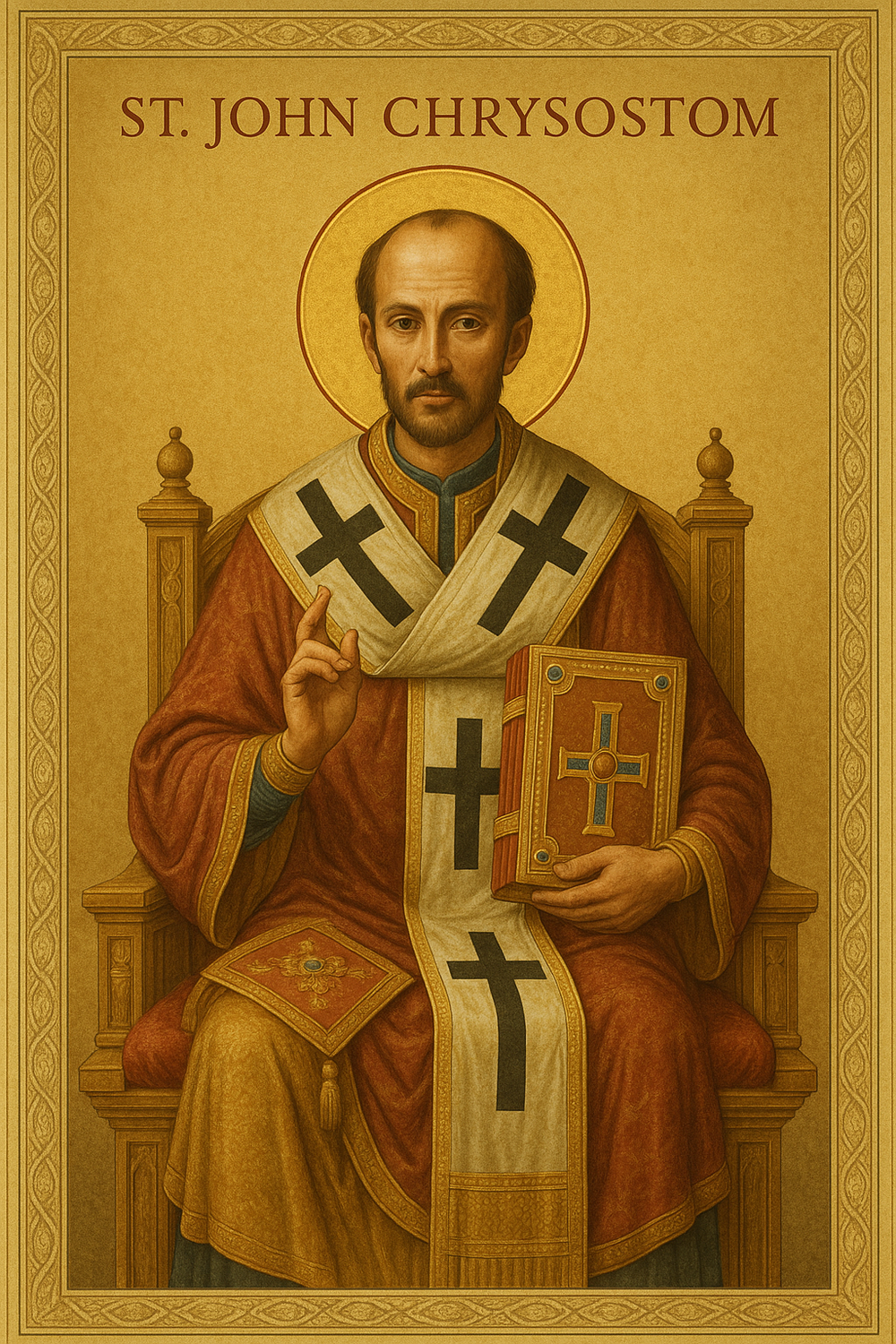
Chrysostom’s engagement with the Elijah-John mystery goes beyond the earthly ministry. He wrote explicitly about John the Baptist preaching Christ even among the dead — treating John’s role as forerunner as extending beyond his martyrdom into the realm where Christ descended. For Chrysostom, the logic was straightforward: John’s entire existence was ordered toward preparing the way of the Lord. Death did not dissolve that calling. If anything, it carried it to its fullest expression.
Ephrem, writing in hymns rather than arguments, described the descent of Christ into Sheol as a moment of awakening. In that poetic vision, silence gave way to recognition. John appears not as one confused or idle, but as one still bearing witness — the herald announcing in that dark place what he had announced by the Jordan: the Lord is near. Ephrem did not offer a systematic explanation of how this is possible. He offered a faithful poetic intuition about what it means for a vocation to be real.
Basil spoke of the righteous gathered from Adam to John the Baptist, placing John at a transitional threshold rather than merely among the waiting crowd. His language situates John at the edge of the great gathering — the one who marks the transition — consistent with John’s entire life as the man who stood at the boundary between the old and new covenants and made that threshold visible to others.
These Fathers also engaged directly with the language of Luke 1:17. John Chrysostom’s theology of the home and family was deeply shaped by his understanding of John the Baptist as the model of prophetic calling in the ordinary world — the voice that prepares rather than the voice that commands. Chrysostom consistently honored the mystery of John’s identity without pressing it toward either side of the apparent contradiction.
What unites all of these Fathers is a posture: they are comfortable standing before a reality they cannot fully explain. They do not resolve the Elijah-John mystery by choosing John’s self-denial over Jesus’ declaration. Nor do they choose Jesus’ declaration in a way that explains away John’s silence. They hold both. That holding — the willingness to abide with tension rather than escape it — is one of the most distinctive and beautiful features of the Eastern Christian contemplative tradition.
Part XI
John’s Mission Beyond Death: The Forerunner in the Shadows
One of the most striking sections of If You Are Willing to Accept It addresses a question most readers have never thought to ask: When John was beheaded, did his mission end? The natural assumption is yes. He prepared the way. He baptized Jesus. He pointed to the Lamb. His work was done, and death completed it.
But Scripture tells us that Christ Himself did not pass from death directly to glory. The Christian faith has always confessed that after the Crucifixion, Christ descended to the place of the dead — to those who had died before His coming, who waited in hope, who trusted promises without ever seeing their fulfillment. First Peter 3:19 speaks of Christ preaching to the spirits in prison. Ephesians 4:9 speaks of His descent to the lower regions. These are not poetic flourishes. They are theological assertions about where Christ went and what He did.
Once this is granted, a question arises quietly and naturally. If Christ went to proclaim among the dead, did He do so unannounced? John had been sent ahead of the Lord at every earlier moment: before Christ’s birth, before His public ministry, before His revelation. The pattern is consistent and deliberate. There is no clear reason to assume it abruptly ceased at death. The Church Fathers who wrote about God’s dealings with those who lived before Christ consistently took seriously the continuity of mission across the boundary of death.
The ancient liturgical memory of the Eastern Church, reflected in homilies attributed to figures like Epiphanius of Salamis, speaks of John arriving among the righteous dead as the forerunner still — announcing that the Messiah was near, preparing hearts there as he had prepared them by the Jordan. These texts do not define doctrine. They are attempts to remain faithful to the shape of a story that Scripture itself tells with consistency: John goes before Christ. Always. In every setting. God does not abandon His patterns. He fulfills them.
This is not a claim the Church has defined as required belief. It belongs to the category of patristic reflection that honors mystery without mapping it. But it is worth sitting with, because it reveals something essential about how the Eastern Christian tradition understands vocation: a calling is not bounded by the span of a single life. It is rooted in God’s intention — and God’s intention does not expire when a human body does.
Part XII
What This Is NOT: Clearing the Reincarnation Question
The most common misreading of the Elijah-John connection is to treat it as evidence of reincarnation in the Bible. This is a category error, and it matters to address it clearly — not to defend a position, but to protect the actual mystery from being replaced by one that Scripture does not support.
Reincarnation, in virtually every framework that uses the term, presupposes death. The soul departs a body at death, passes through some intermediate state, and is reborn in a new body, sometimes with no memory of its previous existence, continuing through cycles until some final state is reached. The entire framework begins with death as its engine.
The Elijah-John connection operates on a completely different premise. Elijah never died. There is no death. There is no rebirth. There is no cycle. What Scripture presents is not a soul that departed and returned, but a living person whom God held in His care outside the ordinary boundaries of time — and then sent again into history. This is not reincarnation. It is something Scripture has its own category for: the freedom of God over life, death, and time.
Additionally, Hebrews 9:27 states plainly: “It is appointed for man to die once, and after that comes judgment.” Christian theology has always understood this as excluding the reincarnation framework. The Elijah-John mystery does not contradict this verse, because Elijah has not yet fulfilled his appointment with death — he has not died. His case is singular and unrepeatable, not a template for general human experience.
This is also not a new teaching, a secret doctrine, or an esoteric reading available only to the spiritually advanced. It is the plain surface of what Jesus said, preserved in the mainstream of Christian tradition by the Church Fathers who wrestled with it, honored by the liturgical memory of the Eastern Church, and guarded from misuse by the Church’s consistent insistence that it remains in the sphere of mystery rather than defined doctrine. Ancient Eastern Christian traditions like the Armenian Apostolic Church and the Church of the East preserved the patristic witness on this question with remarkable consistency precisely because they understood that mystery is not the same thing as ambiguity.
Contemplative Prayer
A Prayer for Receiving Mystery with Humility
O Lord, You are not contained by my categories. You keep Your promises, but You keep them as God — not as I would design them, not at the speed I expect, and not in the form I have already decided they must take.
Teach me the humility of standing before what You have said without demanding that it conform to what I am comfortable with. Let me not be among those who were waiting for Elijah and could not see him when he came — because I was watching for a form rather than a presence.
I thank You for John the Baptist, who lived his entire life in faithful obscurity, pointing toward what was coming without grasping at it for himself. Give me something of his posture — the willingness to prepare rather than possess, to point rather than proclaim, to decrease so that You may increase in the lives around me.
If there are truths in Your word that I have too quickly categorized, too swiftly resolved, or too confidently dismissed — open my eyes. Let me hear what You are saying, not only what I am expecting. Let awe remain alive in my reading. Let wonder outlast familiarity.
Through Christ our Lord, who is larger than all our explanations of Him. Amen.
Why This Still Matters
What the Elijah–John Mystery Reveals About God and About Us
One might reasonably ask why this matters for a twenty-first century Christian. The Temple priests who questioned John are long gone. The specific cultural expectation of Elijah’s literal return no longer carries the same urgency for most readers. Why dwell on a mystery that Scripture itself refuses to resolve?
The answer is that the mystery carries a cargo that remains entirely relevant. At its deepest level, the Elijah-John question is not primarily a question about Elijah or John. It is a question about the freedom of God — about how much latitude we are willing to grant God in the way He keeps His word. And that question is as alive today as it was when Jesus first asked it of His listeners.
A faith that requires fulfillment to arrive in a predictable form is a fragile faith. It works well when God acts along expected lines and shatters when He does not. The Gospels are full of people whose faith shattered this way — not because God was unfaithful, but because their image of faithfulness was too small to contain what God was actually doing. Elijah came. They did not see him. The Messiah came. Many did not see Him either.
The Eastern Christian tradition has a word for the posture this mystery invites: apophatic. Knowing God by releasing the claim that our categories are adequate to contain Him. The great Orthodox spiritual classics return to this again and again — not as an invitation to vague uncertainty, but as the specific discipline of holding what is known firmly while acknowledging that what is known does not exhaust what is true.
What the Elijah-John mystery asks of the reader is this: Can you hold a question that Scripture itself holds open? Can you receive a claim that Jesus made without forcing it into a category that diminishes it? Can you sit with mystery long enough that it becomes not a problem to solve but a window to see through?
If yes — then you are already standing in the same place those disciples stood, after Jesus had spoken and the Gospel tells us they understood. They understood not by reasoning it through completely, but by being willing to accept it.
Frequently Asked Questions
Your Questions About John the Baptist and Elijah
The Mystery Is Larger Than This Article
This article has introduced what Scripture presents and what the tradition has honored. But the full meditation — the chapter-by-chapter, unhurried dwelling with this mystery — lives in one place.
If You Are Willing to Accept It: Elijah, John, and the Freedom of God is the book that does what this article only begins. It moves through every layer of the question with rare theological beauty and genuine contemplative depth. It will not tell you what you must conclude. It will enlarge your sense of what is possible.
If you have read this far, you are exactly the reader this book was written for.