The Ephesians 5:25 Marriage Challenge: When Good Husbands Become Holy Ones
Christian Marriage • Ephesians 5:25 • Eastern Orthodox & Catholic Framework • From The Marriage Habit & The Sacred Mirror
The Ephesians 5:25 Marriage Challenge: When Good Husbands Become Holy Ones
There is a profound gap between the husband who does enough and the husband who loves his wife the way Christ loves the Church. This is what that gap looks like — and what it costs to close it.
At a Glance — This Article
- The Core Question
- What does Ephesians 5:25 actually require — and what changes when you start living it?
- Tradition
- Eastern Orthodox • Eastern Catholic • All Christian traditions welcome
- The Standard
- “Love your wives as Christ loved the Church and gave himself up for her” — Ephesians 5:25
- The Distinction
- Good husband = does enough • Holy husband = measures against Christ’s love
- The Framework
- Marriage as worship • Sacrificial love • Consistent small choices
- Based On
- The Marriage Habit • Love on Purpose • The Sacred Mirror by Jeremy & Ashley Augusta
The Wrong Standard — and Why So Many Good Men Use It
Most married Christian men are asking the wrong question. The question they ask is: Am I a good husband? And most of them can honestly answer yes. They are faithful. They come home. They work hard and provide. They do not raise their voices or check out or abandon their families. By any reasonable measure — by the standard of most men around them, by the standard of what their fathers modeled, by the standard they quietly hold themselves to — they are good husbands.
The problem is not that the answer is wrong. The problem is that the question is too small.
Ephesians 5:25 does not ask whether you are a good husband. It asks whether you are loving your wife the way Christ loved the Church — sacrificially, totally, and without condition. Those are not the same question. They do not lead to the same places. And if you have been asking the first one your entire marriage while believing it was equivalent to the second, you have been measuring yourself against a standard that cannot show you what is possible.
This article is about that gap. Not the gap between a bad husband and a better one — but the gap between a good husband and a holy one. It is a smaller gap in terms of visible behavior and an enormous gap in terms of what it produces. It begins with a single shift: not changing what you do, but changing what you measure yourself against.
Jeremy Augusta works one-on-one with husbands to close the distance between knowing Ephesians 5:25 and actually living it — weekly sessions rooted in Scripture, plus support between sessions when real life requires it. Free 15-minute discovery call. No sales pitch.
Schedule a Free Discovery Call →Part II
What Ephesians 5:25 Actually Requires
The verse is short. Most Christian men have read it dozens of times. “Husbands, love your wives, just as Christ loved the church and gave himself up for her.” It is twelve words of instruction followed by a standard that has no ceiling.
Christ’s love for the Church is total. He did not love the Church when it was lovable. He did not give himself up for her when she had earned it. He loved her in her brokenness, her betrayal, her indifference — and he gave everything. That is the standard Ephesians 5:25 sets for the husband. Not a reasonable standard, adjusted for context and exhaustion. An unreasonable one, held without exception.
What does that actually look like in a marriage? It means loving your wife before she has done anything to deserve it that day. It means serving her when you are tired and she is not grateful. It means choosing not to defend yourself when you believe you are right — not because you were wrong, but because what she needs in that moment is not your argument. It means absorbing conflict instead of escalating it. It means asking what she needs before telling her what you think.
None of this is complicated. All of it is hard. And the reason it is hard is that it asks you to stop measuring yourself against what is reasonable and start measuring yourself against what is holy.
The Eastern Christian tradition has always understood this standard with unusual clarity. Marriage is not merely a civil contract or a romantic arrangement — it is a sacrament, a visible participation in the mystery of Christ’s love for the Church. The Eastern theology of marriage teaches that the husband’s vocation is to be a living icon of Christ’s love to his wife — not occasionally, not in the grand gestures, but in the ordinary fabric of daily life.
Part III
The Gap: Good Husband vs. Holy Husband
The good husband and the holy husband often do the same things on the surface. Both show up. Both provide. Both are present in the home. The difference is not visible from outside the marriage. It is visible in what the wife experiences on the inside of it.
The good husband has a threshold of effort. There is a point at which he has done enough — enough to justify his self-assessment, enough to feel he has held up his side of the arrangement. When he reaches that threshold, he stops. This is not laziness or selfishness; it is simply what happens when “good enough” is the standard. Good enough has a ceiling. Once you reach it, you stop climbing.
The holy husband has no threshold. Not because he is extraordinary, but because the standard he measures himself against has no ceiling. Christ did not love the Church until He had done enough. He gave himself up for her entirely. The husband who measures himself against that standard cannot reach a point where he has done enough — because the love of Christ for the Church is without limit, and the measure of that love is the measure being applied.
The Question Behind Every Choice in Your Marriage
- ✓ The good husband asks: Have I done enough today? The holy husband asks: Have I loved her the way Christ loves the Church today?
- ✓ The good husband asks: Is this fair? The holy husband asks: Is this an act of worship?
- ✓ The good husband asks: Did she deserve that response? The holy husband asks: Does Christ withhold His love when the Church fails?
- ✓ The good husband asks: Am I the problem here? The holy husband asks: What does she need from me right now — regardless of what I need?
- ✓ The good husband asks: Is my marriage good? The holy husband asks: Does my marriage glorify God?
These are not rhetorical distinctions. They are different questions that produce different actions in the same situation. A husband who asks “is this fair?” and a husband who asks “is this an act of worship?” will make different choices when they are in the same argument, facing the same pressure, at the same level of exhaustion. The first question gives him permission to stop. The second does not.
This is what selfless love in Christian marriage actually demands — not the occasional grand gesture, but a persistent, daily reorientation of the measuring stick.
Part IV
Marriage as Worship: The Shift That Changes Everything
There is a moment in every serious Christian man’s life when he realizes that his pursuit of God and his pursuit of a good marriage have been running on parallel tracks — related in general, but never fully merged. He prays. He tries to lead well. He knows his marriage should reflect his faith. But the two paths stay separate: the spiritual life over here, the marriage over there.
The breakthrough — the one that changes everything — is the moment those paths become the same path. When a husband understands that loving his wife is not something he does in addition to worshiping God, but one of the primary ways he does worship God, the entire character of the marriage changes. Every ordinary moment becomes charged with spiritual weight. Every choice toward his wife becomes an offering. Every sacrifice becomes a prayer.
This is not a metaphor. The Eastern Christian tradition teaches that marriage is a sacrament in the fullest and most literal sense — a visible participation in divine mystery, a covenant through which God pours His grace into the daily life of two people. Unlike Baptism or Confirmation, which are celebrated once, marriage is a sacrament that is lived every single day. Every morning a husband wakes up next to his wife is another day in which the sacrament is either being lived or being abandoned.
When you begin to see it this way — when you understand that the act of listening to your wife after a hard day is an act of worship, that the choice to serve her when you are exhausted is an offering to God, that the decision to lead with love in an argument instead of leading with your argument is a participation in the mystery of Christ’s love for the Church — the motivation for doing all of it changes completely. You are no longer doing these things to be a better husband. You are doing them to honor God.
That shift in intention is more powerful than any technique or habit or communication strategy. When the goal changes from “better marriage” to “offering this marriage to God,” the marriage becomes better as a natural consequence — not as the goal, but as the byproduct.

Part V
The Tuesday Test: What This Looks Like in Practice
The transformation described in Ephesians 5:25 does not happen in the grand gestures. It does not happen at the altar or the anniversary dinner or the moment you decide to change. It happens on a Tuesday — in the small, unremarkable moments that make up the actual texture of a marriage.
The Tuesday test is this: what do you do when your wife says something that lands wrong, you believe you are right, and every reasonable instinct is telling you to explain yourself? What do you do when she is struggling and you are tired and there is nothing left to give? What do you do when the marriage has been good lately and the pressure is off and it would be easy to coast for a few days?
The good husband passes a reasonable version of these tests. The holy husband passes a different version — the version that is measured against Christ’s love for the Church.
What the Tuesday Moments Actually Look Like
In the argument where you are right: The holy husband does not lead with his argument. He leads with love. He says “I love you” before he says anything else — not as a technique, but as a genuine reorientation. Before he explains, before he defends, before he establishes that he is correct, he acknowledges the person in front of him. This does not mean he abandons truth or never disagrees. It means that the love comes first, always — because Christ’s love for the Church does not wait until the Church has gotten things right.
In the moment when you are too tired to serve: This is exactly the moment that matters. It is easy to serve when you have capacity. The offering to God is the service rendered when the tank is empty. “Whatever you do, work at it with all your heart, as working for the Lord” (Colossians 3:23) does not include an exception for exhaustion.
In the quiet season when the marriage is fine: The holy husband does not coast. A marriage that is fine is not the goal — a marriage that glorifies God is the goal. Fine has no momentum. Intentional love has momentum. Intentional love in marriage is built in the seasons when nothing is forcing it, not only in the crises.
When she doesn’t know you’re working on it: This is perhaps the most important Tuesday moment. When the transformation in the marriage begins, the wife does not know her husband has decided to love differently. She just begins to notice that something has changed. She stops bracing for the argument to escalate. She begins to trust that the next conversation will not wound her. She does not know why — she just feels it. This is exactly how it is supposed to work. The love is not performed for her benefit; it is offered to God. The marriage is the recipient of the overflow.
Part VI
The “Love First” Practice: One Habit That Rewrites the Marriage
Of all the practical frameworks drawn from years of applying Ephesians 5:25 to an actual marriage, one has proven itself more consistently transformative than any other. It is almost embarrassingly simple. It is harder to sustain than it sounds. And when it becomes a real habit — not an occasional technique but an ingrained default — it changes the emotional architecture of the entire marriage.
The practice: say “I love you” before anything else.
Before defending yourself. Before explaining. Before asking what happened. Before responding to something that hurt you. Before the conversation starts, before you know where it is going, before you have context — lead with love. Say the words. Mean them. Then proceed.
This is not a communication technique. It is a spiritual reorientation enacted in real time. When you say “I love you” before defending yourself, you are physically interrupting the reflex that leads to escalation. You are putting the relationship above the argument before the argument has a chance to demand otherwise. You are making a small offering to God — this moment, this choice, this marriage — before the pressure of the moment can override your intention.
What This Builds Over Time
The first time you do this in the middle of a difficult conversation, it will feel strange. Your spouse may not know how to receive it. You may feel like you are giving ground you should not give. Push through that feeling — it is the resistance of a good habit forming against a bad default.
The tenth time, it starts to feel natural. The twentieth time, your spouse starts to expect it. Not consciously — but something in the room changes when you walk in. The anticipation of conflict softens. The bracing for impact dissolves. Unity in marriage is built not in the resolutions after the arguments but in the small choices that prevent the arguments from becoming what they used to be.
The hundredth time, your spouse writes about it. She writes that she noticed one day that she had stopped bracing for impact, and she did not know why. She writes that something in the marriage felt different — safer, deeper, more permanent — and she could not name the source. She writes that he had started saying “I love you” before anything else, always, no matter what, and that this one small thing had changed everything about the texture of the marriage.
This is what the practice of speaking life into your marriage actually produces when it is sustained over time.

Part VII
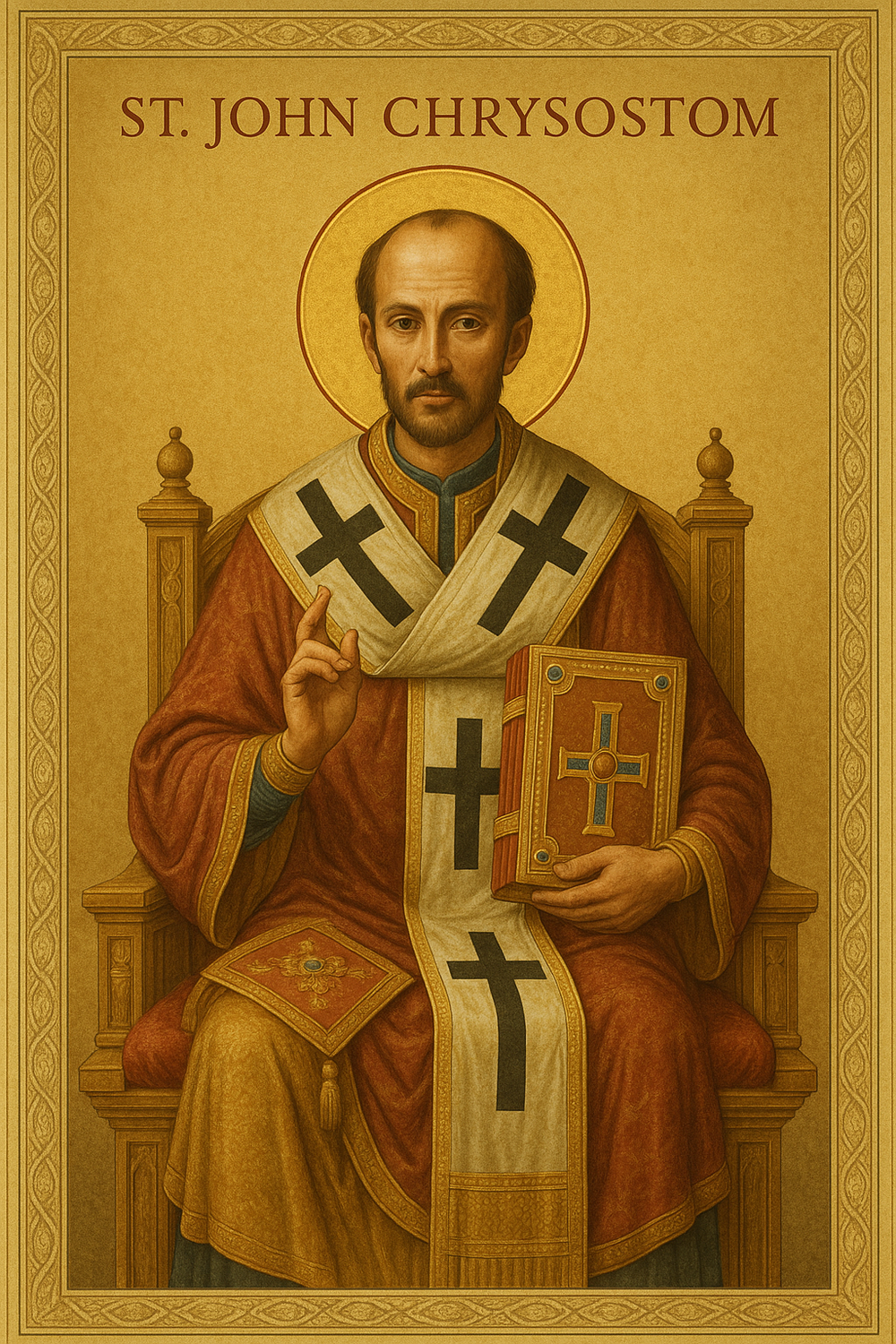
What St. John Chrysostom Said About This — 1,600 Years Ago
None of this is new. The Eastern Christian tradition has been teaching the theology of marriage as worship since the earliest centuries of the Church. The most articulate voice on this subject in the entire Patristic tradition belongs to a man who never married: St. John Chrysostom, Archbishop of Constantinople, who wrote about the mystery of Christian marriage with a clarity that has never been surpassed.
Chrysostom did not soften Ephesians 5:25. He made it harder. He wrote that the husband who loves his wife as Christ loves the Church will have no need to issue commands — because a wife who is loved that way will follow not out of obedience but out of love. He wrote that when the husband submits his ego, his defensiveness, his need to be right, and his pride to the service of his wife, he is not becoming less than a man — he is becoming an icon of Christ. He wrote that a home governed by this love is not just a better home — it is a church.
Chrysostom’s teaching that the home should be a church is not metaphor. It is a direct consequence of Ephesians 5:25. If the husband loves his wife as Christ loves the Church, and if Christ’s love for the Church is what makes the Church holy, then the home where this love is practiced becomes a place of holiness. The ordinary objects of domestic life — the kitchen table, the evening walk, the difficult conversation — become the altar on which this sacrament is continuously offered.
This is why the Eastern Christian framework for marriage is more demanding than most Western approaches to marriage improvement. It does not ask the husband to communicate better or argue more fairly or be more emotionally present. It asks him to become a living icon of Christ’s love. Everything else follows from that — including better communication, fairer arguments, and deeper emotional presence.
You can read more in St. John Chrysostom’s teaching on marriage — a deep well that remains as clear in the twenty-first century as it was in the fourth.
Part VIII
One Person Can Begin This — Without the Other Knowing
One of the most common barriers to beginning this work is the feeling that it requires both spouses to participate simultaneously. That you need to have the conversation first, get agreement, build a shared framework, and then begin together. This is a natural assumption — and it is wrong.
The transformation described in Ephesians 5:25 begins with one person’s decision. Not two. The verse is addressed to the husband, not to the couple. It does not say “husbands and wives, love each other as Christ loved the Church.” It says “husbands, love your wives as Christ loved the church.” The standard is placed on one person. The one person is asked to begin regardless of what the other is doing.
This is not unfair — it is structurally intentional. Christ did not love the Church after the Church had earned it. He loved the Church while the Church was still broken, still resistant, still failing. The husband who waits for his wife to change first before beginning to love her differently has misread the verse entirely. The verse does not say “love your wife the way Christ loved the Church after the Church had gotten her act together.”
What happens when one spouse begins unilaterally? The same thing that happened in the marriage described in this article. The wife does not know her husband has made a decision. She just notices, slowly, that something feels different. The arguments that used to escalate stop escalating. The moments that used to be tense start to soften. She stops bracing for impact. She starts to trust. She does not know the source — she just experiences the fruit.
And then, in many marriages, she begins to move in the same direction. Not because she was told to, not because she read the same book or heard the same theology — but because one person decided to love first, consistently, without requiring anything in return. And love, when it is practiced that way, spreads.
If your spouse is not ready to begin this work with you, that is not an obstacle. It is simply where you are. Loving your spouse as Christ loves the Church does not require their participation. It requires yours.
Most of the men Jeremy works with began alone. Their spouses didn’t know they had made a decision to love differently. They just began. Weekly sessions walk through what Ephesians 5:25 looks like in the specific moments of your specific marriage — the Tuesday tests, the hard conversations, the seasons when nothing forces it. This is what it looks like to have someone walk alongside you while you do this work.
Learn About the Mentorship →Part IX
The 30-Day Challenge: Where This Work Becomes a Habit
Understanding the theology of Ephesians 5:25 is not enough. Every serious Christian husband has read the verse. Many have understood it, admired it, aspired to it. The gap between aspiring to this standard and living it is not a knowledge gap — it is a habit gap. The practices that constitute loving your wife as Christ loves the Church have to be built into the daily fabric of your life until they are no longer choices you have to make consciously, but defaults you return to automatically.
This is what thirty days of intentional practice is designed to produce. Not a completed project at the end of thirty days, but the beginning of habits that will outlast the calendar — a new default for how you engage your wife, how you enter difficult conversations, how you serve when the tank is empty, how you lead in the quiet seasons when nothing is forcing your attention.
The daily practices of a marriage built on Ephesians 5:25 are not dramatic. They are small, consistent, and cumulative. Speak words of encouragement before you need to. Serve in ways she will notice and in ways she will not. Pray for her silently throughout the day, not just in formal prayer. Put your phone away during the moments that matter. Ask “how can I make today easier for you?” and then do it, without keeping score. Create shared rhythms — a walk, a weekly intentional date, a Sunday morning ritual — that make the marriage feel like a shared life rather than two people occupying the same house.
None of these things is complicated. All of them require intention. And intention, repeated daily for thirty days, becomes habit. Habit, sustained over months, becomes character. Character, expressed in a marriage, becomes the testimony that Chrysostom wrote about — the marriage that strangers notice and ask about, because what they see in how you treat each other is something they cannot quite name but recognize as something different from what they see everywhere else.
Everything in this article — the theology, the framework, the daily practices — is laid out in full across these five books. Read whichever calls to you first. The framework is consistent across all of them.


Part X
A Prayer for Husbands Who Want to Love Their Wives Better
Lord, I know what Ephesians 5:25 asks of me. I have read it. I have admired it. I have failed it more times than I can count. Today I am asking not to admire it but to live it — not in the grand gesture I can point to, but in the ordinary moments I will not remember by evening.
When I am right and she is wrong, let me lead with love before I lead with truth. When I am tired and she needs something, let me serve before I calculate what I have left. When the argument starts, let me say “I love you” before I say anything else — and mean it, even when it costs me something.
I do not want to be a good husband who has done enough. I want to be the husband who measures himself against your love for the Church — who knows that standard cannot be reached and pursues it anyway. Make my marriage an act of worship. Make every ordinary choice in it an offering to You. And in that offering, let her see, slowly and over time, what You are doing in this marriage.
Through the intercession of Saint John Chrysostom, who knew what it meant to love the Church as You love her —
Lord Jesus Christ, Son of God, have mercy on me, a sinner, and make me holy through the love I offer my wife. Amen.
FAQ
Frequently Asked Questions
You Already Know Your Marriage Was Made for More Than This
You have read Ephesians 5:25 before. You have aspired to it. You have measured yourself against it in your better moments and found yourself short in the ordinary ones. What this article has tried to do is make the gap visible — not to shame you, but to show you that the gap is closable. Not by becoming extraordinary, but by changing the measuring stick and then building habits that make the new standard your daily default.
The books in this library contain the full framework. The mentorship gives you someone to walk alongside you while you apply it to your specific marriage, in your specific Tuesday moments, with your specific wife. Both are available. One costs a few dollars. One costs a commitment. Both require the same thing from you: the decision to stop measuring yourself against a standard that cannot show you what is possible.
Schedule a Free Discovery Call →