Patron Saints for Money, Financial Help and Jobs: Catholic and Orthodox
Spyridon • Nicholas • Joseph • Lydia • Isidore • Kronstadt
Patron Saints for Money, Financial Help and Jobs: Catholic and Orthodox
When the rent is due, the job is gone or the debt keeps growing, people turn to the saints who knew need. Here is who they are, what is documented about each, and what is devotion.
Which Saint for Which Need
- Debt, Housing, Urgent Needs
- Saint Spyridon the Wonderworker, the Orthodox saint most often asked for money
- Provision for a Family
- Saint Nicholas of Myra and the gift of gold for three daughters
- Work and Finding a Job
- Saint Joseph the Worker • Saint Spyridon
- Business Owners
- Saint Lydia of Thyatira, a seller of purple cloth
- Laborers and Farmers
- Saint Isidore the Farmer
- Poverty and Aid
- Saint John of Kronstadt, who built a House of Industry for the poor
- Medical Bills
- The unmercenary healers Cosmas and Damian
- When Nothing Is Left
- Saint Jude Thaddeus
- Official Status
- Joseph the Worker has a feast set by Pius XII in 1955 • Most other patronages below are devotion, not decree
- Help Today
- Dial 211 for local help with rent, utilities and food
How the Church Speaks About Work, Money and Need
People search for a patron saint of money because they need someone to ask. The honest answer is that the Church has not named one patron of money, and I found no decree naming a patron of the unemployed. What it has is a long list of men and women who knew need, worked with their hands, or gave away what they had. In this article a patronage is called official only when a pope or Church authority made it so. Everything else is devotion, which is old and real, but is a different thing.
What the Catechism says. The Catechism treats work as a duty with dignity attached: “Work is for man, not man for work” (CCC 2428). It says “a just wage is the legitimate fruit of work” and that pay should let a person “provide a dignified livelihood” (CCC 2434). On the problem many readers are facing, it is plain: “Unemployment almost always wounds its victim’s dignity and threatens the equilibrium of his life” (CCC 2436). The shame you feel is not a sign that God has dropped you. It is a recognized wound.
What Scripture promises, and what it does not. Jesus says, “Do not be anxious.” He teaches us to ask for daily bread (Matthew 6:11) and says to seek first the kingdom of God, and that the rest will be added (Matthew 6:33). Paul writes, “My God will supply every need of yours according to his riches in glory in Christ Jesus” (Philippians 4:19, RSV). The same Scripture says “You cannot serve God and mammon” (Matthew 6:24). None of this is a guarantee of wealth. It is a promise that God sees need and acts, and a warning against loving money. The Catechism makes the same point from the other side: “Love for the poor is incompatible with immoderate love of riches” (CCC 2445).
Eastern Christian tradition has always honored almsgiving and the healers who took no pay, and the saints below show it. Prayer and work are not rivals. The Catechism calls work a duty (CCC 2427), and the Orthodox devotional literature on Saint Spyridon advises praying faithfully while also making your own efforts.
Do the practical step first, and pray as you do it. Dial 211 or go to 211.org to be connected to local help with housing, utilities, food and health care. Your parish priest, the local Catholic Charities office or a St. Vincent de Paul conference can often act quickly. The full list of resources is in Part X.
Part II
Table 1: The Saints at a Glance
| Name | Invoked for | Tradition | Standing and basis |
|---|---|---|---|
| Spyridon the Wonderworker (c. 270 to 348) | Money, debt, housing, work | Orthodox, also Catholic | Bishop of Trimythous, Cyprus, at Nicaea in 325; feast December 12 (Orthodox), December 14 (Western); money patronage is devotion |
| Nicholas of Myra (4th century) | Provision, poor families, rescue | Orthodox and Catholic | Bishop; dowry story first written in the early 9th century; feast December 6 |
| Joseph the Worker | Work, employment, providers | Catholic and Orthodox | Feast of Joseph the Worker set by Pius XII in 1955, May 1; carpenter in Matthew 13:55 |
| Lydia of Thyatira (1st century) | Business owners, trade | Catholic and Orthodox | Acts 16; feast May 20 in the Catholic ordinary form; business patronage is devotion |
| Isidore the Farmer (c. 1070 to 1130) | Farmers, day laborers | Catholic | Beatified 1619, canonized 1622; feast May 15; named patron of rural life by the NCRLC in 1947 |
| John of Kronstadt (1829 to 1908) | The poor, financial hardship | Russian Orthodox | Canonized 1964 (ROCOR) and 1990 (Moscow Patriarchate); hardship patronage is devotion |
| Cosmas and Damian | Medical bills, healing | Orthodox and Catholic | Unmercenary physicians; Catholic feast September 26; little is verifiable about their lives |
| Jude Thaddeus (apostle) | Hopeless cases | Catholic and Orthodox | Apostle; patronage of hopeless cases is devotion |
Each entry is covered below with the basis stated. Where a patronage rests on devotion and not on a decree, the text says so.
Part III
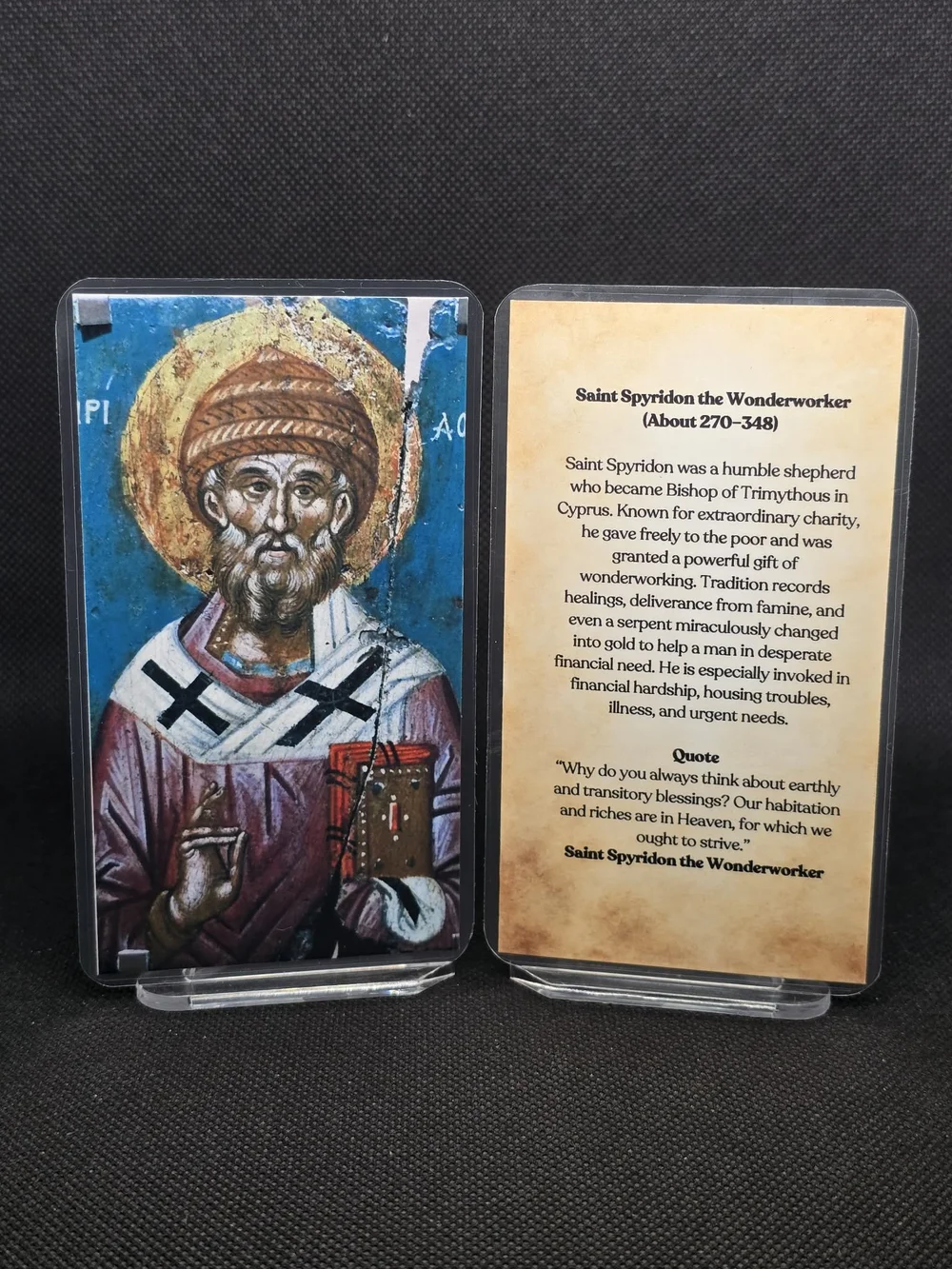
Saint Spyridon the Wonderworker: The Shepherd Orthodox Christians Ask for Money
Spyridon was born around 270 in Assia, Cyprus, and died in 348. According to the standard reference summary, he worked as a shepherd, married and had a daughter, and became Bishop of Trimythous after his wife died. He took part in the First Ecumenical Council of Nicaea in 325, where he helped counter the arguments of Arius. Two seventh-century lives survive, one by Theodore of Paphos.
After the Arab conquest of Cyprus his relics were taken to Constantinople. After 1453 a Corfiote monk carried them to Corfu, where they remain in the church of Saint Spyridon and are carried in procession each Palm Sunday. His feast is December 12 in the Orthodox Church (December 14 in the West).
Why people ask him for money. An article on the history and traditions of his feast says that today people most often pray to him for financial help, for buying and selling property, for business, and for work, including favor with superiors and protection from being fired. Tradition tells of a poor farmer who needed money for seed grain and received a gold piece from the bishop on the condition that he return it after the harvest, and the story is told with a miracle involving a snake and the gold. That story is popular tradition. I could not trace it to the oldest sources, so treat it as tradition and not as record.
What the documented Spyridon gives you. The documented man is a shepherd who became a bishop and was known for his piety. The devotional article says he helped everyone freely and that people came to him for financial support. The same devotional article advises praying each evening and persevering, while also making personal efforts. That is sound counsel. Pray to him for the job, and also send the application. Our card carries him for financial hardship, debt, housing and urgent needs.
Part IV
Saint Nicholas of Myra: The Secret Gift
Nicholas was a fourth-century bishop of Myra in Asia Minor. Little can be known about him with certainty, and the most famous story about him was written down long after his death. According to the standard account, it first appears in the Life of Saint Nicholas by Michael the Archimandrite in the early ninth century.
A once-wealthy man lost his fortune and could not pay dowries for his three daughters. Without a dowry they could not marry and would likely be forced into prostitution. Nicholas, who wished to help without being seen, went to the house at night and threw a purse of gold through a window. The father arranged the first daughter’s marriage. Nicholas gave a second purse in the same way. When he brought the third, the father stayed awake, caught him, and thanked him. Nicholas told him to tell no one.
That is the origin of the three gold balls often shown with him. The story is tradition, and the Council of Nicaea tradition tied to his name is weaker still, since scholars debate whether he attended. What the tradition preserves is a picture of how to help someone: quietly, in time, and without humiliating them. His feast is December 6 (December 19 by the Julian calendar). Our card carries him for financial provision and for rescue in impossible situations. For his full life, see our article on Saint Nicholas the Wonderworker.

Part V
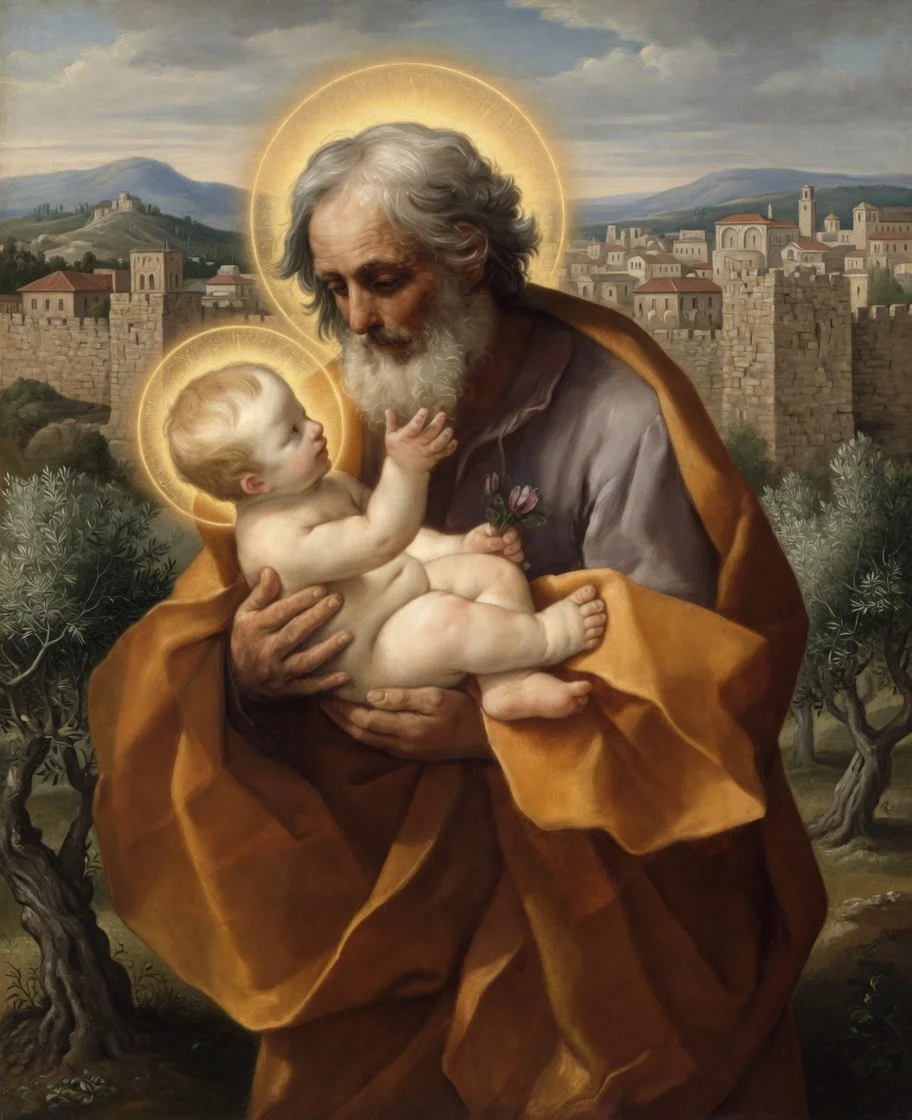
Saint Joseph the Worker: The Carpenter Who Provided
When the people of Nazareth ask about Jesus, they say, “Is not this the carpenter’s son?” (Matthew 13:55). The Greek word is tekton, which is traditionally translated “carpenter” but can cover a maker of objects in wood, stone or other materials. That is the documented core: Joseph worked with his hands, and the Son of God grew up in a house that lived on his labor.
In the Catholic Church the link between Joseph and work is official. Pope Pius XII instituted the Feast of Saint Joseph the Worker in 1955, on May 1, as a Church counterpart to International Workers’ Day, to honor the dignity of human work. Joseph is regarded as patron of workers and is invoked for employment. I did not find a decree naming him patron of the unemployed, so that is devotion built on the first patronage. Orthodox Christians remember Joseph the Betrothed on the Sunday after the Nativity and on other days.
For someone out of work, Joseph is a companion more than a solution. He had no wealth, he fled with his family into Egypt, and he had to start again somewhere strange. Many Catholics pray to him before an interview, at the start of a job search, or when a layoff has arrived. Our card carries him for workers, fathers and providers. See also our page on Saint Joseph.
Part VI
Saint Lydia and Saint Isidore: Business and Honest Labor
Saint Lydia of Thyatira
Lydia appears in Acts 16. She came from Thyatira and sold purple cloth. She was a worshiper of God, the Lord opened her heart to Paul’s message at Philippi, and she and her household were baptized. She then urged Paul and his companions to stay at her home, and they did. That is the Scripture. Church tradition adds the title “Equal to the Apostles” in the Orthodox Church, and a role as the first convert in Europe, and the Catholic Church has named her patroness of dyers. Her feast is May 20 in the Catholic ordinary form, and in many Orthodox jurisdictions.
Her patronage of business owners, and especially women who run a business, rests on devotion drawn from the text. A woman with a trade and a household is shown using her work and her home to serve the Church. Our card carries her for women entrepreneurs. See the standard reference for the scholarly debate about her status.

Saint Isidore the Farmer
Isidore was born around 1070 in Madrid, to poor, devout parents. According to the record, he worked as a hired hand on an estate near Madrid for the landowner Juan de Vargas, who later made him bailiff. He married Maria Torribia (Blessed Maria de la Cabeza), and they had one son, who died young. He shared his food with the poor and died on May 15, 1130. Paul V beatified him in 1619 and Gregory XV canonized him on March 12, 1622, alongside Ignatius of Loyola, Francis Xavier, Teresa of Avila and Philip Neri.
Isidore is patron of farmers, peasants and day laborers. The National Catholic Rural Life Conference named him its patron in 1947. The famous stories of angels plowing beside him and a pot of stew that never ran out come from a fourteenth-century manuscript, written long after his death, so they are legend. The documented Isidore is something harder to forget: a man who worked for someone else all his life and shared his food with the poor. He is a saint for anyone whose work is steady, ordinary and hard. Our card pairs him with his wife.

Part VII
Saint John of Kronstadt: A Priest Who Built a House for the Poor
John of Kronstadt (1829 to 1908) was a priest at Saint Andrew’s Cathedral in Kronstadt from 1855. The record shows him promoting frequent confession and Communion, practicing mass confessions, and opening a House of Industry in 1882 with a school, a hospital, a library, and shelter for thousands of homeless people each year. The Russian Orthodox Church Outside Russia canonized him in 1964, and the Moscow Patriarchate in 1990.
What makes him relevant to this article is the House of Industry. It gave shelter to thousands of homeless people each year and added a school and a hospital, which is what a struggling family needs: a roof and a way forward. Orthodox believers call on him in financial hardship, and our card carries him that way. That is devotion, and the work he did is the reason for it.

Part VIII
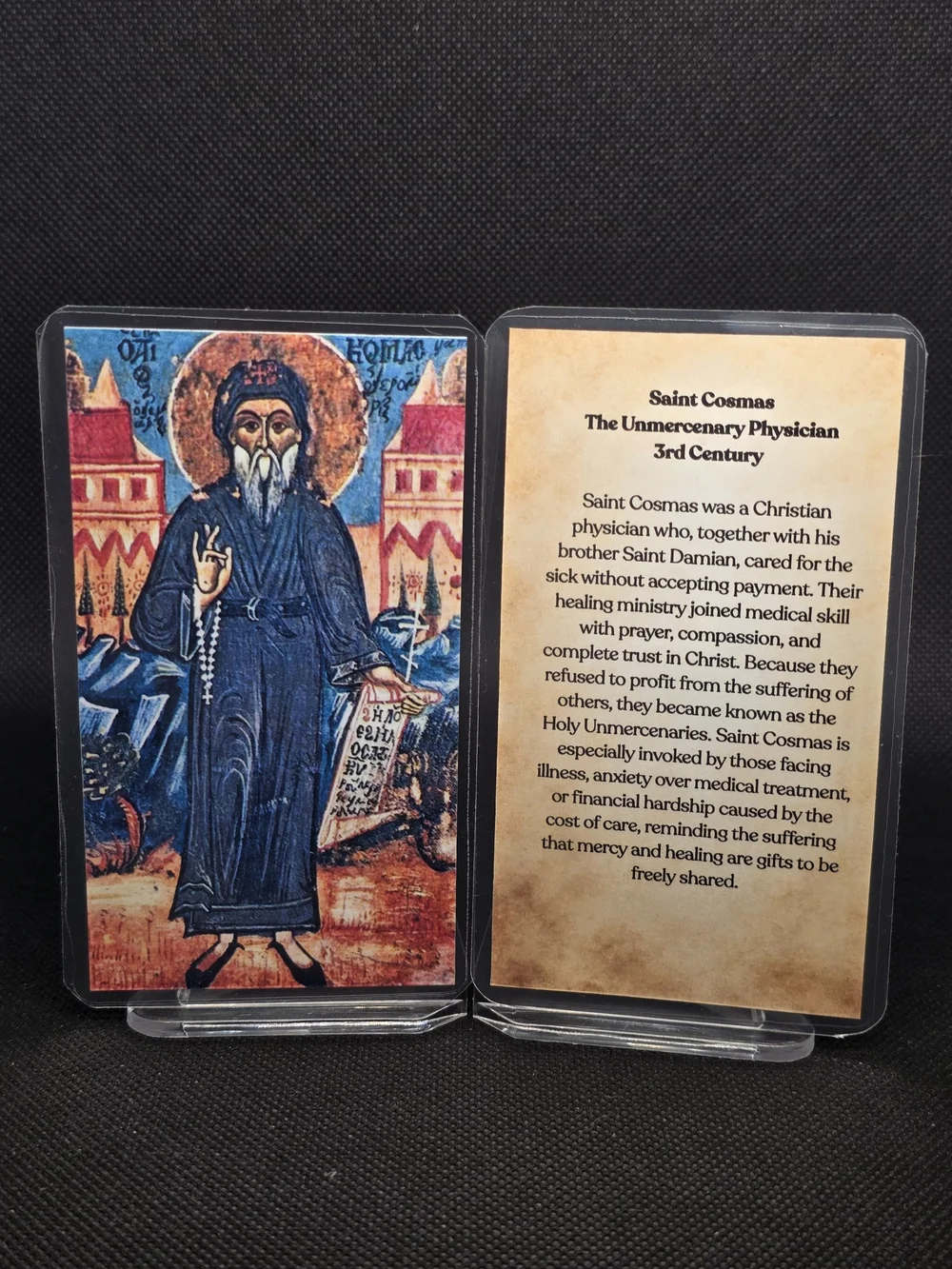
Cosmas and Damian: When Illness Costs Money
Illness and money trouble often arrive together, and the Eastern Church has a pair of saints for that. Cosmas and Damian are called anargyroi in Greek, “the silverless,” because they practiced medicine without charging a fee. The Eastern Church uses the title for healers who serve out of love, following Matthew 10:8: “You received without paying, give without pay.”
Little can be verified about their lives. The Orthodox Church honors three different pairs with these names, on October 17, November 1 and July 1, and the Catholic feast is September 26. Accounts of their torments come from later legend. Devotion invokes them for healing and for physicians, and families turn to them when sickness and money trouble arrive together. Our Saint Cosmas card is for healing, medical anxiety, and the financial hardship that comes with illness. For more saints for sickness, see our guide to saints for life struggles.
Part IX
Saint Jude: When Nothing Is Left
Jude Thaddeus is an apostle, and the New Testament letter of Jude is traditionally attributed to him. His patronage of hopeless cases is devotion, and a popular one: people pray to him when every other option has run out. For a family whose income is gone and whose options are shrinking, it is a natural prayer. It is also a prayer that works with action, not instead of it. If you are praying to Jude, pick up the phone and call 211 as well.

Part X
Practical Help That Works Alongside Prayer
Call 211. The three-digit number 211 was designated by the FCC in 2000 for information and referrals to social services. More than 200 local organizations run it across the country. You can call, use the chat or text on 211.org, and the service is confidential. Most requests are for housing, utilities, food and health care.
Catholic Charities. Catholic Charities agencies serve people “regardless of their faith or background” and offer services including housing, food and nutrition, and workforce development. Find your local office with the Catholic Charities local agency finder. Services vary by agency, so ask what your office provides.
Society of St. Vincent de Paul. Vincentians offer home visits and, depending on the local conference, rental assistance, food pantries and other help. They say they believe everyone deserves a fair chance, regardless of income or life circumstances. Start at the contact page of the Society of St. Vincent de Paul.
Work. CareerOneStop.org, sponsored by the U.S. Department of Labor, lists American Job Centers near you. Unemployment benefits are filed with your state. Do both as soon as you are laid off.
Debt. The National Foundation for Credit Counseling is a nonprofit network of credit counseling agencies. Its member agencies offer budget counseling and debt management plans, and its phone number is 877-360-6322. Be wary of any company that promises to erase your debt for a fee up front.
Your parish. Tell your priest. Many parishes have a St. Vincent de Paul conference or a fund for members in need, and a priest can often point you to help you did not know about.
Be careful of “money prayer” scams. Anyone who promises riches for a donation, or sells a prayer for money, is not offering the Church’s teaching. The Church asks you to pray freely, and to give to those in need as you are able. Cards and holy images are devotional aids and do not guarantee any outcome.

Part XI
Prayers
Lord Jesus Christ, you taught me to ask for daily bread, and today I am asking. You know what I owe and what I do not have. I will not hide it from you, and I will not hide it from the people who can help.
By the prayers of Saint Spyridon and Saint Nicholas, open a door I cannot see. Give me honest work, patience with my creditors and a clear mind to do what is in front of me. Keep me from anger, from despair and from the love of money. Let me not forget the poor while I am poor.
You said, “Seek first his kingdom and his righteousness, and all these things shall be yours as well.” I seek. Provide as you see fit. Amen.
Lord, you made the carpenter of Nazareth your guardian and trusted him with your family. Through the prayers of Saint Joseph, bless my search for work. Guide my applications and my interviews, and give me a good word to say and the courage to say it.
Let me not be crushed by silence or by refusals. If the work I find is humble, teach me to do it as an offering. If it is slow in coming, keep my family fed and my heart steady. Amen.
Part XII
Cards and Gifts
Prayer cards for the family that is short of money: Saint Spyridon, Saint Nicholas, and Saint John of Kronstadt.
Prayer cards for people who work or are looking for work: Saint Joseph, Saint Lydia, and Saint Isidore the Farmer.
Saint Cosmas, Saint Jude, and the Jesus Prayer shirt.
Ask, and Also Act
The saints in this article did not escape need by a trick. One was a shepherd who became a bishop. One was a farmhand. One sold cloth, one worked with wood, and one gave gold in the dark so that no one would see. What they teach is that God is asked for bread, that the Church expects us to work and to share, and that no one should carry a money worry alone. Ask them to pray for you, and then make the call.
Appendix
