Patron Saints for Safe Travel: Catholic and Orthodox Prayers for the Journey
Christopher • Nicholas • Julian • Menas • Joseph of Cupertino • Raphael the Archangel
Patron Saints for Safe Travel: Catholic and Orthodox Prayers for the Journey
Before a long drive, a flight or a pilgrimage, people ask the saints to go with them. Here is who they are, what is known about each, and what is devotion, with a short prayer for the road.
Which Saint for Which Journey
- Any Road
- Saint Christopher, patron of travelers by devotion • Saint Julian the Hospitaller
- By Sea
- Saint Nicholas of Myra, who calmed a storm on a voyage, by tradition
- By Air
- Saint Joseph of Cupertino, the friar of the reported levitations
- Pilgrims
- Saint Menas of Egypt, whose pilgrim flasks reached Germany, England and Sudan
- Guide on the Way
- The Archangel Raphael, who walked with Tobias in the Book of Tobit
- Families on the Road
- Saint Joseph and the Holy Family on the flight into Egypt
- Far from Home
- Saint Raphael of Brooklyn, the Orthodox bishop who traveled to scattered immigrants
- Official Status
- No papal decree names a single patron of travel • The patronages below are devotion unless stated
What Scripture and the Church Say About the Road
People search for a patron saint of safe travel because a journey is one of the oldest times to ask for help. The honest answer is that the Church has not named one patron of travel by decree that I could find. What it has is saints whom the faithful have turned to on the road for centuries. In this article a patronage is called official only when a pope or Church authority made it so. Everything else is devotion, which is old and real, but is a different thing.
What Scripture promises. The Psalm for pilgrims says, “The LORD will keep your going out and your coming in from this time forth and for evermore” (Psalm 121:8, RSV). God tells Israel, “Behold, I send an angel before you, to guard you on the way” (Exodus 23:20, RSV). That is a promise of God’s care. It is not a promise that no accident will ever happen to a Christian, and the saints below met storms, shipwrecks and exile.
What the Church offers. The Catholic Book of Blessings includes an order for blessing pilgrims, and priests and deacons will bless travelers on request. Orthodox Christians can ask their priest for a prayer before a journey. A medal, a prayer card or a small icon in the car is a devotional aid and a reminder to pray. It is not a charm, and it does not guarantee an outcome.
Part II
Table 1: The Saints at a Glance
| Name | Invoked for | Tradition | Standing and basis |
|---|---|---|---|
| Christopher | Travelers, drivers, sailors | Catholic and Orthodox | Martyr honored near Chalcedon by 452; carrying-the-Christ-child story is a 13th-century legend; dropped from the general Roman calendar in 1970 |
| Nicholas of Myra (4th century) | Sailors, travelers | Orthodox and Catholic | Bishop; storm-at-sea story is tradition; relics at Bari since 1087; feast December 6 |
| Julian the Hospitaller | Travelers, ferrymen, innkeepers | Catholic | Legendary figure; earliest reference late 12th century; feast February 12 |
| Menas of Egypt (c. 285 to 309) | Pilgrims, merchants | Coptic, Orthodox, Catholic | Soldier-martyr; Abu Mena shrine; pilgrim flasks found across the Mediterranean; feast November 11 |
| Joseph of Cupertino (1603 to 1663) | Air travelers, aviators, students | Catholic | Beatified 1753, canonized July 16, 1767; feast September 18; flights are reported |
| Raphael the Archangel | Journeys, guidance | Catholic and Orthodox | Book of Tobit (Catholic and Orthodox canon) |
| Joseph and the Holy Family | Families on the road | All Christians | Matthew 2:13 to 15; the flight into Egypt |
| Raphael Hawaweeny (1860 to 1915) | Immigrants, travel to the scattered | Orthodox | First Orthodox bishop consecrated in North America (1904); glorified 2000; feast February 27 |
Each entry is covered below with the basis stated. Where a patronage rests on devotion and not on a decree, the text says so.
Part III
Saint Christopher: The Best-Known Patron of Travelers
Christopher is the saint most people think of first, and he is the one with the thinnest record. The earliest evidence is a stone inscription near Chalcedon, across from Constantinople, recording a shrine to a “blessed Christopher” built from 450 and consecrated in 452. It gives no details about him. The name Christophoros means “Christ-bearer.” His birthplace, era and death vary between the accounts.
The story of Christopher carrying a child across a rising river, finding the child heavier and heavier, and learning that he carried Christ, first appears in the thirteenth-century Golden Legend. It is a legend, and it explains his place in travel devotion: he carries people across dangerous water. In the East the older tradition pictures him with the head of a dog, and the Orthodox Church remembers him on May 9. In the Catholic Church his commemoration was dropped from the general calendar in 1970 and kept in particular calendars, while the Roman Martyrology still lists him on July 25. That is a change in the calendar, not a removal of the saint.
He is invoked by travelers, drivers and sailors, and he is counted among the Fourteen Holy Helpers. Medals and small statues in cars are common. Treat them as a reminder to pray before you start the engine. We do not currently carry a Christopher card, but you can read our article on Saint Christopher.
Part IV
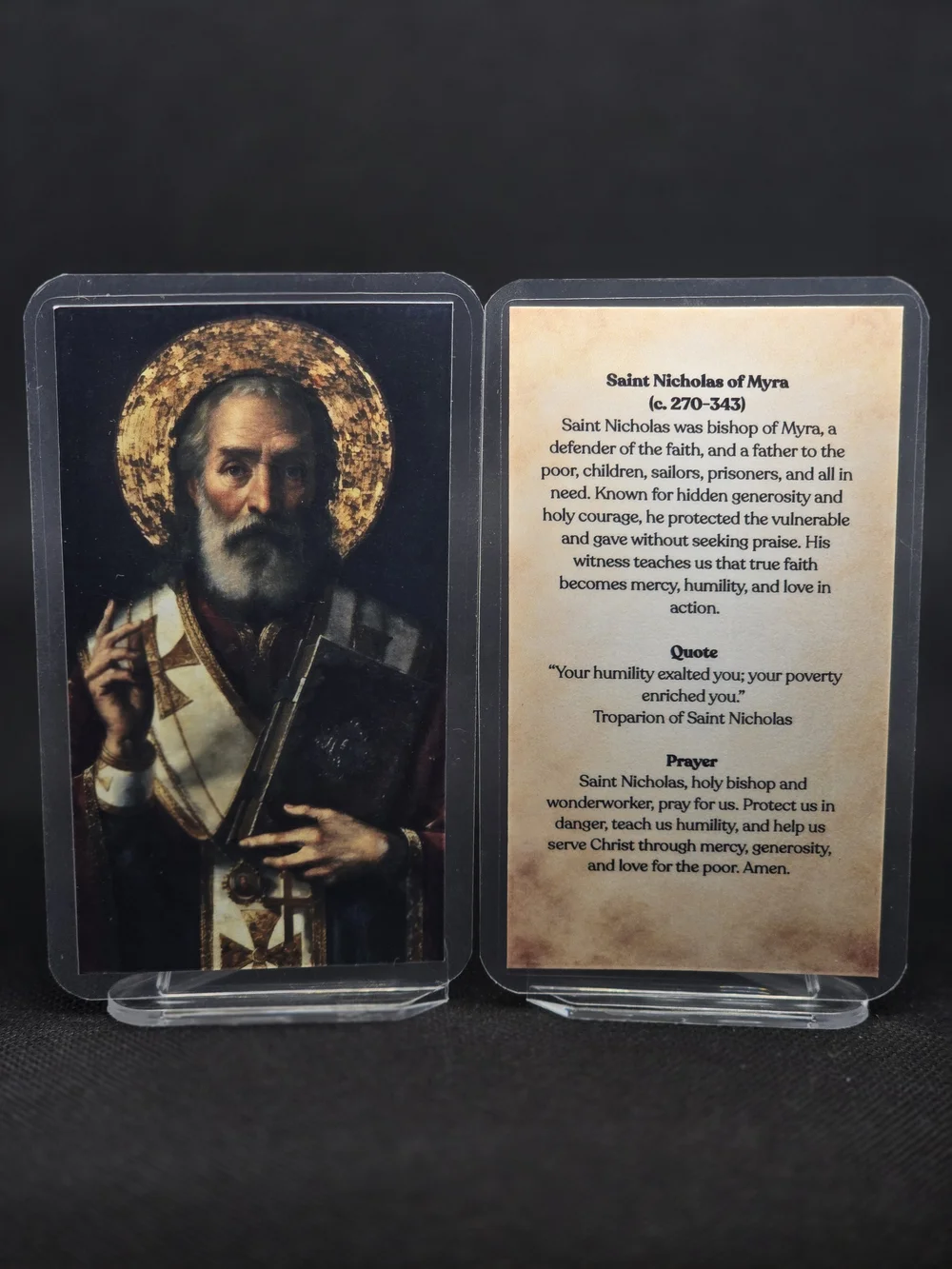
Saint Nicholas of Myra: The Bishop Who Calmed a Storm
Nicholas, the fourth-century bishop of Myra, is the patron of sailors and travelers by devotion, along with children and many others. According to the tradition, on a voyage to the Holy Land the ship was nearly destroyed by a terrible storm, and Nicholas rebuked the waves and the storm subsided. It is told of his youth and has no date, so it is tradition.
The documented part is how far his name traveled. In the spring of 1087, sailors from Bari took the main bones from the church in Myra, over the objections of the Greek Orthodox monks there, and brought them to Italy. Pope Urban II later placed them in the new basilica of San Nicola. His feast is December 6, and December 19 on the Julian calendar. Our card carries him for protection and for rescue in impossible situations. See our article on Saint Nicholas the Wonderworker.
Part V
Saint Julian the Hospitaller: Shelter on the Road
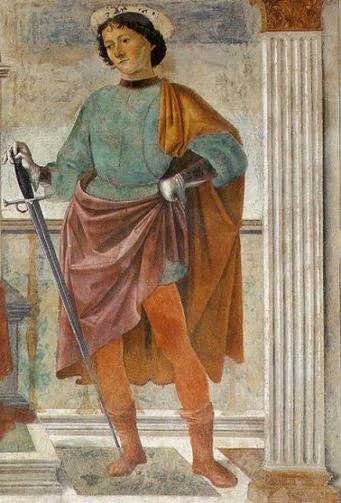
Julian is a legendary figure whose story is first found in the late twelfth century and in the thirteenth-century Golden Legend. The tale says that a prophecy foretold that he would kill his parents, and that he later killed them by mistake. As penance he and his wife built a hospice at a river crossing, where they sheltered weary and sick travelers and ferried people across. In a later episode, Julian turns away a pilgrim and then realizes the pilgrim was Christ.
His historicity is uncertain. Scholars offer competing theories about his origin, and the place of the hospice is disputed. The Church keeps him for what the story teaches: that the road needs hospitality. He is invoked as patron of travelers and pilgrims, especially for lodging, and of ferrymen and innkeepers. His feast is February 12. He appears in the thirteenth-century stained glass at Chartres Cathedral. Our card carries him as patron of travelers. See our biography of Saint Julian the Hospitaller.
Part VI
Saint Menas and the Pilgrim Flasks
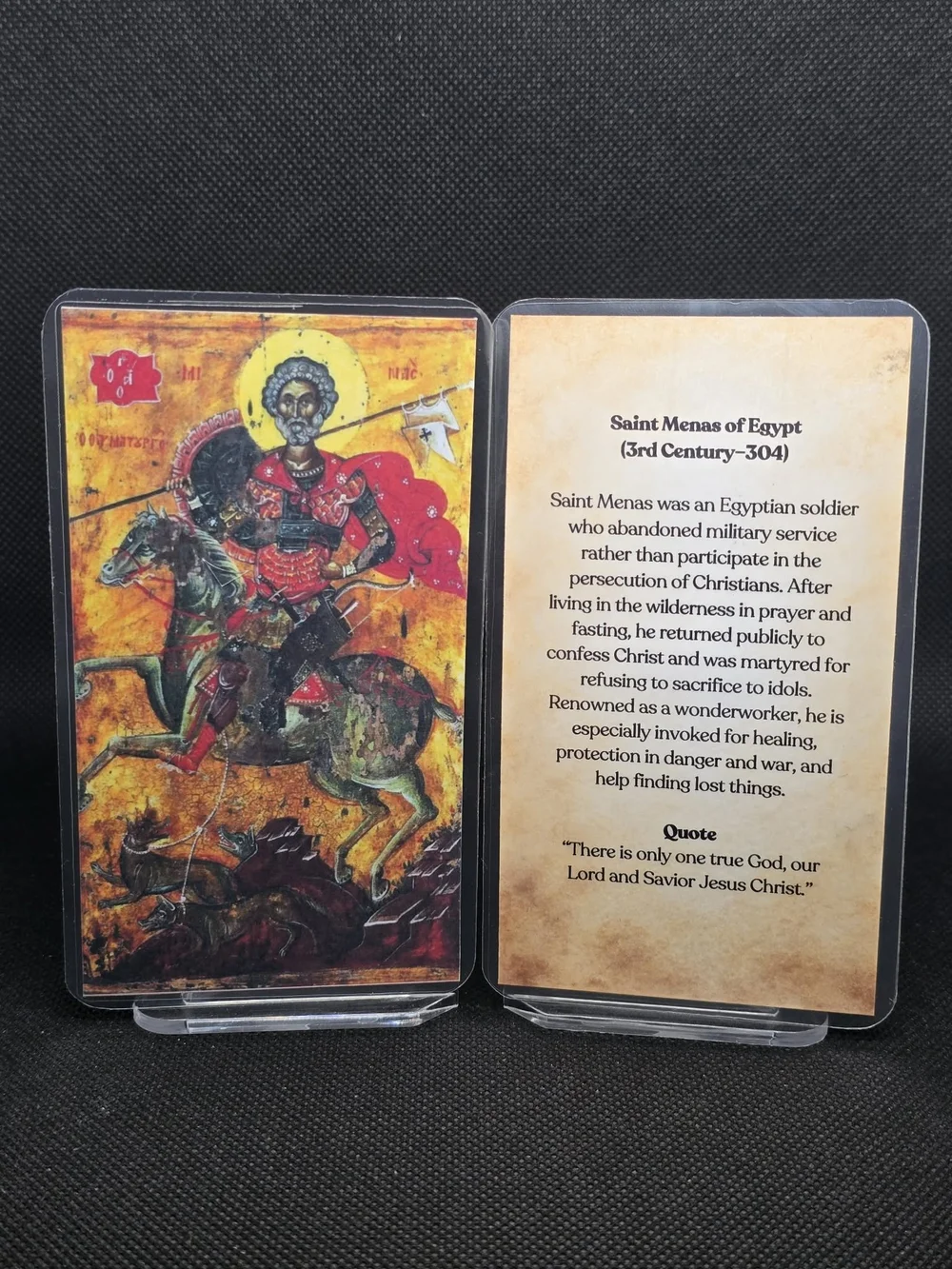
Menas was a Coptic soldier and martyr, born around 285 in Nikiou, near Memphis, who left the army to live as a hermit and was executed around 309 for refusing to renounce his faith. His shrine at Abu Mena, near Alexandria, became a great pilgrimage center, and sick pilgrims came from across the Christian world, seeking healing.
This is the documented part, and it is a travel story. Pilgrims bought small clay flasks stamped with the saint’s name and picture, filled with holy water or oil, and carried them home. Archaeologists have found these flasks across the Mediterranean and beyond, in Germany, Italy, France, Sudan, England and Jerusalem. Archaeology dates the original church at Abu Mena to the late fourth century. The tradition that camels carried his body to Egypt, and that one knelt and would not move at the place where he was buried, is a legend, and it is why he is shown standing between two camels.
The Orthodox and Catholic Churches keep his feast on November 11. The Coptic Church keeps it on 15 Hathor. He was venerated as a protector of pilgrims and merchants. Our card carries him for healing, protection, and courage in fear.
Part VII
Saint Joseph of Cupertino: The Saint for Flying
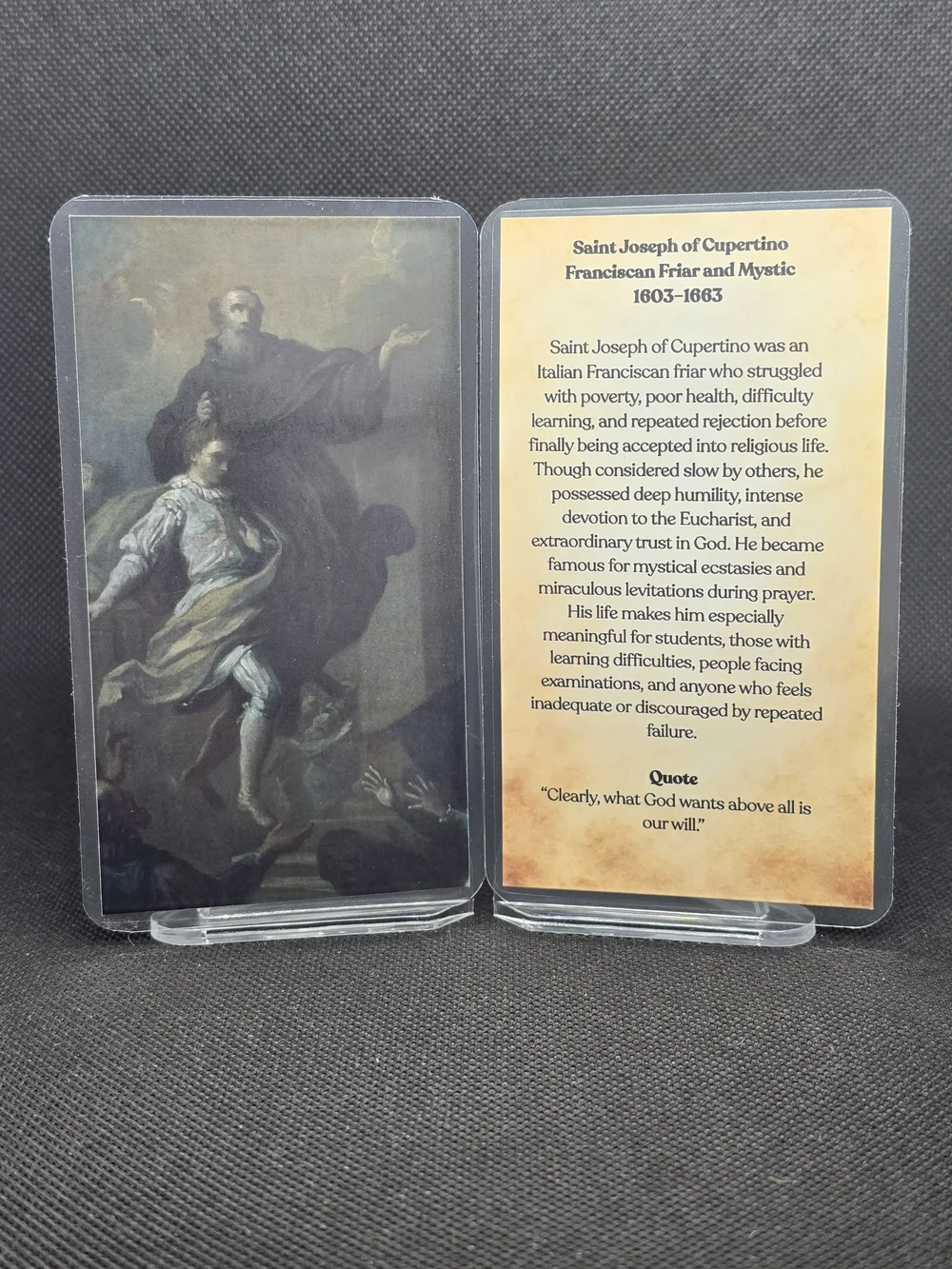
Joseph of Cupertino (1603 to 1663) was a Conventual Franciscan friar and mystic. He was rejected by the Conventuals at first for lack of education and was ordained a priest on March 28, 1628. Beatified in 1753 by Benedict XIV, he was canonized on July 16, 1767, by Clement XIII. His feast is September 18.
He is invoked as patron of air travelers, aviators and astronauts, and also of students and exam takers. The Church has not made that patronage official by a decree that I could find, so it is devotion. The link is the reports of levitation: he was said to rise from the ground during Mass or prayer. Much of what we know comes from canonization inquiries held between 1664 and 1695, when many witnesses were alive, but historians cannot determine whether anyone actually flew, and skeptics think the accounts were exaggerated. Treat the flights as reported, not proven. Many Catholics pray to him before a flight, and the thing to take from his life is his simplicity. Our card carries him for air travelers, students and exam takers.
Part VIII
The Archangels Raphael and Michael
Raphael, the Companion of Tobias
The Book of Tobit, which is part of the Catholic and Orthodox canon but not the Protestant one, is the Bible’s great story of a journey. Tobit sends his son Tobias to collect a debt owed him in Media. The archangel Raphael, in human disguise, offers to go with him. On the way they catch a fish in the Tigris, and its parts later drive out a demon and cure Tobit’s blindness. Tobias marries Sarah, grows wealthy, and returns home. Raphael departs after urging Tobit and Tobias to bless God, pray, fast and give alms.
That is why Raphael is the angel people ask to go with them on a journey. His name means “God heals.” We do not currently carry a Raphael card, but you can read our article on the Archangel Raphael.
Michael, the Defender
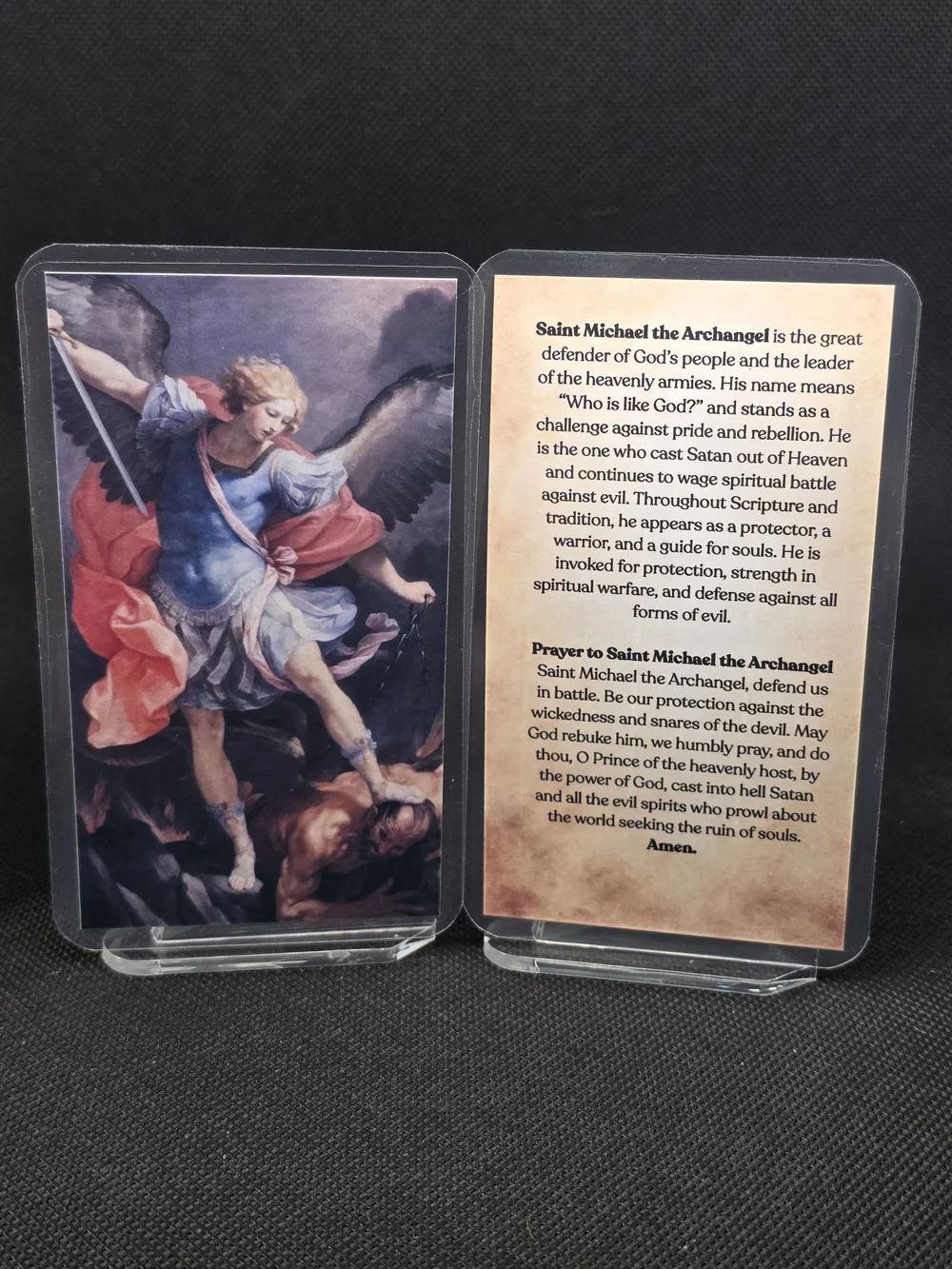
Michael is the archangel who defends the people of God, and many travelers ask for his protection. That is devotion, not a patronage of travel. Our card carries him for protection and spiritual defense. See our article on Saint Michael the Archangel.
Part IX
Saint Joseph and the Holy Family: The First Family Trip
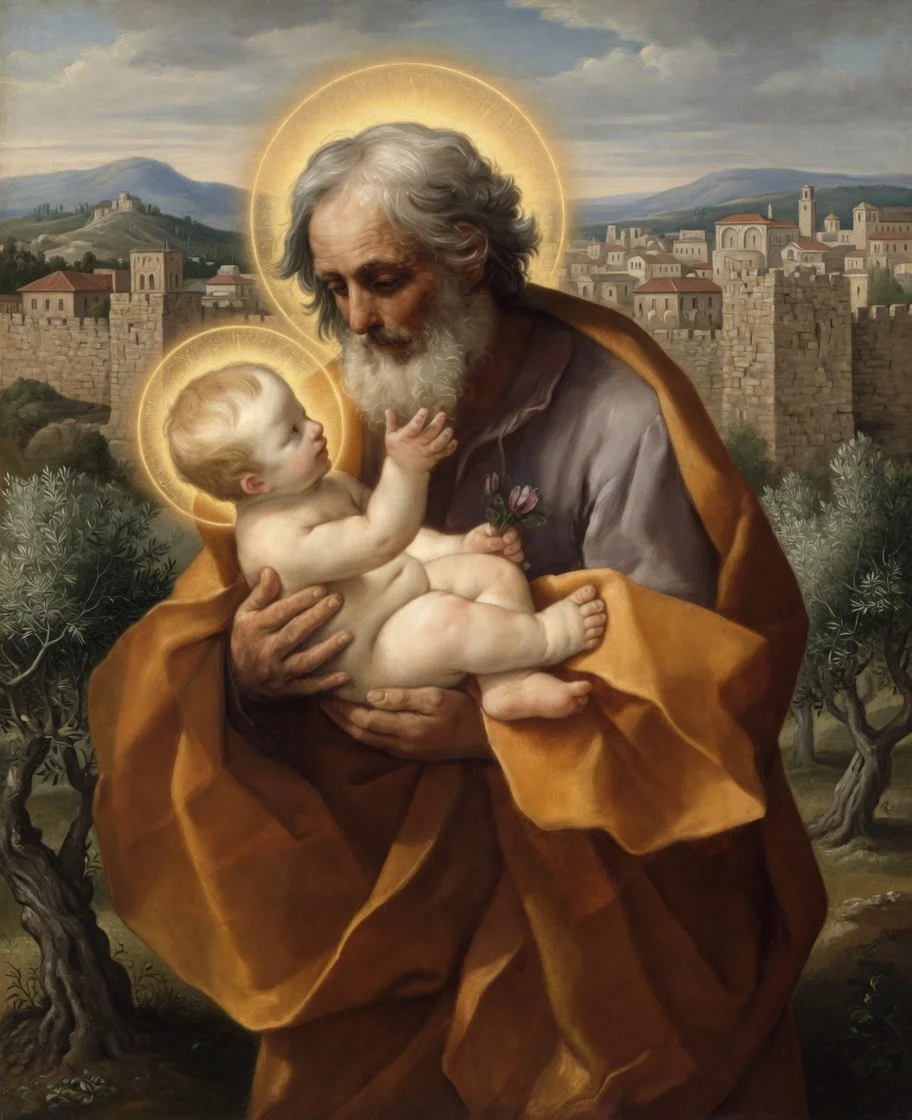
The Gospel gives the first family journey in the Church’s memory. An angel of the Lord appears to Joseph in a dream and tells him to take the child and his mother and flee to Egypt, and Joseph rises in the night and goes (Matthew 2:13 to 15). It was not a vacation. The Holy Family traveled as refugees, under threat, with no map. The Orthodox Church remembers the flight into Egypt on December 26, and Coptic tradition holds a rich body of stories about the places they stayed. Those are tradition.
Joseph is the saint for the one who drives the family anywhere, and the Holy Family is the picture of a family on the road trusting God. Our Saint Joseph card is for the guardian of the home. See our page on Saint Joseph.
Part X
Saint Paul at Sea, and Saint Raphael of Brooklyn
Saint Paul and the Storm
No one in the New Testament traveled more than Paul. He writes, “Three times I have been shipwrecked; a night and a day I have been adrift at sea” (2 Corinthians 11:25, RSV). Acts 27 tells of his voyage to Rome as a prisoner, a violent storm, and an angel who stood by him in the night. He tells the crew, “Do not be afraid, Paul; you must stand before Caesar; and lo, God has granted you all those who sail with you” (Acts 27:24, RSV). The ship is lost, and everyone reaches land. The lesson is not that the voyage was safe. It is that the people on board were kept.
Saint Raphael of Brooklyn
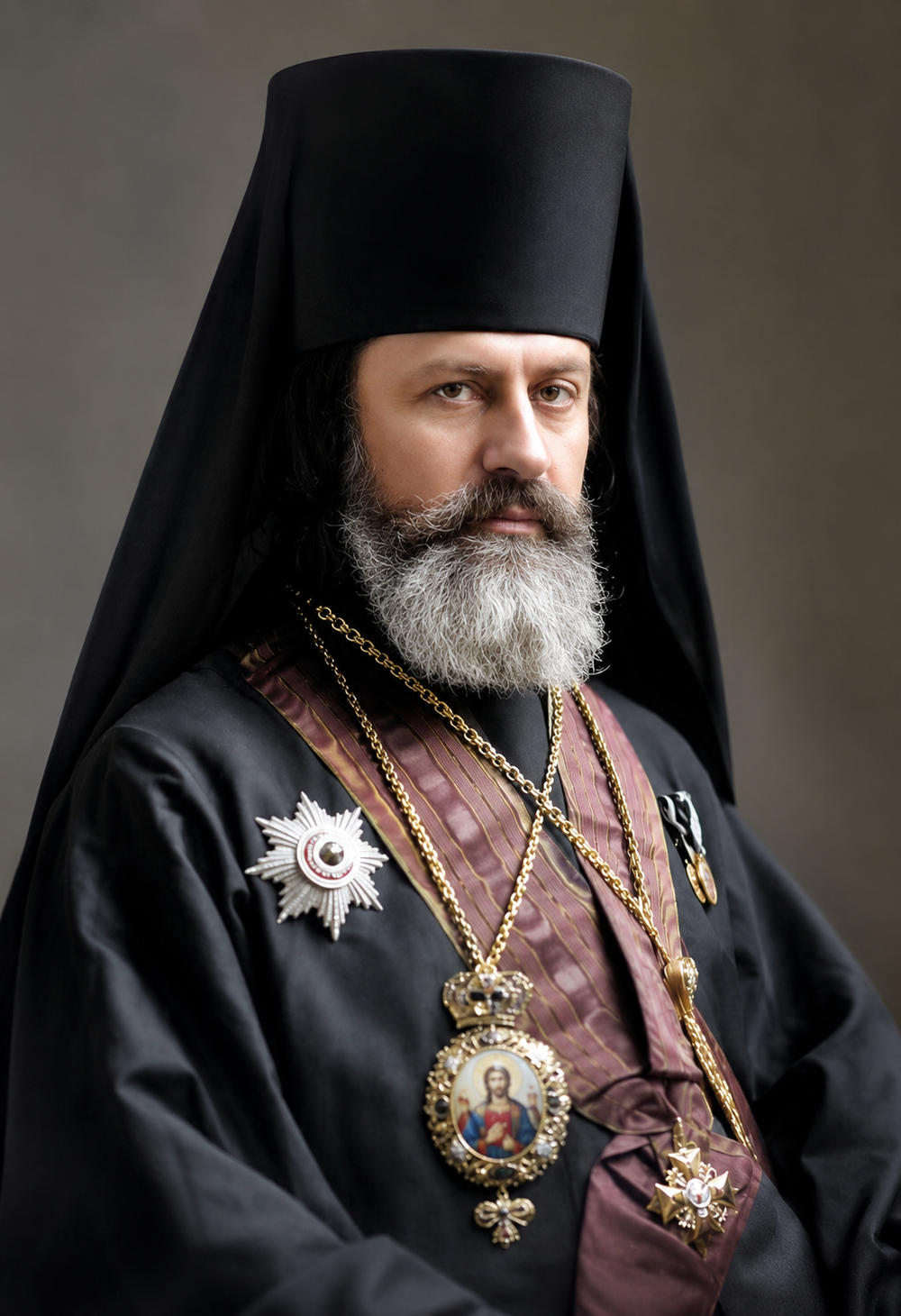
Raphael Hawaweeny was born on November 20, 1860, in what is now Lebanon, to Damascene parents who had fled to Beirut. He studied at Damascus, Halki and Kiev, and in 1895 was sent to New York to serve Orthodox immigrants, including Arabic speakers who wanted a priest in their own language. In 1904 he became the first Orthodox bishop consecrated in North America. From 1903 he made an extensive missionary journey on foot, on horseback, by donkey and by train, reaching as far as Cuba and the Caribbean, to baptize, marry and bless scattered communities. He established thirty parishes. He died on February 27, 1915, and the Orthodox Church in America glorified him in March 2000.
He is the saint for anyone traveling far from home, for immigrants and for the people who serve them. His feast is February 27 in the OCA and the first Saturday of November in the Antiochian Church. Our card carries him for immigrants, missionaries and pastoral care.
Part XI
Alongside Prayer
Prayer does not replace care. The saints in this article asked God for protection and also took the road seriously. Rest before a long drive. Do not drive tired, impaired or distracted. Check the weather and your vehicle. Wear a seat belt, and put children in the right seats. If you are in an emergency, call 911.
Ask for a blessing. A priest or deacon will bless you before a trip. This is especially fitting before a pilgrimage, a mission trip, a move or a long journey away from home.
Pray as you start. Make the sign of the cross when you turn the key, and say the Jesus Prayer when the road gets hard. See our guide to the Jesus Prayer.
Medals, cards and icons. A prayer card in the glove box or a small icon on the dashboard is a reminder to pray. Treat it as such. It is a devotional aid and does not guarantee any outcome.

Part XII
Prayers for the Road
Lord Jesus Christ, you walked the roads of Galilee and you went into Egypt as a child. Be with me on this journey. Keep me alert and patient, and keep me from haste and from pride.
Send your angel before me to guard me on the way, as you promised your people. By the prayers of Saint Nicholas, Saint Christopher, Saint Julian and Saint Menas, protect those who travel with me and those I leave at home. Bring me and all who are with me back in peace. You will keep our going out and our coming in. Amen.
Lord, you know where my loved one is tonight. I cannot see the road, so I give it to you. Send Raphael to walk with them as he walked with Tobias, and let no harm come near them.
Give me peace while I wait, and give them a safe arrival. If there is trouble on the way, send them help. Amen.
Part XIII
Cards and Gifts
Prayer cards to carry or leave in the glove box: Saint Julian the Hospitaller, Saint Nicholas, and Saint Joseph.
Saint Menas, Saint Joseph of Cupertino, and Saint Michael the Archangel.
Saint Raphael of Brooklyn and the Jesus Prayer shirt.
Go With God
The saints in this article crossed rivers, storms, deserts and oceans. Some arrived safely and some did not, and the Church remembers all of them for the same reason: they set out trusting God. Ask them to pray for you, take the ordinary precautions, and begin the trip with the sign of the cross.
Appendix
