Military Saints: The Complete Guide to Catholic and Orthodox Soldier-Saints
Military Saints: The Complete Guide to Catholic and Orthodox Soldier-Saints
From the centurion who stood at the foot of the Cross to the Russian prince who broke the Teutonic Knights on the ice — twenty complete biographies of the men who wore a uniform before they wore a halo, and what their courage still means for the soldiers and veterans who carry their names into battle today.
At A Glance
- Total Military Saints Covered
- 20, in three historical tiers, with full biographies
- Earliest Figure
- Saint Longinus the Centurion, 1st century AD
- Most Recent Figure
- Saint Ignatius of Loyola, 16th century AD
- Shared by Catholic & Orthodox
- 14 saints of the undivided early Church
- Catholic-Specific
- Saint Martin of Tours, Saint Joan of Arc, Saint Ignatius of Loyola
- Orthodox-Specific
- Saint Alexander Nevsky, Saints Peresvet & Oslyabya, Saint Sarkis the Warrior
- Most Invoked for Combat Courage
- Saint George, Saint Demetrios, Saint Sebastian
- Best For Veterans in Transition
- Saint Martin of Tours, Saint Ignatius of Loyola
- Why Military Saints Matter
- Part I — Saints of the Undivided Church
- 1. Saint Longinus the Centurion
- 2. Saint George the Great Martyr
- 3. Saint Demetrios of Thessaloniki
- 4. Saint Theodore of Amasea (Tiro)
- 5. Saint Theodore Stratelates
- 6. Saint Sebastian
- 7. Saint Maurice & the Theban Legion
- 8. Saints Sergius & Bacchus
- 9. Saint Menas of Egypt
- 10. Saint Mercurius (Abu Sefein)
- 11. Saints Eustace & Theopista
- 12. Saint Gordius
- 13. Saint Artemios of Antioch
- 14. Saint Florian
- Part II — Catholic-Specific Military Saints
- 15. Saint Martin of Tours
- 16. Saint Joan of Arc
- 17. Saint Ignatius of Loyola
- Part III — Orthodox-Specific Military Saints
- 18. Saint Alexander Nevsky
- 19. Saints Peresvet & Oslyabya
- 20. Saint Sarkis the Warrior
- Shop Military Saint Prayer Cards
- Frequently Asked Questions
Why Military Saints Matter
Long before Christianity had cathedrals, it had soldiers. In the first three centuries after Christ, the Roman army was one of the largest standing institutions on earth, and the faith spread quietly through its ranks even as emperors periodically demanded that every soldier prove loyalty by sacrificing to the pagan gods. When that demand came, under Diocletian, Galerius, Maximian, and later Julian the Apostate, a great many Christian soldiers refused. They were men who already understood discipline, hierarchy, danger, and the cost of an order that could not be obeyed in good conscience. They simply extended that same discipline to a higher command. The result is one of the largest and oldest categories of sainthood in the Christian world: the military saint, venerated without interruption for over sixteen centuries by both the Catholic Church in the West and the Orthodox Church in the East.
This guide gathers twenty of them into a single, deeply researched reference, and gives each one a full biography rather than a summary: early life and background where it is known, the military career or rank that shaped them, the specific circumstances of their confrontation with imperial or royal authority, the details of their martyrdom or death, the archaeological and historical record of their cult, the iconography that developed around them, and the living feast day traditions that still mark their memory today. It is built specifically for active-duty service members, veterans, military families, and anyone who wants to understand the soldiers who became saints, not the sanitized icon-shop version, but the actual documented lives, the honest historical uncertainties, and the reasons these particular men have been carried into combat, prison camps, and hospital wards for a millennium and a half.
The saints are organized in three tiers, in the order Christian military tradition itself developed. Part I covers the fourteen soldier-saints of the undivided early Church, men venerated by Catholics and Orthodox alike because they lived and died before the Great Schism of 1054 ever divided East from West. Part II covers three military saints particular to the Catholic tradition. Part III covers three military saints particular to the Orthodox tradition. Within each entry, this guide is direct about historical reliability: some of these men are attested by contemporary eyewitnesses and even named in still-surviving sermons preached by people who watched them die. Others come to us only through later hagiography, devotional legend, or a mixture of the two. Both categories are sacred. Only one of them is strict history, and this guide tells you which is which as it goes.
Part I
Saints of the Undivided Church — Venerated by Catholics and Orthodox Alike
Every saint in this section lived and died before 1054, the year the Great Schism formally split the Catholic West from the Orthodox East. That means every one of them belongs equally to both traditions. A Marine in a Roman Catholic parish and a Russian Orthodox conscript both carry Saint George. A Coptic Christian and a Melkite Greek Catholic both carry Saint Menas. These fourteen men are the common inheritance of the whole Church militant, in the oldest and most literal sense of that phrase.
Saint Longinus the Centurion: Full Biography
Who Was Longinus Before the Crucifixion?
Every military saint on this list stands, in some sense, in the shadow of one soldier who was present before any of them: the Roman centurion at the foot of the Cross. The Gospels do not name him. He commanded a small detachment, likely eighty men on paper though almost certainly fewer in practice, and his assignment on the day of the Crucifixion was purely administrative from the perspective of Roman military routine: oversee an execution, confirm death, and report back up the chain of command. He would have witnessed dozens of crucifixions in his career. There was nothing in his training that prepared him for what he witnessed that particular afternoon outside Jerusalem’s walls.
The Confession at Golgotha
The Gospel of Mark records that when this centurion saw how Christ died, accompanied by the earthquake and the tearing of the Temple veil described in the synoptic accounts, he declared, “Truly this man was the Son of God.” It is one of the earliest confessions of faith recorded in the New Testament, made by a professional soldier doing his job at the worst possible moment to have a religious conversion, and he made it anyway, in front of his own men, at the foot of the very cross he had been ordered to guard.
Tradition, the Holy Lance, and the Healing of His Sight
Later tradition, developed over the following centuries and preserved differently in the Latin West and the Byzantine East, identifies this same centurion as the soldier who pierced Christ’s side with a lance to confirm death, an event recorded in the Gospel of John. That same tradition holds that blood and water from the wound touched his eyes and healed a condition of failing sight he had suffered from for years, which is the historical root of his patronage for the blind and for those with eye ailments. The lance itself, later venerated as the Holy Lance or Spear of Destiny, became one of the most contested relics of the medieval world, with rival claimants in Rome, Vienna, Armenia, and Antioch all asserting possession of the true instrument.
From Soldier to Missionary to Martyr
Tradition holds that Longinus was so transformed by what he witnessed that he left the Roman army, was baptized, and spent the remainder of his life preaching Christ, primarily in Cappadocia, in the interior of what is now Turkey. According to the fuller versions of his legend, agents of the Jewish authorities who had pressed for Christ’s execution later sought him out specifically because his eyewitness testimony to the Resurrection was considered dangerous, and after failing to bribe him into silence, arranged for his arrest. He was eventually beheaded for refusing to renounce his faith, becoming one of the first soldiers in history to trade a Roman uniform for martyrdom. His relics are venerated today in multiple locations, most prominently a shrine in the crypt beneath Saint Peter’s Basilica in Rome and a separate tradition placing relics in Mantua, Italy, reflecting how widely his cult spread across the Latin West.
Iconography and Feast Day
In Byzantine and Eastern iconography, Longinus is typically depicted on horseback beneath the Cross, spear in hand, at the moment of confession, often set apart from the other soldiers by a halo already forming around his head, a visual shorthand for the instant of his conversion. In the West he is more often shown standing, lance lowered, gazing up at the crucified Christ. The Eastern Orthodox Church commemorates him on October 16, and the Armenian Apostolic tradition venerates a fragment of the Holy Lance at the monastery of Geghard, whose very name means “the spear.”
On Historical Reliability
The centurion’s presence and his confession at the Cross are scriptural and therefore foundational to Christian history. The name Longinus, the lance, the healed eyesight, and the later missionary life come from early but non-scriptural tradition, layered together over the first few centuries of the Church. Eastern and Western sources do not fully agree on every detail of his later life, but both traditions agree on the essential figure: a Roman soldier who looked directly at the cost of empire and chose Christ instead. For any service member who has ever carried out an order and then had to reckon with what it cost, Longinus is the very first military saint the Church ever produced.
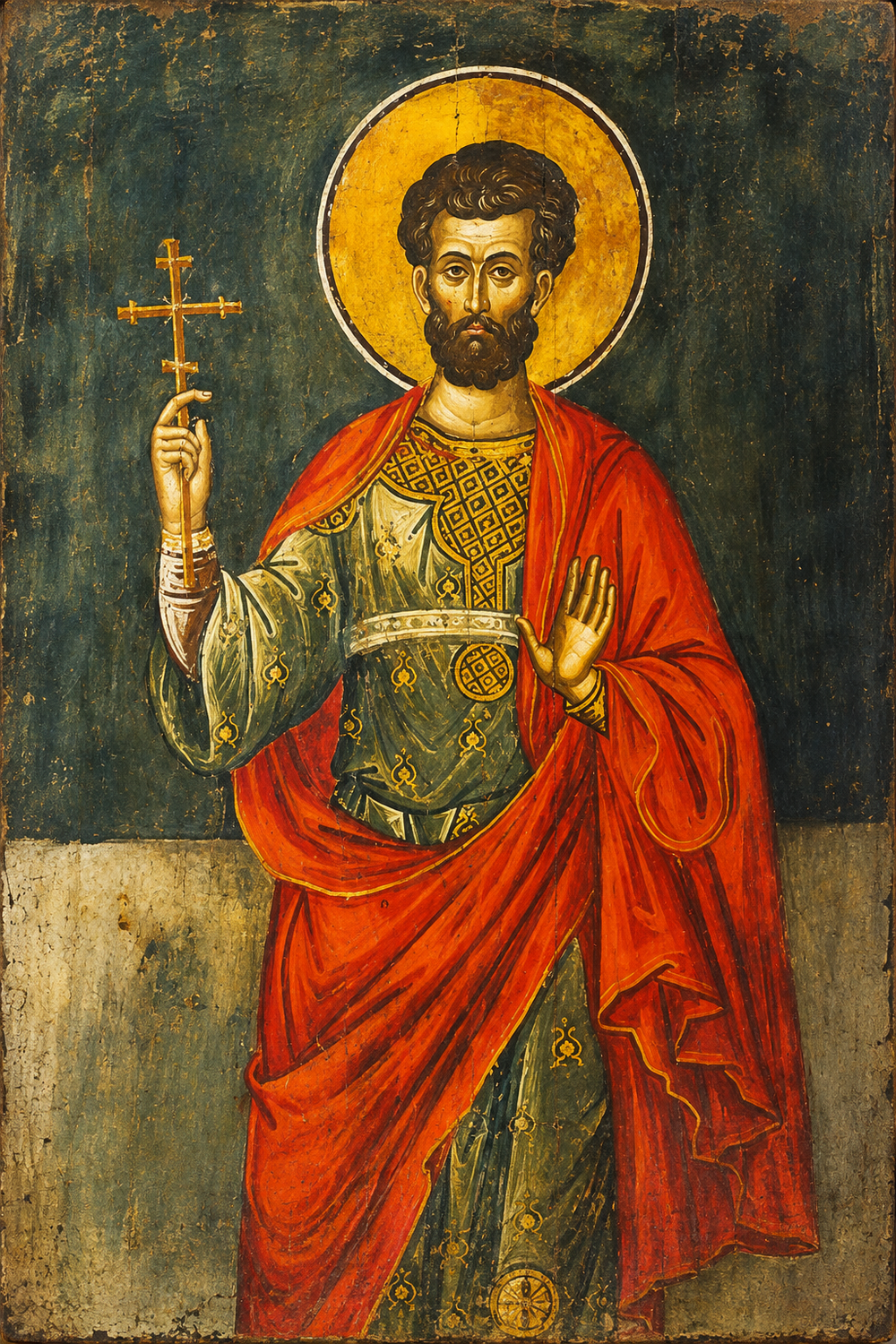
Saint 2 of 20
Saint George the Great Martyr: Full Biography
Early Life and Rise Through the Ranks
According to the earliest layers of his hagiography, George was born in Cappadocia or Lydda in Palestine to a Christian family of some standing; his father is remembered as a soldier who was himself martyred for the faith, and his mother reportedly raised him in her native Palestine after being widowed. George followed his father into military service and, thanks to talent, connections, and the patronage system that governed Roman advancement, rose with unusual speed through the ranks of the imperial army, eventually reaching the position of tribune, a senior officer role, within the personal guard of the Emperor Diocletian himself. By his mid-twenties he stood near the summit of Roman military power, one of the emperor’s own trusted commanders.
The Edict and the Public Refusal
When Diocletian launched the empire-wide persecution of Christians in February 303 AD, ordering every soldier to sacrifice to the Roman gods or be discharged and punished, and commanding that Christian churches be destroyed and scriptures burned, George is said to have made a decision that shocked the entire imperial court: rather than quietly resign his commission, as many Christian soldiers of lesser rank were doing, he publicly tore down the imperial edict where it had been posted in Nicomedia and declared himself a Christian in front of the assembled court, directly beneath the emperor’s gaze. It was an act of open, calculated defiance from a man with everything, rank, wealth, and imperial favor, to lose.
Torture and Martyrdom
What followed, according to tradition, was an extended and escalating sequence of torture stretched over roughly seven days, each attempt failing to break him or, in the fuller hagiographic accounts, being miraculously undone overnight. Sources describe attempts at breaking him on a wheel, boiling in a caldron of lime, forcing him to wear red-hot iron shoes, and repeated scourging, with George reportedly converting members of the court, including, in some versions, the Empress Alexandra herself, through his endurance. He was finally beheaded outside the walls of Nicomedia, in present-day Turkey, in 303 AD.
The Explosive Spread of His Cult
George’s cult exploded almost immediately after his death and spread with unusual speed across both the Greek East and the Latin West, making him one of the first saints venerated on both sides of the empire simultaneously, a rare distinction for a martyr of this period. Emperor Constantine, within a generation of George’s death, is credited with building a church in his honor at Lydda, the traditional site of his tomb, which became a major pilgrimage destination throughout the Byzantine period. By the time of the Crusades, Western knights returning from the Holy Land had adopted him as their patron of chivalry and combat after reportedly witnessing apparitions of him at the Siege of Antioch in 1098, cementing his reputation across medieval Europe.
Patron of Nations and Armies
George went on to become patron of England, where his red cross on a white field became the national flag and his feast a major holiday; patron of the nation of Georgia, which takes its very name from him; and patron of Catalonia, Genoa, Portugal, Ethiopia, and dozens of medieval military orders, chivalric confraternities, and, in the modern era, entire branches of national armed forces. Armies on both sides of countless European wars have marched under his red cross, and the Military Order of Saint George remains one of the oldest continuously operating orders of chivalry in the world.
The Dragon Legend and Its Later Origins
The dragon-slaying legend so central to popular imagination developed centuries after George’s death. It does not appear in any surviving source for roughly nine hundred years and reached its familiar form only in the thirteenth-century Golden Legend, a widely copied medieval compilation of saints’ lives. In the story, George rescues a princess offered as sacrifice to a dragon terrorizing a Libyan city, defeats the creature, and converts the entire population to Christianity as a condition of sparing it. Historians and the Eastern Church alike read the dragon as a symbolic representation of George’s victory over evil and paganism, not a literal event, though the image became so powerful that it dominates nearly all Western iconography of the saint to this day.
On Historical Reliability
George’s martyrdom under Diocletian is treated as historically solid, attested by widespread veneration within a generation of his death and referenced in some of the earliest surviving Christian martyrologies. What is not symbolic is the martyrdom itself, and the simple fact that a Roman officer at the height of imperial favor looked at the full machinery of empire and refused it anyway.
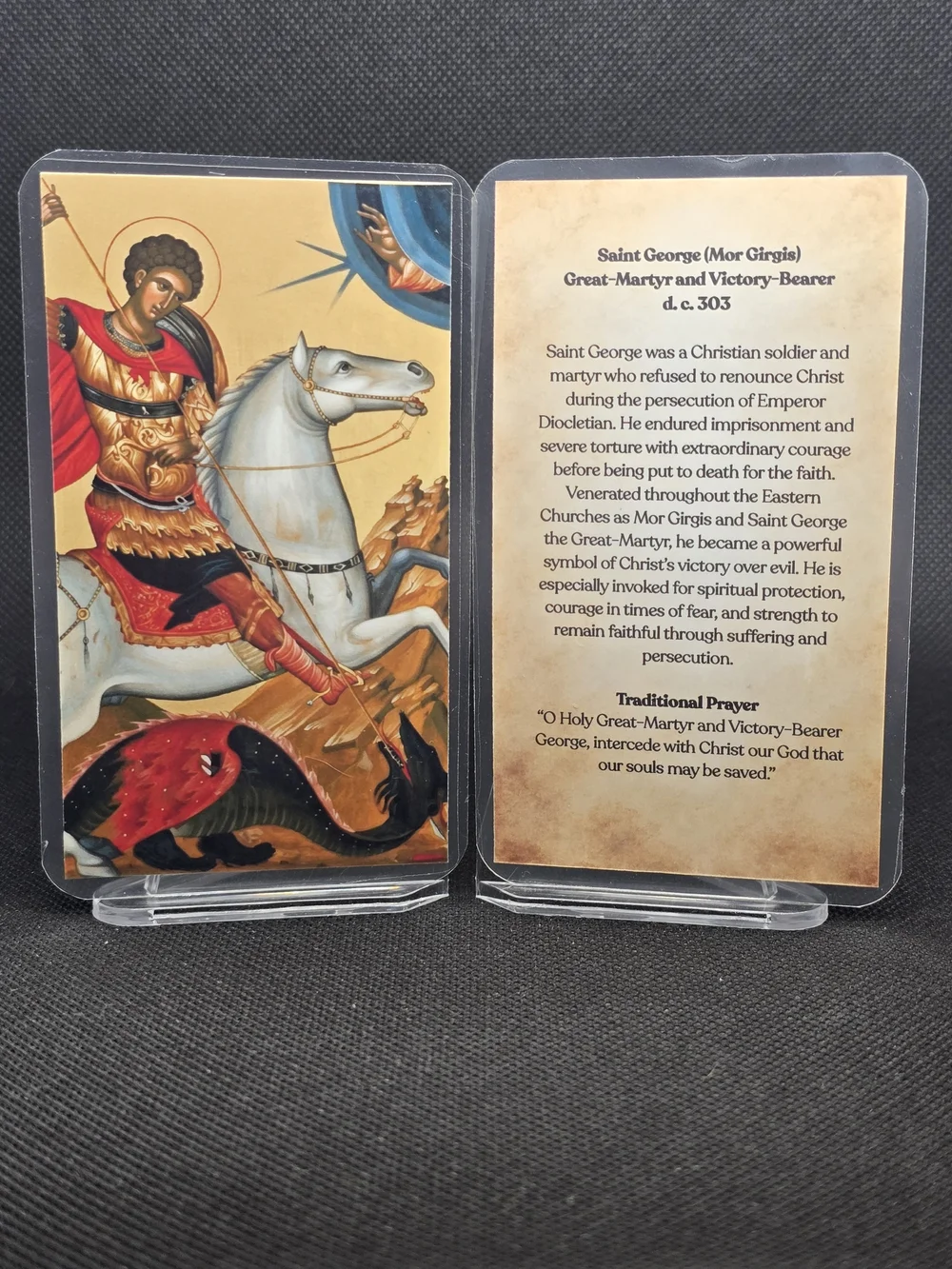
Saint 3 of 20
Saint Demetrios of Thessaloniki: Full Biography
Background and Rise to Office
Demetrios held high Roman office in Thessaloniki, most likely as a military commander or proconsul, when Emperor Galerius intensified the persecution of Christians in the region around 306 AD. Ancient tradition describes him as young, well-born, and highly regarded by the local population even before his faith became public knowledge, holding a position of real civil and military authority in one of the empire’s most important eastern cities.
Secret Teaching and Discovery
According to his ancient hagiography, Demetrios used his position to teach the Christian faith openly to those who sought him out rather than enforce the persecution as his office required, effectively running a clandestine catechetical ministry from within the highest levels of Roman provincial government. When this was discovered, likely through informants within his own household or administration, he was imprisoned in the city’s bathhouse complex and speared to death on Galerius’s direct order, a swift and brutal end intended to make an example of a man who had betrayed his imperial trust.
Nestor the Wrestler and the Arena
Demetrios is closely linked in tradition to Saint Nestor of Thessalonica, a young Christian who, with Demetrios’s blessing given from his prison cell, faced and killed a favored imperial gladiator named Lyaeos in the city’s arena during a public spectacle staged for Galerius’s entertainment. Lyaeos had reportedly been throwing challengers from a raised platform to their deaths below for the crowd’s amusement, and Nestor’s unexpected victory, attributed directly to Demetrios’s intercessory prayer, so enraged Galerius that he ordered both Nestor’s execution and, immediately afterward, Demetrios’s own death in the bathhouse, cementing Demetrios’s reputation as a protector who empowers others to face impossible odds even from behind prison walls.
Burial, the Basilica, and the Myrrh
His body was buried by local Christians at the site of his martyrdom, and within a century a basilica had been raised over his tomb that still stands in Thessaloniki today, one of the oldest continuously venerated Christian shrines in the world and a UNESCO World Heritage Site. Over the following centuries, a fragrant oil began to be reported flowing from his relics, earning him the title Myroblytes, “the myrrh-streamer,” a phenomenon still associated with his tomb in devotional tradition and referenced constantly in Byzantine hymnography written in his honor.
Defender of a City Under Siege
As Thessaloniki survived repeated sieges by Slavic, Avar, and later other invading armies across the sixth through ninth centuries, the city’s defenders repeatedly credited Demetrios’s direct intercession for their survival, with contemporary chroniclers recording visions of him appearing on the city walls in armor during the worst assaults. He was not merely a personal patron in the way later medieval saints often became; he was regarded, city-wide and for centuries, as Thessaloniki’s literal supernatural defender, a status few other saints in Christian history have held with such civic specificity and endurance.
Iconography and Modern Veneration
Byzantine iconography developed a militarized image of Demetrios over the centuries following his death, depicting him as a mounted warrior in full armor, often paired visually with Saint George in church frescoes and mosaics, the two great martyrs frequently shown flanking one another on horseback. His feast on October 26 remains one of the largest civic and religious celebrations in modern Thessaloniki, drawing pilgrims from across the Orthodox world.
On Historical Reliability
Demetrios’s martyrdom and the antiquity of his cult are well documented archaeologically and liturgically, with the basilica bearing his name among the best-preserved early Christian structures in the Balkans. Whether Demetrios personally fought as a combat soldier or served in a civil-military administrative post is genuinely debated by historians, since the earliest layers of his hagiography emphasize teaching and civic authority more than battlefield command; what is not debated is that an entire city, under siege for centuries, believed without hesitation that he was fighting for them.
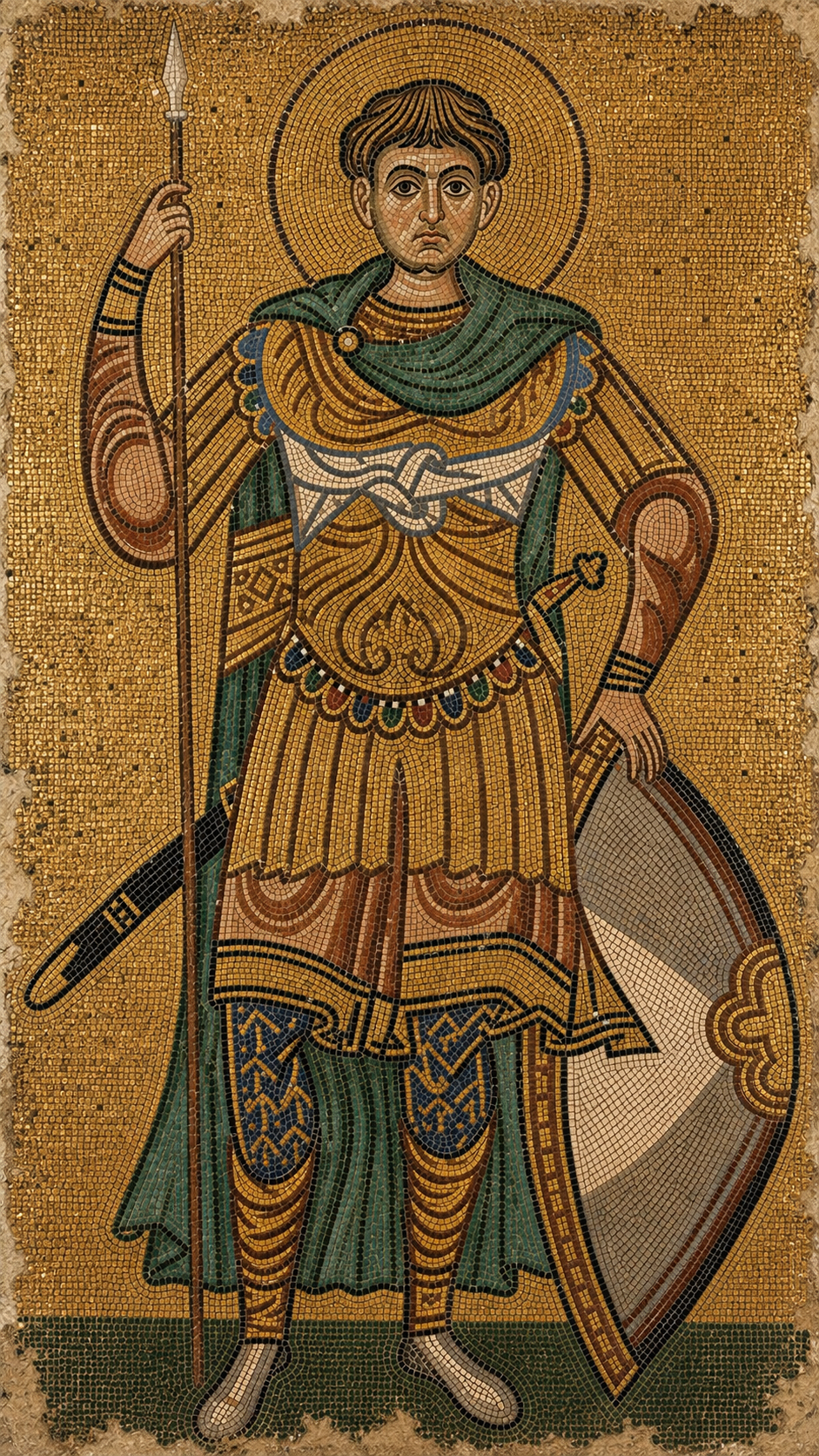
Saint 4 of 20
Saint Theodore of Amasea (Theodore Tiro): Full Biography
A Recruit, Not Yet a Veteran
The nickname “Tiro” is simply the Latin word for a new army recruit, and it is the most accurate description of Theodore’s status when he entered Christian history. Stationed with a Roman cohort near Amasea in the region of Pontus, on the southern coast of the Black Sea, Theodore was a young enlisted soldier, newly Christian and newly sworn into imperial service, when his commanders discovered his faith during the early stages of the Diocletianic persecution. Unlike more senior officers who might negotiate or quietly resign, a raw recruit like Theodore had almost no leverage and no rank to protect him.
The Burning of the Temple of Cybele
Given time to reconsider before facing punishment, Theodore reportedly used that reprieve not to flee or hide but to act. He set fire to a temple of the pagan mother-goddess Cybele in the city, a major cult site, in an open and deliberate act of defiance rather than passive refusal, timing the act for maximum visibility rather than simply avoiding a sacrifice ceremony as many soldiers in his position did. It was, in effect, a declaration of war against the paganism the persecution was meant to enforce.
Torture and Execution by Fire
He was arrested almost immediately, tortured at length in an attempt to force recantation, and ultimately burned alive rather than surrender his confession of faith, a punishment chosen with an evident irony given his own method of protest. His hagiography describes him remaining in prayer and even singing psalms as the flames rose around him, an image that became central to his later liturgical commemoration.
The Kolyva Miracle and Julian the Apostate
Theodore Tiro became one of the most beloved saints of the Byzantine liturgical calendar largely because of an event attributed to him roughly sixty years after his death. Tradition holds that Theodore appeared in a vision to the Patriarch of Constantinople to warn Christians in the city that the Emperor Julian the Apostate, seeking to undermine Christian observance during the first week of Great Lent, had secretly ordered the city’s food supply sprinkled with blood from pagan sacrifices, rendering it ritually defiled for Christian consumption. Theodore instructed the faithful to eat boiled wheat, kolyva, instead until the danger passed, since it required no market purchases and could be prepared entirely from stores already in Christian homes.
Living Tradition: Kolyva on the First Saturday of Lent
Orthodox churches worldwide still bless kolyva, a dish of boiled wheat mixed with honey, dried fruit, and spices, on the first Saturday of Great Lent in his honor, making Theodore Tiro one of the rare saints whose commemoration involves an annually repeated, tangible ritual food offering rather than only prayer or icon veneration. It is a rare case of a martyred soldier remaining active, in devotional memory, as a literal protector of his fellow believers’ physical safety long after his own death.
On Historical Reliability
Theodore’s martyrdom as a young recruit is treated as reliably historical and is among the earliest attested military martyrdoms of the persecution era, referenced in Greek liturgical sources dating close to his own century. Some modern scholars have proposed that Theodore Tiro and the following saint, Theodore Stratelates, may represent one original figure whose story split into two over centuries of retelling in different regions, since both share the name Theodore, a Pontic setting, and broadly similar persecution-era martyrdoms. The Church continues to commemorate them as two distinct saints with separate feast days, reflecting fourteen centuries of unbroken liturgical tradition even where modern historical-critical scholarship raises questions.
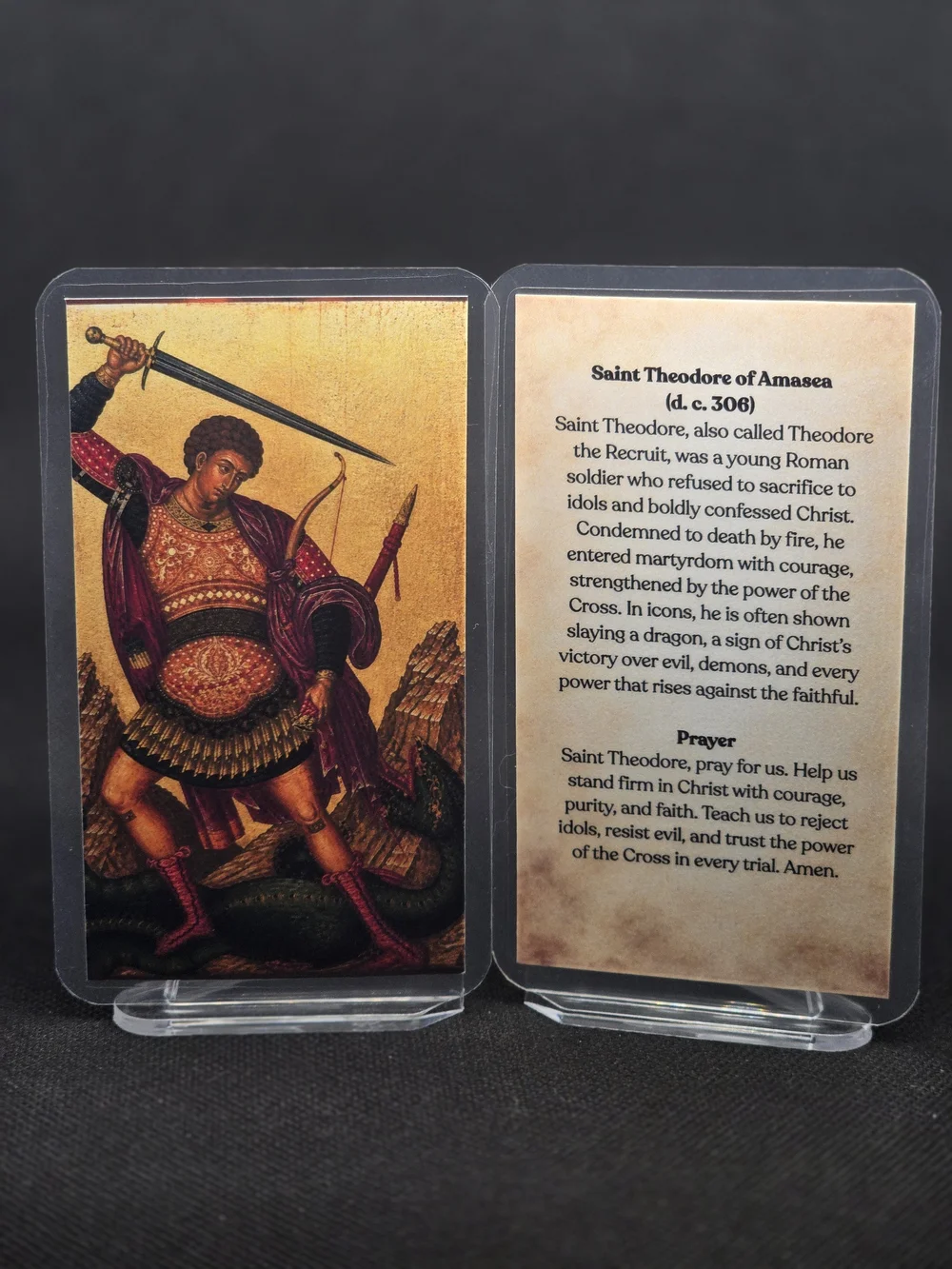
Saint 5 of 20
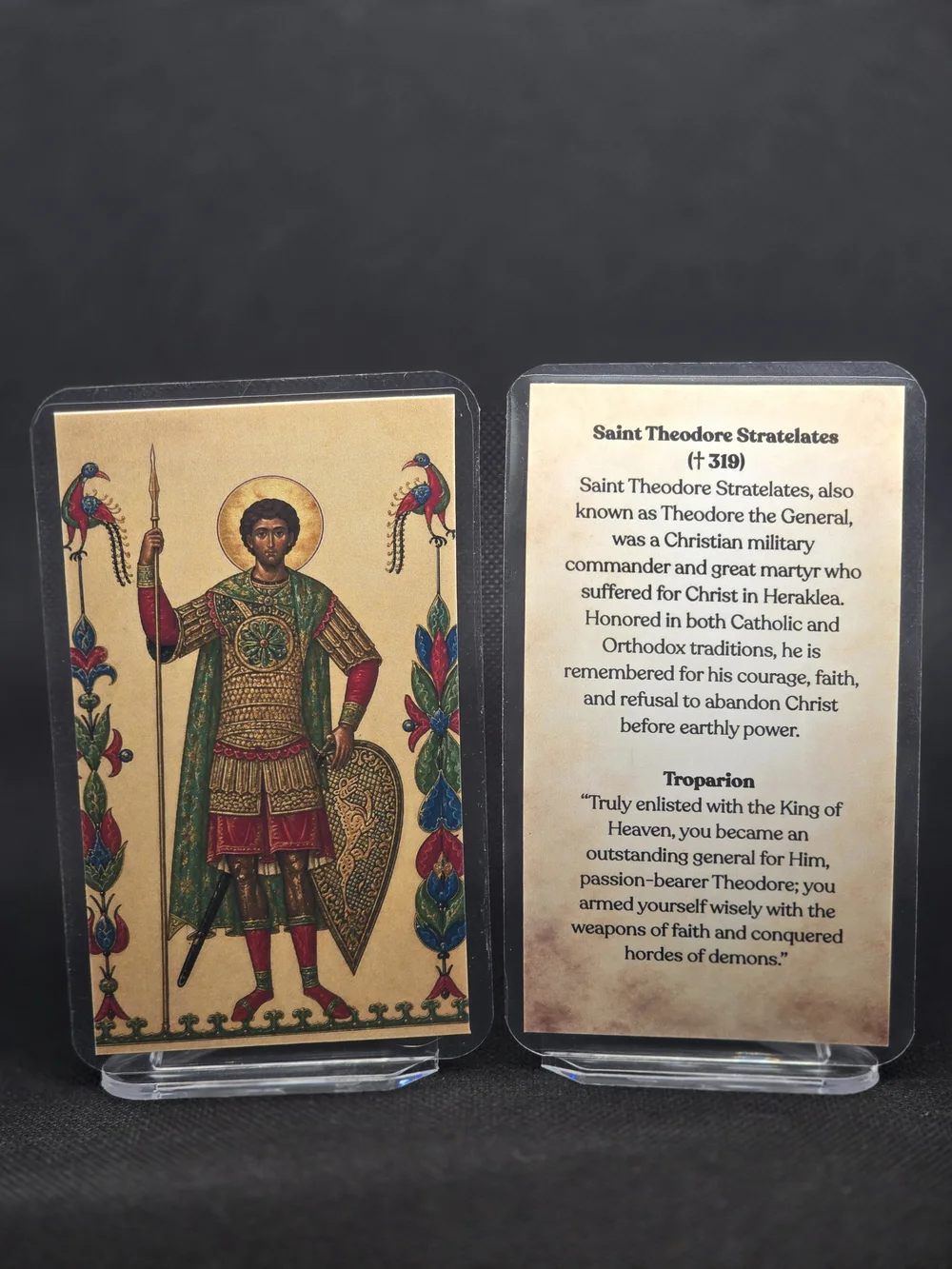
Saint Theodore Stratelates: Full Biography
A General’s Rank and Reputation
Where Theodore Tiro was a raw recruit, Theodore Stratelates carried a title that meant the opposite: stratelates, roughly “general” or “commander-in-chief.” According to his hagiography, he served as military governor of Heraclea Pontica, an important port city on the Black Sea, under Emperor Licinius, and had already earned wide renown for both his military competence and his physical stature and bearing, which sources describe as unusually commanding even by the standards of Roman officer culture.
The Serpent of Euchaita
A local tradition holds that Theodore killed a monstrous serpent, described in some accounts as a dragon, that had been terrorizing the countryside near his home region of Euchaita, demanding periodic human sacrifice from the local population before he intervened and destroyed it, years before the dragon legend was ever attached to Saint George. This episode, whatever its historical weight, established Theodore in local memory as a protector figure well before his martyrdom made him a saint.
Confrontation with Licinius and Martyrdom
When Licinius, co-emperor with Constantine and still committed to persecuting Christians in his own territories, demanded that Theodore lead the persecution of Christians in his jurisdiction, Theodore instead used his rank and authority to publicly proclaim his own faith, going so far as to destroy pagan idols under his jurisdiction as a direct act of provocation rather than simply declining to enforce the order. He was arrested, tortured extensively over several days according to tradition, and beheaded, meeting his death with the same composure his soldiers had reportedly come to expect of him in battle.
Patron of Princes and Commanders in Slavic Lands
Theodore Stratelates is venerated with particular intensity in Russia and the broader Slavic Orthodox world, where he became a patron of princes and military commanders specifically because his own story was one of a man already in command choosing conscience over the chain above him rather than a subordinate refusing an order. Multiple medieval Russian churches and even entire towns bear his name, the most famous being the Church of Theodore Stratelates on the Brook in Novgorod, a masterpiece of medieval Russian ecclesiastical architecture, and Russian noble families frequently gave the name Feodor to sons destined for military service, a naming tradition that persisted for centuries.
Iconography
Byzantine and Russian icons typically depict Theodore Stratelates on horseback in full military dress, often piercing a serpent or dragon with a spear beneath his mount’s hooves, an image visually similar to but historically distinct from the later Saint George dragon iconography, and the two are sometimes confused by casual observers of Orthodox iconography for exactly this reason.
On Historical Reliability
As with Theodore Tiro, Theodore Stratelates’s martyrdom is treated as historical within the tradition, though the two Theodores’ stories share enough structural similarity, including the serpent-slaying motif appearing in some tellings of both men’s lives, that scholars debate whether they reflect one martyr remembered in two regions or two genuinely distinct men separated by roughly a decade and several hundred miles. Devotionally and liturgically, the Church has treated them as separate saints for well over a thousand years, and this guide follows that same long-standing distinction.
Saint 6 of 20
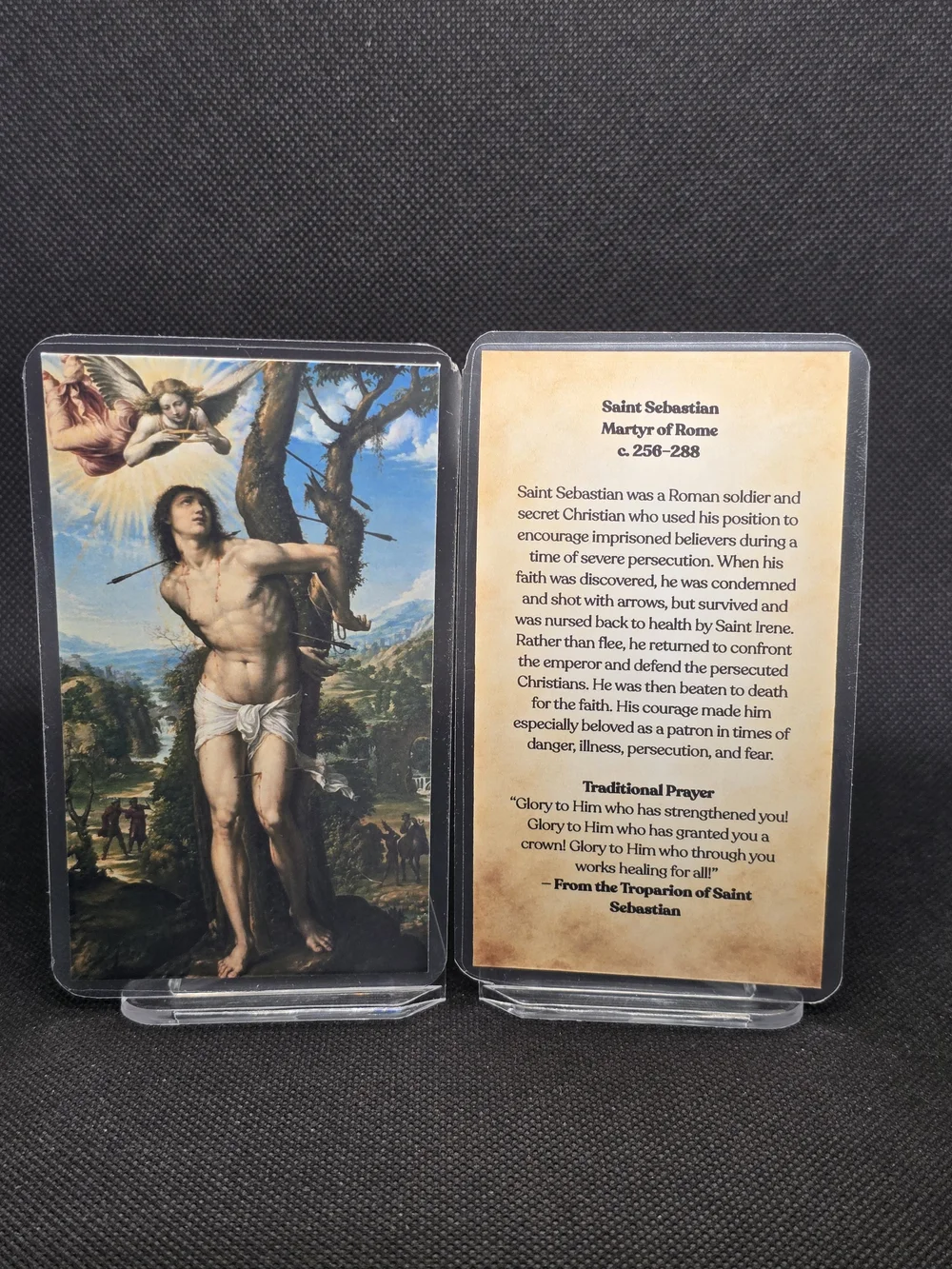
Saint Sebastian: Full Biography
Entry into the Praetorian Guard
Sebastian, according to tradition born in Gaul or Milan and raised in Rome, enlisted in the Roman army and rose to serve as an officer in Diocletian’s Praetorian Guard, the emperor’s own elite personal security force and one of the most prestigious and closely vetted units in the entire empire, while secretly practicing Christianity throughout his tenure. His position gave him privileged access to the imperial court, the prisons, and the movement of officials, access he used deliberately to support the Christian community.
A Double Life in Service of the Persecuted
Sebastian used his rank and freedom of movement to visit, encourage, and materially support Christians imprisoned for their faith during the escalating persecution, reportedly ministering to condemned prisoners and even facilitating conversions among fellow soldiers and Roman officials who might otherwise never have encountered a practicing Christian. Hagiographic tradition credits him with strengthening the resolve of numerous other martyrs during this period, using his unique access as a trusted Praetorian officer to do quietly what an ordinary Christian could never have managed.
Execution by Archers
When his double life was discovered, Diocletian, who reportedly valued Sebastian highly and was said to be personally fond of him, ordered him tied to a stake or tree and shot with arrows by a unit of Mauretanian archers, a punishment severe enough to be considered near-certain death but distinct from outright beheading, perhaps reflecting the emperor’s own conflicted feelings about the sentence. Sebastian was shot repeatedly and left for dead, his body riddled with arrows in the image that would come to define his artistic legacy for the next seventeen centuries.
Saint Irene and the Recovery
According to tradition, a Christian widow named Irene came to retrieve his body for burial and found him still alive, having survived through what wounds proved non-fatal; she nursed him back to health in her own home over a period of weeks, an act of quiet, dangerous mercy carried out entirely outside official notice.
The Second, Final Martyrdom
Rather than flee the city once recovered, an option that would have been both prudent and available to him, Sebastian deliberately positioned himself where Diocletian would pass and publicly confronted the emperor over the injustice of the persecution, refusing to let his survival be treated as evidence of divine disfavor toward Christianity as some in the court had begun to argue. Diocletian, astonished that Sebastian had survived the arrows at all, ordered him beaten to death with clubs this time, a method chosen specifically to leave no chance of a second recovery. His body was thrown into Rome’s main sewer system, the Cloaca Maxima, from which Christians secretly retrieved it under cover of darkness for proper burial in the catacombs that today bear his name along the Appian Way.
Cult, Basilica, and Renaissance Patronage
Sebastian’s cult grew rapidly in Rome, and one of the seven great pilgrimage basilicas of the city, the Basilica of San Sebastiano fuori le Mura, was built over his catacomb burial site and remains an active pilgrimage destination today. During the medieval and Renaissance periods he also became one of the most frequently painted saints in Western art, invoked against plague on the theory that his arrow wounds visually paralleled the sudden, piercing onset of pestilence, giving him a second major patronage entirely separate from his military identity.
On Historical Reliability
Sebastian’s martyrdom and his position in the Praetorian Guard are attested in early Roman Christian tradition and his cult is ancient and well documented, with his catacomb burial site venerated continuously since antiquity and referenced in fourth-century sources. He is one of the few soldier-saints formally and specifically named patron of soldiers by the Catholic Church, a title he shares with Joan of Arc, and remains the single most commonly requested military saint for confirmation names, unit patches, and combat medals.
Saint 7 of 20
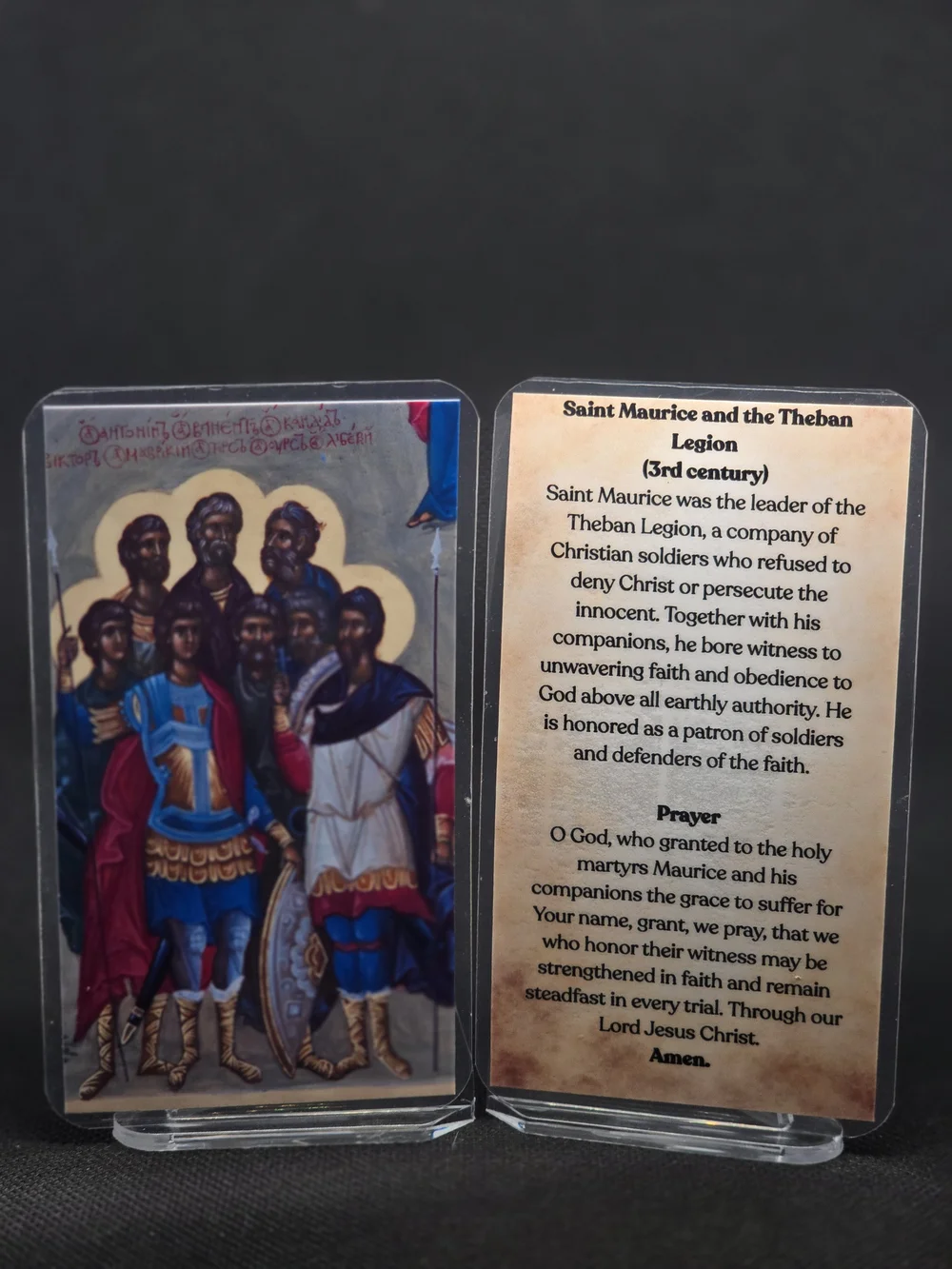
Saint Maurice and the Theban Legion: Full Biography
A Legion Recruited from Christian Egypt
The Theban Legion was recruited from Christian communities in Upper Egypt, near Thebes, at a time when Egyptian Christianity was already deeply rooted and organizationally sophisticated, producing a unit that was, unusually for the Roman army, Christian to a man from its formation rather than through gradual individual conversion. It had gained a reputation for discipline and loyalty within the Roman army under Emperor Maximian, serving competently on multiple campaigns before the events that would define its legacy.
The March into Gaul and the Order to Persecute
According to tradition, the entire legion, under the command of Maurice, was ordered to march into Gaul to help suppress a local uprising among the Bagaudae, a rebellious peasant movement, and, along the way, was commanded to first offer pagan sacrifice to secure divine favor for the campaign and then to help hunt down and execute Christian civilians in the region as part of the broader imperial policy. The legion, being Christian to a man, refused both orders outright, withdrawing to the town of Agaunum, in the Rhone valley, rather than comply.
Two Decimations
Maximian, enraged by this mass refusal from an entire fighting unit rather than a single dissenting officer, ordered the legion decimated, meaning one in every ten soldiers was selected by lot and executed as collective punishment for the mutiny, a traditional Roman military penalty rarely invoked by this period precisely because of its severity. When the survivors still refused to comply after this first decimation, reaffirming their position as a body, Maximian ordered a second decimation, a punishment so extreme it signaled the emperor’s complete loss of patience with the standoff.
The Final Massacre
When even the second decimation failed to break their resolve, Maximian ordered the entire remaining legion put to death near Agaunum, in what is today Saint-Maurice-en-Valais, Switzerland. Ancient sources give the size of the legion as roughly 6,600 men, a figure most historians regard as symbolically inflated rather than a precise headcount, though the core event, a Roman unit executed for mass conscientious refusal, is treated as historically grounded and referenced in near-contemporary sources including a letter attributed to Bishop Eucherius of Lyon written within a century of the event.
The Abbey of Saint-Maurice
The site of the massacre became the location of the Abbey of Saint-Maurice, founded in the early sixth century and still an active monastery today, making it one of the oldest continuously operating monasteries in Western Europe. The abbey holds relics venerated as belonging to Maurice and his companions and has been a major pilgrimage site for over 1,500 years, visited historically by numerous kings, emperors, and popes.
Patron of Infantry and the Swiss Guard
Maurice became patron of infantry soldiers specifically, as distinct from cavalry or naval patrons, and the Pontifical Swiss Guard, still protecting the Pope today in Vatican City, traces its ceremonial lineage and recruitment tradition to the Swiss cantons surrounding this legion’s martyrdom site and considers Maurice a patron of its service, a living institutional link between a fourth-century mass execution and a functioning twenty-first-century military unit.
On Historical Reliability
The martyrdom of the Theban Legion is one of the earliest and most striking recorded instances of organized, unit-wide conscientious objection in military history, predating modern conceptions of that term by over 1,600 years. While the exact numbers involved are almost certainly exaggerated by ancient standards of hagiographic reporting, the underlying event, referenced by multiple early sources and commemorated at a continuously venerated site, is regarded by historians as reflecting a genuine historical execution of Christian soldiers who refused an order.
Saint 8 of 20
Saints Sergius and Bacchus: Full Biography
High Standing in the Imperial Guard
Sergius and Bacchus were high-ranking Roman military officers serving under Emperor Galerius, held in such favor that they were assigned to his personal retinue, an assignment reserved only for the most trusted and capable men in the imperial military structure. Their earliest surviving hagiography describes their relationship using the language of the era’s deepest military brotherhood, companions bound by shared rank, shared risk, and shared secret faith.
Discovery and Public Humiliation
When it was discovered that both men were secretly Christian, likely through the same kind of informant network that exposed other officers of the period, Galerius, apparently as much wounded by the betrayal from men he had personally favored as committed to punishment, ordered a deliberate and calculated public humiliation rather than an immediate execution: the two officers were dressed in women’s clothing, a punishment specifically designed to strip away their military identity and honor in the eyes of their own soldiers, and paraded through the streets in chains before being sent to separate provincial governors for punishment, ensuring neither could offer the other support in his final ordeal.
Separate Deaths
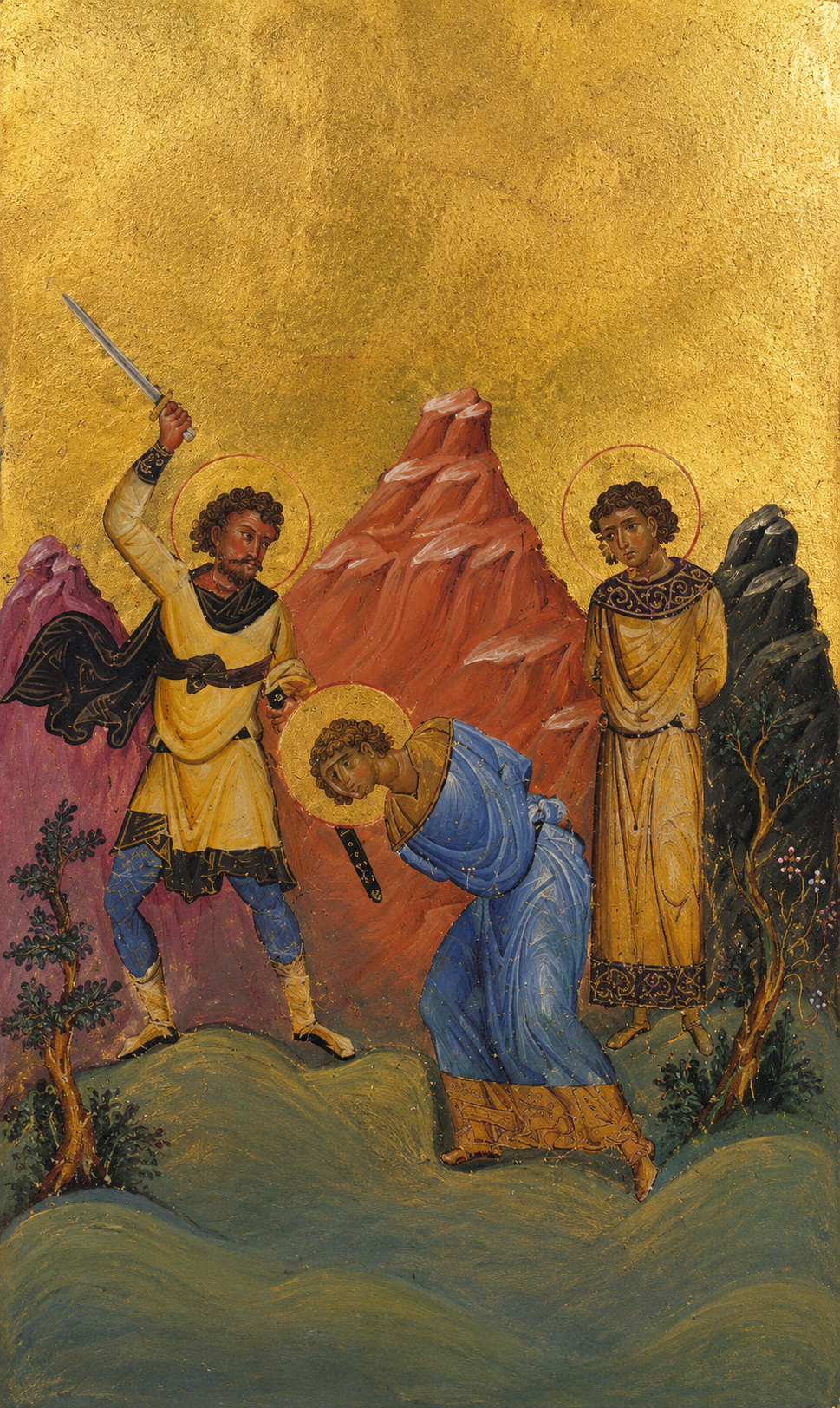
Bacchus died under a severe flogging administered by the governor to whom he was sent, his body reportedly so damaged that he succumbed within hours. Sergius, on hearing of his companion’s death, was forced to march for miles in sandals fitted with iron spikes, a deliberately prolonged torture designed to break him through sheer physical agony over distance rather than a single violent blow, before finally being beheaded at Resafa, in Roman Syria, near the Euphrates frontier.
Sergiopolis and the Byzantine Army
The bond between Sergius and Bacchus made them enormously popular throughout the late antique and Byzantine world as patrons of soldiers who serve, suffer, and if necessary die alongside one another. Resafa was renamed Sergiopolis in Sergius’s honor and grew into a major fortified pilgrimage city and military shrine for the entire Eastern Roman army, complete with an imposing basilica whose ruins still stand in the Syrian desert today, with soldiers departing on campaign customarily seeking his intercession first before any other saint.
Abu Serga in Old Cairo
Their veneration spread quickly beyond Syria into Egypt, where the Church of Saints Sergius and Bacchus, known locally as Abu Serga, was built in Old Cairo, reportedly on or near the site where the Holy Family is believed to have rested during their flight into Egypt. Abu Serga remains one of the oldest continuously functioning churches in Egypt and one of the most significant Coptic pilgrimage sites in Cairo, physically linking these two soldier-martyrs to one of the oldest surviving pieces of Christian architecture on the continent.
On Historical Reliability
The martyrdom of Sergius and Bacchus is ancient and well attested, with their veneration spreading rapidly across Syria, Egypt, and the wider Byzantine world within a generation of their deaths, and their names appearing in some of the earliest surviving Eastern martyrologies. They are recognized as martyrs by the Catholic, Eastern Orthodox, and Oriental Orthodox Churches alike, making them, along with George, Demetrios, and Menas, part of the small circle of universally venerated Roman soldier-martyrs whose feast crosses every major branch of ancient Christianity.
Saint 9 of 20
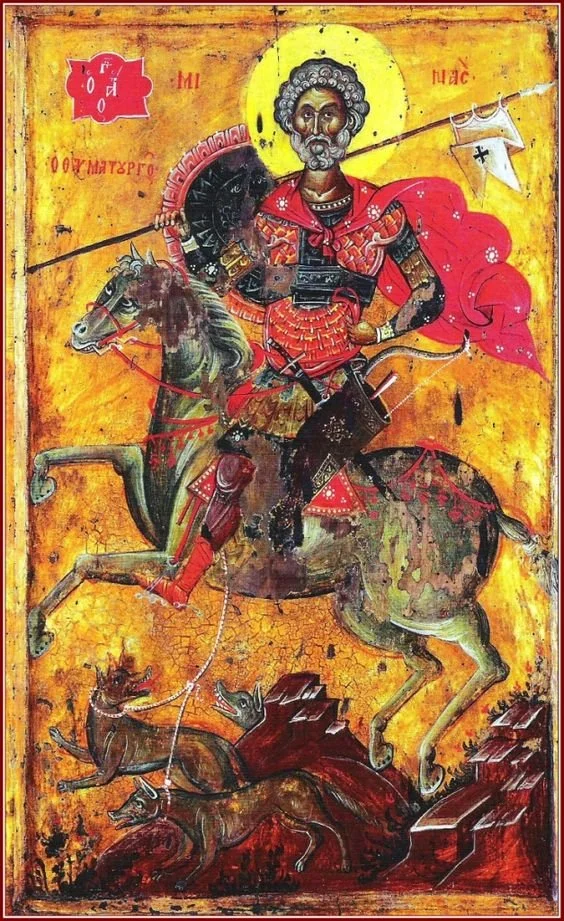
Saint Menas of Egypt: Full Biography
An Egyptian Soldier Posted Far From Home
Menas was an Egyptian, likely born near Memphis or in the Nile Delta, serving as a soldier in the Roman army when he was posted far from home to Phrygia, in the interior of Asia Minor, as persecution against Christians intensified across the empire. Serving in a foreign province, away from any Christian community that might have offered him cover or support, appears to have sharpened rather than weakened his resolve.
Withdrawal into the Desert
Rather than wait to be forced into a public act of apostasy, Menas left his post, an act that under Roman military law technically constituted desertion, and withdrew into the desert to live as a hermit, seeking clarity through prayer and fasting rather than confrontation. He is said to have spent years in this solitary discipline, wrestling with the question of whether hiding indefinitely was compatible with the faith he professed.
The Return and Public Confession
According to his hagiography, Menas eventually received an inner conviction that hiding was no longer the right path, and he deliberately returned to the city during a public pagan festival to openly proclaim his Christian faith in front of the assembled crowd and the provincial governor, fully aware of what the consequence would be. He was arrested, tortured extensively over multiple sessions in an attempt to force recantation, and finally beheaded, likely sometime between 296 and 309 AD depending on which version of the persecution chronology is followed.
The Camel and the Founding of Abu Mina
Tradition holds that his body was placed on a camel to be transported back toward Egypt for burial, and that the camel stopped at a specific, otherwise unremarkable spot in the desert west of Alexandria near Lake Mareotis and refused to move any further, which was taken as a divine sign of where Menas wished to be buried. The tomb’s location was reportedly then lost to memory for a period, according to tradition rediscovered when a local shepherd noticed a sheep with an injury healed after drinking from a spring at the site, drawing attention back to the spot and beginning the flow of pilgrims that would define the location for centuries.
Abu Mina: One of the Ancient World’s Great Pilgrimage Cities
That site, Abu Mina, grew from a simple tomb into one of the largest and most important Christian pilgrimage complexes in the entire ancient world by the fifth century, rivaling shrines in Jerusalem and Rome at its medieval peak, complete with multiple basilicas, a baptistery, bathhouses, workshops, and dedicated pilgrim housing built around a great colonnaded court. The Emperor Arcadius personally ordered a major expansion of the facilities in the early fifth century, reflecting the site’s importance to the imperial church. Pilgrims carried home small clay flasks of oil or water blessed at his tomb, called Menas ampullae, which archaeologists have found scattered as far as France, Italy, and Jerusalem, physical evidence of just how far his cult traveled across the late antique Mediterranean world. The city and its cathedral were ultimately destroyed following the Arab conquest of Egypt in the seventh century and the site fell into obscurity until its rediscovery by German archaeologist C. M. Kaufmann in the early twentieth century.
Modern Recognition and Living Devotion
Abu Mina is recognized today as a UNESCO World Heritage Site, inscribed in 1979, and a modern Coptic monastery, Deir Mar Mina, has been rebuilt near the ancient ruins under the twentieth-century leadership of Pope Cyril VI of Alexandria, restoring active pilgrimage and monastic life to the site after roughly thirteen centuries of dormancy. Menas remains one of the most invoked saints in Coptic Christianity for healing, protection, and the recovery of lost things, a patronage directly connected to the many miracle accounts recorded at his ancient shrine.
On Historical Reliability
Menas’s martyrdom and the extraordinary scale of his ancient pilgrimage site are both archaeologically confirmed through extensive excavation, making him one of the best-documented soldier-saints of the entire period, with physical evidence of his cult’s reach far exceeding what survives for most other saints on this list.
Saint 10 of 20
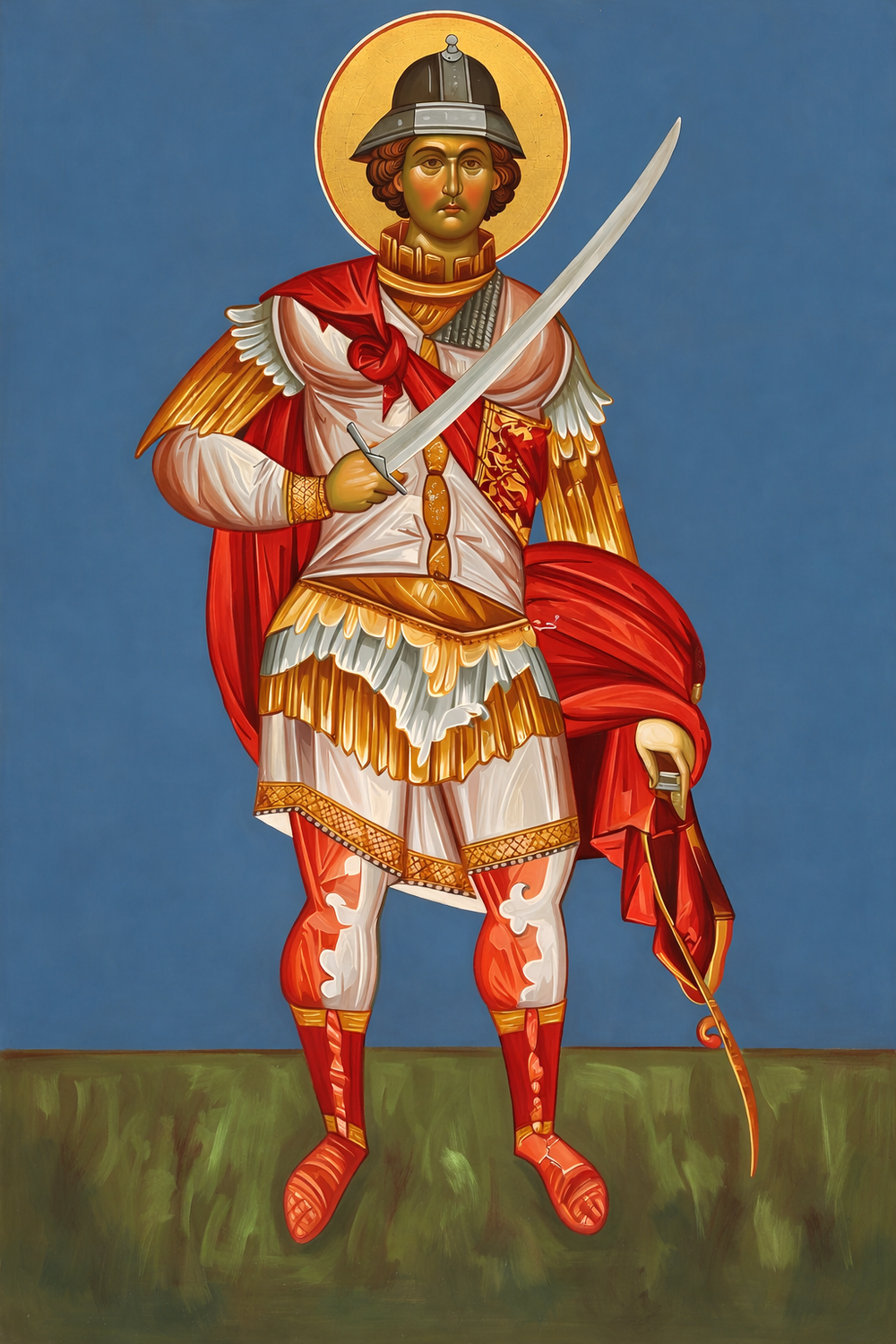
Saint Mercurius (Philopater Mercurius, Abu Sefein): Full Biography
A Scythian Soldier in Roman Service
Mercurius was a soldier of Scythian descent, from the region north of the Black Sea, serving in the Roman army under Emperor Decius during a period of intense pressure on the empire’s northern frontiers from barbarian incursions. His full title in Coptic tradition, Philopater Mercurius, reflects both his father’s name and a devotional epithet meaning roughly “lover of the Father,” a title that developed alongside his growing cult.
The Vision of the Archangel and the Second Sword
According to tradition, during a critical battle against barbarian invaders threatening Roman territory, the Archangel Michael appeared to Mercurius on the field and handed him a second sword, beyond his own, instructing him to fight with both blades simultaneously in defense of Rome. Mercurius’s decisive battlefield performance that day, wielding two swords where every other soldier carried one, earned him rapid promotion and the epithet Abu Sefein, Arabic and Coptic for “father of two swords,” a name that has stayed attached to him for over 1,700 years and remains the name by which he is most commonly known throughout Egypt today.
Refusal to Sacrifice and Martyrdom
When Decius later demanded that Mercurius offer sacrifice to the pagan gods in gratitude for the victory his archangel-assisted heroics had helped secure, Mercurius refused, declared his Christian faith openly before the assembled court, and was tortured over an extended period and ultimately beheaded for it, his rapid fall from military favor mirroring the same pattern seen in Sergius, Bacchus, and other officers of his era.
The Later Legend of Julian the Apostate
A much-loved layer of tradition, developed centuries after his martyrdom, holds that Mercurius appeared again, from beyond the grave, to strike down the Emperor Julian the Apostate during his campaign against the Persian Empire in 363 AD, in direct answer to the prayers of Saint Basil the Great, fulfilling a vision in which Christ had promised Basil that the persecutor would be dealt with before he could inflict further harm on the Church. This second appearance is treated by the Church as a beloved and enduring legend of intercession from beyond death rather than a documented historical event, but it has made Mercurius one of the few saints venerated specifically for defeating an enemy of the Church after his own martyrdom, a theme with obvious appeal to soldiers who wonder whether their service and sacrifice end at death.
Abu Sefein Church and Coptic Devotion
A major church dedicated to Mercurius under his popular title Abu Sefein stands in Old Cairo and remains one of the most visited Coptic Orthodox churches in Egypt, housing what is venerated as a portion of his relics and serving as an active center of pilgrimage, particularly around his November feast. His iconography almost universally shows him mounted, sword raised in each hand, a visual identity unique among the military saints on this list.
On Historical Reliability
Mercurius’s martyrdom under Decius is treated as historically grounded and ancient, referenced in Coptic synaxarion traditions dating to the early centuries of the Church in Egypt. The archangel’s sword and the later killing of Julian belong to the realm of sacred legend, layered onto the historical martyr over subsequent centuries, and this guide presents them accordingly. He remains one of the most venerated Coptic military saints, invoked specifically for spiritual protection and courage in fear.
Saint 11 of 20
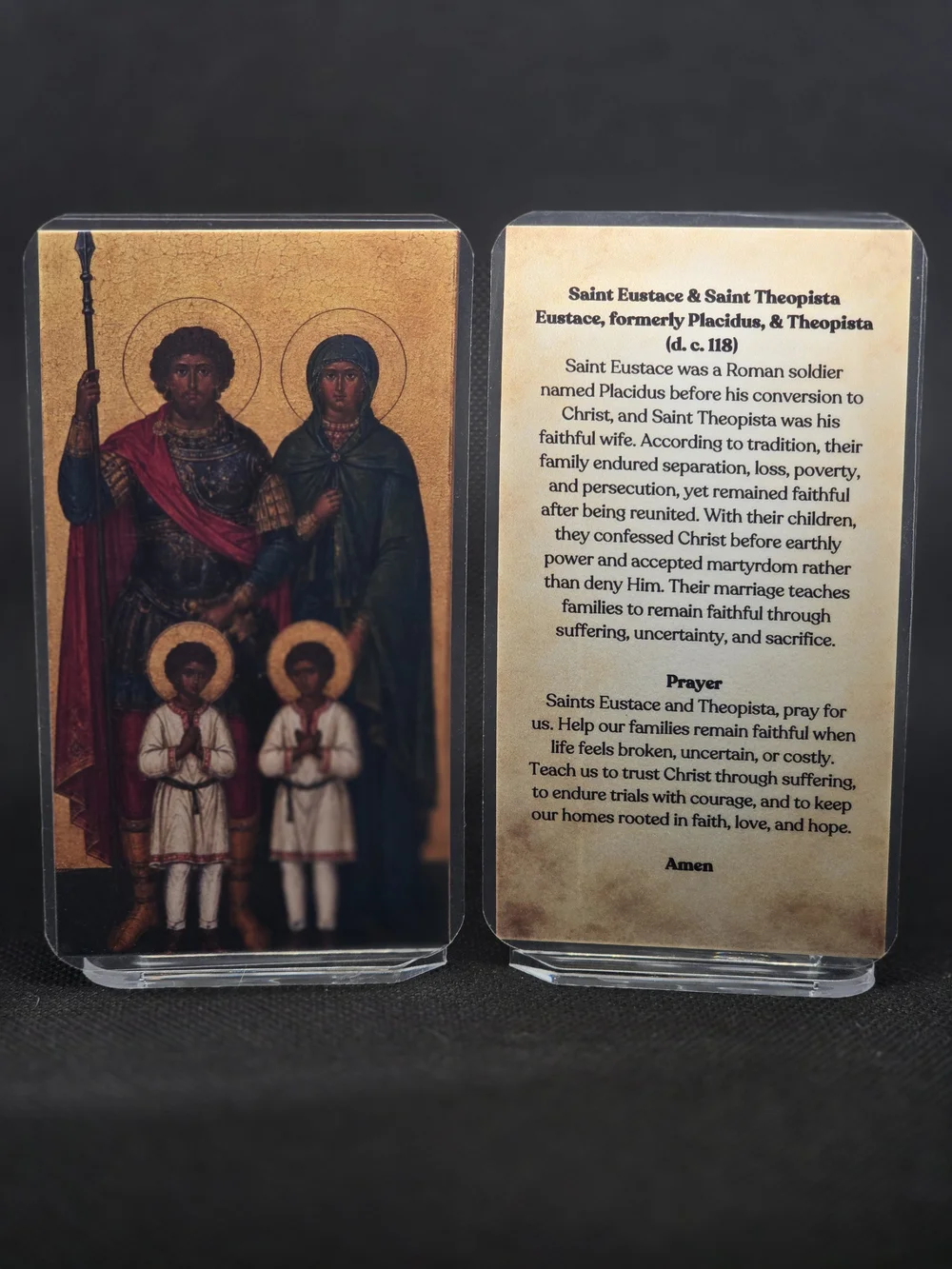
Saints Eustace and Theopista: Full Biography
Placidus, the Decorated General
According to a widely beloved medieval legend, a Roman general named Placidus, a decorated commander under the emperor Trajan or Hadrian depending on the version of the tale, had already achieved considerable military success and worldly standing when the event that would define the rest of his life took place. He was, by every account, an exemplary pagan Roman officer, admired for both competence and personal virtue even before his conversion.
The Vision of the Stag
Out hunting one day, Placidus pursued a magnificent stag deep into the forest, separating himself from his companions, and suddenly saw a crucifix shining brilliantly between the animal’s antlers, along with a voice identifying itself as Christ and calling him to conversion. Placidus, overwhelmed and converted on the spot, was baptized shortly afterward along with his wife and two young sons, taking the name Eustace, meaning “steadfast” or “fruitful,” while his wife took the name Theopista, meaning “faithful to God.”
Catastrophic Loss
What followed, in the story as it has been told for over a thousand years, was an almost Job-like sequence of trials sent to test the newly converted family’s faith. The family lost their fortune entirely, was separated for years by shipwreck, with Theopista taken captive by a ship’s captain and the two boys carried off separately by wild animals during the crossing, and endured extreme poverty as common agricultural laborers in a foreign land, not knowing whether the rest of the family had survived at all.
Miraculous Reunion and Restoration
After years of separate suffering, the family was miraculously reunited: the two sons, it turned out, had been rescued rather than killed by the animals that carried them off and raised in a nearby village without knowing each other's identity until a chance conversation revealed their shared past; Theopista had been protected from harm by her captor's sudden death and lived quietly working the land until she recognized her husband among a group of soldiers recruiting local laborers for a Roman campaign. Eustace was eventually restored to military command and won a great victory for Rome, but when he refused, out of gratitude to Christ rather than the pagan gods who were traditionally credited with military success, to offer the customary sacrifice for the triumph, the emperor, feeling personally betrayed by an officer he had just publicly honored, ordered Eustace, Theopista, and their two now-grown sons martyred together, according to legend by being sealed inside a bronze statue of a bull that was then heated over a fire until all four died.
Enduring Devotional Power Despite Legendary Status
For seventeen centuries, Eustace has been the patron families turn to when catastrophic loss upends an ordinary life and faith is the only thing that survives the wreckage, a devotional function that has outlasted repeated scholarly challenges to the story’s historicity precisely because the emotional and spiritual pattern it describes, sudden conversion, total loss, long separation, and eventual restoration, resonates regardless of whether it happened to one specific Roman general.
On Historical Reliability
Unlike most saints in this guide, the story of Eustace and Theopista is treated by scholars, and increasingly by the Church itself, as hagiographic fiction, a spiritual novel built from older pagan legend patterns, most notably the story of Placida-Hubert’s conversion by a stag with a crucifix, which appears with only minor variation attached to other early saints, rather than a record of an actual historical Roman general. There is no independent historical trace of Placidus or his family outside this narrative tradition, and the Roman Martyrology itself has flagged the story's uncertain historical basis. That does not diminish the story’s enduring devotional power, which is precisely why military families experiencing deployment, separation, and repeated relocation have long found his story unusually resonant, whatever its historical status.
Saint 12 of 20
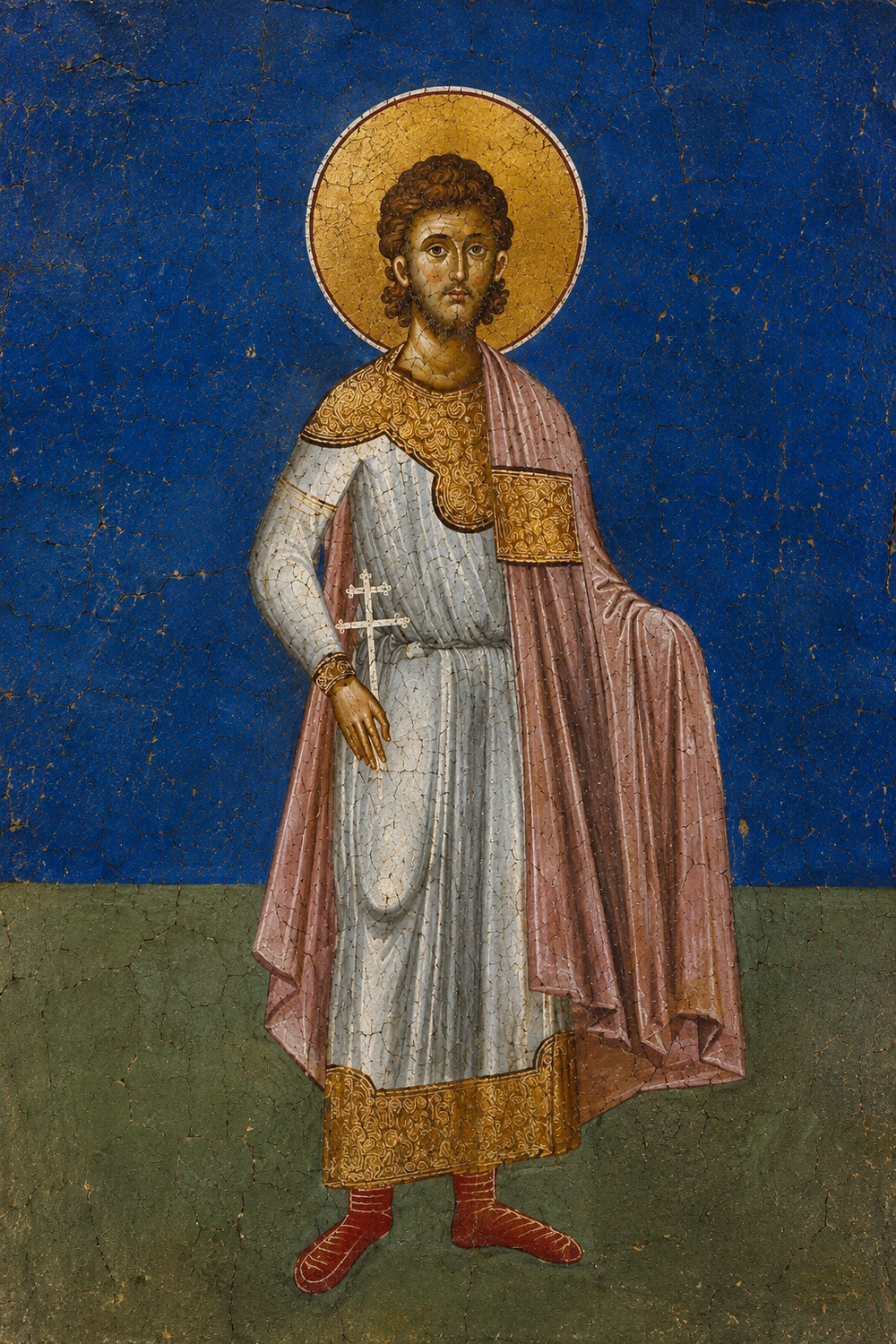
Saint Gordius: Full Biography
A Centurion in Caesarea
Gordius served as a centurion in Caesarea in Cappadocia, a major provincial capital and center of early Christian intellectual life that would, within a generation of his death, become home to Saint Basil the Great and the other Cappadocian Fathers. As a centurion, Gordius commanded roughly eighty men and held the kind of mid-level authority that made him visible within the city’s military and civic life without giving him the political protection that senior generals sometimes enjoyed.
Discharge and Withdrawal to the Wilderness
When the persecution under Emperor Licinius forced Christian soldiers from the ranks, Gordius was discharged and withdrew into the wilderness to live as a hermit, much as Menas would do in Egypt around the same period, a pattern that appears to have been a genuine and recurring response among Christian soldiers of the era who were unwilling to either apostatize or immediately court martyrdom.
Return During the Festival of Mars
After some years in solitude, Gordius made a deliberate decision to return to the city during a large pagan festival honoring the god Mars, an occasion chosen precisely because it would draw the largest possible public crowd, walked into the packed arena, and publicly interrupted the proceedings to proclaim himself a Christian in front of the entire assembled population of the city. He was seized, tried before the provincial governor, and beheaded outside the city walls, refusing every attempt by friends, former comrades, and even sympathetic officials to talk him into a quiet recantation that would have spared his life and allowed a discreet return to civilian obscurity.
Saint Basil’s Sermon and Living Eyewitnesses
Gordius stands apart from almost every other saint in this guide for the sheer quality of his historical sourcing. Roughly fifty years after his death, Saint Basil the Great, one of the most important theologians in Church history and himself a native of Cappadocia intimately familiar with local memory of the martyrdom, delivered a still-surviving panegyric in Gordius’s honor at the annual celebration of his feast. In that sermon, Basil explicitly reminded his congregation that some people listening to him that day had personally witnessed Gordius’s execution as children or young adults decades earlier, an extraordinary direct appeal to living memory that few ancient martyrdoms can claim in surviving written form.
Liturgical Legacy
Basil’s panegyric on Gordius became a model for later Byzantine martyr sermons and is still studied today as an example of fourth-century Cappadocian rhetoric and pastoral theology. Gordius is commemorated in the Orthodox Church on January 3, and his feast retains particular importance in the liturgical memory of Cappadocia and the broader Byzantine tradition that Basil himself helped shape.
On Historical Reliability
It is exceptionally rare for an ancient martyr to be commemorated by name, in a documented sermon, by a major Church Father who could point to living eyewitnesses in the room. For a saint associated with standing firm in faith after a period of quiet withdrawal, that level of direct historical testimony is fitting, and it places Gordius among the most reliably attested martyrs of the entire persecution era.
Saint 13 of 20
Saint Artemios of Antioch: Full Biography
A General Under Constantine the Great
Artemios rose to become one of the most senior Roman military commanders of his era, serving as a general under Constantine the Great during the years when Christianity was first being formally tolerated and promoted at the highest levels of imperial government, a career trajectory very different from the persecution-era martyrs earlier in this guide. His rise reflected both personal competence and the new opportunities opening for openly Christian officers under a sympathetic emperor.
Governor of Roman Egypt
He later served as imperial governor, or dux, of Roman Egypt, a position of substantial civil and military authority over one of the empire’s most economically vital provinces, responsible for both frontier defense and provincial administration across a region with a large and increasingly organized Christian population.
Confronting Julian the Apostate
When Julian the Apostate became emperor in 361 AD and moved decisively to reverse Constantine’s pro-Christian policies, reopening pagan temples across the empire and permitting, in some cases actively encouraging, the desecration of Christian holy sites, Artemios traveled to Antioch, where Julian had established his court while preparing for a campaign against Persia, and publicly confronted the emperor over the treatment of Christians and specifically over the destruction of the relics of Saints Andrew and Luke, which had been disturbed in Constantinople as part of Julian’s broader anti-Christian program.
Arrest, Torture, and Execution
Julian had him arrested immediately, stripped of his military rank and provincial office as a first act of punishment, then subjected to extended torture intended to break both his body and his public standing before finally being executed in 362 AD, making Artemios one of the highest-ranking Roman officials ever put to death specifically for opposing an emperor’s treatment of Christians.
An Unusually Well-Attested Martyr
Artemios is unusually well attested for a saint of this period, appearing not only in Christian hagiography, most notably a lengthy collection of miracle accounts known as the Miracles of Saint Artemios compiled centuries later in Constantinople, but also in the work of the Arian historian Philostorgius, a contemporary chronicler writing from a theological perspective with no particular incentive to embellish a rival tradition’s martyr, lending independent corroboration to the broad outline of his career and death.
Patronage and Iconography
In Greek Orthodox tradition, Artemios developed a specific and somewhat unusual secondary patronage for hernias and reproductive or groin ailments, based on miracle accounts recorded at his shrine in Constantinople, alongside his primary identity as a soldier-saint invoked for courage and healing more broadly. He is typically depicted in Byzantine icons in full military dress appropriate to his general’s rank, distinguishing him visually from the more junior soldier-martyrs on this list.
On Historical Reliability
His confrontation with Julian the Apostate places him among the small number of soldier-saints who directly and publicly opposed a reigning emperor to his face rather than simply refusing a private order, and the independent, non-Christian historical corroboration of his career gives this account unusual credibility even by the standards of well-documented saints.
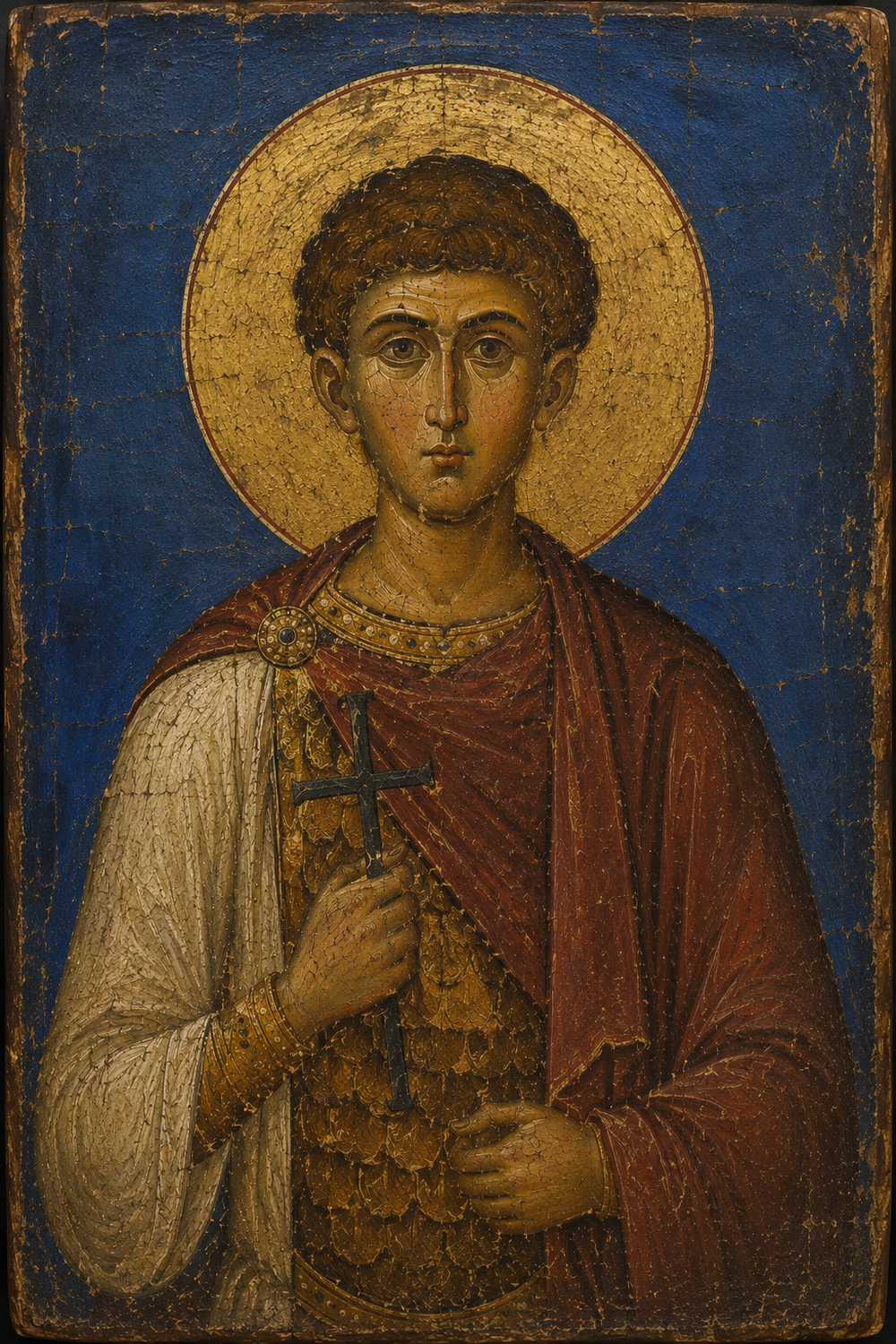
Saint 14 of 20
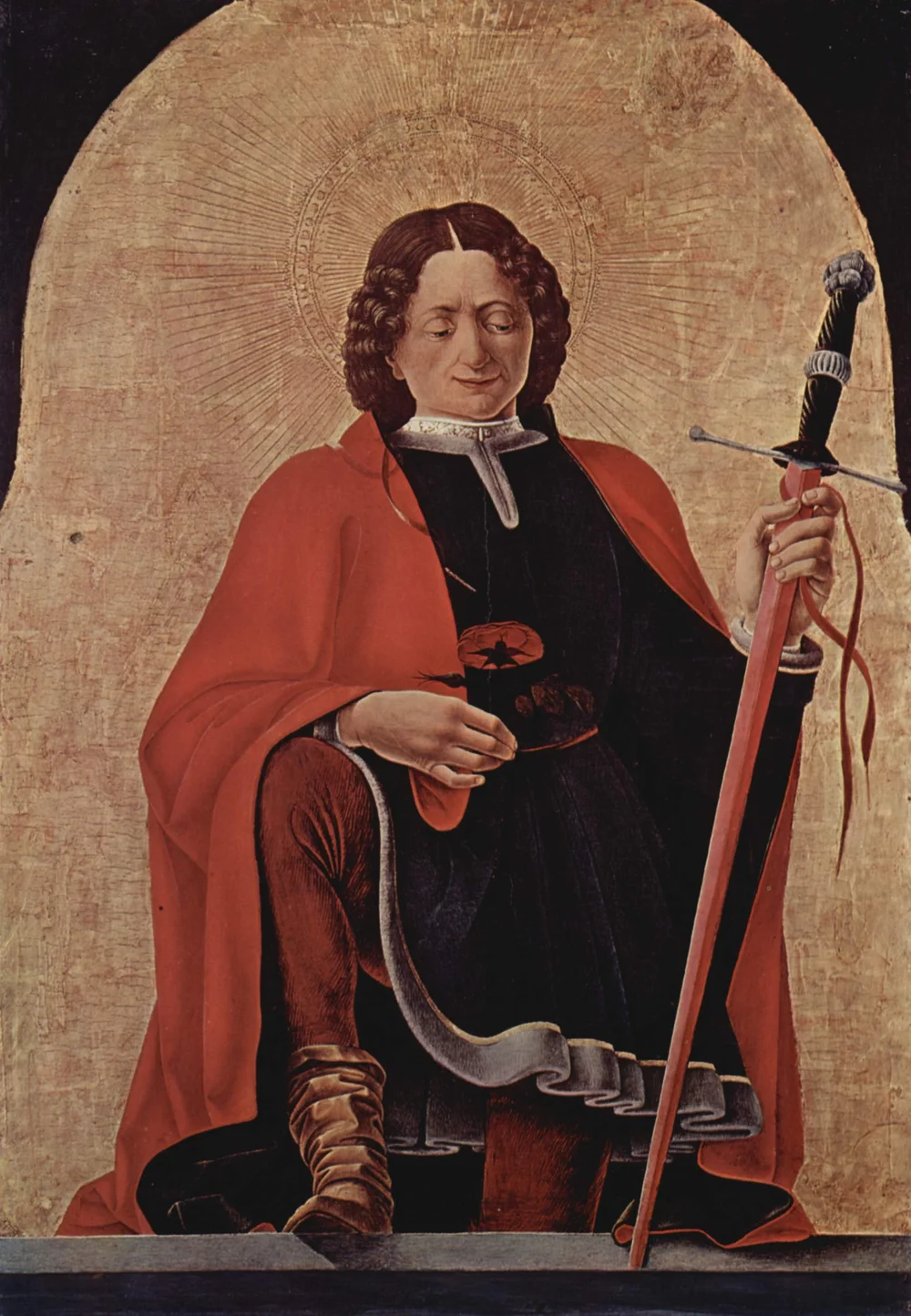
Saint Florian: Full Biography
A High-Ranking Officer on the Danube Frontier
Florian served as a high-ranking officer in the Roman administration of the province of Noricum, in what is now Austria, a frontier province along the Danube that required constant military organization against the threat of incursion from Germanic tribes to the north. His responsibilities extended beyond pure combat command into civil administration, including, according to tradition, the specific task of organizing and training brigades of firefighters within the Roman military and civic structure, a responsibility that has made him the patron saint of firefighters worldwide ever since.
The Arrest of Forty Christian Soldiers
When the Diocletianic persecution reached the province, Florian learned that a group of forty Christian soldiers under his own broader jurisdiction had been arrested by the provincial governor, Aquilinus, and set out deliberately to defend them, traveling to confront the governor directly rather than working through quieter channels that might have kept his own faith concealed.
Self-Identification and Arrest
He was arrested himself the moment he arrived and openly declared his own Christian faith to the governor’s face, effectively volunteering for the same fate as the men he had come to defend rather than attempting to negotiate their release from a position of official authority. Ordered to sacrifice to the Roman gods, he refused without hesitation.
The Millstone and the Enns River
Sentenced to be burned alive, Florian reportedly told his executioners he would climb to heaven on the flames rather than fear them, a statement of such unnerving confidence that the sentence was reportedly changed on the spot: a millstone was tied around his neck and he was thrown from a bridge into the Enns River to drown instead, a method perhaps chosen specifically to deny him the fiery death he had claimed not to fear. Tradition holds that his body washed ashore and was guarded from scavenging animals by a great eagle until a local Christian woman named Valeria recovered it for proper burial at what became the Augustinian Abbey of Sankt Florian near Linz.
Relics and Patronage of Poland
In 1138, Pope Lucius III distributed relics of Florian to the King of Poland and the Bishop of Krakow, establishing his cult firmly in Central Europe and making him, alongside his role as patron of firefighters, a patron saint of Poland and of the city of Krakow specifically, a patronage that persists in Polish Catholic devotion to this day.
Iconography
Florian is almost universally depicted in art wearing Roman military dress and pouring water from a pitcher onto a burning building, an image tied to a popular legend that he single-handedly extinguished a house fire threatening an entire village with a single pitcher of water, cementing his firefighting patronage in visual tradition centuries before organized firefighting existed in its modern form.
On Historical Reliability
Florian’s martyrdom is treated as historically grounded and is venerated in both the Catholic and Eastern Orthodox Churches, a relatively rare instance of full cross-tradition recognition for a saint from the Latin-speaking Danube frontier of the empire rather than the Greek East. Beyond firefighters, his willingness to walk directly into danger to defend fellow service members already under arrest makes him a natural patron for anyone who has ever put themselves at risk specifically to protect the people they served alongside.
Part II
Catholic-Specific Military Saints
The three men in this section all lived after 1054 and are venerated specifically within the Catholic tradition, though their historical example, especially Martin’s, is widely respected and referenced even outside it. Each represents a different kind of military experience: a conscript who could no longer fight in good conscience, a teenage volunteer who led an army into battle, and a career soldier whose wound ended his military life and began an entirely different kind of warfare.
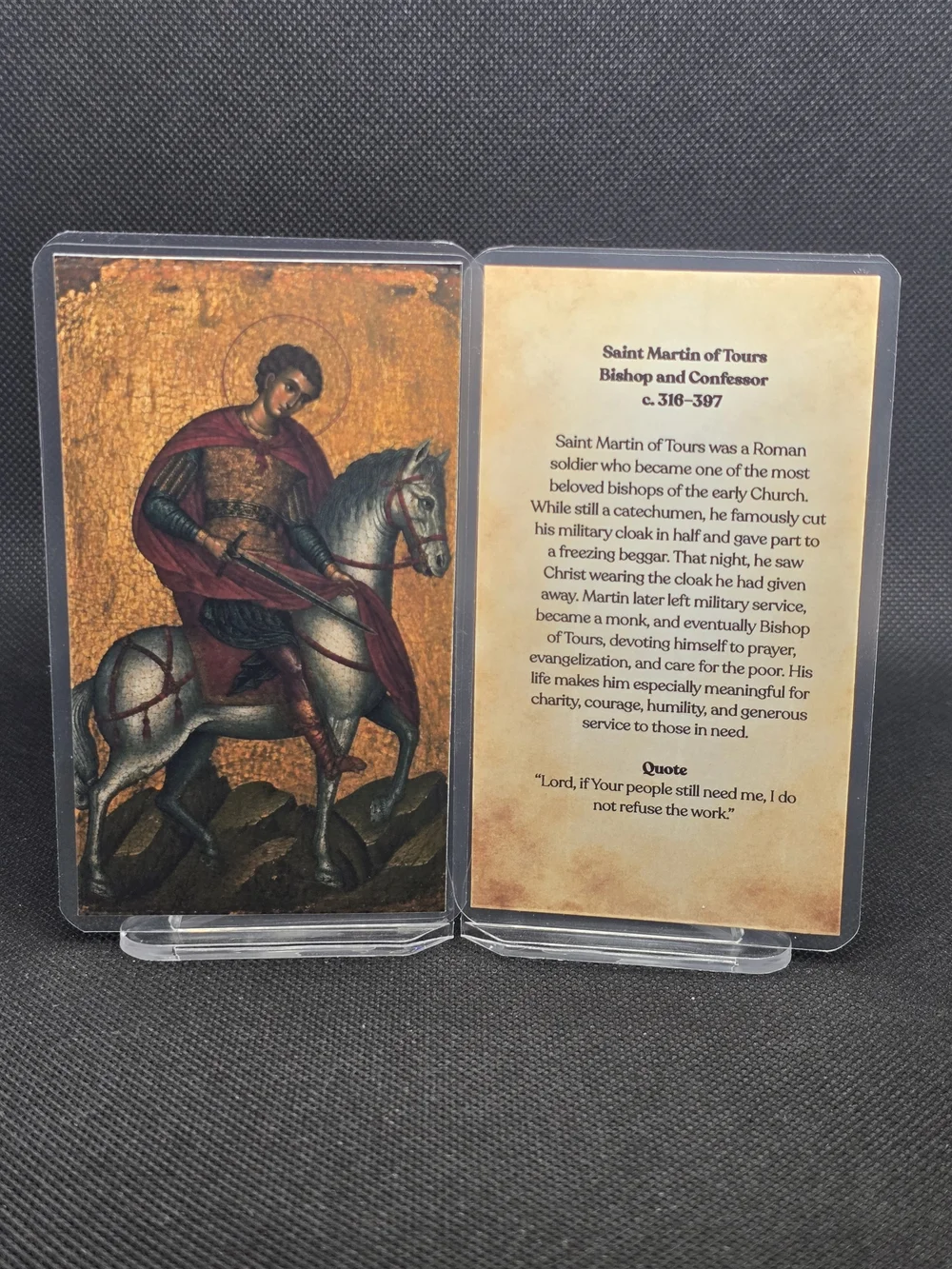
Saint Martin of Tours: Full Biography
Born Into a Military Family
Martin was born around 316 AD in Savaria, in the Roman province of Pannonia (present-day Hungary), the son of a senior Roman military officer, and was raised largely in Pavia, Italy, where his father was later stationed. Roman law at the time required the sons of veteran officers to enter military service themselves, and Martin was enrolled in the imperial cavalry, likely against his own inclination, since he had already expressed interest in Christian instruction as a boy of only ten, well before his conscription.
The Beggar at the Gates of Amiens
The single most famous episode of his life took place while he was stationed in Gaul with an elite cavalry unit called the Scholae. On a bitterly cold night at the gates of Amiens, Martin encountered a freezing, half-clothed beggar whom every other passerby had ignored. Having nothing else of value on him, Martin drew his sword, cut his own heavy military cloak in half, and gave one half to the man, keeping the other for himself. That night he dreamed of Christ wearing the half-cloak he had given away, telling the angels gathered around him, “Martin, still a catechumen, has clothed me.” Martin was baptized shortly afterward, at around eighteen years of age, though he remained in military service for several more years at his commander’s insistence.
“I Am a Soldier of Christ”
Years later, before a battle against invading Germanic tribes near Worms, Martin approached the Roman commander Julian, the future emperor Julian the Apostate, before his later turn against Christianity, and refused to accept the customary donative, a cash bonus given to soldiers before battle, stating that he wished to be released from military service entirely. When accused of cowardice for making this request on the eve of combat, Martin offered to prove his sincerity in the most direct way possible: he volunteered to stand unarmed at the front of the line the next day, between the two armies, relying on nothing but the sign of the cross for protection. According to Martin’s contemporary biographer, the battle never took place; the opposing tribe sent envoys offering surrender before the fighting began, an outcome his hagiography treats as providential vindication of his stand. Martin was discharged from military service shortly afterward, having served roughly twenty-five years by some estimates.
Monk, Then Reluctant Bishop
Martin went on to become a disciple of Saint Hilary of Poitiers and founded one of the first monastic communities in Gaul at Ligugé, introducing a form of organized monastic life to Western Europe earlier than almost anywhere else outside Italy and the East. He was later made Bishop of Tours in 371 AD against his own wishes, reportedly while hiding in a barn or goose pen to avoid the appointment, a detail so charming it gave rise to the custom, still observed in parts of Europe, of eating goose on his feast day.
Evangelizing Rural Gaul
As bishop, Martin spent the remainder of his life evangelizing the rural countryside of Gaul, an area still heavily pagan even as the cities had become largely Christian, personally tearing down pagan shrines and sacred trees while founding churches and monasteries in their place. He governed his diocese with unusual gentleness for the era, notably intervening on behalf of heretics condemned to death by secular authorities, arguing that the Church had no business calling on the state’s sword to settle matters of doctrine, a strikingly early and consistent position for a fourth-century bishop.
An Unusually Well-Documented Ancient Saint
Martin is one of the best-documented saints of the ancient world. His biographer, Sulpicius Severus, was a contemporary who knew Martin personally, visited him, and wrote his Life of Saint Martin while Martin was still alive, giving this saint a level of direct, near-contemporary documentation that is extremely rare for the period and stands in sharp contrast to the centuries-later hagiographies of many other saints on this list.
Patronage and Modern Legacy
Martin is honored as patron of soldiers and, distinctly, of conscientious objectors, a dual patronage that reflects the two halves of his own life. His feast day, November 11, later became the date chosen for Armistice Day marking the end of the First World War, an association many find fitting for a saint whose defining military act was the refusal to fight.
On Historical Reliability
His example of a soldier who serves faithfully but ultimately declines an order in conscience, then proves his courage by other means, remains one of the most referenced military saint stories for veterans wrestling with moral injury or conscientious objection, and the unusually strong contemporary documentation of his life gives that example real historical weight rather than pious legend.
Saint 16 of 20
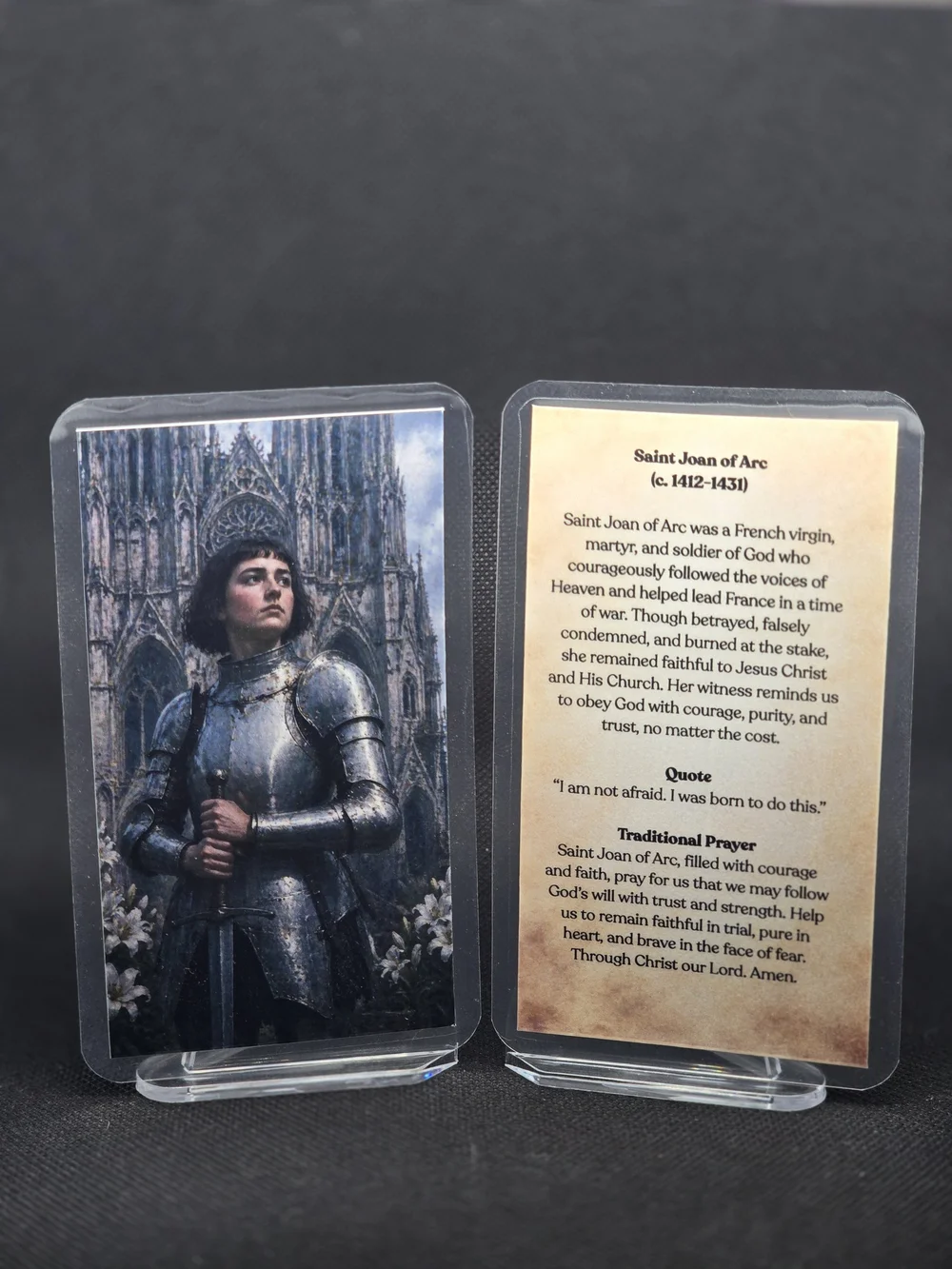
Saint Joan of Arc: Full Biography
A Peasant Girl in a Nation at War
Joan was an illiterate peasant girl from Domrémy, in northeastern France, born into a modest farming family during one of the darkest periods of French history. The Hundred Years’ War had left France divided, with English forces controlling large portions of the north and the Burgundian faction allied against the French crown, while the uncrowned Dauphin Charles struggled to hold together what remained of a legitimate French government.
The Voices Begin
At around thirteen years old, Joan began experiencing visions and voices she identified as Saint Michael the Archangel, Saint Margaret of Antioch, and Saint Catherine of Alexandria, who told her over the following years that France could still be saved, and that she specifically had been chosen to lead the effort, first by relieving the besieged city of Orléans and then by ensuring the Dauphin was properly crowned king.
Convincing a Skeptical Court
At sixteen, she convinced a local garrison commander, Robert de Baudricourt, to grant her an armed escort to the royal court at Chinon, a journey of over three hundred miles through contested territory. Once there, she reportedly identified the Dauphin despite his attempt to disguise himself among his courtiers, a detail cited by contemporaries as evidence of her divine guidance, and underwent formal theological examination by clergy at Poitiers to confirm her orthodoxy before being granted troops.
The Siege of Orléans and Coronation at Reims
At seventeen, dressed in specially commissioned white armor and carrying a banner rather than a weapon, since she insisted she had never killed anyone herself, Joan was placed at the head of a French relief force and led the successful lifting of the English siege of Orléans in May 1429, a turning point in the war that had seemed unwinnable for France only weeks earlier. She followed this with a rapid campaign that culminated in the coronation of Charles VII at Reims Cathedral in July 1429, the traditional site of French royal consecration, cementing his legitimacy as king in a way that no military victory alone could have accomplished.
Capture and Trial
The following year, in May 1430, she was captured by Burgundian forces at Compiègne and sold to the English, who arranged for a politically motivated ecclesiastical trial on charges of heresy and cross-dressing, the latter charge stemming from her continued use of male military attire even in prison, which she maintained was necessary for her own protection from assault by her guards. The trial, conducted at Rouen under the direction of the pro-English Bishop Pierre Cauchon, is regarded by modern historians as a legal travesty conducted to serve English political interests rather than a genuine ecclesiastical proceeding, riddled with procedural irregularities and denial of counsel.
Execution and Posthumous Vindication
She was burned at the stake in the marketplace of Rouen on May 30, 1431, at nineteen years old, her ashes reportedly scattered in the Seine to prevent any relics from being collected. A retrial ordered by Pope Callixtus III in 1456, prompted by an appeal from Joan’s own mother, formally nullified the original verdict and declared her innocent, based on extensive testimony gathered from surviving witnesses to the original trial. She was beatified in 1909 and canonized in 1920.
Official Patron of Soldiers
Joan of Arc is one of the most exhaustively documented figures of the medieval period, thanks to the survival of the complete transcripts of both her original trial and her 1456 posthumous retrial, giving historians her own recorded words under direct interrogation in a level of detail almost unmatched for any other person of her era, saint or otherwise. In 1922, Pope Pius X formally named her, alongside Saint Sebastian, a patron of soldiers, recognizing a teenage girl who led men into battle as one of the Church’s two official protectors of those who serve in uniform.
On Historical Reliability
Unlike nearly every other saint in this guide, Joan of Arc's life requires no historicity caveat. Her military campaigns, capture, trial, and execution are documented in extraordinary contemporary detail, making her the single most thoroughly verified figure among all twenty military saints covered here.
Saint 17 of 20
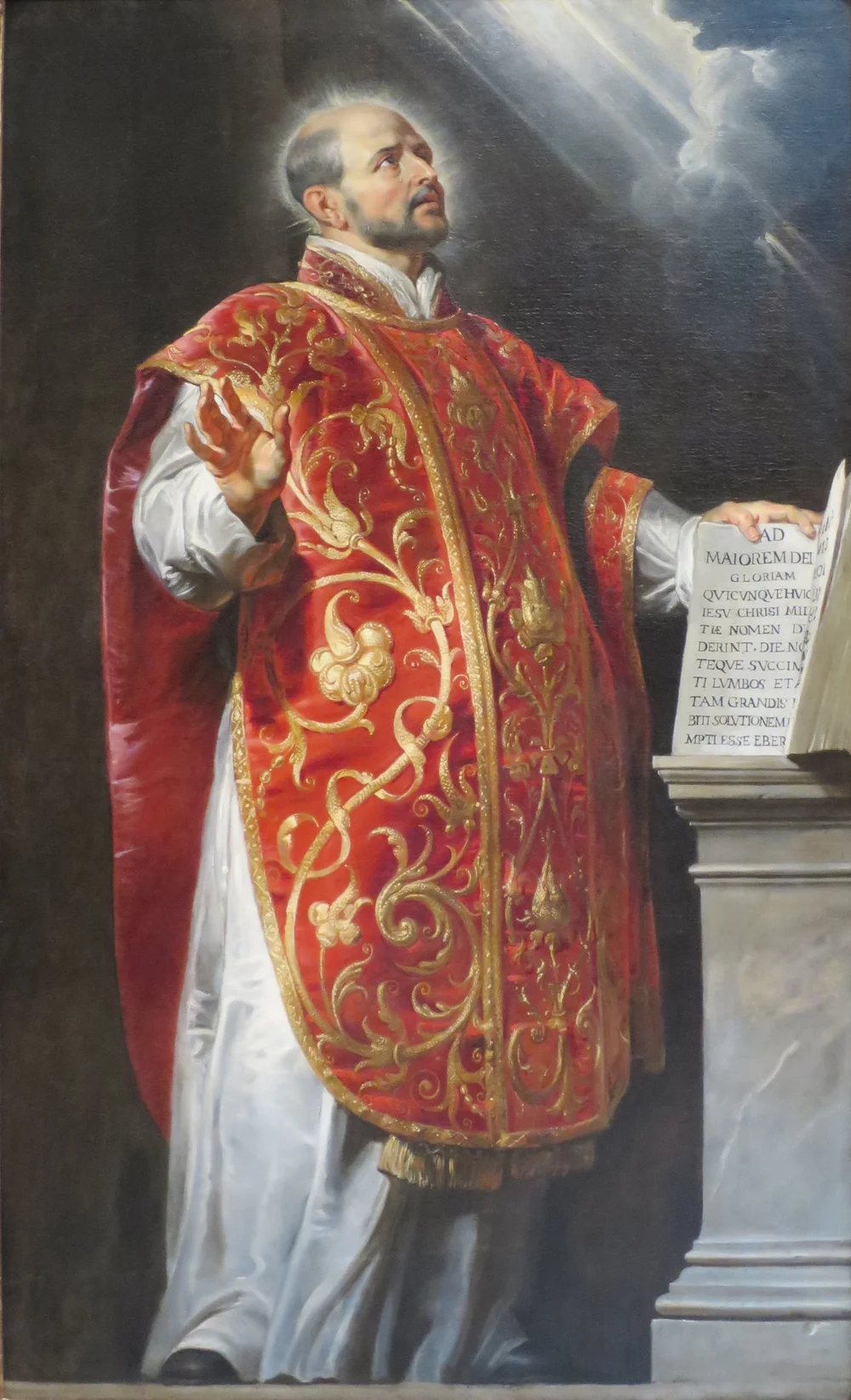
Saint Ignatius of Loyola: Full Biography
A Vain Young Courtier and Soldier
Ignatius, born Iñigo López de Loyola to a noble Basque family in the castle of Loyola in northern Spain, spent his early adulthood as a professional soldier and self-described man of vanity, more interested in dueling, gambling, elaborate court fashion, and courtly romance than religion. He served first as a page in the household of a Castilian nobleman before entering military service, developing a reputation for both personal courage and a quick, sometimes violent temper.
The Siege of Pamplona
In 1521, defending the fortress of Pamplona against a French siege as part of a garrison heavily outnumbered and under orders to surrender, Ignatius argued forcefully for continued resistance out of personal honor even after his commanding officer had concluded the position was hopeless. During the ensuing bombardment, he was struck by a cannonball that passed between his legs, shattering one leg outright and badly injuring the other, effectively ending his military career on the spot in the most literal way possible.
A Long, Painful Convalescence
During a long, painful convalescence at his family’s castle, including at least one deliberately re-broken and reset leg bone undertaken purely for the sake of his vanity and appearance in tight hose, Ignatius had nothing to read but a life of Christ and a book of saints’ lives, since no chivalric romance novels of the kind he preferred were available in the house. Bored and immobilized for months, he began reading them anyway.
The Discernment of Spirits
Ignatius began to notice something during this period that would become the foundation of his entire later spiritual system: fantasies of worldly glory, military success, and romantic conquest left him excited in the moment but empty and restless afterward, while thoughts of imitating the saints and serving Christ left him with a lasting sense of peace that persisted even after the daydream ended. This simple but carefully observed pattern became the seed of what he later formalized as the discernment of spirits, a structured method for distinguishing which interior movements come from God and which do not.
Pilgrimage, Study, and the Founding of the Jesuits
After his recovery, Ignatius undertook a period of intense penance and pilgrimage, including nearly a year of prayer and fasting in a cave near Manresa, Spain, where he composed the earliest version of his Spiritual Exercises, before eventually pursuing formal theological studies in Paris well into his thirties, an unusually late start driven entirely by his conviction that he needed proper training before attempting to guide others. He went on to found the Society of Jesus, the Jesuits, in 1540 along with a small group of fellow students, structuring the order along explicitly military lines, complete with a superior general, a distinctive fourth vow of direct obedience to the Pope beyond the usual three religious vows, and a founding document he titled the Spiritual Exercises, still used today as a structured, disciplined thirty-day program of prayer and self-examination modeled deliberately on the rigor of military training.
A Soldier Who Never Stopped Thinking Like One
Ignatius never stopped thinking like a soldier. The Jesuit order he built emphasized rapid deployment, strict obedience to a chain of command, adaptability to local conditions, and a willingness to be sent anywhere at a moment's notice, all recognizably military virtues redirected entirely toward missionary and educational work. He simply changed which war he was fighting and Who he was fighting it for.
On Historical Reliability
Ignatius is a thoroughly documented figure of the sixteenth century, with his own autobiography, dictated late in life to a fellow Jesuit, surviving alongside extensive Jesuit archival records covering nearly every stage of his adult life. Unlike most saints in this guide, he was not martyred; he died of natural causes in Rome in 1556. His specific value for veterans lies less in his combat record and more in what came after it: a career soldier whose body could no longer serve in uniform, who had to rebuild an entire identity and sense of purpose from the ground up over years of study and self-examination, and who used the very discipline his military training had given him to do it.
Part III
Orthodox-Specific Military Saints
The three saints in this final section developed within the Eastern Orthodox tradition after the Great Schism, and each is tied closely to the defense of Christian Rus’ and Armenia against invasion. Where Part II showed a conscript, a teenage commander, and a career officer, this section shows a ruling prince who had to balance battlefield victory against political survival, two monks who returned to the battlefield they had left behind, and a general who chose exile and death in a foreign court rather than betray his faith.
Saint Alexander Nevsky: Full Biography
Born Into a Rus’ on the Edge of Catastrophe
Alexander was born in 1221 in Pereslavl-Zalessky, the son of Yaroslav II of Vladimir, into a Rurikid princely family governing a patchwork of Rus’ principalities that would, within just over a decade of his birth, face the most devastating invasion in their history: the Mongol conquest that shattered nearly every major Rus’ city between 1237 and 1240, including Kiev itself. Alexander came of age watching his own homeland absorb a catastrophe that permanently reshaped Eastern European history.
Prince of Novgorod at Nineteen
He became Prince of Novgorod, one of the few major Rus’ cities the Mongols did not directly sack, at a moment when it faced enemies on every remaining side: Swedish forces pressing from the northwest under the banner of a papally sanctioned crusade against Orthodox Rus’, the German and Danish crusading Teutonic and Livonian Knights from the west with similar ambitions, and the still-active threat of further Mongol incursion from the shattered east.
The Battle of the Neva, 1240
In 1240, at only nineteen years old, Alexander led a decisively smaller Novgorodian force in a surprise attack against an invading Swedish army camped at the mouth of the Neva River, catching them before they could fully establish their position and winning a victory so significant it became permanently attached to his name: Nevsky, “of the Neva.” The battle secured Novgorod’s access to the Baltic and halted, at least for a generation, one prong of the coordinated Western pressure against Orthodox Rus’.
The Battle on the Ice, 1242
Two years later, in April 1242, he faced the Teutonic Knights and their allies on the frozen surface of Lake Peipus in what became known as the Battle on the Ice. Alexander deliberately positioned his forces to draw the heavily armored knights onto a section of spring ice already weakened by the changing season, a tactical decision that turned the knights’ greatest advantage, heavy cavalry armor, into a fatal liability as the ice began to crack and give way beneath their weight. The victory effectively ended the crusading threat against Novgorod from the west for a generation and remains one of the most studied medieval battles in Russian military history.
The Harder Battle: Submission to the Golden Horde
Alexander’s harder battle was fought without a sword. Recognizing that Rus’ could not simultaneously fight the Mongol Golden Horde and the Catholic crusading orders and survive either war, he made the deeply unpopular decision to travel personally to the court of the Golden Horde, submit politically, and agree to pay tribute, while devoting his available military resources entirely to the western threat rather than provoking a two-front catastrophe. This choice, criticized by some contemporaries and later historians as capitulation, preserved Orthodox Christian Rus’ identity and its Church under Mongol overlordship rather than risking the kind of total destruction the way other Rus’ principalities that resisted the Horde directly, such as Kiev, had suffered.
Death and Deathbed Monastic Vows
He died in 1263 while returning from a difficult and physically exhausting diplomatic mission to the Horde undertaken specifically to negotiate Rus’ soldiers out of forced conscription into Mongol military campaigns, taking monastic vows on his deathbed under the name Alexei. Tradition holds he may have been deliberately poisoned during the journey, though this remains historically unconfirmed.
Canonization and the Alexander Nevsky Lavra
Alexander was formally canonized by the Russian Orthodox Church in 1547, and in 1724, Peter the Great had his relics transferred with great ceremony to Saint Petersburg, where the Alexander Nevsky Lavra, one of the most important monasteries in Russian Orthodoxy, was built to house them, permanently linking the medieval warrior-prince to Russia’s new imperial capital.
On Historical Reliability
Alexander Nevsky is a thoroughly documented figure of medieval Russian history, with his military campaigns recorded in chronicles from multiple, sometimes rival sources, giving historians a genuinely cross-referenced account of his career. He remains, to this day, one of the most invoked patrons for Russian and broader Slavic Orthodox soldiers, specifically remembered for a rare combination of tactical brilliance and the political discipline to know which fights were survivable.
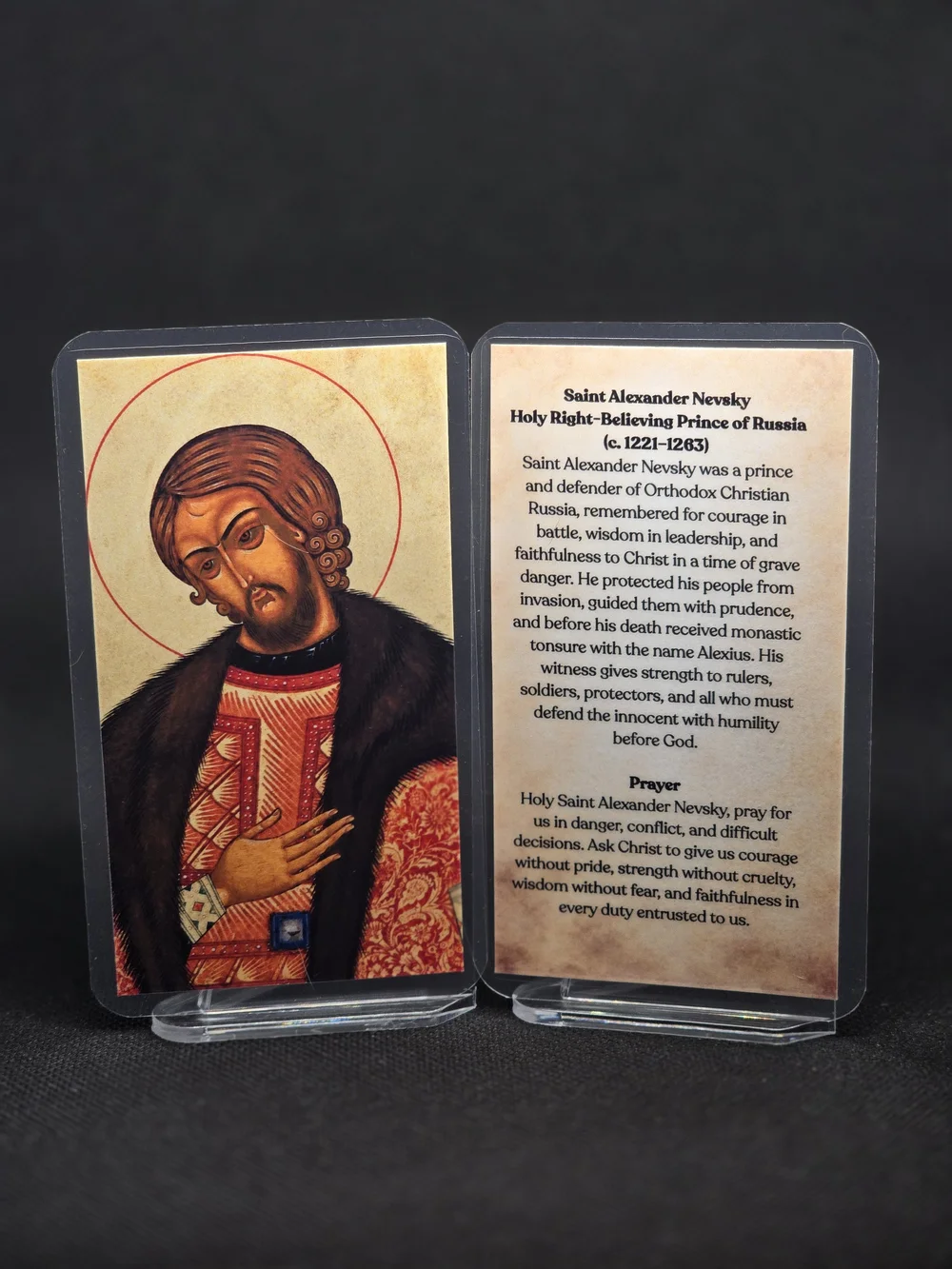
Saint 19 of 20
Saints Alexander Peresvet and Andrei Oslyabya: Full Biography
From the Battlefield to the Monastery
Peresvet and Oslyabya had both been experienced warriors, likely of boyar or noble military background from the Bryansk region, before entering monastic life at the Trinity Lavra under the direct spiritual guidance of Saint Sergius of Radonezh, one of the most revered figures in Russian Orthodox history and the founder of a monastic revival that reshaped Russian spiritual life in the fourteenth century. Both men had, by every indication, genuinely left combat behind for a life of prayer, labor, and stability within monastery walls.
Dmitri Donskoi Seeks a Blessing
In 1380, as Grand Prince Dmitri Donskoi prepared to face the vastly larger Mongol-Tatar army of Mamai at Kulikovo Field, a confrontation that would become one of the pivotal battles in Russian history and the first major Rus’ victory over Mongol forces in over a century of subjugation, he traveled to the Trinity Lavra seeking Sergius’s blessing for the coming fight, understanding that the spiritual legitimacy of the campaign mattered as much to his soldiers’ morale as its military planning.
Sergius Sends His Own Monks to War
Sergius gave his blessing and, in an extraordinary and by no means uncontroversial decision within the monastic tradition, sent both Peresvet and Oslyabya with the army, fully aware he was sending men back into the exact kind of combat they had formally renounced when they took their monastic vows. This decision has been debated by Orthodox theologians for centuries as an exceptional case rather than a precedent, justified specifically by the existential stakes of the battle for the survival of Christian Rus’ identity under Mongol rule.
The Single Combat of Peresvet and Chelubey
According to the chronicles, the battle opened, as was medieval steppe and Rus’ custom, with a ceremonial single combat between champions from each army, intended to set the tone for the larger engagement to follow. Peresvet volunteered to face the Tatar champion, a warrior named Chelubey, also recorded in some sources as Temir-murza, reportedly renowned and feared across the steppe for having never lost such a duel. Still wearing his monastic schema, the outer garment of a fully professed monk, beneath his armor rather than a helmet, a detail chroniclers treat as deliberate and symbolic rather than an oversight, Peresvet rode directly at Chelubey. The two combatants’ lances struck simultaneously in the charge, and both men were killed in the same instant, an act read ever since as a monk consciously and deliberately trading his life to open the battle that would determine his people’s future, choosing not to survive the duel even if a defensive posture might have allowed it.
Oslyabya’s Continued Fight
Oslyabya fought through the remainder of the battle rather than falling in the opening duel, and according to most chronicle traditions also died in the extended fighting that followed, though some later, less reliable sources claim he survived and returned to monastic life; the weight of tradition holds that both monks gave their lives at Kulikovo. Dmitri Donskoi’s forces went on to win a hard-fought and historically decisive victory that, while it did not immediately end Mongol overlordship, marked a turning point in Rus’ morale and military confidence that historians trace directly forward to the eventual full liberation a century later.
Burial and Commemoration
Both monks are traditionally said to be buried at the Old Simonov Monastery in Moscow, a site that remains a place of pilgrimage and commemoration for the battle’s heroes, and their names are recited annually alongside Dmitri Donskoi’s in liturgical commemorations of the Kulikovo victory that continue in Russian Orthodox practice to this day.
On Historical Reliability
The Battle of Kulikovo is a firmly documented historical event of major significance in Russian history, and the participation of Peresvet and Oslyabya is recorded across multiple medieval Russian chronicles, though some specific narrative details, such as the exact circumstances of the single combat, carry the embellishment natural to a story retold for centuries as a defining national memory. Both men are venerated as monastic martyrs and remain uniquely powerful patrons for anyone who has left a life of combat behind, only to be called back into it one final time for the people they love.
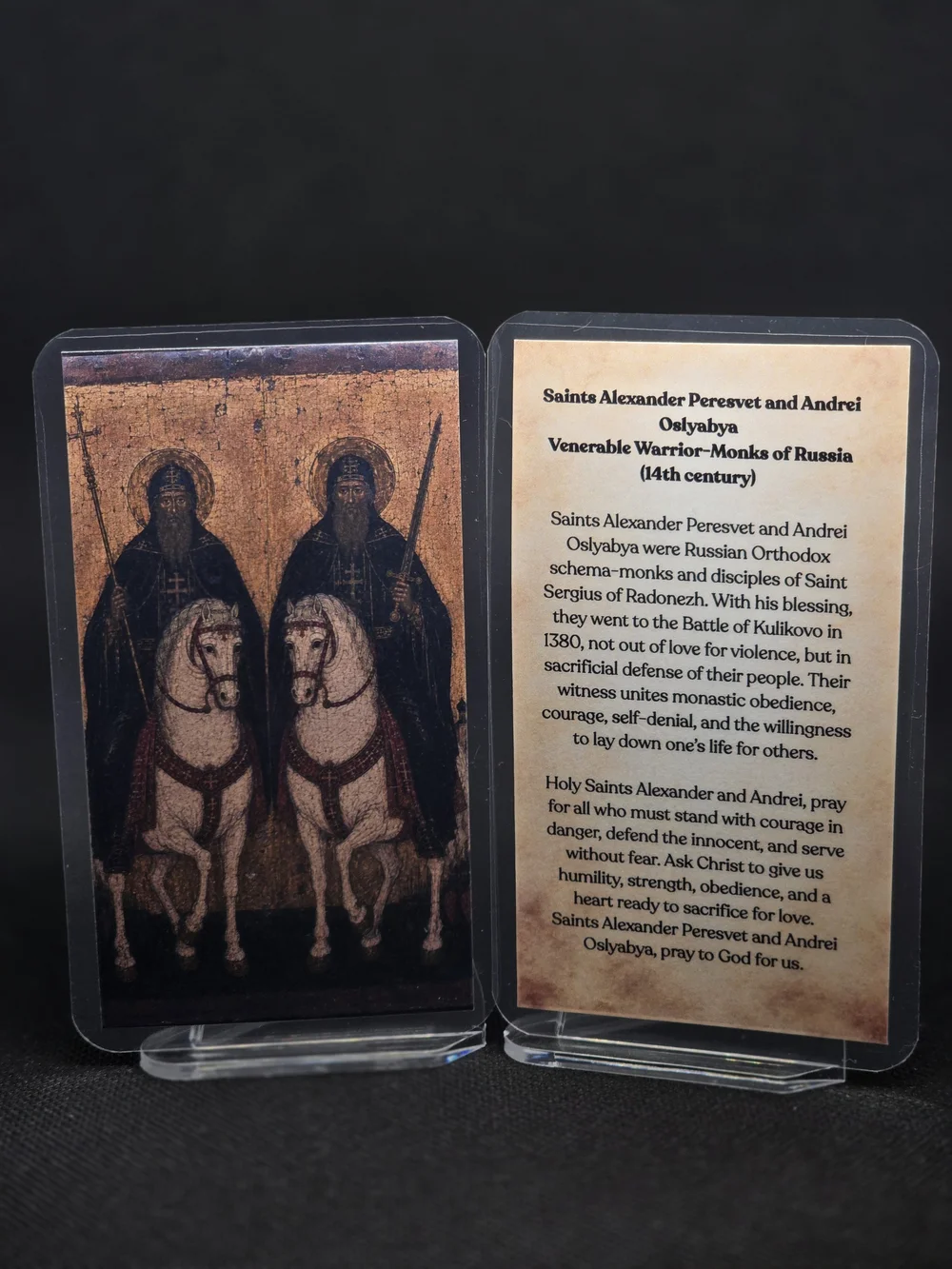
Saint 20 of 20
Saint Sarkis the Warrior: Full Biography
Rise Through Roman Military Ranks
Sarkis, whose name is the Armenian form of Sergius, served as a military commander of Cappadocian or Roman background who rose to high rank in imperial service, reportedly converting large numbers of soldiers under his direct command to Christianity through both his personal example and active teaching, a pattern that made him increasingly conspicuous as pressure on Christian officers intensified.
Flight from Julian the Apostate
When Julian the Apostate began actively persecuting Christians within the Roman military as part of his broader anti-Christian program, Sarkis fled with his young son Mardiros, first to Armenia, which had already formally adopted Christianity as a state religion decades earlier under King Tiridates III, and then, as Roman political pressure followed him even there, further east into the neighboring Sasanian Persian Empire.
Service Under King Shapur II
King Shapur II of Persia, impressed by Sarkis’s military reputation and experience, welcomed him into Persian service despite the ongoing rivalry between Rome and Persia, valuing competent commanders regardless of their religious background in the way many ancient rulers pragmatically did. Sarkis served Shapur loyally and effectively in the field for a period of years, but consistently and quietly refused every demand that he participate in the mandatory worship of the sun central to Persian Zoroastrian state religion, a refusal that royal officials appear to have overlooked for some time given his military value.
Discovery and the Death of Mardiros
Eventually discovered secretly celebrating the Eucharist with his own soldiers in the field, an act that could no longer be quietly ignored once reported to the royal court, Sarkis and Mardiros were arrested together. According to Armenian tradition, Mardiros was executed first, in front of his own father, in a deliberate attempt to break Sarkis’s resolve through the one method that might have worked on anyone else; Sarkis instead used his son’s death and his own subsequent testimony to strengthen the faith of the remaining Christian soldiers under his command before he himself was beheaded.
Premier Military Patron of the Armenian Church
Saint Sarkis holds a place in Armenian devotion unlike any other saint in this guide. Beyond his role as the premier military patron of the Armenian Apostolic and Armenian Catholic Churches, invoked by Armenian soldiers before every major conflict across the centuries, his cult developed a remarkably broad reach into civilian devotional life as well.
Feast Day Customs: Love, Matchmaking, and Safe Travel
His feast, movable and tied to the approach of Great Lent, has also become associated in Armenian folk tradition with young love, matchmaking, and safe travel, a set of associations that developed alongside his military patronage and gives him an unusually broad devotional reach for a soldier-saint, touching both the battlefield and the household in ways few other military saints do. Young unmarried Armenians traditionally observe customs on the eve of his feast believed to reveal a future spouse, a folk practice that coexists comfortably alongside his primary identity as a general martyred for his faith.
Surp Sarkis Churches and Continuing Devotion
Churches dedicated to Surp Sarkis, Saint Sarkis in Armenian, are found throughout the Armenian diaspora worldwide, including a historically significant cathedral in Istanbul serving the Armenian Patriarchate of Constantinople, and Armenian service members and their families continue to invoke him by name before deployment, a living continuation of a devotional pattern stretching back roughly sixteen centuries.
On Historical Reliability
Sarkis’s core narrative, a Roman-trained general who served two empires while refusing religious compromise in either, is treated as historically grounded within the Armenian tradition, though as with several ancient martyrs, some narrative specifics were elaborated across later centuries of retelling. His enduring, near-universal veneration across every branch of the Armenian Church for over sixteen centuries speaks to how central his witness has remained to Armenian Christian identity under repeated foreign domination.
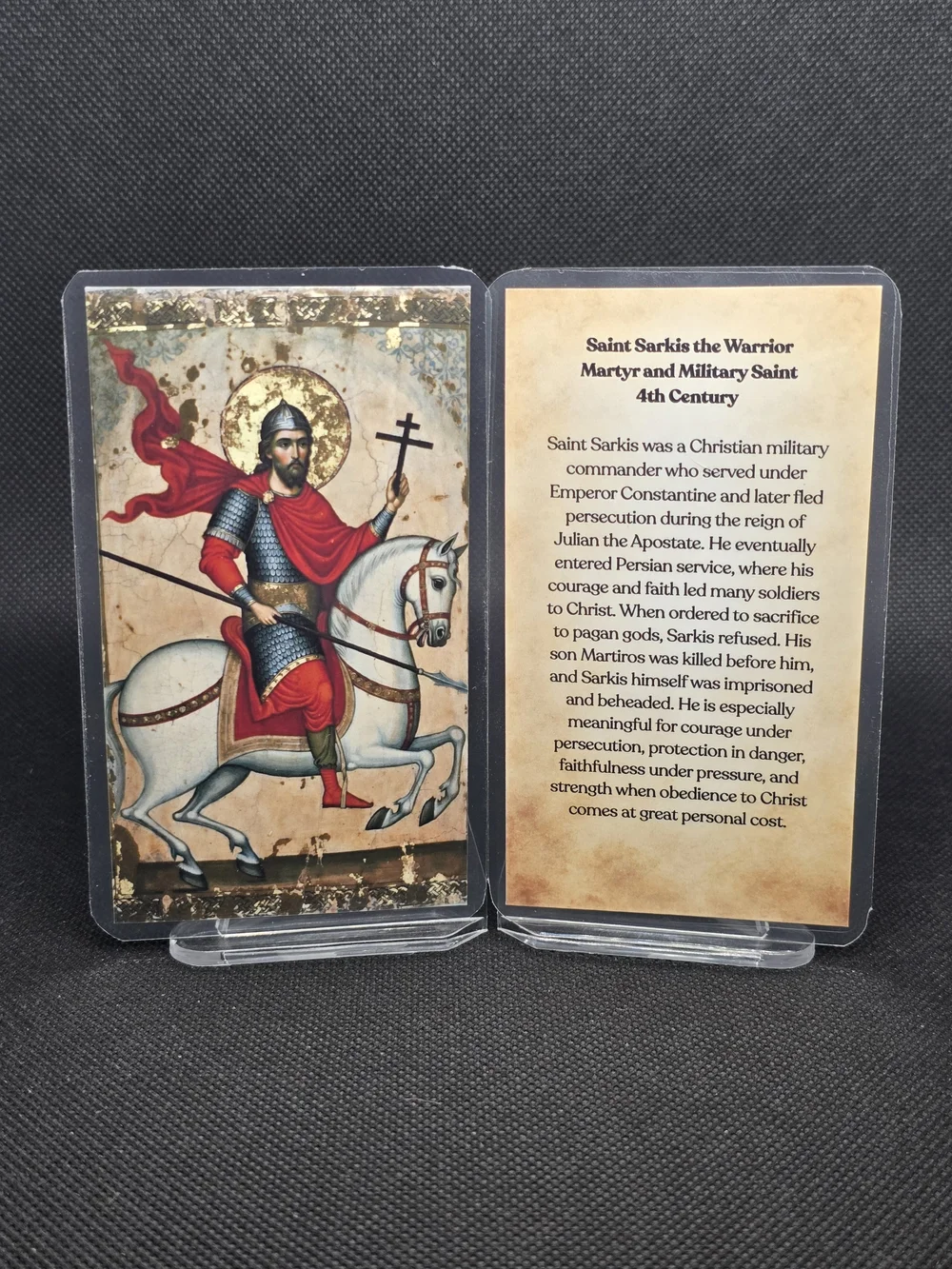
Shop This Guide
All Twenty Military Saint Prayer Cards
Every saint in this guide has a handmade prayer card, small enough for a wallet, a dog tag pouch, a rucksack pocket, or a bedside table, and prayed over throughout its entire creation. Below is the complete collection, organized in the same three tiers covered above.
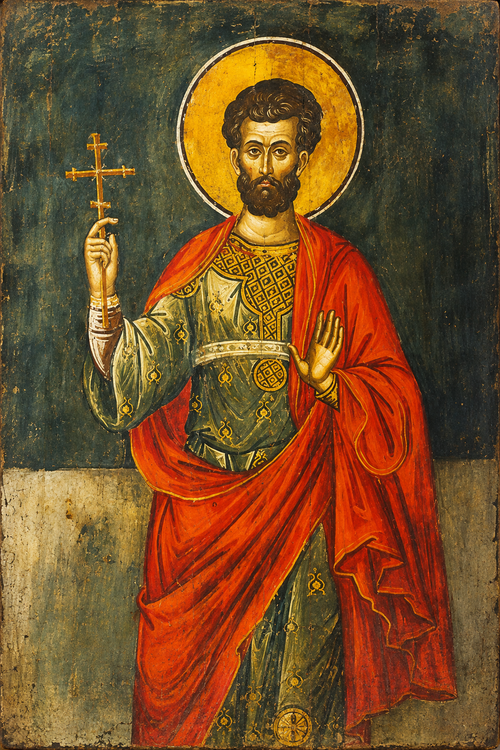
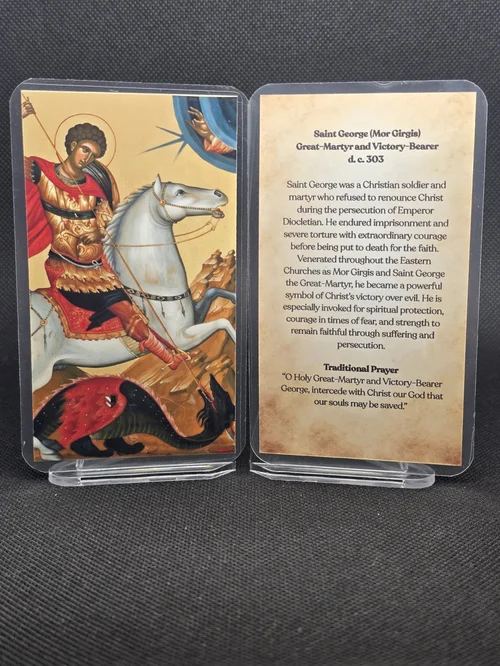
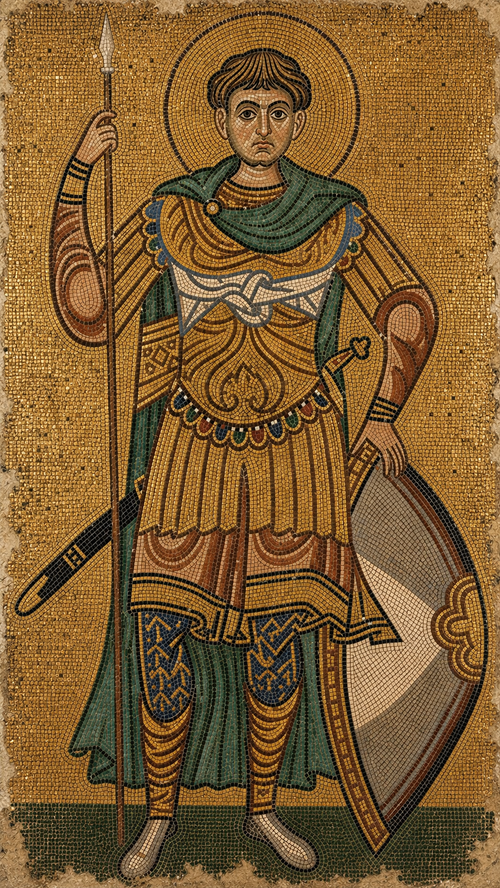
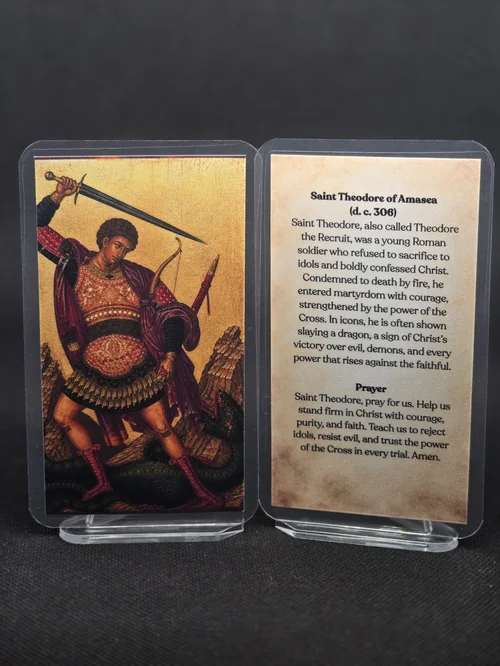
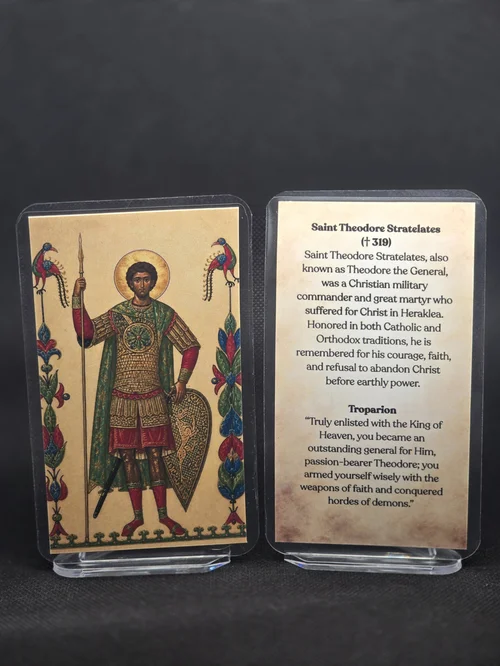
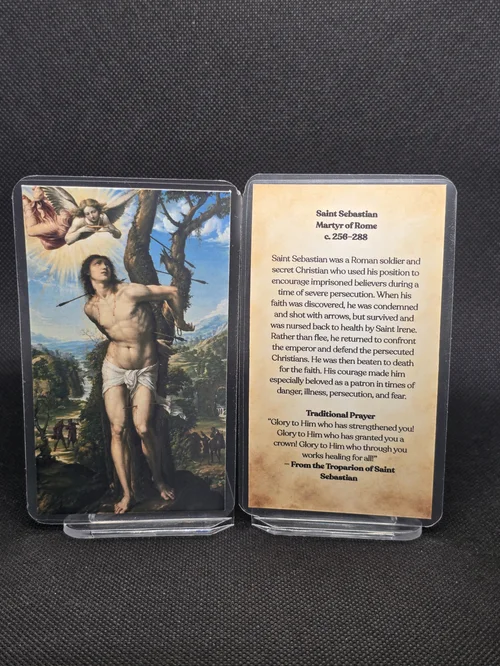
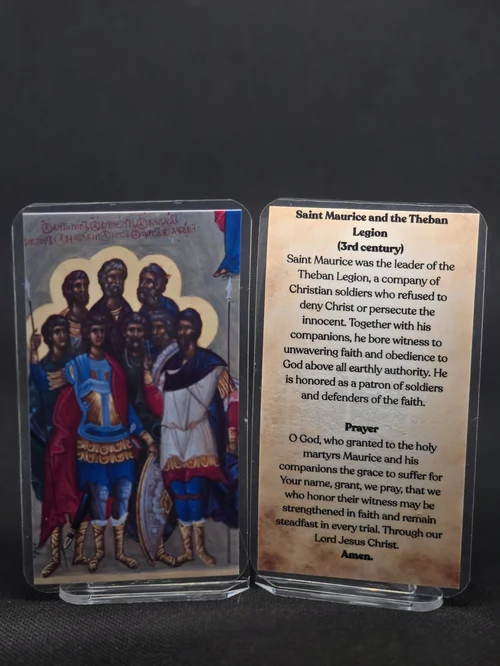
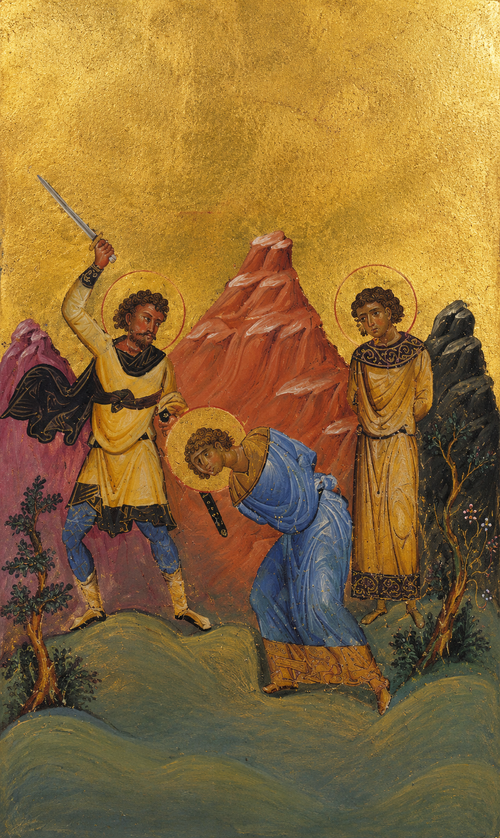
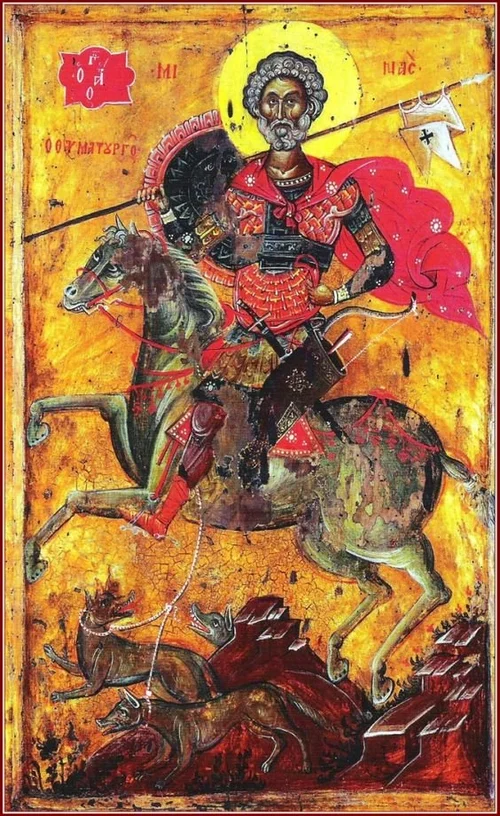
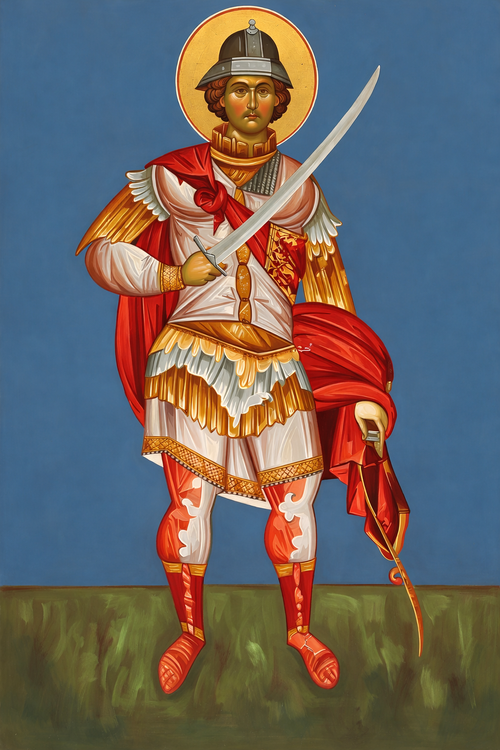
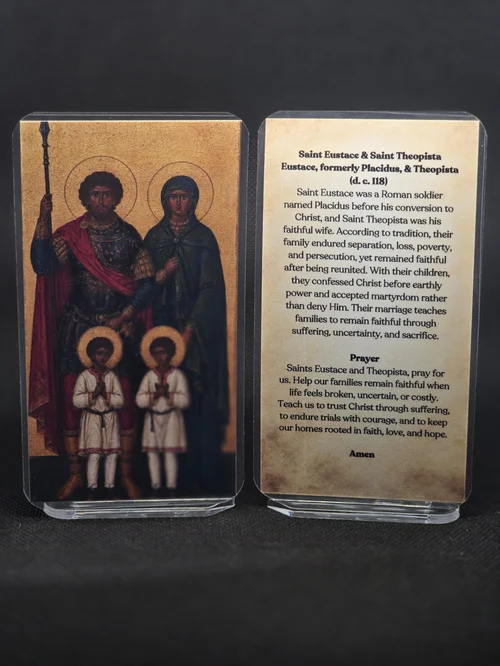
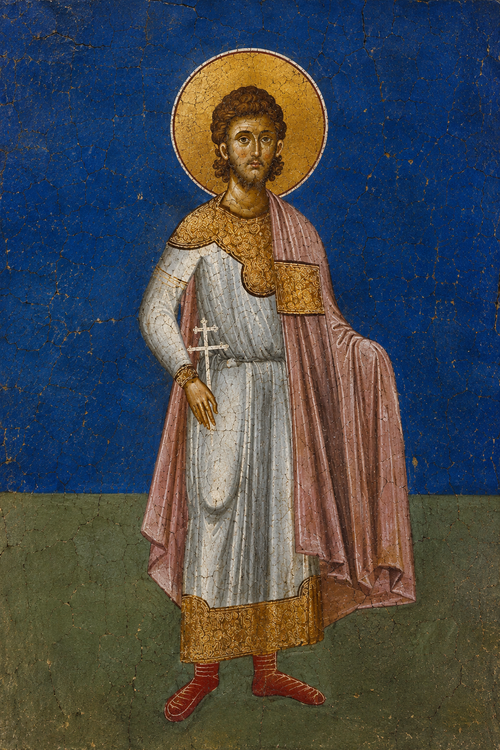
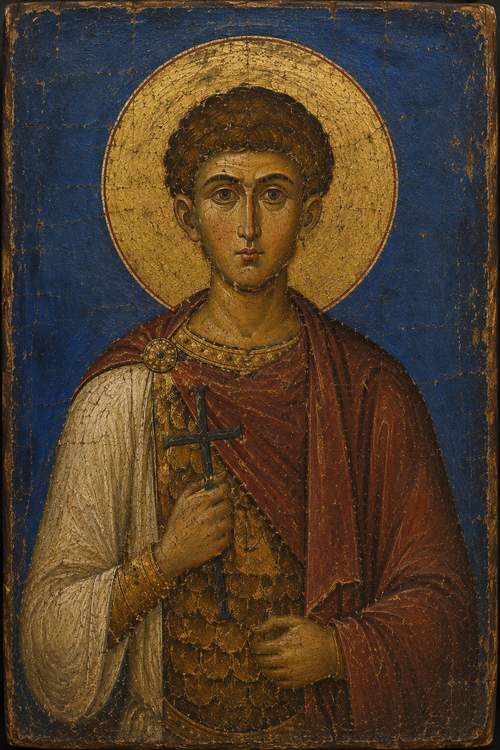
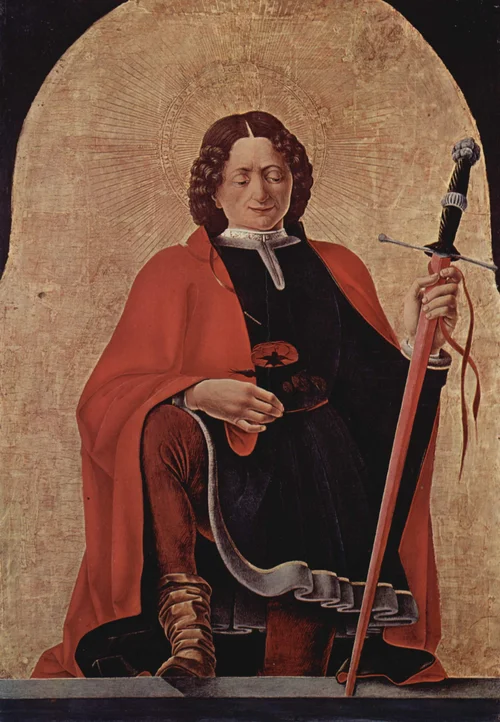
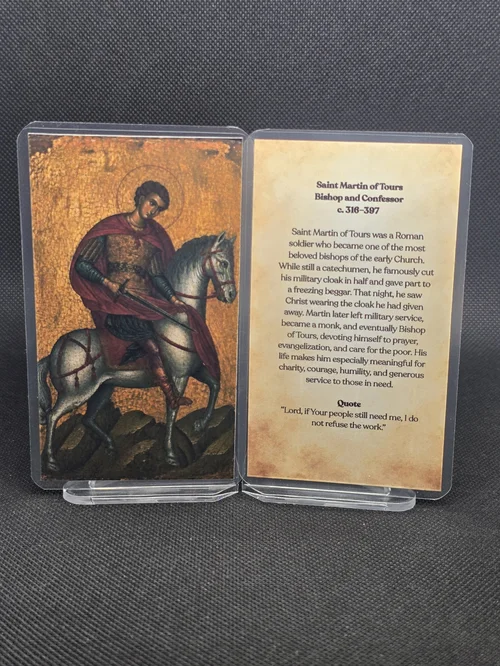
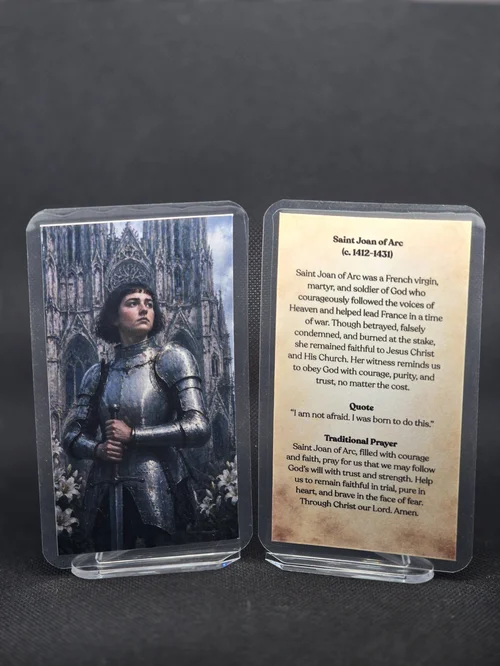
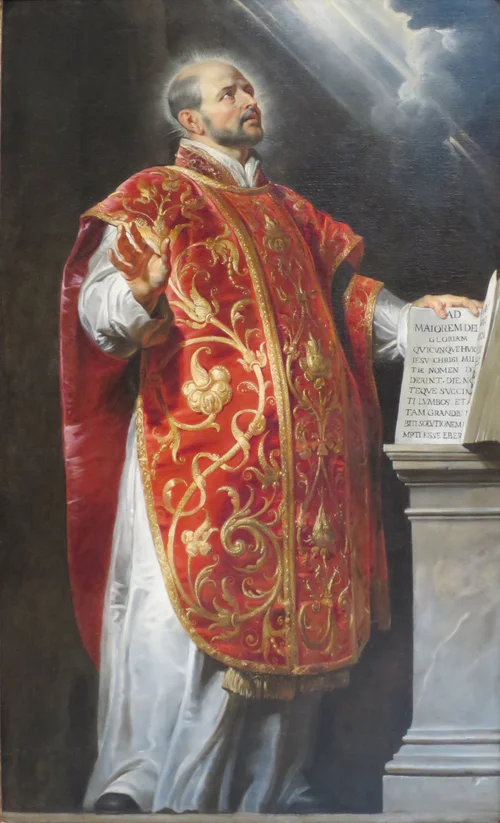
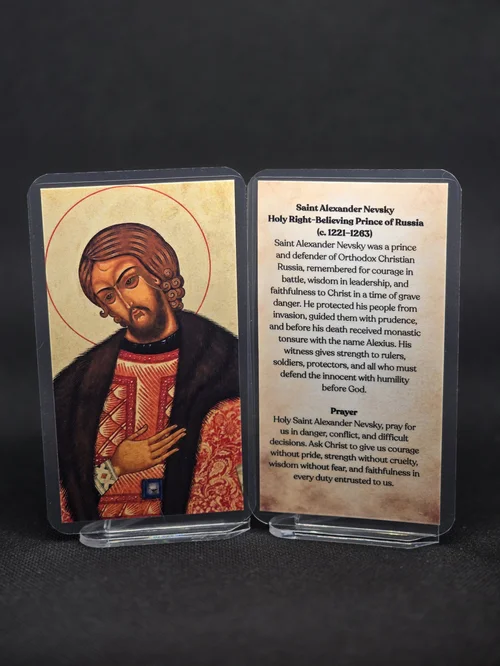
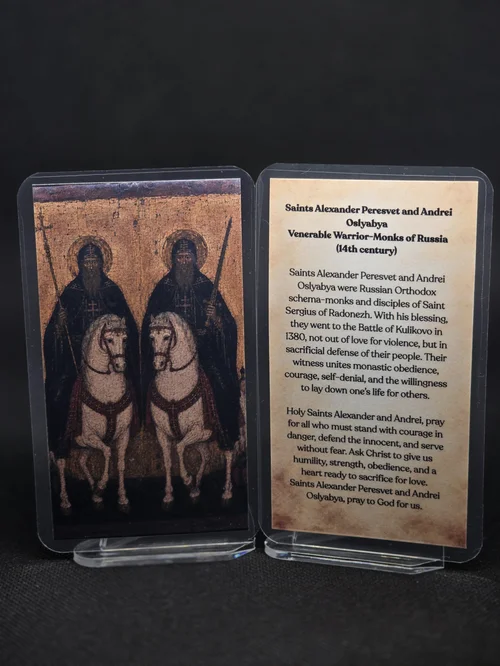
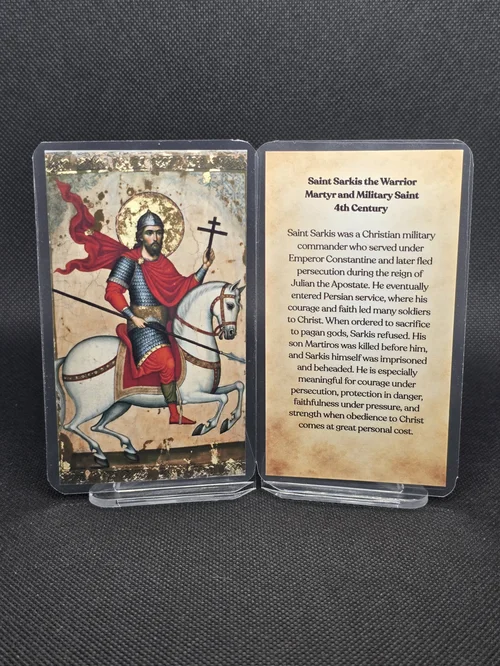
Appendix
Frequently Asked Questions
Twenty Men Who Wore a Uniform Before They Wore a Halo
They were centurions, recruits, generals, and one teenage girl who never held a sword at all. Some faced arrows, some faced fire, some faced an emperor directly, and one faced a fellow warrior in a charge that ended both their lives in the same instant. None of them found faith and combat to be opposites. Each found a way to carry both, honestly, until the day one or the other cost them everything.
For a soldier, a veteran, or the family standing behind either one, these are not distant, unreachable figures. They are men who understood orders, discipline, fear, and the specific weight of a uniform, long before they understood sainthood. Carry one of their prayer cards, and carry a small piece of that understanding with you.
Shop All Military Saint Prayer Cards →